

Kitchen Exhaust ESP for Commercial Kitchens
An in-duct electrostatic precipitator that takes smoke and grease out of the exhaust air before it reaches the duct, the fan or the neighbours. Sized to your airflow by the factory.
- 96.0–97.6%grease removal, third-party tested
- 4,000–60,000m³/h · 41 standard models
- MOQ 1 unitsample orders accepted
- 7–15 daysstandard lead time
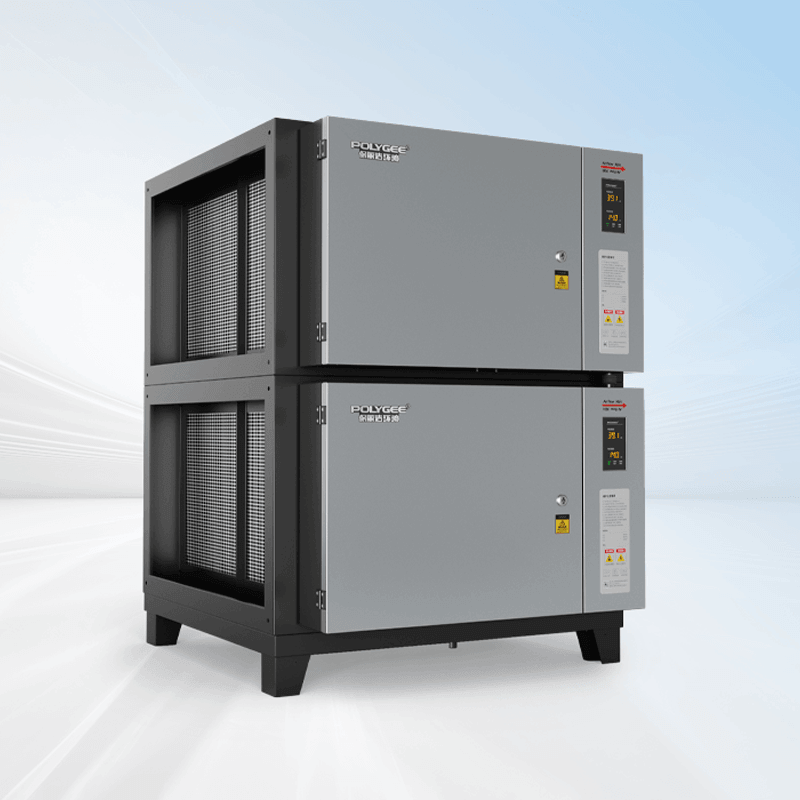
Get a quote for your kitchen exhaust
No list price: each ESP is sized to your airflow and cooking load. Send the extract rate (m³/h or CFM), what you cook and where the unit will sit — engineers reply within 24 hours on business days with a model and a factory-direct price.
Distributor or contractor? Choose your role under “I am” and tell us your market.
Or email scarlett@polygee.com · Mon–Fri 8:00–17:00 (GMT+8)
How we handle enquiry data: Privacy Policy
- BSE 920802Beijing Stock Exchange listed, founded 2004
- 225 patentsgranted, including 39 invention patents
- CE · UL 867CE FQC2602501; UL File E522667 for the 6K, 12K and 18K models
- 50 countriesPolygee equipment exported
Where the ESP sits in a kitchen exhaust system
The hood captures the fumes; the ESP cleans the air inside the duct; the fan moves it out. Polygee builds the cleaning part.
- 1 · HoodCaptures fumes over the cooking line; baffle filters stop the heaviest grease.
- 2 · In-duct ESPPolygeeCharges smoke and grease particles and collects them on washable plates.
- 3 · UV-C / carbonOptionalAdded when odor, not smoke, is the complaint.
- 4 · Extract fanSized to the total static pressure; a matched fan can be quoted with the ESP.
- 5 · DischargeCleaner air leaves at the roof or façade.
Already have hoods and ducts? The ESP flanges into the existing rectangular duct — no hood replacement. Building a new kitchen? Ask about the ESP hood, which puts the ESP cells inside the hood itself.
Three series, one cell technology
All three use the same patented dual-zone plate-type cells in stainless steel. They differ in configuration level, controls and housing.
-
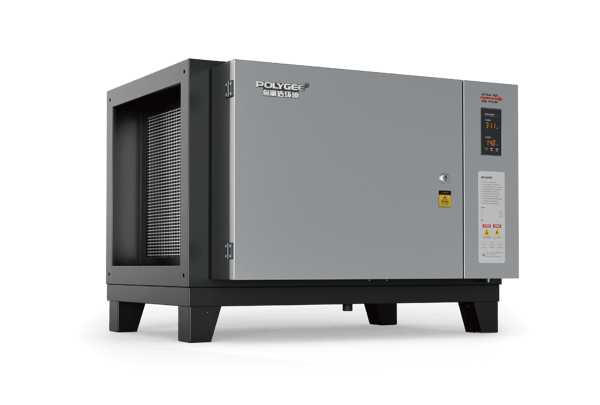
LK-K · top tier
Five-stage configuration with a secondary collection stage, suited to strict emission zones. Smart power supply with automatic arc suppression.
LK-K specifications → -
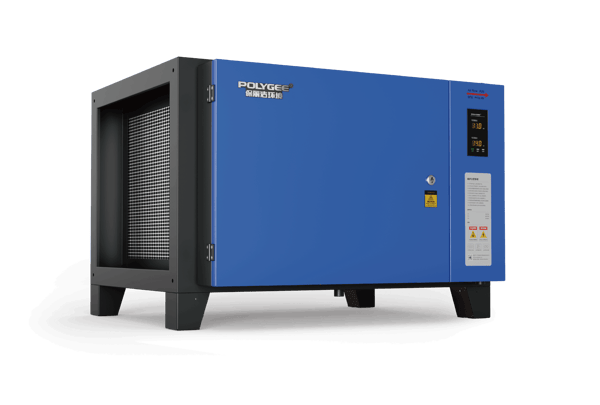
LK-D · high tier
Smart HMI panel showing voltage, current and field status, with fault diagnostics. Suited to general commercial kitchens.
LK-D specifications → -
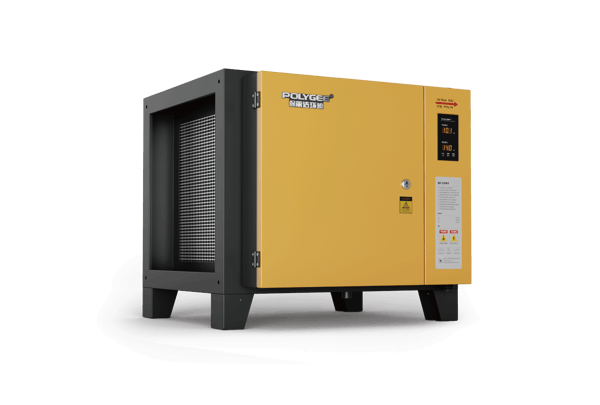
LK-A · standard tier
Durable and cost-effective: stainless-steel core in a powder-coated housing.
LK-A specifications →
Pick the size by airflow
The extract rate fixes the model size; the cooking load decides the series. Larger airflows are split into parallel units or engineered per site.
| m³/h | ≈ CFM | LK-K | LK-D | LK-A |
|---|---|---|---|---|
| 4,000 | 2,354 | LK4K | LK40D | LK40A |
| 6,000 | 3,532 | LK6K | LK60D | LK60A |
| 8,000 | 4,709 | LK8K | LK80D | LK80A |
| 10,000 | 5,886 | LK10K | LK100D | LK100A |
| 12,000 | 7,063 | LK12K | LK120D | LK120A |
| 16,000 | 9,418 | — | LK160D | LK160A |
| 20,000 | 11,772 | LK20K | LK200D | LK200A |
| 24,000 | 14,126 | LK24K | LK240D | LK240A |
| 32,000 | 18,835 | — | LK320D | LK320A |
| 40,000 | 23,544 | LK40K | LK400D | LK400A |
| 48,000 | 28,253 | — | LK480D | LK480A |
| 60,000 | 35,316 | LK60K | — | — |
Also available: LK-K at 15,000, 18,000, 30,000, 36,000, 45,000 and 54,000 m³/h; LK-D and LK-A at 28,000 m³/h. Power 220V or 380V, 50/60 Hz, configured to your market. Pressure drop ≤ 150 Pa including the distribution plate (the ESP field alone 20–30 Pa).
Where a kitchen ESP gets specified
Wherever smoke or grease leaving the duct is a problem — for the building, the fire risk or the people next door.
- RestaurantsWok, grill and teppanyaki lines, each with its own smoke load; the series is chosen for the cooking style.
- Hotel kitchensBanquet, all-day dining and specialty kitchens on one central exhaust, often discharging near guest areas.
- Restaurant chainsOne ESP specification per store format, so procurement and maintenance stay identical across sites.
- Food courtsMany tenants on one riser; modular units scale to the combined airflow.
- BBQ and grill housesHeavy smoke: ESP first, with UV-C added when odor matters as well.
- Cafés and bakeriesLight grease and baking fumes; compact units for small airflows and tight ceiling voids.
ESP, ESP hood or ecology unit?
If the complaint is smoke, an in-duct ESP is usually the answer. If it is smell, the UV-C and carbon stages are what deal with it.
| Route | Smoke & grease | Odor | Best fit |
|---|---|---|---|
| In-duct ESP (this page) | Yes | No — add UV-C or carbon | Existing hoods and ducts; retrofit |
| ESP hood | Yes | No | New kitchens, where the hood is being bought anyway |
| Ecology unit (ESP + UV-C + carbon) | Yes | Yes, two stages | Discharge close to people, or an odor condition |
| Wet scrubber | Yes | Partly | Sites with water supply, drain and effluent handling |
Not sure which route fits? Send the airflow and what is being cooked — we recommend the configuration with the quotation.
Get My QuoteInstalls where your duct runs
Horizontal or vertical mounting, standard flanges to rectangular ductwork.
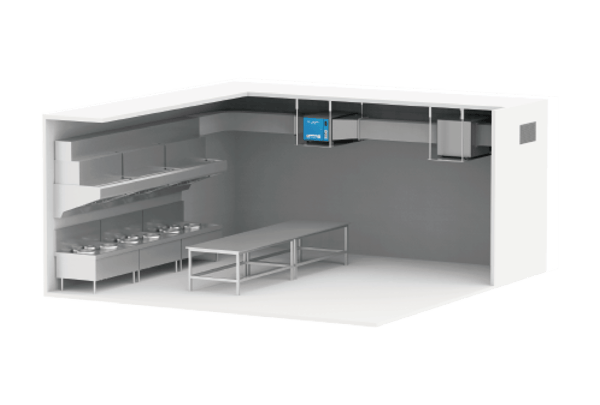
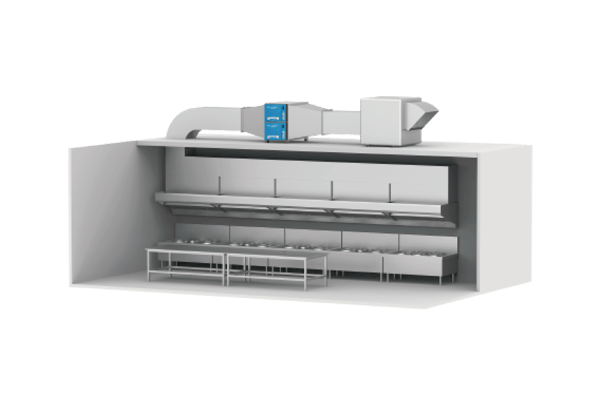
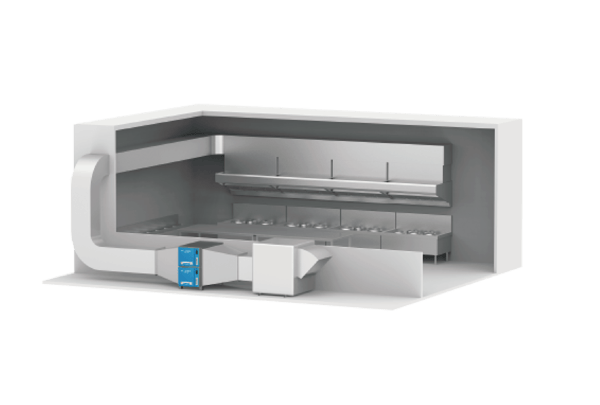
- Retrofit in one off-hours shiftA typical retrofit takes 4–8 hours; the unit connects to the existing duct, so the hood stays.
- Service clearanceLeave at least 850 mm clear in front of the access doors so the cells can be pulled out.
- Washable cells, no filter media to buyThe stainless-steel cells slide out and are cleaned in alkaline degreaser or a commercial dishwasher, then refitted. How often depends on the cooking load — heavy wok and charcoal kitchens wash far more often than cafés.
- Safe to openMagnetic door switches cut the power when a door opens; the smart power supply suppresses arcing within microseconds and recovers from short circuits on its own, and a BMS port reports status to the building system.
Why buy from Polygee
- Efficiency figures you can trace. 97.6% on the LK160 and 97.0% on the LK40 (Beijing Zhongyan Huanneng, CMA, reports ZY05W230298 / ZY05W230296); 96.0% on the LK120 at rated airflow (SQEP, CMA, report 2024I20-35-5322488001). We send the report that covers your model, or say plainly that it has not been tested.
- One supplier for the whole treatment train. ESP, UV-C, carbon and ESP hoods from the same factory, on one drawing — no interface argument between vendors.
- Paperwork for your consultant, at no charge. System design proposal, CAD drawings, full specification sheets, certificates and third-party test reports for tender or authority review.
- Certificates you can check. CE FQC2602501 (LK30–LK480, LK30E1–LK150E1 and UV series, valid to 9 January 2031) · UL 867, File E522667 (6K, 12K and 18K models at 230V/50Hz) · RoHS BKC25114877LC · ISO 9001 / 14001 / 45001. We confirm in writing which certificate covers the exact model you order. All certificates →

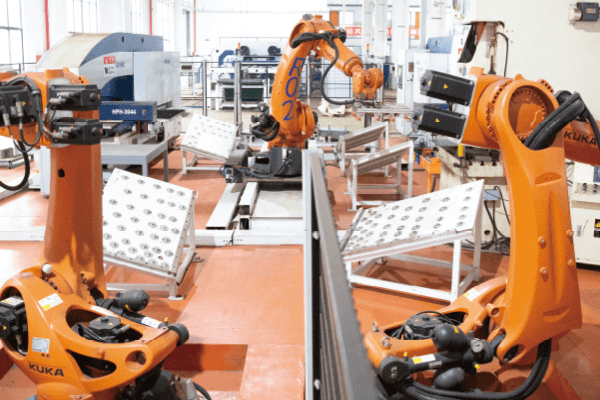
Distributors and engineering contractors wanted
Supplying kitchen exhaust equipment in your market, or installing it on your projects? Work directly with the factory that builds the ESP.
For distributors & wholesalers
Kitchen equipment, HVAC and environmental equipment suppliers
- Sell under your own brand: your logo and housing color on the unit and packaging, OEM terms agreed case by case
- Start with one trial unit — MOQ is 1
- Product training online or on site, plus catalogs, datasheets and installation videos
- Distributor pricing and territory terms are discussed individually
For engineering contractors & HVAC installers
MEP contractors, kitchen ventilation installers and consultants
- System design proposals, CAD drawings and full specification sheets for your tender
- Pressure drop per unit (≤ 150 Pa) ready for fan selection
- Certificates and third-party test reports packed for the authority, at no charge
- Matched extract fan on request; NDA signed on request
Ordering and after-sales
- MOQ
- 1 unit
- Lead time
- 7–15 days
- Payment
- 30% deposit (50% on some orders), balance before shipment · T/T or L/C
- Incoterms
- EXW / FOB / CIF
- Warranty
- 1 year, complete unit, incl. cells and power supply (UV lamps and carbon excluded)
- Support
- Remote video support Mon–Fri (GMT+8); paid on-site service available
- Spare parts
- Common spares in stock; supplied for 1 year after a model is discontinued
- OEM
- Your logo and housing color
Common questions
How much does a kitchen ESP cost?
Price is set by the airflow, which fixes the model size, and by the series (LK-K, LK-D or LK-A), chosen from the cooking load and budget, so we quote per project instead of publishing a list price. Send the extract rate, the cooking style and where the unit will be installed for a model recommendation and a factory-direct quotation.
Does an ESP remove cooking odor?
Not on its own. An ESP collects particles — smoke, grease and oil mist. Odor is a gas, so where smell is the issue a UV-C stage, an activated carbon stage, or both are added behind the ESP. We recommend the combination with the quotation.
Can it be added to my existing exhaust system?
Yes. The unit connects to existing rectangular ductwork with standard flanges and the hood stays as it is; a typical retrofit takes 4–8 hours during off-hours. Check that the existing fan has margin for the added pressure drop of up to 150 Pa — send us the fan details and we will check it with you.
What airflow figure do you need?
The design extract rate of the hood or fan, in m³/h or CFM — it is usually on the hood schedule or the fan nameplate. If you do not have it, send the hood sizes, the cooking equipment and a photo of the fan label, and our engineers will size the unit from that.
Which certificates cover the ESP?
CE FQC2602501, valid to 9 January 2031; UL 867 under File E522667 for the 6K, 12K and 18K models at 230V/50Hz only; RoHS BKC25114877LC; and ISO 9001, 14001 and 45001 for the factory. We confirm in writing which certificate covers the exact model you order.
Send your airflow, get a model and a price
Engineers reply within 24 hours on business days.
Get My Quote