

Engineering-Grade LK-E Electrostatic Precipitator
The LK-E series is the in-duct ESP Polygee supplies when the purification stage is specified as a duct component on a project drawing rather than as a packaged appliance. Patented dual-zone plate-type electrostatic field, drawer-style stainless steel collector cells, standard flange connections. The brochure lineup runs to 33 models across three tiers — LK-E2 at ≥ 98% design efficiency, LK-E1 at ≥ 95% and LK-E0 at ≥ 90% — covering 3,000 to 40,000 m³/h, all on a 220V/50Hz supply. UV-C photolysis and activated carbon drawer modules share the same cabinet interface, so odor control can be added to the same run.
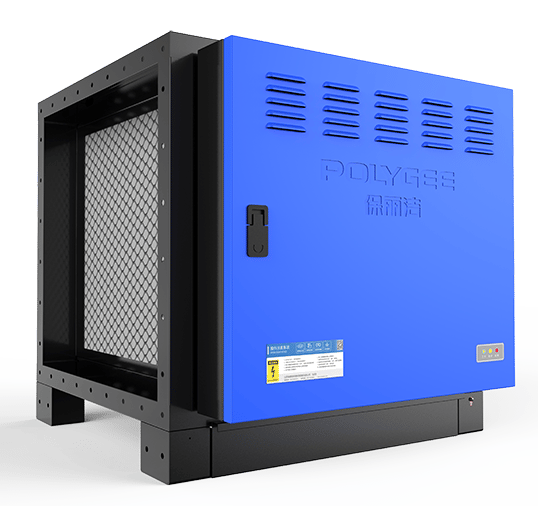
Modular ESP + UV + Carbon: Three Stages You Can Combine in One Duct Run
LK-E cabinets, UV-C photolysis modules and activated carbon modules share the same flange interface and drawer layout, so a project can start with the electrostatic stage alone and add odor control later without reworking the duct. Supplied pre-configured as one train, this arrangement is what a tender calls a kitchen ecology unit.
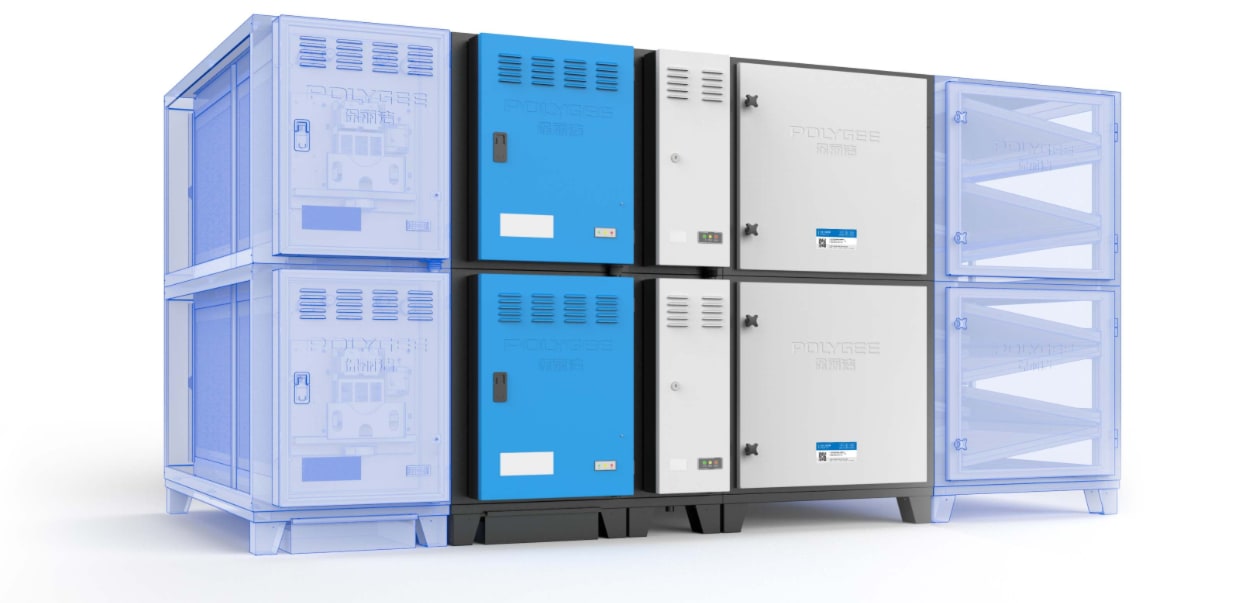
- Stage 1 — LK-E electrostatic precipitator: 33 models, 3,000–40,000 m³/h, 220V/50Hz, equipment resistance 23–34 Pa depending on tier
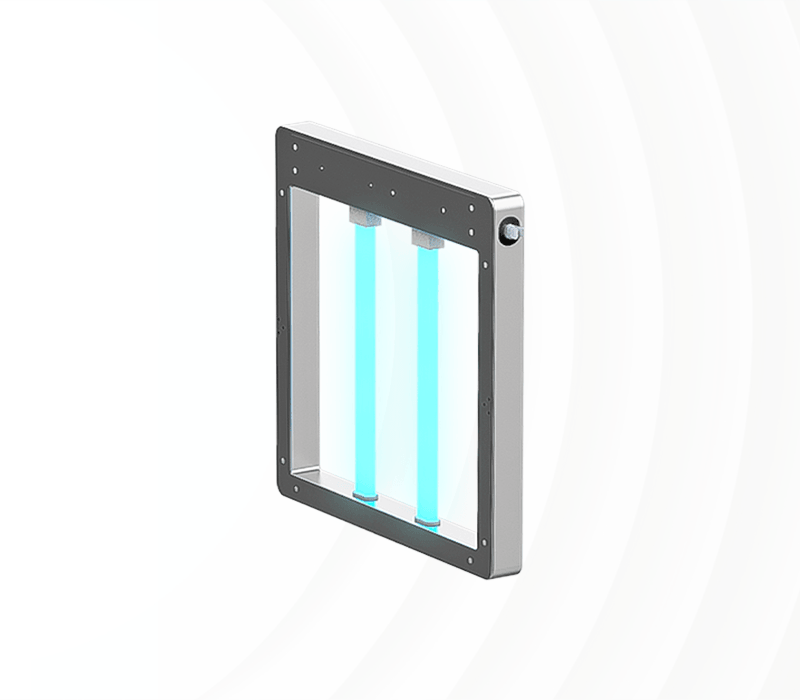
- Stage 2 — UV-C photolysis module: 8 models UV30–UV150, 3,000–15,000 m³/h, 220V/50Hz, maintenance clearance D = 1,000 mm
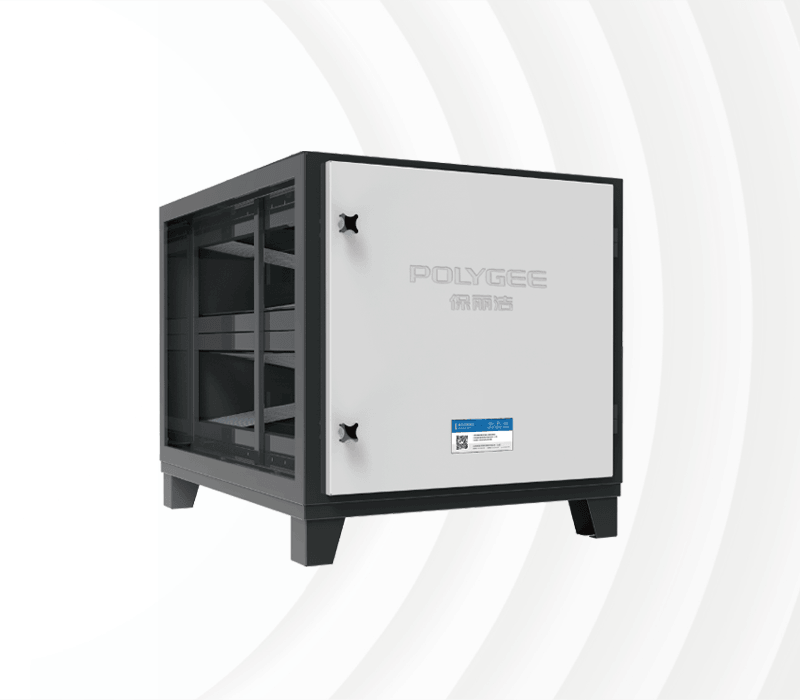
- Stage 3 — activated carbon module: 8 models CB30–CB150, 3,000–15,000 m³/h, 150 Pa equipment resistance, 4 / 8 / 12 carbon frames by size
- Units combine horizontally and stack in one, two or three layers to match the duct cross-section
- UV lamps and activated carbon media are consumables and are replaced on a service schedule
Three LK-E Tiers, One Modular Kitchen ESP Platform
Pick the tier by the emission target the project has to hit and by how much resistance the exhaust fan can absorb. All three tiers run on 220V/50Hz and share the same drawer-style washable cells.
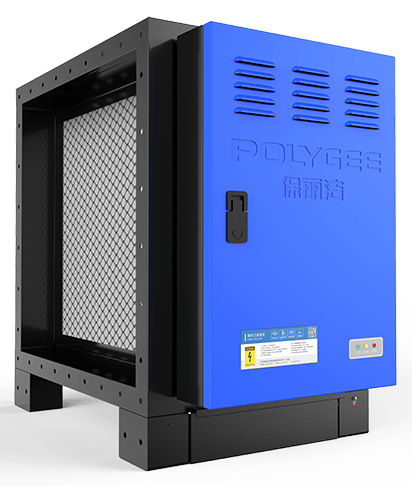
LK-E2 Series
- Airflow: 3,000 – 24,000 m³/h
- Equipment resistance: 34 Pa
- 11 models: LK30E2 – LK240E2
- Rated power: 112 – 924 W
- Input power: 220V/50Hz
- 848 mm deep cabinet — larger collection section
- Drawer-style washable collector cells
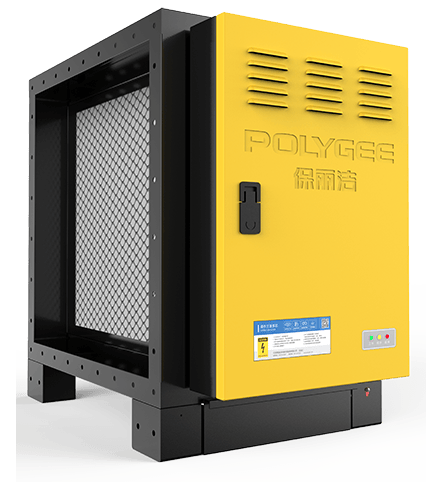
LK-E1 Series
- Airflow: 3,000 – 24,000 m³/h
- Equipment resistance: 23 Pa — lowest of the three tiers
- 11 models: LK30E1 – LK240E1
- Input power: 220V/50Hz
- 560 mm deep cabinet — tight plant-room fit
- Drawer-style washable collector cells
- Same flange pattern as LK-E0 at matching airflow
LK-E0 Series
- Airflow: 4,000 – 40,000 m³/h
- Equipment resistance: 31 Pa
- 11 models: LK40E0 – LK400E0
- Input power: 220V/50Hz
- Widest airflow range in the LK-E family
- 560 mm deep cabinet
- Drawer-style washable collector cells
Electrostatic Precipitator Applications Trusted Across 50 Countries
LK-E units are specified into commercial kitchen exhaust projects of every size — from a single wok line to a centralized food-court riser.
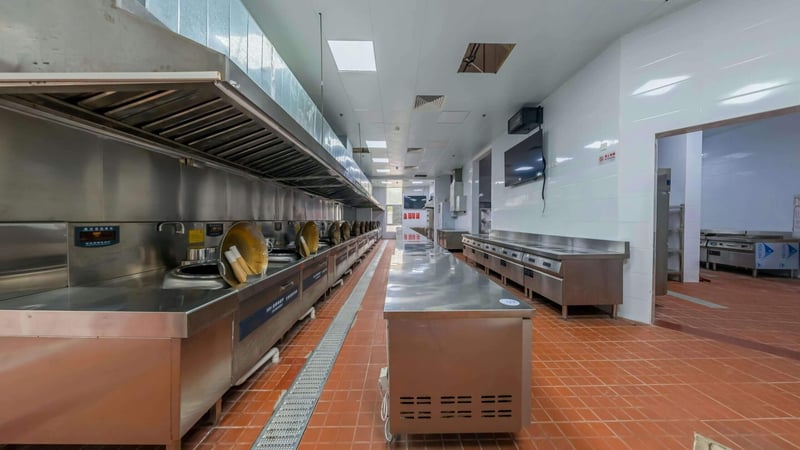
Restaurant Kitchen ESP
Chinese wok, Western grill, Japanese teppanyaki — an LK-E tier and model sized to the hood extract rate of each cooking line.
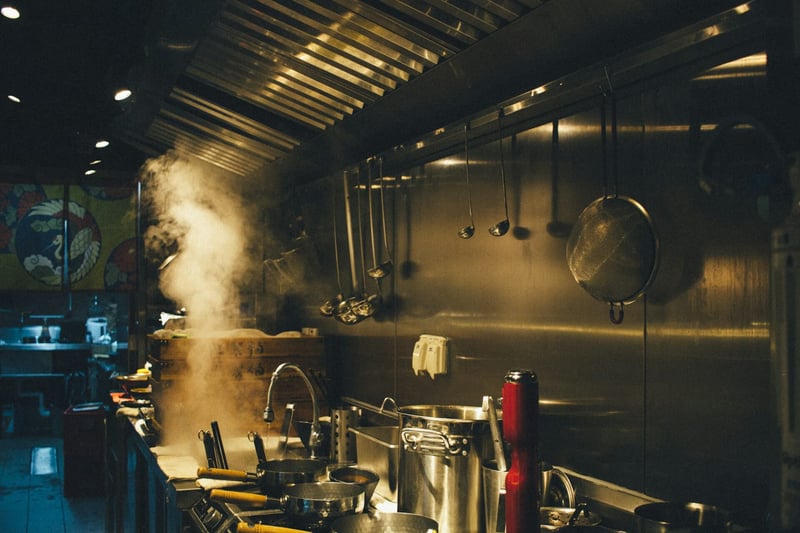
Hotel Kitchen ESP System
Banquet halls, all-day dining and room-service kitchens on one riser — LK-E cabinets stacked to match the shaft cross-section.

Chain Restaurant ESP
One LK-E model number repeated across a rollout keeps drawings, spares and service procedures identical at every location.
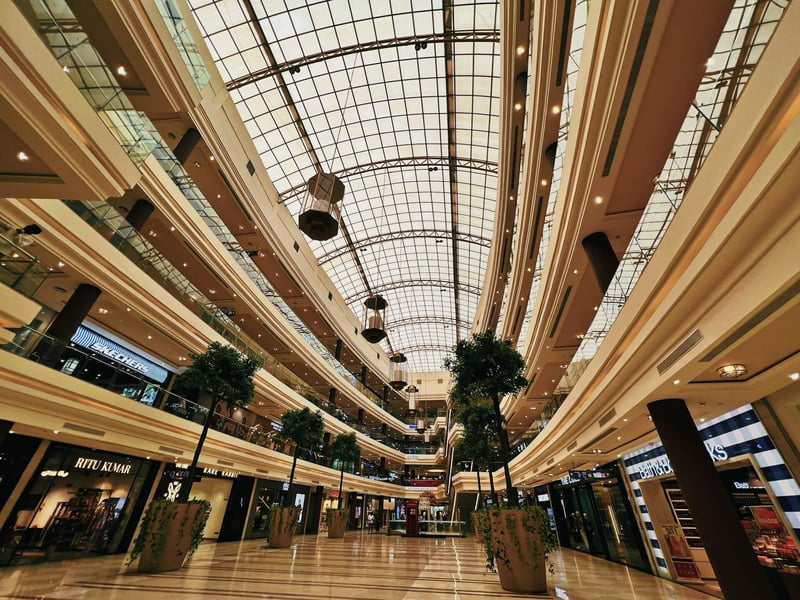
Food Court ESP Purification
A single LK400E0 handles 40,000 m³/h; larger risers are built from units in parallel or stacked layers.
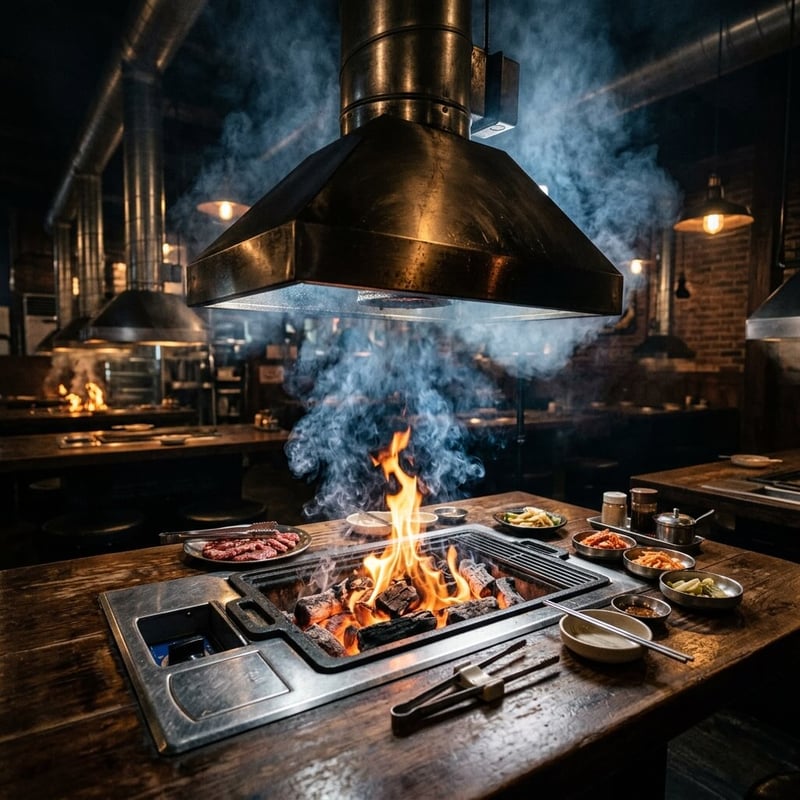
BBQ Smoke Control ESP
Dense-smoke lines usually take the LK-E2 tier, with a UV-C module downstream to work on the odor that survives the electrostatic stage.

Café & Bakery ESP Filtration
Light grease and baking fumes at modest extract rates — the 3,000 m³/h LK30E1 sits at the bottom of the range for storefront kitchens.
Why Commercial Kitchens Need ESP Purification
Cooking Fumes Are a Serious Health & Safety Risk
Kitchen exhaust carries grease particles, PM2.5, VOCs and carcinogenic compounds that contribute to respiratory problems and lung damage among kitchen staff. Grease that passes through a mesh filter settles inside the ductwork, and grease-loaded ductwork is a common cause of commercial kitchen fires.
Regulatory Compliance Is Mandatory
Cities worldwide enforce emission standards for commercial kitchens, and failure to comply brings fines, forced closures and disputes with neighbors. An electrostatic precipitator is an effective way to help meet EPA, EU and local emission requirements — the applicable limit and the test method still depend on your jurisdiction.
- Removes grease, smoke and oil mist at 90% / 95% / 98% design efficiency by tier
- Reduces grease buildup in ductwork — lowers fire risk
- Supports compliance with EPA, EU and local emission requirements
- Protects kitchen staff from prolonged fume exposure
- Addresses neighbor complaints about smoke and odor
- Washable drawer cells — no disposable filter waste stream
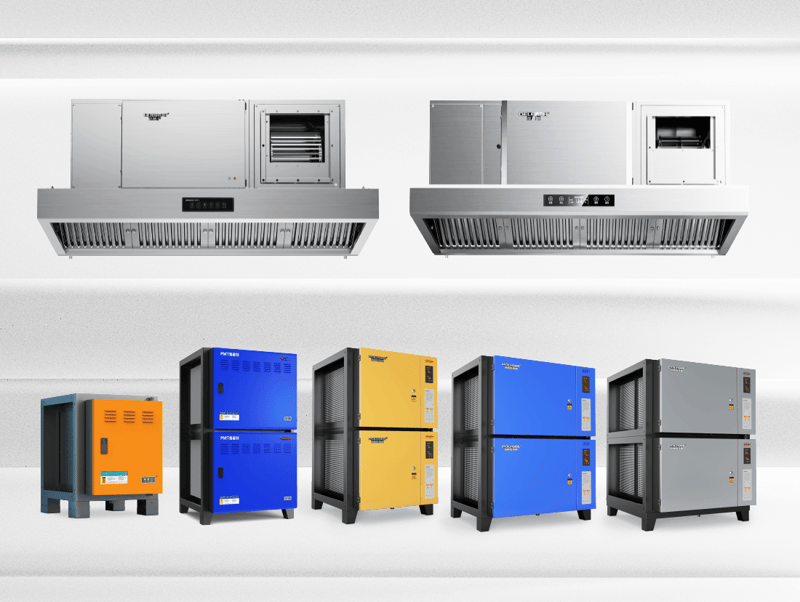
Engineering-Grade ESP Construction
Since 2004, Polygee has been engineering ESP solutions. 225 patents granted. BSE-listed (920802). 110,000㎡ production base.
Dual-Zone Plate-Type Cells
Ionization and collection are separated into two zones. Stainless steel plates, washable and reusable, pulled out as drawers for cleaning.
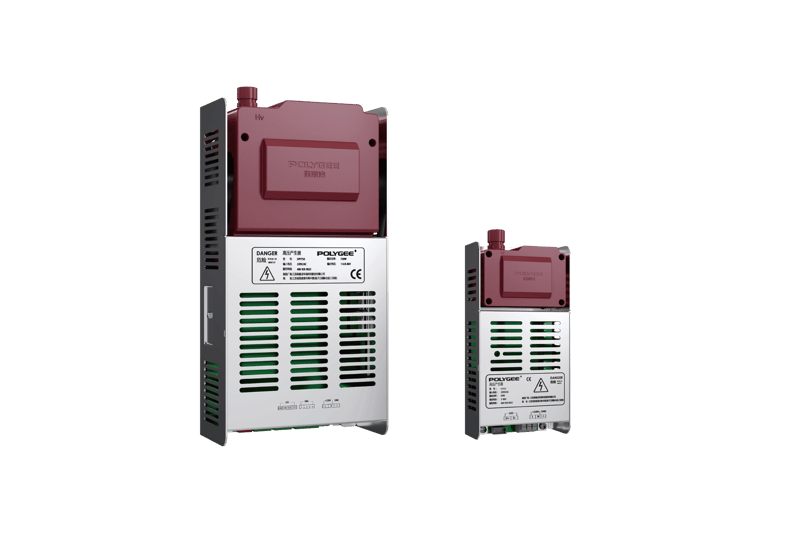
SPP High-Voltage Power Supply
Self-developed switched-mode supply with microsecond-level arc suppression and automatic reset after a short circuit.
Low Equipment Resistance
23 Pa on LK-E1, 31 Pa on LK-E0 and 34 Pa on LK-E2 for the electrostatic stage — a small share of a typical fan’s static budget.
Safety Interlock
Opening the maintenance door breaks the high-voltage circuit, so the field is dead before a cell is touched.
Three Filtration Grades
≥ 90%, ≥ 95% and ≥ 98% design efficiency, so the tier can be matched to the emission target instead of over-specified across a whole site.
Stackable Cabinet Platform
Standard flanges, one, two or three layers stacked, horizontal combination — the array is built to the duct cross-section you already have.
Shared Module Interface
UV-C and activated carbon drawer modules use the same interface, so odor control can be added to an existing LK-E run later.
Washable, Not Replaceable
Cells are soaked in alkaline degreaser or run through a commercial dishwasher and returned to service — no recurring media purchase for the ESP stage.
Principle of Electrostatic Purification
Each LK-E tier runs a multi-stage process through the same cabinet. Select a tier below to see how its stages are arranged.
Airflow Distribution
A washable mesh pre-filter catches the coarse droplets and spreads the airflow evenly across the cabinet section.
→Ionization Zone
The high-voltage ionizing wires put a charge on the grease and smoke particles carried in the airstream.
→Primary Collection
Charged particles are drawn onto the first bank of grounded plates. Collected grease drains down to the tray.
→Secondary Collection
The deeper 848 mm LK-E2 cabinet carries a second collection bank — the reason this tier is rated ≥ 98% by design.
→Optional Odor Control
A UV-C module downstream decomposes VOCs and reduces cooking odors; an activated carbon module can follow it.
Why Dual-Zone Plate-Type ESP as Primary Filtration
Prolonged Wash Cycle & Longer Life
Wider electrode spacing and stainless steel construction let the plate-type cell tolerate a higher working voltage, hold a heavier grease load between washes and survive rigorous cleaning cycles — which is what keeps an engineering-grade unit in service for years.
Higher Collection Efficiency
The dual-zone structure gives a large collection surface with uniform electrode spacing, so field intensity stays even across the cabinet section — the basis for the ≥ 90% / ≥ 95% / ≥ 98% tier ratings.
Separated Ionization & Collection
Charging and collecting happen in two distinct zones rather than one, which lets each zone be tuned separately. The SPP high-voltage supply energizes the field and holds it steady as the grease load builds.
Easy Maintenance & Cleaning
Collector cells slide out as drawers. Soak them in alkaline degreaser or run them through a commercial dishwasher, then slide them back — washable and reusable, with no disposable media cost for the electrostatic stage.
Electrostatic Field & Intelligent Power Supply
The two components Polygee develops and builds in-house — the collecting field and the high-voltage supply that drives it.
Dual-Zone Plate-Type Cell
SPP Intelligent High-Voltage Power
Model Specifications — 33 LK-E Models
Every figure below is taken from the LK-E brochure. Select the tier your project calls for, then match the model to your extract rate and the space you have in the duct run.
| Model | Airflow (m³/h) | Rated Power (W) | Dimensions L×W×H (mm) | Flange A×B (mm) | Weight (kg) |
|---|---|---|---|---|---|
| LK30E2 | 3,000 | 112 | 678×848×833 | 431×614 | 95 |
| LK40E2 | 4,000 | 154 | 846×848×833 | 599×614 | 112 |
| LK50E2 | 5,000 | 182 | 898×848×833 | 651×614 | 120 |
| LK60E2 | 6,000 | 224 | 1188×848×833 | 941×614 | 151 |
| LK80E2 | 8,000 | 308 | 1524×848×833 | 1277×614 | 189 |
| LK100E2 | 10,000 | 364 | 1628×848×833 | 1381×614 | 205 |
| LK120E2 | 12,000 | 462 | 2202×848×833 | 1955×614 | 268 |
| LK150E2 | 15,000 | 546 | 2358×848×833 | 2111×614 | 292 |
| LK160E2 | 16,000 | 616 | 1524×848×1536 | 1277×1317 | 368 |
| LK200E2 | 20,000 | 728 | 1628×848×1536 | 1381×1317 | 400 |
| LK240E2 | 24,000 | 924 | 2202×848×1536 | 1955×1317 | 524 |
Equipment resistance: 34 Pa • Input power: 220V/50Hz • Design efficiency: ≥ 98%
Request Custom Configuration →| Model | Airflow (m³/h) | Dimensions L×W×H (mm) | Flange A×B (mm) | Weight (kg) |
|---|---|---|---|---|
| LK30E1 | 3,000 | 678×560×833 | 431×614 | 61 |
| LK40E1 | 4,000 | 846×560×833 | 599×614 | 71 |
| LK50E1 | 5,000 | 898×560×833 | 651×614 | 76 |
| LK60E1 | 6,000 | 1188×560×833 | 941×614 | 95 |
| LK80E1 | 8,000 | 1524×560×833 | 1277×614 | 116 |
| LK100E1 | 10,000 | 1628×560×833 | 1381×614 | 125 |
| LK120E1 | 12,000 | 2202×560×833 | 1955×614 | 168 |
| LK150E1 | 15,000 | 2358×560×833 | 2111×614 | 182 |
| LK160E1 | 16,000 | 1524×560×1536 | 1277×1317 | 224 |
| LK200E1 | 20,000 | 1628×560×1536 | 1381×1317 | 242 |
| LK240E1 | 24,000 | 2202×560×1536 | 1955×1317 | 326 |
Equipment resistance: 23 Pa • Input power: 220V/50Hz • Design efficiency: ≥ 95%
Request Custom Configuration →| Model | Airflow (m³/h) | Dimensions L×W×H (mm) | Flange A×B (mm) | Weight (kg) |
|---|---|---|---|---|
| LK40E0 | 4,000 | 678×560×833 | 431×614 | 61 |
| LK60E0 | 6,000 | 846×560×833 | 599×614 | 71 |
| LK80E0 | 8,000 | 898×560×833 | 651×614 | 76 |
| LK100E0 | 10,000 | 1188×560×833 | 941×614 | 95 |
| LK120E0 | 12,000 | 1524×560×833 | 1277×614 | 116 |
| LK150E0 | 15,000 | 1628×560×833 | 1381×614 | 125 |
| LK200E0 | 20,000 | 2202×560×833 | 1955×614 | 168 |
| LK220E0 | 22,000 | 2358×560×833 | 2111×614 | 184 |
| LK250E0 | 25,000 | 1524×560×1536 | 1277×1317 | 224 |
| LK300E0 | 30,000 | 1628×560×1536 | 1381×1317 | 242 |
| LK400E0 | 40,000 | 2202×560×1536 | 1955×1317 | 326 |
Equipment resistance: 31 Pa • Input power: 220V/50Hz • Design efficiency: ≥ 90%
Request Custom Configuration →Flexible Installation for Any Kitchen Environment
LK-E units mount wherever the duct route allows — indoors at ceiling level, on the roof, or at ground level outside the building.
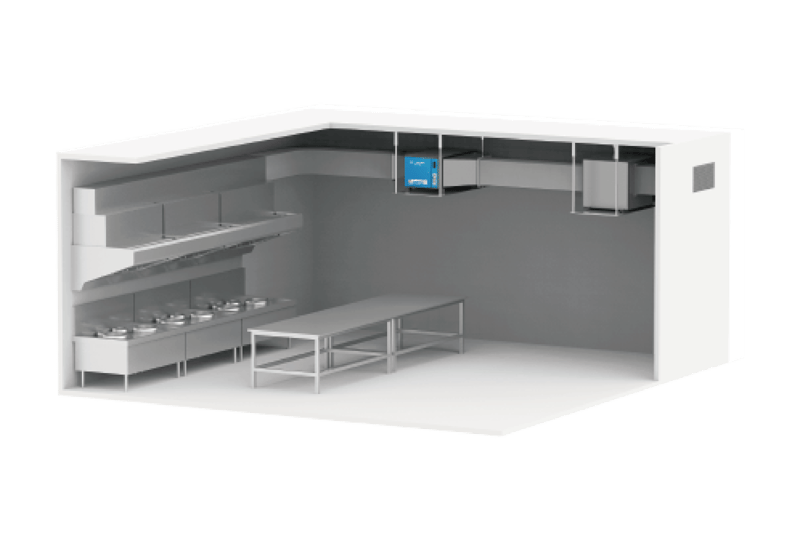
Indoor Ceiling-Mounted
The unit hangs indoors at ceiling level and the exhaust duct carries on to the roof. Keeps the cabinet out of the weather and the maintenance door within easy reach.
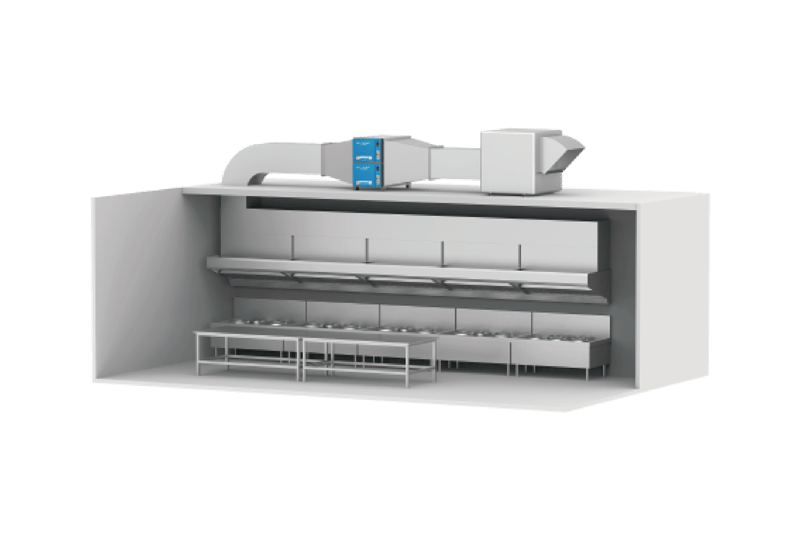
Rooftop Installation
Unit and ductwork both sit on the roof, which frees up indoor plant space. Weather protection for the enclosure is specified with the project.
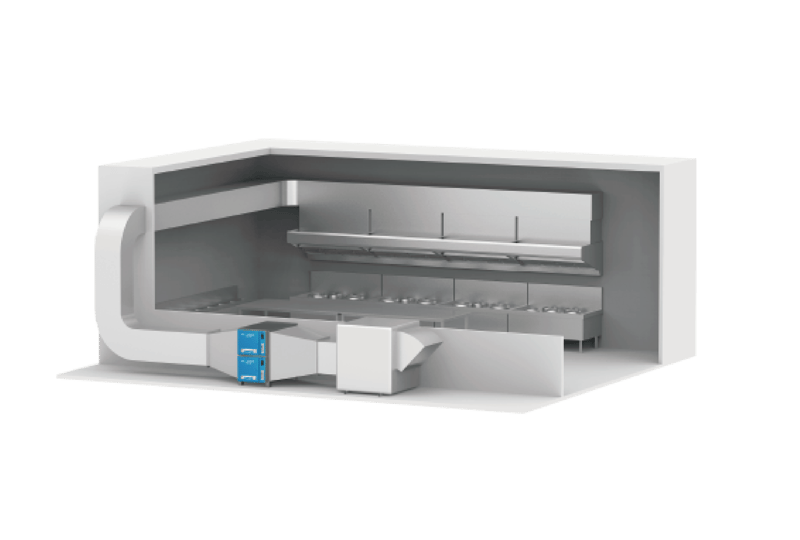
Outdoor Ground-Level
The unit stands at ground level outside the building and connects back into the exhaust duct — the usual answer when roof access is limited.
- Standard flange connections — compatible with rectangular ductwork
- Single, double and triple stacking supported, plus horizontal combination across the duct section
- Power supply: 220V/50Hz across all 33 LK-E models
- No hood replacement needed — the LK-E cabinet joins the existing duct run
- Leave clear space in front of the maintenance door for cell removal; the exact clearance is confirmed for your model at quotation
- UV-C and activated carbon drawer modules need D = 1,000 mm of maintenance clearance
- Retrofit installation typically takes 4–8 hours during off-peak hours
- Support horizontal and vertical mounting orientations
Explore More Products for Multi-Stage Kitchen Exhaust Treatment
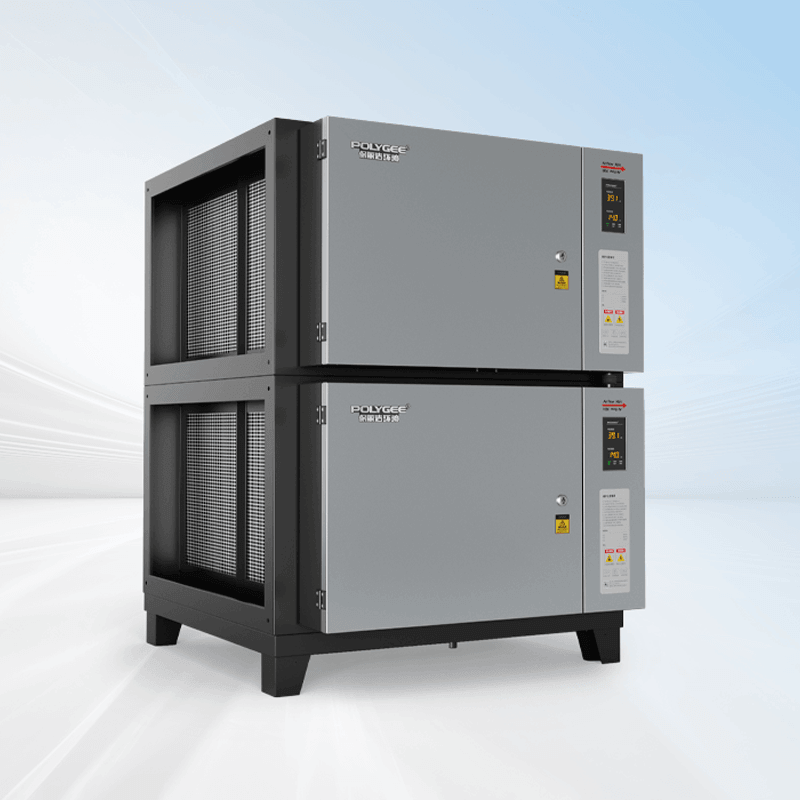
In-Duct ESP — LK-K / LK-D / LK-A
The packaged in-duct range, with third-party tested grease removal figures and UL Listed 6K / 12K / 18K models.
In-duct kitchen electrostatic precipitator specifications →UV-C Photolysis Purifier
8 models UV30–UV150, 3,000–15,000 m³/h. Designed to sit downstream of an LK-E cabinet in the same duct run.
UV kitchen odor control details →
Activated Carbon Filter
8 models CB30–CB150 holding 4, 8 or 12 carbon frames, for residual odor and VOC adsorption at the end of the run.
Activated carbon filter details →Request a Free Quote
Tell us the extract rate, the emission target and the space you have in the duct run. Our engineering team responds within 24 hours (Mon–Fri) with a tier recommendation, a model number and a quotation.
Request a Quote for the LK-E Series
Fill out the form below. We respond within 24 hours (Mon–Fri) with a detailed proposal and factory-direct pricing.
1-year warranty on the complete unit • MOQ 1 unit • Lead time 7–15 days • Support Mon–Fri 8:00–17:00 (GMT+8)
📄 Commercial Terms
Payment: 30% deposit (50% on some orders), balance paid in full before shipment; T/T, L/C and other common bank instruments accepted.
Trade terms: Incoterms arranged to suit the buyer (EXW / FOB / CIF).
Warranty: 1 year on the complete unit — electrostatic collector cells and the SPP high-voltage power supply covered; UV lamps and activated carbon media are consumables and are excluded; labor and travel not included, paid site visits available.
MOQ 1 unit • Standard lead time 7–15 days • OEM quantity and lead time agreed case by case. · Project and volume pricing quoted per project.
Spare parts: common items held in stock; dispatch timing confirmed per order; parts supplied for 1 year after a model is discontinued.
Engineering Support: System design proposals, CAD drawings and full specification sheets — request with your project’s airflow details.
🏭 Manufacturer
Jiangsu Polygee Environmental Technology Co., Ltd.
BSE Listed: 920802 • 225 Patents Granted
110,000㎡ Production Base, Zhangjiagang, China
📜 LK-E Certifications
CE (FQC2602501, covering LK30–480, LK-E and UV) • RoHS (BKC25114877LC) • ISO 9001 (ABZB25Q30072R3M) / ISO 14001 (ABZB25E30043R3M) / ISO 45001 (ABZB25S30027R2M)
The UL 867 Listing (File E522667) covers the 6K, 12K and 18K models at 230V/50Hz and does not extend to the LK-E series. We confirm the exact certificate match for your chosen model at quotation.
LK-E Engineering ESP: Frequently Asked Questions
Common questions about the Polygee LK-E engineering electrostatic precipitator series.