

Choosing the right commercial kitchen exhaust materials is, more than anything, a fight against corrosion. Hot, grease-laden air mixes with acidic condensate, high humidity, and frequent caustic washdowns — a combination that quietly attacks ducts, hoods, and electrostatic precipitator (ESP) cells from the day they’re installed.
Material is often the last line on a spec sheet, decided on price alone. That’s a costly habit: for distributors and project buyers, the metal a system is built from is the single biggest factor in how long it holds its rated efficiency before corrosion forces a rebuild. This guide breaks down the materials used across kitchen exhaust and ESP systems, where each one fits, and when a project justifies stepping up to stainless — or even titanium — for the harshest sites.
What kitchen exhaust does to metal
Corrosion in a commercial kitchen isn’t one problem; it’s four, working together around the clock:
- Grease and acidic condensate — combustion byproducts and charbroiling create an acidic film that etches unprotected metal.
- Chlorides — from coastal air, salt, and many cleaning chemicals; they are the main trigger for pitting in stainless steel.
- Constant moisture — humidity plus daily washdowns keep surfaces wet, the precondition for almost all corrosion.
- Thermal cycling — repeated heating and cooling stresses coatings and welds, opening paths for attack.
Inside an ESP this hits performance directly. Ionizing wires thin and eventually snap; collector plates pit and lose their precise spacing, which causes arcing and a steady drop in capture efficiency. Long before a cell fails outright, a corroded one is quietly letting more grease and smoke through — meaning odor complaints, added fire load in the ducts, and emissions that can drift out of compliance.
Replacing corroded cells, ducts, and hoods mid-life costs far more than specifying the right material once. Corrosion is predictable, so it is preventable at the spec stage.
Commercial kitchen exhaust materials: what each metal does
Four metals cover the vast majority of kitchen exhaust and ESP builds, and each has a clear sweet spot.
Galvanized steel is the default for ductwork — cheap, strong, widely available. Its zinc coating sacrifices itself to protect the steel underneath, but that coating degrades under acidic grease condensate, so galvanized is best kept to drier runs rather than the condensate-prone sections near the cooking line.
Aluminum turns up in lightweight ductwork, housings, and filter frames rather than in the electrostatic field itself. It is light and forms a self-protecting oxide layer, but it is relatively soft and strong alkaline detergents attack it over repeated wash cycles — which is why it is a poor match for the washdown regime a collector cell has to survive.
304 stainless steel is the everyday workhorse for hoods and general kitchen ductwork. It resists general corrosion well and tolerates repeated cleaning, but it is vulnerable to chloride pitting — a poor match for coastal or salt-heavy environments.
316 stainless steel adds molybdenum, which dramatically improves chloride and pitting resistance. It costs more than 304, but in humid, coastal, or heavy-grease operations it buys years of extra service life and is usually the smarter long-term spec.
| Material | Corrosion resistance | Relative cost | Best fit |
|---|---|---|---|
| Galvanized steel | Low–moderate | $ | Dry duct runs |
| Aluminum | Moderate | $$ | Light housings, filter frames |
| 304 stainless | Good | $$$ | Hoods, general kitchens |
| 316 stainless | Very good | $$$$ | Humid, coastal, heavy-grease |
| Titanium | Outstanding | $$$$$ | Marine / high-chloride critical parts |
When standard materials aren’t enough
Most restaurants are well served by standard stainless steel cells and hoods. But some environments push even 316 past its comfort zone:
- Marine, offshore, and coastal kitchens — cruise ships, ferries, platform galleys, and beachfront resorts sit in chloride-saturated air that pits standard stainless over time.
- High-volume charbroil and BBQ lines — heavy char grilling produces especially acidic, sooty exhaust that loads and attacks surfaces fast.
- Industrial canteens and chemical-adjacent facilities — ambient fumes can make the incoming air itself corrosive.
- Washdown-heavy operations — central and commissary kitchens cleaned several times a day keep metal permanently wet and chemically loaded.
In these settings 316 still works for most ductwork and hood components, but the parts that fail first — fasteners and frames in the wettest zones — can justify a higher-tier specification. Collector plate material for an electrostatic precipitator is a separate question, confirmed against your operating conditions at quotation rather than assumed from a duct specification. In the most extreme marine or high-chloride cases, some operators specify titanium selectively for the hardest-hit parts; for the vast majority of commercial kitchens, though, the right stainless grade with a sensible cleaning regime is the practical answer.
Grade matters. Grade 2 (commercially pure titanium) is the corrosion workhorse — tough, weldable, and resistant across most service conditions. Grade 7 adds a small amount of palladium for even better resistance in reducing acids, the chemistry you find in heavily fouled, acidic exhaust. When titanium is specified, its grades and mechanical limits come from ASTM B348. This ASTM B348 titanium bar guide breaks down which grades to call out on an RFQ — for corrosion service, Grade 2 and Grade 7 are the practical choices rather than higher-strength structural grades like Grade 5.
How Polygee builds for durability
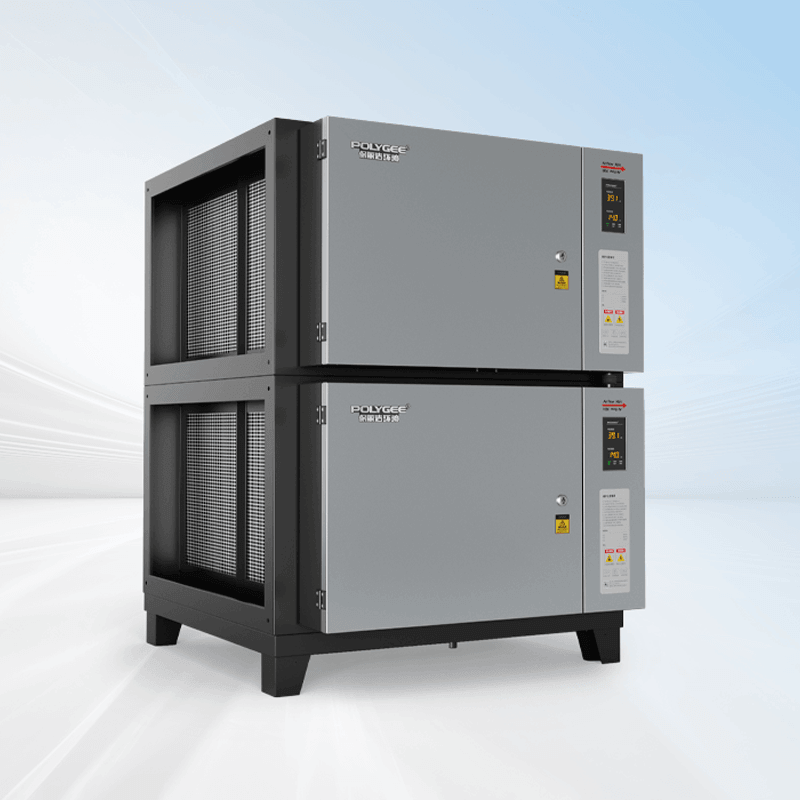
Polygee builds collector cells and housings around one principle: match the material to the job so the system keeps hitting its rated efficiency for years. Our collector cells are stainless steel throughout, and housing and frame materials are specified to the site environment rather than to a single catalog default — worth raising with us early for coastal and high-chloride kitchens. Every cell is designed as a fully washable unit, so operators can clean off grease and condensate without degrading the plates, and material is matched to the cleaning chemistry the site actually uses.
That choice runs across our three collection-cell tiers, so buyers can match both capture performance and build quality to the project — LK in-duct units measured 96.0–97.6% grease removal at rated airflow in third-party lab tests (Reports 2024I20-35-5322488001 and ZY05W230298):
| Series | Tier | Best for |
|---|---|---|
| LK-A Series | Standard tier, 4-stage | Cost-effective light-to-standard kitchens |
| LK-D Series | High tier, 4-stage | Mainstream commercial kitchens |
| LK-K Series | Top tier, 5-stage | High-grease and demanding sites |
With the right material and routine cleaning, washable cells deliver years of dependable service instead of becoming a replacement line-item every season. For a tough or marine environment, our engineering team specs materials to your project rather than to a catalog default — see our kitchen ESP units or talk to our team.
The same logic applies beyond the kitchen
Material-first thinking is not unique to restaurants. Industrial oil-mist collectors, workshop air purification, and exhaust systems in humid or chemical settings face the same corrosion drivers — and reward the same discipline of matching metal to environment. If you are specifying air purification for anything harsher than a standard indoor kitchen, treat material as a performance decision, not a cost line.
Frequently asked questions
What are the best commercial kitchen exhaust materials for corrosion resistance?
The best commercial kitchen exhaust materials depend on the site. For most kitchens, 316 stainless steel gives the best balance of corrosion resistance and cost. For marine, offshore, or high-chloride sites where even 316 can pit over time, higher-tier metals are sometimes specified selectively for the parts that fail first.
Is 316 stainless really worth the extra cost over 304?
In dry, inland kitchens, 304 is usually fine. But anywhere with coastal air, high humidity, or heavy use of chloride-based sanitizers, 316’s added molybdenum prevents the pitting that shortens 304’s life — so it typically pays for itself in avoided replacements.
Do I ever actually need titanium in a kitchen exhaust system?
Rarely, and only in the harshest environments — marine galleys, offshore platforms, cruise ships, beachfront resorts, or industrial exhaust with aggressively acidic air. For a normal restaurant it is overkill. Where it fits, it is used selectively in the wettest, hardest-hit components rather than the whole system.
How does corrosion reduce ESP efficiency?
Corrosion pits collector plates and thins ionizing wires, changing the precise gap spacing an ESP relies on. That causes arcing, uneven charging, and a steady drop in capture rate — so a corroded ESP lets more grease and smoke through long before it visibly fails.
Can I upgrade the cell material in an existing ESP?
Often yes. Many in-duct ESPs use removable, washable cells, so a higher-grade cell can be retrofitted without replacing the whole unit. Confirm cell dimensions and electrical spec with your supplier before ordering.
References & further reading
Further reading from Polygee: Plate-type ESP air purification and our commercial kitchen ESP buying guide.
Standards referenced: NFPA 96, Standard for Ventilation Control and Fire Protection of Commercial Cooking Operations; ASTM B348, Standard Specification for Titanium and Titanium Alloy Bars and Billets.