

Direct answer: A baffle filter and an ESP are not direct substitutes. A baffle filter works at the hood stage. An ESP works downstream to remove fine smoke particles that pass the hood filter. In a smoky kitchen, the practical question is not “which one,” but “is baffle-only enough, or do we need baffle plus ESP?”
If you are comparing electrostatic precipitator vs baffle filter, start with each device’s role. Replacing the wrong stage can create smoke complaints, harder maintenance, and code-review problems. A better comparison is: what does each device capture, where does it sit, and when is added smoke control needed? If the ESP material you are reading was written for an industrial unit, check it first against kitchen ESP vs industrial ESP; the two machines share a principle and nothing else.
Quick Facts: Baffle Filter vs ESP
| Question | Baffle filter | Electrostatic precipitator |
|---|---|---|
| Where it sits | In the kitchen hood or hood filter bank | Downstream in the duct, ceiling, rooftop, or packaged exhaust system |
| Main job | Remove larger grease droplets and help protect the hood/exhaust chain | Remove fine smoke and oil-mist particles after mechanical filtration |
| Evidence to request | Grease capture and pressure-drop data, ideally by recognized test method | Model-specific performance data, airflow capacity, safety listing, and service access requirements |
| Does it solve visible smoke alone? | Usually not when fine smoke is the main complaint | Often the correct stage to assess for visible plume and fine oil mist |
| Biggest buyer mistake | Treating all hood filters as equal | Treating ESP as a replacement for required grease filters |
What a Baffle Filter Actually Does
A baffle filter is a mechanical grease filter. Instead of using a flat mesh screen, it forces kitchen exhaust through angled passages. As the air changes direction, heavier grease droplets are more likely to separate from the airstream and drain away. This makes baffle filters useful in the hood because they are rigid, washable, and built for hot commercial cooking environments.
The important limitation is particle size. Large grease droplets and fine smoke behave differently. A baffle filter can reduce grease load entering the duct, but it is not designed to be the final answer for fine smoke, blue haze, or oil mist that stays suspended in the air. That is why a kitchen can have clean baffle filters and still have a visible plume at the discharge point.
For procurement, avoid asking only for a broad “baffle filter grease removal efficiency” number. Performance depends on filter design, face velocity, particle size, loading condition, and cleaning state. ASTM F2519 addresses grease particle capture efficiency and pressure drop for commercial kitchen filters and extractors. UL 1046 is the listing the code actually asks for at the hood, and what it does and does not prove is set out in commercial kitchen grease filter requirements. It is important here for a different reason: it is a grease-filter safety/listing context, not a universal capture-efficiency number.
What an Electrostatic Precipitator Does Differently
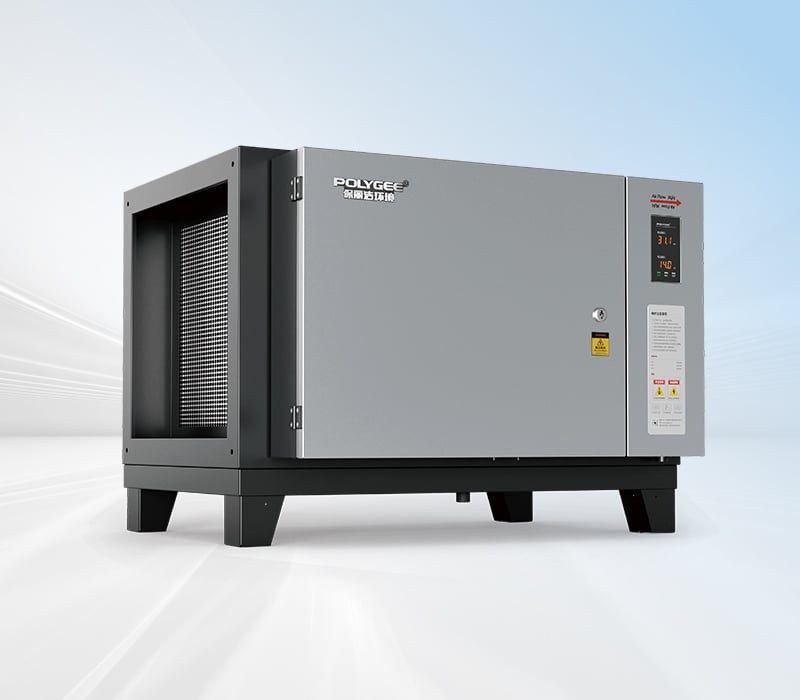
An electrostatic precipitator, usually shortened to ESP, targets smaller airborne particles downstream of the hood filter. In a kitchen exhaust ESP, the contaminated air normally passes through a charging section and then a collector section. The particles receive an electrical charge and are attracted to collector plates, where they can be removed during maintenance.
That role makes ESP useful for cooking styles that produce visible smoke or fine oil mist: wok cooking, barbecue, grilling, frying, teppanyaki, hot pot, and high-volume restaurants. It is an added smoke-control stage for exhaust that has already passed through the hood and mechanical grease filtration.
If your kitchen has visible discharge, neighbor complaints, or a design requirement for higher exhaust treatment, review a commercial kitchen electrostatic precipitator after you confirm the existing hood filter condition and airflow. For due diligence, ask for model-specific airflow capacity, service access requirements, electrical safety context, and maintenance instructions. UL 867 is a safety standard context, not a performance rating.
ESP vs Baffle Filter: Side-by-Side Role Comparison
| Criteria | Baffle filter | ESP |
|---|---|---|
| System position | Hood filter bank | Downstream exhaust treatment stage |
| Primary job | Grease separation near the hood | Fine smoke and oil-mist particle control |
| Mechanism | Mechanical direction change and grease drainage | Electrical charging and collection on plates |
| What to ask suppliers | Filter size, construction, pressure drop, test basis, cleaning method | Airflow range, collection stage design, pressure drop, cleaning access, electrical/safety documentation |
| Smoke effect | Limited for fine visible smoke | Designed for fine particulate smoke control when properly sized |
| Odor effect | Not an odor-control device | May reduce particle-related odor, but gas-phase odor often needs additional treatment |
| Maintenance trigger | Grease loading, kitchen duty, cleaning schedule, inspection result | Collector loading, smoke return, pressure/electrical alarms, cleaning schedule |
| Failure mode | Grease buildup, poor airflow, higher duct load | Poor collection if undersized, dirty, bypassed, or hard to service |
| Key buyer question | “Is this filter tested and maintained for my cooking load?” | “Is this ESP sized for my airflow, smoke load, and service access?” |
Neither device is universally “better.” A baffle filter is better at the hood-stage job. An ESP is better at the downstream fine-particle job.
Why an ESP Does Not Replace a Baffle Filter
Do not use an ESP as a shortcut around grease-filter requirements. NFPA identifies NFPA 96 as the standard for ventilation control and fire protection of commercial cooking operations, and local adoption or authority interpretation can decide what a project must follow. UL Standards lists UL 1046 under grease filters for exhaust ducts, including single-stage and multi-stage grease filters intended for commercial cooking exhaust contexts.
That matters because a hood grease filter is part of the fire-safety and grease-management chain. The ESP usually comes after that stage. If the hood filter is missing, wrong, dirty, or poorly installed, the downstream ESP has to deal with a heavier grease load than it was meant to handle. That can increase maintenance difficulty and reduce real-world performance.
In practice, keep these roles separate:
- Baffle filter: hood-stage grease separation and support for the kitchen exhaust fire-safety chain.
- ESP: downstream fine smoke and oil-mist control.
- Authority review: local code, consultant, insurer, landlord, or AHJ requirement.
- Supplier review: airflow, smoke load, installation space, service access, and discharge conditions.
For a new project or retrofit, confirm the hood grease-filter requirement before you specify downstream air cleaning.
Smoke, Grease, and Odor Are Different Problems
Kitchen exhaust complaints often get summarized as “smoke,” but the real problem may be a mix of grease droplets, fine particulate smoke, vapor, and gas-phase odor. Those problems do not respond to one device in the same way.
| Problem | Typical signal | Better question |
|---|---|---|
| Larger grease droplets | Hood and duct grease loading | Are the hood filters correct, clean, and tested for the cooking load? |
| Fine smoke or oil mist | Visible plume, blue haze, sticky residue near discharge | Is the ESP sized for airflow and particle load? |
| Gas-phase odor | Smell complaints even when visible smoke improves | Does the system need an added odor-control stage? |
An ESP is primarily a particle-control device. It can help reduce smoke and particle-associated odor, but it should not be sold as an automatic answer to every odor problem. In odor-sensitive sites, a supplier may add a UV-C odor control stage or an activated carbon filter after reviewing the menu, duct route, discharge point, and local rules. An ESP followed by both stages is the three-stage arrangement that kitchen drawings call an ecology unit.
Five-Year Cost: Compare Cost Drivers, Not Just Equipment Price
The cheapest equipment price is not always the lowest operating cost. At the same time, a universal ESP payback claim is not reliable without your real kitchen data. A useful five-year comparison should separate the cost drivers.
| Cost driver | Baffle-only system | Baffle plus ESP system |
|---|---|---|
| Initial equipment | Lower because the exhaust chain is simpler | Higher because ESP cabinet, power, controls, and installation are added |
| Cleaning labor | Hood filters still need regular cleaning | Hood filters plus ESP cells/plates need planned cleaning |
| Duct cleaning | Depends on cooking load and filter performance | May reduce downstream grease/smoke load when correctly sized and maintained |
| Fan energy | Depends on hood/filter pressure drop and duct design | Adds its own pressure drop, so fan capacity must be checked |
| Downtime risk | Smoke complaints or authority issues may force later retrofit | More components to maintain, but better smoke-control path when needed |
| Proof needed | Filter data, cleaning records, inspection results | ESP sizing, airflow match, maintenance access, and service plan |
For a board, landlord, or procurement team, do not present ESP cost as a brochure number. Build the case with cleaning invoices, complaint risk, operating hours, airflow, and a supplier quotation. The stronger question is: what problem are we paying to solve, and what happens if we do not solve it?
When Baffle-Only May Be Enough
Baffle-only may be enough when the cooking load is light, the menu produces limited visible smoke, the discharge point is remote from neighbors, and local requirements do not call for additional treatment. It may also work for a kitchen with good hood capture, clean ductwork, and no complaint history.
Not every kitchen needs ESP. If there is no visible plume, odor complaint, landlord requirement, authority concern, or planned cooking-load increase, the next investment may be better cleaning records, filter replacement, airflow balancing, or hood maintenance.
But baffle-only should be a decision, not an assumption. If the kitchen changes menu, increases volume, moves discharge closer to people, or starts receiving complaints, the exhaust treatment plan should be reviewed again.
When to Add ESP After Baffle Filters
Review ESP when the problem is downstream smoke, fine oil mist, visible discharge, or operational risk that baffle filters are unlikely to solve on their own. How the electrostatic, UV and carbon stages line up behind the baffle filter, by menu and airflow, is set out in our kitchen exhaust filtration guide.
| Kitchen condition | Baffle-only may be acceptable | Review baffle plus ESP |
|---|---|---|
| Cooking style | Light cooking, boiling, baking, low smoke | Wok, grill, barbecue, frying, teppanyaki, high-oil cooking |
| Exhaust discharge | High rooftop discharge away from neighbors | Sidewall, low rooftop, courtyard, alley, mall, or dense street |
| Complaint history | No smoke or odor complaints | Neighbor, landlord, mall, or authority complaints |
| Retrofit pressure | Existing system performs acceptably | Existing hood is acceptable but visible plume remains |
| Future plan | No major menu or volume change | New branch, chain rollout, hotel upgrade, food court fit-out |
For restaurant projects where the hood stage is already defined but smoke control is still uncertain, use a restaurant kitchen ESP solution as the next review step. The key is not to buy a generic ESP cabinet. The key is to match airflow, cooking load, duct route, service access, and discharge risk.
What to Send a Supplier for a Useful ESP Quote
Do not ask only, “How much is an ESP?” Send project conditions instead.
Prepare:
- Cooking type and menu: frying, grilling, wok, barbecue, hot pot, mixed cooking, or bakery.
- Operating hours and peak periods.
- Hood type, hood size, and current baffle filter details.
- Exhaust airflow if available.
- Duct route, duct size, and available installation space.
- Discharge point photos: rooftop, sidewall, shaft, alley, mall, or nearby windows.
- Existing problems: visible smoke, odor complaint, grease buildup, authority comment, or landlord requirement.
- Service access: where staff can safely remove and clean filters or ESP cells.
- Local standard or consultant requirement if already known.
- Photos, drawings, or a short video of the kitchen and exhaust path.
With those details, a supplier can discuss whether the project needs only better hood-stage maintenance, a downstream ESP, or ESP plus an odor-control stage. To move from comparison to sizing, send your kitchen details for an ESP quote and ask for a project-specific recommendation instead of a generic equipment list.

Conclusion: Baffle Filter, ESP, or Both?
Baffle filters and electrostatic precipitators solve different parts of commercial kitchen exhaust. Keep the baffle filter role for hood-stage grease management and fire-safety review. Add ESP when fine smoke, oil mist, discharge location, complaints, or authority pressure make downstream treatment necessary. The right buying decision is not “ESP or baffle filter.” It is a staged exhaust chain, sized for your cooking load and maintained in the real kitchen.
References & Sources
- NFPA 96 standard page – NFPA.
- UL 1046, Grease Filters for Exhaust Ducts – UL Standards & Engagement.
- ASTM F2519, Standard Test Method for Grease Particle Capture Efficiency of Commercial Kitchen Filters and Extractors – ASTM International.
- Revised Standard for UL 867, Electrostatic Air Cleaners – UL Solutions.
- Kitchen exhaust filtration technical article – AIRAH / Ecolibrium.