

A kitchen ESP is a two-stage, plate-type electrostatic precipitator that takes grease aerosol and smoke out of cooking exhaust, with collector cells that slide out for washing. An industrial ESP is a multi-field precipitator for process gas, cleaned by rapping or water rinsing. This page gives the eight rows on which the two differ and what each means for a quotation.
The physics is the same; the machine is not. The expensive error is reading industrial ESP literature as if it described a kitchen unit: writing rapping, resistivity or field counts into an enquiry for a restaurant, or rejecting a kitchen quotation because it carries none of them. The second error runs the other way: taking a kitchen ESP datasheet to a process-gas problem it was never built for.
This page helps you decide whether the ESP material in front of you, a datasheet, a quotation or a certificate, is describing a kitchen machine or an industrial one, and how to write a kitchen ESP enquiry in the right terms. It does not select stages or size a unit; that is on the kitchen exhaust filtration page and the product pages. For a quotation on a named model, go to the kitchen electrostatic precipitator range.
| Question | Our answer |
|---|---|
| What a kitchen ESP is | A two-stage plate-type electrostatic precipitator, duct-mounted or built into a hood, with washable drawer cells, for grease aerosol and smoke from cooking |
| What an industrial ESP is | A multi-field precipitator for process gas, with plates or pipes cleaned by rapping (dry) or water (wet) and energized by a transformer-rectifier set, as the US EPA describes it |
| The rows that decide a quote | All eight: rows 1 to 4 (pollutant, cleaning method, airflow band, supply and power supply) fix the price, rows 5 to 8 fix the scope |
| What a kitchen ESP does not do | Remove gas-phase odor, cool the exhaust, or handle dry dust from a process that is not cooking |
| What to send for a kitchen quote | Cooking process, design airflow, where the unit sits in the duct, where the outlet is, and the filters already in the hood |
| Not on this page | Stage selection (kitchen exhaust filtration page), price lines (price page), the cleaning procedure (cleaning page), the four ESP types (types page) |
- What a kitchen ESP is, and what an industrial ESP is
- The 8-Row Kitchen-vs-Industrial ESP Check
- Why a kitchen ESP is a two-stage plate unit with drawer cells
- What buyers mean when they search kitchen esp
- Which standards prove what
- When neither machine is the answer
- Buyer record and key takeaways
- Frequently asked questions
What a kitchen ESP is, and what an industrial ESP is
Both machines charge particles in a moving gas stream and pull them onto an oppositely charged surface. That is the whole of the shared physics, and it is why a search for ESP returns power stations next to restaurants.
The industrial machine is the one most published material describes. The US EPA description of an electrostatic precipitator lists four components: gas distribution plates, discharge electrodes, collection surfaces as plates or pipes, and rappers. The discharge electrodes are divided into fields, most units carrying three or four in series and very large units up to fourteen, and they are energized by a transformer-rectifier set. A dry ESP clears its collection surfaces by rapping, a mechanical impulse that knocks the collected material loose; a wet ESP rinses them with water, and is used where the particles are sticky. The EPA page also notes that performance can be affected by the electrical resistivity of the particle, a property that belongs to a process gas rather than to cooking exhaust.
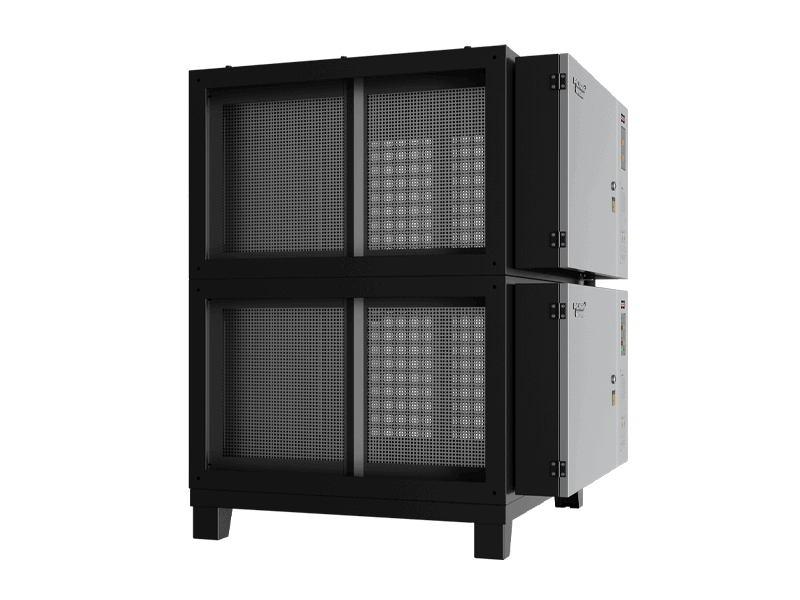
The kitchen machine is the one this site is about. A kitchen ESP is a two-stage unit: an ionizer section charges the grease aerosol and smoke, and a collector section of stainless steel plates holds them. The two stages sit in one cell that slides out of the housing for washing, and the unit is fed by compact high-voltage power modules housed inside it rather than by a transformer-rectifier set. Our in-duct kitchen electrostatic precipitator range runs to 41 standard LK models from 4,000 to 60,000 m³/h, with duties from 2,000 m³/h and larger airflows met by units in parallel; the LK-E engineering series covers 3,000 to 40,000 m³/h in 33 models, and the HME hoods build the precipitator into the canopy at 3,000 to 4,800 m³/h. The dry, wet, plate and tube taxonomy that the EPA material uses is explained on our types of electrostatic precipitator page; a kitchen unit is a dry plate-type machine whose plates are washed rather than rapped.
Who buys which is settled by the exhaust, not by the building. A shopping mall food hall, a hotel kitchen floor and a chain restaurant all buy the kitchen machine: the TRX project in Kuala Lumpur took 300 units of the LK-E and UV series in 2022, and the Dubai Mall project took 40 units on an ODM basis in 2017. A boiler house or a kiln in the same city buys the industrial machine, and the two never cross.
Decision rule. IF the document in front of you mentions rapping, particle resistivity or a transformer-rectifier set, THEN it describes an industrial ESP, BECAUSE those belong to plant-scale designs; a kitchen datasheet describes its unit by airflow band, cell arrangement and supply voltage. The word field on its own does not decide it: kitchen datasheets, ours included, call the ionizer-and-collector stage an electrostatic field.
The 8-Row Kitchen-vs-Industrial ESP Check
A kitchen ESP is the candidate when the exhaust carries cooking grease and smoke at hood airflow; an industrial ESP remains the candidate when the stream is process gas carrying particulate at plant scale. The eight rows below are the ones on which a datasheet, a quotation or a certificate gives itself away, and the last column says what each row does to the quotation you are comparing.
The 8-Row Kitchen-vs-Industrial ESP Check (our own comparison, not an industry standard)
| # | Row | Kitchen ESP | Industrial ESP | What it means for your quote |
|---|---|---|---|---|
| 1 | What is collected | Grease aerosol and smoke from cooking: liquid at duct temperature, sticky, flammable | Process particulate: fly ash, dust, mist from a plant stream, dry or wet | A quote for cooking exhaust names grease and smoke as the duty; a datasheet written around dust does not transfer |
| 2 | Collection surface and cleaning | Stainless steel plates in drawer cells that slide out and are washed | Plates or pipes cleaned in place by rapping (dry) or water rinsing (wet) | Ask how the cells come out and where they are washed; a question about rappers has no answer on a kitchen unit |
| 3 | Airflow per unit | One unit per duct run, sized to the hood: our LK standard range 4,000 to 60,000 m³/h in 41 models, from 2,000 m³/h, larger duties by parallel units | Sized to the process gas flow of a plant; no standard catalogue sizes | The airflow on the quote is the hood design figure in m³/h, met by one unit or several in parallel, not by a field count |
| 4 | Electrical supply and power supply | 220 V single-phase or 380 V, 50 or 60 Hz to the customer’s site; compact high-voltage power modules housed in the unit | Transformer-rectifier set on a plant supply | Write the site supply on the enquiry; expect the power modules to be listed on the quotation, not a transformer-rectifier set |
| 5 | Stages in series | Ionizer and collector as two stages inside one cell; the number of cells is set by the model and the airflow | Three or four fields in series as the common case, more on large units | “Dual-pass” or “double-zone” on a kitchen datasheet refers to the cell arrangement, not to fields; ask for the cell count and arrangement in writing |
| 6 | Fire and access rules | Treated under NFPA 96 as a pollution control unit, with its access, grease-drainage and fire-protection provisions; where the air cleaner itself is listed, the listing is to UL 867 and names specific models (ours: LK/SE-6K, LK/SE-12K and LK/SE-18K, 230 V/50 Hz, File E522667) | Process and emission codes; no cooking-fire provisions | Ask which listing names the model you are quoted and which code edition the installer works to |
| 7 | Position in the train | Hood grease filters → duct → ESP → UV or carbon where odor is a condition → fan → outlet | Gas conditioning → ESP → stack | An ESP quote does not replace the hood filters, and an odor stage is a separate line, not a property of the ESP |
| 8 | How it is sold | Standard models by airflow (our terms: MOQ 1 unit; standard lead time 7 to 15 days; 1-year warranty on the unit, with UV lamps, carbon and site labour excluded) | Engineered and priced per project | Compare kitchen quotes on airflow, cell count, supply and scope; industrial pricing has no place in the comparison |
This table answers which machine a document describes. It does not answer which stages your kitchen needs; that is the kitchen exhaust filtration page, and the lines that make up a price are on the electrostatic precipitator price page.
Decision rule. IF rows 1 to 4 of a datasheet read as the kitchen column, THEN compare it with other kitchen quotations on airflow, cell count, supply and scope, BECAUSE rows 1 to 4 fix the price and rows 5 to 8 fix the scope; IF any of rows 1 to 4 reads as the industrial column, THEN the document belongs to another market and the comparison stops there.
Why a kitchen ESP is a two-stage plate unit with drawer cells
Cooking grease decides the design. It arrives as an aerosol, condenses on the collector as a liquid film, stays sticky at duct temperature and burns. Rapping, which clears dry dust from an industrial plate, does not release a grease film, and a wet industrial design that rinses continuously has no place in a restaurant plant room. The kitchen answer is a plate stack built as a drawer: the cell is withdrawn, washed, dried and returned, and the housing carries a drain for what runs off. The plates on our units are stainless steel, and the access door cuts the high voltage when it opens.
Two numbers on a kitchen datasheet need their basis read before they are compared. The first is pressure drop. Our LK units are quoted at 150 Pa or less for the complete unit including the standard air-distribution plate; the LK-E catalogue gives 23 to 34 Pa for the electrostatic field alone. The two figures describe different things, and a quotation that gives one without saying which is not yet comparable. The second is efficiency. The LK series carries a third-party figure of up to 97.6%, from a CMA-accredited laboratory test of the LK160 at its rated airflow, report ZY05W230298; the HME hoods tested at 98.0 to 98.1%; the LK-E series carries design figures of 90, 95 and 98% by grade, which are design values and not test results. None of these figures is a prediction for your kitchen, and how to read a report line against your own duty is on the electrostatic precipitator test report page.
How often the cell comes out is the question every operator asks, and the answer on a kitchen unit is set by the cooking duty, the hours and the airflow, not by the machine. We state the interval in writing at quotation for the kitchen described, and the electrostatic precipitator cleaning page covers what a service visit consists of and how the basis is written into the order.
What buyers mean when they search kitchen esp
The phrases below are the ones that bring readers to our product pages, taken from our own search data and from the terms typed into our advertising. Each one hides an engineering question, and each question has a document that answers it.
| What buyers search | The engineering question behind it | Record to request |
|---|---|---|
| esp filter, esp unit | Is there a filter medium to replace? | There is none; ask for the cell count and the washing arrangement on the quotation |
| kitchen esp filter smoke | Will it stop visible smoke at the outlet? | The tested efficiency with its method, model and airflow, and the outlet baseline taken at commissioning |
| esp unit for kitchen, kitchen esp system | Which unit, and what else goes in the duct? | The design airflow, the stage list (ESP, UV, carbon) and the duct position, on the enquiry |
| esp kitchen exhaust, electrostatic precipitator for kitchen exhaust | Can the unit I found online go on a kitchen duct? | Rows 1 to 4 of the 8-Row Kitchen-vs-Industrial ESP Check against its datasheet |
| commercial kitchen esp | Which listing or certificate applies? | A certificate that names the model; the scope table in the next section |
| esp filter price | What sets the price? | Airflow, cell count, supply and scope of supply; the price page |
This table turns a search phrase into the record to ask for. It does not grade suppliers; the questions to put to any factory are on the verifying a Chinese ESP manufacturer page.
Which standards prove what
A kitchen ESP and an industrial ESP are covered by different documents, and the quickest test of which machine a certificate belongs to is the standard it cites. The table gives each document, what it supports, what it does not prove on its own, and the models our own documents name.
| Evidence | What it supports | What it does not prove on its own | Product-condition scope | Buyer action |
|---|---|---|---|---|
| UL 867 listing, File E522667 | The listed models meet the safety standard for electrostatic air cleaners | Grease-capture performance; code acceptance of the installation | Three models only: LK/SE-6K, LK/SE-12K and LK/SE-18K, 230 V/50 Hz | Ask for the file number and check the model on it in UL Product iQ; how to read a listing is on our UL 867 page |
| CE certificate FQC2602501 | Conformity of the models it names | Performance; acceptance in a UL market | LK30 to LK480, LK30E1 to LK150E1 and the UV series | Ask for the certificate and its model list |
| Test report ZY05W230298 (CMA-accredited laboratory) | Efficiency of the tested model at its rated airflow | Efficiency in your kitchen; odor control | The LK160 on the report | Read the model, airflow and method lines before the percentage |
| NFPA 96 | How an in-duct unit is treated in a commercial cooking exhaust: as a pollution control unit with access, drainage and fire-protection provisions | That any particular unit is listed | The installation, by the contractor | Ask the installer which edition applies; our pollution control unit page follows the provisions through the IMC |
| UL 8782 | Pollution control units for commercial cooking, evaluated as a system | Anything about a unit that is not on its own UL 8782 listing | Only units named on a UL 8782 listing | Where a specification calls for UL 8782, say so at enquiry; the point is settled before a quotation, not at submittal |
| US EPA ESP description | What an industrial ESP is and how it is cleaned | Anything about kitchen units | Industrial | Use it to recognize the other machine, not to specify yours |
This table covers the documents a kitchen ESP enquiry meets. It does not cover the acceptance of the installed system, which is three separate layers, equipment evidence, site installation and whole-system operation, as set out on our certifications page; passing one layer does not clear the next.
Decision rule. IF a specification asks for UL 8782, THEN tell us at enquiry, BECAUSE the documents we hold are the UL 867 listing on the three named models and the CE certificate on the named models, and whether they meet the specification is settled before a quotation rather than discovered at submittal.
When neither machine is the answer
- The complaint is smell, not smoke. An ESP takes particles; odor carried as gas passes through either machine. The step is to find out whether the residual odor is particle-phase or gas-phase, then price a UV or carbon stage after the ESP; the commercial kitchen odour control page sets out that order.
- The exhaust is steam with no cooking aerosol. Dishwash and steamer exhaust carries nothing for an ESP to hold. The step is a hood and duct design question, not a precipitator.
- The duty is solid-fuel cooking at high outlet temperature. A kitchen ESP is specified against the duct conditions it will see, and solid fuel changes them. The step is to send the appliance list and the expected duct temperature before any model is named; the solid-fuel exhaust page lists what the codes ask for first.
- The particulate comes from a process that is not cooking. Dust, fume or mist from a plant stream belongs to the industrial column of the Check, and the enquiry belongs with an industrial supplier.
Buyer record and key takeaways
Before an enquiry for a kitchen ESP goes out, these five items go in it, and they are the five that let a factory answer with a model rather than a question.
- The cooking process and appliance list, and whether solid fuel is used.
- The design airflow in m³/h or CFM, with its source (hood schedule, balancing report or estimate).
- Where the unit sits in the duct, and the distance to the fan and the outlet.
- The outlet location and any odor condition attached to it.
- The filters already in the hood, and the site supply voltage and frequency.
Key takeaways
- Same physics, two machines: charging and collecting is shared; everything from the cleaning method to the sales model is not.
- Eight rows decide a kitchen quote: rows 1 to 4 (pollutant, cleaning method, airflow band, supply) fix the price and rows 5 to 8 fix the scope; compare quotations on those, not on anything from an industrial datasheet.
- Rapping is the giveaway: a document that mentions rapping, particle resistivity or a transformer-rectifier set is describing an industrial ESP.
- A certificate names models, not a series: UL 867 on LK/SE-6K, LK/SE-12K and LK/SE-18K only; CE on LK30 to LK480, LK30E1 to LK150E1 and the UV series.
- Odor is a separate line: neither machine removes gas-phase odor; the UV or carbon stage is priced on its own.
Frequently asked questions
- Is a kitchen ESP the same as an industrial ESP?
- No. They share the principle of charging particles and collecting them on plates, and nothing else. A kitchen ESP is a two-stage plate unit with drawer cells that are washed, sized to a hood airflow and fed by compact high-voltage modules inside the housing; an industrial ESP is a multi-field unit for process gas, cleaned by rapping or water rinsing and energized by a transformer-rectifier set.
- Can an industrial electrostatic precipitator be installed on a kitchen exhaust?
- Not as built. Rapping does not clear a grease film, and an industrial unit carries none of the access, drainage and fire-protection provisions NFPA 96 applies to a pollution control unit in a cooking exhaust. A kitchen exhaust takes a kitchen ESP, selected by airflow and cooking duty, with the listing that names the quoted model checked at enquiry.
- What is the main downside of a kitchen ESP?
- It collects particles only, so an odor that is gas-phase passes through and needs a UV or carbon stage after it. The cells also have to come out and be washed on a schedule set by the cooking duty, and the unit has to be fed the airflow it was sized for; an undersized unit and an unwashed cell are the two ordinary causes of smoke returning at the outlet.
- Is an ESP filter something you replace?
- No. A kitchen ESP has no filter medium; the collector cell is a stack of stainless steel plates that is withdrawn, washed and returned. The consumables in a kitchen exhaust train are the UV lamps and the activated carbon, where those stages are fitted, and they are priced as separate lines.
- How often is a kitchen ESP cleaned?
- As often as the cooking duty, the hours and the airflow require, and that interval is stated in writing on the quotation for the kitchen described, not as a figure on a page. The practical signs that a cell is due are a fall in capture at the outlet and the indication on the unit; the cleaning page covers what a service visit consists of.
Checking whether an ESP quotation is a kitchen machine?
Send us the datasheet or quotation you are looking at, together with the cooking process, the design airflow and where the unit will sit in the duct. You get back the row-by-row reading against the 8-Row Kitchen-vs-Industrial ESP Check and, if the duty is cooking exhaust, a quotation on a named LK, LK-E or HME model with the supply, the cell count and the scope of supply written out.
Send the datasheet and your airflow →
If you have not found a datasheet yet and want to start from the duty, the inputs are the five items in the buyer record above, and the models they map to are on the kitchen electrostatic precipitator range.
Why we write this. Readers reach this page from the same search that returns power-station precipitators, and the questions behind it are whether the unit they found is the one for a restaurant and what to write in the enquiry. It answers both with the comparison rows and the enquiry inputs. This page does not size or configure equipment; sizing and quotation live on the product pages.
Reviewed by Law, Project Manager, 13 October 2026
Written by Law · Project Manager, PolygeeLaw manages project delivery at Polygee and reviews the airflow, stage and interface lines of offers against the site before an order is confirmed. Polygee, founded in 2004, manufactures the in-duct electrostatic precipitators and kitchen ESP hoods named on this page at its factory in Zhangjiagang, China, and has exported to 50 countries.
References & further reading
- US EPA, Air Emissions Monitoring Knowledge Base: Monitoring by Control Technique, Electrostatic Precipitators (components, fields, dry and wet cleaning, resistivity). epa.gov
- NFPA 96, Standard for Ventilation Control and Fire Protection of Commercial Cooking Operations, National Fire Protection Association. nfpa.org
- UL 867, Standard for Electrostatic Air Cleaners, UL Standards & Engagement. shopulstandards.com
- UL Solutions, Pollution Control Units for Commercial Cooking Systems: Then and Now (UL 8782). ul.com
- Our own documents: the certifications page (UL 867 File E522667, CE FQC2602501 and the models each names), the test report page (report ZY05W230298) and the supplier profile.
Related reading
- Types of electrostatic precipitator: dry, wet, plate and tube, and the single-stage versus two-stage split that places the kitchen unit.
- Electrostatic precipitator vs baffle filter: why the hood filter stays when an ESP goes in, and what each one controls.
- Electrostatic precipitator price: the lines that set a kitchen ESP quotation, which rows 3, 4 and 8 of the Check feed.
- Electrostatic precipitator cleaning: what a service visit covers and how the cleaning basis is written into the order.