

Type 1 hood vs Type 2 comes down to one question: what does the appliance underneath send into the air? Grease and smoke call for a Type 1 hood. Heat, steam and moisture alone call for a Type 2.
The split comes from the U.S. mechanical and fire codes — the International Mechanical Code (IMC) and NFPA 96 — and the final call on any real project belongs to the local authority having jurisdiction (AHJ).
Here is how the two hood types differ, how to tell which one a cookline needs, and what goes downstream of each.
What is a Type 1 hood?
A Type 1 hood — often called a grease hood or a Type 1 vent hood — is the canopy U.S. codes assign to cooking that produces grease-laden vapors or smoke: fryers, griddles, charbroilers, open-burner ranges, woks, salamanders.
Pizza ovens baking cheese- and meat-topped pies belong here too. If the process throws grease or smoke into the airstream, it is Type 1 duty, and the drawings will call out a Type 1 kitchen hood over it.
The construction follows the job. A Type 1 exhaust hood is built liquid-tight and carries a bank of grease filters — usually baffles — angled so captured grease drains into a trough instead of dripping back onto the cookline. What the code asks of that bank, from the UL 1046 label to the angle and the height above the appliance, is in commercial kitchen grease filter requirements.
It connects to a dedicated grease duct, and it is installed to work alongside the fire suppression system that local codes require over grease-producing appliances; what that system has to be is in commercial kitchen hood fire suppression requirements.
Every element answers the same concern: grease that escapes capture builds up as fuel inside the duct, and duct fires are what NFPA 96 exists to prevent. The codes therefore treat a Type 1 hood system as one grease-handling path — hood, filters, duct and suppression reviewed together.
What is a Type 2 hood?
A Type 2 hood is the light-duty counterpart: a condensate hood for equipment that releases heat, steam and moisture but little or no grease. Dishwashers, steamers, pasta cookers and some light-duty ovens are the classic cases.
Its job is comfort and moisture control — moving humid air out before it condenses on ceilings and walls — not fire protection.
With no grease to trap, Type 2 hoods skip the grease filters, the trough and the suppression tie-in. The canopy is simpler, the duct is a standard vent duct for warm, moist air, and purchase and running costs sit well below a comparable Type 1 installation.
That simplicity is exactly why the classification matters: putting grease-producing equipment under a Type 2 hood removes every safeguard the codes count on. The code’s own line between the two, appliance class by appliance class, is drawn in type 2 hood requirements.
Type 1 hood vs Type 2 hood: side by side
| Type 1 hood | Type 2 hood | |
|---|---|---|
| What it removes | Grease-laden vapor and smoke from cooking | Heat, steam and moisture from non-grease equipment |
| Typical appliances | Fryers, griddles, charbroilers, ranges, woks, most pizza ovens | Dishwashers, steamers, pasta cookers, some light-duty ovens |
| Grease filters | Yes — typically baffle filters, with grease drainage | None |
| Fire suppression | Paired with a suppression system over grease cooklines | Not normally involved |
| Ductwork | Dedicated liquid-tight grease duct | Standard duct for warm, moist air |
| Governing references | NFPA 96 and the IMC, applied by the local AHJ | The IMC, applied by the local AHJ |
| Relative cost | Higher — filters, suppression and grease duct add up | Lower — simpler canopy and duct |
One clarification: there is no “Type 3” hood in the U.S. codes, which define Type I and Type II only. Ventless, self-filtering appliances are a separately listed equipment category, not a third hood type.
Which one does your kitchen need?
The decision rule is short, because the classification follows the appliance, not the hood:
- The process produces grease or smoke → Type 1 duty. Frying, griddling, charbroiling, wok cooking, roasting meat.
- The process produces only heat, steam or moisture → Type 2 duty. Warewashing, steaming, boiling pasta.
- The duty changes → the classification changes with it, whatever hood is already hanging there.
- Fuel type does not change the call — an electric fryer or griddle makes grease-laden vapor all the same, so it is still Type 1 duty. Gas vs electric matters at a different boundary: combustion products are part of how the AHJ weighs a Type 2 hood against no hood at all.
Quick reference by appliance
- Fryer, griddle, charbroiler, range, wok, salamander → Type 1
- Ovens roasting meat or in other grease-producing duty → Type 1
- Deck pizza oven on cheese- and meat-topped menus → typically Type 1
- Dishwasher, warewasher → Type 2
- Steamer, pasta cooker, rice cooker → Type 2
- Holding cabinets, some light-duty electric ovens → Type 2 or no hood, as the AHJ directs
Pizza ovens are the borderline case buyers ask about most. A gas or electric deck oven baking cheese- and meat-topped pizzas produces grease-laden vapor, so a Type 1 hood for a pizza oven is the usual outcome.
Wood-fired and other solid-fuel ovens add a second layer of rules — solid-fuel cooking generally gets its own dedicated exhaust path, set out in solid fuel cooking exhaust requirements. Fuel and menu decide; the AHJ confirms.
Four specification mistakes that cost money
The same patterns come up again and again in project reviews. All four are cheap to avoid on paper and expensive to fix in steel:
- Classifying by hood, not by appliance. The canopy on the drawing does not decide anything; the equipment schedule underneath it does. Start every review from what each station actually cooks.
- Letting the menu outgrow the hood. Concept updates and equipment swaps are classification changes, not just operational ones. A station that added a griddle needs a Type 1 review, whatever hood is hanging there.
- Treating a downstream filter as a shortcut. An electrostatic precipitator cleans the exhaust stream; it does not reclassify the hood in front of it. Grease duty still calls for a Type 1 hood, with the ESP as the filtration stage behind it.
- Choosing the canopy in isolation. Type 1 exhaust is reviewed as a system — hood, filters, duct, fan, suppression and filtration together. A hood picked without the rest of the path tends to get re-engineered at plan review. The full list a reviewer walks is in commercial kitchen hood code requirements.
What goes after a Type 1 hood: the filtration stage
A Type 1 hood solves capture and containment. It does not finish the air-cleaning job — and on projects with close neighbors, rooftop discharge limits or a watchful landlord, what happens after the hood is where the real engineering sits.
The hood’s baffle filters are a first stage: sharp turns in the airstream throw larger grease droplets onto the metal, where they drain away. Fine grease mist and smoke ride straight through — see our comparison, electrostatic precipitator vs baffle filter.
Left untreated, that fine fraction condenses along the duct run, coats the fan, and leaves the roof or facade with a visible, smellable plume. The fixes, in the order that works, are in how to reduce smoke from commercial kitchen exhaust.
The standard fix is a kitchen electrostatic precipitator mounted in the duct downstream of the hood. It charges the fine particles the baffles miss and collects them on stainless steel plates that wash and go back in, rather than getting replaced.
Polygee’s LK in-duct units measured up to 97.6% grease removal in third-party tests.
The engineers in the room will also ask where the ESP sits in the approval process. In-duct filtration is part of the plan-review scope: NFPA 96 carries provisions for pollution control units — service access, grease drainage, fire protection — and current IMC editions add a listing for the unit itself, covered in grease duct requirements, so the AHJ and the mechanical consultant review the unit together with the hood, duct and suppression, as part of the same system described above.
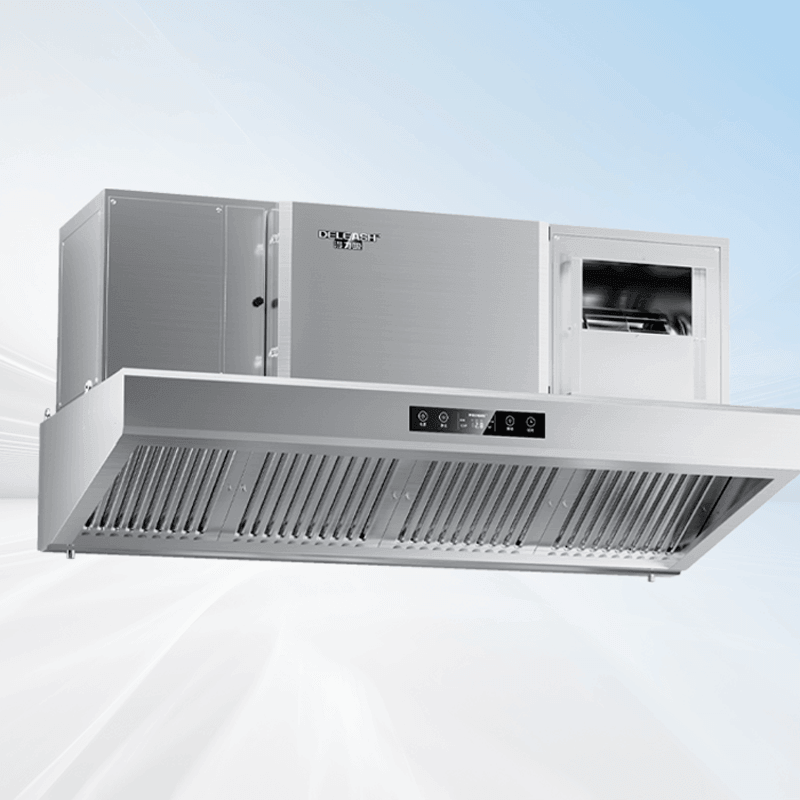
Where duct space rules out an in-duct unit, or the hood itself is being replaced in a new build or full renovation, a commercial kitchen hood system with ESP cells built into the canopy handles capture and fine filtration in one housing; Polygee’s HME models measured 98.0–98.1% grease removal in third-party tests.
Grease is only half of what bothers the neighbors; cooking smell is the other half. Downstream of the ESP stage, UV modules break down odor compounds and activated carbon adsorbs what remains — the options are laid out on our kitchen exhaust odor control page.
Two placement notes for engineers and consultants: leave service access at the ESP so the collector cells can come out for washing, and put the unit on a duct run that feeds it steady, evenly distributed airflow. Grease removal efficiency is measured at rated, evenly distributed airflow — a turbulent or unevenly fed inlet gives part of it away.
Type 2 exhaust rarely joins this conversation: heat and steam are vented directly, and there is no grease to filter. If a Type 2 station starts producing grease, the fix is reclassification — not a filter bolted onto the wrong hood type.
For a worked example of how hood, ESP and odor stages line up on one cookline, see our restaurant kitchen exhaust filtration solution page.
Frequently Asked Questions
- How can you tell if a hood is Type 1 or Type 2?
- Look at what the hood serves and what is inside it. A Type 1 hood hangs over grease-producing appliances and carries grease filters and a drainage point; a Type 2 hood serves steam- and heat-producing equipment and has no grease filters. If the hood is factory-built and listed, its label also states its type. For borderline cooklines, the local code official makes the call.
- Does a Type 2 hood need a fire suppression system?
- Type 2 hoods serve appliances that produce heat, steam and moisture rather than grease-laden vapors, so they are not normally paired with the fire suppression that grease cooklines call for. Local rules vary, though, and the authority having jurisdiction (AHJ) has the final word for any specific installation.
- Do pizza ovens require a Type 1 hood?
- Usually, yes, when they cook pizzas with cheese and meat toppings, because that duty produces grease-laden vapors and smoke — Type 1 territory. Wood-fired and other solid-fuel ovens bring additional rules of their own, often including a dedicated exhaust system. Treat the oven’s fuel and menu as the deciding factors and confirm the classification with your local AHJ.
- Can an electrostatic precipitator be used with a Type 1 hood?
- Yes. An electrostatic precipitator (ESP) installs in the duct downstream of a Type 1 hood’s grease filters and captures the fine grease mist and smoke that pass through them; ESP hoods build the same cells directly into the canopy. The hood remains the capture and containment device, while the ESP handles the fine-particle filtration behind it.
Planning the exhaust side of a Type 1 cookline?
We build the filtration stage that goes behind Type 1 hoods — in-duct ESP units, ESP hoods, UV odor modules and carbon stages — and we work with engineering firms, consultants and dealers on the duct-side design around them.
Send us the cooking type, the duct layout and the local emission rules, and our project team will come back with a sized proposal and the test data behind it.
Talk to our project team →Law manages kitchen exhaust filtration projects at Polygee, from spec review through duct-side ESP sizing and installation support. Polygee has built commercial kitchen ESP systems since 2004. This article explains U.S. hood classifications for planning purposes only — it is not a code-compliance determination, so confirm the classification of any specific installation with your local AHJ.
References & further reading
- NFPA 96, Standard for Ventilation Control and Fire Protection of Commercial Cooking Operations. nfpa.org
- International Mechanical Code (IMC), Chapter 5: Exhaust Systems. codes.iccsafe.org
- Polygee — kitchen exhaust filtration product range and third-party test reports. polygeeesp.com