

Commercial kitchen hood CFM requirements come from one table in the International Mechanical Code: a wall-mounted canopy hood needs 200 CFM per linear foot over light-duty appliances, 300 over medium-duty, 400 over heavy-duty and 550 over extra-heavy-duty cooking. Island canopies run higher, and a hood listed to UL 710 may use the rate on its listing instead.
But the CFM figure most projects fight over is not the one that decides whether the kitchen works. That number is the airflow the whole exhaust path is designed around: the fan, the duct, the make-up air, and the filtration unit behind the hood. Get the hood rate right and size the rest to a different number, and the system fails at the point nobody was looking at.
This guide lays out the code rates by hood style and cooking duty, explains why a listed hood can legitimately quote a lower number, and walks the figure downstream to the in-duct filtration it has to match.
Commercial kitchen hood CFM requirements: the IMC rates by duty
Cooking duty sets the rate, and the hood style sets which row you read. The International Mechanical Code (Section 507.5, Capacity of Hoods) fixes a minimum exhaust quantity per linear foot of hood, graded by how much grease and heat the appliances underneath produce:
| Cooking duty | Wall-mounted canopy | Single-island canopy | Typical appliances (examples) |
|---|---|---|---|
| Light-duty | 200 CFM / ft | 400 CFM / ft | Ovens, steam-jacketed kettles and similar low-grease equipment |
| Medium-duty | 300 CFM / ft | 500 CFM / ft | Fryers, griddles, electric discrete-element ranges and hot-top ranges |
| Heavy-duty | 400 CFM / ft | 600 CFM / ft | Charbroilers (under-fired broilers), gas open-burner ranges with or without oven, wok ranges, upright broilers and salamanders |
| Extra-heavy-duty | 550 CFM / ft | 700 CFM / ft | Solid-fuel cooking: wood, charcoal, mesquite, which also runs on its own exhaust system (see solid fuel cooking exhaust requirements) |
“Light-duty” here is an IMC exhaust tier for appliances that still need a Type 1 hood; heat- and steam-only equipment under a Type 2 hood is outside this table; its rules are in type 2 hood requirements.
Three rules make the table work in practice.
The heaviest appliance under the hood sets the tier for the whole hood. A 14-foot canopy with twelve feet of fryers and griddles and two feet of charbroiler is a heavy-duty hood, end to end. The code does not prorate by appliance; it protects the worst case. Where a charbroiler is also under an emissions rule, the thresholds and the devices are in charbroiler emissions regulations.
Hood style matters as much as duty. An island canopy has no wall behind it to help contain the plume, so every tier runs higher. Double-island, backshelf and eyebrow hoods carry their own rows in the code table, and the numbers differ again.
The rate is a floor, not a design target. It is the code minimum for an unlisted hood before any local amendment; the authority having jurisdiction (AHJ) may require more. The mechanical engineer may design higher for capture, and a listed hood may sit lower, which is the next section.
What is the difference between a type 1 and type 2 commercial hood?
For this table, the distinction that matters is that a Type 1 hood sits over grease- and smoke-producing appliances, and the rates above apply to it. A Type 2 hood serves heat- and steam-only equipment and is sized on a different basis. The grease-or-steam question decides which type a hood is; the light-to-extra-heavy duty grade then sets the exhaust rate inside Type 1. The classification itself, and borderline cases such as pizza ovens, are worked through in our type 1 hood vs type 2 guide.
Listed hoods: why the catalog number can be lower
Factory-built hoods that are listed and labeled to UL 710, the standard for exhaust hoods over commercial cooking equipment, are tested for capture and containment at their own exhaust rate. The IMC lets those hoods run at the rate on their listing and exempts them from the Section 507.5 table. How a UL 710 listing differs from a UL 710B recirculating system listing, and what each one proves, is set out separately.
That is why a listed hood from a major manufacturer can legitimately carry a catalog exhaust rate below the code minimum for its duty, and why two quotes for “the same” 12-foot hood can differ substantially in CFM. Neither is wrong. One is a tested listing; the other is the code fallback for a hood without one. Above a total kitchen hood exhaust of 5,000 cfm the energy code makes that listing compulsory and adds a maximum rate on top of the code minimum, which is set out in demand control kitchen ventilation.
From hood CFM to filtration capacity: the 3-Step Hood-to-Filter Sizing Check
The code table answers “how much air must leave the hood.” The purchasing question behind it is “what does that number mean for the equipment downstream.” We use a short check for that, and it is worth being clear that this is our own framework, not an industry standard: it turns the code rate into a filtration-capacity band, and nothing more. If you came here looking for a kitchen hood CFM calculator, the arithmetic is short enough to do by hand.
Step 1: code minimum. Hood length in feet × the rate for the heaviest-duty appliance under it. For a listed hood, substitute the listed rate. Where several hoods share one exhaust duct and fan, add their figures first; the filtration unit sees the sum.
Step 2: convert. Filtration equipment from metric-market suppliers, ours included, is rated in cubic meters per hour, so convert before comparing. One CFM is 1.699 m³/h: multiply CFM by 1.7 for a working number, and divide by 1.7 going the other way.
Step 3: match the band, then confirm with the fan design. Place the m³/h figure against the capacity range of the filtration unit, and check that the fan can deliver it through the added resistance. Pick the model whose rated airflow is at or above the design airflow; running above rating costs efficiency, as the next section explains.
A worked example, using the code method for an unlisted hood: a 12-foot wall-mounted canopy over a line that includes a charbroiler is heavy-duty, so 12 × 400 = 4,800 CFM. At 1.699 m³/h per CFM that is roughly 8,150 m³/h. That figure sits inside Polygee’s in-duct kitchen electrostatic precipitator range: 41 standard models from 2,000 m³/h, with a standard lineup spanning 4,000–60,000 m³/h and larger airflows configured to order. The complete unit adds ≤150 Pa of resistance, which goes into the fan static-pressure calculation next to the duct run and the hood filters.
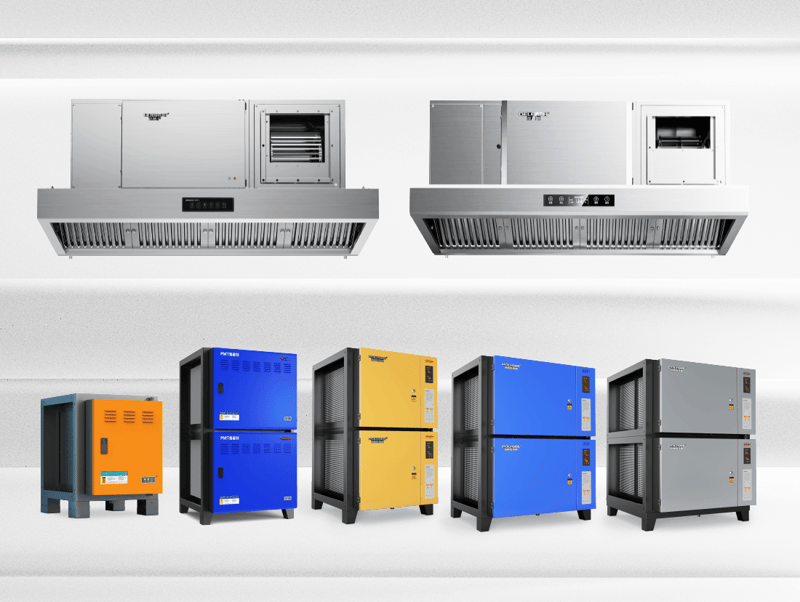
The same arithmetic tells you when the hood-integrated route is realistic. Polygee’s HME line, a commercial kitchen hood system with ESP cells built into the canopy, covers 3,000–4,800 m³/h across 12 models. Note the unit: that is m³/h, not the 4,800 CFM in the example above, and 4,800 m³/h ÷ 1.7 is about 2,800 CFM. That is the ESP airflow rating; the hood’s code exhaust rate is still set by Step 1. At the wall-canopy rates, 2,800 CFM covers roughly a 14-foot light-duty, 9-foot medium-duty or 7-foot heavy-duty hood; a heavy-duty 12-foot line is in-duct territory.
Two cautions on Step 3. The band check is a screening step, not a selection: the final model follows the design airflow the engineer commits to, which may be above the code minimum. And the check says nothing about odor. If the discharge has neighbors, UV and carbon stages are sized against the same airflow and added behind the ESP.
Why the CFM number matters behind the hood
Every piece of equipment downstream is rated at a specific airflow, and its rated performance holds only at that airflow. The commercial kitchen exhaust CFM set at the hood is where that chain starts.
- Grease removal efficiency is measured at rated airflow. An electrostatic precipitator that reached its tested efficiency at its rated, evenly distributed airflow gives part of that efficiency away when the fan pushes more air through it than it was sized for. Undersizing the filter to save on the quote is paid for in a dirtier duct.
- The fan sees the filter. A complete Polygee in-duct unit, airflow-distribution plate included, is rated at ≤150 Pa; ask for the figure at your design airflow. That resistance belongs in the fan static-pressure calculation next to the duct run and the hood filters, and a fan selected for the hood alone can fall short of the CFM the hood needs once the filter is in the line. The fan’s own code requirements, from its listing to the interlock, are in commercial kitchen exhaust fan requirements.
- Airflow is the first line on the quote. Suppliers ask for the CFM or m³/h before anything else because capacity is the largest of the factors behind an in-duct filter’s price, laid out in electrostatic precipitator price.
- Make-up air closes the loop. Whatever leaves through the hood has to come back in. A kitchen starved of make-up air runs negative, the hood loses capture even at the right CFM, and doors start fighting the staff. It is a separate design item, but it is sized from the same number. What the code actually asks of it, the four routes replacement air can arrive by and why a compensating hood can supply only a tenth of it are in commercial kitchen makeup air requirements.
The restaurant kitchen exhaust filtration solution page shows where the fan, ESP and odor stages sit relative to the hood on a typical cookline.
Where this guide stops
Six boundaries, so the table above is used for what it is:
- Not an engineering design. The rates here are the code floor for unlisted hoods; the rest of what plan review checks around the hood is in commercial kitchen hood code requirements. Duct velocity, static pressure, fan selection and make-up air are the mechanical engineer’s work, and the AHJ signs off on the result. The airflow settled here is also the number that caps the duct section, which is where commercial kitchen exhaust duct size picks up.
- Edition and amendments. Jurisdictions adopt different IMC editions and amend them; some states layer energy-code requirements such as demand-controlled ventilation on top. Confirm which edition governs your site before quoting a number.
- Residential range hoods. Household range hoods fall under a different code and a different conversation. Nothing here applies to them.
- Hood styles not in the table. Double-island, backshelf and eyebrow hoods have their own rates in the code table. We showed the two most common styles; read the others from the adopted edition rather than from a summary.
- Outside IMC jurisdictions. The table is U.S. code. Elsewhere, the local mechanical code or the hood listing sets the exhaust rate; Steps 2 and 3 still apply once you have that number.
- Not the NFPA 96 tiers. These IMC duty tiers are not the NFPA 96 inspection tiers, which sort kitchens by cooking volume for cleaning schedules — see commercial kitchen exhaust cleaning requirements.
Frequently Asked Questions
- How many CFM for a commercial hood?
- Under the International Mechanical Code, a wall-mounted canopy hood needs at least 200 CFM per linear foot of hood over light-duty appliances, 300 over medium-duty, 400 over heavy-duty and 550 over extra-heavy-duty (solid-fuel) cooking. Single-island canopies run higher, from 400 to 700 CFM per foot across the same four tiers. A hood listed to UL 710 may instead run at the rate on its listing, which is often lower, and your local authority decides which edition applies.
- How do I calculate the CFM needed for my kitchen hood?
- For an unlisted hood the code method is hood length in feet multiplied by the rate for the heaviest-duty appliance underneath it. A 12-foot wall canopy over a charbroiler line is heavy-duty, so 12 × 400 = 4,800 CFM. For a listed hood, use the capacity on its UL 710 listing instead. Either way, confirm the final figure with the mechanical engineer who sizes the fan, because duct losses and any in-duct filtration change what the fan must actually deliver.
- Can CFM be too high or too low?
- Yes, in both directions. Too little exhaust lets grease-laden vapor escape the hood, which can fail inspection and loads the kitchen with smoke. Too much pulls conditioned air out of the building, drives up energy and make-up air costs, and can pull an in-duct filtration unit above its rated airflow, where its grease removal efficiency falls. The target is the code minimum for the duty, delivered evenly across the hood, with the downstream equipment sized to the same number.
- What are the code requirements for commercial kitchen exhaust hoods?
- In the U.S. the baseline is the International Mechanical Code, Chapter 5: a Type 1 hood over grease-producing appliances, a minimum exhaust rate set by hood style and cooking duty, grease filters, a grease duct built to the code, and make-up air to replace what the hood removes. NFPA 96 adds the fire-protection and cleaning requirements. Listed hoods follow their UL 710 listing for capacity. Your local authority having jurisdiction adopts a specific edition and may amend it.
Have a hood CFM and need the filtration behind it?
Send us the hood length and cooking duty (or the listed exhaust rate), or the design exhaust airflow from the mechanical schedule if your engineer has already fixed it, plus where the discharge goes. Our project team will come back with the in-duct or hood-integrated option that matches the airflow, the resistance figure for the fan calculation at that airflow, and the third-party test reports for the model we propose.
Talk to our project team →Reviewed by Law, Project Manager, 9 October 2026
Written by Law · Project Manager, PolygeeLaw manages kitchen exhaust filtration projects at Polygee, from spec review through duct-side ESP sizing and installation support. Polygee, founded in 2004, builds commercial kitchen exhaust filtration equipment. This article summarizes published code rates for planning purposes only — it is not a mechanical design or a compliance determination, so confirm the rates for any specific installation with your engineer, your local AHJ and the adopted edition of the code.
References & further reading
- International Mechanical Code (IMC), Chapter 2: Definitions, Section 202 General Definitions (light-, medium-, heavy- and extra-heavy-duty cooking appliances); Chapter 5: Exhaust Systems, Section 507 Commercial Kitchen Hoods — Capacity of Hoods. codes.iccsafe.org
- UL 710, Standard for Exhaust Hoods for Commercial Cooking Equipment. ul.com
- NFPA 96, Standard for Ventilation Control and Fire Protection of Commercial Cooking Operations. nfpa.org
- Polygee — kitchen exhaust filtration product range and third-party test reports. polygeeesp.com