

Commercial kitchen exhaust cleaning requirements start from one question: what does the kitchen cook? NFPA 96 — the U.S. baseline, referenced well beyond it — sorts cooking operations into four tiers: solid fuel is inspected monthly, high-volume quarterly, moderate-volume semiannually, and low-volume or seasonal annually.
But the detail that matters most is the one most owners misread. Those four intervals are inspection intervals, not a cleaning calendar. The standard separates the two on purpose: someone qualified looks at the system on schedule, and cleaning happens whenever that look finds grease past the allowed limit — which on a busy cookline can arrive well before the next date on the contract.
This guide breaks down the four tiers, what each part of the exhaust path actually needs, who is allowed to do the work, and how the filtration equipment you choose changes the size of the recurring bill.
One disclosure up front: Polygee builds duct-side filtration equipment, not cleaning services. We do not sell hood cleaning, which is why the contractor guidance below is written without a stake in that decision.
The four tiers behind commercial kitchen exhaust cleaning requirements
The cooking process sets the interval, and solid fuel sits in a category of its own. NFPA 96 groups commercial cooking operations by how fast they load the system with grease:
| Inspection interval | Cooking operation | Why it sits here |
|---|---|---|
| Monthly | Solid-fuel cooking — wood, charcoal, mesquite (its exhaust rules are in solid fuel cooking exhaust requirements) | Solid fuel adds creosote and ash on top of grease, and burns hotter inside the system |
| Quarterly | High-volume operations — 24-hour kitchens, charbroiling, wok cooking | Near-continuous heavy-grease duty with few idle periods |
| Semiannually | Moderate-volume operations | Standard restaurant service loads the duct at a predictable rate |
| Annually | Low-volume and seasonal operations — churches, day camps, senior centers | Intermittent, light-duty cooking |
Two practical notes before you write one of these into a service contract.
First, the tier follows the menu, not the venue type. A hotel with a banquet kitchen that fires charbroilers nightly is a high-volume operation whatever the sign outside says. When the concept changes, the tier can change with it — the same trap that catches hood classification, which we covered in type 1 hood vs type 2. For a multi-site group this also cuts against the instinct to buy one interval across the estate: a 24-hour outlet and a seasonal banquet kitchen sit in different tiers, and a single group-wide schedule will over-serve one and under-serve the other.
Second, your local authority having jurisdiction (AHJ) decides which edition of the standard applies and can require more. Insurers frequently add their own conditions. Treat the four tiers as the floor, then check what your jurisdiction and your policy have layered on top. In the UK the equivalent floor is TR19 Grease, whose intervals, 200 micron deposit limit and certificate contents are in the TR19 Grease cleaning standard, with the wider UK map in commercial kitchen extraction regulations in the UK.
Why NFPA 96 inspection frequency is not cleaning frequency
This is the misreading we run into most often, and it costs money in both directions.
The standard asks a qualified person to inspect the system on the tier schedule and measure how much grease has accumulated. If the buildup has passed the limit the standard allows, the system gets cleaned — whether or not the annual service date has arrived. If a kitchen changed its menu, extended its hours, or simply had a busier quarter than expected, the inspection catches it.
Read the other way, a quarterly inspection is not a promise of quarterly cleaning. The clean happens when the grease says so.
What actually gets cleaned — and what gets replaced
The grease path is the whole job, not just the shiny parts a diner can see. In practice a full service reaches the hood plenum, the filters, the entire duct run and the exhaust fan — though the exact scope required is set by the edition your AHJ has adopted. The full list of what a reviewer checks on the exhaust system is in commercial kitchen hood code requirements.
- Hood and plenum. The capture surfaces and the grease trough. Visible, and usually the part that gets attention first.
- Grease filters. Baffle filters come out and get washed — the routine task the kitchen team usually owns. Mesh filters clog faster and load the fan, and whether a bare mesh panel is an acceptable grease filter at all is a listing question, covered in commercial kitchen grease filter requirements.
- Ductwork. The part that decides whether a duct fire has fuel. It is also the hardest to reach, which is why access panels matter at design time — the IMC and NFPA 96 govern how the duct and its access openings are built, set out in grease duct requirements, while NFPA 96 governs the cleaning of what collects inside them.
- Exhaust fan. Grease on the wheel throws the fan out of balance and drags airflow down across the whole system.
- Filtration equipment in the duct. Whatever sits downstream has its own service routine — and this is where the two designs diverge sharply.
Baffles are the stage a kitchen team routinely services itself; what rides past them is what makes the duct run the costly part of every contractor visit. Why baffles stop where they do, and what catches the rest, is the subject of our comparison, electrostatic precipitator vs baffle filter.
Is kitchen exhaust cleaning the same as hood cleaning?
Not quite, and the gap between the two terms is where quotes get misread. In everyday use “hood cleaning” often means the canopy and its filters — the part anyone can see. Kitchen exhaust cleaning covers the whole grease path behind it: plenum, duct run and fan.
When you compare contractor quotes, that distinction is usually what explains a price gap. Ask which sections of the duct run are included, and what the contractor does where access panels are missing or the run is concealed.
What are the commercial kitchen hood cleaning code requirements?
The code asks for four things, and only one of them is a date. The hood, the filters, the plenum, the duct and the fan are inspected at an interval set by the cooking type. Wherever grease has accumulated, the contaminated parts are cleaned to bare metal rather than wiped. The work is done by properly trained, qualified and certified personnel acceptable to the AHJ. And each visit leaves a written record. NFPA 96 supplies that wording, and it reaches a kitchen through whatever code the local authority has adopted, which is why the answer to what the commercial kitchen hood cleaning code requirements are looks the same across jurisdictions while the interval does not.
Equipment installed in the duct keeps its own schedule alongside that regime, on the manufacturer’s terms rather than the code’s; for an in-duct air cleaner that is set out in electrostatic precipitator cleaning.
Who is allowed to do the work
NFPA 96 asks for grease-contaminated parts of the system to be cleaned by properly trained, qualified and certified persons acceptable to the AHJ. It also asks for a written record of each visit — confirm the wording in the edition your AHJ has adopted. Which certification counts, and who issues it, is for the AHJ to decide. Some U.S. jurisdictions license hood-cleaning contractors directly, others lean on industry certification programs, and insurers frequently set a bar of their own.
Three questions worth asking any prospective contractor: which credential do you hold, which jurisdiction or insurer recognizes it, and what documentation do I receive after each visit? The last one matters more than it sounds — the record is what a fire marshal can actually look at, and what makes a completed job auditable later.
Filter washing is the routine exception. Pulling baffle filters and running them through the warewasher is normal in-house work between contractor visits, and it is also the task most likely to be skipped when a kitchen is short-staffed.
Washable cells vs replaceable media: the recurring bill
Compliance sets the schedule; the equipment sets what each service visit costs. Downstream of the hood, two designs create very different maintenance economics.
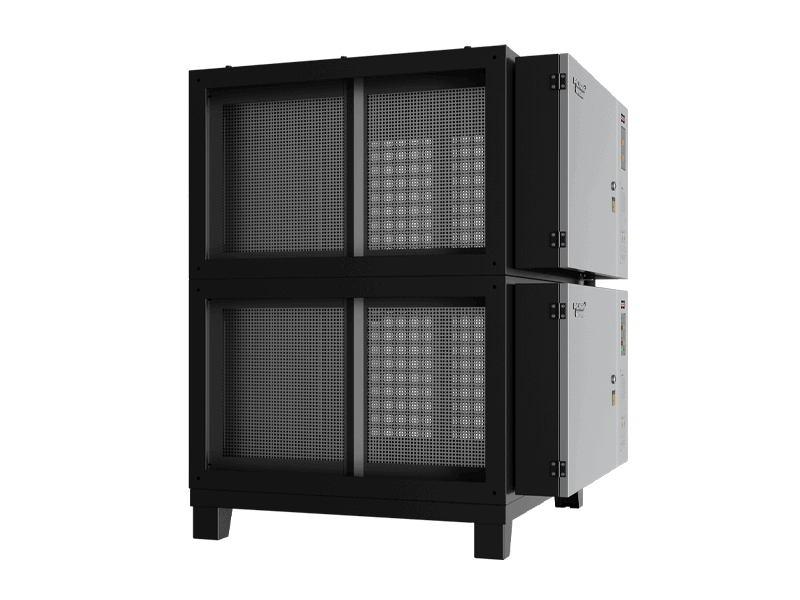
A kitchen electrostatic precipitator collects fine grease on stainless steel plates. Servicing it means sliding the cells out, washing them, and putting the same cells back — the ESP stage itself consumes no filter media, which is why its maintenance line stays labor rather than a standing purchase order. The purchase side of the same decision is broken down in electrostatic precipitator price. Polygee builds its collector cells in stainless steel for exactly this reason, and warrants the unit itself for 1 year, with consumables and service labor excluded. Common spare parts are stocked, and when a model is discontinued its parts remain available for another year.
Odor-control stages work the other way, and it is worth being blunt about it. The carbon inside an activated carbon filter kitchen exhaust module adsorbs odor compounds until it saturates; washing does not regenerate it, so carbon is replaced on a schedule. UV lamps are consumables too. Polygee treats both as consumables outside the whole-unit warranty — not a loophole, just what those materials are.
So the honest comparison is not “washable good, replaceable bad.” It is that particle capture can be washable, while odor control is inherently consumable. A system specified for both should budget for both from day one.
One design decision does more for the recurring bill than most people expect: leave service access at the filtration equipment. Cells that are awkward to reach get washed late, and a collector running dirty gives away part of the efficiency it was specified for. On new builds, a commercial kitchen hood system with cells built into the canopy puts that access at the cookline where staff already work.
What this guide does not cover
Four boundaries on these commercial kitchen exhaust cleaning requirements, so nobody plans against the wrong document:
- Grease depth limits and measurement. The thresholds that trigger a clean, and how they are measured, belong in the adopted edition of the standard. Read them there rather than from a summary — ours included.
- Local rules beyond the standard. Adopted editions, permits and contractor licensing vary widely between jurisdictions, and this guide is written for planning, not as a compliance determination. Outside the jurisdictions that adopt NFPA 96, the governing document may be a different standard entirely — confirm which one applies to your site before using these tiers.
- Residential range hoods. Everything here concerns commercial cooking operations. Home kitchens are a different regime and a different maintenance routine.
- Fire suppression service. The suppression system over a grease cookline carries its own inspection and service requirements, handled by a different contractor from the one who cleans the ducts.
Frequently Asked Questions
- How often should commercial kitchen exhaust hoods be cleaned?
- NFPA 96 sets the interval by what the kitchen cooks, not by the calendar alone. Systems serving solid-fuel cooking are inspected monthly; high-volume operations such as 24-hour kitchens, charbroiling and wok cooking are inspected quarterly; moderate-volume operations semiannually; and low-volume or seasonal operations annually. Those are inspection intervals — cleaning follows whenever an inspection finds grease built up beyond the limits the standard allows. Check the edition your jurisdiction has adopted, since local rules and insurers can be stricter.
- Is it mandatory for a restaurant kitchen exhaust system to be cleaned?
- In practice, yes. Commercial cooking exhaust falls under fire codes based on NFPA 96, which requires scheduled inspection of the system for grease buildup and cleaning once that buildup passes the allowed limit. Fire marshals check the records, and insurance policies commonly require documented service by a qualified contractor — in practice a gap in that paperwork tends to surface at claim time rather than at inspection time. The exact adopted edition and enforcement belong to your local authority having jurisdiction (AHJ).
- Do you need a certification to clean commercial hoods?
- Under NFPA 96, yes. The standard asks for grease-contaminated parts of the exhaust system to be cleaned by properly trained, qualified and certified persons acceptable to the authority having jurisdiction (AHJ). It also asks for a written record of each service. Which certification counts is up to the AHJ: some U.S. jurisdictions license hood-cleaning contractors directly and others rely on industry credentials. Insurers often set their own bar as well. Ask a prospective contractor which credential they hold, which jurisdiction recognizes it, and what documentation you receive after each visit.
- Can charcoal range hood filters be washed and reused?
- No. Activated carbon works by adsorbing odor compounds until its pores are saturated, and washing does not restore that capacity — carbon is a consumable that gets replaced on a schedule, which is why Polygee treats it as outside the whole-unit warranty. This is the opposite of an electrostatic precipitator’s collector cells: those are stainless steel, and washing them is exactly how they are maintained.
Specifying filtration that a kitchen team can actually maintain?
Send us your cooking type, your duct layout and the service access you have to work with, and our project team will come back with a sized proposal, a recommended washing routine for that duty, and the third-party test reports for the model we propose.
Talk to our project team →Reviewed by Law, Project Manager, 9 October 2026
Written by Law · Project Manager, PolygeeLaw manages kitchen exhaust filtration projects at Polygee, from spec review through duct-side sizing, installation support and maintenance planning. Polygee, founded in 2004, builds commercial kitchen exhaust filtration equipment. This article summarizes published standards for planning purposes only — it is not a compliance determination, so confirm the requirements for any specific installation with your local AHJ and the adopted edition of the standard.
References & further reading
- NFPA 96, Standard for Ventilation Control and Fire Protection of Commercial Cooking Operations — inspection schedules and cleaning provisions. nfpa.org
- International Mechanical Code (IMC), Chapter 5: Exhaust Systems. codes.iccsafe.org
- Polygee — kitchen exhaust filtration product range and third-party test reports. polygeeesp.com