

Electrostatic precipitator price is a quote, not a list number. A commercial kitchen ESP is built to an exhaust airflow, so suppliers price each order against six factors: airflow capacity, efficiency tier, configuration, build and materials, certification scope, and the commercial terms behind the deal.
This guide walks through those six factors in the order a purchasing team meets them, shows how each one moves a quote up or down, and ends with the short checklist that gets a firm number out of a supplier in one email instead of four.
The scope here is kitchen exhaust: the precipitators that remove grease mist and smoke from restaurant, hotel and food-court cooklines. If the technology itself is new to you, start with what is an electrostatic precipitator and come back for the numbers. Power-plant and industrial process precipitators are a different class of precipitator priced by different rules — more on that boundary below.
Why there is no list price on a commercial ESP
Search for electrostatic precipitator price and the results with visible numbers are mostly household electronic air cleaners and marketplace listings — plug-in appliances sold by the box. A commercial kitchen ESP sits on the other side of the meter: it lives exhaust-side, selected against a duct airflow and an emission target, often as one stage in a longer filtration train.
The same cabinet footprint can also hide very different precipitators. Field count, collecting area, power supply grade and certification scope all change what is inside the box without changing how it looks in a brochure photo.
So manufacturers quote per project rather than publish a price list. That is not evasive; it is how an ESP priced by airflow is sold. The useful skill for a buyer is knowing which variables move the number — because those are the variables a good request for quotation pins down in advance.
The six factors that set an electrostatic precipitator quote
1. Airflow capacity — the biggest single driver
ESP sizing starts from the exhaust airflow in m³/h. More air means a larger cabinet, more collector cells and a bigger high-voltage power supply, and the quote scales with all three.
For reference, Polygee’s in-duct kitchen electrostatic precipitator range runs to 41 standard models from 2,000 m³/h, with a standard lineup spanning 4,000–60,000 m³/h and larger duties configured to order. The distance between the smallest and largest of those models is the distance between a cafe cookline and a mall food court — and their quotes are just as far apart.
Two sizing mistakes cost money in opposite directions. Oversizing buys capacity the kitchen never uses; undersizing runs the ESP above its rated airflow and gives part of the efficiency away. Quote against the measured or design airflow, not a guess.
2. Efficiency tier and field count
Grease removal efficiency is bought with collecting area: more field sections, or a higher-grade field, cost more and remove more. Many suppliers therefore sell the same duct position at more than one price point.
Polygee’s LK-E series, a modular kitchen ESP line, is the clearest example: 33 models across three tiers, with design efficiency of 90%, 95% and ≥98% — three answers to the same duct, at three prices. On the measured side, LK in-duct units reached up to 97.6% grease removal in CMA-accredited third-party tests.
The buying rule: match the tier to the emission target and the neighborhood, not to the biggest number on the page. A ground-floor ESP venting over a walkway needs a different tier than a rooftop discharge with no neighbors.
3. Configuration — how many stages, and where they sit
An ESP removes particles: grease mist and smoke. Cooking smell is gas-phase and rides through an ESP field, so odor control adds its own modules — UV, activated carbon, or both — each with its own cabinet section and its own line on the quote. Polygee builds 8 UV models and 8 carbon modules, each covering 3,000–15,000 m³/h.
Combined cabinets that carry ESP, UV and carbon in one housing sit at the top of the configuration range — in Middle East and Southeast Asian tenders they are often specified as kitchen ecology units — and they are priced as the three-stage machines they are.
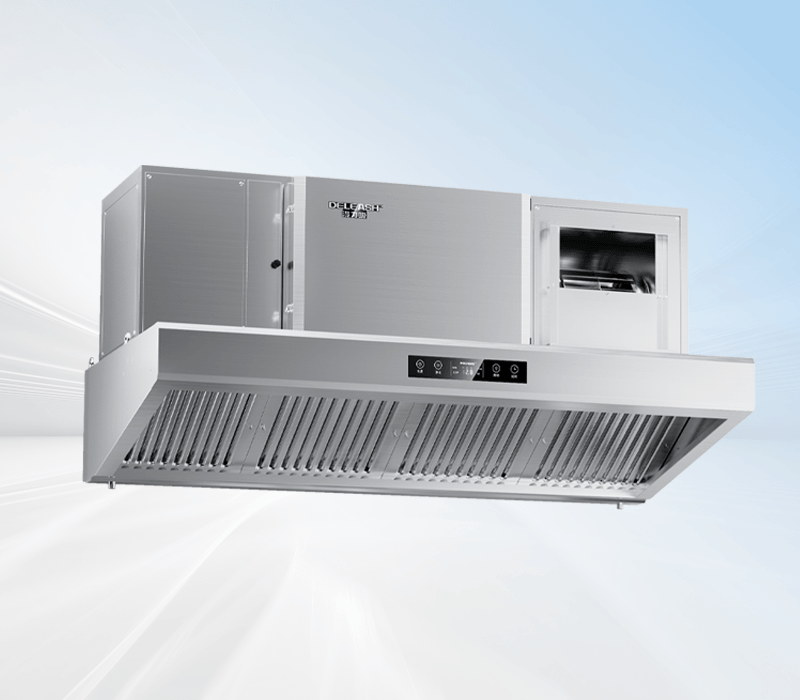
Placement is a configuration choice too. The default is an in-duct ESP behind the existing hood. In new builds and full renovations, a commercial kitchen hood system with ESP cells built into the canopy — Polygee’s HME line, 12 models covering 3,000–4,800 m³/h — folds capture and fine filtration into one purchase instead of two.
4. Build and materials
Two builds with the same airflow rating can sit at different prices for reasons that only show up years later. The collector cells are the place to look first: Polygee’s are stainless steel and washable, which is what keeps the maintenance line on the budget at cleaning labor instead of a recurring media purchase.
The high-voltage power supply is the working heart of the unit and the component where build quality earns its price difference. The practical check: ask whether the power supply sits inside the whole-unit warranty and whether its spares are stocked — at Polygee it is covered by the 1-year whole-unit warranty, with common spares held in stock. Supply voltage itself is a configuration item rather than a cost trap — Polygee units are configured to order for 220V/380V and 50/60Hz grids.
One build number worth asking every supplier for: pressure drop. A complete Polygee in-duct ESP, airflow-distribution plate included, is rated at ≤150 Pa — a figure the mechanical engineer needs for fan selection, and part of the operating-cost picture below. If you are holding quotations headed ESP, ecology unit and PCU for the same duct, the five lines that make them comparable are in pollution control unit cost.
5. Certification scope for your market
Certification is not a logo row; it is a per-model scope that narrows which models you can specify and carries real testing cost. Polygee’s UL 867 listing (File E522667) covers the LK/SE 6K, 12K and 18K models — the shortlist for a U.S. project written around a UL requirement. CE certification (certificate FQC2602501) covers the LK30–480 in-duct units, the LK-E series and the UV modules for European work.
The buyer’s move is simple: name the target market in the RFQ, then ask for certificate numbers and the covered model list rather than a general assurance. If the certification your spec calls for does not cover the model being quoted, better to learn that at quotation than at customs.
6. Commercial terms behind the unit price
The last factor is not in the machine at all. Polygee’s standing terms, as a reference for what to ask any supplier:
- MOQ 1 unit — a single-unit trial order gets a direct quote; no volume threshold to clear.
- Lead time 7–15 days for standard models.
- Incoterms arranged to suit the buyer — EXW, FOB or CIF. The same ESP lands at a different total depending on who carries the freight.
- Payment: a 30% deposit (50% on some orders) with the balance settled before shipment; T/T and L/C are both accepted.
- OEM: customer logo and cabinet color are available, with quantities and lead times agreed case by case.
- Warranty: 1 year on the complete unit. UV lamps and activated carbon are consumables outside warranty. Common spare parts are stocked, and parts for a discontinued model remain available for another year.
| Factor | What to tell the supplier | How it moves the quote |
|---|---|---|
| Airflow capacity | Measured or design exhaust airflow in m³/h | The main driver — cabinet, cells and power supply all scale with it |
| Efficiency tier | Emission target and discharge location | Higher tier or more fields, higher price |
| Configuration | Smoke only, or smoke plus odor; in-duct or hood-integrated | Every extra module adds a cabinet section and a cost line |
| Build and materials | Ask: cell material, washable or disposable, pressure drop | Washable stainless cells cost more up front, less over the years |
| Certifications | Target market and the standard your spec names | Narrows the model list; certified scope carries testing cost |
| Commercial terms | Quantity, Incoterm, destination, delivery date | Freight, payment terms and OEM work all land on the final number |
Electrostatic precipitator cost: quote price vs lifetime cost
Two quotes that match on the day of the order can drift apart every month after commissioning. Three lines decide the long-run number:
- Media. Washable stainless steel collector cells turn maintenance into cleaning labor. Disposable-media designs turn it into a standing purchase order. Over a multi-year horizon this is usually the largest gap between two otherwise similar offers — so before you compare two quotes, ask each supplier what their design consumes in a year and price that alongside the unit. The cleaning side of that comparison, including what a compliant service covers, is in commercial kitchen exhaust cleaning requirements.
- Fan energy. Every pascal of pressure drop is paid for in fan power for as long as the kitchen runs. That is why the ≤150 Pa complete-unit figure belongs in the comparison, not just in the mechanical drawings — and while you are asking, request the ESP’s own rated power consumption for the operating-cost sheet.
- Consumables you did choose. Odor modules earn their keep, but UV lamps and activated carbon are genuine consumables. If the configuration includes them, budget their replacement from day one rather than discovering the line item at the first service visit.
A supplier who will talk about all three lines is quoting you a system; one who will only talk about the sticker is quoting you a box.
Where this pricing model stops
Honest boundaries save purchasing teams the most time, so here are the cases this guide does not price:
- Utility and industrial process ESPs. Precipitators for power stations and process gas are engineered projects, costed through methods like the EPA’s control cost manual — a different world from catalog-model kitchen ESPs, even though the physics matches.
- Odor-only problems. If the complaint is smell without visible smoke, the money belongs in UV and carbon units, not in a larger ESP. Pricing an ESP against an odor problem buys the wrong machine.
- The hood’s own filters. An ESP works downstream of the hood’s grease filters and does not replace them — the split of roles is covered in our comparison of the electrostatic precipitator vs baffle filter. Budget the hood side separately.
- Installed cost. A factory quote covers the precipitator itself. An in-duct ESP is a filter, not a fan — the exhaust fan that moves the air is a separate line in the mechanical package — hood-integrated HME units, which carry their own fans, are the exception. Ductwork modifications, rigging, electrical connection and commissioning are likewise site-side costs that vary with the building, and no factory can price them sight unseen.
How to get a firm quote fast
Everything above collapses into one email. Send a supplier these eight items and the reply can be a number instead of a questionnaire: Once two or three replies are in, the sixteen lines for reading them on one basis are on our electrostatic precipitator quotation comparison page.
- Exhaust airflow in m³/h — or, failing that, hood dimensions and the cooking type under it (how the code derives the figure is in commercial kitchen hood CFM requirements);
- What the cookline produces: smoke only, or smoke plus a smell problem;
- Discharge situation — rooftop, facade, distance to neighbors;
- Placement: in-duct retrofit, or hood-integrated for a new build — and where an existing unit is being taken out, the interface measurements that govern the quote are listed in commercial kitchen ESP replacement;
- Supply voltage and frequency at site;
- Target market and any certification named in the spec;
- Destination and preferred Incoterm;
- Quantity for this order — a single trial unit or a multi-site rollout — and the date it needs to arrive.
With an MOQ of 1 unit and 7–15 day standard lead times, the lowest-risk way to settle a shortlist is often a single trial unit on the busiest duct — priced, shipped and measured before the fleet order.
Frequently Asked Questions
- What is the cost of an electrostatic precipitator?
- There is no single figure. A commercial kitchen ESP is quoted against six variables: airflow capacity, efficiency tier, how many stages the configuration carries, build and materials, the certifications your market calls for, and the commercial terms behind the order. Two units that look alike from the outside can carry very different quotes once airflow and certification scope are pinned down, which is why suppliers ask questions before they name a number.
- Are electrostatic filters worth it?
- For a commercial kitchen that cooks daily, the arithmetic usually favors them, and it is about operating cost rather than the sticker. An ESP’s collector cells are washable stainless steel, so routine upkeep is cleaning rather than a stream of replacement media. Weigh the quote against what disposable-media alternatives consume over the same period, and against the duct buildup and neighbor complaints the unit is there to reduce.
- How long does an electrostatic filter last?
- The collector cells in a commercial kitchen ESP are stainless steel and made to be washed and reused, so there is no fixed replacement interval the way there is with disposable media. Polygee covers the complete unit with a 1-year warranty; UV lamps and activated carbon count as consumables outside it. Common spare parts are stocked, and when a model is discontinued its parts remain available for another year.
- What are the downsides of using electrostatic filters?
- Three honest ones. Performance depends on cleaning: collector cells that never get washed drift below their rated efficiency. An ESP removes particles, not odor gases, so smell control needs UV or activated carbon stages behind it. And it works downstream of the hood’s grease filters rather than replacing them — the hood still does the capture. Together they set what a realistic specification looks like.
Pricing an ESP for a live project?
Send us the eight RFQ items above — airflow, duty, discharge, placement, voltage, market, Incoterm and quantity — and our team will come back with a sized proposal, the covered certifications, and the third-party test data behind the efficiency figures.
Request a commercial kitchen ESP quote →Scarlett leads commercial work at Polygee, from first RFQ through Incoterms, certification scope and delivery for engineering firms, consultants and dealers in 50 countries. Polygee has built commercial kitchen ESP systems since 2004. This article explains pricing factors for planning purposes; the figure for any specific project comes from a written quotation.
References & further reading
- U.S. EPA — Air Pollution Control Cost Manual, Section 6: Particulate Matter Controls (Electrostatic Precipitators). epa.gov
- Polygee — kitchen exhaust filtration product range and third-party test reports. polygeeesp.com