

A kitchen ecology unit is a packaged treatment section inside a commercial kitchen exhaust duct, downstream of the hood, usually built as three stages in series rather than one machine: electrostatic precipitation, then UV-C photolysis, then activated carbon adsorption. The term describes an arrangement, not a component, so two quotations both headed “ecology unit” can contain different stages. This page says which stage does which job, which sizes exist, what to record for cleaning, and which number no supplier can give before seeing the kitchen.
This guide helps you decide what equipment the term refers to and which stages your project actually requires. It does not select a model, size your duct, or price a project, and it is not a compliance determination for any jurisdiction. For configuration and quotation, see the kitchen ecology unit page.
| What it is | Where it fits | Typical use | Not the same as |
|---|---|---|---|
| A packaged multi-stage air treatment section for kitchen extract, usually electrostatic precipitation plus UV-C plus activated carbon | In the duct, downstream of the hood and its grease filters, upstream of the fan and the discharge | Kitchens discharging where smoke or smell reaches people: malls, hotels, mixed-use buildings, shared risers | A hood; a grease filter; a fan; a fire-protection device; a single-stage precipitator on its own |
- What an ecology unit is, and why the name changes by market
- What is inside one: the stages and what each controls
- What ESP means inside an ecology unit
- The carbon stage, and the number nobody can give you
- What an ecology unit is not
- What it asks of the building
- Sizes and airflow: the eight standard units
- Cleaning and maintenance: what to record
- Scope and limits
- Buyer record
- Frequently asked questions
What an ecology unit is, and why the name changes by market
An ecology unit treats the air a commercial kitchen has already captured. The hood collects the plume, the grease filters in the hood take the coarse droplets and act as the first barrier, and what leaves the hood is a mixture of fine grease aerosol, smoke particles and gas-phase compounds. The ecology unit is the section of duct where that mixture is worked on before it reaches the fan and the discharge point.
The confusion around the term is a naming problem rather than a technical one. The same equipment is sold under different names depending on where the specification was written, and a buyer comparing offers across markets will see all of them.
| Term you will see | Where it is common | What it usually means | What to check before comparing |
|---|---|---|---|
| Ecology unit, or ECU | The Gulf, South Asia, parts of Southeast Asia | A multi-stage kitchen exhaust treatment section, often three stages | How many stages are actually included |
| Pollution control unit, or PCU | North America | The same role in the duct; the emphasis is on the discharge requirement | Whether it is a packaged unit or a single stage |
| Kitchen exhaust air cleaner | General technical writing | Any in-duct treatment, from one stage upward | Almost always needs the stage list spelled out |
| Electrostatic precipitator, or ESP | Everywhere | One specific stage, not the whole train | Whether the offer is a single stage or a train that includes one |
| Odor control unit | Mixed | Emphasis on the gas-phase stages | Whether particle treatment is included at all |
This table answers what the names mean. It does not tell you which arrangement your project needs; that follows from the cooking process and the discharge situation, and it is covered further down.
What is an ecology unit in HVAC?
In an HVAC drawing it is a duct-mounted plant item, scheduled like any other piece of in-line equipment: it has an airflow, a resistance, a weight, an electrical supply and a service access requirement. That is the practical answer to why the term appears on mechanical schedules rather than kitchen equipment schedules. It belongs to the extract system, it is selected against the extract airflow, and its resistance has to be inside the fan’s pressure budget. Whoever owns the extract system owns this item, which in most projects means the mechanical contractor rather than the kitchen supplier, even though the reason it exists is the cooking.
What is inside one: the stages and what each controls
The thing that makes this equipment hard to compare is that each stage answers a different physical problem, and the problems are not interchangeable. Grease and smoke are particles carried in the airstream. Smell is mostly gas-phase molecules dissolved in that same airstream. A device that is excellent at the first does nothing about the second.
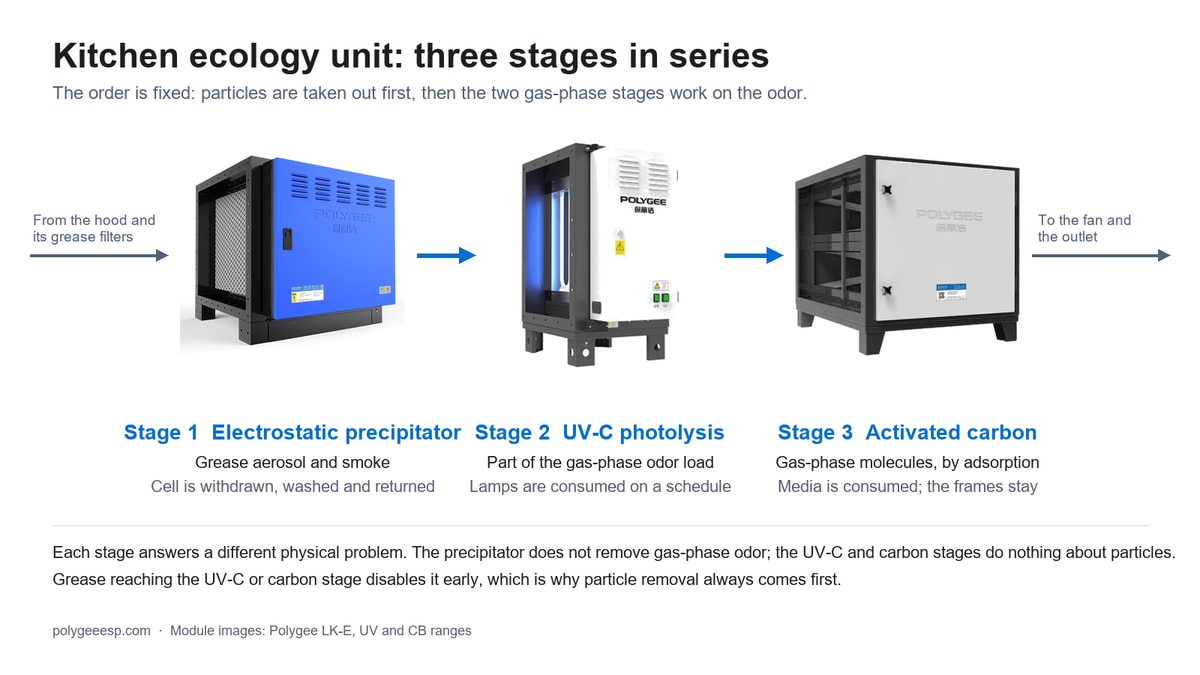
| System stage | Controls | Does not control | Critical interface | What it means for the build |
|---|---|---|---|---|
| Grease filters in the hood | Coarse grease droplets; the first fire barrier at the hood | Fine aerosol, smoke, any smell | Filter bank condition decides what the next stage receives | Neglect here shortens the service life of everything downstream |
| Electrostatic precipitation (ESP) | Particle-phase grease aerosol and smoke | Gas-phase molecules; it is not an odor device | Airflow and cell condition; cells must be withdrawable for washing | This is the stage that does the visible work; size the access space for it |
| UV-C photolysis | Part of the gas-phase load, by photolysis of odor molecules | Particles; it is not a disinfection claim and not a substitute for carbon | Installed downstream of particle removal, never upstream | Lamps are consumables; the rack needs clear access to be re-lamped |
| Activated carbon adsorption | Gas-phase molecules, by physical adsorption onto the media | Particles; and it stops working once the media is saturated | Media condition; panels must be withdrawable for exchange | This stage has a running cost, not just a capital cost |
Decision rule. IF the complaint is visible smoke or grease at the discharge, THEN the stage that matters is the precipitator, BECAUSE the problem is particle-phase. IF the complaint is smell with little visible plume, THEN the particle stage alone will not close it, BECAUSE the molecules causing the smell are not captured by charging and collecting particles. Most real projects have some of both, which is why the three-stage arrangement exists at all.
What ESP means inside an ecology unit
ESP stands for electrostatic precipitator, and inside an ecology unit it is normally the second stage and the one carrying most of the load. It works in two steps in the same housing. Incoming particles pass through an ionizing section where a high-voltage field gives them an electrical charge. They then pass between closely spaced collector plates held at an opposite potential, and the charged particles migrate to the plates and stay there. Clean air continues down the duct; the grease stays on the plates until the cell is washed.
Two consequences of that mechanism matter to a buyer, and neither is obvious from a brochure.
First, the collection performance is a property of the whole arrangement rather than of the cell alone. It depends on the airflow through the cell, the condition of the plates, whether air is leaking past the cell instead of through it, and what the hood filters let through. This is why a percentage quoted without a test condition is not a specification. Our own figure for the LK series is up to 97.6 percent from third-party tests carried out by CMA-accredited laboratories, and we hand over the report numbers with the test conditions attached rather than the percentage on its own.
Second, the cell is washable rather than consumable. Ours are built in stainless steel and are designed to be taken out, washed and returned to service, which is why the running cost of this stage is a cleaning routine rather than a stream of replacement media. It is also why service access, not just duct space, has to be planned for. What a service visit covers is set out in our cleaning and maintenance guide, and how a precipitator compares with the filter bank in the hood is in electrostatic precipitator against baffle filter.
On resistance, the figures we publish are the complete-module ones rather than the cell alone: the LK-E stage is rated at no more than 150 Pa complete with its airflow distribution plate, with the electrostatic cell itself contributing roughly 20 to 30 Pa. The brochure equipment resistance for the three grades is 31 Pa on E0, 23 Pa on E1 and 34 Pa on E2. Use the complete-module figure when you are checking the fan, because that is what the duct sees.
The carbon stage, and the number nobody can give you
The carbon stage is where most of the confusion, and most of the disappointment, lives. It is worth being specific.
What it is. Activated carbon media held in panels or frames in the airstream. Ours is coal-based columnar carbon with an iodine adsorption value of at least 800 mg/g and a specific surface area of at least 800 m²/g. The mechanism is physical adsorption: gas-phase molecules are held on the enormous internal surface area of the media.
Is a carbon filter the same as a charcoal filter? In everyday use the words are interchangeable, and both describe carbon that has been activated to open up its pore structure. The distinction that matters commercially is not the word but the feedstock and the grade. Carbon made from different raw materials, and activated to different grades, behaves differently in the same duct, and the iodine adsorption value is the figure to ask for, because it is a measurable property rather than a descriptive claim.
What it does not do. It does not touch particles. Putting carbon where grease can reach it is the most expensive mistake available in this equipment, because grease blinds the media and the stage stops adsorbing long before its useful life would otherwise be over. That is the entire reason the stage order is fixed.
| Concern buyers raise | What is actually true | Limitation (what it will not do) | What to do about it |
|---|---|---|---|
| “Carbon has disadvantages” | It does: the media saturates, it adds resistance, and it is a recurring cost | No carbon bed adsorbs indefinitely, whatever the grade | Budget it as a consumable line, not a one-off purchase |
| “How long will it last?” | It depends on the gas-phase load, which depends on the menu, the hours and the airflow | Nobody can give a universal figure from a catalog | Ask for the change interval to be set in writing for your site at quotation |
| “It will remove the smell” | It reduces gas-phase load; how much is a project question | A treatment stage is not an outcome promise at a neighbor’s window | Record the actual complaint and its location before specifying |
| “It will add pressure” | Correct, and it has to be inside the fan’s budget | Brochure equipment resistance is 150 Pa across CB30 to CB150; verify total system static pressure with your fan | Check the pressure allowance before the stage is added, not after |
What an ecology unit is not
The fastest way to avoid a disappointing purchase in this category is to be clear about the boundaries of the equipment.
- It is not a substitute for the grease filters in the hood. Those filters are part of the hood and part of the fire strategy, and the ecology unit sits downstream of them. The positive action: confirm the filter bank is correct and maintained before you evaluate anything downstream of it.
- It is not a fire-protection device. Fire protection at the cookline and in the duct is a separate system with its own rules, set out for commercial cooking in the United States in NFPA 96 and in each market’s own documents. The positive action: keep the two conversations separate, and make sure the mechanical and fire-protection engineers are looking at the same layout.
- It is not a fan. It adds resistance rather than moving air, so it always has to be checked against the fan selection. The positive action: get the pressure allowance from whoever selected the fan before the stages are chosen.
- It is not an odor outcome. The stages reduce gas-phase load; whether a specific complaint at a specific window closes depends on the discharge point, the distance, the prevailing conditions and the source. The positive action: record the complaint, its location and its timing first, because that record is what turns a hope into a specification.
- It is not one defined product. Two proposals with the same title may hold different stages. The positive action: compare stage lists, not titles.
What it asks of the building
An ecology unit is three modules in series, so it occupies straight duct run, adds weight, adds resistance and needs clear space on the access side of each module in order to be serviceable. As a sense of scale, the published maintenance clearance for our UV and carbon modules is D = 1,000 mm on the access side, and that clearance is frequently the constraint that decides the layout rather than the duct dimensions themselves.
Those four demands, and the arithmetic for checking them against a real plant room, are worked through in ecology unit installation: space, weight, pressure and access. If the duct itself is what is constraining the project, start instead with commercial kitchen exhaust duct size.
Sizes and airflow: the eight standard units
Our kitchen ecology unit is sold in eight standard sizes, from 3,000 to 15,000 m³/h, and the size is set by the airflow the extract system delivers, not by the floor area of the kitchen. The UV-C and carbon modules run from the UV30 and CB30 to the UV150 and CB150 across that band, and the electrostatic stage ahead of them is the LK-E module, which on its own covers 3,000 to 40,000 m³/h; the packaged unit is therefore limited by its gas-phase stages rather than by the precipitator. Above 15,000 m³/h the duty is configured at quotation rather than picked from the eight.
The size follows the airflow, and the airflow comes from whoever selected the fan; a unit chosen from the floor area of the kitchen is a common way to end up with a module that is either starved or over-driven.
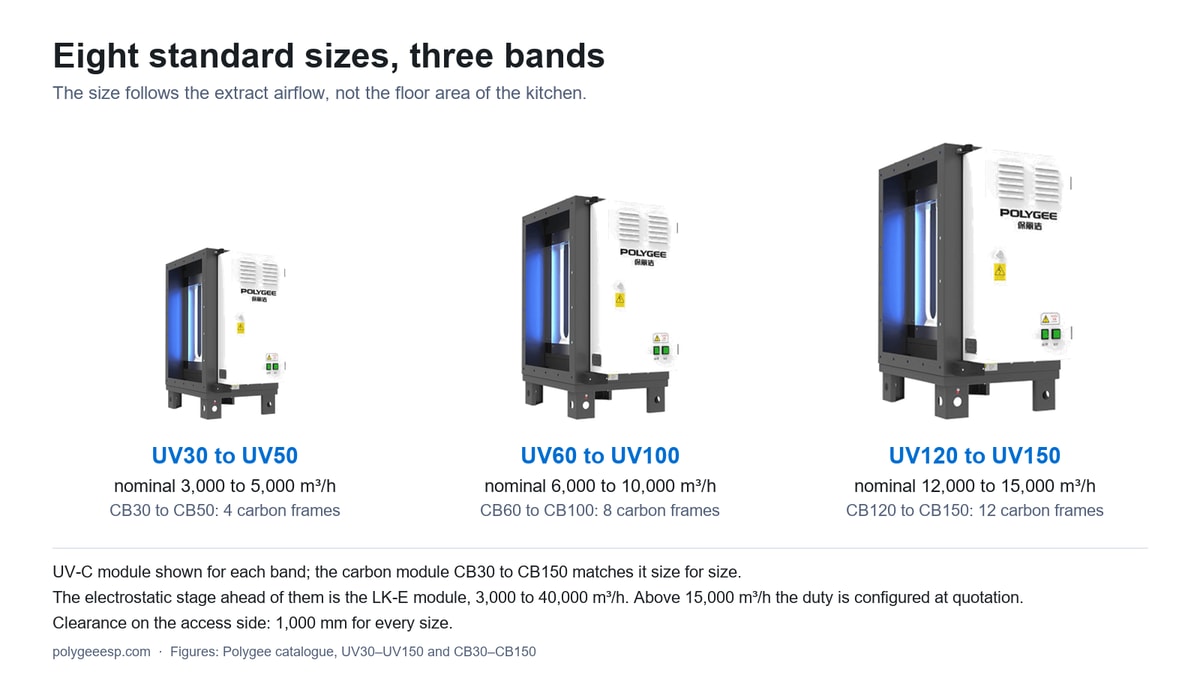
| Size band | UV-C module | Carbon module | What changes with size | What it means for the build |
|---|---|---|---|---|
| UV30 to UV50 (nominal 3,000 to 5,000 m³/h) | Two lamps on one ballast at the UV30, rising with size | CB30 to CB50: four carbon frames | The smallest number of frames to recharge with media | The smallest modules still need the 1,000 mm clearance on the access side; the clearance does not shrink with the airflow |
| UV60 to UV100 (nominal 6,000 to 10,000 m³/h) | More lamps than the small band | CB60 to CB100: eight carbon frames | Twice the frames of media to exchange | Budget the exchange labor for eight frames, not four |
| UV120 to UV150 (nominal 12,000 to 15,000 m³/h) | The largest lamp arrays in the range | CB120 to CB150: twelve carbon frames | Twelve frames of media per exchange; the carbon line on the running cost scales with the frame count | Check the plant-room door and the route before the module is ordered |
This table answers which module band an airflow falls in and what grows with size. It does not pick the size for your duct: the extract airflow sets the UV and carbon module size and the cooking load sets the ESP tier, and both are inputs on the kitchen ecology unit page. For the fan check, the resistances to carry are the complete LK-E stage at no more than 150 Pa with its distribution plate, the carbon stage at a brochure 150 Pa across CB30 to CB150, and the UV stage figure issued per model with the configuration proposal. The UV module takes a 220 V/50 Hz supply as standard, with 380 V and 60 Hz configured to order; the carbon module has no electrical connection.
Cleaning and maintenance: what to record
The stages in the train are maintained in different ways, and the record a buyer should hold is who does which, on what basis, and where that basis is written down. The electrostatic cell is withdrawn, washed and returned; the UV-C lamps and the carbon media in its frames are consumed and exchanged, while the frames themselves stay; the grease filters in the hood are the kitchen team’s routine and sit outside the unit.
| Stage | Washed or consumed | What tells you it is due | Record to hold | Who |
|---|---|---|---|---|
| Grease filters in the hood | Washed | Visible loading; the hood’s own schedule | The kitchen cleaning log | Kitchen team |
| Electrostatic cell | Washed and returned | Smoke returning at the outlet against the baseline photographs; the indication on the unit | The cleaning basis from the quotation: cooking duty, hours and airflow; who pulls the cell; where it is washed; the date of the first service | Service contractor or trained site staff |
| UV-C lamps | Consumed | Elapsed service life on the lamp schedule; odor returning with the smoke still clear | The lamp schedule that came with the configuration proposal | Service contractor |
| Carbon media, in its frames | Consumed; the frames stay and are recharged | Smell returning at the discharge with the particle stages clean | The change interval set in writing at quotation; the frame count per exchange | Service contractor |
We do not put an interval in weeks or months on this page for any of the three, because each one follows the cooking process, the operating hours and the airflow, and the same unit on a charcoal grill and on a bakery line is on two different schedules. The interval is stated in writing at quotation for the kitchen described, copied into the order, and carried into the commissioning record, which also holds the outlet photographs that later service visits are compared against. What a service visit on the electrostatic stage consists of is on the electrostatic precipitator cleaning page, and the twelve entries of the commissioning record, including the cleaning basis and the outlet baseline, are on the commissioning page.
Decision rule. IF a maintenance offer quotes one interval for the whole unit, THEN ask for it stage by stage with the basis beside each, BECAUSE the washed cell, the consumed lamps and the consumed carbon media do not run on one clock, and a single number hides which stage is being under-serviced.
Scope and limits
Three layers have to be cleared separately, and passing one does not clear the next. Layer one, equipment evidence: test reports and certificates describe a model under a stated condition, and they travel with the model rather than with your project. Layer two, site installation and interface: airflow, duct arrangement, leakage past the cell and service access are site facts that no certificate addresses. Layer three, whole-system operation: capture at the hood, delivered airflow, cleaning discipline and the cooking process decide the result at the discharge. Passing one layer does not clear the next.
Specific limits on this page:
- No cleaning interval and no carbon change interval is given here in weeks or months, for any model. Both are set in writing for the specific site at quotation.
- No ozone figure is given for the UV-C stage, because we do not publish one. If ozone is a condition on your project, raise it as a project question and it will be answered against the configuration rather than from a catalog.
- Efficiency figures are tested conditions, not site results. The action that follows is to ask for the report number and the test condition alongside any percentage, and to state your own discharge requirement rather than adopting a supplier’s number as your target.
- Certificates cover named models, not catalogs. Ask which model numbers a certificate actually lists before treating it as coverage for the equipment you are being offered, including ours. What the various listings in this field prove is set out in UL 710B compared with UL 710.
- Nothing here is a compliance determination. Which document applies to your address, and what your local authority requires at the discharge, is a question for your engineer and that authority.
Buyer record
Before asking anyone to propose an ecology unit, write down four things. They take one conversation to collect and they change the shape of every quotation you receive. For projects in Saudi Arabia or Qatar, the country terms and the enquiry sheet are on our ecology unit supplier page for Saudi Arabia and our ecology unit supplier page for Qatar.
The cooking process: what is actually on the line, because a charcoal grill and a bakery do not send the same load down the duct, and the difference decides which stages are justified.
The complaint, if there is one: whether it is visible plume, smell, or both; where it is observed; at what time of day. A smell complaint from a balcony twelve meters from the discharge is a different specification from a soiling complaint on a roof.
The extract duty: design airflow, and who set it. Everything downstream is selected against that figure.
The pressure allowance: how much static pressure the fan selection left for treatment, and who owns that number. It is usually held by whoever selected the fan and is rarely revisited when stages are added later.
Ask every supplier, in writing: the stage list and the order; the resistance of each stage at your airflow; the report number and test condition behind any efficiency figure; which model numbers their certificates cover; the service access each module needs; and what they will not commit to without a site review.
Key takeaways
- Definition: an ecology unit is an arrangement of stages in the duct, not a single defined product — so compare stage lists rather than titles.
- Division of labor: particles and smell are separate physical problems; the precipitator answers the first and the gas-phase stages answer the second.
- Order: particle removal comes before UV-C and carbon, because grease reaching those stages disables them early.
- Running cost: the precipitator cell is washed and returned to service; the carbon media and the UV lamps are consumed.
- The honest gap: a carbon change interval cannot come from a catalog, because it follows your menu, your hours and your airflow.
- Sizes: our eight standard units run from 3,000 to 15,000 m³/h and are chosen from the extract airflow; above that the duty is configured at quotation.
Frequently Asked Questions
- What is an ecology unit?
- An ecology unit is a packaged multi-stage treatment section installed in a commercial kitchen exhaust duct, downstream of the hood and its grease filters and upstream of the fan. In its usual form it contains three stages in series: electrostatic precipitation for particle-phase grease and smoke, UV-C photolysis for part of the gas-phase load, and activated carbon adsorption for the remaining gas-phase molecules. The important thing to understand about the term is that it describes an arrangement rather than a defined component, so two offers with the same heading can contain different stages. Before comparing prices, establish how many stages each proposal includes and in what order they are arranged.
- What is ESP in an ecology unit?
- ESP means electrostatic precipitator, and it is normally the second stage and the one doing most of the work. It charges the particles carried in the exhaust in an ionizing section, then collects them on closely spaced plates held at an opposite potential, so the grease and smoke stay on the plates while clean air continues down the duct. Two things follow from that mechanism. Its performance depends on the airflow through the cell and the condition of the plates, not on the cell alone, which is why an efficiency percentage without a stated test condition is not a specification. And the collector cell is washable rather than consumable, so the running cost of this stage is a cleaning routine rather than replacement media.
- What is the carbon filter in an ecology unit used for?
- It removes gas-phase molecules by physical adsorption onto the media surface, which is the part of the smell problem that the particle stages cannot reach. Our media is coal-based columnar carbon with an iodine adsorption value of at least 800 mg/g and a specific surface area of at least 800 m²/g. Two boundaries matter. The stage does nothing about particles, and it must sit downstream of particle removal, because grease reaching the media blinds it and ends its useful life early. And the media saturates, so this stage carries a recurring cost rather than only a capital cost. The change interval is set in writing for the specific site at quotation, because it follows the menu, the hours and the airflow.
- What are the disadvantages of using a carbon filter?
- There are three worth knowing before you specify one. The media saturates, so the stage has a finite working life and a recurring replacement cost rather than a one-off capital cost. It adds resistance to the system, which has to sit inside the pressure allowance the fan selection left for treatment; our brochure equipment resistance is 150 Pa across CB30 to CB150, and total system static pressure should be verified with your fan. And it is vulnerable to what reaches it, so a carbon stage installed where grease can arrive will stop adsorbing long before it otherwise would. None of these rule the stage out. They simply mean the carbon stage should be budgeted, pressure-checked and correctly positioned rather than added at the end of a design.
- Is a carbon filter the same as a charcoal filter?
- In ordinary use the two words describe the same thing, and both refer to carbon that has been activated to develop its internal pore structure. The distinction that matters when you are buying is not the word but the feedstock and the measurable grade. Carbon from different raw materials, activated to different grades, behaves differently in the same duct, and the figure to ask for is the iodine adsorption value, because it is a measurable property rather than a descriptive claim. Ask what media is offered, what its iodine value is, and how the panels are withdrawn for exchange, and the vocabulary question stops mattering.
- What is the use of an ecology unit?
- To treat the exhaust a commercial kitchen has already captured before it is discharged, where the discharge point cannot take untreated air: a mall, a hotel, a mixed-use building or a shared riser. The precipitator stage takes the grease aerosol and smoke, and the UV-C and carbon stages work on the gas-phase part of the smell. It is used when either the visible plume or the smell at the discharge is the problem, and which stages are justified follows from which of the two it is.
- How often should a kitchen ecology unit be cleaned?
- Stage by stage, on a basis set for the kitchen rather than from a page. The electrostatic cell is washed and returned on a schedule that follows the cooking duty, the hours and the airflow; the UV-C lamps and the carbon media in its frames are exchanged on the schedule that came with the configuration proposal. We state those intervals in writing at quotation for the kitchen described, and the signs that a stage is due are smoke returning at the outlet against the baseline photographs for the cell, and smell returning with the particle stages clean for the carbon.
Working out which stages your kitchen actually needs?
Send us four things you already have: what is on the cookline, the design extract airflow, where the discharge is and what the complaint is if there is one, and how much static pressure the fan selection left for treatment. We will tell you which stages are justified for that load, which you can leave out, what each one would add in resistance at your airflow, and what we would not commit to without a site review. You get back a stage list with reasons, not a catalog.
Tell us what is on your cookline
Reviewed by Law, Project Manager, 13 October 2026
Written by Scarlett · Business Director, PolygeeScarlett handles export inquiries, dealer relationships and commercial terms at Polygee, including multi-stage kitchen exhaust projects across the Gulf and South Asia. Polygee, founded in 2004, manufactures the electrostatic, UV-C and activated carbon stages described here. This article explains equipment and terminology for planning purposes; it is not a mechanical design, not a compliance determination, and not a substitute for a project review.
References & sources
- UL Standards & Engagement — UL 867, Standard for Electrostatic Air Cleaners, the product safety standard applied to the electrostatic stage. shopulstandards.com
- Building Engineering Services Association — DW/172, Specification for Kitchen Ventilation Systems, the reference specification covering kitchen extract and odor control practice in the United Kingdom. thebesa.com
- NFPA — NFPA 96, Standard for Ventilation Control and Fire Protection of Commercial Cooking Operations, which governs the fire strategy that sits alongside, and separately from, air treatment. nfpa.org
- Polygee — stage specifications, module dimensions and third-party test report numbers, supplied on request. polygeeesp.com
Related reading
- Ecology unit installation: space, weight, pressure and access — whether a three-stage train physically fits, with the arithmetic and a pre-installation checklist.
- Electrostatic precipitator against baffle filter — why the precipitator does not replace the filter bank in the hood, and when to add one.
- Commercial kitchen odour control in the UK — how a UK authority scores a site, and which scheme route rules this equipment in or out.
- Electrostatic precipitator cleaning and maintenance — what a service visit covers on the stage that is washed rather than replaced.