

A pollution control unit, or PCU, is the term the International Mechanical Code uses for manufactured equipment installed in a grease exhaust duct to extract smoke, grease particles and odors by a series of filters. It is the same duct-mounted equipment that a Gulf tender calls an ecology unit, and that a UK specification calls an in-duct electrostatic precipitator, with any odor stages listed separately. The name carries a listing: the 2021 IMC asks for UL 8782, and the 2018 edition asked for UL 1978.
This guide helps you decide which listing, if any, your code path asks a duct-mounted unit to carry, and what that listing is evidence of.
It does not select or size equipment, quote a price, or decide compliance for a jurisdiction; the authority having jurisdiction does that.
For product-specific review, see the in-duct electrostatic precipitator page and the kitchen ecology unit page.
| What it is | Where it fits | Typical use | Not the same as |
|---|---|---|---|
| Manufactured equipment in a grease exhaust duct that extracts smoke, grease particles and odors by a series of filters (IMC 2021, Section 202) | Downstream of the hood, in line with the grease duct, indoors or on the roof, ahead of the discharge | Discharge locations that cannot take untreated exhaust: mixed-use buildings, low-level terminations, air-quality conditions of approval | A hood (UL 710) · a grease duct (UL 1978) · an exhaust fan (UL 762 or UL 705) · an electrostatic air cleaner component on its own (UL 867) · a recirculating system (UL 710B) |
What a pollution control unit is
A pollution control unit is manufactured equipment installed in a grease exhaust duct to extract smoke, grease particles and odors by a series of filters, and that sentence is the code’s own definition rather than a supplier’s. Chapter 2 of the 2021 IMC reads:
POLLUTION-CONTROL UNIT (PCU). Manufactured equipment that is installed in a grease exhaust duct system for the purpose of extracting smoke, grease particles and odors from the exhaust flow by means of a series of filters.
Three things in that definition decide how the rest of the code treats the unit. It is installed in a grease exhaust duct system, so the reviewer looks at it as a section of the duct, with the duct’s fire questions attached. It works by means of a series of filters, so the definition turns on the role in the duct rather than on a fixed stage count. Whether a single-stage unit is read as a “series of filters” is the reviewer’s call, and worth asking before the submittal. And it is manufactured equipment, so the code can attach a listing to it, which is what Section 506.5.2 does.
UL’s description of what goes inside matches what the market sells. Its regulatory note on the category says the filters may be electrostatic precipitators, metal mesh, media types and disposable filters, and that units typically carry built-in static pressure sensors to flag filter loading. Fire suppression and wash systems can be factory fitted. The exhaust fan can sit outside the unit or be built into its housing; a fan outside the housing is evaluated and certified separately. An in-duct electrostatic precipitator is therefore one filter type a PCU can be built around, and often the first stage of one.
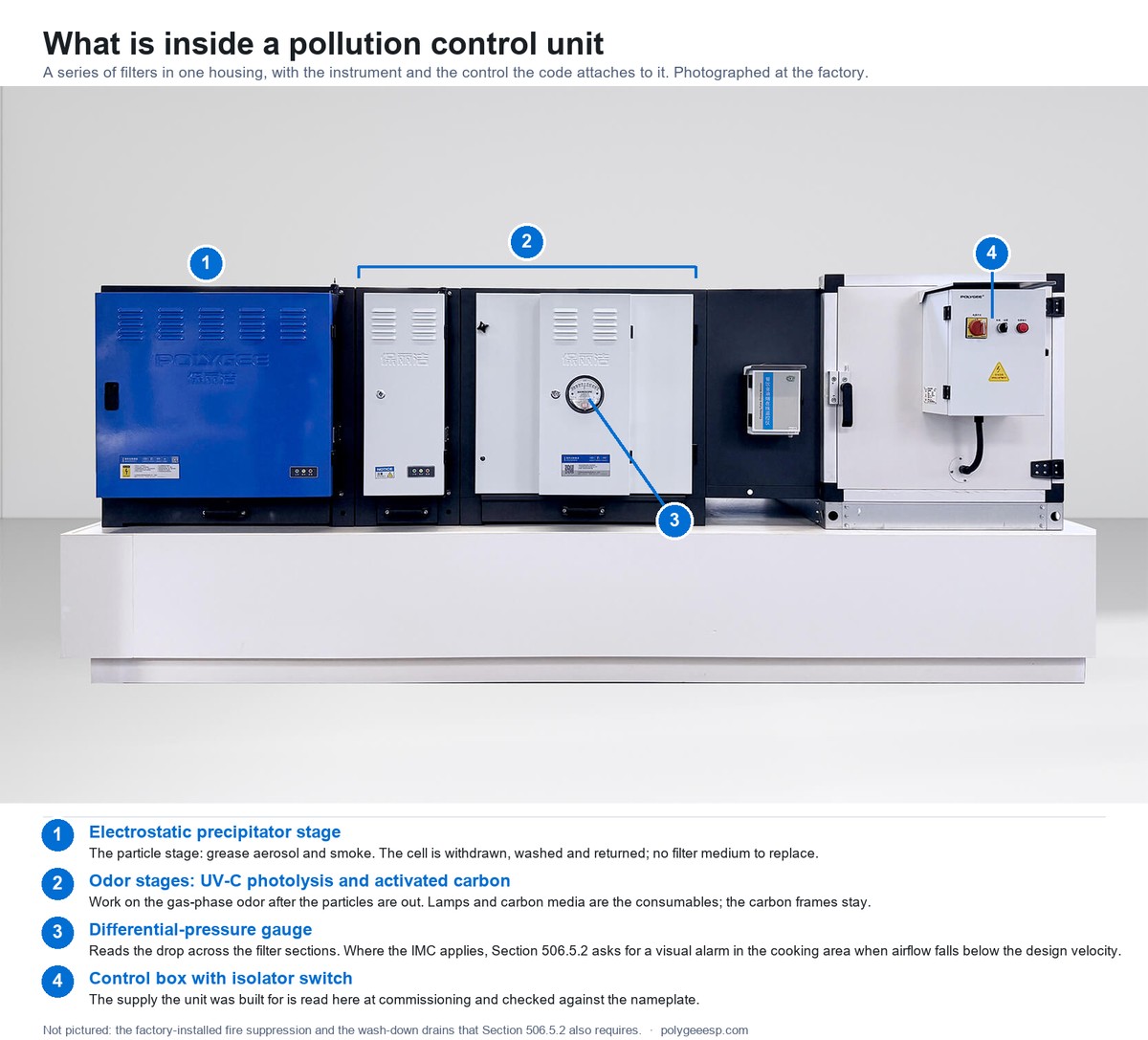
What the definition settles for a buyer. The unit is reviewed as part of the grease duct, not as an air cleaner in the heating-and-ventilation sense. That is why the safety listing the code asks for is written around the duct, and why the electrostatic air cleaner standard, UL 867, answers a different question even though it covers the same electrostatic cell.
One duct section, three names
The same duct-mounted treatment section is sold under three names. It is a pollution control unit in North America, an ecology unit in the Gulf and much of Asia, and an in-duct ESP, with or without odor stages, in the UK and in most engineering writing. The naming is regional, not technical, and UL said as much when it set up the category. Its 2019 note on the update to UL 8782 states that the products “are called by many names: ecology units, air filtration units, exhaust filtration units.” The same note says UL and industry “determined that an appropriate terminology for these products would be pollution control units.”
| Heading you will meet on a quotation | Where | What it usually contains | What to check before comparing |
|---|---|---|---|
| Pollution control unit (PCU) | North America; the IMC, the UMC and NFPA 96 | One or more filter stages, often packaged with fire suppression, a wash-down system and a differential-pressure alarm because the code asks for them | Whether the quotation is a packaged unit or a single stage |
| Ecology unit (ECU) | The Gulf, South Asia, parts of Southeast Asia | A multi-stage section, commonly electrostatic, then UV, then activated carbon | How many stages are actually included, and in what order |
| In-duct ESP | The UK, Europe, most engineering specifications | One electrostatic stage; odor stages specified separately | Whether a resistance figure is for the cell alone or the complete module |
The name tells you what a quotation usually implies; only the stage list tells you what it contains, which is why three quotations for the same duct rarely compare, the subject of pollution control unit cost. The stage-by-stage picture of the Gulf naming is in what an ecology unit is.
What is inside a pollution control unit
A pollution control unit is a series of filters in one housing, and the code definition leaves the series open. What the market puts in it is a short list, and UL’s 2019 note names the members: electrostatic precipitators, metal mesh, media-type and disposable filters, usually with a built-in static pressure sensor to flag loading, and, depending on location and climate, with fire suppression and a wash system fitted at the factory; where the IMC applies, Section 506.5.2 requires the suppression system to be factory installed. Odor stages, UV-C and activated carbon, sit after the particle stages where the discharge condition calls for them. Each member of the series is maintained differently, and that is the detail a quotation should state rather than leave to the word unit.
| Stage | What it removes | Washed or consumed | What Section 506.5.2 attaches to it | Buyer check |
|---|---|---|---|---|
| Metal mesh or baffle pre-filter | Coarse grease droplets ahead of the electrostatic cell | Washed | Part of the filter series the differential-pressure control monitors | Ask whether it is inside the unit or left in the hood |
| Electrostatic precipitator cell | Grease aerosol and smoke, the particle-phase load | Washed and returned; on our units the plates are stainless steel | The pressure monitoring, the wash-down drains and the factory suppression apply to the unit as a whole; this is the stage that loads with grease | Ask how the cell comes out and where it is washed, and for the test report behind any efficiency figure |
| Media or disposable filters | Fine particles, on designs that use them | Consumed | Loading is what the differential-pressure alarm is there to catch | Ask for the replacement line on the running cost |
| UV-C stage | Part of the gas-phase odor load | Lamps consumed | None specific | Ask for the lamp schedule with the configuration |
| Activated carbon | Gas-phase molecules, by adsorption | Media consumed; the frames stay | None specific | Ask for the change interval in writing for the site, and the frame count per exchange |
| Differential-pressure control and alarm | Nothing; it monitors the drop across the filter sections | Instrument | Required: a visual alarm in the cooking area when airflow falls below the design velocity | Ask where the alarm is mounted and who responds to it |
| Factory-installed fire suppression | Nothing; it protects the unit | System, serviced on its own schedule | Required in every IMC edition on this page | Ask whether it is factory fitted on the model quoted, and who services it |
This table answers what a unit can contain and how each member is kept working. It does not say which members your kitchen needs; that follows from the cooking process and the discharge condition, the subject of kitchen exhaust filtration, and which items are consumed is set out stage by stage in ecology unit filters.
Our own units are built around the electrostatic stage: the LK in-duct precipitator or the LK-E module as the particle stage, with the UV and carbon modules after it where the discharge calls for them. None of our three stages carries a replaceable particle medium; the precipitator cell is washed, and the lamps and the carbon media in the two odor stages are the consumables. How a service visit on the cell is run is on the electrostatic precipitator cleaning page.
How to choose one: the inputs
Choosing a pollution control unit is six inputs, and five of them exist before any supplier is contacted. The sixth, the pressure allowance, usually has to be asked for from whoever selected the fan.
| # | Input | Who holds it | What it decides | If it is missing |
|---|---|---|---|---|
| 1 | Adopted code edition, and the unit location: indoor, inside an enclosed run, or on the roof | The AHJ and the mechanical drawings | Which listing the drawing has to show, and whether an enclosure listing is needed | The document pack cannot be fixed; raise it before anything is selected |
| 2 | Design extract airflow, and who set it | The hood schedule or the balancing report | The model size; every stage is selected against this figure | Do not estimate it from floor area; ask the designer for the schedule |
| 3 | Cooking process and appliance list, including any solid fuel | The operator | Which stages are justified; solid fuel keeps the unit out unless it is listed for it | Send the menu and the line drawing; the stage list cannot be set without them |
| 4 | The complaint or condition at the discharge: visible smoke, smell, or a condition set by the authority | The operator, the neighbor, the authority | Whether odor stages are needed at all | Record where and when it is observed before specifying |
| 5 | Service access, and the route into the plant room | The mechanical drawings | Whether the cells and frames can be withdrawn; Section 506.5.2 asks for access for servicing and cleaning, with service space to the manufacturer’s instructions | Check the 1,000 mm clearance published for our UV and carbon modules on the lamp-rack access side before the position is fixed |
| 6 | Static pressure left for treatment by the fan selection | Whoever selected the fan | Whether the stages fit inside the fan’s budget: our LK units are quoted at 150 Pa or less for the complete unit with its standard air-distribution plate, and each odor stage adds its own resistance, issued per model with the configuration proposal | Ask for it; it is rarely revisited when a unit is added later |
Decision rule. IF inputs 1, 2 and 3 are known, THEN a supplier can propose a model and a stage list; IF input 6 is unknown, THEN the proposal is provisional, BECAUSE a unit that fits the airflow but not the pressure allowance starves the hood. The ten lines an enquiry should carry are on the ESP enquiry sheet; add the adopted code edition and the pressure allowance beside them, because the sheet does not ask for those two. How to read the datasheet that comes back is on the datasheet page.
Does a commercial kitchen need a pollution control unit?
Not every kitchen. The code sets the rules for a pollution control unit where one is installed; it does not put one on every grease duct. A unit is needed when the discharge cannot take untreated exhaust, a termination close to a neighboring property or an air intake, a mixed-use building with a shared riser, or an air-quality condition attached to the approval, and when an emission rule applies to the appliances themselves: the charbroiler rules in New York City and in the South Coast district trigger on the appliance and its throughput rather than on the outlet, as set out on our charbroiler emissions page. Installing a unit does not shorten the termination distances; Section 506.5.2 sends the outlet back to Section 506.3.13. The test is the discharge condition and the rules that apply to the appliances, not the size of the kitchen.
Where UL 8782 comes from
UL 8782 exists because the three standards that covered a commercial kitchen exhaust system did not address a unit installed in the duct to treat the exhaust. UL’s note lists the three: hoods under UL 710, ducts under UL 1978, fans under UL 762. It then states that pollution control units “are not addressed within the scope of the referenced commercial kitchen exhaust standards.” Before a dedicated document existed, UL’s regulatory engineer records that the applicable requirements of UL 710 and UL 1978 were applied so that listed units could reach the market. A dedicated document replaced that case-by-case application of two other standards.
The document itself is the Outline of Investigation for Pollution Control Units for Commercial Cooking Operations, UL 8782. UL’s standards store lists it as Edition 1, published January 30, 2017, active, with no revisions on file, and describes it as the first issue of the outline. It is published as an Outline of Investigation rather than as a UL Standard for Safety. The code text nonetheless reads “listed and labeled in accordance with UL 8782,” and the store page labels the document “UL Outline.” The certification category UL created for it is YZHK, and UL set April 30, 2020 as the date after which products manufactured would be assessed to UL 8782 rather than to the earlier mix of requirements. UL’s 2019 note describes the certification category and its transition date; the store page shows no revision to the 2017 text.
What the outline covers, in UL’s words, is “pollution control unit assemblies that are intended to be installed in line with commercial grease ducts used to exhaust heat, smoke, and grease-laden vapors from commercial cooking operations to the outdoors as specified in” NFPA 96, the IMC and the UMC. It includes “modular pollution control assemblies, unwelded connections between adjoining parts, fittings, access doors, and the like.” The unwelded connections and access doors are the point. A grease duct is expected to behave like a continuously welded metal duct in a fire, and a unit spliced into it with doors and joints has to be shown to do the same.
What a UL 8782 listing proves, and what it does not
A UL 8782 listing is a safety listing, and UL says so in its own words:
Please note that this outline addresses the safety aspects of this appliance and does not measure the efficacy of the pollution control unit to remove grease-laden effluent from the air stream, nor other factors that do not directly affect users or electrical and fire safety.
UL’s note records that earlier certifications for these units used the elevated-temperature flue gas tests, 260°C in the normal condition and 1,093°C in the abnormal condition. The purpose was that in an abnormal situation the duct section remains equivalent to a continuously welded metal duct. It adds that the outline’s electrical requirements are drawn from UL 710 and other standards. Fire containment and electrical safety of the assembly are what the listing speaks to. Grease removal at your airflow is a separate evidence question, and so is odor.
| Evidence | What it supports | What it does not prove on its own | Product-condition scope | Buyer action |
|---|---|---|---|---|
| UL 8782 listing (UL category YZHK) | Fire and electrical safety of the assembly installed in line with a grease duct | Grease removal efficiency · odor control · performance at your airflow | The models named in the file; indoor or outdoor as listed; solid fuel only where listed | Ask for the file number and the certifier, then read the model list in that certifier’s directory (UL Product iQ for a UL file) against the model quoted |
| Third-party efficiency test report | Capture at the tested airflow, condition and position in the system | Safety · other models · loaded condition · your process | The model, method and conditions on the report | Request the report itself and check the serial-number link and test conditions; how to read the figure is in ASTM F2519, and our reading of it is on the test method page |
| UL 867 listing (electrostatic air cleaner) | Electrical safety of the electrostatic cleaner as a component | A PCU listing · efficiency · installation | The models in the file | Read it with UL 867; do not present it as the other document |
| Manufacturer’s installation instructions | The service space, ventilation and maintenance items Section 506.5.2 refers to | Any listing · any performance figure | The model | Attach to the submittal; the reviewer will ask for them by name |
This table answers which document supports which claim. It does not answer whether a given unit performs in a given kitchen; that depends on capture at the hood, airflow, duct arrangement and maintenance.
Which edition of the IMC asks for it
Whether a plan reviewer asks for UL 8782 depends on which edition of the IMC the jurisdiction adopted, because the reference in Section 506.5.2 changed in 2021 and the fan reference changed again in 2024. The three editions read differently on four points that land on a submittal.
| Edition | PCU listing (item 1) | Fan listing (item 2) | Clearance to combustibles | Indoor unit on an enclosed duct |
|---|---|---|---|---|
| 2018 IMC, 506.5.2 | UL 1978 | UL 762 | A fixed 18 inches (457 mm) | Located in a room or space with the same fire-resistance rating as the duct enclosure |
| 2021 IMC, 506.5.2 | UL 8782 | UL 762 | In accordance with the listing | The unit itself listed to UL 2221 or ASTM E2336 for location in an enclosure of the duct’s rating |
| 2024 IMC, 506.5.2 | UL 8782 | UL 705 | In accordance with the listing | Listed to ASTM E2336 or UL 2221, and installed in a dedicated room or space enclosure built to Section 506.3.11 |
Which edition your jurisdiction adopted, and how it amended the text, is the first thing to confirm with the authority having jurisdiction.
What did not change is most of the section. Across all three editions: a roof-mounted unit is listed for outdoor use and sits not less than 18 inches (457 mm) above the roof. An airflow differential pressure control monitors the drop across the filter sections and triggers a visual alarm in the cooking area when airflow falls below the design velocity. The unit carries a factory-installed fire suppression system, and its wash-down drains discharge through a grease interceptor with a trap seal. Extra-heavy-duty appliance exhaust is not connected to the unit unless the unit is specifically designed and listed for solid fuels. The unit is maintained to the manufacturer’s instructions. The four requirements that land on the duct drawings (listing, access for servicing and cleaning, drainage and downstream fire protection) and the enclosure question are worked through in grease duct requirements. The solid-fuel exclusion is the reason solid fuel cooking exhaust is treated as its own system.
Decision rule. If the adopted edition is 2021 or 2024, the drawing has to show a UL 8782 listing for the unit and the fan listing that edition names. If it is 2018, the reference is UL 1978 and the clearance is a fixed 18 inches. If the jurisdiction is on an older edition, UL’s regulatory note says the model codes “may be of great value when evaluating a code modification request for alternate materials and methods to enable use of a PCU.” That is the conversation to have with the AHJ before a unit is selected. The same note records that the 2018 UMC permits the installation of listed PCUs and that the 2017 edition of NFPA 96 contains PCU provisions. It also records that both the UMC and NFPA 96 require the ductwork downstream of the unit to carry an approved automatic fire-extinguishing system, a point that lands in hood fire suppression requirements.
Outside the IMC: Canada, the UK, Singapore and specification-driven markets
Outside the jurisdictions that adopt the IMC, the listing question is answered by a different document, and in several markets by no product listing at all. The map below is the buyer asset of this page: one row per code framework, what its PCU clause references, what the same clause also requires, and where to confirm it. Copy it into the RFQ and ask each supplier to state, against the row that applies, which document their unit carries.
| Code framework | What the PCU clause references | What the same clause also requires | Where to confirm |
|---|---|---|---|
| IMC 2024, 506.5.2 | UL 8782 listing; fans UL 705 | Indoor and enclosure listing (ASTM E2336 or UL 2221), differential-pressure alarm, factory suppression, wash-down drain, solid-fuel exclusion | codes.iccsafe.org and the AHJ |
| IMC 2021, 506.5.2 | UL 8782; fans UL 762 | Fifteen items in this edition; clearance per the listing | Same |
| IMC 2018, 506.5.2 | UL 1978; fans UL 762 | A fixed 18-inch clearance; enclosure by room rating | Same |
| IMC before 2018 | Not quoted on this page; UL’s note suggests an alternate materials and methods request for a jurisdiction on an older edition | Confirm with the AHJ whether the adopted text carries a PCU section | The AHJ |
| UMC and NFPA 96 | Listed PCUs permitted (2018 UMC, 2017 NFPA 96, per UL) | An approved automatic fire-extinguishing system in the ductwork downstream of the unit | The adopted edition |
| Canada | NFPA 96 as adopted by the province; UL’s note records that 2017 NFPA 96 carries PCU provisions (clause numbers not quoted here) | The hood listing says nothing about the unit in the duct: CAN/ULC 646:2024 clause 1.9 excludes electrostatic precipitators and points them to UL 867 | The province’s adopted edition; see NFPA 96 in Canada |
| United Kingdom (DW/172) | No product listing; DW/172 issues no certificates | Low-level discharge only with effective pollution control and local authority approval, with the added resistance of any pollution control included in the fan selection (24.1, 24.11); tested separators ahead of it (24.3) | The local authority; see DW/172 |
| Singapore | NEA, SFA and SCDF do not certify air cleaning equipment | The officer checks the outcome at the outlet | See Singapore requirements |
| The Gulf and other specification-driven markets | Whatever listing the consultant’s specification names | The stage list and the access clearance the specification sets | The specification itself; the naming is explained in what an ecology unit is |
This map answers where the listing requirement comes from in each framework. It does not interpret a specific jurisdiction’s adopted edition or speak for an AHJ; confirm the row that applies before a document goes on a drawing.
Two rows need a sentence. In Canada the document to read is the hood standard, because its scope says in clause 1.9 that it excludes evaluation of electrostatic precipitators for commercial kitchen ventilation and that they are covered under UL 867. A Canadian reviewer therefore reads the electrostatic stage against a different document than a U.S. reviewer on the 2021 IMC does. In the UK the question is not a listing at all: DW/172 asks that the resistance of any pollution control be included when the fan is selected, which turns the pressure-drop basis on the quotation into the compliance question.
Where Polygee sits
Our in-duct units are the equipment this term describes: an electrostatic stage supplied on its own or as the first stage of a multi-stage unit, which the IMC reviews under Section 506.5.2 as a pollution control unit. The listings we hold are stated per model. UL 867, File E522667, covers three in-duct models, the LK/SE-6K, LK/SE-12K and LK/SE-18K at 230 V/50 Hz, and no other. CE certificate FQC2602501 covers the LK30 to LK480, the LK-E models it names and the UV series. A separate UL file, E514664, covers the SPP power supply. On a submittal we write, model by model, which listings and which test reports the unit carries, with the test conditions, so the reviewer reads a scope rather than a logo row. Grease removal on the LK series is supported by CMA-accredited third-party testing, up to 97.6% under report ZY05W230298, and that report, not any listing, is what supports the figure.
Which document your code path asks for is the first question we put back to an enquiry, because it decides the document pack, and it decides it before price does. The way to verify any supplier’s answer, ours included, is the file number and the model list in the certifier’s directory; for a UL file that is UL Product iQ, which is free to use after a one-time registration.
Where this guide stops
Three layers, and clearing one does not clear the next.
- Listing and test evidence. A listing names models and a condition of use; a test report names a model, a method and an airflow. Passing one layer does not clear the next. Where your unit, location or airflow differs from what the document names, ask for the difference to be stated rather than assumed away.
- Site installation and interfaces. Section 506.5.2 (2021 edition) puts most of its fifteen items on the installation: bracing, enclosure rating, fan listing, clearance, service space, freeze protection and the duct transitions. The alarm, the factory suppression and the wash-down drains sit on the unit; the interceptor they discharge to sits on the installation. These are settled on drawings against the adopted edition, with the unit shown in the run.
- Whole-system operation in service. What an installed unit achieves depends on capture at the hood, the cooking process actually run, and whether the differential-pressure alarm is acted on when it sounds. No listing settles this in advance.
This page summarizes the published code text and UL’s published notes for planning purposes. It is not a compliance determination, and it does not reproduce the outline’s test procedures, which are in the purchasable document.
Buyer record
- Request from the jurisdiction: the adopted mechanical code and edition · any local amendment to Section 506.5.2 · whether the unit location counts as an enclosed run.
- Request from every supplier: the file number, the certifier and the models the file names · the condition of use listed (indoor, outdoor, solid fuel) · the test report with its method and airflow · the installation instructions the code refers to.
- Record for your own file: which edition path the project is on · which of the section’s items the unit supplies (suppression, wash-down, alarm) and which the installation supplies (fan, enclosure, interceptor, freeze protection).
- Triggers a re-check: a change of adopted edition · a local amendment to Section 506.5.2 · a UMC jurisdiction · moving the unit from the roof to an enclosed run · adding a solid-fuel appliance · a model substitution · a change of target market.
Key takeaways
- Definition: judge the unit as a filtered section of the grease duct, which is what the code defines, not as an HVAC air cleaner.
- Naming: judge PCU, ecology unit and in-duct ESP as one role with three regional names, not as three products.
- Listing: judge UL 8782 as a fire and electrical safety document, in UL’s own words, not as a performance rating.
- Edition: judge by the edition the jurisdiction adopted, because 2018 references UL 1978 and 2021 references UL 8782, not by the year on the model code.
- Elsewhere: judge by the framework in force, since Canada reads the electrostatic stage against UL 867 through its hood standard, and the UK asks for no listing at all.
- Inputs: judge a proposal by whether it was built from the code edition, the design airflow, the cooking process, the discharge condition, the access and the pressure allowance, not from the kitchen’s floor area.
Frequently Asked Questions
- What is a pollution control unit?
- A pollution control unit is manufactured equipment installed in a grease exhaust duct system to extract smoke, grease particles and odors from the exhaust flow by means of a series of filters. That is the definition in Chapter 2 of the 2021 International Mechanical Code. UL describes the filters inside as electrostatic precipitators, metal mesh, media types and disposable filters, usually with built-in static pressure sensors, and sometimes with factory-fitted fire suppression and wash systems.
- Is a pollution control unit the same as an ecology unit?
- In role, yes. Both terms describe a treatment section installed in the kitchen exhaust duct after the hood. UL noted when it set up its certification category that the products were called ecology units, air filtration units and exhaust filtration units, and chose pollution control unit as the term. What differs between two quotations is the stage list and the accessories included, not the name, so compare the stages before comparing the units.
- Does the IMC require UL 8782 for a pollution control unit?
- The 2021 and 2024 editions do. Item 1 of Section 506.5.2 requires pollution-control units to be listed and labeled in accordance with UL 8782. The 2018 edition referenced UL 1978 in the same item, and UL’s regulatory note describes 2018 as the edition that incorporated PCU requirements into the IMC. For a jurisdiction on an older edition, UL’s note suggests an alternate materials and methods request as the route to raise with the authority having jurisdiction. Confirm the adopted edition and its amendments before a document goes on a drawing.
- What does a UL 8782 listing prove?
- Safety. UL states that the outline addresses the safety aspects of the appliance and does not measure the efficacy of the unit in removing grease-laden effluent from the air stream. The listing speaks to fire containment and electrical safety of the assembly installed in line with a grease duct. Grease removal at your airflow is a separate evidence question answered by a test report. To verify a listing, ask for the file number and the certifier; for a UL file, the category to look up on UL Product iQ is YZHK.
- Does a UL 867 listing satisfy a UL 8782 requirement?
- No. They are different documents about different things. UL 867 covers electrostatic air cleaners as a component and places installation requirements elsewhere; UL 8782 covers the assembly installed in line with a commercial grease duct. Which one a project needs depends on the code path: a U.S. jurisdiction on the 2021 IMC references UL 8782 for the unit, while Canada’s hood standard points electrostatic precipitators to UL 867. State the code path in the enquiry and ask each supplier which document each model carries.
- Does a commercial kitchen need a pollution control unit?
- Not every kitchen. The IMC sets the rules for a pollution control unit where one is installed; it does not put one on every grease duct. A unit is needed when the discharge cannot take untreated exhaust: a termination near a neighboring property or an air intake, a shared riser in a mixed-use building, or an air-quality condition on the approval, or when an emission rule applies to the appliances themselves. The test is the discharge condition and the rules that apply to the appliances, not the size of the kitchen.
- How often should a pollution control unit be cleaned and its filters replaced?
- Stage by stage, on a basis set for the kitchen rather than from a page. The electrostatic cell is washed and returned on a schedule that follows the cooking duty, the hours and the airflow; media filters, UV-C lamps and carbon media are replaced on the schedule that came with the configuration. The differential-pressure alarm the code requires flags a loaded filter section; the electrostatic cell holds its resistance as it loads, so its signal is smoke returning at the outlet against the commissioning baseline. The cleaning basis is written into the quotation and carried into the commissioning record.
Send us the code edition
Preparing a submittal with a duct-mounted unit on it? Send us the adopted code edition, the design airflow and where the unit will sit, whether indoors, inside an enclosed duct run or on the roof. We will return a document pack for the models proposed: which listings and which test reports each carries, with test conditions, and which of the code’s installation items fall to the unit and which to the installation. You get back a per-model document list, with the scope of each listing and the conditions of each report written out, quoted EXW, FOB or CIF as you prefer.
Send the code edition →Why we write this
We build in-duct electrostatic precipitators, which the IMC reviews as pollution control units. The questions we are asked most are which listing the drawing has to show, whether an ecology unit and a PCU are the same thing, and whether a PCU listing says anything about grease removal. This page answers those from the code text and from UL’s own published notes, with the sources linked. It does not size or configure equipment; sizing and quotation live on the product pages.
Reviewed by Law, Project Manager, 13 October 2026
Written by Law · Project Manager, PolygeeLaw manages commercial kitchen exhaust filtration projects at Polygee, from specification review through duct-side sizing and installation support. Polygee, founded in 2004, designs and builds commercial kitchen exhaust filtration equipment. The UL file numbers and the third-party test report referenced here are available on request. This article summarizes published code text and UL’s published notes for planning purposes; it is not a compliance determination.
References & further reading
- International Code Council — 2021 International Mechanical Code: Chapter 2 Definitions, “Pollution-control unit (PCU)”, and Section 506.5.2 Pollution-control units. Chapter 2 · Chapter 5
- International Code Council — 2018 and 2024 International Mechanical Code, Section 506.5.2. 2018 edition · 2024 edition
- UL Solutions — Updates to UL 8782, Pollution Control Units for Commercial Cooking (December 3, 2019), and Pollution Control Units for Commercial Cooking Systems: Then and Now (August 21, 2019). Updates to UL 8782 · Then and Now
- UL Standards & Engagement — UL 8782, Outline of Investigation for Pollution Control Units for Commercial Cooking Operations, Edition 1, January 30, 2017. shopulstandards.com
- ULC Standards — CAN/ULC 646:2024, Standard for Exhaust Hoods for Commercial Cooking Equipment, published 28 April 2024, scope clause 1.9 as published. BESA — DW/172 Specification for Kitchen Ventilation Systems, 2018, Section 24.
Related reading
- Pollution control unit cost — why three quotations for the same duct, headed ESP, ecology unit and PCU, do not compare until five lines are aligned.
- Grease duct requirements — listing, access for servicing and cleaning, drainage and downstream fire protection: what the run has to provide once a unit sits in it.
- UL 867 — the electrostatic air cleaner listing, what its scope covers and the three things it excludes.
- What is an ecology unit — the same duct section under its Gulf name, stage by stage.