

Quick answer: an ecology unit does not have “a filter.” It has three stages, and the word covers three different commercial realities. The electrostatic collection cell is washed and put back, so it is a labor cost rather than a purchase. The UV-C lamps are consumed on a clock, whether the kitchen is busy or not. The activated carbon media is consumed by gas-phase load, which means the menu and the operating hours set the pace, not the airflow. Read this and you will know which of the three you will keep buying, which you will not, and what to settle in writing before the order rather than after the first invoice.
This guide helps you decide what the recurring commitment looks like on a three-stage unit and how to write the consumable terms into a contract. It does not select a model, size anything, or price a project, and it does not give a change interval in weeks or months, for any stage, for reasons set out below. For the equipment itself, start with what is an ecology unit.
| Stage | What happens to it | Who normally owns the task | What it costs you over time |
|---|---|---|---|
| Electrostatic collection cell | Withdrawn, washed, returned to service | Kitchen team or service contractor | Labor and downtime, not parts |
| UV-C lamp array | Lamps replaced on a schedule | Service contractor | Lamps and ballasts as consumables |
| Activated carbon | Media exchanged when spent | Service contractor | Media as a recurring purchase |
- Three stages, three different meanings of the word
- Stage one is washed, not bought
- Stages two and three are consumed, by different clocks
- Why nobody can give you an interval, and what to ask instead
- The five consumable clauses to settle before you order
- Scope and limits
- Inspection and change log
- Frequently asked questions
Three stages, three different meanings of the word
The confusion is worth naming precisely, because it costs real money at the quotation stage. In a hood, a filter is a baffle or mesh panel that intercepts grease. In a ventilation catalog, a filter is usually a media panel that is thrown away and replaced. Inside an ecology unit, neither definition holds for all three stages.
What the three stages have in common is only their position in the duct. What they do, how they degrade and what they cost are different in every case.
| Stage | What the “filter” physically is | How it stops working | What restores it | What it means for your budget |
|---|---|---|---|---|
| 1. Electrostatic precipitation | A cell of closely spaced stainless steel collector plates plus an ionizing section | Plates load with collected grease, so collection falls off | Washing, then return to service | A service cost that repeats; not a parts cost |
| 2. UV-C photolysis | An array of dual-band lamps in a rack, with ballasts | Lamp output decays with running hours, and lamps eventually fail | New lamps | A parts cost that repeats on a time basis |
| 3. Activated carbon adsorption | Panels or frames holding coal-based columnar carbon media | The media saturates; its internal surface fills and adsorption stops | New media | A parts cost that repeats on a load basis |
Decision rule. IF you are comparing two quotations that both say filters are included, THEN establish which stage each one means and whether the item is washable or consumable, BECAUSE a washable item included once is included forever, while a consumable included once is a sample.
Stage one is washed, not bought
Our collection cells are built in stainless steel and are designed to be withdrawn, washed and returned to service rather than discarded. That is the single most useful thing to know about the running cost of this equipment, and it is the reason the first stage behaves unlike anything else in the train: there is no media to reorder.
The cost that does repeat here is the service visit, not the part. What that visit covers, who does which part of it and what raises or lowers the frequency is set out in full in electrostatic precipitator cleaning and maintenance, and this page does not repeat it.
Two commercial points belong here rather than there. The collection cells and the high-voltage power module are covered by our twelve-month whole-unit warranty, which is not true of the consumable items in the other two stages. And common spare parts are held in stock, with parts remaining available for one year after a model is discontinued — a question worth asking any supplier in writing, because it decides whether a unit is still serviceable in year six.
Stages two and three are consumed, by different clocks
This is the part that surprises buyers who have only specified single-stage equipment before. The two gas-phase stages both consume material, but they are driven by different variables, so they do not fall due together and they cannot be budgeted as one line.
The UV-C stage runs on a clock
Lamp output decays with running hours. A kitchen that runs fourteen hours a day consumes lamp life roughly twice as fast as one that runs seven, and that is true regardless of what is being cooked, because the lamps are energized whenever the system is running. The array is physically substantial: a UV80 module, sized for 8,000 m³/h, carries six lamps and three ballasts at 240 W. Lamps are consumables and are not covered by the warranty; the replacement schedule is issued with the configuration proposal rather than quoted from a page.
The carbon stage runs on load
Carbon does not wear out with time in the same way. It fills. The media has a finite internal surface area, and every gas-phase molecule it adsorbs takes up part of it. A charcoal grill house and a bakery running identical airflow for identical hours will not consume carbon at the same rate, because they are not sending the same load into the media.
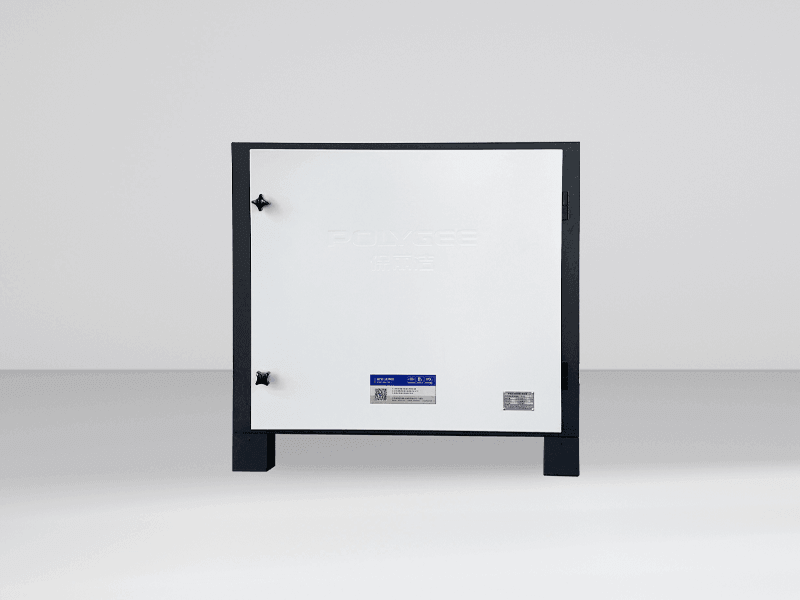
Our media is coal-based columnar carbon with an iodine adsorption value of at least 800 mg/g and a specific surface area of at least 800 m²/g. The figure to hold on to there is the iodine value, because it is a measurable property rather than a descriptive claim, and it is the fair basis on which to compare one supplier’s media with another’s.
The practical unit of purchase is the frame rather than the kilogram. Frame count rises with module size: the CB30, CB40 and CB50 carry four frames each, the CB60, CB80 and CB100 carry eight, and the CB120 carries twelve. Knowing the frame count for your model is what turns “carbon is a consumable” into a number you can put in a budget once you have a price per frame.
Why nobody can give you an interval, and what to ask instead
You will find pages that quote a carbon change interval in months and a lamp life in hours. Treat both with care, and understand what is actually being claimed.
A lamp-hours figure is a property of the lamp under test conditions, not a statement about when your lamps need changing in a duct carrying hot, greasy air. A carbon interval in months is a statement about somebody else’s kitchen. Neither is wrong as a laboratory number; both become wrong the moment they are read as a schedule for a specific site.
The one figure we publish is a planning window: the activated carbon module page gives 3 to 6 months by cooking load, a range to budget against, not a schedule for your site. The change interval for both stages is confirmed for your site and set in writing at quotation, against the cooking process, the operating hours and the airflow. A range is a less satisfying answer than a date, and it is the honest one.
The productive move is to change the question. Instead of asking how long it lasts, ask these, in writing:
| Ask this | Why it is answerable | What a good answer looks like | Buyer action |
|---|---|---|---|
| What is the interval you will commit to for my process and hours? | It is a project statement, not a catalog one | A stated interval tied to named conditions | Put the named conditions in the order |
| What tells me the stage is spent, before the complaint arrives? | There are observable signs | A check the operator can actually perform | Add it to the inspection log |
| What is the price per lamp and per carbon frame today? | These are current prices | Unit prices plus order lead time | Multiply by count; that is your annual line |
| How long will these parts remain available? | It is a commercial commitment | A horizon in years, in writing | Compare against your expected service life |
| What voids the consumable position, and what is under warranty? | The boundary is contractual | Named covered and excluded items | Settle before the order, not at the first failure |
This table answers what to ask when the interval cannot be quoted. It does not tell you what the interval will be; that arrives with the configuration proposal against your own conditions.
The five consumable clauses to settle before you order
Everything above reduces to five lines in a purchase order. They cost nothing to agree beforehand and are difficult to recover afterwards.
One, which items are covered and which are consumable. Our position, so you have something to compare: the whole-unit warranty runs twelve months and covers the electrostatic collection cells and the high-voltage power module; UV lamps and activated carbon media are consumables and are not covered; labor and site attendance are not included and are quoted separately, with chargeable site visits available.
Two, the change interval and the conditions it assumes. Not a number in isolation, but a number attached to the process, the hours and the airflow it was set against, so that a change in the kitchen is visibly a change in the basis.
Three, unit prices and lead time for the consumable items. Price per lamp, per ballast and per carbon frame, with the order lead time. Our standard equipment lead time is 7 to 15 days and the minimum order is one unit; consumable dispatch is confirmed order by order.
Four, the parts horizon. How long items remain orderable after the model is discontinued. Ours is one year, with common spare parts held in stock.
Five, who attends. Whether the supplier, a local contractor or your own team performs the exchange, and what access the work requires. That last point connects back to the layout: the published maintenance clearance on our UV and carbon modules is D = 1,000 mm on the access side, and a module that cannot be opened cannot be serviced at any price. The space side of this is worked through in ecology unit installation.
Scope and limits
Three layers clear separately and passing one does not clear the next. Layer one, the equipment: media grade, lamp count and frame count are properties of the model. Layer two, the installation: access clearance and stage order decide whether the consumable behaves as designed. Layer three, operation: the cooking process, hours and service discipline decide what you actually spend. Passing one layer does not clear the next.
- No carbon change interval and no lamp life figure is given here, for any model; the 3 to 6 month carbon window on the product page is a planning range by cooking load, not a site schedule. Both intervals are set in writing for your site with the configuration proposal.
- No ozone figure is given for the UV-C stage, because we do not publish one. If ozone is a project condition, raise it before the stage is specified.
- Sound levels do not transfer between models. We hold measured figures from specific test reports — 51 dB(A) for an HME integrated hood unit and 49 dB(A) for an SE unit — and those figures belong to those tests, not to the modules described here.
- This page does not cover how the cell is washed. The procedure, the isolation arrangement and who may do which part of it are in the cleaning and maintenance guide; physical work on installed equipment belongs to a competent contractor working to the documentation issued with the unit.
- Nothing here is a compliance determination. Duct cleaning duties in your jurisdiction sit alongside equipment servicing and are a separate obligation.
Inspection and change log
One sheet, kept by whoever operates the kitchen, settles most of the arguments that otherwise arrive two years into a contract.
Per stage, record: what was done, on what date, by whom, and what condition the item was in when it was opened. For the electrostatic stage that is the wash date and the state of the plates. For the UV-C stage it is the number of lamps replaced and the running hours at replacement, if the panel reports them. For the carbon stage it is the number of frames exchanged and whether any showed grease rather than normal loading.
Alongside it, record the conditions: the cooking process as it is now, the daily operating hours, and any change to either. This is the single most valuable column, because it is what makes a shortened interval explainable rather than disputed.
What triggers the next action: a complaint at the discharge, a visible change in the plume, a stage opened and found spent early, or a change in the menu or the hours. What is still missing until commissioning is measured airflow, which no supplier can hand you in advance.
Key takeaways
- Three meanings: one stage is washed, two are consumed — “filters included” means nothing until you know which.
- Different clocks: lamps run on hours, carbon runs on gas-phase load; they do not fall due together.
- Unit of purchase: carbon is bought by the frame, and frame count follows module size — four, eight or twelve.
- Grease is the enemy of the consumable: media blinded by grease is spent early, which is a stage-order and maintenance failure rather than a media failure.
- Ask the answerable question: not how long it lasts, but what interval the supplier will commit to for your named conditions, and at what unit price.
Frequently Asked Questions
- What filters does an ecology unit have?
- Three stages, and only one of them is a filter in the sense most catalogs use. The electrostatic stage holds a collection cell of closely spaced stainless steel plates, which is washed and returned to service rather than replaced. The UV-C stage holds an array of lamps with ballasts, which are consumed on a time basis. The activated carbon stage holds media in withdrawable frames, which is consumed by gas-phase load. Upstream of all three, the hood itself carries grease filters, which are part of the hood rather than part of the ecology unit. When a quotation says filters are included, establish which of these four it means before comparing it with anything.
- How often do ecology unit filters need changing?
- The only interval we publish is the carbon planning window on the product page, 3 to 6 months by cooking load; an interval taken from a catalog is a statement about a different kitchen than yours. The three stages also do not fall due together. The electrostatic cell is washed rather than changed, on a frequency set by grease load. The UV-C lamps decay with running hours, so a fourteen-hour kitchen consumes them roughly twice as fast as a seven-hour one regardless of the menu. The carbon media is consumed by gas-phase load, so a charcoal grill and a bakery at identical airflow and hours will not use it at the same rate. The interval for your site is established against your cooking process, hours and airflow, and set in writing with the configuration proposal.
- Are electrostatic precipitator cells replaced or cleaned?
- Cleaned, in normal service. Our cells are built in stainless steel and are designed to be withdrawn, washed and returned to duty, which is why the recurring cost of that stage is a service visit rather than a stream of replacement media. The cells and the high-voltage power module are also covered by our twelve-month whole-unit warranty, unlike the consumable items in the other two stages. Replacement becomes the question only when the geometry has gone, meaning plates bowed out of parallel or ionizer wires broken, because plate spacing is what creates the field and washing does not restore a deformed stack.
- How much activated carbon does an ecology unit hold?
- It is bought and replaced by the frame rather than by weight, and the frame count follows the module size. Our CB30, CB40 and CB50 modules carry four frames each, the CB60, CB80 and CB100 carry eight, and the CB120 carries twelve. The media itself is coal-based columnar carbon with an iodine adsorption value of at least 800 mg/g and a specific surface area of at least 800 m²/g. For budgeting, the number you need is the frame count for your model multiplied by the current price per frame, which is why the unit price and the order lead time are worth getting in writing at the same time as the equipment quotation.
- What is covered by warranty and what counts as a consumable?
- On our units the whole-unit warranty runs twelve months and covers the electrostatic collection cells and the high-voltage power module. UV lamps and activated carbon media are treated as consumables and are not covered. Labor and site attendance are not included and are quoted separately, with chargeable site visits available. Common spare parts are held in stock and parts remain available for one year after a model is discontinued. Settle this boundary in writing before the order rather than after the first failure, and ask any supplier for the same three things: which items are covered, which are consumable, and how long parts stay orderable.
Working out what a three-stage unit will cost you to run?
Send us four things: the stages in your configuration, the design airflow, what is on the cookline, and the daily operating hours. We will come back with the change interval we will commit to for those conditions, the lamp and frame counts for the modules concerned, the unit prices and order lead time, and a plain statement of what we will not commit to without a site review. You get back a consumable budget you can put in a contract, not a brochure figure.
Reviewed by Law, Project Manager, 29 September 2026
Written by Law · Project Manager, PolygeeLaw manages project delivery at Polygee, from application review and equipment configuration through interfaces, installation support and handover documentation for consultants, contractors and dealers. Polygee, founded in 2004, manufactures the electrostatic, UV-C and activated carbon stages described here. This article describes equipment behavior and our own published commercial terms; it is not a maintenance instruction and not a substitute for the documentation issued with a specific unit.
References & sources
- Polygee — module specifications by model, including lamp and ballast counts, carbon frame counts, media grade and maintenance clearances; commercial terms for warranty, consumables and parts availability. polygeeesp.com
- Building Engineering Services Association — DW/172, Specification for Kitchen Ventilation Systems, the reference specification covering kitchen extract maintenance practice in the United Kingdom. thebesa.com
- NFPA — NFPA 96, Standard for Ventilation Control and Fire Protection of Commercial Cooking Operations, which sets the duct-cleaning duties that run alongside equipment servicing. nfpa.org
Related reading
- What is an ecology unit — the three stages, what each controls, and why the stage order cannot be changed.
- Ecology unit price — what sets the capital number, and the one figure two quotations almost never state the same way.
- Ecology unit installation — the access clearance that decides whether any of this servicing is physically possible.
- Electrostatic precipitator cleaning and maintenance — what a service visit on the washed stage actually covers.