

DW/172, often written DW172, is the Building Engineering Services Association’s Specification for Kitchen Ventilation Systems, the document a UK consultant means when a tender says the extract system shall comply with DW/172. The current text is the second edition of 2018 with addenda from April 2020 and May 2024. It is not a statute; it binds a project through the contract that cites it, through Approved Document F, which points commercial kitchens to it, and through the insurers and councils that write its provisions into their conditions.
It is also more specific than most summaries admit. It allows one extract-rate method, sets the canopy overhang and the separator height in millimeters, tests the grease separators, spaces the access doors, fixes the discharge velocity, and gives the electrostatic precipitator one job with two conditions attached.
This guide sets out what the 2018 edition requires clause by clause, what it leaves to the local authority, and what an in-duct ESP does and does not do inside a DW/172 system. It does not size a canopy or select a unit; the ventilation contractor’s calculation and the product pages do that. For the unit, see the kitchen electrostatic precipitator page; for the UK picture of law, specification and guidance around it, see commercial kitchen extraction regulations in the UK.
One disclosure: Polygee builds in-duct electrostatic precipitators. DW/172 issues no certificates and approves no products, so no unit is “DW/172 approved”, ours included. Our CE certificate FQC2602501 covers the LK30 to LK480, the LK-E series and the UV series, and we state on request what each model carries and what it does not.
What DW/172 is, and how it becomes binding
DW/172 binds a project when a specification, a planning condition or an insurance policy cites it; by itself it binds no one. The first edition appeared in 1999 as DW/171, was renamed DW/172 in 2005, and was rewritten as the second edition published by BESA on 1 October 2018. Addenda followed in April 2020 and May 2024, the latter updating the guidance on fire-resisting and smoke-control ductwork, so the latest edition is the second edition incorporating the May 2024 addendum; as of September 2026 there is no third edition. That addendum is the reason the fire side of a UK kitchen duct is worth reading separately, and the UK position on dampers in the extract is in fire dampers in a commercial kitchen extract. Its scope note defines its verbs: must marks a requirement of law at publication, shall a procedure to be followed in full, should one to be followed unless a considered deviation is equivalent or better.
Four routes make it an obligation. Approved Document F Volume 2, the 2021 statutory guidance to the Building Regulations for buildings other than dwellings in England, sends the designer of a commercial kitchen to HSE Catering Information Sheet 10 (2017) and to DW/172 (2018). The mechanical specification cites it, which makes its shall clauses contract terms. Insurers write cleaning frequencies, usually by reference to TR19, into policy conditions. Local authorities cite its discharge and pollution control clauses in planning conditions, and Section 25 reproduces a Westminster City Council guideline.
| Document | Product scope | What it supports | What it does not prove |
|---|---|---|---|
| DW/172, BESA, 2nd edition 2018, addenda April 2020 and May 2024 | The installed system: canopies, separators, ductwork, fans, interlocks, pollution control, cleaning access | A verifiable standard of design and workmanship a specifier, building control officer or insurer can hold the installer to | Any product’s performance; it issues no certificate and lists no equipment |
| Approved Document F Volume 2, 2021, England | Ventilation of buildings other than dwellings | That a kitchen designed to CAIS 10 and DW/172 follows the statutory guidance | Fire, gas, food hygiene or nuisance compliance |
| TR19 Grease, BESA, August 2020 issue (first published 2019) | Cleaning of grease extract systems | That the system was clean to a measured deposit on a stated date | The design or its performance in service |
| BS 6173:2020 with IGEM/UP/19 Edition 2 (July 2022) | Gas-fired catering appliances and the ventilation interlock | That gas cannot flow unless the ventilation is proved | Extract rate, capture, grease removal or emissions |
This table answers what each document is for. It does not answer whether a kitchen complies with any of them; that takes the design calculation, the commissioning record and the local authority’s conditions.
The design numbers DW/172 sets
The extract rate under DW/172 is calculated from the appliances, never assumed from the room, by a single method. Clause 3.2, repeated at 4.1, states that the thermal convection method should be the only method used. Each appliance is allocated a coefficient in m³/s per m² of its plan area, with separate gas and electric values; area times coefficient is summed for everything under the canopy and multiplied by a canopy factor for exposure to cross-drafts, and diversity factors are not allowed. The schedule shows how far fuel and appliance move the number: a bench 0.03, a mild-steel griddle 0.30 gas and 0.25 electric, a gas wok range 0.90, a chargrill 0.95 gas and 0.52 electric. The specification warns that designing a kitchen by air changes can be dangerous, offers 60 per hour only as an early estimate for sizing risers when the cooking is unknown, and treats an area with no cooking as a preparation area at 20 per hour.
Around that calculation sit the clauses that decide the shape of the build; clause numbers are those of the 2018 edition.
| Clause | What DW/172 says | What it means for the build |
|---|---|---|
| 3.2, 4.1–4.3 | Extract rate by the thermal convection method, which should be the only method used; no diversity factors | The appliance schedule with fuel and plan sizes is the first document the contractor needs |
| 3.7 | Dedicated make-up air at 75 to 95 percent of the extract flow | Supply and extract designed together; the kitchen runs slightly negative |
| 6.2, 6.3, 6.9 | Canopy to exceed the equipment by at least 250 mm on each free side, 600 mm at the front over combination ovens, 300 mm from the open door of solid fuel appliances; at least 450 mm from the separator’s lowest edge to the cooking surface | The canopy is sized from the equipment plan; the UK counterpart of commercial kitchen hood clearance requirements |
| 11.1, 11.3 | Primary grease separators verifiably tested for fire protection performance and separation efficiency; mesh filters not to be used as primary | The first filter is a tested baffle separator; anything finer sits behind it |
| 18.2, 18.5, 18.7 | No flexible ductwork; extract duct to DW/144 at 0.8 mm minimum; where full grease-tightness is required, 1.2 mm stainless or 1.6 mm mild steel, fully welded | Gauge and joints are specified, as under the U.S. codes in grease duct requirements |
| 18.15, 29.1 | Access panels at the side of the duct, at least 10 mm above the base, at each floor on risers; without a cleaning specification, access doors at 2 m centers | Every in-line item, an ESP included, needs access on both sides |
| 18.16, 18.17, 18.19 | Discharge positioned so it cannot be entrained into a supply intake, at a height described by the local authority, at 12 to 15 m/s, with no cowl that obstructs the upward flow | The termination is a local authority matter; the specification sets velocity and shape |
| 20.3–20.5 | Gas interlock under BS 6173 on all new commercial kitchens with gas cooking built or fitted out since September 2001, on both extract and supply air; no override, however short-lived | The ventilation proves itself before gas flows |
| 24.1, 24.11 | Discharge at least 1 m above ridge level as most codes require, or at low level with effective pollution control and local authority approval; the added resistance of any pollution control included when the fan is selected | Pollution control changes the fan selection, not only the discharge |
| 28.2 | Commissioning records separator face velocity, supply and extract flows, the airflow verified at the canopy itself and not only at the fan, the total system pressure drop, fan currents, noise and CO/CO₂ | The commissioning record is the evidence that the calculated rate was delivered |
This table answers what the clauses ask for. It does not answer whether a design meets them; that is the contractor’s calculation and the 28.2 record, and the U.S. counterparts of the same decisions are in commercial kitchen hood CFM requirements. Four sections the table above only touches are read clause by clause elsewhere: Section 10 on make-up air in commercial kitchen makeup air requirements, Section 20 on gas interlocking in gas interlock in a commercial kitchen, Section 22 on demand controlled kitchen ventilation in demand control kitchen ventilation, and Section 29 on cleaning, beside TR19 Grease, in the TR19 Grease cleaning standard.
Grease separation comes first
Under DW/172, anything downstream is considered only after a high-efficiency canopy with tested primary separators is in place. Clause 24.3 makes that the precursor to any pollution control, and Section 11 defines “tested”: verifiably tested for fire protection performance and for separation efficiency, with UL 1046, VDI 2052, ASTM F2519, NFPA 96, UL 710 and LPS 1263 named as the routes. A separator that retains grease in its matrix is not to be used as primary, and mesh, which has no barrier to flame, sits only behind the baffle separator as a coalescer. On maintenance, the specification asks for visual inspection at least weekly, baffle separators cleaned at least weekly, secondary mesh twice a week, and the duct cleaned by a specialist to the intervals in Table 12, from 12 months for light duty to 2 months for heavy grease production above 16 hours a day, with the note that property insurance policies often stipulate more. The U.S. reading of the same duties is in commercial kitchen exhaust cleaning requirements.
Section 24, pollution control: what DW/172 says about smoke, odor and the ESP
DW/172 treats pollution control as project-specific, names five pollutants, and gives the electrostatic precipitator one job with two conditions attached. Clause 24.1 opens with the discharge: most codes and regulations call for the exhaust to leave at least 1 m above ridge level, and with an effective pollution control system installed, subject to local authority approval, a low-level discharge should be possible. Clause 24.12 adds that planning authorities in dense urban areas increasingly call for high-performance odor control from the outset, even with a high-level discharge. Clause 24.5 defines the pollutants as particulate matter, meaning smoke; cooking odors; surplus ozone, only where UV-C is involved; heat; and noise. Clause 24.7 explains why odor cannot be handed to the particulate stage: removing the particulate reduces the smoke, but most of the odor sits in the gas phase as volatile organic compounds too small for filtration.
| Option | The role DW/172 gives it | The condition DW/172 attaches | On this site |
|---|---|---|---|
| Electrostatic precipitator (24.6, 24.7) | Reduces the smoke at the discharge to a particle size the eye cannot see, which the specification puts at 0.3 microns or smaller | Care in selection, because at higher velocities small particles can pass through untreated; not a primary form of odor control, although it removes moisture and extends the life of disposable filters downstream | Kitchen electrostatic precipitator |
| Three stages of disposable filters (24.6, Appendix B) | The alternative route to the same particulate result; their life depends on what reaches them | Classified under ISO 16890 (Appendix B) | Not a Polygee product |
| Activated carbon (24.7, 24.8) | Adsorbs gas-phase odor; also the recommended means of adsorbing surplus ozone before discharge where UV-C is used | Needs a high level of upstream protection or the cells have a short life; increasingly not accepted by local authorities as the primary means of odor control | Activated carbon filter |
| UV-C lamps (24.7, 24.8, 22.13) | Break down odor molecules by photolysis and, at 185 nm, by the ozone released; in the canopy plenum, the ventilated ceiling or a remote ecology unit | Interlock between fan and lamps; a local isolator; staff not to see the lamps when removing separators; regular maintenance; filtration to adsorb surplus ozone before discharge, with carbon the recommended means; more ozone at reduced airflow under demand control | UV kitchen odor control |
This table answers how the specification describes each option. It does not answer which combination a kitchen needs; under 24.5 that is decided by the pollutant present, the discharge and the local authority, and under 24.11 whichever combination is chosen adds resistance that goes into the fan selection. Dispersion itself stays the baseline, at the height the authority describes and 12 to 15 m/s at the terminal; the U.S. distances for the same outlet are in commercial kitchen exhaust termination requirements.
Does a commercial kitchen extract have to vent outside under DW/172?
Not always, but the route that does not is narrow. Section 25 covers systems that recirculate treated air back into the space, reproducing the Westminster City Council guideline that a new hot-food application needs either a full-height discharge scheme or an approved recirculation scheme with electric-only cooking. Its conditions: no external discharge of cooking effluent; all cooking by electricity; recirculated air meeting the Workplace (Health, Safety and Welfare) Regulations 1992 and the HSE EH40 exposure limits; no UV or ozone in the filtration process, which the clause reads as excluding electrostatic precipitators; an interlock so that cooking runs only when airflow is proved; filter status monitored, with the system inoperable if a filter is removed; and signage that no gas or solid fuel may be used. An in-duct ESP therefore belongs to the discharging route. The U.S. equivalent, the UL 710B listing, is in UL 710B vs UL 710, where, unlike Section 25, the listed package is built around an ESP as its particulate stage.
DW/172 odor control: what the specification settles, and what the council decides
Section 24 of DW/172, Pollution Control, describes the stages that treat smoke and odor and the conditions attached to each. It does not set how much odor control a site needs; the local authority decides that. Where a council scores that level, it typically uses the Annex C risk method of the Defra guidance on the control of odour and noise from commercial kitchen exhaust. Its four parts are dispersion, distance to the nearest sensitive receptor, kitchen size and cooking type; the total sets a low, high or very high level of odor control.
Defra withdrew the guidance on 15 September 2017, but councils still reproduce its method. Westminster’s March 2021 guidance, for example, prefers full-height discharge, then electric-only recirculation, and uses the score for the bespoke low-level schemes that come third. It recommends the paid EMAQ+ update of the same guidance.
| Odor-side question | Who answers it | Where it is covered |
|---|---|---|
| Which stages treat smoke and odor, and the conditions on each | DW/172, Section 24 | The pollution control table above |
| The resistance those stages add to the fan duty | DW/172, Section 24, then the ventilation engineer’s fan selection | The pollution control table and the clause table above |
| How much odor control the site needs | The local authority, usually through the Annex C risk score | The UK odor control guide linked below |
| Whether a low-level discharge or a recirculation scheme is acceptable | The local authority, on the whole scheme; DW/172 Section 25 sets the conditions for recirculation | The recirculation answer above, and the scheme routes in the UK odor control guide |
| What a factory-direct ESP order for a UK kitchen covers, and which documents come with it | The supplier, in writing | Our electrostatic precipitator UK page, linked below |
This table answers who decides each odor question. It does not answer what your site scores; that needs the address, the discharge position, the covers and the menu.
Decision rule. If the condition or complaint is visible smoke or grease at the terminal, look at the in-duct ESP after the tested separators. If it is smell, the ESP alone does not answer it. Add UV-C or activated carbon behind it, with the conditions the pollution control table lists, and carry their resistance into the fan selection. In the high or very high band, settle the whole train with your ventilation engineer before the fan is chosen.
To total the score for your address and find your scheme route, use our guide to commercial kitchen odor control in the UK, which reproduces the scoring table. If the scheme discharges externally and you are buying the particulate stage direct from the factory, read our electrostatic precipitator UK page. It sets out what the order covers, the documents we supply and the inputs for a quotation you can compare.
Which document proves what
Nothing about a DW/172 system is proved by a product certificate alone; compliance with the specification is shown by the design calculation and the commissioning record, and each certificate answers one component and one question.
| Evidence | What it supports | What it does not prove on its own | Product-condition scope | Buyer action |
|---|---|---|---|---|
| DW/172 design calculation and 28.2 commissioning record | The rate was calculated by the thermal convection method and delivered at the canopy, with the total pressure drop measured | Smoke or odor at the discharge; cleanliness in service | That installation, that day | Ask for both at handover; check the flow was measured at the canopy |
| TR19 Grease certificate | The grease extract was cleaned to a measured deposit on a stated date | The design, or the duct a month later | The cleaned sections | Match the interval to the insurance policy, not only the table |
| EN 16282-6:2020 (separators) and EN 16282-8:2017 (installations for the treatment of aerosol) | Design and safety requirements for the separator, or for the exhaust treatment installation, including temperature resistance and access for maintenance | A DW/172 clause, a planning condition or an odor level | The component or installation assessed | Ask each supplier which route the product holds; Polygee holds no EN 16282-8 report and says so |
| CE certificate (for Polygee, FQC2602501 under the Machinery, EMC and Low Voltage Directives) | Conformity of the named models with those directives; CE marking continues to be recognized for the Great Britain market under the Product Safety and Metrology etc. (Amendment) Regulations 2024 | Performance, DW/172 compliance or any emission result | The LK30 to LK480, LK-E and UV series only | Match the model on the quotation to the models the certificate names |
| Third-party grease removal efficiency report (for example, CMA-accredited report ZY05W230298 on Polygee LK units) | Grease removal at rated, evenly distributed airflow under that test | The 0.3 micron smoke result in 24.6, an odor result, or performance at another velocity | The tested model at its rated airflow | Request the report itself and check the serial-number link and test conditions before treating any efficiency figure as a performance basis |
This table answers which document to ask for against which question. It does not answer what a unit will measure on a given cookline; only a site measurement does, and DW/172 asks for that at commissioning.
Where a Polygee in-duct ESP fits a DW/172 system
An in-duct ESP is a candidate for the particulate stage of Section 24 when visible smoke at the discharge is the problem; it remains the wrong answer when odor is the complaint or the route is recirculation. Acceptance comes in three layers, and passing one layer does not clear the next.
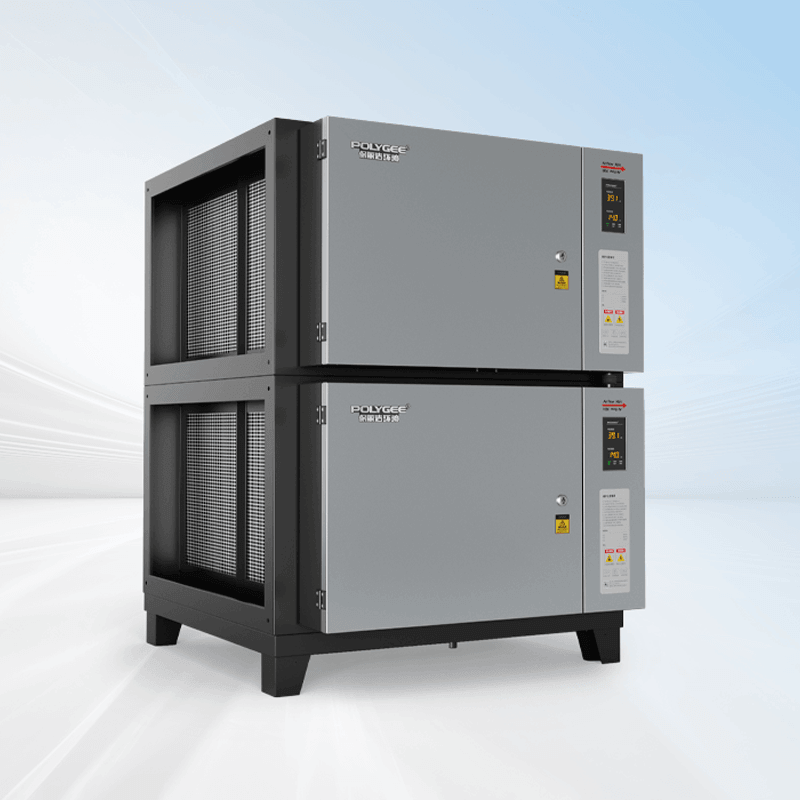
Layer 1, the equipment. Clause 24.6 names electrostatic precipitators for particulate reduction without describing a construction. Ours are washable stainless-steel collector cells in a duct-mounted housing, with the LK series starting at 2,000 m³/h. In CMA-accredited third-party tests the LK units reached up to 97.6% grease removal at rated, evenly distributed airflow; that is a grease removal test, not the smoke particle-size result 24.6 refers to, and not an odor result. A complete unit with its standard airflow distribution plate is rated at ≤150 Pa, the figure clause 24.11 sends to the fan selection. The UL 867 listing on the LK/SE 6K, 12K and 18K is a U.S. document and plays no part in a UK review; we hold no EN 16282-8 report and no LPCB approval, and we state that in writing.
Layer 2, the installation. The unit sits after the tested primary separators, never instead of them, with its own access on both sides and a drain. The velocity caution in 24.6 is addressed at selection: the flow from the thermal convection calculation has to fall within the rated band of the model chosen, and the distribution plate our resistance figure includes is there to even the flow across the cells. Where UV-C is added for odor, the fan interlock and the local isolator are the specification’s conditions, and clause 24.8 calls for filtration to adsorb surplus ozone before discharge, with activated carbon as the recommended means; our UV page sizes the duct run for ozone consumption, and a UK scheme still has to show the council how surplus ozone is handled.
Layer 3, the system in operation. Commissioning under 28.2 measures the flow at the canopy and the total pressure drop with the unit in the duct; the local authority sets the discharge height and judges any low-level scheme; the cell cleaning is logged beside the TR19 certificates. None of that is proved by the unit’s documents. What the cleaning certificate has to carry, and why Section 29’s own Table 12 does not always give the same interval as TR19 Grease, is in the TR19 Grease cleaning standard. What the unit does not do is as useful in a specification as what it does: it does not control odor on its own, so a smell complaint goes to UV-C or carbon on the UV kitchen odor control page; it has no place in a recirculation system under 25.5; and it does not by itself make a low-level discharge acceptable, which is the authority’s decision on the whole scheme. The static pressure its resistance consumes is worked through in commercial kitchen exhaust fan requirements.
Where this guide stops
- The text. DW/172 is a copyrighted document sold by BESA; this guide paraphrases the 2018 clauses, and a project reads them with the 2020 and 2024 addenda. A contract written before October 2018 may cite the 2005 edition, whose schedule and pollution control section differ.
- Local authority discretion. Discharge height, low-level approval and the odor control level are the authority’s decisions under its own guidance and the EMAQ+ risk score described in commercial kitchen extraction regulations in the UK.
- Devolved law and solid fuel. The Approved Document F reference is the English one; Scotland and Northern Ireland have their own building and fire legislation. Section 14 adds spark arrestors, CO and CO₂ detection and separation distances for charcoal and wood appliances not reproduced here; the U.S. reading is in solid fuel cooking exhaust requirements.
Buyer record: what to have ready, what to ask for, what triggers a re-check
- Have ready: the appliance schedule with fuel type and plan sizes; the canopy type, height and free sides; the discharge point, its height against eaves and ridge, and the local authority’s condition on it; the insurer’s cleaning clause; whether UV-C or carbon is planned; the pressure budget on the fan.
- Ask the ESP supplier for: the CE certificate naming the model quoted; the third-party test report with method, airflow and conditions; the resistance at your design airflow; the rated airflow band against your calculated flow; the access and drain drawing; a written statement of what the model does not hold.
- Re-check when: an appliance or its fuel changes, because the coefficient changes; UV-C is added, because the interlock, the isolator and the surplus-ozone filtration follow; the discharge moves or the authority’s condition changes; the scheme changes to recirculation, which removes the ESP; or BESA issues a new addendum or edition.
Frequently Asked Questions
- Is DW/172 a legal requirement in the UK?
- No statute names DW/172; it is a specification published by the Building Engineering Services Association. It binds a project through four routes: Approved Document F Volume 2, the statutory guidance to the Building Regulations in England, points commercial kitchens to HSE Catering Information Sheet 10 and to DW/172; the mechanical specification cites it, which makes it a contract term; insurers write cleaning frequencies into policy conditions; and local authorities write its discharge and pollution control clauses into planning conditions. Its own verbs tell you what kind of clause you are reading: must marks a requirement of law, shall the specification’s own requirement, should a default open to a considered equivalent.
- What extract rate does DW/172 require for a commercial kitchen?
- DW/172 gives no single figure. It names the thermal convection method and states that this should be the only method used: each appliance under the canopy is given a coefficient in cubic meters per second per square meter of its plan area, with separate gas and electric values, the products are added, and the total is multiplied by a canopy factor; diversity factors are not allowed. The coefficients and a worked example are in the section above, and the delivered rate is measured at the canopy at commissioning, not only at the fan.
- Does DW/172 allow a kitchen extract to discharge at low level?
- Under conditions. Clause 24.1 notes that most codes and regulations call for the exhaust to discharge at least 1 meter above ridge level, and that with an effective pollution control system installed, and subject to local authority approval, a low-level discharge should be possible. The height itself is set by the local authority; the specification asks for 12 to 15 meters per second at the terminal, no cowl that impedes the upward flow, and a check on courtyards, air intakes, maintenance access and approvals. Systems that recirculate treated air instead of discharging it are covered separately in Section 25, which limits them to electric-only cooking and excludes UV, ozone and electrostatic precipitators.
- Does DW/172 require an electrostatic precipitator?
- No. Section 24 makes pollution control project-specific and names the electrostatic precipitator as one way to reduce the smoke in the exhaust to a particle size at the discharge that the eye cannot see, with three stages of disposable filters as the alternative. It attaches two conditions: care in selection, because at higher velocities small particles can pass through untreated, and that an ESP should not be considered a primary form of odor control, although it removes moisture and extends the life of disposable filters downstream. Whether a kitchen needs an ESP is decided by the smoke at the discharge, the discharge height and the local authority, not by the specification.
Writing an extract specification to DW/172?
Send us the appliance schedule with fuel types and plan sizes, the calculated extract flow, the duct route with the position available for an in-line unit, the discharge height and the local authority’s condition on it, and whether UV-C or carbon is planned. Our project team will come back with the model whose rated airflow band fits the flow, its resistance at that flow for the fan selection, the documents that model carries, and a written statement of the ones it does not.
Talk to our project team →Reviewed by Law, Project Manager, 9 October 2026
Written by Law · Project Manager, PolygeeLaw manages kitchen exhaust filtration projects at Polygee, from spec review through duct-side ESP sizing and installation support. Polygee, founded in 2004, builds commercial kitchen exhaust filtration equipment. This article summarizes a published specification and public guidance for planning purposes only — it is not a compliance determination, so confirm the requirements for a specific project with your ventilation contractor, your local authority and the edition of the specification named in your contract.
References & further reading
- Building Engineering Services Association — DW/172 Specification for Kitchen Ventilation Systems, second edition 2018, with addenda April 2020 and May 2024. publications.thebesa.com
- NBS Publication Index — DW/172 Specification for kitchen ventilation systems, 2nd edition (incorporating addendum May 2024), superseding the 2nd edition incorporating the addendum of April 2020. thenbs.com
- HM Government — Approved Document F, Volume 2: Buildings other than dwellings, 2021 edition. gov.uk
- Health and Safety Executive — Catering Information Sheet No 10, Ventilation in catering kitchens (2017). hse.gov.uk
- Building Engineering Services Association — TR19 Grease and kitchen extract system cleaning. thebesa.com
- Institution of Gas Engineers and Managers — IGEM/UP/19 Edition 2 and Supplement 1, interlock devices in commercial catering establishments. igem.org.uk
- BSI Knowledge — BS EN 16282-6:2020, Equipment for commercial kitchens, Components for ventilation in commercial kitchens, Part 6: Aerosol separators; the same series carries Part 8, Installations for treatment of aerosol (2017). knowledge.bsigroup.com
- Department for Business and Trade — Placing UKCA or CE marked products on the market in Great Britain. gov.uk
- Westminster City Council — Prevention of odour and fume nuisance from commercial kitchen exhaust systems (March 2021). westminster.gov.uk
- Polygee — kitchen exhaust filtration product range and third-party test reports. polygeeesp.com
Related reading
- Commercial kitchen extraction regulations in the UK — the map of law, specification and guidance that DW/172 sits inside, with the EMAQ+ odor risk score and the planning route.
- Commercial kitchen exhaust fan requirements — what the added resistance of a pollution control unit does to the fan selection.
- Commercial kitchen exhaust cleaning requirements — the NFPA 96 inspection intervals, and why they are not a cleaning calendar, to set beside Table 12 and TR19.
- UL 710B vs UL 710 — the U.S. listing that governs recirculating systems, the counterpart of Section 25 with the opposite view of the ESP.