

Commercial kitchen odour control in the UK starts with an awkward fact: the guidance almost everyone still cites, the Defra document on the control of odour and noise from commercial kitchen exhaust systems, was withdrawn on 15 September 2017, and no government replacement has been published since. What survived is a method — a four-part risk score that sets how much abatement a site needs — carried forward in local authority documents and in a paid successor from the same authors. The contrast worth knowing before you price anything is that the score is dominated not by your equipment but by where and how fast you discharge, and that one common scheme type in central London may not legally contain an electrostatic precipitator, UV or ozone stage at all. This guide sets out which documents a council actually works from, reproduces the scoring table so you can total your own site, explains what each stage in a treatment train removes and what it leaves behind, and gives you a worksheet you can put straight into an enquiry.
This guide helps you decide what level of odour control your site needs, and which treatment stages belong in the train once that level is known. It does not size or select equipment, calculate your extract rate, or tell you what a particular council will accept. For the wider UK regulatory picture see commercial kitchen extraction regulations in the UK; for product-specific review, the kitchen electrostatic precipitator page.
| Application | Critical input | Initial route | Still needs confirmation |
|---|---|---|---|
| New or changed hot food premises in the UK | Discharge height and velocity, distance to nearest sensitive receptor, covers, cuisine | Total the four-part risk score, then match the control level to it | The local authority’s own guidance, which may be stricter than the general method |
| Full-height external discharge | Whether a route to above ridge or eaves exists | Treatment train sized to the scored level, with an electrostatic precipitator as the particle-phase stage | Structural and planning feasibility of the stack |
| Recirculation | Whether cooking is electric only, and which borough | In Westminster this route excludes ESP, UV and ozone stages entirely | Air quality testing by an accredited laboratory, and the council’s position |
| Bespoke low-level external discharge | Why the other two routes are not possible | Scored design, generally the longest treatment train | Case-by-case acceptance; no low-level scheme fully removes impact |
| Existing site with a complaint | What changed: menu, covers, discharge, or neighbours | Re-score before re-equipping — the change may be in dispersion | Whether an abatement notice or planning condition already fixes the answer |
Why the fan is not the answer, and what the two problems actually are
The most common question behind this search is whether an extractor fan gets rid of smells. It does not, and the reason is worth stating precisely because the rest of the decision follows from it. A fan establishes airflow. It changes where cooking exhaust goes. It does not change what that exhaust contains.
Cooking exhaust carries two populations that behave differently and are removed by different means. The first is particle-phase: oil droplets, grease aerosol and smoke, suspended in the airstream and large enough to be collected by a device that charges and attracts them. The second is gas-phase: molecules released by the cooking process that are not attached to any particle and pass straight through a collector that works on charge.
An electrostatic precipitator acts on the first population. That is what it is for, and within an external-discharge system it is normally the first treatment stage after the hood filters, because everything downstream of it lasts longer when the particle load has already been taken out. It does not act on the second population, and a supplier who implies otherwise is selling you a service interval problem. Ordering a precipitator direct from our factory for a UK project? What that order covers and where the unit sits under DW/172 are set out on our electrostatic precipitator UK page.
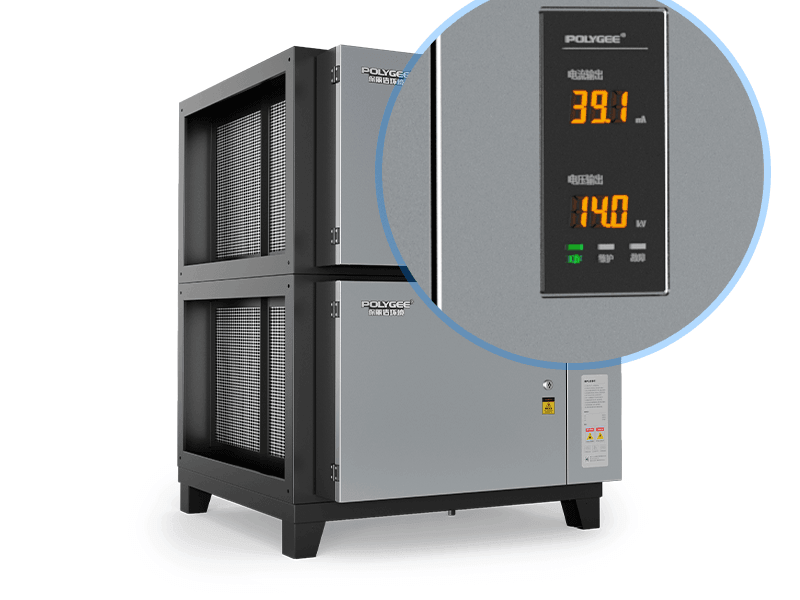
Decision rule. If the complaint is visible smoke or greasy deposition around the terminal, the particle-phase stage is where to look. If the complaint is smell with no visible plume, adding collection capacity alone will not settle it, and the question becomes which gas-phase stage to add behind the precipitator — or whether the discharge arrangement itself is the cheaper fix. Key point: establish which of the two problems you have before anyone quotes equipment.
Which document a council actually works from now
This is the part that trips up buyers who do their own research, because the document that comes back first from a search is no longer live.
| Document | Status | What it supports | What it does not prove | Buyer check |
|---|---|---|---|---|
| Defra, Guidance on the control of odour and noise from commercial kitchen exhaust systems (ref. PB10527, prepared by Netcen, an operating division of AEA Technology) | Withdrawn on 15 September 2017 | The four-part risk assessment method that is still in general use, reproduced in local guidance | Any current government position. The gov.uk page now points to general guidance on how councils deal with nuisance smell complaints | If a proposal cites it, ask whether the author knows it was withdrawn |
| EMAQ guidance, Control of Odour and Noise from Commercial Kitchen Exhaust Systems, first issued by Ricardo-AEA Limited in 2018 and since revised; emaq.uk now sells Version 3 | Current in practice, sold rather than published free | An updated treatment by people involved in the original Defra document | That it is government guidance. It is not | Ask which edition the designer worked from, and whether they hold a copy |
| Local authority guidance, e.g. Westminster City Council, Prevention of odour and fume nuisance from commercial kitchen exhaust systems, March 2021 | Current for that authority | Scheme routes, acceptance conditions and the reproduced scoring table for that borough | Anything about other boroughs, which publish their own | Get the guidance for your actual authority before design |
| DW/172, Kitchen Ventilation Systems, Second Edition 2018, BESA | Current industry specification | Ventilation system design, including make-up air, referenced directly by Westminster | Odour acceptability at the boundary, which is an environmental health matter | Confirm the edition; the second edition carries later addenda |
| TR19 Grease, Specification for Fire Risk Management of Grease Accumulation within Kitchen Extraction Systems, BESA, August 2020 issue | Current | The cleaning regime for the ductwork the treatment stages sit in | Anything about abatement performance | Agree who owns cleaning before handover |
| HSE EH40, Workplace Exposure Limits | Current | The exposure limits recirculated air is tested against, including CO, CO2, ozone and NOx | Anything about external discharge | Only relevant if the scheme recirculates |
A note on the dates, because they do not agree. The gov.uk record for the withdrawn publication gives a publication date of 25 March 2011, while Westminster’s 2021 guidance refers to the same document as the 2005 Defra guidance. We have not reconciled that, and it does not affect a design decision: what matters today is the withdrawal, not the edition year. Where a date matters to your submission, take it from the document your authority names rather than from a secondary source.
Score your site: the four-part method, reproduced
The method is a sum of four contributions — dispersion, proximity of receptors, size of kitchen and cooking type — and the total places the site in one of three bands. The table below is reproduced from Westminster City Council’s March 2021 guidance, which itself reproduces Annex C of the withdrawn Defra guidance. It is not a Polygee scoring system and we have not modified it.
| Criteria | Band | Score | Score details |
|---|---|---|---|
| Dispersion | Very poor | 20 | Low level discharge, discharge into courtyard or restriction on stack |
| Poor | 15 | Not low level but below eaves, or discharge at below 10 m/s | |
| Moderate | 10 | Discharging 1 m above eaves at 10–15 m/s | |
| Good | 5 | Discharging 1 m above ridge at 15 m/s | |
| Proximity of receptors | Close | 10 | Closest sensitive receptor less than 20 m from kitchen discharge |
| Medium | 5 | Closest sensitive receptor between 20 and 100 m from kitchen discharge | |
| Far | 1 | Closest sensitive receptor more than 100 m from kitchen discharge | |
| Size of kitchen | Large | 5 | More than 100 covers or large sized take away |
| Medium | 3 | Between 30 and 100 covers or medium sized take away | |
| Small | 1 | Less than 30 covers or small take away | |
| Cooking type (odour and grease loading) | Very high | 10 | Pub (high level of fried food), fried chicken, burgers or fish & chips |
| High | 7 | Kebab, Vietnamese, Thai or Indian | |
| Medium | 4 | Cantonese, Japanese or Chinese | |
| Low | 1 | Most pubs, Italian, French, Pizza or steakhouse |
Total below 20 is a low to medium impact risk, calling for a low level of odour control. Total of 20 to 35 is a high impact risk, calling for a high level. More than 35 is a very high impact risk, calling for a very high level. This table answers how much control the site needs. It does not answer which equipment delivers that level; that depends on the scheme route and the treatment stages discussed below.
The published guidance includes four worked examples, reproduced here because they show how the weightings behave in practice. These are the guidance’s figures, not measurements from our own projects.
| Example | Dispersion | Proximity | Size | Cooking type | Total | Band |
|---|---|---|---|---|---|---|
| Small Indian restaurant, extract discharging into a small courtyard | 20 | 10 | 1 | 7 | 38 | Very high |
| Traditional pub, rural, discharging at roof ridge, nearest receptor 25 m | 5 | 5 | 5 | 1 | 16 | Low to medium |
| Medium French restaurant, ground floor of a two-storey building with taller neighbours, discharging at eaves | 15 | 10 | 3 | 1 | 29 | High |
| Large burger restaurant within 20 m of housing, discharging at eaves | 10 | 10 | 5 | 10 | 35 | High |
What the examples show that the table alone does not. The small Indian restaurant is the smallest kitchen of the four and lands in the highest band, because a courtyard discharge scores the full 20 for dispersion and the receptor is close. The large burger restaurant has five times the covers and the worst cooking type, and still scores lower. Decision rule: before adding a treatment stage to a poorly dispersing site, price the alternative of fixing the discharge, because dispersion is the only criterion on the sheet that can move by 15 points.
Three scheme routes, and the one that rules our equipment out
Westminster’s guidance sets out three routes, in a deliberate order of preference, and the route decides whether there is an equipment conversation at all.
| Route | What it is | Where an ESP fits | Main constraint | Buyer consequence |
|---|---|---|---|---|
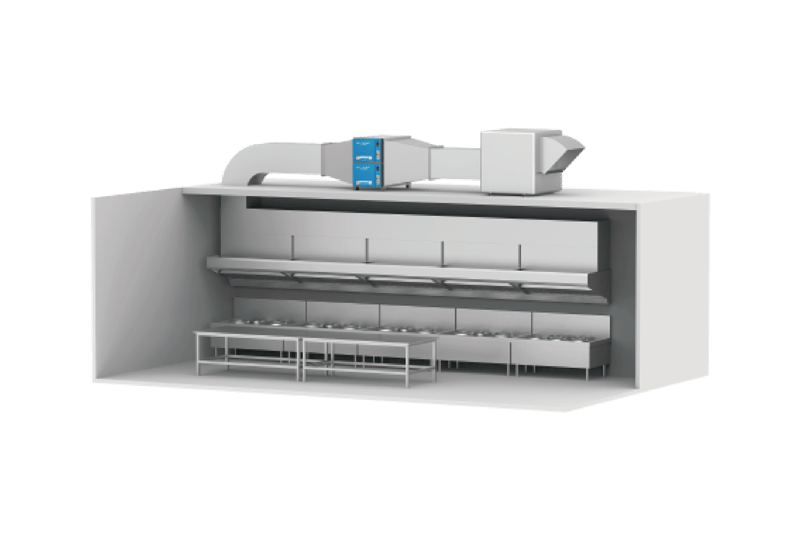
| Full-height external discharge (first option) | Discharge at high level, above eaves or ridge | Particle-phase stage in the treatment train, sized to the scored level | Needs a physical and planning route for the stack | Scores lowest on dispersion, so often the shortest treatment train for a given band |
| Recirculation (second option) | No direct external discharge of cooking fumes; treated air returned to the space | Not permitted. The system must not incorporate elements that generate or add chemicals, and UV, ozone and electrostatic precipitators are named as examples | Electric cooking only — no gas or solid fuel; interlocked with the cooking equipment; filter status monitored | If this is your route in Westminster, our equipment is not part of it. Air must be tested against HSE EH40 by an independent ISO 17025 UKAS accredited laboratory |
| Bespoke low-level external discharge (third option) | Discharging below eaves level, designed case by case | Particle-phase stage, normally with gas-phase stages behind it | Permitted only where the other two routes cannot be implemented; no low-level scheme removes all impact | Highest dispersion score, therefore usually the longest and most expensive train |
We would rather lose the enquiry here than later. A recirculating scheme in that borough is a scheme our electrostatic precipitator, UV and activated carbon stages cannot be specified into, and no amount of performance data changes that, because the rule is about what the unit may contain rather than about how well it performs. Establish the route first.
Two cautions on reading that. The rule quoted is Westminster’s, and local authorities publish their own guidance, so it should not be treated as a national prohibition. And the requirement that recirculating schemes run on electric cooking only interacts with gas safety obligations — see gas interlocks in commercial kitchens for that side of it.
What each stage removes, and the order they go in
Once the route is external discharge and the band is known, the train is assembled from stages that do different jobs. The order is not a preference; it follows from what each stage acts on.
| System stage | Controls | Does not control | Critical interface | What it means for the build |
|---|---|---|---|---|
| Hood and grease filters | Capture at source; coarse grease | Fine particulate that passes; anything gas-phase | Capture velocity, filter listing and access | What is not captured here cannot be recovered downstream |
| Duct and fan | Transport; duct velocity | Odour, in either phase | Design airflow, static pressure allowance | Budget static pressure for the treatment stages before selecting the fan |
| Electrostatic precipitator | Particle-phase oil droplets, grease aerosol and smoke | Gas-phase compounds; any compliance conclusion on its own | Upstream pressure drop, power supply, access for cell removal | First treatment stage. Protects the service life of everything behind it |
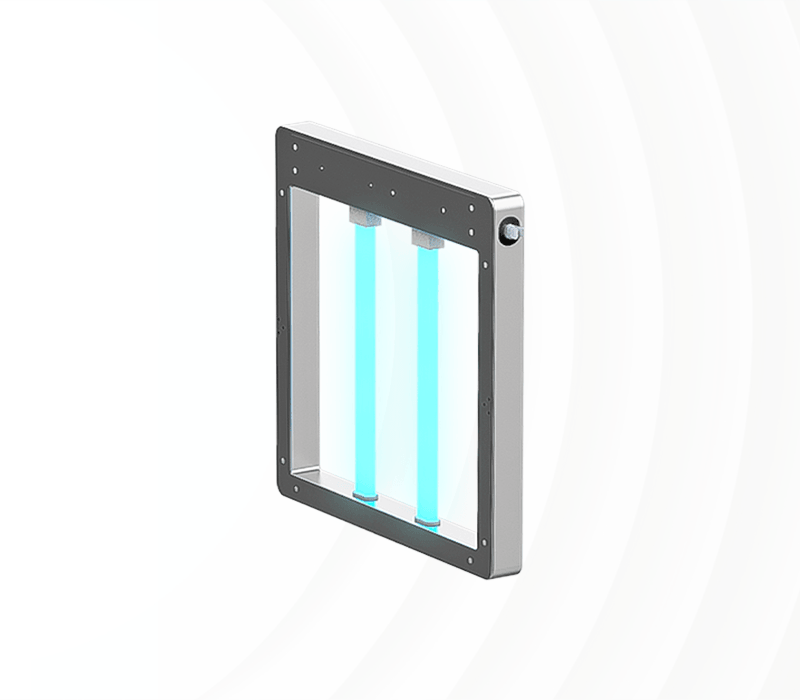
| UV stage | Acts on part of the gas-phase fraction | Particulate; it is not a collector | Lamp replacement access, ozone management, interlocks | Enters consideration in the higher bands, not as a default addition |
| Activated carbon | Adsorbs gas-phase molecules | Particulate — grease blinds the working surface | Replacement access, pressure drop as it loads | Polishing stage, placed after the precipitator. In front of it, the media is spent on grease |
| Discharge terminal | Dispersion | Source concentration | Height, efflux velocity, direction, nearby openings | Worth up to 15 points on the score sheet. Frequently the cheapest improvement available |
Carbon is usually the better candidate when the residual complaint is smell with no visible plume and the discharge arrangement is already as good as the site allows. The precipitator remains the better first investment when there is visible smoke or greasy deposition, because a gas-phase stage installed in front of an untreated particle load is replaced on a schedule set by grease rather than by odour. This table answers what each stage acts on. It does not answer how many stages your band requires, which is a design decision for your ventilation engineer working from your authority’s guidance.
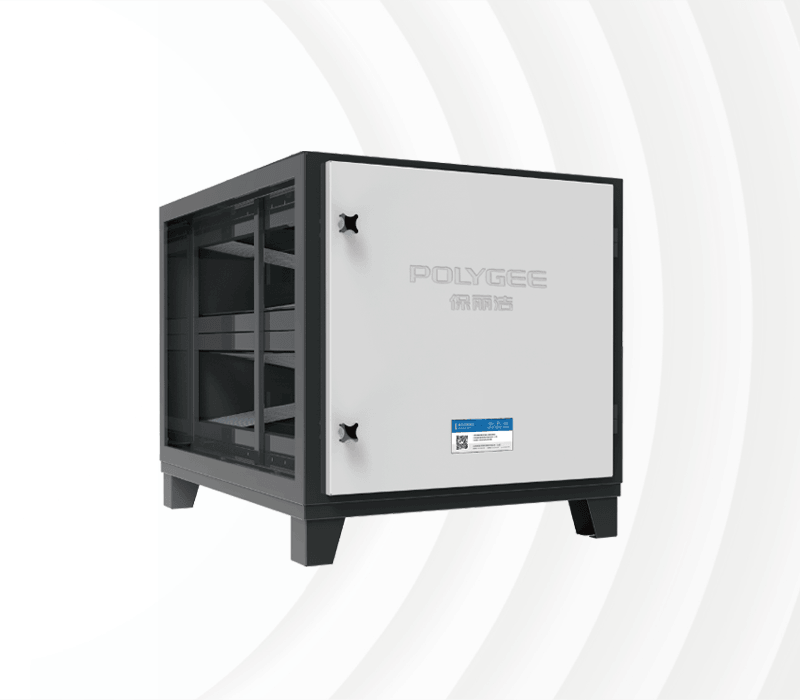
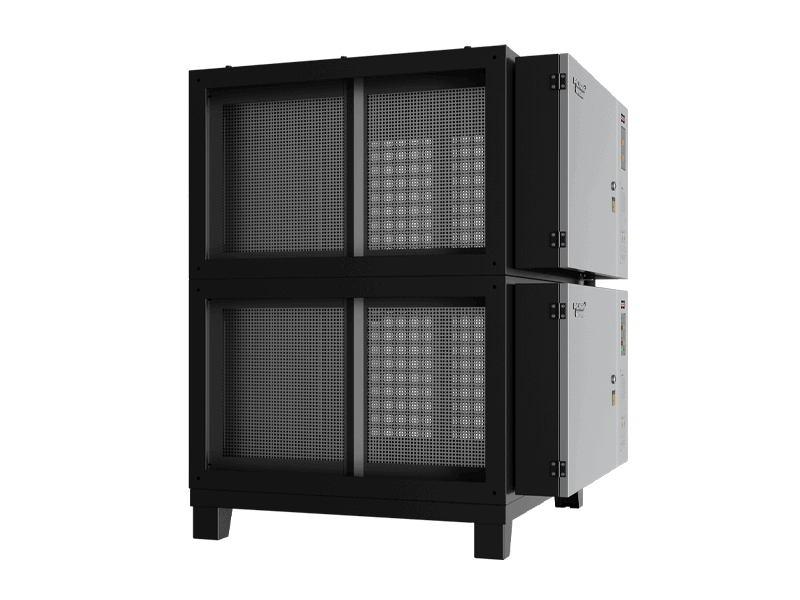
Where the whole train is delivered as one packaged unit rather than as separate sections, that is what the market calls an ecology unit; the stage logic above is unchanged, but the interfaces move inside the box and the access arrangements become a single supplier’s responsibility.
Scope and limits
An electrostatic precipitator collects particle-phase grease and smoke carried in the exhaust stream. Outcome at the terminal depends on capture at the hood, actual airflow against design, bypass leakage, cell condition and maintenance history — none of which are properties of the equipment alone. Passing one layer does not clear the next.
- Equipment evidence does not establish site compliance. A test report describes a unit under stated conditions. It does not describe your kitchen. Next step: ask for the report itself, with the issuing laboratory, its accreditation and the test conditions, and check which model numbers it covers.
- Installation and interfaces are a separate layer. Correct equipment installed with bypass leakage, inadequate access or a fan selected without allowance for the treatment stages will not perform as tested. Next step: settle static pressure allowance and access dimensions at design stage, not at commissioning.
- Operation is a third layer. Performance follows the maintenance regime. Next step: ask every supplier to state a written cleaning interval for the duty you have described, and treat any interval quoted without reference to your cooking type and hours as provisional.
- We cannot tell you what your council will accept. The scoring method is published and general; acceptance is local and case by case, particularly for low-level discharge. Next step: obtain your authority’s current guidance before design.
- This page does not address odour assessment for planning. Where a planning application needs a formal assessment, that is the Institute of Air Quality Management’s guidance and a qualified assessor’s work, not a supplier’s. Next step: ask your planning consultant whether an assessment is required before specifying.
- Recirculating schemes in Westminster are outside our scope entirely. Next step: confirm the scheme route first; if it is recirculation, the specification belongs to suppliers of systems built for that rule.
Buyer record
Before you request a quotation, record: the discharge arrangement including height relative to eaves or ridge and the efflux velocity; the distance to the nearest sensitive receptor; covers or take-away size; the cuisine and how much frying is involved; the design extract rate; and which of the three scheme routes the project is taking.
Ask every supplier for: which stage in their proposal acts on particle-phase grease and which acts on gas-phase compounds; the test report number, issuing laboratory, accreditation and test conditions behind any performance figure; which model numbers each certificate actually covers; the pressure drop at your design airflow and what it becomes as the cell loads; a written cleaning interval for your stated duty; and a plain statement of what they will not commit to without a site assessment.
What is still missing at that point is your authority’s position, which no supplier can provide. What triggers a re-score: a menu change that raises the cooking type band, an increase in covers, any change to the discharge arrangement, new residential development within 100 m, or a change of scheme route.
Key takeaways
- Documents: work from your authority’s current guidance, not from the Defra document search results return, which was withdrawn in 2017.
- Requirement level: settle it by totalling the published four-part score, not by asking a supplier how much filtration is normal.
- Dispersion: treat the discharge arrangement as the first lever, not the last, because it carries the widest scoring range on the sheet.
- Scheme route: establish it before equipment, because one route excludes electrostatic precipitators, UV and ozone by rule rather than by performance.
- Stage order: particle-phase collection first, gas-phase polishing behind it, because carbon placed in front of the grease load is spent on the wrong thing.
Frequently Asked Questions
- Do kitchen extractor fans get rid of smells?
- A fan moves air. It does not treat it. That distinction is the whole of the problem, because the complaint that reaches a council is about what leaves the terminal, and a fan changes where that air goes rather than what is in it. Cooking exhaust carries two different things: particle-phase grease and smoke, which behave like an aerosol and can be collected, and gas-phase compounds, which are molecules in the airstream and have to be adsorbed or chemically acted on instead. An electrostatic precipitator is the stage that deals with the first group. Moving the discharge higher and faster helps as well, and in the scoring method councils use it helps more than most buyers expect, because dispersion carries the heaviest weighting in the table. But neither the fan nor the stack removes the gas-phase fraction. That is a separate stage and a separate decision.
- Is the Defra guidance on odour and noise from commercial kitchen exhaust still current?
- No. The gov.uk record for that publication carries the notice that it was withdrawn on 15 September 2017, and the page now points readers to general guidance on how councils deal with nuisance smell complaints rather than to a replacement technical document. Nothing of equivalent technical scope has been published by government since. What happened instead is that Ricardo-AEA Limited, who were involved in producing the original Defra document, issued an updated guidance under the EMAQ name in 2018. Westminster City Council describes it in its own March 2021 document. The guidance has since been revised; emaq.uk sells the current edition, Version 3, rather than publishing it free. So the honest position is that the technical method most UK councils still work from comes from a withdrawn document, kept alive through local guidance and a paid successor. If a supplier quotes that guidance to you as though it were current government policy, that is worth a question.
- Can a recirculating kitchen ventilation system use an electrostatic precipitator?
- In Westminster, no. The City Council’s March 2021 guidance states that an acceptable recirculation system must not incorporate elements that generate or add chemicals, and names Ultraviolet, Ozone and Electrostatic Precipitators as examples. That is a categorical design rule for that scheme type in that borough, and it means the equipment conversation only begins once you know you are discharging externally. Other authorities set their own requirements and this rule should not be read as a national one, so the first thing to establish is which council you are dealing with and which of the scheme routes your site is taking. If the scheme is recirculating, our equipment is not the answer for it and we will say so rather than quote.
- How much odour control does my restaurant actually need?
- There is a published method for answering that, and it is arithmetic rather than opinion. The risk assessment reproduced in Westminster’s March 2021 guidance adds four contributions: dispersion, proximity of receptors, size of kitchen, and cooking type. A total below 20 indicates a low to medium impact risk calling for a low level of odour control, 20 to 35 indicates high impact risk calling for a high level, and more than 35 indicates very high impact risk calling for a very high level. The weightings are worth reading before you price anything, because dispersion alone ranges from 5 to 20 points. A site that scores badly on dispersion can sometimes move a band by changing the discharge arrangement rather than by adding filtration stages.
- Does activated carbon go before or after the electrostatic precipitator?
- After. Carbon adsorbs gas-phase molecules, and its working surface is finite; put it in front of the stage that collects particle-phase grease and that surface loads with grease rather than with the compounds you installed it for. The order follows from what each stage acts on, which is why the electrostatic precipitator is described as the first treatment stage in an external-discharge train and carbon as a polishing stage behind it. The practical consequence is a service question rather than a compliance one: carbon in the wrong position is replaced far sooner, and the cost of that shows up in operation rather than in the quotation. Ask any supplier to state, in writing, which stage in their proposal acts on particles and which acts on gases.
Scoring a site before anyone prices equipment
Send us four things you already have: the discharge arrangement and roughly how high it sits relative to eaves or ridge, the distance to the nearest housing, your covers or take-away size, and the cuisine. We will total the published score with you, say which band it falls in, and tell you which of the three scheme routes the project appears to be on. You get back a completed score sheet and a stage-by-stage outline of what an external-discharge train would contain at that band, with the questions to put to your ventilation engineer marked as theirs rather than ours.
Reviewed by Law, Project Manager, 9 October 2026
Written by Law · Project Manager, PolygeeLaw manages project delivery at Polygee, from application review and equipment configuration through interfaces, installation support and handover documentation for consultants, contractors and dealers. Polygee, founded in 2004, builds commercial kitchen exhaust filtration equipment. This article summarises published local authority guidance and published industry standards for planning purposes only — it is not a compliance determination for any site, and it is not an odour assessment. Confirm requirements with your ventilation engineer and the local authority, working from the guidance currently in force in that area.
References & sources
- Westminster City Council — Prevention of odour and fume nuisance from commercial kitchen exhaust systems, Environmental Health Department recommendations, March 2021. Scheme routes, recirculation conditions, and the reproduced Annex C risk assessment. westminster.gov.uk
- GOV.UK — Guidance on the control of odour and noise from commercial kitchen exhaust (ref. PB10527, prepared by Netcen, an operating division of AEA Technology, for Defra and the Devolved Administrations). Withdrawn 15 September 2017. gov.uk
- Ricardo Energy & Environment (EMAQ) — Control of Odour and Noise from Commercial Kitchen Exhaust Systems, first issued 2018; the edition now sold on emaq.uk is Version 3. Described by Westminster City Council as the updated guidance from parties involved in the original Defra document; available for purchase. emaq.uk
- Building Engineering Services Association — DW/172, Kitchen Ventilation Systems, Second Edition 2018. TR19 Grease, Specification for Fire Risk Management of Grease Accumulation within Kitchen Extraction Systems, August 2020 issue. thebesa.com
- Health and Safety Executive — EH40, Workplace Exposure Limits, for use with the Control of Substances Hazardous to Health Regulations (as amended). hse.gov.uk
- Institute of Air Quality Management — Guidance on the assessment of odour for planning. iaqm.co.uk
Related reading
- Commercial kitchen extraction regulations in the UK — the four kinds of document that govern a UK kitchen extract, and which of them carry legal force.
- DW/172 kitchen ventilation specification — the design specification Westminster references for make-up air and system design.
- TR19 grease cleaning standard — what happens to the ductwork the treatment stages sit in, and who owns it after handover.
- Types of electrostatic precipitator — the differences between configurations, once the scheme route has settled that an ESP belongs in the train.