

A gas interlock is the safety system in a commercial kitchen most likely to close the business. It stops gas reaching the cooking equipment whenever the ventilation is not running properly, and the standard behind it permits no way around that, not even for a few minutes during maintenance.
That is what makes it worth understanding before it trips rather than afterwards. The rule is short, the exceptions do not exist, and the reset is not something the kitchen team is allowed to do.
This guide sets out what the interlock covers, when it became compulsory, how it is usually implemented, what makes one trip, and who may put it back. It is written for the UK arrangement under BS 6173, which markets that follow British practice draw on as well. It is a planning guide, not a compliance determination, and it contains no instructions for working on gas or electrical equipment: that work belongs to a Gas Safe registered engineer and a competent electrical contractor. For the filtration that sits in the same duct run, see the kitchen electrostatic precipitator page.
Gas interlock: what it is, and when it became compulsory
A gas interlock is a purpose-provided system that prevents the gas supply reaching the catering appliances without an adequate ventilation system being in operation. DW/172 puts the reason in one sentence: it is there so that the kitchen staff, and in certain cases the customers, are not subjected to harmful levels of gases such as carbon monoxide, nitrogen dioxide and carbon dioxide.
The standard behind it is BS 6173, titled a specification for the installation and maintenance of gas-fired catering appliances for use in all types of catering establishments (2nd and 3rd family gases). The clause numbers quoted on this page are DW/172’s, read clause by clause in the DW/172 kitchen ventilation specification. It covers a good deal more than interlocking; the interlock is the part that concerns the ventilation system.
| Question | What the documents say |
|---|---|
| Which kitchens | To comply with BS 6173, all new commercial kitchens with one or more items of gas-fired cooking equipment, built or fitted out since September 2001, must have a gas interlocking system on the ventilation system |
| What about a straight swap | Old gas equipment that is replaced requires gas interlocking even if replaced like for like |
| Older kitchens | HSE guidance notes that BS 6173 is not retrospective, but where no interlock exists the risk has to be assessed and acted on. Not automatically non-compliant is not the same as nothing to do |
| What is out of scope | DW/172 states that its own specification is not intended to apply to domestic kitchens, or to LPG appliances temporarily used outdoors |
| Its relationship to other systems | The interlock is a separate system from emergency power knock-off buttons or fire suppression interlocks, although a common gas valve may be used |
This table answers when an interlock is required and what it is not. It does not tell you whether the one in your kitchen is correctly set, which is a commissioning question. That last row is the one that catches refurbishments. A kitchen can have an emergency stop, a suppression system and a working extract fan and still have no interlock, because none of those things is an interlock. The wider UK framework these duties sit inside is mapped in commercial kitchen extraction regulations UK.
Both air systems, and no override
Two clauses do most of the work, and both are commonly misread.
It covers the supply air as well as the extract. DW/172 clause 20.4 states that the requirement applies to both the mechanical extract and the supply air system. Operators often assume the interlock watches the extract fan, because that is the fan they think of as the ventilation. But a kitchen pulling extract with no replacement air is not ventilated correctly, the extract cannot reach its rated flow, and the interlock is meant to catch that as much as a stopped fan. Where the replacement air comes from, and why it is interlocked to the exhaust in the first place, is set out in commercial kitchen makeup air requirements, whose UK section reads DW/172 Section 10.
There is no override. DW/172 clause 20.5 records that, unlike some of the earlier versions of the standard, BS 6173 states that overrides, however short-lived, are not permitted. HSE guidance says the same in its own words about manual bypass. This is worth being blunt about on a live site: a bypass key or a maintenance switch that lets gas flow while the fans are down is not a compliant arrangement, whatever the reason for fitting it and however briefly it is used.
How it is done, and where the sensing goes wrong
DW/172 clause 20.7 names the usual methods, and then warns about the one that most often causes trouble in service.
| Method | What it senses | What to watch |
|---|---|---|
| Electrical current draw monitoring, or a current-sensing switch | That the fan motor is actually drawing current, rather than that a switch has been thrown | Not from DW/172, but worth knowing: it proves the motor turns, not that air is moving, if a belt or an impeller has failed |
| Pressure switches in the supply and extract ductwork | The pressure the duct is actually at, which is closer to proving airflow | Pitot position. DW/172 asks for care so the tubes receive accurate readings and do not get blocked with contaminants in the airstream: on a linear run, and not on or near a grease catchment area such as a bend or a tee section |
This table answers what each sensing method proves. It does not tell you which one is fitted in your kitchen; the commissioning record does. In each case the principle is the same. If either air system drops below a pre-set value, an electrical signal goes through a small control panel to a solenoid valve on the gas supply pipework serving the kitchen. The valve shuts off, and the gas-fired catering equipment stops.
The pitot warning deserves its own sentence because it is a maintenance issue disguised as a design detail. A tube placed at a bend sits where grease collects. Once it has loaded, the switch is reading something other than duct pressure, and the interlock either trips when nothing has failed or, worse, does not trip when something has. What keeps the duct, and the sensing in it, from loading up is the cleaning regime in the TR19 Grease cleaning standard. Where the tubes are, and whether anyone checks them, belongs on the commissioning record and in the maintenance schedule.
What trips it, and who is allowed to reset it
The reset is not a kitchen task. DW/172 describes the sequence plainly: the valve shuts off and the gas-fired catering equipment ceases to operate until an approved Gas Safe registered engineer attends site, rectifies the problem with the ventilation system, and then resets the gas supply.
Two things follow from that, and both are commercial rather than technical.
- The response time is a supplier question, not a maintenance question. If the nearest Gas Safe engineer is a day away, a ventilation fault is a day of closed gas cooking. That is worth establishing before it happens, not during a service.
- The cause is usually on the ventilation side. The interlock is doing its job when it trips; what failed is upstream of it. Anything that reduces proved airflow will do it: a stopped or failing fan on either system, a blocked intake, a loaded filter, a sensing line that has gone off, or a supply system that has been switched off separately from the extract.
Because it can be tripped by things that are not faults in the interlock, the useful record after an event is the sequence: what the control panel showed, which system dropped, and what the measured flows were before and after. That belongs beside the commissioning figures, which DW/172 asks to carry the supply and extract flows and the total pressure drop. The duties the codes put on the extract fan itself are collected in commercial kitchen exhaust fan requirements, which works from the US code.
CO and CO2 detection, and the one thing that overrides the controls
Detection sits alongside the interlock rather than inside it, and it takes priority over the ventilation control strategy. DW/172 clause 20.6 asks that carbon monoxide and carbon dioxide detectors are installed and positioned in accordance with the manufacturer’s instructions, and states that the detectors must override the settings of the demand control system. The same requirement appears again in its demand control section at clause 22.12.
That last point matters more as demand control becomes common. A demand control system exists to reduce airflow when the cooking load falls; a CO or CO2 detector exists to raise the alarm when the air in the room is wrong. Where they disagree, the detector wins, and the control strategy has to be built that way rather than adjusted later. HSE guidance goes further on the behavior expected of the alarm itself: a detection system linked to the gas supply should shut the gas automatically, fail safe, and require manual reset. What a demand control system may and may not do to the airflow it modulates is set out in demand control kitchen ventilation, which puts the British and American thresholds side by side.
British Standard 6173 was revised in 2020, and carbon dioxide detection interlocking is handled by reference to IGEM/UP/19, whose second edition dates from July 2022 with a supplement in August 2024. If your specification cites edition numbers, check them against the commissioning certificate for what is actually installed, rather than against the specification that was written first.
What in-line equipment changes about a pressure-sensed interlock
Anything installed in the duct is part of the same system curve the pressure switch is reading, and that is the honest connection between our equipment and this subject.
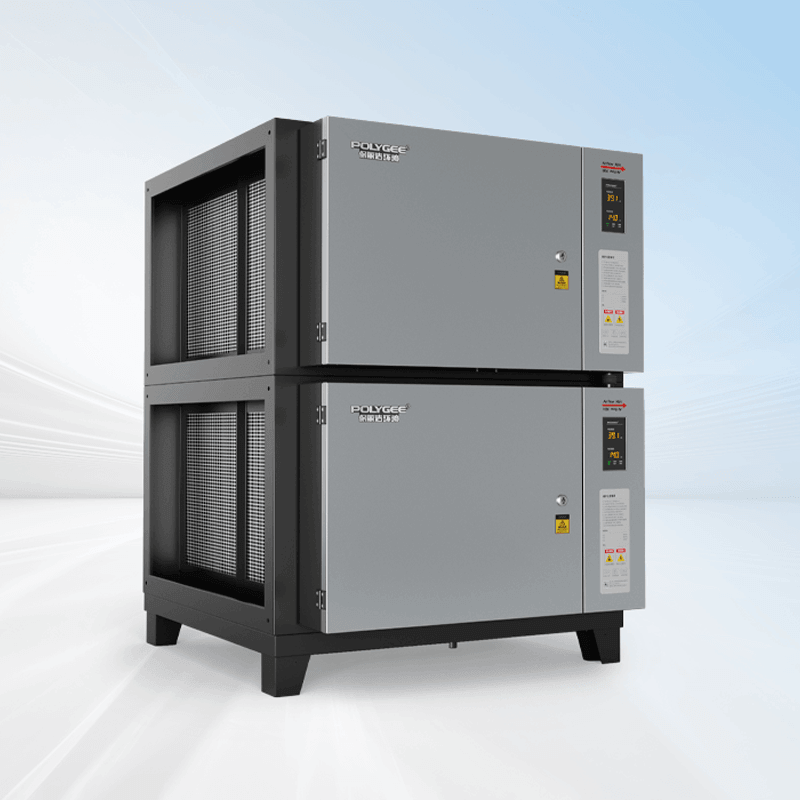
An in-line air cleaner adds resistance. That resistance belongs in the fan selection from the start, and it belongs in the pressure the interlock is set against. Our complete in-duct units, with the standard airflow distribution plate fitted, are rated at not more than 150 Pa, and we give the figure at your design airflow when we quote. If a unit is added to a duct run after the system was balanced and the interlock was set, the setting is no longer describing the same system, and revisiting it is for the interlock installer and the Gas Safe registered engineer, not for the site.
The second connection is about service rather than design. Equipment in the airstream loads up between cleans, and loading raises resistance. On a kitchen whose interlock senses pressure, a service regime that has slipped does not simply reduce filtration performance; it moves the reading the interlock is watching. That is the mechanism by which a maintenance decision turns into a closed kitchen, and it is a good reason to keep the service records where the person setting the interlock can see them. What a service visit on our equipment covers, and who owns each item, is in electrostatic precipitator cleaning.
What we do not do is supply interlock panels, sensors, solenoid valves or controls, and nothing here is a specification for them. We can give you the resistance figure for our equipment at your design airflow, in writing, which is the number the people designing the interlock need from us.
Where this guide stops
- No clause numbers from BS 6173. The clause references here are DW/172’s, which is a published specification we have read. BS 6173 is a British Standard behind a paywall and this guide does not quote its clause numbering.
- No work instructions. Nothing here tells anyone how to fit, adjust, bypass or reset an interlock. Gas work belongs to a Gas Safe registered engineer; the electrical side belongs to a competent electrical contractor.
- Jurisdiction. This is the UK arrangement. Markets that follow British practice commonly specify BESA and BSI documents by name; which ones and which editions is for the tender to confirm, as are the enforcing authority and any local amendments.
- Our scope. We build in-duct and hood-integrated filtration. We do not make interlock systems, sensors or controls. What our equipment carries is on the certificates page.
Buyer record
Have ready:
- The year the kitchen was built or last fitted out, and whether gas equipment has been replaced since.
- Whether an interlock is fitted, and by which method it senses.
- Where the commissioning record says the pitot tubes are, if pressure switches are used.
- The commissioning record with the measured supply and extract flows.
- The CO and CO2 detector positions, and what they are wired to.
Ask each party for:
- From the interlock installer: the set points, the sensing method, and a written statement of who is to be called when it trips.
- From the ventilation contractor: confirmation that the supply system is interlocked, not only the extract.
- From the maintenance provider: the Gas Safe response time when the interlock trips.
- From every in-line equipment supplier: the resistance at your design airflow. Ours, complete with the standard airflow distribution plate fitted, are rated at not more than 150 Pa.
Re-check when:
- Any gas appliance is replaced, including like for like.
- Anything is added to or removed from the duct run.
- A demand control strategy is added, since the detectors have to override it.
- The interlock trips without an obvious cause, which usually points at the sensing rather than the fan.
Frequently Asked Questions
- Is a gas interlock a legal requirement in a commercial kitchen?
- The duty comes from the Gas Safety (Installation and Use) Regulations 1998, which treat an extract system acting as the flue for a gas appliance as a flue that has to be interlocked with the gas supply, and from the Workplace (Health, Safety and Welfare) Regulations 1992, which require effective and suitable ventilation in every enclosed workplace. BS 6173 is the standard that says how to meet those duties. DW/172 puts the practical rule plainly: to comply with BS 6173, all new commercial kitchens with one or more items of gas-fired cooking equipment, built or fitted out since September 2001, must have a gas interlocking system on the ventilation system, and old gas equipment that is replaced needs interlocking even if it is replaced like for like. HSE guidance adds that BS 6173 is not retrospective, so a kitchen predating it is not automatically non-compliant, but where no interlock exists the risk has to be assessed and acted on.
- Does a gas interlock cover the supply air fan as well as the extract?
- Yes. DW/172 clause 20.4 states that the requirement applies to both the mechanical extract and the supply air system, and clause 20.7 describes pressure switches fitted in both the supply and extract ductwork. That surprises operators who assume the interlock watches the extract fan alone. A kitchen running its extract with the supply air system off is not balanced, the extract cannot reach its rated flow, and the interlock is meant to catch that condition as much as a stopped extract fan.
- Can a gas interlock be overridden while the fan is being worked on?
- No. DW/172 clause 20.5 notes that, unlike some earlier versions of the standard, BS 6173 states that overrides, however short-lived, are not permitted, and HSE guidance says the same about manual bypass. A bypass switch on the panel is not a compliant arrangement even if it is only used during maintenance. When the ventilation fails, the gas valve closes and the gas-fired equipment stops until a Gas Safe registered engineer attends, rectifies the ventilation problem and resets the supply.
- Why did our gas interlock trip when nothing had failed?
- A pressure-sensed interlock reads duct pressure, so anything that changes the pressure the switch sees can trip it. DW/172 clause 20.7 warns that where pressure switches are used, care must be taken to position the pitot tubes correctly so they receive accurate readings and do not get blocked with contaminants in the airstream, which means on a straight run and not on or near a grease catchment area such as a bend or a tee. A pitot that has loaded with grease, a loaded filter or air cleaner, or a supply fan that has dropped out will all move that reading. Diagnosis belongs to a competent engineer, and the gas side belongs to a Gas Safe registered engineer.
Adding filtration to a duct run that carries an interlock?
Send us the design extract flow, the duct size and route, the position available for an in-line unit, and the electrical supply. Our team will come back with the model whose rated airflow band fits the flow, its resistance at that flow so it can go into the fan selection and the interlock setting, the third-party grease removal test report with the airflow it was measured at stated on it, and a written note of which documents that model carries. Tell us if the interlock senses pressure, and we will make sure the resistance figure reaches whoever is setting it.
Talk to our team →Scarlett leads commercial work at Polygee, from first RFQ through Incoterms, certification scope and delivery for engineering firms, consultants and dealers, with equipment exported to 50 countries. Polygee, founded in 2004, builds commercial kitchen exhaust filtration equipment. This article summarizes a published specification and public guidance for planning purposes only — it is not a compliance determination, and it is not instructions for work on gas or electrical systems. Confirm the requirements for a specific kitchen with your engineer, a Gas Safe registered engineer and the edition in force.
References & further reading
- BESA — DW/172 Specification for Kitchen Ventilation Systems, Section 20 Gas Interlocking. thebesa.com
- BSI — BS 6173:2020, Installation and maintenance of gas-fired catering appliances for use in all types of catering establishments. knowledge.bsigroup.com
- IGEM — IGEM/UP/19 Edition 2, design and application of interlock devices and associated systems used with gas appliance installations in commercial catering establishments. igem.org.uk
- Health and Safety Executive — Catering Information Sheets on gas safety and ventilation in catering. hse.gov.uk
- Gas Safe Register — the official gas registration body for Great Britain. gassaferegister.co.uk
- Polygee — kitchen exhaust filtration product range, certificates and third-party test reports. polygeeesp.com
Related reading
- Commercial kitchen extraction regulations UK — where gas safety sits among the other UK duties on a kitchen extract.
- Commercial kitchen makeup air requirements — the supply system the interlock also watches, and what the code asks of it.
- Demand control kitchen ventilation — the control strategy the CO and CO2 detectors must be able to override.
- TR19 Grease — the cleaning regime that keeps the duct, and the sensing in it, from loading up.
- DW/172 kitchen ventilation specification — the source of every clause number quoted here, read section by section.