

Charbroiler emissions regulations are the clearest case in U.S. commercial kitchen rules where an emission control device is mandatory rather than optional. New York City, the South Coast Air Quality Management District around Los Angeles, San Diego County and the San Joaquin Valley each set a threshold in pounds of meat cooked per week, and a charbroiler above it has to carry an emission control device that has been certified or field-tested to a stated percentage of particulate removal.
What the rules do not do is agree with each other. The thresholds run from 400 lb a week in one district to 875 lb in New York City, the required reduction is 75 percent in one city and 83 percent in three California districts, chain-driven and under-fired charbroilers are treated differently, and the device that is standard for one type is not the one regulators expect on the other.
This guide lays the rules side by side, sets out what a device has to prove and by which test, describes the technologies as the regulators describe them, and states plainly what an electrostatic precipitator can and cannot bring to the process. It does not determine compliance for any charbroiler; the city’s or the district’s text and the test result do that. For the unit itself, see the kitchen electrostatic precipitator page.
One disclosure: Polygee builds in-duct electrostatic precipitators. The third-party reports behind our units measure grease removal efficiency, not the particulate test methods these rules name, and we state on request which approvals and listings a model carries and which it does not.
Why charbroilers are regulated when the rest of the kitchen is not
Charbroiling is regulated as an emission source in its own right. The California Air Resources Board frames the issue as fine particulate matter, PM2.5, from charbroiling operations, and four U.S. jurisdictions have written a device mandate for the appliance while leaving the rest of the cookline to the mechanical and fire codes.
The rules divide the equipment in two. A chain-driven charbroiler carries the food through the flame on a conveyor, at a steady rate, in the fast-food format, and a catalytic oxidizer has been the standard control since South Coast Rule 1138 in 1997. An under-fired charbroiler is the open grate over gas or charcoal that a steakhouse or a burger kitchen cooks on; its output varies with the cook, the cut and the hour, the particulate load is heavier, and the devices regulators point to are electrostatic precipitators, filters and scrubbers rather than catalysts.
Charbroiler emissions regulations, side by side
Four jurisdictions require a control device above a throughput threshold, and a fifth regulates by what the plume looks like. The figures below are the rule texts and the agencies’ own summaries as verified for this guide; the adopted text governs.
| Rule | What is covered | Threshold | What the device has to do | Adopted / in force |
|---|---|---|---|---|
| New York City, 15 RCNY Chapter 37 | Chain-driven char broilers, new and existing; under-fired char broilers installed after May 6, 2016 | More than 875 lb of meat per week | A certified device: a flameless catalytic oxidizer or other device for chain-driven units, an ESP or other device for under-fired units; at least 75 percent reduction of baseline PM10 including condensable particulate; for units installed after May 6, 2016, a site test showing not more than 10 mg/m³ is an accepted alternative | May 6, 2016 |
| New York City, 15 RCNY Chapter 64 | Under-fired char broilers installed on or before May 6, 2016 | More than 875 lb of meat per week | A device on the Fire Department and DEP approved list, or one that passes a site-specific field test run by a licensed engineer or architect using EPA Method 5 or South Coast Method 5.1: 75 percent PM reduction or not more than 10 mg/m³; a hardship variance needs a licensed professional’s assessment filed within one year of the chapter’s effective date | November 20, 2025 |
| South Coast AQMD Rule 1138 | Chain-driven charbroilers only; the rule says under-fired charbroilers may be subject to future rule provisions | Exempt below 400 lb of meat per week, or below 10,800 lb in any continuous 12-month period while under 875 lb per week; the old under-875 lb exemption ended on September 6, 2026 | A certified catalytic oxidizer, 83 percent PM reduction; equipment filings under Rule 222, and weekly meat records for units run under an exemption | 1997; amended September 5, 2025 |
| San Diego County APCD Rule 67.26 | Chain-driven charbroilers, new and existing | More than 415 lb of meat per week | Registration before a new unit is bought and run; a certified flameless catalytic oxidizer at 83 percent PM and 86 percent VOC, or an alternative device at the same efficiencies approved in writing by the air pollution control officer; maintenance and records | Adopted August 14, 2025 |
| San Joaquin Valley APCD Rule 4692 | Chain-driven charbroilers; under-fired charbroilers for reporting and registration | Chain-driven: thresholds and exemptions in pounds per week; under-fired: registration above a set threshold | Chain-driven: a catalytic oxidizer at not less than 83 percent PM10 and 86 percent VOC; under-fired: a one-time report by January 1, 2019, registration, weekly meat records, and controls funded through incentives rather than a mandate | 2018 amendments |
| Maryland COMAR 26.11.18.06 | Char-broilers and pit barbecues with more than 5 sq ft of cooking area, operating 15 days a year or more | Opacity, not throughput | No more than 10 percent opacity for units built after December 17, 1974 within 300 ft of a dwelling, 30 percent elsewhere; an approved control device on new sources near dwellings unless shown unnecessary | 1985 |
This table answers where a device is required and to what standard. It does not answer whether a particular device meets that standard; only the certification or the field test does, and that is the next section.
What the device has to prove, and by which test
A control device satisfies these rules either by being on the jurisdiction’s certified or approved list, or by evidence accepted for the installation: a site-specific test in New York City, the air pollution control officer’s written approval of an alternative device in San Diego. The performance standard behind all of them is a percentage reduction of particulate against the uncontrolled charbroiler.
New York City’s standard is at least 75 percent reduction of the char broiler’s baseline PM10, condensable particulate included, or not more than 10 mg/m³ at the outlet on a site test; under Chapter 64 that test is run by a licensed professional engineer or registered architect using EPA Method 5 or South Coast Method 5.1. The California chain-driven rules use 83 percent particulate, and San Diego and the San Joaquin Valley add 86 percent VOC, which a catalytic oxidizer removes and an electrostatic field does not.
The distinction that matters to a buyer is what each document proves and what it does not:
| Evidence | What it supports | What it does not prove on its own | Product-condition scope | Buyer action |
|---|---|---|---|---|
| Approved-list certification (New York City; certified catalytic oxidizers in California) | The device is accepted without a site test | Performance at your throughput or on a charbroiler the listing does not name | The listed model and configuration | Check that the listing entry matches the model and configuration quoted |
| Site-specific field test (Method 5 or 5.1, licensed engineer) | Compliance for that installation | Any other site, appliance or duty | That charbroiler, that cooking, that day | Keep the report with the meat records; ask whether a retest is needed if the appliance changes |
| Grease removal efficiency test report (for example, CMA-accredited third-party report ZY05W230298 on Polygee LK units) | The unit’s grease removal at rated, evenly distributed airflow under that test | PM reduction by Method 5 or 5.1; any listing or approval | The tested model at its rated airflow | Request the report itself and check the serial-number link and test conditions before treating any efficiency figure as a performance basis |
| UL 867 component listing | The electrostatic air cleaner meets its component standard | Emission performance under any of these rules | The listed models only; for Polygee, the LK/SE 6K, 12K and 18K | Ask which models carry it, by file number |
| Weekly meat log | Whether the threshold is crossed, and the baseline the rule refers to | Anything about the device | The charbroiler it is kept for | Start it before anyone asks; the California districts write weekly records into the rule, and every throughput threshold is a weekly figure |
This table answers which document to ask for. It does not answer what a given unit will measure on a given charbroiler; only the field test does.
The device types, as the regulators describe them
The chain-driven rules were written around one device, the catalytic oxidizer; the under-fired rules leave the technology open, and the regulators’ own descriptions name the electrostatic precipitator among the options, with CARB calling it the most used.
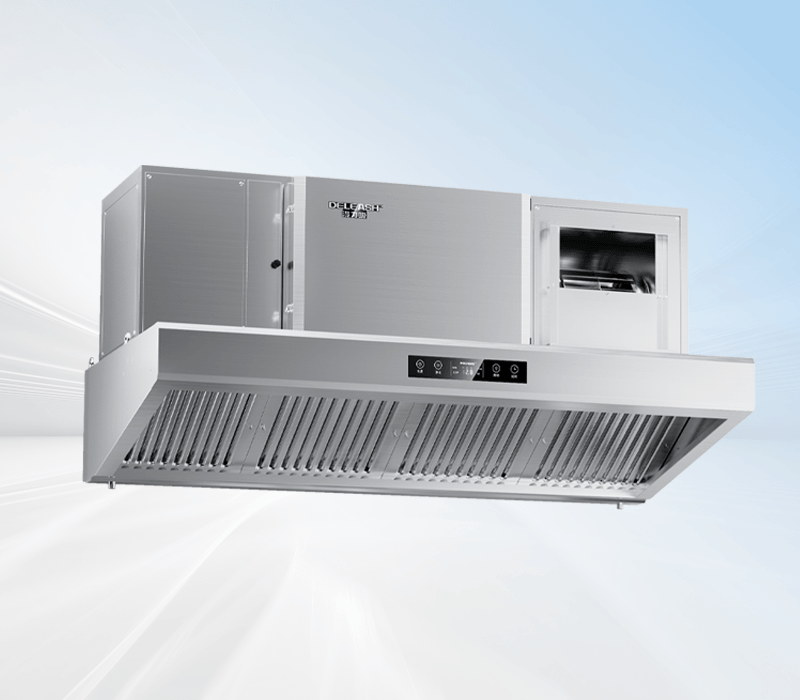
A catalytic oxidizer sits in the exhaust of a chain-driven charbroiler and oxidizes the smoke and the organic gases as they pass; South Coast certifies specific units, San Diego and the San Joaquin Valley write the 83 percent particulate and 86 percent VOC figures around it, and New York City names it first for chain-driven units.
For under-fired charbroilers the California Air Resources Board describes three commercially available technologies that have been deployed at many locations across the country. The electrostatic precipitator, which charges the particles and collects them on plates, it calls currently the most used technology and very effective at removing pollution, at a higher cost than the alternatives. Media filters, which trap particulate in a replaceable filter, it puts at 10 to 50 percent efficiency and the lowest cost. Scrubbers spray a fluid into the exhaust to capture the particulate for removal. New York City names an ESP, or another certified device, for new under-fired char broilers in Chapter 37, and the chapter and the engineering guidance written around it list electrostatic precipitators, wet scrubbers, air filtration and hybrid ESP-plus-filter systems, with the note that an ESP’s electrical components need Fire Department approval.
Where Polygee sits in that description is simple to state. Our in-duct units are the electrostatic precipitator type these pages describe: a kitchen electrostatic precipitator with washable stainless-steel collector cells, and the LK units reached up to 97.6% grease removal in CMA-accredited third-party tests at rated, evenly distributed airflow. That is a grease removal test, not a Method 5 or Method 5.1 particulate test, and it is not a listing on any city’s or district’s approved-device list.
The exhaust system the device joins
A charbroiler control device is one more component on a Type 1 exhaust run that already has rules of its own, and the device changes the review of the run in three places: the unit’s own listing and access, the fire protection downstream of it, and the fan static pressure.
An under-fired charbroiler is heavy-duty cooking under the International Mechanical Code, which puts the unlisted-hood exhaust rate at 400 CFM per linear foot of wall canopy; a charcoal charbroiler is solid-fuel cooking at the extra-heavy-duty exhaust rate, with its own separate exhaust system, spark arrester and monthly inspection. The hood, the grease duct and the fan are read against the sections set out in commercial kitchen hood CFM requirements and solid fuel cooking exhaust requirements before any emission rule is opened.
Once the device goes in, it is reviewed as a pollution control unit: the listing the adopted mechanical code asks for, access on both sides, grease drainage and the fire protection downstream of it are in grease duct requirements and commercial kitchen hood fire suppression requirements. The device also adds resistance to the run, so the fan is re-checked against the new static pressure; a complete Polygee in-duct unit, airflow-distribution plate included, is rated at ≤150 Pa, and the figure at your design airflow goes into the calculation set out in commercial kitchen exhaust fan requirements.
Four records to keep together, because they are read together:
- The weekly meat log, by charbroiler, from the day the rule applies.
- The device’s listing entry or the field-test report, with the installation date of the charbroiler it was tested on.
- The maintenance record, to the manufacturer’s schedule; for an ESP, the collector cell washing interval set against the duty, logged with the exhaust cleaning record.
- The balance report after the device is installed, showing the hood still receives its exhaust rate.
For charcoal and tabletop grills, the layout of an ESP, carbon and UV train on that duty is on our BBQ smoke control page, and the symptom-by-symptom route to a smoke fix is in how to reduce smoke from commercial kitchen exhaust.
Where this guide stops
Five boundaries on this reading of charbroiler emissions regulations, so the tables are used for what they are:
- Jurisdictions. The four device mandates and the Maryland opacity rule are the ones verified for this guide. Other districts run studies, incentive programs or nuisance provisions, and any of them can adopt a rule after this page was written.
- Dates and penalties. The dates above are the adoption or effective dates the rules themselves state; compliance deadlines, phase-in schedules and penalties come from the adopted text and the agency, not from this page.
- Thresholds this page does not settle. The San Joaquin Valley chain-driven thresholds carry exemptions this page does not reproduce; read the rule for the number that applies to you.
- Polygee approvals. Our records carry no listing on any city’s or district’s approved-device list; we say so, and we state by model what a unit does carry.
- Outside the United States. Singapore, the Gulf, Southeast Asia and Europe regulate cooking emissions under their own instruments; the pounds-per-week logic does not travel. For the UK, the map from nuisance law to the EMAQ+ odor score is in commercial kitchen extraction regulations in the UK; for Singapore, where NEA asks for the roof and no visible smoke, see restaurant kitchen exhaust requirements in Singapore.
Frequently Asked Questions
- Does the NYC char broil rule apply to my restaurant?
- It applies if a commercial char broiler in the restaurant cooks more than 875 pounds of meat per week, and which chapter applies depends on the type and the installation date. Under 15 RCNY Chapter 37, in force since May 6, 2016, chain-driven char broilers of any age and under-fired char broilers installed after that date need a certified emissions control device that reduces baseline PM10, including condensable particulate, by at least 75 percent; for units installed after May 6, 2016, a site-specific test showing not more than 10 mg/m3 of particulate is an accepted alternative. Under 15 RCNY Chapter 64, effective November 20, 2025, under-fired char broilers installed on or before May 6, 2016 also need a device, either one on the approved list kept by the Fire Department and the Department of Environmental Protection or one that passes a site-specific field test to the same 75 percent or 10 mg/m3 standard. The DEP text and its compliance dates govern.
- Do under-fired charbroilers in California need an emission control device?
- It depends on the air district. In the South Coast Air Quality Management District, Rule 1138 requirements apply only to chain-driven charbroilers; the rule says under-fired charbroilers may be subject to future rule provisions. Its September 5, 2025 amendment cut the chain-driven exemption threshold from 875 to 400 pounds of meat a week. A second exemption covers chain-driven units cooking under 10,800 pounds in any continuous 12 months and under 875 pounds a week. The old 875-pound weekly exemption ended on September 6, 2026. San Diego County Rule 67.26, adopted August 14, 2025, applies to chain-driven charbroilers cooking more than 415 pounds a week; it is written for chain-driven units. The San Joaquin Valley district requires under-fired charbroiler operators to report, to register units above a threshold and to keep weekly meat records, and funds controls through incentives rather than a mandate. The California Air Resources Board describes electrostatic precipitators as the most used control technology for under-fired charbroilers. Check the rule text of your own district; the thresholds and dates differ.
- Can an electrostatic precipitator meet the charbroiler rules?
- It can be the device, but compliance is decided per model and per installation, not per technology. New York City names an ESP, or another certified device, for new under-fired char broilers, and the California Air Resources Board calls the ESP the most used control technology for under-fired charbroilers. The unit has to be on the approved list where a list exists, or pass a site-specific field test run by a licensed engineer to the stated standard, 75 percent PM reduction or 10 mg/m3 in New York City, using EPA Method 5 or South Coast Method 5.1. The chain-driven rules are written around catalytic oxidizers, and two districts add a VOC reduction an electrostatic field does not deliver. A grease removal efficiency figure from a manufacturer test is a different measurement from a Method 5 result, and Polygee states on request which approvals and listings each model carries and which it does not.
Under a charbroiler rule, or about to be?
Send us the jurisdiction, the charbroiler type and its installation date, the weekly meat figures if you keep them, the hood length or design exhaust airflow, the duct route and where on it a unit can sit, and whether the rule you face requires an approved-list device or accepts a site test. Our project team will come back with the unit that fits the airflow, the third-party grease removal test report where the model has one, with its method and conditions stated, its resistance at your design airflow, the access and drain details the engineer needs, and a written statement of which approvals and listings that model carries and which it does not.
Talk to our project team →Reviewed by Law, Project Manager, 9 October 2026
Written by Law · Project Manager, PolygeeLaw manages kitchen exhaust filtration projects at Polygee, from spec review through duct-side ESP sizing and installation support. Polygee, founded in 2004, builds commercial kitchen exhaust filtration equipment. This article summarizes published rules and agency guidance for planning purposes only — it is not a compliance determination, so confirm the requirement for a specific charbroiler with the air district or city agency, your engineer and the adopted text.
References & further reading
- New York City Department of Environmental Protection — 15 RCNY Chapter 64, Emissions Reduction Technologies for Existing Under-Fired Commercial Char Broilers, and 15 RCNY Chapter 37, emissions control devices for chain-driven and new under-fired commercial char broilers. rules.cityofnewyork.us
- South Coast Air Quality Management District — Rule 1138, Control of Emissions from Restaurant Operations (adopted 1997, amended September 5, 2025). aqmd.gov
- San Diego County Air Pollution Control District — Rule 67.26, Commercial Charbroiling Operations (adopted August 14, 2025). sdapcd.org
- San Joaquin Valley Air Pollution Control District — Rule 4692, Commercial Charbroiling. valleyair.org
- California Air Resources Board — Underfired Charbroiling Control Technology. arb.ca.gov
- Maryland Department of the Environment — COMAR 26.11.18.06, Control of Emissions from Certain Food Preparation Installations. law.cornell.edu
- Polygee — kitchen exhaust filtration product range and third-party test reports. polygeeesp.com