

Commercial kitchen hood fire suppression requirements start from one trigger in the International Mechanical Code: any cooking appliance that needs a Type 1 hood also needs an approved automatic fire-extinguishing system. The International Fire Code then says what that system has to be: a type recognized for commercial cooking, listed to UL 300 if it is a pre-engineered wet or dry chemical system, with a manual pull station, an automatic fuel and power shutoff, and service at least every six months.
What the code does not spell out on the same page is that the system protects a defined list of things, the appliances, the hood plenum and the duct, and that a pollution control unit added to the run needs protection of its own, downstream of it.
This guide walks the requirements in the order a fire plan reviewer reads them, separates what the system listing covers from what the installer owes, and shows where an in-duct filtration unit enters the suppression drawing. It does not design the system; that is the fire-protection contractor’s work under the system’s listing. For the filtration unit itself, see the kitchen electrostatic precipitator page.
One disclosure: Polygee builds the in-duct electrostatic precipitators that sit in Type 1 exhaust runs. We do not make fire-extinguishing systems, conventional hoods or exhaust fans, and nothing here is a compliance determination; the authority having jurisdiction (AHJ) applies the edition it has adopted.
When a system is required, and which document says so
Under the IMC, the fire-extinguishing system follows the Type 1 hood: where the hood is required, the system is required. Section 509.1 requires every commercial cooking appliance that Section 507.2.1 puts under a Type 1 hood to be provided with an approved automatic fire suppression system complying with the International Building Code and the International Fire Code. The classification, by what the cooking produces rather than by the appliance name, is worked through in type 1 hood vs type 2, and the rest of what plan review reads against the hood is in commercial kitchen hood code requirements.
The fire code then defines the system. Section 904.13 of the IFC requires it to be of a type recognized for protection of commercial cooking equipment and exhaust systems; pre-engineered automatic dry- and wet-chemical systems have to be tested in accordance with UL 300 and listed and labeled for the application, and automatic sprinklers are an alternative route, installed to NFPA 13. NFPA 96 addresses fire-extinguishing equipment in its Chapter 10 and inspection and maintenance in Chapter 11, and NFPA 17A is the standard a wet chemical system is installed and serviced to.
UL 300, the Standard for Fire Testing of Fire Extinguishing Systems for Protection of Commercial Cooking Equipment, exists because vegetable cooking oils ignite at higher temperatures than animal fats and better-insulated appliances cool more slowly, so the fires a modern system has to put out and keep out are hotter and longer-lived than the ones earlier systems were tested against.
Does a commercial kitchen need a fire suppression system?
If any appliance in it needs a Type 1 hood, yes: the mechanical code requires the system the moment it requires the hood, the fire code and NFPA 96 define it, and the system listing and NFPA 17A extend the protection from the appliances to the hood plenum, the grease filters and the duct. A kitchen whose cooking produces only heat, steam or moisture, and which therefore runs on a Type 2 hood or no hood, does not trigger the requirement. How the fire code’s provisions are read against a factory-built recirculating system listed to UL 710B, which carries its extinguishing system inside the package listing, is in our comparison of the two hood listings.
Commercial kitchen hood fire suppression requirements, in the order a reviewer checks them
The requirements follow the fire from the cooking surface to the roof, and most of them are about what happens in the first minute of a discharge, not about the agent.
| Requirement | What it asks for | Where it is decided |
|---|---|---|
| When required | Every appliance that needs a Type 1 hood is protected by an approved automatic fire-extinguishing system | IMC 509.1 |
| System type and listing | A type recognized for commercial cooking equipment and exhaust systems; pre-engineered wet and dry chemical systems tested to UL 300 and listed and labeled; sprinklers to NFPA 13 as an alternative | IFC 904.13 |
| What is protected | The cooking appliances, the hood plenum, the grease filters and the exhaust duct, per the system listing and the nozzle layout; NFPA 17A also lists odor and energy recovery devices among what a wet chemical system may protect | IMC 509.1; NFPA 17A |
| Manual actuation | A manual actuation device not less than 10 ft (3,048 mm) and not more than 20 ft (6,096 mm) from the kitchen exhaust system, 42 to 48 in (1,067 to 1,200 mm) above the floor | IFC 904.13.1 |
| Fuel and power shutoff | Activation automatically shuts off the fuel or electrical power to the protected cooking equipment; NFPA 96 extends it to gas appliances under the same ventilation that do not themselves need protection; the reset is manual | IFC 904.13.2; NFPA 96 10.4 |
| Exhaust fan | Keeps running after the system discharges unless a listed component of the ventilation system or the system design requires shutdown | NFPA 96 8.2.3 |
| In-duct filtration | A pollution control unit in the run has an approved automatic fire-extinguishing system in the duct downstream of it | NFPA 96; UMC |
| Service | Serviced at least every six months and after any activation; fusible links and sprinkler heads replaced at least annually under the IFC, fusible-alloy links at least semiannually under NFPA 96 | IFC 904.13.6; NFPA 96 11.2 |
| Portable extinguishers | A portable extinguisher within 30 ft travel distance of the cooking equipment; Class K where the cooking uses vegetable or animal oils and fats or solid fuel | IFC 904.13.5 |
This table answers what the system is checked against. It does not answer the nozzle layout, the agent or the cylinder; that is the contractor’s design under the listing. The exhaust fan row is expanded in commercial kitchen exhaust fan requirements, and the in-duct filtration row below.
Coverage, the pull station and the shutoff: the three rules that decide the drawing
The listing is appliance-specific, the pull station is where staff leave the line, and the shutoff is what keeps a suppressed fire from restarting.
Coverage. Nozzles are placed for the appliances on the drawing, at the positions and heights the system listing allows for each hazard. A charbroiler swapped for a fryer, or a cookline shifted a foot along the hood, changes the hazard under each nozzle in an appliance-specific layout; whether the listing lets the move stand without re-piping is the fire-protection contractor’s call, and NFPA 17A requires the system to be checked for correct positioning whenever the protected equipment is replaced, modified or relocated. A menu change is a suppression change, and it goes to the contractor before the appliance is moved.
The pull station. The IFC puts the manual actuation device between 10 and 20 ft from the exhaust system and between 42 and 48 in above the floor. The distance keeps the station off the cookline and on the way out of it; on a tenant fit-out, check that it sits on the route staff take away from the hood rather than on whichever wall has space.
The shutoff. The system itself cuts the fuel or electrical power to the protected appliances when it discharges, through the shutoff devices the listing and the contractor’s design provide, and the reset is manual so that the cookline cannot come back up until someone has looked. The exhaust fan is the exception: it keeps running through and after the discharge unless the listing or the system design says otherwise, so that the hood keeps capturing while the agent works.
Suppression and the in-duct unit
A filtration unit in the duct is not a fire-protection device, and the hood’s nozzles do not cover it unless the drawing says so.
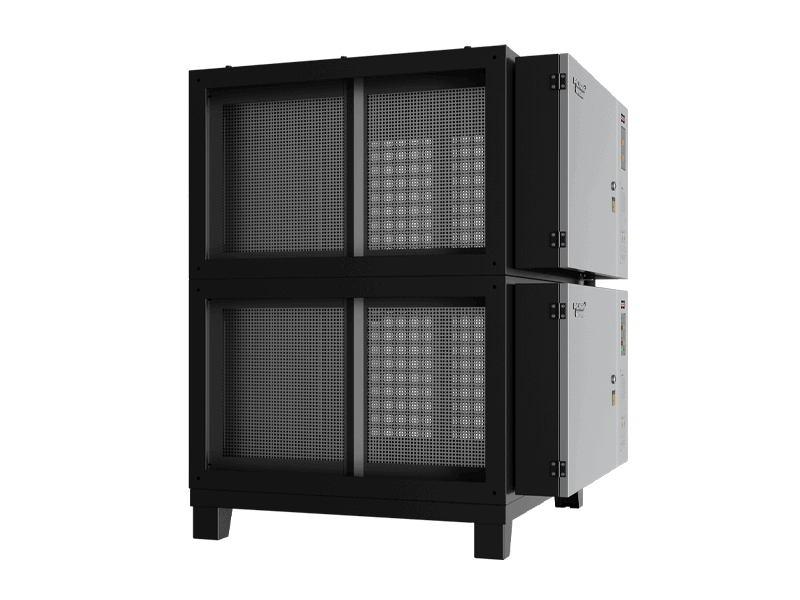
NFPA 96 and the Uniform Mechanical Code require an approved automatic fire-extinguishing system in the duct downstream of a pollution control unit. The reasoning is the unit’s own job: a kitchen electrostatic precipitator collects the fine grease mist and smoke that pass the hood filters, and what it collects is fuel until the cells are washed. The code therefore gives the unit its own protection, access and cleaning, alongside the listing the adopted edition asks of the unit; all three are in grease duct requirements.
On a retrofit the ESP extends the protected hazard, and the fire-protection contractor has to provide the downstream coverage, from the hood system where its listing allows or from a separate listed system, and the drawing is revised with it. Polygee’s in-duct units are washable stainless-steel collector cells in a duct-mounted housing; they are not fire-extinguishing equipment, and we do not supply the suppression. Our in-duct models do not carry UL 8782 or any suppression listing; the listing we hold is UL 867 on the LK and SE 6K, 12K and 18K models. What we supply for that drawing is our own unit’s data: its position in the run, its access doors, its drain, and a plain statement of which listings the model carries and which it does not.
Four points when a unit goes onto a protected run, and the first call is to the fire-protection contractor who holds the system’s service contract, before the unit is ordered:
- Put the unit on the suppression drawing at the design stage, with its position in the run, so the downstream coverage is priced with the system rather than as a change order.
- Ask the ESP supplier for three things: the access it needs on both sides, where it drains, and whether the model carries any listing the fire code will ask about; in the 2021 IMC that is UL 8782 for pollution control units, and the honest answer for a given model may be none.
- Put the washing interval in the same log as the suppression service. The interval is set with the supplier against the duty and logged next to the semiannual tag. The record structure is in commercial kitchen exhaust cleaning requirements.
- Solid fuel is a separate case. The suppression listing has to cover the solid-fuel appliance itself, a spark arrester goes ahead of the filters where embers can be produced, and the exhaust runs on its own system; the rest is in solid fuel cooking exhaust requirements.
Service, links and extinguishers: the part that continues after the permit
The permit proves the system was right on the day it was inspected; the semiannual service is what proves it is still right.
The IFC requires the system to be serviced at least every six months and after any activation, and NFPA 96 asks for the work to be done by trained, qualified and certified persons. The two documents differ on the temperature-sensing elements: the IFC requires fusible links and automatic sprinkler heads to be replaced at least annually, with other devices serviced or replaced to the manufacturer’s instructions, while NFPA 96 asks for fusible-alloy links to be replaced at least semiannually. Where both are adopted, the adopted text, the system listing and the manufacturer’s instructions decide which interval applies; replacing the links on the shorter interval is the conservative reading, not a rule this page can set.
The semiannual visit is also when coverage is checked against the appliances actually under the hood, and the tag is what the inspector reads; a tag that predates the new fryer says as much as one that is out of date.
Two things sit alongside the system. A portable extinguisher is required within 30 ft travel distance of the cooking equipment, Class K where the cooking uses vegetable or animal oils and fats or solid fuel, because a Class K agent is made for those fires and an ordinary extinguisher is not. And the exhaust system is inspected for grease buildup on the NFPA 96 tiers and cleaned when the inspection calls for it: the suppression system is the last line of defense for a fire in the hood or duct, and the cleaning schedule is the first.
Where this guide stops
Six boundaries on these commercial kitchen hood fire suppression requirements, so the table is used for what it is:
- Edition and amendments. The provisions are the International Mechanical Code, the International Fire Code, the Uniform Mechanical Code, NFPA 96 and NFPA 17A as model documents. Jurisdictions adopt different editions and amend them, and where the IFC and NFPA 96 differ, as they do on link replacement, the adopted text and the system listing govern.
- Outside U.S. code jurisdictions. Singapore, the Gulf, Southeast Asia and Europe set their own suppression rules and listing regimes. The logic of protecting the appliances, the plenum and the duct travels; UL 300, the distances and the intervals do not.
- Not a system design. Agent, nozzle count and placement, cylinder sizing and the fuel and electrical shutoff devices are the fire-protection contractor’s work under the listing, and the AHJ signs off on the result.
- Provisions this page does not quote. NFPA 96 also carries provisions this page does not set out, among them the simultaneous operation of systems protecting one hood and the connection to the building alarm; the adopted edition has the wording.
- Polygee does not make fire-extinguishing systems. Nothing here is a suppression specification; what we can state about our own unit is in the section above.
- Residential ranges. A domestic kitchen is covered by the residential code, and nothing here applies to it.
Frequently Asked Questions
- Is a kitchen hood fire suppression system required?
- In U.S. code jurisdictions, yes wherever a Type 1 hood is required. Section 509.1 of the International Mechanical Code requires every commercial cooking appliance that needs a Type 1 hood, meaning any appliance that produces grease-laden vapor or smoke, to be protected by an approved automatic fire-extinguishing system complying with the building and fire codes. The International Fire Code then sets what that system has to be: a type recognized for commercial cooking equipment and exhaust systems, listed to UL 300 if it is a pre-engineered wet or dry chemical system, with a manual actuation device, an automatic fuel and power shutoff, and service at least every six months. Cooking that produces only heat, steam or moisture, served by a Type 2 hood or no hood, does not trigger the requirement; the authority having jurisdiction decides the classification.
- What commercial exhaust hoods have fire suppression features?
- None have it as a feature of the hood itself. The fire-extinguishing system is a separately listed system, UL 300 for a pre-engineered wet chemical system, that a fire-protection contractor designs and installs in and around the hood for the appliances actually under it. The one exception is a factory-built recirculating system listed to UL 710B, where the extinguishing system is part of the listed package rather than of an exhaust hood. Hood manufacturers do sell hoods pre-piped for a named system, with the nozzle drops and the agent cabinet built into the hood end, which saves site work but does not change who is responsible for the listing, the nozzle layout and the service. A hood with electrostatic precipitator cells built into it is still a hood in this respect: the suppression system is added to it in the same way, and the filtration cells are not a fire-protection device.
Adding filtration to a protected exhaust run?
Send us the appliance list with the fuel, the hood and duct route with the point where a unit can sit, which suppression system is installed so the downstream coverage question goes to the right contractor, and whether any of the cooking is solid fuel. Our project team will come back with the unit configuration for that run, the position, dimensions, access-door and drain details the fire-protection contractor needs to draw the downstream coverage, the washing routine the duty calls for, and the third-party test reports for the model we propose, together with a plain statement of which listings that model carries and which it does not.
Talk to our project team →Law manages kitchen exhaust filtration projects at Polygee, from spec review through duct-side ESP sizing and installation support. Polygee, founded in 2004, builds commercial kitchen exhaust filtration equipment. This article summarizes published model-code requirements for planning purposes only — it is not a compliance determination, so confirm every requirement for a specific installation with your engineer, your fire-protection contractor, your local AHJ and the adopted edition of the code.
References & further reading
- International Mechanical Code (IMC), Chapter 5: Exhaust Systems — Section 509, Fire Suppression Systems. codes.iccsafe.org
- International Fire Code (IFC), Chapter 9: Fire Protection and Life Safety Systems — Section 904.13, Commercial Cooking Systems. codes.iccsafe.org
- NFPA 96, Standard for Ventilation Control and Fire Protection of Commercial Cooking Operations — Chapter 10, Fire-Extinguishing Equipment; Chapter 11, Procedures for the Use, Inspection, Testing and Maintenance of Equipment. nfpa.org
- NFPA 17A, Standard for Wet Chemical Extinguishing Systems. nfpa.org
- UL 300, Standard for Fire Testing of Fire Extinguishing Systems for Protection of Commercial Cooking Equipment. ul.com
- Polygee — kitchen exhaust filtration product range and third-party test reports. polygeeesp.com