

Commercial kitchen hood code requirements in the U.S. come down to one system, not one appliance: a Type 1 hood over any cooking that produces grease or smoke, an exhaust rate set by the International Mechanical Code, listed grease filters, a liquid-tight grease duct, an automatic fire-extinguishing system, make-up air to replace what leaves, and an outlet that keeps its distance from neighbors and air intakes. Readers building in the UK will find the equivalent map, from workplace law to DW/172 and the planning route, in commercial kitchen extraction regulations in the UK.
But the hood itself is the part that rarely fails plan review. What gets projects sent back is one of the attachments: the clearance nobody measured, the mesh filter that is not listed, the duct with no cleanout, the outlet eight feet from an air intake. The code treats the hood as the head of a chain, and it checks the whole chain.
This guide is that chain as a checklist of the commercial kitchen ventilation requirements a reviewer applies: when a hood is required at all, the eleven points a reviewer walks through, and the decision that follows the hood but sits outside the code, the filtration behind it.
One disclosure up front: Polygee builds the filtration that goes behind Type 1 hoods, as in-duct ESP units or as ESP cells built into a hood canopy. We do not make conventional hoods, grease ducts or suppression systems, and nothing here is a compliance determination; the authority having jurisdiction (AHJ) makes that call against the edition it has adopted.
When a hood is required at all
The trigger is what the appliance emits, not what it is called. The IMC (Section 507.2) requires a Type 1 hood wherever cooking produces grease-laden vapors or smoke. Fryers, griddles, charbroilers, ranges and woks are in; so are ovens on a grease-producing duty. Equipment that releases only heat, steam and moisture falls under a Type 2 hood, or under no hood where the AHJ agrees. The canopy the trade calls a commercial range hood is, in code language, a Type 1 hood, and the commercial range hood requirements a reviewer applies are the Type 1 hood requirements that follow.
Two documented exceptions exist, and both rest on testing rather than argument. An electric appliance that an approved testing agency has shown to release 5 mg/m³ or less of grease at an exhaust rate of 500 CFM, tested under UL 710B, does not need a Type 1 hood. And factory-built recirculating systems listed and labeled to UL 710B follow their listing instead of the hood sections. Ventless concepts live inside those two exceptions; everything else lives under a hood. What a UL 710B listing proves, and the operating conditions that come with it, are set out separately.
Does a commercial kitchen need a hood?
If it cooks with grease or smoke, yes, and the fire code adds suppression over it, set out in commercial kitchen hood fire suppression requirements. The borderline cases are the ones worth a call to the AHJ before equipment is ordered: pizza ovens, light-duty ovens, and concepts built around UL 710B listed ventless equipment. The classification itself, and how to tell a Type 1 from a Type 2 hood, is worked through in our type 1 hood vs type 2 guide, and which appliances the code puts under a Type 2 hood, or under none, is in type 2 hood requirements. Canadian projects reach the same NFPA 96 through a provincial code article, as set out in NFPA 96 in Canada.
Commercial kitchen hood code requirements: the eleven-point checklist
Plan review walks the exhaust path from the cookline to the outlet, and every point on it has a section of code behind it. The table is the order a reviewer tends to follow. The eleven points are our grouping of the code sections, not a list the code itself uses:
| # | Check | What the code asks for | Where it is decided |
|---|---|---|---|
| 1 | Is a Type 1 hood required? | Grease or smoke from the cooking process | IMC 507.2; UL 710B for the exceptions |
| 2 | Hood type | Type 1 for grease-producing appliances, Type 2 for heat and steam only | IMC 507.2 |
| 3 | Exhaust rate | Minimum CFM per linear foot by hood style and cooking duty, or the listed rate for a UL 710 hood | IMC 507.5; UL 710 |
| 4 | Hood construction and listing | Factory-built listed hoods follow their listing; unlisted hoods follow the construction sections | UL 710; IMC 507 |
| 5 | Clearance to combustibles | 18 inches for an unlisted Type 1 hood, or the reduced clearance on a UL 710 listing | IMC 507.2.6 (2021 edition; 507.9 in the 2018 edition) |
| 6 | Grease filters | Listed grease filters; bare mesh only where it is part of a listed hood or backed by a listed primary filter. Read in full in commercial kitchen grease filter requirements | IMC 507.2.8 (2021 edition; 507.11 in the 2018 edition); UL 1046 |
| 7 | Grease duct | Dedicated, liquid-tight duct with cleanouts, enclosed or wrapped where it passes through the building | IMC 506.3; NFPA 96 |
| 8 | Fire suppression | Automatic fire-extinguishing system over the Type 1 hood cookline | Fire code; NFPA 96 |
| 9 | Make-up air | Replacement air for what the exhaust removes | IMC 508 |
| 10 | Exhaust termination | Outlet at least 40 in above the roof and 10 ft from property lines, buildings and air intakes (or 3 ft above an intake); a wall termination only where it is not a public nuisance or fire hazard | IMC 506.3.13; NFPA 96 |
| 11 | Inspection and cleaning | Scheduled inspection for grease buildup by cooking type, cleaning when it exceeds the limit | NFPA 96 |
Points 3, 7, 10 and 11 each have a guide of their own on this site: the exhaust rates by duty are in commercial kitchen hood CFM requirements, the duct materials, joints, slope, cleanouts and enclosure are in grease duct requirements, the outlet distances and wall-termination rules are in commercial kitchen exhaust termination requirements, and the inspection tiers and what a compliant clean covers are in commercial kitchen exhaust cleaning requirements. What Section 508 requires of the makeup air, and the air balance the drawings have to show, are in commercial kitchen makeup air requirements.
The points that get projects sent back
Four of the eleven carry most of the rework engineers tell us about, and all four are cheap to fix on paper.
Clearance to combustibles (point 5). An unlisted Type 1 hood needs 18 inches (457 mm) to combustible construction. A hood listed to UL 710 for a smaller clearance may use the clearance on its listing, which is the usual route in a tight ceiling. Where an unlisted hood meets gypsum board on a noncombustible frame, the code accepts a smooth, cleanable, nonabsorbent, noncombustible layer extending at least 18 inches in every direction from the hood in place of the air gap. The failure mode is a hood drawn tight to a wood-framed bulkhead with no listing to justify it. Every distance around the hood, the NFPA 96 tiers, the overhang and height limits and the filter distance from the cooking surface, is in commercial kitchen hood clearance requirements.
Grease filters (point 6). The filters in a Type 1 hood have to be listed grease filters. Mesh filters are not accepted on their own; they are allowed only where they are part of a listed hood or installed with a listed primary filter. Baffle filters are the common answer, and they are also the part the kitchen team cleans in-house. What baffles catch and what they let through is the subject of electrostatic precipitator vs baffle filter.
Grease duct (point 7). The duct from a Type 1 hood is a grease duct, not a ventilation duct: dedicated to the hood, liquid-tight, fitted with cleanouts at the intervals the code sets so the run can be inspected and cleaned, and enclosed or wrapped with a listed system where it passes through other parts of the building. The duct slopes toward a grease collection point, and grease draining from a low point in the duct or at the fan has to land in a container that is noncombustible, closed, rainproof and structurally sound (NFPA 96). If in-duct filtration is part of the design, this is also the run it is planned into, with its own access so the collector cells can be pulled for washing.
Termination (point 10). The IMC puts the outlet at least 40 in (1,016 mm) above the roof surface, at least 10 ft (3,048 mm) from property lines, adjacent buildings and other parts of the same building, and at least 10 ft from or 3 ft (914 mm) above any air intake, with 5 ft (1,524 mm) accepted where the outlet discharges away from the object in question. A termination through an exterior wall is allowed only where the discharge does not create a public nuisance or a fire hazard. Urban sites and mall roofs run out of room for those distances faster than anything else on the list. The distances are geometry, so the fix is routing: move the outlet, raise it above the intake, or turn it away. No filtration equipment shortens a code distance; what comes out of the outlet matters only where the reviewer applies the nuisance test to a wall termination.
After the hood: the filtration decision
Nothing in the eleven points requires a filter behind the hood. The code stops at capturing the grease-laden air, moving it out and keeping it from starting a fire. What it does not do is make the discharge acceptable to the people downwind of it, and that is where a twelfth decision sits, outside the checklist and inside almost every urban project.
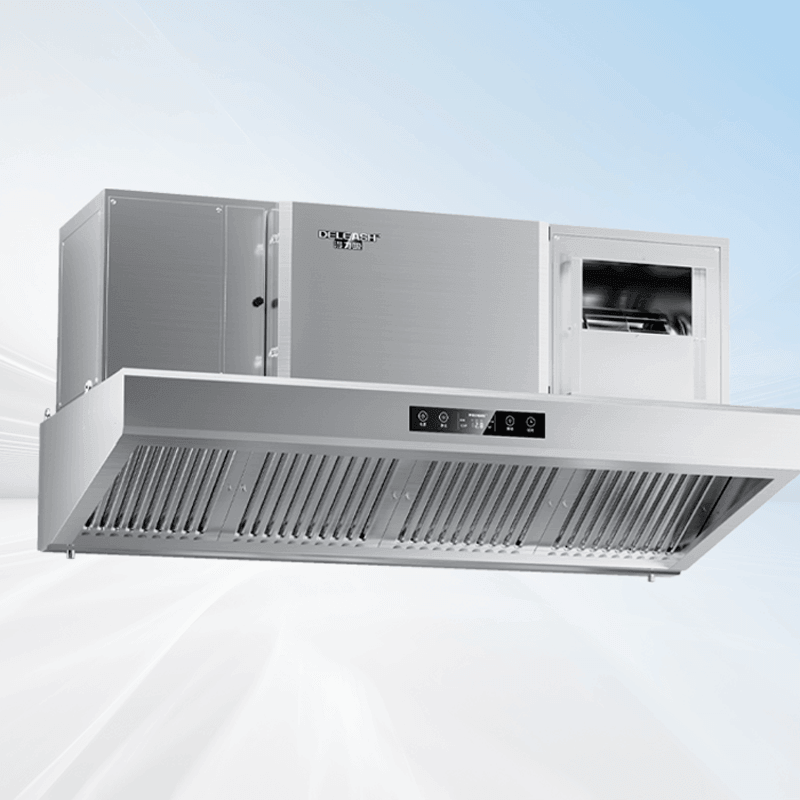
The hood’s baffles remove the larger grease droplets. The fine grease mist and smoke that ride past them are what coats the duct, loads the fan and leaves a visible, smellable plume at the outlet. A kitchen electrostatic precipitator in the duct downstream of the hood collects that fine fraction; Polygee’s LK in-duct units reached up to 97.6% grease removal in CMA-accredited third-party tests, measured at rated, evenly distributed airflow. Where the discharge has neighbors, UV modules behind the ESP break down odor compounds and an activated carbon stage adsorbs what remains; the options are on our kitchen exhaust odor control page. Whether a given outlet counts as a public nuisance under the wall-termination rule is the AHJ’s call at the outlet, not the equipment’s. The route from a smoke symptom to its fix is in how to reduce smoke from commercial kitchen exhaust.
Two things to plan for if that route is taken. NFPA 96 carries provisions for pollution control units (service access, grease drainage, fire protection), and current IMC editions add a listing requirement for the unit itself, covered in grease duct requirements, so the unit is reviewed with the hood, duct and suppression as one system rather than added afterward. And in a new build or full renovation, a commercial kitchen hood system with the ESP cells built into the canopy puts capture and the fine-filtration stage in one housing; points 2 through 6 are then checked against that hood’s own documentation, exactly as for any other Type 1 hood, and its ESP airflow rating is not the code exhaust rate.
Where this guide stops
Seven boundaries on these commercial kitchen hood code requirements, so the checklist is used for what it is:
- U.S. baseline, adopted locally. The sections cited are the International Mechanical Code and NFPA 96 as model documents. Jurisdictions adopt different editions and amend them; the binding text is the one your AHJ enforces.
- Outside IMC jurisdictions. Singapore, the Gulf, Southeast Asia and Europe run their own mechanical and fire codes. The chain of checks is similar; the numbers and section references are not. Confirm the governing document before using any figure here.
- Not a design. Duct sizing, static pressure, fan selection and suppression layout are the mechanical and fire-protection engineers’ work.
- Residential range hoods. A different code and a different conversation. Nothing here applies to a home kitchen.
- Ventless systems. UL 710B listed equipment has its own listing conditions and its own inspection routine, which this guide does not cover.
- Not the whole submittal. The eleven points follow the air from hood to outlet; the exhaust fan’s own listing, mounting and access requirements are in commercial kitchen exhaust fan requirements; the electrical interlocks between exhaust, make-up air and suppression, and the suppression system’s own design, are reviewed alongside them and are not covered here.
- Solid-fuel cooking. Wood, charcoal and other solid-fuel appliances carry their own requirements, generally including a dedicated exhaust path, on top of everything above; they are in solid fuel cooking exhaust requirements.
Frequently Asked Questions
- What commercial kitchen equipment does not require a hood?
- Under the International Mechanical Code, appliances that produce only heat, steam or moisture, such as dishwashers, steamers and some light-duty ovens, fall under a Type 2 hood rather than a Type 1, and some need no hood at all as the local authority directs. Separately, an electric appliance documented by an approved testing agency to release 5 mg/m³ or less of grease at 500 CFM under UL 710B does not need a Type 1 hood, and factory-built recirculating systems listed to UL 710B follow their listing instead of the hood sections. Everything else that produces grease or smoke goes under a Type 1 hood.
- What ventilation is required in a commercial kitchen?
- For a cookline that produces grease or smoke: a Type 1 hood, an exhaust rate set by hood style and cooking duty, listed grease filters, a grease duct with cleanouts and an enclosure where it passes through the building, an automatic fire-extinguishing system over the hood, make-up air to replace what the exhaust removes, and an outlet that meets the code’s termination clearances. NFPA 96 then governs inspection and cleaning once the kitchen is running. Your local authority having jurisdiction adopts a specific edition and may add to it.
- Is it against code to not have a vent hood?
- For grease- or smoke-producing cooking in a commercial kitchen, yes: the International Mechanical Code requires a Type 1 hood over those appliances, and the fire code adds suppression over it. The exceptions are narrow and documented: heat- and steam-only equipment under a Type 2 hood or none, appliances proven under UL 710B to release very little grease, and listed recirculating systems. Anything outside those cases without a hood is what plan review is set up to send back, and what a fire marshal looks for later. The binding text is the edition your local authority having jurisdiction has adopted, which decides the borderline cases.
- What are the legal requirements for commercial kitchen ventilation?
- In the U.S. they come from three documents working together: the International Mechanical Code (Chapter 5) for the hood, exhaust rate, duct, make-up air and termination; the fire code and NFPA 96 for suppression, inspection and cleaning; and the listings behind the equipment, chiefly UL 710 for hoods and UL 710B for ventless systems. The legally binding version is whichever edition your jurisdiction has adopted, with any local amendments, and the authority having jurisdiction applies it at plan review and inspection.
Working the exhaust side of a plan-review package?
Send us the hood schedule, the duct route and where the outlet lands, and our project team will come back with the in-duct or hood-integrated filtration option that fits the airflow, the resistance figure at your design airflow for the fan static-pressure calculation, the access it needs on the duct run, and the third-party test reports for the model we propose.
Talk to our project team →Law manages kitchen exhaust filtration projects at Polygee, from spec review through duct-side ESP sizing and installation support. Polygee, founded in 2004, builds commercial kitchen exhaust filtration equipment. This article summarizes published model codes for planning purposes only — it is not a compliance determination, so confirm every point for a specific installation with your engineer, your local AHJ and the adopted edition of the code.
References & further reading
- International Mechanical Code (IMC), Chapter 5: Exhaust Systems — Sections 506 (Commercial Kitchen Hood Ventilation System Ducts and Exhaust Equipment), 507 (Commercial Kitchen Hoods) and 508 (Commercial Kitchen Makeup Air). codes.iccsafe.org
- NFPA 96, Standard for Ventilation Control and Fire Protection of Commercial Cooking Operations. nfpa.org
- UL 710, Standard for Exhaust Hoods for Commercial Cooking Equipment; UL 710B, Recirculating Systems; UL 1046, Grease Filters for Exhaust Ducts. ul.com
- Polygee — kitchen exhaust filtration product range and third-party test reports. polygeeesp.com