

Ecology unit requirements are the clauses that make a landlord or an authority ask for grease, smoke and odour treatment on a kitchen exhaust, and the documents they then want to see. In the UAE they sit mostly in landlord fit-out manuals, Saudi Arabia has a national guide, and Qatar’s public texts do not name the unit.
The costly mistake on a Gulf food and beverage fit-out is ordering the unit before anyone has said which text is asking for it. A landlord manual, a building code and a municipal guide ask for different things at different gates, and a unit bought against the wrong one comes back as a re-submission, a missing document at opening, or a letter nobody can sign.
This page helps you decide which ecology unit to order for a project in the UAE, Saudi Arabia or Qatar by first finding out who requires it and what they will ask to see. It is written for the MEP or fit-out contractor preparing the submission. How the unit itself is put into a tender specification is on our ecology unit specification page; what the three stages inside the unit do is on the what is an ecology unit guide.
| Question | Short answer |
|---|---|
| Does the Dubai code require an ecology unit? | The Dubai Building Code 2021, the Dubai Food Code 2013 and Dubai Municipality’s kitchen safety guideline do not name one; the two landlord fit-out manuals we read do |
| Does Saudi Arabia require one? | A national guide sets at least 90% removal for purifiers where they are fitted, makes them mandatory only in the central areas of Makkah and Madinah, and calls for them in place of stacks on existing single-storey buildings |
| Does Qatar require one? | The Civil Defence guide sends commercial cooking to NFPA 96 and sets duct and discharge rules; no Qatari text we opened names an ecology unit, and no mall manual is public |
| Who usually asks | In the UAE, the landlord’s technical team, at design approval and before opening; in Saudi Arabia and Qatar no landlord manual is public, so ask the landlord and the consultant |
| What the factory supplies | The datasheet, the general arrangement drawing, the test report for the model, the installation documents, the certificate copies and a written statement of the measured efficiency |
| What it does not settle | The hood, the fire suppression and the duct fire rating, which Civil Defence and the fire codes govern, and the discharge position, which the building code or municipal guide sets in Dubai and Saudi Arabia and the Civil Defence guide sets in Qatar |
- Who asks for an ecology unit in the Gulf
- UAE: the building code, the food code and the fit-out manuals
- Saudi Arabia: the MOMAH chimney guide
- Qatar: Civil Defence, NFPA 96 and the QCS submittal routine
- The 3-Gate Gulf Ecology Unit Approval Map
- What the factory signs, and on what basis
- Mistakes that cost a re-submission
- Buyer record and key takeaways
- Frequently asked questions
Who asks for an ecology unit in the Gulf
In the UAE the texts that name an ecology unit are landlord fit-out manuals, not the building code; in Saudi Arabia a national guide sets at least 90% removal for purifiers where they are fitted and makes them mandatory only in the central areas of Makkah and Madinah; in Qatar the public texts we opened do not name the unit, and no mall manual is public. We opened the codes, guides and manuals named below on 15 October 2026 and read their kitchen exhaust clauses; the UAE Fire and Life Safety Code, NFPA 96, the Saudi Building Code, the Saudi Civil Defense regulations and any Saudi or Qatari mall manual we did not open; where they appear below, it is through the texts that refer to them.
The text that applies to your unit decides the configuration and the paperwork, so find it before the order: a landlord manual can name the stages and the documents, a code usually names only the hood, the duct and the discharge.
| Your project | Text that applies | Does it name an ecology unit? | What it asks of the equipment | What it means for your order |
|---|---|---|---|---|
| F&B tenant in a Dubai mall or tower | The landlord’s fit-out manual (examples: Central Park Towers 2023, JLT Retail Tenant Handbook R4) | Yes: one manual requires a “DM approved ecology unit” on every kitchen extract; another asks for the ESP or ecology unit selection and its filtration stages | The unit type and its details, airflow calculations and shop drawings at design; operating manuals, warranties and third-party testing and commissioning records at handover | Configure the electrostatic, UV-C and carbon stages to the manual, and ask the landlord in writing what “approved” means before you order |
| Street-front or stand-alone outlet in Dubai | Dubai Building Code 2021, Dubai Food Code 2013, Dubai Municipality guideline HSD-GU46 | No | Hood and duct to ASHRAE, the UAE Fire and Life Safety Code and DW/172; exhaust equipment of an approved design; discharge without nuisance; the layout, showing the ventilation, approved by Food Control before work starts | The codes ask for no treatment as such; if the discharge would still cause a nuisance, treatment is one way to answer it, and the reviewer decides whether it does |
| Abu Dhabi | Abu Dhabi International Mechanical Code 2013 | No | Appliances listed and labeled unless otherwise approved; roof outlets at least 1,016 mm above the roof | Ask the authority which listing route it accepts for the unit |
| Riyadh, Jeddah or the Eastern Province | MOMAH Chimney Guide for Commercial Activities, made binding by the 2025 restaurant requirements | Yes, as “electromagnetic air purifiers”; optional here, though the stack clauses pair them with short stacks and with existing single-storey buildings | Where fitted: at least 90% removal of cooking smoke, fumes and harmful emissions, no nuisance noise, corrosion resistant, serviceable. For every commercial kitchen system: a completion test of exhaust airflow, make-up airflow and operation before final approval | Fit one where the stack route cannot be built, on existing single-storey buildings, or where the landlord or the Amanah asks; agree with the reviewer how the 90% is shown |
| Central Makkah or Madinah | The same guide, clause 5.1 | Yes, and mandatory | As above | Budget the purifier from the first design |
| Doha or Lusail | Qatar Civil Defence guide 2022 (NFPA 96 for commercial cooking) and the project specification | No, and mall manuals are not public | A dedicated exhaust system, a duct rated at least 1 hour, discharge at least 5 m from any air intake, no fire dampers in the kitchen duct | Ask whether the landlord’s manual or the consultant’s specification names one; the public texts set only the duct and discharge rules |
This table answers which text asks for the unit and what it asks. It does not answer which model to choose; that follows from the airflow and the cooking, as the kitchen ecology unit page sets out.
Decision rule. IF the only reason you have for an ecology unit is a sentence in an email, THEN ask for the clause and its source before you request a quotation, BECAUSE the landlord manual, the code and the guide differ on whether a unit is needed, which stages it carries and which documents prove it.
UAE: the building code, the food code and the fit-out manuals
The Dubai Building Code 2021 requires a hood and an extract duct over every cooking area, designed to its section H.4.12.15 and the UAE Fire and Life Safety Code (clause B.9.5.1.3), and names the design references for kitchen exhaust as the ASHRAE handbooks, chapter 10 section 2.18 of the UAE Fire and Life Safety Code, and DW/172 (clause H.4.12.15.1). The same clause asks for exhaust equipment, fans included, to be “of an approved design for the application” and does not allow fire dampers or any similar device that obstructs the exhaust flow. Discharge must not cause a nuisance and must keep the separation distances in ASHRAE 62.1 (clause H.4.12.7), and a tenant fit-out has to comply with both the code and the Fire and Life Safety Code (Table A.1). Nowhere in these clauses does the code name an ecology unit, an electrostatic precipitator, UV or carbon, or set a removal efficiency. We read the code’s own text; the Fire and Life Safety Code it refers to we could not open.
Dubai Municipality checks the layout. Under section 2.2 of the Dubai Food Code 2013, the layout of a new or renovated food establishment is reviewed and approved by the Food Control Department before construction, and the layout plan has to show the mechanical ventilation. The municipality’s kitchen safety guideline HSD-GU46, version 3 of 2024, adds that the vertical stack should extend 1.5 m above the highest point of the building. None of the three documents mentions an ecology unit.
The two landlord manuals we could open are where the unit is named. The Central Park Towers retail fit-out manual (DIFC, 2023 edition) states that all kitchen extract systems must be fitted with a “DM approved ecology unit” connected to the tenant’s hoods, asks for the ecology unit type and all relevant details, airflow design calculations and a complete set of shop drawings, and its timeline lists the approvals: landlord no-objection, DIFC no-objection, Civil Defence initial approval, Dubai Municipality food and health approval for F&B units, the utility design approval, and the development authority. At handover it asks for as-built drawings, operation and maintenance manuals, warranty certificates, and testing and commissioning documents certified by a third party. The JLT Retail Tenant Handbook R4 asks for the “ESP / Ecology Unit selection and filtration stages” in the mechanical submission and leaves the whole filtration train with the tenant.
Large malls can go further. A 2015 copy of the Emaar tenant manual for The Dubai Mall, which circulates online, asks for electrostatic precipitators for particulate control with UV and carbon stages, names pre-approved makes, wants stamped manufacturer data sheets with the design submission, and asks for a commissioning report and a manufacturer’s letter before opening. We could open only a third-party copy, so read it as an example of what a large mall may ask and request the current edition from the mall.
Abu Dhabi works from an IMC-based code. The Abu Dhabi International Mechanical Code 2013 requires roof outlets serving Type I hoods to discharge at least 1,016 mm above the roof and at least 3 m from property lines (section 506.3.12), and appliances to be listed and labeled for their application unless otherwise approved (section 301.4).
Decision rule. IF the project is in a Dubai mall or tower, THEN order the configuration and the document set the landlord manual names, and get its meaning of “approved” in writing, BECAUSE the manual, not the code, is what the landlord’s engineer checks the submission against.
Saudi Arabia: the MOMAH chimney guide
Saudi Arabia is the one Gulf state in this review where a national text sets a performance level: the Chimney Guide for Commercial Activities of the Ministry of Municipalities and Housing asks a purifier to remove at least 90% of the smoke, fumes and harmful emissions from cooking (clause 4.4). The guide calls the device an electromagnetic air purifier and defines it as a unit with ionisation-type air filters; in an ecology unit that is the job of the electrostatic stage, though the words “ecology unit” and “electrostatic” do not appear in the guide. The same clause asks that the purifier make no noise that disturbs neighbours, resist corrosion, be easy to service and keep the kitchen under negative pressure.
The 2025 restaurant requirements make the guide binding on restaurants (clause 4.7), require the ventilation to follow the Saudi Building Code, and require design and site supervision by an engineering office accredited by the ministry (clause 4.1). Civil Defense approval comes before the municipal licence is issued (clause 2.1).
| Clause of the chimney guide | What it says | What it means for the unit |
|---|---|---|
| 3.1 | A stack rises no more than 2 m above the building, with purifiers installed, and is kept away from main-street facades | The guide pairs short stacks with purifiers, while clause 5.1 makes purifiers optional outside central Makkah and Madinah; ask the Amanah which reading it applies |
| 3.2 | In new buildings, stack routes are shown in the drawings for the building permit, with purifiers and make-up air | The unit’s position is fixed at permit stage, not at fit-out |
| 3.3 | On existing single-storey buildings, stacks are replaced by purifiers | A purifier is the route for those buildings |
| 4.1 | A performance test on completion, before final approval of any commercial cooking ventilation system, checks the exhaust airflow, the make-up airflow and correct operation | Plan it for every system, with or without a purifier; it measures airflow and operation, not removal efficiency |
| 4.2 | Exhaust equipment is of an approved design or listed for the application | Ask the reviewing engineer which evidence counts |
| 4.4 | Where fitted, purifiers remove at least 90% of cooking smoke, fumes and harmful emissions; the guide names no test method and asks for no test report | Agree with the reviewer how the 90% is shown |
| 5.1 | Purifiers are mandatory only in the central areas of Makkah and Madinah, optional elsewhere | Elsewhere the decision rests on the stack, the landlord and the neighbours |
The guide states no test method for the 90% and asks for no test report. The evidence a supplier can offer is a laboratory report for the model supplied, stating the method, the test airflow and the measured figure; the figures for the LK-E stage used in our ecology units are listed on our specification page. Agree with the reviewing engineer before the order whether such a report is accepted, and read the model and airflow lines of any report before its percentage, as our test report page explains.
Import is a separate file. The SASO technical regulation for machinery safety (2024) lists HS heading 8421, filtering and purifying machinery for gases, and calls for a certificate of conformity from a body SASO accepts; it treats the product and tariff list on the SABER platform as the current one, and the party responsible is the Saudi agent or, where there is none, the importer, not the overseas factory. The factory supplies the technical file, and the exact route for your tariff line is confirmed on SABER.
Decision rule. IF the project is outside central Makkah and Madinah, THEN decide on the purifier from the stack route, the building type and any request from the landlord or the Amanah, and plan the completion test for the system either way, BECAUSE the guide makes purifiers optional there but pairs them with short stacks and existing single-storey buildings, and its performance test covers every commercial cooking ventilation system.
Qatar: Civil Defence, NFPA 96 and the QCS submittal routine
Qatar’s Civil Defence guide sends commercial cooking to NFPA 96 and sets its own duct and discharge rules, but none of the Qatari texts we opened names an ecology unit, and no Qatari mall tenant manual is public. The Civil Defence technical requirements guide (2022, replacing the 2015 guidelines) applies the NFPA codes where it is silent and requires commercial cooking in shops and malls to follow NFPA 96.
Its ventilation annex adds the local rules: kitchen exhaust in hotels, food courts and restaurants runs on a system independent of the rest of the building; hoods and ducts stay at least 500 mm from unprotected combustibles; kitchen exhaust ducts carry at least a 1-hour fire rating; discharge goes directly outside at least 5 m from any air intake; and fire dampers are not fitted in kitchen exhaust ducts. Small outlets on the same floor may share one exhaust system within set area and length limits, and a food court may share only under a single owner or operator.
The submittal routine comes from the project specification. In the 2014 edition of the Qatar Construction Specifications, section 22 asks for full technical data with the tender and references from at least three satisfied owners or engineers, shop drawings with three weeks allowed for review and the shipping and working weights shown, and operation and maintenance manuals at least one month before completion. The 2024 edition has replaced it, and we could read the 2014 text only in a copy, so check the edition named in your contract.
Decision rule. IF the project is in Qatar, THEN ask whether the landlord’s manual or the consultant’s specification names an ecology unit, and build the submittal to the routine in your contract, BECAUSE Civil Defence governs the hood, the duct and the discharge, and the public texts we read set no treatment standard.
The 3-Gate Gulf Ecology Unit Approval Map
Across the texts above, the documents fall into three gates, design approval, completion and opening, and handover, with import and tender papers alongside; the factory produces five of them, and the contractor, a third party or the importer produces the rest. The map below is our own working summary of the clauses quoted on this page, not an official checklist; the authority or landlord on your project decides the final list.
The 3-Gate Gulf Ecology Unit Approval Map (our own framework)
| Gate | Document | Who asks for it (text and clause) | Who produces it | Our page |
|---|---|---|---|---|
| 1 Design approval | Ecology unit type, stages and selection | Central Park Towers manual 2.2.18; JLT handbook R4 | Contractor selects; factory supplies the datasheet | specification |
| 1 | Exhaust and make-up air calculations | Central Park Towers manual 2.2.26; make-up air at 75 to 95% of the extract under Dubai Building Code H.4.12.15.3 | Contractor or consultant, using the rated airflow and pressure drop from the factory | n/a |
| 1 | Shop drawings and ecology unit layout with cleaning access | Central Park Towers manual 2.2.26 and QCS 2014 section 22 (shop drawings); the Emaar 2015 copy (ecology layout with cleaning access points) | Contractor; factory supplies the general arrangement drawing | drawing approval |
| 1 | Establishment layout showing the ventilation | Dubai Food Code 2.2 | Contractor, to Dubai Municipality Food Control | n/a |
| 1 | Building permit drawings with the stack route | Saudi chimney guide 3.2 | Accredited engineering office | n/a |
| 1 | Third-party efficiency test report for the model | No text we opened asks for it by name; it is the evidence for the 90% in Saudi clause 4.4 and for any efficiency a landlord asks you to state (our recommendation) | Factory | test report |
| 2 Completion and opening | Performance test or commissioning report | Saudi chimney guide 4.1 (exhaust and make-up airflow and operation, every system); the Emaar 2015 copy (commissioning report before opening) | Contractor on site, with the factory’s commissioning guidance | commissioning |
| 2 | Manufacturer’s statement on the unit supplied | The Emaar 2015 copy, section 12.3 | Factory | Next section |
| 3 Handover | Installation and operation documents, warranty certificate | Central Park Towers manual 3.4.5; QCS 2014 (one month before completion) | Factory | n/a |
| 3 | As-built drawings | Central Park Towers manual 3.4.5 | Contractor | n/a |
| 3 | Testing and commissioning records certified by a third party | Central Park Towers manual 3.4.5 | Third-party agency appointed by the contractor | n/a |
| Import | Certificate of conformity (Saudi Arabia) | SASO machinery safety regulation, HS 8421 | Saudi agent or importer, with the factory’s technical file | n/a |
| Tender | References from three local owners or engineers | QCS 2014 section 22 | Contractor or importer | n/a |
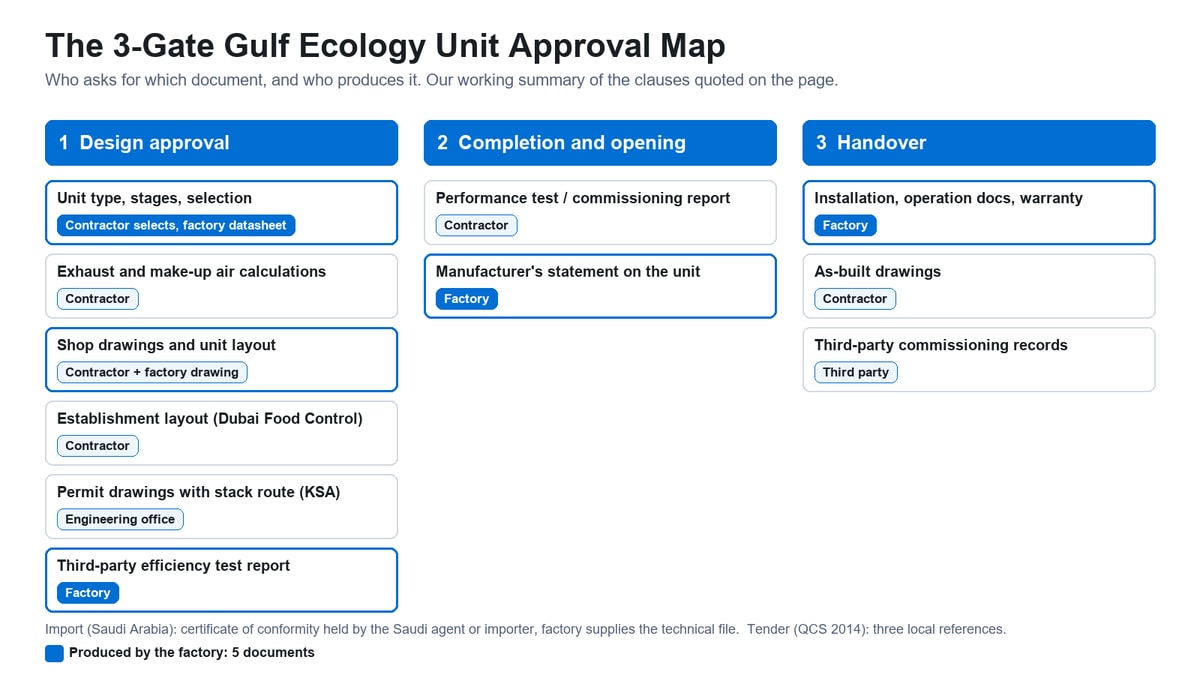
This table answers which document is asked for at which gate and who produces it. It does not answer whether a given landlord or reviewer will accept a given document; that is the question to put to them in writing before the order.
Decision rule. IF a document on your project’s list is one the factory produces, THEN ask for it with the quotation, not after delivery, BECAUSE gate 1 documents are needed before the unit is approved for the drawings, and an order placed without them waits for the paperwork.
What the factory signs, and on what basis
A factory can put its tested efficiency, the report number and the test conditions in writing, and it should not sign a figure that no test supports. The 2015 copy of the Emaar manual asks for a manufacturer’s letter confirming that grease, smoke and odour are fully removed before discharge. We do not put an unqualified figure in such a letter; what we sign names the configuration supplied (the electrostatic, UV-C and carbon stages), the model numbers and their design airflow, and the measured efficiency of the model with the test method, the laboratory, the report number and the airflow it was tested at.
| What the reviewer asks | What we put in writing | Where it comes from |
|---|---|---|
| Efficiency | The measured figure in the report for the model supplied, with the test method and the test airflow; the figures for the LK-E stage used in our ecology units are listed on our specification page | Laboratory test reports, sent on request |
| Certificates | Copies naming the models: CE for LK30 to LK480, LK30E1 to LK150E1 and the UV series | Our certifications page |
| Configuration | The stages in each unit, the control gear, and the extract fan where we supply it, selected on the total static pressure | The proforma invoice and the datasheet |
| Installation and operation | The installation manual and the certificate pack | Sent on request with the order documents |
| Warranty | One year on the unit, with the electrostatic cells and the SPP high-voltage power supply covered and UV-C lamps and carbon excluded as consumables | Our published terms |
This table answers what a reviewer can be given in writing. It does not answer whether a particular landlord accepts it in place of a make on its list; ask that question with the table in hand.
Decision rule. IF a manual asks for a letter with a figure stronger than any test report, THEN ask the landlord whether a statement of the tested figure, with the report attached, meets the clause, BECAUSE a letter is checked against the report behind it, and a figure without a report is what fails at opening.
Mistakes that cost a re-submission
- Ordering before “approved” is defined. A manual that asks for an approved unit can mean an approved layout, a listing, a test report or a make on its own list. Get the answer in writing first.
- Reading the code as if it settled the question. The Dubai code does not name an ecology unit, but its nuisance and distance rules for the discharge still apply, and the reviewer decides whether a discharge without treatment meets them.
- Reading the Saudi completion test as an efficiency test. It checks exhaust airflow, make-up airflow and operation on every system; the 90% for purifiers has no stated method, so agree the evidence with the reviewer before the order.
- Adding a fire damper to the kitchen exhaust. The Dubai code and the Qatar Civil Defence guide both exclude fire dampers from kitchen exhaust ducts; the ecology unit layout must not bring one in.
- Leaving the Saudi certificate of conformity to the factory. Under the SASO regulation the Saudi agent or importer is the responsible party; the factory supplies the file.
- Signing a figure no report supports. The letter is read against the test report at opening.
Buyer record and key takeaways
Before the ecology unit is ordered, these five items are in your file.
- The clause that requires the unit, with the document name, edition and number, from the landlord manual, code or guide that applies.
- The landlord’s written answer on what “approved” means for the unit.
- The document list for each gate, with who produces each item, taken from the approval map above.
- The factory’s datasheet, general arrangement drawing and test report for the models on the schedule.
- For Saudi Arabia, the name of the importer or agent who will hold the certificate of conformity.
Key takeaways
- In Dubai the landlord asks first: the ecology unit is named in the fit-out manuals we read, not in the codes; in Qatar the public texts do not name it and the mall manuals are not public.
- Saudi Arabia sets a figure: at least 90% removal where purifiers are fitted, mandatory only in central Makkah and Madinah; the completion test before final approval checks airflow and operation on every system.
- Three gates, one file: design approval, completion and opening, and handover each ask for their own documents, and five of them come from the factory.
- “Approved” needs a definition: ask which evidence counts before the order.
- Sign only what is tested: efficiency is stated with the test method, the report number and the test airflow.
Frequently asked questions
- Is an ecology unit mandatory in Dubai?
- Not under the Dubai Building Code 2021, the Dubai Food Code 2013 or Dubai Municipality’s kitchen safety guideline, none of which names one. It can be required by the landlord: of the manuals we could open, the Central Park Towers fit-out manual requires one on every kitchen extract, and the JLT tenant handbook asks for the ESP or ecology unit selection and its filtration stages in the mechanical submission. Ask your landlord for the current manual before you order.
- Is an ecology unit mandatory in Saudi Arabia?
- The Chimney Guide for Commercial Activities, which the 2025 restaurant requirements make binding, makes purifiers mandatory only in the central areas of Makkah and Madinah and optional elsewhere, although it calls for them in place of stacks on existing single-storey buildings. Where one is fitted, the guide asks it to remove at least 90% of cooking smoke, fumes and harmful emissions, without naming a test method. Separately, every commercial cooking ventilation system gets a performance test of its airflow and operation before final approval.
- What does “DM approved ecology unit” mean?
- The phrase appears in landlord manuals and on supplier pages. In the Dubai codes and guides we opened we did not find a public Dubai Municipality approval scheme for ecology units; what the municipality approves is the food establishment layout, which has to show the mechanical ventilation. Ask the landlord in writing which evidence it accepts, and get the answer before the order.
- Who obtains the SASO certificate for an ecology unit shipped to Saudi Arabia?
- Under the SASO machinery safety regulation, which lists HS heading 8421, the certificate of conformity from a SASO-accepted body is the responsibility of the Saudi agent or, where there is none, the importer. The factory supplies the technical file, and the route for your tariff line is confirmed on the SABER platform.
Preparing a Gulf F&B fit-out submittal?
Send us the clause from the landlord’s fit-out manual, or the code or guide your reviewer cited, together with the hood airflow and the cooking. You get back the gate 1 documents from the factory side: the datasheet for each model, the general arrangement drawing, the test report for the model where one exists and the certificate copies that name it, and a draft of the manufacturer’s statement in the form described above, with anything the clause asks for that we cannot supply listed as an open point.
Send the clause and the airflow →
If the unit itself is still open, start from the kitchen ecology unit page; for an exhaust that needs only the electrostatic stage, see the in-duct kitchen electrostatic precipitator range.
Why we write this. Whether an ecology unit is required in Dubai, Riyadh or Doha, and what goes with it, is one of the questions buyers put to AI assistants and search engines about this equipment, and no page of ours set out which text asks for the unit and at which gate. This page answers it with the clauses we could open and names the texts we could not: the UAE Fire and Life Safety Code, NFPA 96, the Saudi Building Code, the Saudi Civil Defense regulations and any Saudi or Qatari mall manual. It does not replace the landlord’s manual, the authority’s review or your consultant’s specification.
Law manages project delivery at Polygee and prepares the factory documents that go into contractors’ submittals. Polygee, founded in 2004, manufactures the in-duct electrostatic precipitators, kitchen ESP hoods and kitchen ecology units named here and has exported to 50 countries. This page summarises published texts for planning purposes; it is not legal advice or an authority’s interpretation.
References & further reading
- Dubai Municipality, Dubai Building Code, 2021 edition: clauses B.9.5.1.3, H.4.12.7, H.4.12.15 and Table A.1. dm.gov.ae
- Dubai Municipality Food Control Department, Food Code, 2013, section 2.2; and Health and Safety Department, guideline HSD-GU46, version 3, 2024. Food Code · HSD-GU46
- Central Park Towers, Retail Fitout Manual, 2023: sections 2.2.18, 2.2.26, 3.4.5 and 11.0. centralparktowers.ae
- JLT (DMCC), Retail Tenant Handbook R4, mechanical submission list. jlt.ae
- Ministry of Municipalities and Housing, Saudi Arabia, Chimney Guide for Commercial Activities (clauses 3, 4.1, 4.2, 4.4 and 5.1) and Restaurant Requirements 2025 (clauses 2.1, 4.1 and 4.7). Chimney guide · Restaurant requirements
- Qatar General Directorate of Civil Defence, Technical Requirements Guide, 2022, mercantile chapter and ventilation annex. moi.gov.qa
Related reading
- Ecology unit supplier in the UAE: the commercial terms, documents and shipping for buying from the factory into the UAE.
- Ecology unit supplier in Saudi Arabia: supply, SABER clearance by the importer of record, and the ports.
- Ecology unit supplier in Qatar: what we supply into Qatar and the Lusail installation.
- Electrostatic precipitator drawing approval: the general arrangement drawing the gate 1 shop drawings are built on, and the lines to check before production.