

A commercial kitchen in Canada is designed to NFPA 96, an American standard, because a Canadian building code says so. Ontario’s 2024 Building Code states it at Article 6.3.1.6(1): all commercial cooking equipment shall be provided with ventilation systems designed, constructed and installed to conform to NFPA 96.
What surprises buyers is the layer underneath. The hood over the cookline is certified to a Canadian standard of its own, CAN/ULC 646, whose current edition was published in April 2024, and that standard spends much of its scope saying what it does not cover. Electrostatic precipitators are one of the exclusions, and it names the standard that does cover them.
This guide follows the chain a Canadian submittal travels: from the provincial code article to NFPA 96, from NFPA 96 to the listed hood, and from the hood standard to the separate documents that govern the grease filters, the fire suppression and anything installed in the duct. It does not interpret a specific province’s edition or speak for an authority having jurisdiction. For the equipment, see the kitchen electrostatic precipitator page.
One disclosure: Polygee builds in-duct electrostatic precipitators and holds a UL 867 listing on three models, which is the standard the Canadian hood standard points to for this equipment. What that listing does and does not establish is set out below, in the same section as the model scope.
NFPA 96 Canada: how an American standard becomes a Canadian requirement
NFPA 96 binds a Canadian project by adoption, not by its own authority, and the document to quote is the provincial code article that adopts it. Canada works from national model codes, and each province adopts them and may amend them before publishing its own edition. Article numbers move between those editions, so a specification citing only a national article number can be citing something the reviewer does not have in front of them. Ontario’s 2024 code is worth reading because its wording is public and short. It adopts the National Building Code of Canada 2020 as amended by Ontario, and since 1 January 2025 two articles have replaced the 2012 code’s Article 6.2.2.6. Article 6.3.1.6 carries NFPA 96 into the project, and Article 6.9.1.3 sends the fire protection for commercial cooking equipment using vegetable oil or animal fat to ANSI/CAN/UL/ULC 300 or ULC/ORD-C1254.6.
| Link in the chain | What it does | What it does not do |
|---|---|---|
| The provincial building code, for example Ontario’s 2024 code, Division B, Articles 6.3.1.6 and 6.9.1.3 | Requires the ventilation system for commercial cooking equipment to conform to NFPA 96, and points the suppression to ANSI/CAN/UL/ULC 300 or ULC/ORD-C1254.6 | Restate NFPA 96’s content; the standard is read alongside the code |
| NFPA 96 | Sets the design, construction, installation, inspection and maintenance rules for the hood, duct, fan and suppression, with listed hoods following their listing and unlisted hoods following the construction sections | Certify any product; a listing is a separate exercise by a certification body |
| CAN/ULC 646:2024 | Is the Canadian product standard a Type I hood is evaluated to, for capture and containment at a stated airflow | Cover the fire-extinguishing system, the grease extraction efficiency, UV, recirculating systems or electrostatic precipitators |
| The separate product standards: CAN/ULC-S649 for grease filters, ANSI/UL 300 or ULC/ORD-C1254.6 for suppression, UL 867 for electrostatic air cleaners, UL 710B for recirculating systems | Each cover one component the hood standard leaves out | Substitute for one another; a mark from one says nothing about the others |
This table answers where the requirement comes from. It does not tell you which edition your province has adopted, which is the first thing to confirm, and the U.S. reading of the same NFPA 96 duties is collected in commercial kitchen hood code requirements.
CAN/ULC 646:2024, and the six things its scope excludes
The Canadian hood standard is unusually explicit about its own boundaries, and a buyer who reads only its first clause will misread what a listed hood has proved. The current text is CAN/ULC 646:2024, Standard for Exhaust Hoods for Commercial Cooking Equipment, published by ULC on 28 April 2024 and superseding CAN/ULC-S646-10 (R2021). The publisher issued the fourth edition as a binational joint standard.
| Clause | What the scope says | What it means on a submittal |
|---|---|---|
| 1.1 | Covers Type I commercial kitchen exhaust hoods intended for placement over commercial cooking equipment, with and without exhaust dampers | The listing is about the canopy over the cookline, and only a Type I canopy |
| 1.3 | Hoods are evaluated relative to the minimum exhaust air flow required and the maximum supply air flow allowed for capture and containment of cooking effluents under laboratory conditions | The listing carries an airflow the hood must be run at; the design flow follows the listing rather than a rule of thumb |
| 1.5 | Where fire-actuated exhaust dampers are fitted they close automatically to prevent exhaust duct gas temperatures exceeding 191 °C (375 °F) | The damper is part of what the listing evaluates, and the temperature it must hold the duct below is stated in the standard itself |
| 1.6, 1.7 | Excludes fire-extinguishing systems, while noting that all hoods are intended to be used with them; covers hoods with manual or automatic cleaning or washing systems, but excludes the fire-extinguishing aspects of those systems | Suppression is a separate listing and a separate submittal, as in commercial kitchen hood fire suppression requirements |
| 1.8 | Excludes evaluation of ultraviolet systems; Annex A carries the requirements for those products | A UV odor stage is assessed separately from the hood it sits in |
| 1.9 | Excludes evaluation of electrostatic precipitators for use in commercial kitchen ventilation; they are covered under the Standard for Electrostatic Air Cleaners, UL 867 | The subject of the next section |
| 1.10 | Excludes commercial electric cooking appliances with integral or non-integral recirculating systems, previously called ductless hoods; UL 710B covers those | The ventless route is a different listing, explained in UL 710B vs UL 710 |
| 1.11, 1.12 | Hoods are intended for installation under NFPA 96, the electrical code (NFPA 70 in the United States, CSA C22.1 in Canada) and codes such as the IMC, the National Building Code of Canada and the UMC; products rated 600 volts or less | The standard expects the code chain above, and caps the voltage it evaluates |
| 1.13 | Excludes evaluation of the exhaust hoods with respect to their grease extraction efficiency, noting that filter capture efficiency can be measured using ASTM F2519 | A listed hood has not been graded on how much grease it removes; that evidence comes from elsewhere |
This table answers what a hood listing covers. It does not answer how much grease anything removes, which clause 1.13 puts outside the standard altogether, and which is why downstream filtration is specified on a heavy cookline at all.
Clause 1.9: where an electrostatic precipitator is evaluated
Canada’s hood standard does not evaluate electrostatic precipitators, and it names the standard that does. For a specifier that single clause settles two arguments: a hood listing is not evidence about the air cleaner in the duct, and the air cleaner is not expected to appear in the hood’s certification.
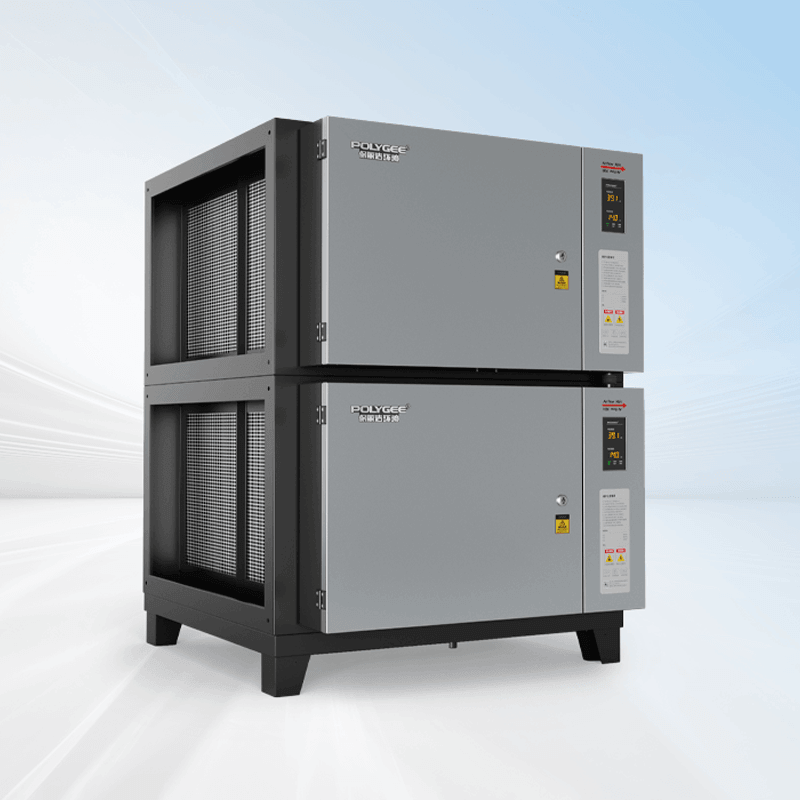
UL 867 is worth understanding before it is asked for. It covers electrostatic air cleaners rated 600 volts or less that are intended to remove dust and other particles from air, for use under the electrical code, and it addresses the safety of portable and fixed equipment, duct-connected units included. It carries a section for models that produce ozone, which is the route by which regulators such as the California Air Resources Board set an ozone limit measured to this standard. It is, in short, an electrical safety and ozone standard.
What it is not is a performance standard. UL 867 does not grade grease removal, and neither does CAN/ULC 646, which excludes grease extraction efficiency at clause 1.13. On a Canadian project that leaves a gap the buyer has to fill deliberately: the listing answers whether the equipment is safe to install, and a separate test report answers how much grease it removes and under what conditions.
Where Polygee sits. Our in-duct units are electrostatic air cleaners of the type clause 1.9 describes, and we hold a UL 867 listing under File E522667 covering the LK/SE 6K, 12K and 18K models at 230 V/50 Hz. That is a listing on three models, not on the range, and it establishes electrical safety and ozone rather than performance. Separately, in CMA-accredited third-party tests the LK units reached up to 97.6% grease removal at rated, evenly distributed airflow, which is a measurement under stated conditions and not a listing. Our integrated ESP hood is a different question: a hood on a Canadian project is expected to carry the Canadian hood listing and ours does not, so on a Canadian job our equipment belongs in the duct behind a listed hood. Which documents a model carries is something we put in writing with the quotation, and the scope by series is on our certificates page.
Grease filters, suppression and cleaning
Two more product standards sit between the code article and a complete submittal, and both are named rather than implied. Grease filters that are removable but not an integral part of a listed hood are listed for Canada to CAN/ULC-S649, the Standard for Grease Filter for Commercial and Institutional Kitchen Exhaust Systems, a national standard that requires noncombustible construction and includes fire testing. A filter that came with a listed hood is covered by the hood’s own listing; a filter bought separately is not, which is where a maintenance purchase can quietly leave the specification behind.
Fire suppression follows the code article rather than the hood standard, and the two agree from opposite directions. Ontario’s Article 6.9.1.3 sends fire protection for commercial cooking equipment using vegetable oil or animal fat to ANSI/CAN/UL/ULC 300 or ULC/ORD-C1254.6. Clause 1.6 confirms that fire-extinguishing systems are outside the hood standard’s scope, even though every hood is intended to be used with one.
Cleaning is where the Canadian chain rejoins the American one. Because the building code adopts NFPA 96, the inspection and cleaning regime a Canadian kitchen runs is the NFPA 96 regime, with the schedule set by cooking type and the contaminated parts cleaned to bare metal by a trained, qualified person. Those four tiers arrive in Canada through the same provincial adoption, and they are set out in commercial kitchen exhaust cleaning requirements. They govern the hood and the duct rather than equipment installed inside them, which is a separate regime described in electrostatic precipitator cleaning.
Which document proves what
A Canadian submittal is a set of listings and reports that each answer one question, and no mark answers a question outside its own standard.
| Evidence | What it supports | What it does not prove on its own | Product-condition scope | Buyer action |
|---|---|---|---|---|
| The provincial code article and its edition | That NFPA 96 applies, and which version arrives with it | That any product on the drawing is listed | The jurisdiction and the adopted edition | Confirm the edition before the specification is written |
| CAN/ULC 646 listing on the hood | Capture and containment at a stated exhaust airflow, with a maximum supply airflow, evaluated in a laboratory | Grease extraction efficiency (clause 1.13); suppression; UV; recirculating systems; electrostatic precipitators | The listed hood model and configuration | Ask the certification body for the listing record with the standard and edition on it |
| CAN/ULC-S649 listing on grease filters | That a separately supplied filter is noncombustible and fire tested for this use | The performance of the hood or of anything downstream | The filter model | Check it when filters are replaced, not only at handover |
| ANSI/UL 300 or ULC/ORD-C1254.6 suppression listing | That the extinguishing system is listed for the cooking it protects | Anything about capture, airflow or emissions | The listed system and its coverage | Match the listing to the appliance line as built |
| UL 867 listing on an electrostatic air cleaner (for Polygee, File E522667 on the LK/SE 6K, 12K and 18K at 230 V/50 Hz) | Electrical safety of the unit, including duct-connected models, and the ozone requirements of the standard | Grease removal performance; any hood requirement; models the file does not name | The models named in the file, at the stated supply | Match the model on the quotation to the models in the file |
| Third-party grease removal test report (for example, CMA-accredited report ZY05W230298 on Polygee LK units) | Grease removal at rated, evenly distributed airflow under that test | Compliance with any Canadian code or listing | The tested model at its rated airflow | Request the report itself and check the serial-number link and test conditions before treating any efficiency figure as a performance basis |
This table answers which document to ask for. It does not answer whether a reviewer will accept a given package, which is the authority having jurisdiction’s decision and is worth settling before equipment is ordered rather than after.
Where this guide stops
- Provincial editions. Articles 6.3.1.6 and 6.9.1.3 are quoted from Ontario’s 2024 Building Code Compendium, updated to 16 January 2025. Ontario amendments issued after that date were not checked. Where Ontario’s text differs from the national code, as in the wording of Article 6.3.1.6, the Ontario text applies. A drawing that still cites Article 6.2.2.6 is working to the 2012 code, which O. Reg. 163/24 keeps only for transition projects. Those have a permit issued by 31 December 2024, or drawings substantially complete by then and a permit application by 31 March 2025. In either case, construction has to start within six months after the permit is issued. Other provinces adopt the national model codes with their own amendments and article numbers, so confirm the article in the edition your province has adopted.
- Energy requirements. Canada’s energy code places separate obligations on high-volume kitchen exhaust, on top of the fire and mechanical requirements described here; read the version your province has adopted.
- Cleaning frequency. The schedule comes from NFPA 96 as adopted, and from the insurer where a policy is stricter. This guide gives no interval and no penalty figures.
- Polygee’s documents. We hold a UL 867 listing on the three models named above and third-party grease removal reports on the LK units. Anything else a project needs, the hood listing included, comes from the supplier of that product, and we say so in writing.
Buyer record
Have ready:
- The province, and the code edition the authority has adopted.
- The appliance schedule and fuel.
- The hood model with its listing record, and the design exhaust airflow against the hood’s listed airflow.
- The duct route and the position available for an in-line unit.
- The electrical supply, since these product standards cap at 600 volts.
Ask each supplier for:
- The listing record naming the standard, the edition and the model, not a photograph of a label.
- The test report behind any efficiency figure, with its method and conditions.
- The resistance at your design airflow. Our complete units with the airflow distribution plate are rated at ≤150 Pa; ask for the figure at your flow.
- A written statement of which documents the model carries.
Re-check when:
- The project moves province, or the province adopts a new code edition.
- The hood is changed to a recirculating package.
- A separately purchased grease filter replaces the one supplied with the hood.
- An in-line unit is added after the hood was listed and balanced.
Frequently Asked Questions
- Do NFPA standards apply in Canada?
- NFPA 96 is not Canadian law by itself; it applies because a building code adopted in the province requires it. Ontario’s 2024 Building Code puts it plainly at Article 6.3.1.6(1): all commercial cooking equipment shall be provided with ventilation systems designed, constructed and installed to conform to NFPA 96. So a Canadian kitchen exhaust is designed to NFPA 96, but the document to quote in a submittal is the provincial code article, and the edition the authority having jurisdiction has adopted decides which version of the standard comes with it.
- What does a CAN/ULC 646 listing on a kitchen hood prove?
- That a Type I hood was evaluated, under laboratory conditions, for the minimum exhaust air flow it needs and the maximum supply air flow it can take while still capturing and containing the cooking effluent. What it does not prove is set out in the standard’s own scope: it does not cover fire-extinguishing systems, and clause 1.13 states that it does not cover evaluation of the hoods with respect to their grease extraction efficiency, noting that filter capture efficiency can be measured using ASTM F2519 instead. A listed hood therefore answers a capture question and leaves the grease-removal question to be answered somewhere else.
- Does an electrostatic precipitator need its own listing in Canada?
- It is evaluated under a different standard from the hood. Clause 1.9 of CAN/ULC 646:2024 states that its requirements do not cover evaluation of electrostatic precipitators for use in commercial kitchen ventilation, and that electrostatic precipitators are covered under the Standard for Electrostatic Air Cleaners, UL 867. That standard addresses electrical safety and, in a section of its own, ozone; it does not establish grease removal performance, and any listing covers only the models the file names. Whether the authority having jurisdiction asks to see it on a given project is a question for that authority.
- Is a UL 710 listed hood accepted in Canada?
- That is the authority’s call, not the manufacturer’s. The Canadian standard for the product is CAN/ULC 646, whose fourth edition was published in April 2024 and supersedes CAN/ULC-S646-10 (R2021); the publisher issued that edition as a binational joint standard, which is why hoods are increasingly certified to both sides at once. The safe route on a submittal is not to argue from the mark on the label but to ask the certification body for the listing record showing the standard and edition the hood was evaluated to, and to put that record in front of the authority having jurisdiction before the hood is ordered.
Specifying kitchen exhaust filtration for a Canadian project?
Send us the province and the adopted code edition, the appliance schedule, the hood model and its listed airflow, the design exhaust flow, the duct route with the position available for an in-line unit, and the electrical supply. Our team will come back with the model whose rated airflow band fits the flow, its resistance at that flow, the UL 867 file reference where the model is one of those it names, the third-party grease removal test report with its method and conditions stated, and a written statement of which documents that model carries.
Talk to our team →Reviewed by Scarlett, Business Director, 9 October 2026
Written by Scarlett · Business Director, PolygeeScarlett leads commercial work at Polygee, from first RFQ through Incoterms, certification scope and delivery for engineering firms, consultants and dealers, with equipment exported to 50 countries. Polygee, founded in 2004, builds commercial kitchen exhaust filtration equipment. This article summarizes a published product standard and a published provincial code article for planning purposes only — it is not a compliance determination, so confirm the requirements for a specific project with your engineer, the authority having jurisdiction and the edition in force.
References & further reading
- Standards Council of Canada — CAN/ULC 646:2024, Standard for Exhaust Hoods for Commercial Cooking Equipment, published 28 April 2024, superseding CAN/ULC-S646-10 (R2021); scope clauses 1.1 to 1.13. scc-ccn.ca
- Standards Council of Canada — Standard for Grease Filter for Commercial and Institutional Kitchen Exhaust Systems (CAN/ULC-S649). scc-ccn.ca
- Government of Ontario — O. Reg. 163/24, Building Code, in force 1 January 2025, adopting the National Building Code of Canada 2020 as amended by Ontario; Division B, Articles 6.3.1.6 and 6.9.1.3, Commercial Cooking Equipment, as consolidated in the 2024 Building Code Compendium updated to 16 January 2025. e-Laws · ontario.ca · nrc.canada.ca
- NFPA — NFPA 96, Standard for Ventilation Control and Fire Protection of Commercial Cooking Operations. nfpa.org
- UL Standards & Engagement — UL 867, Standard for Electrostatic Air Cleaners. shopulstandards.com
- Polygee — kitchen exhaust filtration product range, certificates and third-party test reports. polygeeesp.com
Related reading
- Commercial kitchen hood code requirements — the U.S. reading of the same NFPA 96 duties, from exhaust rate to termination.
- UL 710B vs UL 710 — the recirculating listing that CAN/ULC 646 clause 1.10 sends elsewhere.
- Type 2 hood requirements — the U.S. code reading of the hoods that fall outside a Type I listing.
- Electrostatic precipitator cleaning — what a service visit covers, who owns each item, and what decides the interval.