

Most UK kitchen extract contracts say the ductwork will be cleaned to TR19. Far fewer say which TR19, how the result will be judged, or what the contractor has to hand over at the end. Those three questions decide whether a clean survives an insurer’s question, and they have short answers.
The important one is the second. TR19 Grease does not accept a date as evidence. It sets a measured limit on the grease left behind, which means the interval in the table is a starting point and the measurement is the test.
This guide reads the parts of the standard a buyer has to act on: which document is which, what gets measured, the published intervals and why a second BESA document gives different ones, what a compliant certificate contains, and how the law and the insurance policy attach. It is written for the UK arrangement, which markets that follow British practice draw on as well. It is a planning guide, not a compliance determination, and it does not price cleaning work. For the equipment that sits in the duct this regime cleans around, see the kitchen electrostatic precipitator page.
TR19 or TR19 Grease: which document your contract means
The name now covers three BESA publications, and a contract that says only “TR19” has not finished the sentence. TR19 Grease covers kitchen grease extract and TR19 Air covers general ventilation; both replaced parts of the older TR/19 guide. That history is why specifications written a few years apart can mean different things by the same four characters.
| Document | What it covers | Where you meet it | If your contract says only "TR19" |
|---|---|---|---|
| TR/19, the older guide, since replaced by TR19 Grease and TR19 Air | Internal cleanliness of ventilation systems as a whole. DW/172, second edition 2018 with addenda in April 2020 and May 2024, cites the second edition of 2013 in its Appendix J and leans on it for grease extract cleaning frequency | Older specifications, and any document that predates 2019 | If the contract predates 2019 it can only have meant this one. Ask for it to be restated |
| TR19 Grease, first published 2019; current issue August 2020 | Grease extract systems in commercial kitchens: the measurement, the intervals and the evidence | What a fire authority, an insurer or a specialist cleaning contractor means today | Name it in full, with the year, before anyone prices the work |
| TR19 Air, launched April 2024; current issue March 2026 | Internal cleanliness and hygiene management of ventilation systems. BESA covers kitchen grease extract separately, in TR19 Grease | Ventilation hygiene contracts for commercial and public buildings, from April 2024 on | Not the document for a kitchen grease extract. Name TR19 Grease and its issue date instead |
This table answers which publication is which. It does not tell you which one your insurer has in mind, and that is worth a direct question. The practical consequence is small but it costs money to discover late. A specification written before 2019 cannot have meant TR19 Grease, and DW/172 clause 29.10, which says a specialist ventilation hygiene contractor should be appointed to clean and maintain the grease extraction system as TR/19, was written against the earlier document. If your contract is being renewed, the cheapest half hour on the job is agreeing in writing which publication and which edition the cleaning clause refers to. The wider UK picture that this standard sits inside is mapped in commercial kitchen extraction regulations UK.
What TR19 Grease measures: 200 microns, not a date
The test is the grease left on the inside of the duct, and it is a number. TR19 Grease asks for a mean grease depth of not more than 200 microns, established by measurement rather than by inspection at arm’s length. The readings are taken with a wet film thickness test or a deposit thickness test, and they form part of the post-clean evidence.
That single design decision is what makes the standard useful to a buyer rather than to a contractor. A date in a diary can be met by a visit that cleaned what was reachable. A mean depth across recorded positions can be checked by someone who was not there, months later, which is exactly the position an insurer or a fire officer is in.
It also changes what a cheap quotation means. Two contractors quoting the same building can be quoting different scopes: one to clean what can be reached through the existing access, one to reach the whole system. Only the second can produce a mean across the system, and only the second is measurable against the limit.
The starting intervals, and the BESA table that gives different numbers
TR19 Grease sets intervals by hours of use, and DW/172 Section 29 sets them by grease load as well, so the two BESA documents do not produce the same answer. Both are legitimate; a specification citing both without choosing has left an argument for later.
| Use | TR19 Grease starting interval | DW/172 Section 29, Table 12, by grease load |
|---|---|---|
| Heavy, 12 to 16 hours a day | Every 3 months | Low grease 6 months · medium 4 months · high 3 months |
| Moderate, 6 to 12 hours a day | Every 6 months | Low grease 12 months · medium 6 months · high 3 months |
| Light, 2 to 6 hours a day (DW/172 bands this as up to 6 hours) | Every 12 months | Low grease 12 months · medium 12 months · high 6 months |
| More than 16 hours a day | Read with the measured deposit; the published table goes no further than heavy use | Low grease 6 months · medium 3 months · high 2 months |
This table answers what each document proposes as a starting point. It does not set your interval; the measured deposit and the policy do that. Read the two together and the shape is clear enough to work with. DW/172 asks a second question TR19 Grease leaves to the measurement, which is how greasy the cooking actually is, and on a heavy cookline running long hours the two documents converge on a short interval anyway. Where they diverge is the light-to-moderate kitchen, and that is precisely where an operator is most tempted to stretch the interval.
Two more DW/172 clauses sit alongside and are easy to forget because they are not annual events. Clause 29.2 puts the interval between visual inspections at not more than a week, and clause 29.4 puts the typical minimum cleaning period at once each week for baffle-type self-draining separators and collection drawers, and at least twice each week for secondary mesh filters. Those are kitchen-team tasks that happen between contractor visits, and the state they are kept in is a large part of what the contractor finds. The rest of that specification, section by section, is in the DW/172 kitchen ventilation specification. The U.S. equivalent of the whole regime, which works from cooking type rather than hours, is in commercial kitchen exhaust cleaning requirements.
What a compliant clean leaves behind
The deliverable is a document set, and its contents are specified rather than left to the contractor’s house style. After a TR19 Grease clean you should receive all of the following.
| Item on the certificate | What it proves | What it does not prove | If it is missing |
|---|---|---|---|
| Before-and-after photographs from matching positions | That the named position was in the stated condition before the visit and after it | Anything about a position that was not photographed, and nothing at all if the two frames are of different places | Reject. Two photographs of different bends prove nothing, and matching is the whole point |
| Wet film thickness or deposit thickness readings | The grease depth actually left behind, which is the criterion the standard sets | That the whole system is at that depth, unless enough positions were read to support a mean | Reject. Without readings the clean has no evidence behind it, whatever interval was followed |
| The positions the readings were taken from | Which parts of the system the numbers describe | That unreachable sections were included | Ask for them. A mean without positions cannot be checked by anyone who was not there |
| Hygiene certificate with date, location and named technician | Who did the work, where, and when, so the record can be traced later | Competence in itself; the name is traceability, not a qualification | Reject. An unnamed, undated certificate is not evidence for an insurer |
| A written report on any section not reached | That the contractor has told you what is outstanding and what access it needs | That the section is clean | Ask for it. A certificate that quietly excludes a section is worse than a report that names it |
This table answers what to accept and what to send back. It does not tell you what your own contract or policy asks for beyond this, and where either asks for more, the stricter of the two governs.
Ask for that set before the work rather than after it, because it is also a scope question. A contractor who has not been asked to measure will not have measured, and a contractor who cannot reach a section will not photograph it. Where a system genuinely cannot be reached, the honest outcome is a report naming the section and the access it needs, and that report is worth more to a responsible person than a certificate that quietly excludes it. Access panels are a design item rather than a cleaning item. DW/172 puts them at 2 m centres in the absence of a detailed cleaning specification, and the U.S. reading of the same problem is in grease duct requirements.
Who TR19 binds, and through what
TR19 Grease is an industry specification, not a statute. Three separate mechanisms give it teeth, and they bite in different ways.
| Route | What it actually requires | Who enforces it | What non-compliance costs |
|---|---|---|---|
| Fire law: the Regulatory Reform (Fire Safety) Order 2005 | The responsible person for a non-domestic premises assesses and reduces the fire risk. The grease extract is part of that risk, and the Order names no interval | The fire and rescue authority | The duty sits on the responsible person; TR19 Grease is what the trade points to as a reasonable regime |
| The insurance policy | Policies commonly name TR19 by reference and set the frequency as a condition | The insurer, usually after an incident | BESA states that failing to comply can invalidate a policy. This is the mechanism operators feel first |
| The contract | A specification citing TR19 Grease turns its requirements into contract terms between the parties | The specifier, the main contractor or the landlord | A contractual failure, and a handover that does not complete |
Gas safety runs on a separate track with a separate enforcement route, and its interlock requirement is set out in gas interlock. This table answers how the cleaning standard becomes binding. It does not tell you what your own policy says, which is the one document in the list written specifically about your building, and it is worth reading before the interval is set rather than after a claim.
What in-duct filtration changes, and what it does not
An in-duct air cleaner does not reduce the cleaning obligation, because the obligation is written about the duct, not about the equipment. That distinction is worth being exact about, because it is often sold the other way round.
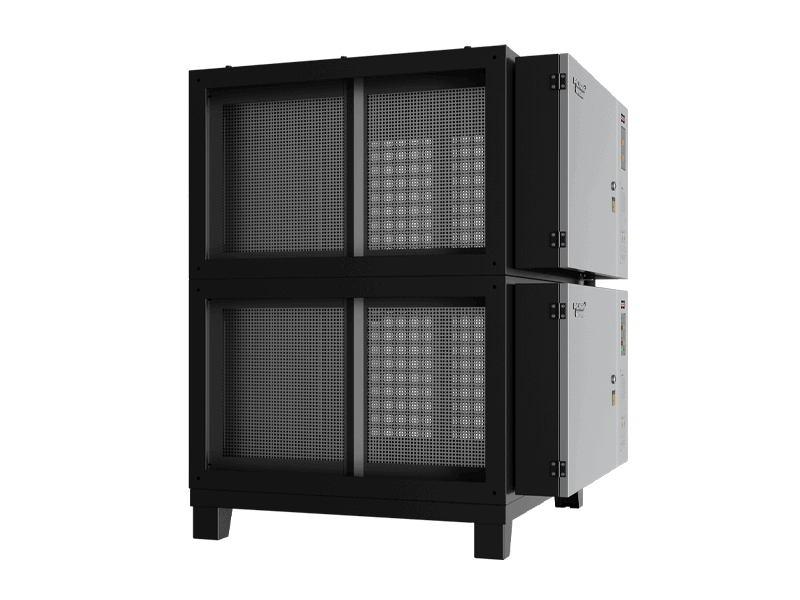
What an in-duct unit changes is what the measurement finds. Grease captured on a collector cell is grease that did not continue down the duct, so what the contractor measures downstream of the unit is whatever got past it. Whether that moves your interval is a question for the measurement and the insurer, not for us, and we do not publish a figure for it. What you can do is generate the evidence: have the mean depth read downstream of the unit at the next two cleans, and put the pair of readings in front of the insurer. A trend in your own duct is the only thing that moves an interval.
What it does not change is any of the following. The duct still has to be inspected and cleaned to the same standard, upstream of the unit as much as downstream. The baffle separators in the canopy still get washed on the weekly cycle DW/172 describes. The access the contractor needs is still a design item. And the unit itself is outside the contractor’s scope: it keeps its own service regime on the manufacturer’s terms, and those records sit beside the TR19 certificates rather than replacing them. What that service regime covers is set out in electrostatic precipitator cleaning.
One honest boundary on our side. Our LK in-duct units carry CE, and a third-party grease removal test: in CMA-accredited tests (report ZY05W230298) they reached up to 97.6% grease removal at rated, evenly distributed airflow. That is a grease removal result at a stated airflow. It is not a TR19 result and it does not predict a mean deposit in your duct. On the UK side, our position is the one stated on our other pages: the CE certificate on the named series (FQC2602501) continues to be recognized for the Great Britain market alongside UKCA, and we hold no EN 16282-8 report and no LPCB approval, which we say in writing. Which documents a given model carries, we put in writing with the quotation.
Where this guide stops
- The standard itself. This guide summarizes the requirements a buyer acts on. TR19 Grease is a BESA publication and the full text, including the detail of the test methods, comes from BESA.
- Jurisdiction. This is the UK arrangement. Markets that follow British practice commonly specify BESA documents by name; which ones and which editions is for the tender to confirm.
- Your interval. The published tables are starting points. The interval that governs your kitchen comes from the measured deposit and from your insurance policy, and this guide sets neither.
- Costs and penalties. No cleaning prices, no premium figures and no penalty amounts appear here. They are specific to a building and a policy.
- Our own equipment. We build in-duct and hood-integrated filtration. We are not a duct cleaning contractor and we do not issue TR19 certificates. What our equipment does carry, and what it does not, is on the certificates page.
Buyer record
Have ready:
- The hours the kitchen cooks per day, and an honest view of the grease load.
- The cleaning clause from the contract, with the document and edition it names.
- The relevant condition from the insurance policy.
- The last certificate, with its measurements and photographs.
- A drawing of the duct run showing where access exists and where it does not.
Ask the cleaning contractor for:
- Which document and edition they are quoting to.
- Whether the price includes measurement, and at how many positions.
- Which sections they can reach, and a written report on any they cannot.
- The certificate format, confirming date, location and named technician.
Re-check when:
- Trading hours change, or the menu gets greasier.
- The insurer changes, or the policy is renewed with new conditions.
- Anything is added to the duct run, since it changes both the load downstream and the access.
- A measurement comes back near the limit rather than well under it.
Frequently Asked Questions
- What is TR19?
- TR19 is a BESA technical publication, and the name now covers three different documents. TR/19 is the older guide to internal cleanliness of ventilation systems generally; DW/172, published in 2018, cites the second edition of 2013 in its bibliography. TR19 Grease, first published separately in 2019 and now in its August 2020 issue, deals with grease extract systems in commercial kitchens. It is the document a fire authority, an insurer or a cleaning contractor means in practice. TR19 Air, launched in April 2024, updates the older guide for general ventilation and leaves kitchen grease extract to TR19 Grease. Because a specification written before 2019 can only have meant the older document, a contract that says only TR19 is worth pinning down before anyone prices the work.
- How often does TR19 say a kitchen extract must be cleaned?
- TR19 Grease gives starting intervals by hours of use per day: every 3 months for heavy use of 12 to 16 hours, every 6 months for moderate use of 6 to 12 hours, and every 12 months for light use of 2 to 6 hours. Those are starting points rather than a schedule to be followed regardless. The interval that governs is the one that keeps the measured grease deposit inside the limit, and an insurance policy can require more frequent cleaning than the published table. DW/172 Section 29 carries a table of its own with different numbers, so a specification citing both needs to say which one it means.
- Is TR19 a legal requirement?
- Not by itself. TR19 Grease is an industry specification, not a statute. What is law is the Regulatory Reform (Fire Safety) Order 2005, which makes the responsible person for a non-domestic premises assess and reduce the fire risk; the grease extract is part of that risk. TR19 Grease becomes binding when someone cites it: a fire authority as the measure of a reasonable regime, an insurer as a policy condition, or a specifier as a contract term. BESA states that failing to comply can invalidate an insurance policy, which is usually the sharpest of those three in practice.
- What is the 200 micron figure in TR19 Grease?
- It is the acceptance criterion for the grease deposit itself. TR19 Grease asks for a mean grease depth of not more than 200 microns, measured with a wet film thickness test or a deposit thickness test, with the readings recorded as part of the post-clean evidence. That is what turns cleaning from a date in a diary into something a third party can check: if the measured mean sits above the limit, the system needs cleaning whatever the calendar says, and if it sits below, the measurement is the evidence. Ask that the readings, and the positions they were taken from, appear on the certificate.
Reducing what reaches the duct in the first place?
Send us the extract flow rate, the duct size and route, the position available for an in-line unit, and the cooking type. Our team will come back with the model whose rated airflow band fits the flow, its resistance at that flow, the third-party grease removal test report with the airflow it was measured at stated on it, and a written note of which documents that model carries. We will not tell you it changes your cleaning interval; that is between your measurements and your insurer.
Talk to our team →Reviewed by Law, Project Manager, 9 October 2026
Written by Law · Project Manager, PolygeeLaw manages kitchen exhaust filtration projects at Polygee, from spec review through duct-side ESP sizing and installation support, including the access and maintenance questions that follow a system into service. Polygee, founded in 2004, builds commercial kitchen exhaust filtration equipment. This article summarizes a published industry specification and the law it attaches to, for planning purposes only — it is not a compliance determination, so confirm the requirements for a specific building with your fire risk assessor, your insurer and the edition in force.
References & further reading
- BESA — TR19 Grease (first published 2019; current issue 1 August 2020). TR19 Air (launched April 2024; current issue March 2026). TR/19 Second Edition 2013, Guide to Good Practice, Internal Cleanliness of Ventilation Systems, as cited in DW/172 Appendix J. thebesa.com
- BESA — DW/172 Specification for Kitchen Ventilation Systems, Section 29 Cleaning & Maintenance and Appendix J. thebesa.com
- UK Government — Regulatory Reform (Fire Safety) Order 2005. legislation.gov.uk
- Health and Safety Executive — Catering Information Sheets on ventilation and gas safety in catering. hse.gov.uk
- Polygee — kitchen exhaust filtration product range, certificates and third-party test reports. polygeeesp.com
Related reading
- Commercial kitchen extraction regulations UK — the map of law, specification and guidance this standard sits inside.
- DW/172 kitchen ventilation specification — the design specification whose Section 29 carries the second interval table.
- Commercial kitchen exhaust cleaning requirements — the US regime, which sets intervals by cooking type instead of hours.
- Electrostatic precipitator cleaning — the service regime an in-duct unit keeps alongside the duct cleaning.
- Gas interlock — the other UK duty that a ventilation fault turns into a trading fault.