

Ask how many types of electrostatic precipitator there are and you will get three different answers, because the technology is classified along three axes at once. None of them is wrong. They are just answering different questions.
One axis is how the collected material comes off the plates. One is the shape of the collection surface. And one, which sits outside the usual classification but decides more than either for a commercial kitchen, is whether the machine charges and collects in the same place or in two separate places.
This guide takes them in that order, says which type suits which duty, and is explicit about which type we build. General statements about precipitators come from the US Environmental Protection Agency’s public control-technique reference; statements about our own equipment are ours. For the unit itself, see the kitchen electrostatic precipitator page. For where each type gets used, see electrostatic precipitator applications.
Types of electrostatic precipitator: the four the EPA publishes a fact sheet for
The cleanest published answer comes from the EPA, which publishes a separate technical fact sheet for each of four combinations. Two classifications crossed with each other give the four.
| Type | Collection surface | How it is cleaned | EPA fact sheet |
|---|---|---|---|
| Dry, wire-plate | Flat plates | Rapping: mechanical impulse or vibration | EPA-452/F-03-028 |
| Dry, wire-pipe | Pipes or tubes | Rapping | EPA-452/F-03-027 |
| Wet, wire-plate | Flat plates | Rinsing with water | EPA-452/F-03-030 |
| Wet, wire-pipe | Pipes or tubes | Rinsing with water | EPA-452/F-03-029 |
This table answers how the technology is formally classified. It does not tell you which one a given duty needs, which depends on the particle rather than on a preference, and it leaves out the single-stage and two-stage distinction entirely, because that is not part of this classification.
Dry and wet: the difference is how the plates get cleaned
The names suggest something about the gas. They are actually about housekeeping. The EPA puts it plainly: the primary difference between the two classifications is the method by which the collector plates are cleaned. In dry precipitators the plates are cleaned by applying mechanical impulses or vibration, which knocks the collected particulate loose, a process called rapping. In wet precipitators the plates are rinsed with water.
Two consequences follow, and they decide most projects.
- Dry is the default. The EPA describes dry precipitators as the most commonly used. If the dust is dry and will fall when the plate is struck, there is no reason to introduce water and the effluent that comes with it.
- Wet exists for what will not fall off. The EPA notes that wet precipitators are typically employed when gas streams contain sticky particles with low resistivity. That is the technical description of a mist, a tar or a fume that would build up on a plate no matter how hard you hit it.
Plate and pipe: the shape of the collection surface
The second axis is geometry, and the EPA folds it into the same four fact sheets. Collection surfaces are either plates or pipes, and the discharge electrodes are wires running between or through them, which is where the wire-plate and wire-pipe names come from.
| Geometry | What it looks like | Where it tends to appear |
|---|---|---|
| Wire-plate | Parallel flat collection plates with discharge wires in the gaps; gas passes horizontally between the plates | The large dry precipitators on boilers and kilns. A kitchen cell uses flat collection plates too, but with its charging section ahead of the plate pack rather than wires between the plates |
| Wire-pipe | Vertical pipes or tubes with a discharge wire down the center of each; gas passes up or down through the pipe | Duties where the collected material runs down and out, which is often a wet application |
This table answers what the two geometries are. It does not decide anything on its own: a project arrives at a geometry through the particle and the cleaning method, rarely by choosing the shape first.
Single stage and two stage: the split that decides a kitchen
This is the distinction that matters most to anyone specifying for a commercial kitchen, and it is not part of the dry-and-wet classification at all.
A single-stage precipitator charges the particles and collects them in the same region. That is the arrangement of the big industrial units: the EPA describes discharge electrodes divided into fields, with most units carrying three or four fields in series and very large ones as many as fourteen, energized by a transformer-rectifier (T-R) set power supply.
A two-stage precipitator separates the two jobs: a charging section ionizes the particles first, and a collection section behind it holds them. That is the arrangement used in commercial kitchen exhaust, and it is what a kitchen ESP cell actually is.
This distinction is not part of the EPA classification above and we are not citing it to the EPA: it is the ordinary industry description of the two layouts, and the reason we state it is that our own units are built the second way.
The same arrangement travels under three names, which is worth knowing before you compare quotations. Two stage describes a charging section followed by a collection section, and is the term to put in a specification. Dual zone is the same idea named after the two zones rather than the two stages, and it is the phrase our own product literature uses. Dual field or double pass means something else again: two such assemblies in series, so the air is charged and collected twice. A quotation that names only one of the three has told you less than it appears to.
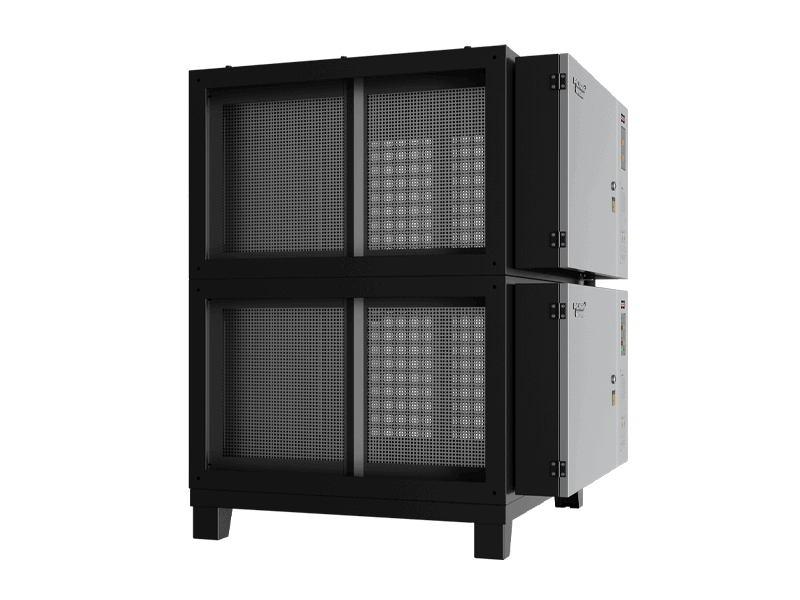
The rest of the comparison between the kitchen machine and the industrial one — sticky and flammable grease, daily cycling, and the space available — is in kitchen ESP vs industrial ESP. What matters here is that if a specification says only “electrostatic precipitator” without saying two-stage, it has not yet described the machine a kitchen needs.
What every type has in common
Whatever the type, the EPA describes a precipitator as being made up of four components. They appear in a power station and in a duct-mounted cabinet, at very different sizes.
| Component | What the EPA says it does | What it looks like in a kitchen unit |
|---|---|---|
| Gas distribution plates | Several perforated plates that help maintain proper flow distribution of the entering gas stream | The airflow distribution plate fitted as standard in our in-duct units, and the reason the published resistance figure is for the complete unit |
| Discharge electrodes | Energised electrodes that create ions, which collide with particles and apply the charge | The charging electrodes in the front section of the cell |
| Collection surfaces | Plates or pipes that provide the surface the charged particulate collects on | The stainless steel collector plates in the cell behind the ioniser |
| Rappers | The system responsible for removing collected particulate from the collection surfaces | Absent. A kitchen unit has no rappers, because grease does not fall off when struck; the cells come out and are washed instead |
This table answers what the components are for. It is the EPA’s classification of the technology, not the parts list of a kitchen cabinet: for that, including the washable mesh pre-filter that sits ahead of all of it, see the component list on our kitchen electrostatic precipitator range. The last row is the honest reason a kitchen unit needs a service routine rather than a mechanism, and what that routine covers is in electrostatic precipitator cleaning.
Which type for which duty
Read the left column as a description of your own gas stream; the row tells you which family you are buying from. The right-hand column is left blank for your own answer.
| If the duty is | The type that fits | Why | Is this my duty? |
|---|---|---|---|
| Dry dust at high volume and temperature | Dry, wire-plate, single stage, several fields | The dust can be rapped loose, and residence time is bought with fields in series | |
| Sticky particles with low resistivity; mists; acid | Wet, plate or pipe | The combination the EPA names for wet units: nothing will fall off a plate, so the surface has to be rinsed | |
| Collected material that should drain away | Wire-pipe | The geometry lets it run down and out | |
| Commercial kitchen exhaust | Dry, plate type, two stage, with washable cells | Grease is sticky, but it is not the sticky-and-low-resistivity mist duty the EPA describes for wet units. The kitchen answer is a cell that comes out and is washed off the machine |
This table answers which family a duty falls into. It does not size anything, and it does not settle acceptance, which depends on the documents an authority asks for rather than on the type.
What we build. Our in-duct units are dry, plate-type, two-stage cabinets with washable stainless steel collector cells and an airflow distribution plate fitted as standard, supplied in the airflow bands set out on the kitchen electrostatic precipitator page. A complete unit with that plate is rated at not more than 150 Pa, and we give the figure at your design airflow when we quote. The EPA’s greater-than-99-percent figure quoted for the technology as a class is not ours and does not describe this equipment; what we can state is the result of a test on named models. In CMA-accredited third-party tests our LK in-duct units reached up to 97.6% grease removal at rated, evenly distributed airflow, under report ZY05W230298. We do not build wet precipitators, wire-pipe units, or anything for boilers, kilns or smelters. Which documents a given model carries is on the certificates page.
Where this guide stops
- Industrial equipment. The dry, wet and wire-pipe material is here so the classification is complete. We do not supply those machines and this is not a specification for them.
- Efficiency. The EPA says precipitators as a class are capable of collection efficiencies greater than 99 percent. That is a statement about the technology, not about any model, and it is not our figure. Ours is the grease removal result quoted above, on named models at a stated airflow.
- Sizing and selection. Nothing here sizes a unit. That needs the airflow, the duct and the duty.
- Acceptance. Which listings or approvals an authority requires is that authority’s decision, and it is worth settling before the type is even chosen.
Buyer record
Have ready:
- Whether the particle is dry or sticky, and roughly what its resistivity is if anyone has measured it.
- The airflow, and how much of the day it is at that flow.
- The duct size and route, and the space available for a cabinet.
- The cooking type and the electrical supply, both of which the quotation will ask for.
- Whether odor is part of the problem, since no precipitator type addresses it.
Ask each supplier for:
- Which of the four types they are quoting, in those words, and whether it is single or two stage.
- How the collection surfaces are cleaned, and by whom.
- The rated airflow band for the model.
- The resistance at your design airflow, for the complete unit rather than the cell alone.
Re-check when:
- The process or the menu changes the particle.
- The flow is going to be modulated rather than held at one rate.
- A supplier describes a kitchen unit as a wet precipitator, which is worth a direct question.
Frequently Asked Questions
- What are the types of electrostatic precipitator?
- Two classifications overlap. The first is dry against wet, which the EPA draws around how the collection surfaces are cleaned: a dry precipitator knocks the collected material loose by applying mechanical impulses or vibration, known as rapping, while a wet one rinses the plates with water. The second is the geometry of the collection surface, either plates or pipes, which the EPA reflects in its own fact sheets by publishing four of them: dry wire-plate, dry wire-pipe, wet wire-plate and wet wire-pipe. A third distinction, single stage against two stage, is not part of that classification but is the one that decides which machine goes into a commercial kitchen.
- What is the difference between a dry and a wet electrostatic precipitator?
- How the plates are cleaned, and therefore what the machine can be used on. In a dry precipitator the collector plates are cleaned by applying mechanical impulses or vibration, which knocks the collected particulate loose. In a wet precipitator they are rinsed with water instead. The EPA notes that dry precipitators are the most commonly used, and that wet ones are typically employed where the gas stream contains sticky particles with low resistivity. That is why a wet unit appears on process mists and certain metallurgical fumes, and why neither answer is the one a commercial kitchen uses.
- Is a kitchen electrostatic precipitator a wet type?
- No, and it is worth being precise because the words look similar. A wet electrostatic precipitator washes its collection surfaces with water while it is in service, as part of how it runs. A commercial kitchen unit is a dry precipitator whose collector cells are taken out of the machine and washed off it, then put back. Cooking grease is sticky, so it cannot be rapped loose the way dry industrial dust is, but the answer the kitchen industry reached was removable washable cells rather than in-service rinsing. Our own in-duct units are dry, two-stage, plate-type cabinets with washable stainless steel collector cells.
- What is a two-stage electrostatic precipitator?
- One that charges the particles in a separate region from the one that collects them: an ionizing section first, then a collection section behind it. A single-stage machine does both in the same region, which is the arrangement of the large precipitators used on boilers and kilns, where the EPA describes fields of discharge electrodes energized by a transformer-rectifier (T-R) set power supply. The two-stage arrangement is the one used for commercial kitchen exhaust, and the reason it suits that duty, along with the rest of the comparison between the kitchen machine and the industrial one, is set out in our guide to what an electrostatic precipitator is.
Specifying the type for a commercial kitchen?
Send us the extract flow rate, the duct size and route, the position available for an in-line unit, the cooking type and the electrical supply. Our team will come back with the model whose rated airflow band fits the flow, its resistance at that flow for the complete unit, the third-party grease removal test report with the airflow it was measured at stated on it, and a written note of which documents that model carries. If what you actually need is a wet or wire-pipe machine, we will say so rather than quote you the wrong type.
Talk to our team →Scarlett leads commercial work at Polygee, from first RFQ through Incoterms, certification scope and delivery for engineering firms, consultants and dealers, with equipment exported to 50 countries. Polygee, founded in 2004, builds commercial kitchen exhaust filtration equipment. This article summarizes a public control-technique reference and our own product facts for planning purposes only — industrial types are described so the classification is complete, not offered as products.
References & further reading
- US EPA — Air Emissions Monitoring Knowledge Base, Monitoring by Control Technique: Electrostatic Precipitators (components, dry and wet classification, rapping, resistivity, fields and transformer-rectifier sets). epa.gov
- US EPA — Air Pollution Control Technology Fact Sheets, linked from the control-technique page above: dry ESP wire-pipe (EPA-452/F-03-027), dry ESP wire-plate (F-03-028), wet ESP wire-pipe (F-03-029), wet ESP wire-plate (F-03-030).
- Polygee — kitchen exhaust filtration product range, certificates and third-party test reports. polygeeesp.com
Related reading
- Electrostatic precipitator applications — the industry view: which gas streams take which type, and where a kitchen sits.
- Kitchen ESP vs industrial ESP — the eight rows on which the two machines differ, and what each one means for a quotation.
- Electrostatic precipitator vs baffle filter — what the hood filters do before any of this starts.
- Electrostatic precipitator cleaning — what washable cells mean in service, and who does the work.
- Commercial kitchen ESP buying guide — once the type is settled, the checks that separate one supplier from another.