

Quick answer: a dry scrubber for kitchen exhaust is a unit that cleans the extract without water. The name does not tell you what is inside it. In listings we reviewed in September 2026, it covered electrostatic units for smoke and grease aerosol, activated carbon units for odor, and combinations of stages. A wet scrubber washes the airstream with a water circuit instead, which needs a water supply, a drain and effluent handling, and adds humidity to the discharge. So the useful question is what the unit contains and what your site can support. This guide shows how to tell the builds apart, when wet suits better, what a factory-direct electrostatic unit from Polygee includes, and the inputs to send for a comparable quotation.
This guide helps you decide which scrubber build fits a commercial kitchen and what to ask each supplier. It does not size a unit, quote a price, or cover local approval requirements. For the order of stages in a full exhaust train, see kitchen exhaust filtration; for the three-stage dry unit, see the kitchen ecology unit.
| Build | Main difference | Better fit when | Main limitation | What it means for your purchase |
|---|---|---|---|---|
| Electrostatic dry unit | High-voltage cells charge and collect smoke and grease aerosol; the cells are washed and reused | Visible smoke and grease are the problem and there are no water services | Does not treat gas-phase odor | Add a carbon or UV-C stage if smell is part of the complaint |
| Activated carbon dry unit | Carbon adsorbs gas-phase odor | Smell is the problem and grease is removed ahead of it | Short media life if grease reaches the carbon; the media is consumed | Protect it with a particulate stage and budget media replacement |
| Combined dry unit | Electrostatic, UV-C and carbon stages in one run | Both smoke and smell matter | More stages mean more resistance and more space | Check the access space and carry the resistance into the fan selection |
| Wet scrubber | A water circuit washes the airstream | The specification calls for a wet process | Needs water supply, drain and effluent handling; adds humidity to the discharge | Plan plumbing and effluent before choosing |
What is inside a unit sold as a dry scrubber
A unit sold as a dry scrubber can contain an electrostatic stage, an activated carbon stage, or both, and the two do different jobs. Ask which stages a quoted unit contains before comparing two prices, because an electrostatic unit and a carbon box can carry the same product name and solve different problems.
How an electrostatic dry unit works
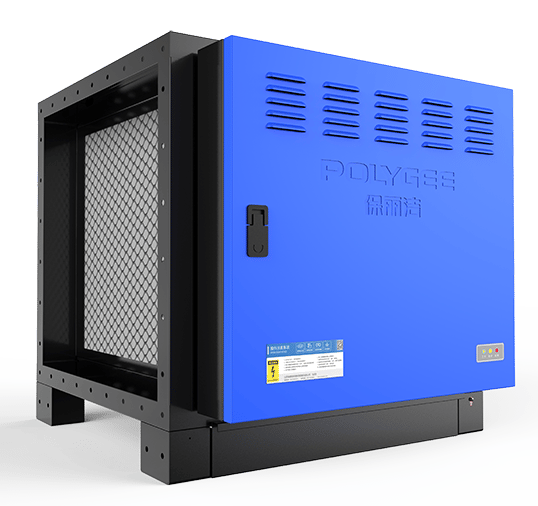
An electrostatic dry unit is an electrostatic precipitator, or ESP, built for kitchen exhaust. Exhaust air passes an ionizing section, where a high-voltage field gives the smoke and grease particles an electric charge. The charged particles are then drawn onto the plates of a collector cell and held there until the cell is removed and washed. Nothing is consumed in the process, which is why an electrostatic stage has no filter media to replace; the running work is cleaning the cells. Our collector cells are stainless steel and slide out for washing.
On performance, the figure to ask for is a test result with its conditions. Our LK in-duct units reached up to 97.6% grease removal in CMA-accredited third-party tests (report ZY05W230298) at rated, evenly distributed airflow. That is a grease removal result, not an odor result, and it holds for the tested model at its rated airflow. The LK-E engineering series is offered in three grades, at or above 90, 95 and 98 percent design efficiency, chosen from the cooking load.
What carbon and UV-C add
Most cooking odor sits in the gas phase, as compounds too small to be collected as particles, so an electrostatic stage reduces the smoke without removing the smell. Activated carbon adsorbs those compounds, and UV-C breaks them down; where UV-C is used, carbon behind it also adsorbs surplus ozone before discharge. Carbon needs the grease removed ahead of it, or its life is short. Our carbon media is coal-based columnar activated carbon with an iodine value of at least 800 mg/g.
Dry or wet: choose by what your site can support
Neither build is better in general; the site decides. A dry electrostatic unit suits kitchens without water services at the unit. A wet scrubber suits a specification that calls for a wet process, on a site that can take its plumbing and effluent. Work through the conditions below before asking for prices.
| Site condition | Dry electrostatic or combined unit | Wet scrubber |
|---|---|---|
| No water supply or drain near the unit | Suits: no water services needed | Needs a supply, a drain and effluent handling at the unit |
| Humidity at the discharge matters | Adds none | Adds humidity to the discharge |
| Smoke and grease are the complaint | An electrostatic stage addresses it | Removes particles |
| Smell is part of the complaint | Needs a carbon or UV-C stage behind the electrostatic stage | Treats odor partly |
| Maintenance access | Cells slide out for washing; carbon and UV-C stages need 1,000 mm clear on the access side | Ask the supplier for the water treatment and cleaning routine |
| Space | In-duct or in a plant area, one stage or several | Usually a plant room |
This table answers which build suits which site. It does not rank suppliers or products; within each build, compare the stages, the airflow basis and the resistance at your airflow.
What a factory-direct dry unit from Polygee includes
A factory-direct order covers the treatment stages, their control gear and the documents; installation, ductwork and any local approval stay with your contractor. These are the terms that apply, written out so you can hold any offer against them, ours included.
| Term | What applies | What it means for your project |
|---|---|---|
| Minimum order | One unit | A single unit for one kitchen is a normal first order |
| Lead time | 7–15 days as standard | Freight time is added according to the route and the Incoterm |
| Payment | A 30% deposit releases production, with the balance settled before shipment; a 50% deposit is also available; T/T and L/C are both accepted | Schedule the balance ahead of the shipment date |
| Incoterms | EXW, FOB or CIF, arranged to suit the buyer | Tell us the delivery point and we quote on that basis |
| Warranty | One year on the complete unit, covering the collection cells and the SPP high-voltage power supply; UV lamps and activated carbon media are consumables and are not covered | Budget consumables separately |
| Extract fan | Available with the unit, selected on the total static pressure of the configuration | Say whether you want it in the offer |
| Installation and site attendance | Not included; paid on-site service is available | Price installation with your local contractor |
| Spare parts | Common spares held in stock; parts supplied for one year after a model is discontinued | Agree the spares holding with the order |
| Remote support | Video calls backed by illustrated manuals, Monday to Friday, 8:00–17:00 (GMT+8), which is 05:30–14:30 IST | Plan commissioning questions for the Indian morning |
| Your brand | Your logo on the unit and a different enclosure color; quantity and lead time for OEM builds agreed case by case | State it in the first enquiry |
This table answers what the terms are. It does not answer the price, which follows the stages and the airflow; what sets an electrostatic precipitator price explains what moves it.
Sizes in m³/h and CFM
Our in-duct units start at 2,000 m³/h, about 1,177 CFM, and the standard LK table covers 41 models from 4,000 to 60,000 m³/h, about 2,354 to 35,316 CFM. The LK-E engineering series runs from 3,000 m³/h, about 1,766 CFM, with its widest grade reaching 40,000 m³/h, about 23,544 CFM. The three-stage ecology unit comes in eight sizes per run, from 3,000 to 15,000 m³/h, about 1,766 to 8,830 CFM, and larger extract rates are split into parallel runs. The brochure input supply is 220 V, 50 Hz, with 380 V and 60 Hz configured to order, so state your site supply.
Model tables are on the LK-E series page, and the full range is under kitchen electrostatic precipitator.
What to send for a quotation
Three Asian projects on record, with year, equipment and unit count; none is in India, and you can ask about any of them. The inputs that make a dry scrubber quotation comparable with any other, with where each is found, are set out in our electrostatic precipitator quotation guide.
| Project | Year | Equipment | Units |
|---|---|---|---|
| Marina Bay Sands, Singapore | 2012 | ODM units | 500 |
| Tun Razak Exchange, Kuala Lumpur | 2022 | LK-E and UV series | 300 |
| Landmark 81, Vietnam | 2021 | LK-E series | 70 |
Kitchen scrubber enquiry sheet
| # | Send us | Why it matters |
|---|---|---|
| 1 | Exhaust rate in CFM or m³/h, and who set it | Fixes the model in every stage |
| 2 | Cooking style: tandoor, charcoal grill, heavy wok, frying or light cooking | Sets the electrostatic grade |
| 3 | Whether smell is part of the requirement, and who raised it | Decides whether carbon or UV-C stages are needed |
| 4 | Hood and duct size, the space available and the access side | Decides in-duct or plant-area installation, in line or stacked |
| 5 | Site power supply: voltage, phase and frequency | The brochure input is 220 V, 50 Hz; other supplies are configured to order |
| 6 | Whether the extract fan is in our scope | Keeps offers comparable |
| 7 | Delivery point and preferred Incoterm | Fixes the freight basis of the proforma invoice |
| 8 | Required on-site date | Shows whether lead time plus freight fits your programme |
What you get back:
- The stages we propose, with the reason for each
- The resistance of each stage at your airflow, with its basis stated
- A proforma invoice on your Incoterm
- Which parts are consumables and which are covered by the warranty
- The documents available for your consultant or landlord
Scope and limits
Three layers clear separately. Layer one, the equipment: the stages, the terms and the documents. Layer two, the installation: hood capture, duct route, access and the fan selection. Layer three, operation: delivered airflow, cleaning and consumables decide the result at the discharge. Passing one layer does not clear the next.
- No prices appear on this page. Send the enquiry sheet and the price comes back against stated stages.
- No wet scrubber performance figures are given. Ask the wet scrubber supplier for a test result with its conditions, as you would ask us.
- An electrostatic stage alone is not odor control. Where smell is the issue, add carbon or UV-C behind it.
- Local approval is not covered here. Ask your consultant what the local authority or the building management asks for, and send us that list.
- No cleaning interval is given. It depends on the cooking load and the operating hours, and we put it in writing with the quotation.
Key takeaways
- The name: “dry scrubber” describes how a unit works without water, not what is inside it; ask which stages it contains.
- Dry or wet: the site decides, through water services, drainage, humidity and whether smell is part of the complaint.
- Odor: an electrostatic stage clears smoke; smell needs carbon or UV-C behind it.
- Enquiry: eight inputs make quotations comparable; a request for a price alone does not.
Frequently Asked Questions
- What is a scrubber in a commercial kitchen?
- It is a unit in the exhaust line that cleans the extract before it is discharged. A wet scrubber washes the airstream with a water circuit and needs a water supply, a drain and effluent handling. A dry scrubber works without water, and units sold under that name can be electrostatic, activated carbon or a combination of stages, so ask which stages a quoted unit contains.
- How does a dry electrostatic scrubber work?
- An ionizing section gives the smoke and grease particles an electric charge, and the charged particles are drawn onto the plates of a collector cell. The cells are removed and washed, so there is no filter media to replace. The electrostatic stage reduces smoke and grease; it does not remove gas-phase odor, which needs activated carbon or UV-C behind it.
- Are wet or dry scrubbers better for kitchen exhaust?
- Neither in general; the site decides. A dry electrostatic unit suits a kitchen without water services at the unit and adds no humidity to the discharge. A wet scrubber suits a specification that calls for a wet process and a site that can provide a water supply, a drain and effluent handling. Where smell is part of the complaint, a dry unit needs a carbon or UV-C stage, and a wet scrubber treats odor only partly.
- Which dry scrubber suits a commercial kitchen exhaust?
- Match the build to the problem. For visible smoke and grease, an electrostatic unit is the candidate. For smell, add activated carbon or UV-C behind it; for both, a combined unit carries all three stages in one run. Then compare offers on the same basis: the stages each one contains, the airflow it was sized for, the resistance at that airflow, and which parts are consumables.
Choosing a dry scrubber for a commercial kitchen?
Send us the exhaust rate in CFM or m³/h, the cooking style and whether smell is part of the requirement. We will come back with the stages we propose and the reason for each, and the resistance at your airflow with its basis stated. You get back a proforma invoice on EXW, FOB or CIF terms and a plain list of which parts are consumables.
Law manages project delivery at Polygee, from application review and equipment configuration through interfaces, installation support and handover documentation for consultants, contractors and dealers. Polygee, founded in 2004, manufactures commercial kitchen exhaust filtration equipment. This article is a planning aid based on published module data; it is not a mechanical design, not a quotation, and not a substitute for a site survey.
References & sources
- Polygee — module specifications, airflow ranges, carbon media data and ordering terms, from the product specification tables. polygeeesp.com/kitchen-ecology-unit
- Building Engineering Services Association — DW/172, Specification for Kitchen Ventilation Systems (2018), Section 24, on the roles of electrostatic, carbon and UV-C stages. publications.thebesa.com
Related reading
- Kitchen exhaust filtration — which stages a commercial kitchen needs, in what order, and what each one does not remove.
- Kitchen ecology unit — the three-stage dry unit, its sizes and its stage tables.
- What is an ecology unit — what each stage controls and what the equipment cannot do.
- What sets an electrostatic precipitator price — the factors behind a quotation once the stages are fixed.