

Ozone is a three-atom form of oxygen, a strong oxidant and a lung irritant, which can be produced by corona discharge or by ultraviolet radiation at suitable wavelengths. Electrostatic precipitator ozone in a kitchen exhaust therefore has more than one source, and the published limits apply to different air streams. This page sets out the sources, the limits, who accepts an in-duct UV ozone stage, and what to ask a supplier to prove.
A buyer in New York, Sydney or Singapore can meet the question in several forms: a plant room engineer asking whether the precipitator will take the room over a workplace limit, a consultant asking whether a UV unit can be called ozone-free, a hospital asking what evidence to require beside an air intake. The honest answers are shorter than the brochures suggest, and they come from documents a buyer can open.
This page helps you decide what to ask about ozone before an electrostatic, UV-C or ozone stage is accepted into a kitchen exhaust, and which document answers each part. It does not size the carbon stage that follows the UV lamps, which our HEPA and second carbon pass guide covers, and it does not decide the outlet position that the residual ozone argument depends on, which is on our low-level discharge page.
| Question | Short answer |
|---|---|
| Does a kitchen ESP produce ozone? | It can, from the corona, and the amount is a design matter; the US EPA cost manual records positive polarity being used to limit it, and a NIST study of in-duct units records the potential. A third-party outlet measurement is the answer for a specific model |
| Does the UV stage produce ozone? | Yes, on purpose, at 185 nm, inside an enclosed chamber; the duct run after the lamps is designed so that it is consumed before discharge. It cannot be called ozone-free |
| Which limit applies? | Workplace limits apply to the air people breathe: OSHA 0.1 ppm over 8 hours, NIOSH a 0.1 ppm ceiling, UK 0.2 ppm over 15 minutes, Australia a 0.1 ppm peak. California certifies electronic air cleaners, including in-duct devices, at 0.050 ppm. The discharge is governed by the odor guidance, which in the UK requires high-level discharge for UV ozone systems |
| Is UV ozone accepted in the UK and Australia? | In the UK the Defra method lists an in-duct UV ozone system behind particle removal at its high and very high odor control levels, with high-level discharge as its condition; in Australia the AIRAH guideline lists UV and ozone among treatment equipment, with the discharge assessed under the applicable requirements. Dosing room air with an ozone generator is a different matter: for permitted sites in England the Environment Agency does not accept such indoor-air treatments as appropriate measures until they are more firmly established and shown effective in a relevant assessment |
| How many carbon passes for the ozone? | Not a count. The carbon bed sits last and takes up part of the residual ozone at a cost in capacity; the discharge height requirement does not change |
| What evidence should a supplier give? | An outlet ozone test report with its method, airflow and model; the lamp specification; the chamber enclosure and door interlock; the downstream duct design; commissioning records; and, where relevant, the UL 867 listing or California certification. The Ozone Evidence Sheet below lists all eight |
| Quick specs on this page | Figure | Basis |
|---|---|---|
| US workplace limit | 0.1 ppm, 0.2 mg/m³, 8-hour time-weighted average | OSHA 29 CFR 1910.1000, Table Z-1 |
| US recommended ceiling | 0.1 ppm, 0.2 mg/m³, not to be exceeded at any time | NIOSH recommended exposure limit |
| US medical devices | Ozone output no more than 0.05 ppm | FDA requirement, as stated by the US EPA |
| California air cleaners, including in-duct | Ozone emission no greater than 0.050 ppm, 50 ppb | California Air Resources Board certification |
| UK workplace exposure limit | 0.2 ppm averaged over 15 minutes | HSE EH38, third edition 2014, under COSHH |
| Australian exposure standard | Peak limitation of 0.1 ppm, 0.2 mg/m³, measured over no more than 15 minutes | WorkSafe Victoria safety alert |
| Polygee SE series in-duct unit, third-party test at 20,000 m³/h | Ozone at the outlet below 0.010 mg/m³ against the 0.2 mg/m³ reference limit stated in the report, HJ 504-2009 method; 99.2% efficiency; 150 Pa | Test report ZY07W250330 |
| Polygee UV-C modules | 254 nm and 185 nm lamps; enclosed chamber; door interlock; UV30 to UV150, 3,000 to 15,000 m³/h; no ozone generation figure is published | Polygee product data |
- Where the ozone comes from, and why the three sources are not one question
- Which limit applies to which air
- United Kingdom, Australia and Singapore: is an in-duct UV ozone stage accepted?
- How many carbon passes does the ozone need?
- The Ozone Evidence Sheet
- Where this guide stops
- Buyer record and key takeaways
- Frequently asked questions
Where the ozone comes from, and why the three sources are not one question
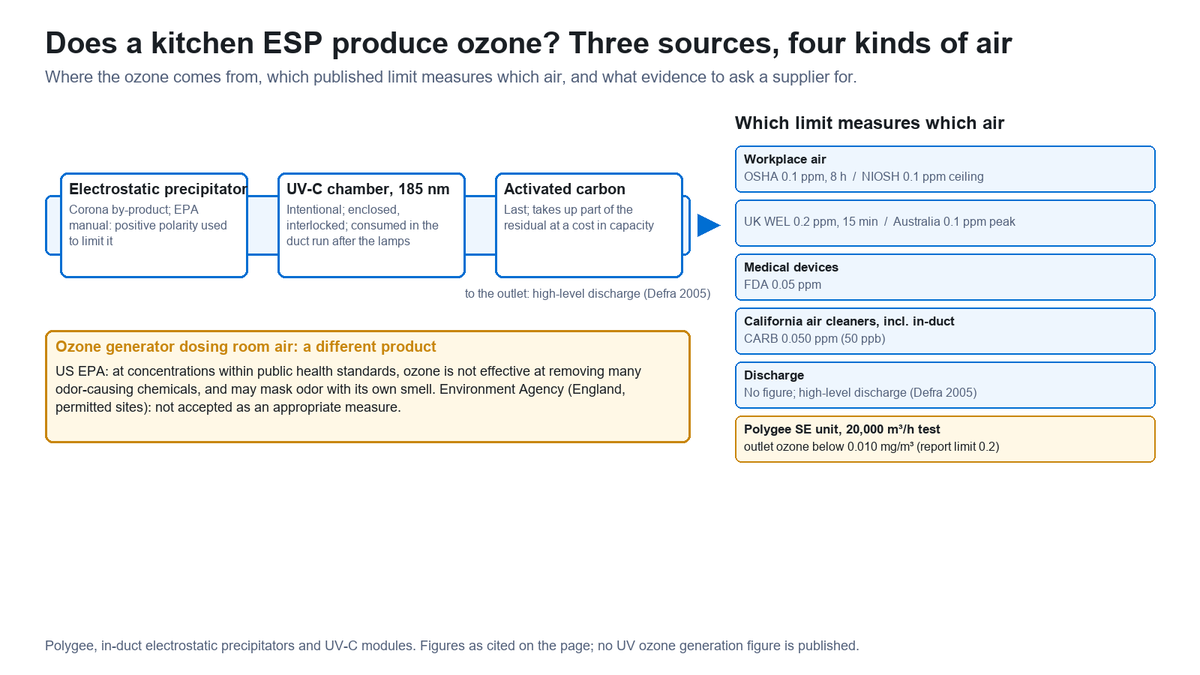
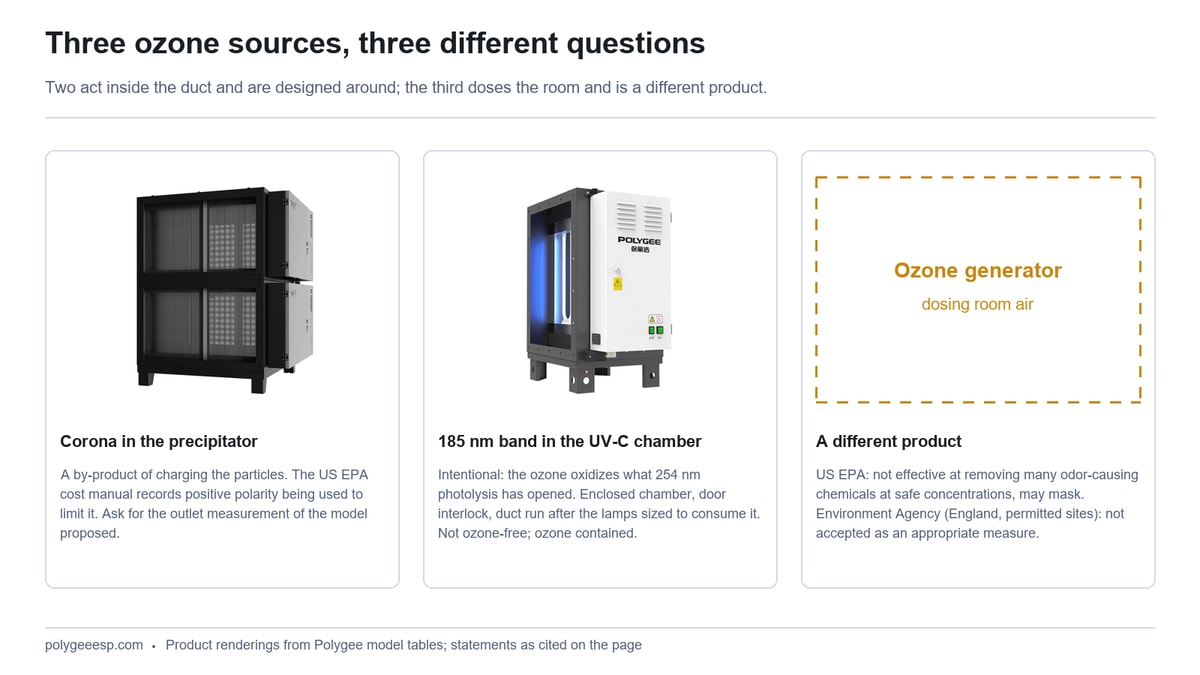
Ozone in a treated kitchen exhaust has three possible sources, and they are designed for different purposes: a by-product of the corona in an electrostatic precipitator, an intended product of the 185 nm band in a UV-C chamber, and the whole output of an ozone generator that doses air directly. A buyer who keeps them apart asks three different questions and gets three usable answers.
Does an electrostatic precipitator produce ozone?
It can, because the corona that charges the particles also acts on oxygen, and how much depends on the design. The US EPA’s Air Pollution Control Cost Manual, in its chapter on electrostatic precipitators, records that a flat-plate design operates equally well with either polarity and that the manufacturer has chosen positive polarity to reduce ozone generation, and that the two-stage precipitator used for indoor applications is operated with positive polarity to limit ozone generation. A NIST study of in-duct electrostatic air filters, on the institute’s publication page, reports them as an effective control for 20 to 100 nm ultrafine particles with the potential to increase indoor ozone concentrations due to corona discharge; the study used residential units, and its figures are not ours.
Two things follow for a kitchen unit. The physics is real, so a flat denial is not an answer; and the quantity is a measurement, so a brochure adjective is not an answer either. What can be stated for our equipment is a test result: on an SE series in-duct unit tested at 20,000 m³/h, the third-party report ZY07W250330 records ozone at the outlet below 0.010 mg/m³ against the 0.2 mg/m³ reference limit stated in the report, measured by the HJ 504-2009 method, with 99.2% removal efficiency and 150 Pa resistance on the same test. That is one model at one airflow under one method. It says nothing about a UV stage, and it is quoted here because it is the number our record holds, not because it transfers to a plant room.
Does the UV stage produce ozone, and can it be called ozone-free?
It produces ozone on purpose, and a unit with a 185 nm band cannot honestly be called ozone-free. Our UV kitchen odor control modules emit at 254 nm, which photolyses odor molecules directly, and at 185 nm, which splits oxygen so that ozone forms inside the chamber and oxidizes what photolysis has opened; the chamber is enclosed, a safety interlock cuts the lamps when the access door is opened, the precipitator sits upstream so the lamps receive air with the grease aerosol already removed, and the duct run after the lamp rack is sized so that the ozone is consumed in the oxidation stage before discharge. The withdrawn 2005 Defra guidance on odour and noise from commercial kitchen exhaust, which UK councils still reproduce, describes the same arrangement in its section 4.7.6: ozone or oxygen ions from an electrostatic field or UV lamps injected into the exhaust duct or a reaction chamber, a typical dose rate for a restaurant of 1 ppm by volume, reaction times to completely oxidise material of as much as 20 seconds that have to be allowed for in the downstream duct, and faster decay above 35 °C or in high moisture.
The Australian buyer who asks which lamp specification and which test would support an ozone-free claim is therefore asking for something the lamp cannot give. What a supplier can give is the specification that shows which bands are present, the enclosure and interlock that keep the ozone in the duct, the downstream design that consumes it, and a measurement at the outlet. We do not publish an ozone generation figure for the UV modules, because our record does not hold one; the figure for a specific model and airflow is requested from us in writing and supplied once our technical department has confirmed it. The HSE guidance note EH38 adds a reason the precipitator belongs in front of the lamps: ozone is a powerful oxidising agent that can react explosively with oil and grease, which is one more argument for taking the grease out before the oxidant is made.
Is an ozone generator the same thing?
No. An ozone generator sold to treat a room or a dining area doses ozone into air that people breathe; an in-duct oxidation stage makes it inside a closed duct, consumes it there, and discharges the remainder outdoors at height. The US EPA’s page on ozone generators that are sold as air cleaners states that at concentrations that do not exceed public health standards, ozone has little potential to remove indoor air contaminants and is not effective at removing many odor-causing chemicals, that body odor may be masked by the smell of ozone, and that concentrations considerably higher than those standards are possible even when a user follows the manufacturer’s operating instructions. Its companion page on ionizers and other ozone-generating air cleaners draws the line this page uses: ozone is produced indirectly by ion generators and some other electronic air cleaners and directly by ozone generators, and the direct, purposeful introduction of a lung irritant into indoor air is the greater concern.
For England the Environment Agency’s guidance on appropriate measures for odour management under environmental permits says the same from the regulator’s side: indoor air treatments such as misting or reactive chemicals like ozone are very difficult to monitor, the Agency will not accept them as appropriate measures until they are more firmly established and have shown their effectiveness in a thorough assessment relevant to the activity, and ambient abatement that treats indoor air directly has minimal potential for odor mitigation because of the lack of control over mixing and dosage and can expose workers to harmful reagents. That guidance governs permitted sites rather than a restaurant’s planning consent, and it is quoted for the principle: the regulator distinguishes dosing a room from treating a duct. The owner of a Thai restaurant asking whether an ozone generator will remove cooking odor, and the operator pricing a retrofit, are asking about the room-dosing product; the answer from the documents is that it is not the route the guidance supports.
| Source | Why the ozone is there | Where it acts | What the documents say about it | What to ask the supplier |
|---|---|---|---|---|
| Corona in an electrostatic precipitator | By-product of charging the particles | Inside the duct, downstream of the cells | EPA cost manual: positive polarity used to limit it; NIST: potential to raise indoor ozone in residential units | The outlet measurement for the model, with method and airflow |
| 185 nm band in a UV-C chamber | Intentional: oxidizes what 254 nm photolysis has opened | Inside the enclosed chamber and the duct run after it | Defra 2005 section 4.7.6: 1 ppm by volume typical dose, up to 20 s reaction time, residual to be discharged at high level | Lamp bands, enclosure and interlock, downstream duct design, outlet measurement |
| Ozone generator dosing room air | The whole product | In the air people breathe | EPA: not effective for many odor chemicals at concentrations within public health standards, may mask; Environment Agency, for permitted sites: not accepted as an appropriate measure until established and shown effective in a relevant assessment | Whether it is being offered at all; if so, the exposure measurements in the occupied space |
The table restates the EPA, NIST, Defra and Environment Agency documents as we read them on 27 October 2026 and our own product data; it does not give a figure for any stage other than the one test result quoted above.
Which limit applies to which air
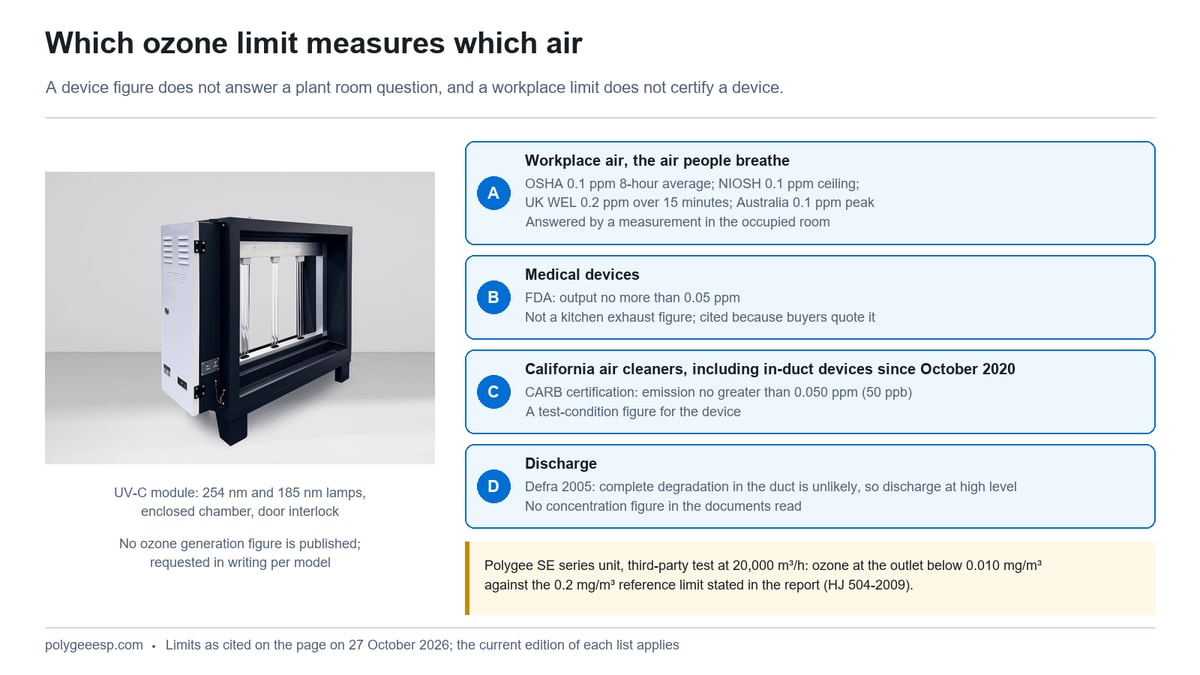
Six published limits turn up in ozone questions about kitchen exhaust, and they measure four different kinds of air: the air a worker breathes, the output of a medical device, the emission of an air-cleaning device under a certification test, and the discharge from a stack. A device figure does not answer a plant room question and a workplace limit does not certify a device, which is why the first thing to settle is which air the clause names.
Does an electrostatic precipitator in an indoor mechanical room exceed OSHA limits?
The limit that applies is the one for the room’s air, and only a measurement in the room answers it. In the United States, OSHA’s Table Z-1 under 29 CFR 1910.1000 lists ozone at 0.1 ppm, 0.2 mg/m³, as an 8-hour time-weighted average, and the NIOSH Pocket Guide gives a recommended exposure limit of a 0.1 ppm ceiling, 0.2 mg/m³, not to be exceeded. The EPA’s ozone generator page summarizes the same figures beside the Food and Drug Administration’s requirement that indoor medical devices emit no more than 0.05 ppm, and lists the health effects the limits exist for: decreases in lung function, aggravation of asthma, throat irritation and cough, chest pain and shortness of breath, inflammation of lung tissue and higher susceptibility to respiratory infection, with risk rising with concentration, duration, breathing rate and pre-existing lung disease.
A precipitator inside a duct treats air that goes to the outlet; any contribution to the room’s air, through leakage, access openings or maintenance, is assessed separately, and the duct outlet result does not establish the room concentration. So the precipitator’s outlet result, such as the figure below 0.010 mg/m³ on our SE unit test, describes the duct, and the room is described by a reading taken in the room with the unit running. Where a room is occupied for long periods, that reading against the 8-hour average and the ceiling is the evidence; for maintenance, residual exposure is assessed and the isolation and purge procedure is followed before the cells are handled. We say this as the maker: the test report is ours to give, the room measurement is the site’s to take, and the one does not stand in for the other.
What does California’s 0.050 ppm certification mean for an in-duct unit?
It is a device emission limit under a certification test; portable air cleaners have been covered since 2010, and electronic in-duct air cleaners have been subject to it since October 2020. The California Air Resources Board’s certified air cleaning devices page explains that portable indoor air cleaning devices sold in the state, and electronic in-duct air cleaners within the regulation’s scope, must be certified, that electronic in-duct devices became subject to the regulation in October 2020, and that devices listed as electronic, which include ionizers, electrostatic precipitators and photocatalytic units, have been tested and found to produce an ozone emission concentration no greater than 0.050 ppm, 50 ppb. The Board’s fact sheet on complying with the regulation adds that the exemption for electronic in-duct cleaners was removed with certification required before 1 October 2022, that the label text reads that the device meets California’s ozone emissions limit, and that air cleaners used solely for specified industrial purposes are exempt but must carry an advisory that they are for industrial use only in unoccupied spaces and emit ozone.
Two readings matter for a kitchen exhaust buyer in California. Whether a given commercial kitchen exhaust unit falls inside the regulation’s definition of an indoor air cleaning device, or inside its industrial exemption, is a question for the Board and the installer, and we do not answer it here. And a 0.050 ppm certification, where it exists, is a test-condition figure for the device; it is not a reading from the plant room or a discharge measurement. The OSHA workplace figure of 0.1 ppm and the California device figure of 0.050 ppm measure different air.
| Limit | Figure | Which air it measures | Who sets it | What answers it for a kitchen exhaust |
|---|---|---|---|---|
| OSHA permissible exposure limit | 0.1 ppm, 0.2 mg/m³, 8-hour average | Air a worker breathes in the plant room or kitchen | 29 CFR 1910.1000, Table Z-1 | A measurement in the occupied room with the unit running |
| NIOSH recommended exposure limit | 0.1 ppm ceiling, 0.2 mg/m³ | The same air, at any moment | NIOSH Pocket Guide | The same measurement, read as a peak |
| FDA medical device limit | 0.05 ppm | Output of an indoor medical device | FDA, as summarized by the US EPA | Not a kitchen exhaust figure; cited because buyers quote it |
| California air cleaner certification | 0.050 ppm, 50 ppb | Device emission under the certification test, including electronic in-duct devices | California Air Resources Board | The certification, where the regulation applies to the device |
| UK workplace exposure limit | 0.2 ppm, 15-minute reference period | Air a worker breathes | HSE EH40 list, explained in EH38 | A workplace measurement under COSHH |
| Australian exposure standard | Peak limitation 0.1 ppm, 0.2 mg/m³, measured over no more than 15 minutes | Air a worker breathes | Workplace exposure standard, as explained by WorkSafe Victoria | A workplace measurement; WorkSafe recommends alarms and automatic shut-off on ozone equipment |
| Discharge | No concentration figure in the documents we read | The exhaust leaving the outlet | Defra 2005 section 4.7.6 as reproduced by councils | High-level discharge, because complete degradation in the duct is unlikely |
The table lists the figures as they appear in the cited documents on 27 October 2026; national lists change, and the current edition of each is the one that applies. The European Union and Singapore publish their own workplace values, which we have not reproduced here.
United Kingdom, Australia and Singapore: is an in-duct UV ozone stage accepted?
In the documents we read, the UK Defra method lists an in-duct UV ozone system behind particle removal with high-level discharge as its condition, the Australian AIRAH guideline lists UV and ozone among treatment equipment with the discharge assessed against the applicable requirements, and in both countries the workplace limit applies to the air people breathe; the decision on a given site stays with the council, the certifier or the agency. Three sentences carry that answer, and each has a boundary.
Is UV-C ozone treatment acceptable for kitchen exhaust odor control in the UK?
Within council guidance, yes as an in-duct option, and the same guidance makes high-level discharge its condition. The 2005 Defra method lists fine filtration or an electrostatic precipitator followed by a UV ozone system as an alternative to carbon at the high and very high odor control levels, as our UK odour control page sets out, and the Epping Forest District Council checklist of April 2024 reproduces that list; section 4.7.6 of the Defra text then requires that, because complete degradation of ozone is unlikely to take place within the ductwork, the extraction system must discharge at high level, with restricted application in areas housing multiple commercial kitchens. Westminster’s recirculation route, for electric-only cooking that does not discharge outdoors, excludes systems that add or generate chemicals, naming UV, ozone and electrostatic precipitators, so an ozone stage belongs only on a system that discharges outside. The Epping Forest checklist asks, for any UV system proposed, the anticipated level of ozone being generated and the anticipated residence time, which is why the written request to us in the sheet below exists.
The UK buyer comparing UV-C with ozone for a high-volume burger exhaust on a shopping park is comparing two names for one route in that guidance, because the UV system it lists is the ozone-producing kind; the workplace exposure limit of 0.2 ppm over 15 minutes, from the HSE list, applies to the kitchen and plant room air regardless of which name the equipment carries. Whether ozone generators dosing indoor air are permissible under UK workplace regulation is a question for the employer’s COSHH assessment against that limit, with EH38 as the HSE’s guidance on sources and controls; it is not the same question as whether a council accepts an in-duct stage.
Are UV grease filters and UV-C ozone treatment safe and legal in Australia?
They are listed treatment equipment in the Australian industry guideline, and the safety question is answered by the exposure standard and the discharge. The AIRAH BPG guideline on commercial kitchen exhaust management, in the section our low-level discharge guide summarizes, lists UV, electrostatic precipitators, ozone and other equipment as effluent treatment that may be installed in the hood, in the duct, in a plant room or before the outlet; the discharge itself is governed by AS 1668.2 and the certifier. On exposure, WorkSafe Victoria’s safety alert on ozone explains that the Australian exposure standard for ozone is a peak limitation, the maximum concentration over the shortest measurable period and not more than 15 minutes, set at 0.1 ppm, 0.2 mg/m³, and recommends ozone equipment with alarms and controllers that shut it off on a leak, and training for the people who work with it. For an in-duct UV stage, the enclosure, the interlock and the exposure controls are assessed against that standard by the site; the reading in the kitchen is still the site’s evidence.
What ozone evidence, UV shielding and interlocks should a Singapore hospital require?
The evidence sheet below, plus the National Environment Agency’s own guidance on UV-C devices, which is written for the people who work near the lamps. The NEA’s safety guidelines for the use of UVC devices state that UVC radiation can cause eye injury such as irritation and inflammation of the cornea and skin injury such as erythema, that UVC devices should only be operated by trained personnel to avoid accidental exposure, that no person should be in line of sight of a device in operation, that the maximum permissible exposure limits should be requested from the manufacturer if the manual does not contain them, and that the location of the emergency stop should be part of training. For an in-duct module those points translate into an enclosed chamber and a door interlock that cuts the lamps, which our UV page describes, plus an isolation arrangement and a commissioning record of the interlock test, which are requested from the installer. For the air intake, the question is a measurement at the intake with the unit running and the outlet position relative to it, which is the subject of our Singapore requirements page and the low-level discharge guide.
How many carbon passes does the ozone need?
None as a count; the carbon bed sits last in the train partly because residual ozone decomposes on it, and the discharge height requirement stands whatever the bed takes up. Our carbon guide states the mechanism: residual ozone that survives the duct run after the lamps is decomposed on the carbon and uses some of its capacity, which is a reason to keep the UV stage between the precipitator and the carbon and the carbon last. The 2005 Defra guidance did not treat carbon as the answer to residual ozone; it required high-level discharge. How the residence time of the carbon bed is set, and why a request for a second pass is a residence time question, is on the HEPA and second carbon pass page, which also tabulates the three ozone sources beside what deals with each.
How much ozone does the ESP generate, then?
For the one unit our record measures, the outlet figure is below 0.010 mg/m³ at 20,000 m³/h on the SE series test; for other models the figure is a test to be requested, and for the UV modules it is not published. A buyer who is given a single number for an ozone-producing train should ask which stage it measures, at which point, at which airflow, by which method, because the number for the precipitator alone and the number after a 185 nm chamber are different measurements.
The Ozone Evidence Sheet
The sheet lists what a buyer can ask for, what each item proves and does not prove, who produces it, and what we supply against each line. It is the written ozone statement that our UL 867 guide recommends asking any supplier for, written out as a request; the listing itself is looked up by File Number on UL Product iQ.
The Ozone Evidence Sheet: eight items, what each proves, what it does not, who produces it, and what Polygee supplies.
| Evidence | What it proves | What it does not prove | Who produces it | What Polygee supplies |
|---|---|---|---|---|
| Third-party ozone measurement at the outlet of the model proposed, with method, airflow and date | The unit’s emission under the test conditions | The plant room or kitchen concentration on your site | Testing laboratory, via the supplier | Report ZY07W250330 for the SE series unit at 20,000 m³/h; other models on request |
| UL 867 listing with File Number and model list, and a written ozone statement | Which models are listed and assessed against a standard that contains ozone requirements | A limit value, which is in the paid text; coverage of models not on the list | UL, via the supplier’s file | File E522667 for the LK and SE 6K, 12K and 18K models; the statement in writing |
| California certification, where the device is sold there and the regulation applies to it | Emission no greater than 0.050 ppm under the certification test | Exposure in the room; applicability to an exempt industrial device | California Air Resources Board, via the supplier | Confirmed per model and market with the quotation |
| Lamp specification: bands present, number of lamps and ballasts by model | Whether a 185 nm band exists, so whether ozone is intended | How much ozone leaves the chamber | Supplier | 254 nm and 185 nm; lamp and ballast counts by model on the UV page |
| Chamber enclosure and door interlock, with the commissioning record of the interlock test | That the ozone and UVC stay inside the duct during operation | Behavior with the door open and the interlock defeated | Supplier and installer | Enclosed chamber; interlock cuts the lamps on door opening; commissioning records to be agreed with the installer |
| Downstream duct design: length after the lamps and the carbon stage position | That the reaction time the Defra text describes has been allowed for, and that carbon sits last | The residual at the outlet without a measurement | Designer, with the supplier’s data | Duct run after the lamp rack sized for consumption; carbon last |
| Workplace air measurement in the plant room or kitchen with the unit running | Compliance with the 8-hour, ceiling, 15-minute or peak limit that applies | Anything about the device under other conditions | Site, occupational hygienist | Not ours to supply; we state which stages are in the duct and where access openings are |
| Measurement at a sensitive intake with the outlet position recorded | Whether the discharge reaches the intake | Compliance of the outlet position, which the authority decides | Site, with the designer | Not ours to supply; the outlet position question is on the low-level discharge page |
Two things the sheet does not do. It does not tell you what a council, a certifier or a hospital reviewer will accept, because that is their decision on the documents submitted; and it does not turn a device figure into a room figure, because no document we read does that either.
Where this guide stops
Four things are deliberately missing. An ozone generation figure for our UV-C modules, because our published record does not carry one and the figure for a model is supplied in writing once our technical department has confirmed it. The ozone requirements inside UL 867, because the standard is a paid document and our UL 867 guide explains why we do not quote a limit we have not read in the original. The European Union, Singapore and current US ambient figures, because we did not read the current editions of those lists while preparing this page and a limit copied from a secondary source is not a limit. And any promise that a unit will keep a particular room below a particular limit, because that is a measurement in the room.
Three layers of acceptance apply here as to everything else about these units. The first is equipment data: the lamp bands, the enclosure, the outlet test for the model. The second is the installation: where the stages sit, how long the duct is after the lamps, where the access openings are and where the outlet terminates. The third is the system in operation: what the hygienist measures in the room, what the intake monitor reads and what the authority concludes. An ozone question may require evidence from all three layers.
Buyer record and key takeaways
Before an electrostatic, UV-C or ozone stage is accepted, these items are in your file.
- The clause or request that raised the ozone question, in its own words, with the air it names: workplace, device, intake or discharge.
- For each stage proposed, which of the three sources it is: corona by-product, intentional 185 nm generation, or a generator dosing room air.
- The outlet test report for the precipitator model proposed, with method, airflow and date, and the written ozone statement with the UL 867 File Number where relevant.
- For a UV stage, the lamp bands, the enclosure and interlock description, the downstream duct length and the carbon stage position.
- Whether the plant room is occupied, and the measurement plan against the limit that applies there.
- Whether the unit is sold in California, and whether the regulation or its industrial exemption applies to it.
- For a hospital or a sensitive intake, the intake measurement point and the outlet position, with the NEA UVC safety points written into the handover.
Key takeaways
- Three sources, three questions. Corona ozone is a design by-product the EPA manual shows being limited by polarity; 185 nm ozone is intentional and contained; generator ozone dosed into a room is a different product the EPA and the Environment Agency do not support for odor.
- A unit with a 185 nm band is not ozone-free; the supportable claim is ozone contained, proved by the lamp specification, the enclosure and interlock, the downstream design and an outlet measurement.
- Six limits, four kinds of air. OSHA 0.1 ppm over 8 hours and NIOSH’s 0.1 ppm ceiling, the UK’s 0.2 ppm over 15 minutes and Australia’s 0.1 ppm peak measure the air people breathe; the FDA’s 0.05 ppm and California’s 0.050 ppm measure devices; the discharge is governed by the odor guidance.
- In the UK the Defra method lists an in-duct UV ozone stage behind particle removal with high-level discharge as its condition, and in Australia the AIRAH guideline lists UV and ozone treatment equipment with the discharge assessed by the site; in both, the workplace limit applies and the council or certifier decides.
- Our record holds one measured ozone figure, ozone below 0.010 mg/m³ at the outlet of an SE series unit at 20,000 m³/h, and no UV generation figure; the Ozone Evidence Sheet lists what else to ask for.
Frequently asked questions
- Does a kitchen electrostatic precipitator produce ozone?
- It can, as a by-product of the corona that charges the particles, and the amount depends on the design. The US EPA’s cost manual notes that two-stage precipitators for indoor applications are operated with positive polarity to limit ozone generation, and a NIST study of in-duct units reports the potential to raise indoor ozone through corona discharge. The question to put to a supplier is not whether the physics exists but what a third-party test measured at the outlet of the model proposed. For our SE series in-duct unit tested at 20,000 cubic meters per hour, the report records ozone below 0.010 mg per cubic meter against the 0.2 mg per cubic meter reference limit stated in the report.
- Can a UV-C kitchen odor unit be described as ozone-free?
- Not one that uses a 185 nm band, because that band is there to make ozone. Our UV-C modules emit at 254 nm, which photolyses odor molecules, and at 185 nm, which splits oxygen so that ozone forms inside the enclosed chamber and oxidizes what photolysis has opened; the chamber is interlocked and the duct run after the lamps is sized so that the ozone is consumed before discharge. The claim that can be supported is not ozone-free but ozone contained, and it is supported by the lamp specification, the enclosure and interlock, the downstream duct design and an outlet measurement, not by a word on a brochure.
- Which ozone limit applies to an electrostatic precipitator in an indoor plant room?
- The workplace limit for the air the people in that room breathe, not a device rating. In the United States OSHA’s Table Z-1 sets 0.1 ppm, 0.2 mg per cubic meter, as an 8-hour average, and NIOSH recommends a ceiling of 0.1 ppm not to be exceeded at any time; in the United Kingdom the workplace exposure limit is 0.2 ppm averaged over 15 minutes; in Australia the exposure standard is a peak limitation of 0.1 ppm measured over no more than 15 minutes. A device test such as California’s 0.050 ppm certification limit for electronic air cleaners, which has included in-duct devices since October 2020, describes the device under test conditions. Whether a plant room meets its limit is answered by measuring the plant room.
- Will an ozone generator remove cooking odor from a restaurant exhaust?
- A generator that doses ozone into occupied indoor air is a different product from an in-duct oxidation stage, and the regulators we read do not support it for odor. The US EPA states that at concentrations that do not exceed public health standards, ozone is not effective at removing many odor-causing chemicals and may mask odor with its own smell, and that concentrations considerably higher than those standards are possible even when the user follows the instructions. The Environment Agency’s permit guidance for England says it will not accept indoor air treatments such as ozone as appropriate measures until they are more firmly established and their effectiveness has been shown in a thorough assessment relevant to the activity. The in-duct route that the UK Defra method lists at its high and very high odor control levels is a UV ozone system behind particle removal, discharging at high level.
Asked to prove the ozone is under control?
Send us the clause or the question in its own words, the stage list proposed, where the unit will sit and whether that room is occupied, the distance to the nearest intake or window, whether the site is a hospital, and the market the unit is sold in. You get back the outlet test report for the precipitator model proposed, the UL 867 File Number and written ozone statement where the model is listed, the UV module’s lamp bands and enclosure and interlock description, the downstream duct length we size for, the interlock commissioning record to be agreed with the installer, and a written answer on the ozone figure for the UV model once our technical department has confirmed it. The room measurement and the authority’s acceptance stay with the site; the Ozone Evidence Sheet above tells you which items are theirs.
Send the clause and the stage list →
If the train is already chosen, the in-duct electrostatic precipitator page covers the particle stage and its test reports, and the test report guide explains how to read a third-party report line by line.
Why we write this. The word ozone reaches a buyer attached to a fear or a slogan, and either way without its source. This page puts the documents under the word: the EPA and NIST on where corona ozone comes from, Defra on what an in-duct UV ozone stage is and why it discharges at height, OSHA, NIOSH, HSE, WorkSafe Victoria and the California Air Resources Board on which limit measures which air, the EPA and the Environment Agency on why dosing a room is a different matter, and our own record on the one figure we can show and the one we cannot. It makes no claim that a unit is ozone-free and no promise about a room it has not measured.
Law manages project delivery at Polygee. Polygee, founded in 2004, manufactures the in-duct electrostatic precipitators, UV-C and activated carbon modules and kitchen ecology units named here and has exported to 50 countries. The regulations, guidance and agency pages cited on this page were read in the sources listed below; equipment figures are from third-party test reports and Polygee’s published model tables, and no figure is given where the record holds none.
References & further reading
- United States Environmental Protection Agency, Air Pollution Control Cost Manual, Section 6, Chapter 3: Electrostatic Precipitators. epa.gov
- National Institute of Standards and Technology, Ultrafine particle removal and ozone generation by in-duct electrostatic precipitators, publication page with abstract. nist.gov
- United States Environmental Protection Agency, Ozone Generators that are Sold as Air Cleaners, and What are ionizers and other ozone generating air cleaners? Indoor Air Quality. epa.gov; epa.gov
- Occupational Safety and Health Administration, 29 CFR 1910.1000, Table Z-1, Limits for Air Contaminants. osha.gov
- National Institute for Occupational Safety and Health, NIOSH Pocket Guide to Chemical Hazards: Ozone. cdc.gov
- California Air Resources Board, List of CARB-Certified Air Cleaning Devices, and the fact sheet Complying with the Air Cleaner Regulation: Frequently Asked Questions. ww2.arb.ca.gov; ww2.arb.ca.gov
- Health and Safety Executive, EH38 Ozone: Health hazards and control measures, third edition, 2014, and the EH40 workplace exposure limits list. hse.gov.uk; hse.gov.uk
- WorkSafe Victoria, Ozone exposure, safety alert. worksafe.vic.gov.au
- Department for Environment, Food and Rural Affairs, Guidance on the control of odour and noise from commercial kitchen exhaust systems, January 2005, reference PB10527, section 4.7.6; withdrawn 15 September 2017 and reproduced in council guidance. assets.publishing.service.gov.uk
- Environment Agency, Odour management: comply with your environmental permit, section 3, Appropriate measures for odour management, published 3 December 2025. gov.uk
- National Environment Agency, Singapore, Safety guidelines for use of UVC devices. nea.gov.sg
Related reading
- Do you need a HEPA filter or a second carbon pass after a kitchen ESP?: the three ozone sources beside what deals with each, and why carbon residence time is the unit the odor guidance uses.
- Ecology unit low-level discharge: why residual ozone is one of the reasons the UK guidance requires high-level discharge, and who decides the outlet.
- UL 867 for kitchen electrostatic precipitators: what the listing covers, how to look up a File Number, and why a written ozone statement is the thing to ask for.
- Commercial kitchen odour control in the UK: the scoring method and the levels at which a UV ozone system is listed as an alternative to carbon.