

Electrostatic precipitator applications are usually listed by industry, which is the least useful way to learn them. A precipitator does not know whether it is on a cement kiln or over a wok range. It knows the particle, and the particle decides almost everything else.
So this guide is organized the way an engineer actually decides: first what the gas stream is like, then which applications share that character, and only then the industry names. It covers the heavy-process uses the technology was built for, and it covers commercial kitchen exhaust, which is a much smaller class of application and the one we build equipment for.
Statements attributed to the EPA below come from its public control-technique reference and are marked as such. Where applications are grouped by industry, the grouping is our own general engineering observation rather than the EPA’s, which does not list applications that way. Statements about our own equipment are ours and marked as such. For the unit itself, see the kitchen electrostatic precipitator page. If you want the working principle rather than the applications, start with what is an electrostatic precipitator.
What actually decides an electrostatic precipitator application
Four properties of the gas stream decide whether a precipitator suits an application, and only one of them has anything to do with the industry.
| Property | Why it decides | What it changes about the machine |
|---|---|---|
| Particle resistivity | The EPA describes the desirable case as moderate resistivity: the particle conducts away some of its charge at the plate but keeps enough to be held lightly. Very high resistivity means it is slow to give up charge, so a negative charge builds on the plate that inhibits further particles from depositing. Very low resistivity means it loses its charge on arrival, takes the plate’s charge and is repelled back into the gas stream to be charged again | Whether the application works at all, or whether the gas has to be conditioned first |
| Stickiness | A dry dust can be shaken off a plate. A sticky deposit cannot | How the collection surfaces are cleaned, which is the difference between a dry and a wet precipitator |
| Gas temperature | The materials have to survive the stream, and temperature is one of the operating indicators the EPA lists | Construction, and whether the unit sits before or after other equipment |
| Volume and velocity | Collection depends on the particle having time in the field | The size of the unit, and how far the flow can be turned down before performance moves |
This table answers what to look at first. It does not size anything, and it does not tell you which type of precipitator results; that is in types of electrostatic precipitator.
One number is worth stating early, because it gets quoted loosely. The EPA says precipitators as a class are capable of collection efficiencies greater than 99 percent. That is a statement about the technology as a class, not a specification of any particular machine, and not of ours. What our own equipment achieved under a stated test is further down.
The applications, grouped by what the gas stream is like
Group the applications by the particle and the same few families appear, whatever the industry is called.
| Family | Typical applications | What the stream is like | What that asks of the precipitator |
|---|---|---|---|
| Combustion ash | Utility and industrial boilers, power generation, waste incineration | High volume, hot, dry particulate; resistivity varies with fuel and temperature | The classic large dry precipitator: fields in series, rappers to shake the dust off. The hardware itself is described in types of electrostatic precipitator |
| Mineral process dust | Cement, lime, glass, mineral processing | Very high dust loading, and resistivity that often sits at the difficult end | Robust dry construction, and in many plants some form of gas conditioning before the precipitator |
| Metals and smelting fume | Steel, non-ferrous smelting, foundries | Fine fume, sometimes moist, sometimes with low-resistivity particles | Where the particle is sticky and of low resistivity, which is the combination the EPA names, this is where wet precipitators appear |
| Process mists and acid | Chemical processing, acid plants, some pulp and paper duties | Liquid mist rather than dry dust; corrosive | A wet precipitator, because the collection surfaces are washed rather than rapped |
| Cooking effluent | Commercial kitchen exhaust | Moderate volume, warm rather than hot, and the particle is grease: sticky, and mixed with smoke | Something the industrial answers do not provide, which is the next section |
The EPA reference does not group applications by industry; this grouping is ours. The table answers which applications resemble each other. It does not give emission limits, permit conditions or equipment sizing for any of them, all of which are specific to a plant and a jurisdiction.
Commercial kitchen exhaust, the application we build for
A kitchen is a precipitator application with one awkward property: the particle is sticky. That single fact separates it from every family above, and it explains why kitchen equipment looks different.
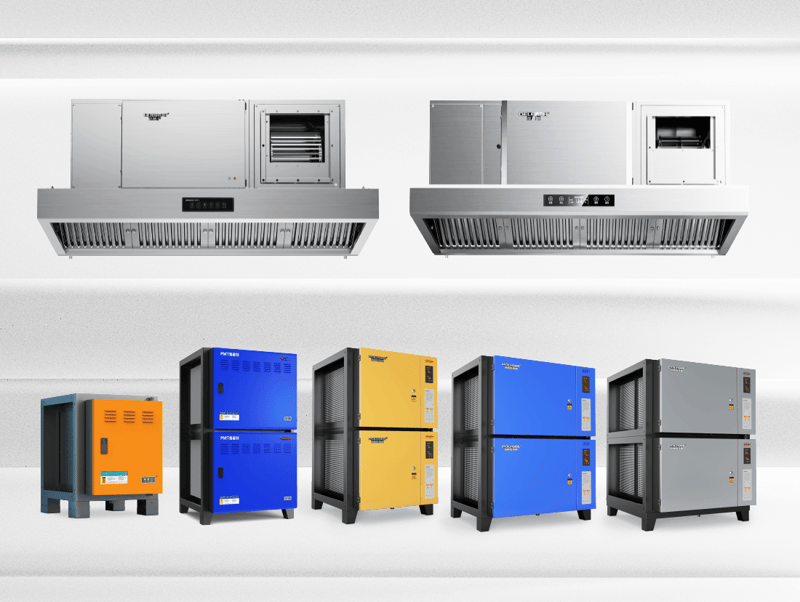
A dry industrial precipitator cleans its collection surfaces by rapping, which the EPA describes as applying mechanical impulses or vibration so that the collected material is knocked loose. Fly ash falls off. Cooking grease does not. So a kitchen unit takes the other route: the collector cells are built to be removed and washed, and the machine is sized as a duct-mounted cabinet rather than a plant-sized structure with fields in series.
The rest of what differs — that grease is sticky and flammable where fly ash is neither, that a kitchen cycles daily rather than running continuously, and that the space available is a duct rather than a plant room — is set out in what is an electrostatic precipitator, which compares the two machines directly. The arrangement inside the machine, including the two-stage layout a kitchen cell uses, is in types of electrostatic precipitator.
What we can say about our own equipment. Our in-duct units are dry, two-stage, plate-type cabinets with washable stainless steel collector cells, rated in airflow bands and fitted with an airflow distribution plate. That last component has an EPA name: gas distribution plates, described there as perforated plates that help maintain proper flow distribution of the entering gas stream. In CMA-accredited third-party tests our LK in-duct units reached up to 97.6% grease removal at rated, evenly distributed airflow, under report ZY05W230298. That is a grease removal result at a stated airflow on stated models, and it is not the same claim as the EPA’s general figure for the technology. A complete unit with its standard airflow distribution plate is rated at not more than 150 Pa, and we give the figure at your design airflow when we quote. The range and its capacity bands are on the kitchen electrostatic precipitator page, and which documents a given model carries is on the certificates page.
Applications where a precipitator is the wrong answer
The technology has a clean boundary, and most disappointed buyers were standing on the wrong side of it.
- The target is a gas, not a particle. A precipitator charges and collects particulate. Odor molecules are in the gas phase and pass through. In a kitchen this is the single most common misunderstanding: the unit addresses smoke and grease, and the smell needs a separate stage, such as the UV-C and activated carbon stages of an ecology unit.
- Resistivity sits at an extreme and nothing is done about it. Both extremes defeat collection in the ways the EPA describes, and the answer is generally to condition the gas or change technology rather than to buy a bigger precipitator.
- The duty is rarely at rated airflow. Collection depends on residence time in the field. A unit that spends its life well away from the flow it was selected for is not being asked the question it was designed to answer.
- Acceptance depends on a document the equipment does not hold. This is a paperwork boundary rather than a physical one, and it stops projects just as effectively. Establish the listing or approval the authority expects before the equipment is chosen.
For the kitchen version of the first bullet, including what an ESP does and does not fix when a neighbour is complaining, see how to reduce smoke from commercial kitchen exhaust, and for the comparison against the filters already in the hood, electrostatic precipitator vs baffle filter.
Where this guide stops
- Industrial equipment. We do not build precipitators for boilers, kilns, smelters or chemical plants, and nothing here is a specification for one. The industrial material is included because the question “which applications use an ESP” cannot be answered honestly without it.
- Limits and permits. No emission limits, permit conditions or compliance requirements appear here. They are specific to a plant, a pollutant and a jurisdiction.
- Sizing. This guide does not size a unit for any application, including a kitchen. That needs the airflow, the duct and the duty.
- The efficiency figures. The EPA’s greater-than-99-percent is a statement about the technology; our 97.6% is a grease removal result on named models at a stated airflow. Neither predicts the other.
Buyer record
Have ready:
- What the particle actually is, and whether it is sticky.
- The extract flow rate, and how much it varies through the day.
- The cooking type, if the application is a kitchen.
- Whether odor, as opposed to smoke, is part of the complaint.
- The space available in the duct run, and the electrical supply.
Ask each supplier for:
- Which application family they built the model for, in their own words.
- The rated airflow band, and what happens either side of it.
- The test report behind any efficiency figure, with the method and the airflow stated on it.
- The resistance at your design airflow. Ours, complete with the standard airflow distribution plate fitted, are rated at not more than 150 Pa.
Re-check when:
- The process or the menu changes what the particle is.
- The flow is going to be modulated rather than run at one rate.
- An odor complaint arrives and is treated as a smoke complaint.
Frequently Asked Questions
- What are the main applications of an electrostatic precipitator?
- Anywhere a large volume of gas carries particles that have to be taken out before discharge. The long-established uses are combustion and heavy process industry: boilers and power generation, cement, metals, pulp and paper, chemical processing and waste incineration. A separate and much smaller class of application is commercial kitchen exhaust, where the particle is cooking grease rather than fly ash. The industries differ, but the question an engineer asks is the same in all of them: what is the particle, how sticky is it, what is its electrical resistivity, how hot is the gas, and how much of it is there.
- What decides whether an electrostatic precipitator suits an application?
- Particle resistivity does more of the deciding than the industry name. The EPA describes the desirable case as moderate resistivity: the particle gives up some of its charge at the plate but keeps enough to be held there. Very high resistivity means the particle is slow to release its charge and a negative charge builds on the plate that stops further particles depositing. Very low resistivity means the particle loses its charge on arrival, picks up the plate’s charge and is repelled back into the gas stream to be charged again. Stickiness and gas temperature then decide how the plates get cleaned, which is what separates a dry ESP from a wet one.
- Is a commercial kitchen ESP the same machine as an industrial one?
- The physics is the same and the machine is not. An industrial precipitator on a boiler is built around fields of discharge electrodes energized by a transformer-rectifier (T-R) set power supply, with rappers that vibrate the collection surfaces so dry dust falls off; the EPA notes that most units have three or four fields in series and very large ones may have as many as fourteen. Cooking grease does not behave like fly ash: it is sticky, so it is not knocked loose by rapping. A kitchen unit is a duct-mounted cabinet with washable collector cells that are taken out and cleaned. The comparison is set out in full in our guide to what an electrostatic precipitator is.
- When is an electrostatic precipitator the wrong choice?
- When the thing you need to remove is not a particle. An ESP charges and collects particulate; gases and odor molecules pass through it, which is why odor is handled by a separate stage rather than by the precipitator. It is also the wrong answer where resistivity sits at either extreme without conditioning, where the duty is intermittent enough that the unit is rarely at its rated airflow, and in any application where a listing or approval the equipment does not hold is a condition of acceptance. In a kitchen the practical test is simpler: an ESP addresses the smoke and grease in the airstream, not the smell.
Is your application a commercial kitchen?
That is the one we build for. Send us the extract flow rate, the duct size and route, the position available for an in-line unit, the cooking type and the electrical supply. Our team will come back with the model whose rated airflow band fits the flow, its resistance at that flow, the third-party grease removal test report with the airflow it was measured at stated on it, and a written note of which documents that model carries. If your application is industrial, we will tell you plainly that it is not ours.
Talk to our team →Law manages kitchen exhaust filtration projects at Polygee, from spec review through duct-side ESP sizing and installation support. Polygee, founded in 2004, builds commercial kitchen exhaust filtration equipment. This article summarizes a public control-technique reference and our own product facts for planning purposes only — it is not a specification, and industrial applications are described for context rather than offered as products.
References & further reading
- US EPA — Air Emissions Monitoring Knowledge Base, Monitoring by Control Technique: Electrostatic Precipitators (description, components, dry and wet classification, resistivity, performance indicators). epa.gov
- US EPA — Air Pollution Control Technology Fact Sheets, linked from the control-technique page above: dry ESP wire-pipe (EPA-452/F-03-027), dry ESP wire-plate (F-03-028), wet ESP wire-pipe (F-03-029), wet ESP wire-plate (F-03-030).
- Polygee — kitchen exhaust filtration product range, certificates and third-party test reports. polygeeesp.com
Related reading
- Types of electrostatic precipitator — the hardware view: dry and wet, plate and tube, single stage and two stage.
- What is an electrostatic precipitator — the working principle, and the kitchen machine against the industrial one.
- Electrostatic precipitator vs baffle filter — what each stage in a kitchen hood actually removes.
- Electrostatic precipitator cleaning — what washing the cells involves once the unit is in service.
- Commercial kitchen ESP buying guide — the next question once the duty is settled: which supplier, and what to check.