

Quick answer: a commercial kitchen ESP replacement is decided at the duct interface, not by the airflow figure stamped on the old nameplate. Airflow only produces a shortlist. What decides whether any unit on that shortlist can physically go in is the flange size, the bolt-hole pattern, the clear space needed to withdraw a collection cell, the static pressure still available for treatment, and the electrical supply already at the position. Read this and you will be able to say whether the precipitator or the system around it is what failed, choose between a repair, a cell rebuild and a whole new unit, and hand any supplier a survey they can quote against without a site visit.
This guide helps you decide whether to repair, rebuild or replace an existing in-duct electrostatic precipitator, and what to record before you ask anyone for a price. It does not size or select equipment, diagnose a hood that is spilling smoke into the kitchen, or set a cleaning interval. For model selection and quotation, see the in-duct electrostatic precipitator range.
| Situation | Critical input | Initial route | Still needs confirmation |
|---|---|---|---|
| Cells corroded or deformed, cabinet sound | Cell dimensions and cabinet make | Replacement cells rather than a new unit | Whether cells for that cabinet are still manufactured |
| Power section dead, cells sound | Supply voltage, phase and frequency on site | Power module replacement | Part availability for a discontinued model |
| Grease still reaching the outlet after a service | Design airflow against measured airflow | Diagnose before buying anything | Whether capture, airflow or treatment is at fault |
| Airflow has increased since installation | The new design exhaust rate | New unit selected to the new figure | Duct section and pressure budget at that rate |
| Parts no longer obtainable | Maker, model and year | Whole-unit replacement | Interface dimensions of the existing opening |
- First, find out what actually failed
- Repair, rebuild or replace: four questions that settle it
- The four measurements that decide whether anything fits
- What a replacement has to match, and what it does not
- Changing supplier: what to ask for in writing
- Scope and limits
- Buyer record
- Frequently asked questions
First, find out what actually failed
An electrostatic precipitator sits in the middle of a chain: appliances, hood, grease filters, duct, treatment stage, fan, terminal. It acts on what reaches it, at the airflow the fan actually delivers, in the condition the last service left it. Every one of those upstream links can produce a symptom that looks like a failed precipitator from the kitchen floor.
The reason this matters commercially is narrow and worth stating plainly. A replacement unit is a capital purchase with a lead time. A diagnosis is a morning with a flashlight and a camera. Buying the first before doing the second is the most common way an operator ends up replacing the same equipment twice.
| What you are seeing | What it usually means | Where it belongs | What to record now |
|---|---|---|---|
| Smoke spilling at the hood edge, kitchen side | Capture, not treatment — the precipitator never received it | Hood geometry and exhaust rate | Where it escapes, at which appliance, at what time of service |
| Grease or visible haze at the roof terminal | Treatment stage, cleaning condition, or airflow above selection | This guide, plus the cleaning record | Date of last cell wash, and whether output changed after it |
| Odor complaint from a neighbor, little visible plume | Gas-phase compounds, which a precipitator does not target | A separate treatment stage | Time of day, weather, distance and direction of the complaint |
| Fan straining, extract obviously weak | System resistance, often duct or loaded filters | Duct section and total static pressure | Static pressure readings if any exist, and duct route changes |
| Repeated sparking, tripping, or a dead indicator | Power section or cell condition | This guide | Fault behavior: at start-up, under load, or intermittently |
Decision rule. IF the symptom is on the kitchen side of the hood, THEN it is a capture question and no precipitator will fix it, BECAUSE the equipment only treats the air the hood has already collected. The sequence for a hood that is spilling smoke is set out in how to reduce smoke from a commercial kitchen exhaust, and the airflow side of it in commercial kitchen hood CFM requirements.
IF the symptom appears at the terminal and the last cell wash did not change it, THEN the treatment stage is a genuine candidate, BECAUSE a precipitator whose cells are clean and energized should show a measurable change at the outlet. What a service visit actually covers, and which parts of it are the operator’s and which the manufacturer’s, is in electrostatic precipitator cleaning and maintenance.
Repair, rebuild or replace: four questions that settle it
Once the fault is genuinely in the equipment, there are three outcomes and four questions that choose between them. Work them in this order, because each one can end the exercise.
1. Are the cells recoverable?
A collection cell is a stack of plates and an ionizing section. Ours are built in stainless steel and are designed to be washed and returned to service rather than discarded, which is why a cell that is simply loaded is a cleaning job and not a purchase. Recovery stops being possible when the geometry has gone: plates bowed out of parallel, ionizer wires broken or missing, insulators cracked or tracked. Plate spacing is what sets the field, so a deformed stack does not return to its original behavior after washing, however thorough the wash.
Field note. Ask whoever services the unit to photograph a cell end-on, in daylight, with a straight edge laid across the plate edges — they are already isolating and opening the unit as part of a service visit, so it costs nothing to add. That single photograph answers the recoverability question faster than any description over email.
2. Is the power section the fault rather than the cells?
On our in-duct units the high-voltage supply is a separate assembly from the cell pack, which means a dead power section does not automatically condemn the cells, and vice versa. Our SPP high-voltage power supply carries its own UL file, E514664, separate from the file covering the units themselves. On other makes the split may or may not exist; the question to put to the original supplier is simply whether the power module is orderable on its own.
3. Can you still get parts?
This is the question that most often decides a replacement, and it is a commercial question rather than a technical one. Our own position, stated so you have something to compare against: common spare parts are held in stock, and parts remain available for one year after a model is discontinued. Whole-unit warranty runs twelve months and covers the collection cells and the SPP power module; UV lamps and activated carbon media are consumables and are not covered; labor and site attendance are not included, and are quoted separately.
Ask the incumbent supplier for the same three figures in writing. An answer that will not commit to a parts horizon is itself the answer.
4. Has the duty changed since it was installed?
Equipment is selected against an airflow and a cooking process. Both drift. A wok line added to a bakery extract, a hood extended, a fan replaced with a larger one, an extra outlet joined into the same riser — each changes what arrives at the treatment stage. If the duty has moved, the correct action is a new selection at the new figure, not a like-for-like swap, because a like-for-like swap reproduces a unit that is already undersized.
| Finding | Route | What it costs you in time | What it means for your operation |
|---|---|---|---|
| Cells loaded, geometry intact, power section healthy | Service and return to duty | A service visit | No procurement at all; fold it into the maintenance schedule |
| Cells deformed or ionizer damaged, cabinet and power sound | Replacement cells for the existing cabinet | Parts lead time only | Cheapest real fix, but only if the cell format is still made |
| Power section failed, cells recoverable, part obtainable | Power module replacement | Parts lead time only | Check the supply on site matches the replacement module |
| Parts unobtainable, or two of the three sections failed | Whole-unit replacement | Selection plus manufacturing lead time | Your one chance to correct interface and access mistakes |
| Duty has changed since installation | New selection at the new airflow | Selection, and possibly duct work | Treat it as a new project; the old model number is not a specification |
Above the line, this table answers which route to take. It does not answer which model to buy, and it does not price anything; the factors behind a quotation are in what sets an electrostatic precipitator price.
The four measurements that decide whether anything fits
This is the section that separates a replacement from a new installation, and it is where most of the wasted effort in a replacement project happens. On a new build, the duct is drawn around the equipment, and the space, weight, pressure and access a full three-stage train asks of a plant room are worked through in ecology unit installation. On a replacement, the equipment has to go into an opening that already exists, usually in a plant room or a ceiling void with fixed clearances, and often above a running kitchen.
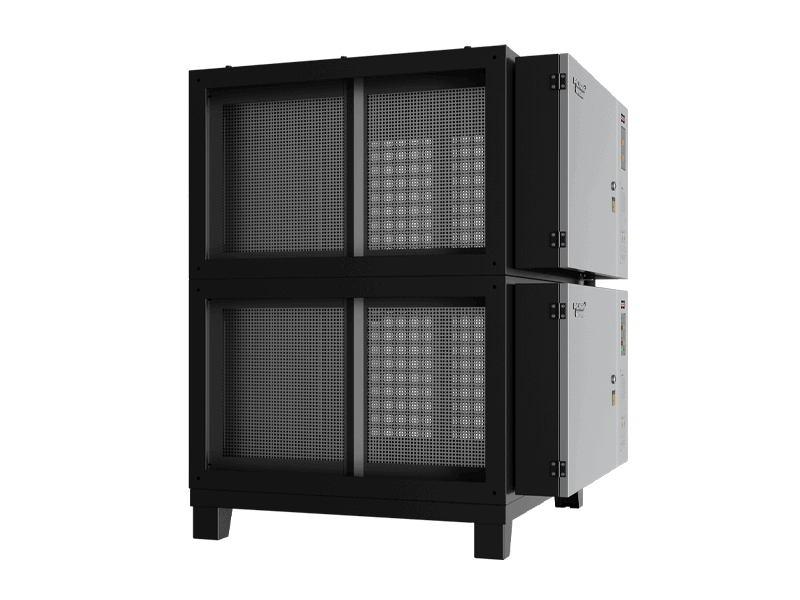
Flange size at inlet and outlet
Measure the actual flange, not the duct. On our engineering-grade units the flange is published per model: a unit rated 8,000 m³/h in the LK-E1 grade has a flange of 1,277 × 614 mm, a cabinet envelope of 1,524 × 560 × 833 mm and a weight of 116 kg. Those three figures together decide whether a unit reaches the position and whether it can be supported once it is there. The full table by model is on the LK-E series page.
Bolt-hole pattern
Two flanges of the same overall size do not necessarily bolt together. Record pitch, hole diameter and edge distance. Where the patterns differ, the fix is an adapter plate, which is routine, but an adapter plate adds length — and length is exactly what a replacement position usually does not have spare.
Clear access on the cell side
A precipitator that fits the duct but cannot be opened is a maintenance problem you buy once and pay for repeatedly. The cell has to come out sideways, so what matters is the clear distance on the service face, measured to the nearest obstruction rather than to the wall. For comparison, our UV and activated carbon modules publish a maintenance space of 1,000 mm; for a precipitator the required figure is model-specific and confirmed at selection, which is why it belongs on the survey rather than in a catalog.
Static pressure still available
The fan was selected against a resistance schedule that included whatever was in the duct at the time. If the replacement has a different resistance, the airflow moves. Our in-duct units are quoted at no more than 150 Pa for the complete unit including the standard air-distribution plate, with the cell body itself in the region of 20 to 30 Pa as a technical note. The figure you need from the project is how much allowance the fan selection left for treatment, and that number is usually held by whoever selected the fan rather than by the kitchen. Where the duct itself is the constraint, commercial kitchen exhaust duct size works through how section, velocity and pressure interact.
What a replacement has to match, and what it does not
Replacement projects stall on the assumption that a new unit has to imitate the old one. Most of it does not. Separating the two lists shortens the exercise considerably.
| Item | Has to match? | Why | What it means for your quote |
|---|---|---|---|
| Duct interface and bolt pattern | Yes, or by adapter | Physical connection, and adapters consume straight run | Send measured dimensions, not the model number |
| Access clearance on the service side | Yes | The cell must withdraw for washing | Governs which cabinet arrangement is offerable |
| Airflow band | Match the duty, not the old rating | The old rating may already be wrong for the kitchen | Supply the current design exhaust rate |
| Pressure allowance | Yes, within the fan schedule | Resistance changes airflow, which changes capture | State the allowance; ask for pressure drop at your airflow |
| Electrical supply | Yes, at the position | What is at the isolator is what is available | Our units are configured to order for 220 V or 380 V, 50 or 60 Hz |
| Brand, cabinet color, badging | No | Cosmetic and commercial, not functional | Re-badging and cabinet color changes are available on OEM terms |
| Efficiency grade of the old unit | No | A replacement is a chance to re-choose | Grades differ; specify against the outlet requirement, not the predecessor |
This table answers what to hold fixed in a replacement. It does not tell you which grade to choose; that follows from the outlet requirement and the cooking process, and belongs in a selection conversation against the product range. Where odor rather than visible grease is the driver, the treatment stage that answers it is a different one, and a combined arrangement is described on the kitchen ecology unit page.
Changing supplier: what to ask for in writing
An operator replacing equipment has one advantage a first-time buyer does not: direct evidence of how the last supply behaved over years rather than over a sales call. The way to convert that into a better purchase is to ask the next supplier for the things the last one could not produce.
| Evidence | What it supports | What it does not prove on its own | Buyer action |
|---|---|---|---|
| Third-party efficiency test report | Collection performance of a specific model under a stated test condition | The outlet result in your kitchen, at your airflow, on your menu | Ask for the report itself; check the serial-number link and the test conditions before treating any efficiency figure as a performance basis |
| Product safety listing | Electrical safety and ozone for the models named in the certificate | Grease removal efficiency, and it does not extend to models outside the listing | Ask which model numbers the file covers, in writing |
| Certificate of conformity for a market | The specific series and model range named in the annex | Whole-catalog coverage | Request the annex, not the certificate cover page |
| Warranty statement | What the maker will carry, and for how long | That labor, travel or consumables are included | Get the boundary in writing: covered parts, consumables, and whether attendance is chargeable |
| Parts availability commitment | How long the unit stays serviceable after the model is retired | Stock on the day you need it | Ask for the horizon in years, and for typical dispatch time |
For calibration, here is what we put on the table for our own range. Efficiency for the LK series is stated as up to 97.6 percent, from third-party tests carried out by CMA-accredited laboratories, and we supply the report numbers with the test conditions attached rather than a bare percentage. Our UL listing to UL 867 is held under file E522667 and covers the LK and SE units at 6K, 12K and 18K in the 230 V, 50 Hz configuration; it is an electrical safety and ozone listing and it does not cover the rest of the range, and we will say so to a consultant who asks. How the various product listings in this field differ, and what each one is actually evidence of, is set out in UL 710B compared with UL 710, and the certificate scope itself is on the certificates page.
The commercial terms belong in the same list, because they are what a replacement buyer is usually trying to fix: minimum order is one unit, standard lead time is 7 to 15 days, and technical support runs Monday to Friday, 08:00 to 17:00 GMT+8. Payment terms, Incoterms and OEM arrangements are set per order.
Scope and limits
Three layers have to be cleared separately on a replacement, and passing one does not clear the next.
Layer one, equipment evidence. Test reports and certificates describe a model under a condition. They travel with the model, not with your project. Layer two, site installation and interface. Flange, bolt pattern, support, access clearance and supply are site facts, and no certificate speaks to them. Layer three, whole-system operation. Capture at the hood, delivered airflow, cleaning discipline and the cooking process decide the outlet result. Passing one layer does not clear the next.
Specific limits on what this page can tell you:
- Whether our collection cells or power module will fit another manufacturer’s cabinet is a project review, not a catalog answer. We do not give a general yes or no to it, and you should be wary of anyone who does without seeing the cabinet. If that is the route you want to explore, send photographs of the cell rails, the cabinet interior and the nameplate, and we will tell you whether it is worth surveying. The positive action in the meantime is to record the interface dimensions anyway, because they are needed either way.
- No cleaning interval is given here in weeks or months, for any model. The interval follows the cooking process, the operating hours and the grease load, so for a specific site it is set in writing at quotation rather than taken from any page. What a service visit covers is in the cleaning and maintenance guide.
- Sound levels do not transfer between models. We hold measured figures from specific test reports — 51 dB(A) for an HME integrated hood unit and 49 dB(A) for an SE unit — and those figures belong to those tests. If noise is a planning condition on your site, ask for it as a project question rather than assuming a catalog value.
- Efficiency figures are tested conditions, not site results. The action that follows is to record your own outlet requirement and let it drive the grade, rather than matching whatever the previous unit claimed.
- Nothing here is a compliance determination. Which code and which edition applies to your address is a question for your engineer and the authority having jurisdiction.
Buyer record
Everything above collapses into one sheet. Fill it in before you contact anyone, and the same sheet works for every supplier you approach.
From the existing unit: maker, model and serial from the nameplate; year installed; the supply at the isolator, with voltage, phase and frequency.
From the interface, measured rather than taken from a drawing: flange size at inlet and outlet; bolt-hole pitch, diameter and edge distance; cabinet envelope; and the clear access dimension on the cell side, measured to the nearest obstruction.
From the system: the current design airflow; the static pressure allowance left for treatment and who set it; duct orientation at the unit position; and the load the support arrangement will carry.
Why it is being replaced, as a checklist rather than a sentence: grease at the outlet, odor complaint, repeated sparking or tripping, cells corroded or deformed, power section dead, parts unobtainable, airflow increased, new compliance requirement. More than one box is normal and the combination is diagnostic.
Ask every supplier, in writing: the test report number, issuing body and test condition behind any efficiency figure; which model numbers the certificates actually cover; pressure drop at your airflow; the warranty boundary including what counts as a consumable and whether labor is included; how long parts stay available after the model is discontinued; and what they will not commit to without a site review.
What is still missing at that point is measured airflow, which comes from commissioning rather than from any supplier. What would send you back to the start: a change in the appliance line, a duct alteration, a fan replacement, or a new outlet requirement arriving from the landlord or the authority.
Key takeaways
- Sequence: diagnose the system before pricing equipment, not after, because two of the five common replacement triggers are not equipment faults at all.
- Constraint: the binding constraint on a replacement is the interface and the access clearance, not the airflow rating.
- Cells: treat geometry, not grease, as the test of whether a cell is recoverable — loaded is a wash, bowed is a purchase.
- Parts: a supplier who will not state a parts horizon in years has answered the replacement question for you.
- Freedom: brand, cabinet color and the old efficiency grade are not constraints; re-choosing the grade against the current outlet requirement is the point of replacing.
Frequently Asked Questions
- Can I replace an electrostatic precipitator with a different brand?
- Usually yes, because what has to match is the interface rather than the badge. The four things that decide it are the flange size at inlet and outlet, the bolt-hole pattern, the clear space available to withdraw the collection cell for washing, and the static pressure the fan schedule left for the treatment stage. Where the flange or the bolt pattern differs, an adapter plate is routine, but it consumes straight duct run, which is often the scarcest thing at a replacement position. The electrical supply at the isolator also has to match what the new unit expects. Send measured dimensions rather than the old model number, because a nameplate records what the previous buyer selected and says nothing about the opening the equipment has to fit into.
- Is it worth repairing an electrostatic precipitator, or should I replace it?
- It depends on which of the three sections has failed and whether parts are still made. A collection cell that is simply loaded with grease is a cleaning job, not a purchase. A cell whose plates are bowed out of parallel or whose ionizer wires are broken has lost the geometry that creates the field, and washing will not restore it, so that is a parts purchase at minimum. A failed power section does not condemn the cells on units where the two are separate assemblies. The decision usually turns on the fourth question rather than the first three: if the model is discontinued and parts are no longer obtainable, repair stops being an option regardless of condition. Ask the original supplier for a parts availability horizon in writing before spending anything on diagnosis.
- What do I need to measure before ordering a replacement ESP?
- Six measurements, none of which come from a catalog, plus one reading that is not a measurement. Measure the flange size at the inlet and the outlet; the bolt-hole pattern, meaning pitch, hole diameter and edge distance; the cabinet envelope that the position will accept; the clear access distance on the cell side, taken to the nearest obstruction rather than to the wall; the current design airflow, which may differ from what the old unit was selected for; and the static pressure allowance the fan selection left for treatment. The seventh item is the supply at the isolator, recorded with voltage, phase and frequency. Those seven figures let a supplier quote a replacement without a site visit, and they are also what an adapter plate or a transition has to be designed against.
- How long are spare parts available for a commercial kitchen ESP?
- That is a commercial commitment rather than a technical property, so it varies by manufacturer and it should be asked for in writing before purchase, not after a failure. Our own position is that common spare parts are held in stock and that parts remain available for one year after a model is discontinued. The related boundary to establish at the same time is the warranty: ours runs twelve months on the whole unit and covers the collection cells and the high-voltage power module, while UV lamps and activated carbon media are treated as consumables and are not covered, and labor and site attendance are quoted separately rather than included. A supplier who will not put a parts horizon in numbers has effectively answered your replacement question.
- Does a replacement precipitator need the same efficiency rating as the old one?
- No, and treating the old rating as a specification is a missed opportunity. The figure that should drive the selection is the outlet requirement you actually have now, which may come from a landlord, a planning condition, a neighbor complaint or a change in the cooking process, and it may be higher or lower than whatever the previous unit claimed. Two cautions apply to the figures themselves. An efficiency percentage is only meaningful with the test condition and the report behind it, so ask for both rather than accepting a number in a brochure. And a precipitator acts on particle-phase grease and smoke, so if the driver for replacing is odor rather than visible plume, the grade of the precipitator is not the variable to adjust; that is a question about adding a different treatment stage.
Replacing a precipitator that is already installed?
Send us the six figures from the survey above: flange size, bolt pattern, cabinet envelope, clear access on the cell side, current design airflow and the static pressure allowance left for treatment. We will tell you which units fit that opening, what pressure drop each would add at your airflow, whether an adapter plate is needed and how much length it takes, and what we would not commit to without a site review. You get back a fitted shortlist with connection dimensions, not a catalog.
Send us your replacement survey
Scarlett handles export inquiries, dealer relationships and commercial terms at Polygee, including replacement and retrofit inquiries from operators changing supplier. Polygee, founded in 2004, manufactures commercial kitchen exhaust filtration equipment. This article describes an assessment method and our own published commercial terms; it is not a mechanical design, not a compliance determination, and not a substitute for a site survey.
References & sources
- UL Standards & Engagement — UL 867, Standard for Electrostatic Air Cleaners, the standard behind the product listings referenced here. shopulstandards.com
- International Code Council — 2021 International Mechanical Code, Section 506.3.4, air velocity in grease duct systems, which governs the duct side of a replacement position. codes.iccsafe.org
- Building Engineering Services Association — DW/172, Specification for Kitchen Ventilation Systems, the reference specification for kitchen extract systems in the United Kingdom. thebesa.com
- Polygee — model dimensions, flange sizes, weights and pressure-drop data by model, supplied on request with the corresponding test report numbers. polygeeesp.com
Related reading
- Electrostatic precipitator cleaning and maintenance — what a service visit covers, and how to tell a cleaning job from a parts job before you commit to either.
- How to reduce smoke from a commercial kitchen exhaust — the diagnosis sequence for symptoms that turn out to be capture rather than treatment.
- What sets an electrostatic precipitator price — the six factors behind a quotation, and quoted price against lifetime cost.
- Commercial kitchen exhaust duct size — how section, velocity and pressure interact when the duct itself is the constraint on what can be installed.