

Kitchen exhaust filtration is a sequence of stages, and each stage is built for one kind of pollutant: the hood filter for grease droplets and flame, an electrostatic precipitator for the fine aerosol and smoke that pass it, and UV or activated carbon for the gas-phase molecules behind a smell. The stage most often bought on its own, the carbon or charcoal filter, is the one that does least until the stages ahead of it have done their work, because grease blinds carbon long before the media is spent on odor. Read this and you can name the pollutant behind your complaint and decide which stages belong on your list, in which order. You can also fill in the input sheet a supplier needs before anything is sized; model selection and quotation stay on the product pages.
This guide helps you decide which filtration stages a commercial kitchen exhaust needs, in what order, and what each stage does and does not remove.
It does not select or size a model, quote a price, or promise an odor result at a neighbor’s window.
For product-specific review, see the kitchen exhaust filtration system range and the in-duct electrostatic precipitator page.
| Application | Critical input | Initial route | Still needs confirmation |
|---|---|---|---|
| Bakery, steam, electric ovens, little frying | Discharge location, and whether a plume or a complaint is on record | Listed hood filter only; an in-duct stage only if the record shows a plume | Whether the plume is a capture failure at the hood or the fine fraction passing it |
| Gas griddle, fryer, salamander, Western grill | Design exhaust airflow and where the duct discharges | Hood filter, then an in-duct electrostatic precipitator where the discharge is low or near people | Static pressure still available for the stage; whether an odor requirement exists in writing |
| Wok, high-oil frying, teppanyaki | Airflow, run hours, and who complains about what | Hood filter, then the ESP as the base stage; UV or carbon only against a documented odor complaint | Which phase the complaint belongs to: particle, gas, or dispersion at the outlet |
| Charcoal, wood, charbroiler | The separate exhaust system and the spark arrester the codes require | ESP designed in from the start, behind the spark arrester | Temperature at the proposed position; the suppression drawing for the run downstream |
Three pollutants, three kinds of stage
The pollutant decides the stage, so the first job is to name what leaves your hood: grease droplets, fine grease aerosol and smoke, or the gas-phase molecules that carry a smell. Each of those is handled by a different mechanism, and no single filter does all three. A hood grease filter works by inertia; the heavier droplets cannot follow the air around the baffles, so they hit metal and drain off. An electrostatic precipitator charges the fine particles that pass the hood and collects them on stainless steel plates. UV photolysis and activated carbon act on molecules, not particles, and only after the particles are gone.
The search term hides that sequence. Kitchen exhaust filtration covers a washable mesh cartridge for a domestic hood, a stainless steel baffle for a restaurant hood and a plant-room train with three stages. The same word, filter, is used for all of them. The buyer asks which filter; the engineering question is which pollutant. We use one working rule for this, our own and not an industry standard: name the pollutant, then the stage, then the model, in that order.
A listed hood filter followed by an electrostatic stage is usually the right candidate when the record shows grease or smoke at the discharge. Gas-phase stages are the better choice only when a written complaint, a lease clause or a planning condition names odor rather than smoke.
| System stage | Controls | Does not control | Critical interface | What it means for the build |
|---|---|---|---|---|
| Hood grease filter (listed to UL 1046) | Coarse grease droplets, by inertia; the flame barrier at the hood | Fine aerosol, smoke, any smell | Filter condition and airflow set what the next stage receives | Required by code whatever sits downstream; neglect here shortens the life of every stage behind it |
| In-duct electrostatic precipitator (ESP) | Particle-phase grease aerosol and smoke | Gas-phase molecules; it is not an odor device | Even airflow across the cells, cell condition, the static pressure it adds | The stage that does the visible work; give it a straight run and a service side |
| UV module | Part of the gas-phase load, by photolysis | Particles; not a substitute for carbon | Installed after particle removal, never before; lamp access; ozone management | Enters the list against a written odor requirement, not by default |
| Activated carbon module | Gas-phase molecules, by adsorption onto the media | Particles; it stops working once the media is loaded | Media condition; panels withdrawable for exchange | A running cost, not a one-off; last in the train |
| Discharge terminal | Dispersion of whatever remains | Source concentration | Height, velocity, distance to the nearest opening | Often the cheapest improvement available, and outside the filtration scope |
What this table settles is which stage acts on which pollutant. It does not answer how many modules a site needs. That requires the design airflow and the position on the duct, which the tier table and the input sheet below collect.
What kind of filters are available for a kitchen exhaust fan?
Two groups, and the word filter is doing different work in each. At the hood: baffle grease filters listed to UL 1046, and mesh filters only where they are listed as part of a hood. In the duct: the three stages in the table, chosen by pollutant, which packaged together are sold as an ecology unit or a pollution control unit. Some suppliers sell them as a dry scrubber instead; our dry scrubber for kitchen exhaust guide shows what that name can contain and when a wet scrubber suits better. What the domestic market calls a filter, a mesh cartridge or a charcoal pad in a recirculating range hood, is a third group and does not belong on a commercial list. A MERV rating describes a supply-air filter, not a grease stage.
The hood filter stays, whatever you add downstream
A listed hood grease filter is a code item and a fire barrier, so no in-duct stage replaces it. Section 507.2.8 of the 2021 International Mechanical Code requires the grease filters on a Type I hood to be listed and labeled in accordance with UL 1046. UL 1046 is a flame-projection and drainage test, not an efficiency test.
That distinction settles two arguments at once. An in-duct unit with a mesh of its own does not release the hood from the listing. And a UL 1046 label says nothing about how much smoke passes the filter, which is the question the next stage exists to answer. The clause-by-clause reading, and what a label does and does not prove, is in commercial kitchen grease filter requirements.
The hood filter also decides what the duct stage receives. A filter bank with a panel missing, mounted too flat, or loaded to the point where the air channels through it passes coarse droplets on to the duct stage. An electrostatic precipitator then has to carry them, and its cells load faster than the interval they were sized for. When the argument on site is whether to keep the baffles or to add a precipitator, the answer is both. The role of each, and the five-year cost drivers, are in electrostatic precipitator vs baffle filter.
Point to remember. Read the label before you read the brochure. No UL 1046 label, no compliant hood, whatever else is bought.
When an electrostatic precipitator belongs in the duct
An in-duct electrostatic precipitator belongs on the list when the record shows fine grease aerosol or smoke leaving a hood that captures. It does not belong there to fix a hood that does not. Smoke rolling out of the hood front is a capture failure; a room in negative pressure is a make-up air failure; a fan short of its airflow is a fan failure.
None of those is a filtration problem, and the six fixes in the order that works are in how to reduce smoke from commercial kitchen exhaust. The precipitator is for the plume that leaves a working hood. That means the blue haze from wok cooking and charbroiling, the grease film on the roof and the facade, and the fine fraction a baffle was never built to hold.
If the hood captures and the discharge still shows a plume or grease, put an electrostatic stage on the list. The fine fraction is what passes a baffle and what the precipitator collects. If the complaint is a smell that remains after the plume is gone, the precipitator alone will not settle it; that is the next section.
Inside the unit, a charging section puts a charge on the particles and a collecting section holds them on stainless steel plates, which are withdrawn and washed rather than replaced. The variable that moves the result most is airflow. When SQEP, a CMA-accredited laboratory, tested our LK120 under report 2024I20-35-5322488001, the same unit was run at 80 percent, 100 percent and 120 percent of its rated airflow. The collection efficiency moved with the airflow: highest below rated, lowest above it. That is why the figure a supplier shows you is a point at a stated airflow, not a property of the cabinet.
Our LK range measured up to 97.6 percent grease removal under the tested condition, on an LK160 under report ZY05W230298 from a CMA-accredited laboratory. The LK-E series carries design tiers of at least 90, 95 and 98 percent for the E0, E1 and E2 grades. A design tier is a specification basis, not a test result. Request the report itself and check the airflow it was run at against your design figure before treating any efficiency figure as a performance basis.
The stage adds resistance, and that resistance belongs in the fan selection. Across our in-duct models the measured pressure drop ranges from 50 to 292 Pa depending on model, below 300 Pa. The fan has to deliver the design airflow against the static of the whole run with that figure inside it. A precipitator added to a fan with no margin left gives you a different complaint, not a cleaner outlet. The airflow falls, capture at the hood falls with it, and the plume moves to the hood front.
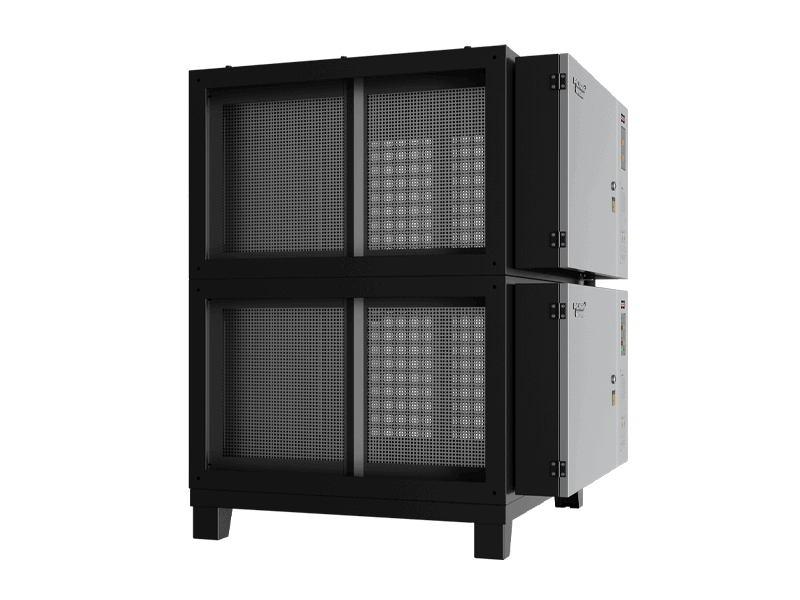
Field note. Before asking anyone for a unit, record the cooking process and its fuel, the airflow basis, the duct position with the access around it, and the complaint with where it was made. Those four lines are the first rows of the input sheet below.
When UV and activated carbon earn their place, and why they go last
UV and activated carbon earn a place only when the requirement names odor rather than smoke, and they go after particle removal because both are spent by grease. An electrostatic precipitator does not act on gas-phase molecules, so a smell that remains once the plume is controlled is the case for a gas-phase stage. A smell that arrives together with a visible plume at a low outlet is usually a particle and dispersion problem first. Adding carbon to it buys a stage that clogs.
A UV module treats part of the gas-phase load by photolysis. Ours run on two bands, 254 nm and 185 nm, in modules rated 3,000 to 15,000 m³/h each (about 1,766 to 8,830 CFM). The lamps are a consumable line, and ozone management is part of the design rather than an afterthought.
The order is not a preference. When our UV80 was tested by SQEP under report 2018I20-35-1594159016, the test was run with an electrostatic stage upstream of the module. That is how the stage is used in service, and it is why the result cannot be read as a stand-alone UV figure.
Activated carbon holds gas-phase molecules on the internal surface of the media by physical adsorption. Ours is coal-based columnar carbon with an iodine adsorption value of at least 800 mg/g, in modules rated 3,000 to 15,000 m³/h each. Two facts govern how it is bought.
The media is consumed, so the change interval is a running cost. It is set in writing for the site rather than read off a page; there is no catalog number for it. And grease blinds the media, so carbon placed where grease can reach it stops adsorbing long before it would otherwise be spent. That is the whole reason the stage order is fixed. What the three stages look like packaged as one cabinet is in what an ecology unit is.
The configuration follows the requirement, not the catalog. At Tun Razak Exchange in Kuala Lumpur (2022), the exhaust treatment was LK-E electrostatic stages followed by UV modules, 300 units in total. A carbon stage is added where the complaint record of a site asks for it, not as a default third box.
If a complaint, a lease or a planning condition puts odor in writing, list a gas-phase stage after the precipitator and budget its consumables. If nothing in writing names odor, leave the gas-phase stages off the list and record why, so the decision can be reopened if a complaint arrives.
Matching the stage list to airflow and menu
Airflow sets the module count and the menu sets the stage list, so the two are read together.
Three airflow bands matter for our range. Below 3,000 m³/h, in-duct electrostatic units from 2,000 m³/h per unit (about 1,177 CFM) exist, but the UV and carbon modules do not. An odor stage at that size is therefore a per-project question. Between 3,000 and 15,000 m³/h each stage is one module. Above 15,000 m³/h the electrostatic stage is sized per site, and the UV and carbon stages are configured as parallel banks rather than scaled up. That changes the space the plant room has to give them. The Stage Tier Table is the second buyer asset of this page.
For a griddle, fryer or wok kitchen with a plume and no written odor requirement, the usual list is a listed hood filter and one electrostatic stage. Adding UV, carbon or both is the better choice when the requirement names odor, and only then.
| Cooking load | Below 3,000 m³/h (about 1,766 CFM) | 3,000–15,000 m³/h (about 1,766–8,830 CFM) | Above 15,000 m³/h | What it means for your project |
|---|---|---|---|---|
| Light: baking, steaming, electric ovens, no frying line | Listed hood filter only, as a rule. An in-duct ESP from 2,000 m³/h per unit is available if a plume or a complaint is on record | Hood filter; ESP only where the record shows a plume; gas-phase stages rarely justified | Treat as several hoods on one run and check each duty separately; the heaviest duty sets the list | Do not buy stages the pollutant does not justify; record the complaint first, then choose |
| Medium: gas griddle, fryer, salamander, Western grill | Hood filter, then an ESP where the discharge is low, on a wall, or near an opening | Hood filter, then ESP; add UV or carbon only against a written odor requirement | Hood filter, then ESP sized per site; UV or carbon as parallel banks if required | The discharge location decides more than the menu here; check the terminal before adding stages |
| Heavy: wok, high-oil frying, teppanyaki | Hood filter, then ESP as the base stage; an odor stage below 3,000 m³/h is a per-project question | Hood filter, then ESP, then UV, carbon or both where a complaint or a planning condition names odor | Hood filter, then ESP per site, then parallel UV or carbon banks | Budget the fan static for every stage and the consumables for the gas-phase ones before the order is placed |
| Solid fuel: charcoal, wood, mesquite, charbroiler | Its own exhaust system under the mechanical codes and NFPA 96, with the spark arrester and the suppression by others; the ESP is designed in from the start behind the spark arrester, on that run alone. Module count follows the airflow bands above | Never share this run with other cooking; the fine fraction is there whatever the hood does, and the ESP is the stage that acts on it | ||
This table answers which stages belong on the list for a given load and airflow. It does not answer the model or the number of modules; that needs the design airflow, the duct position and the static pressure available.
A wok kitchen has a design exhaust airflow of 12,000 m³/h, about 7,063 CFM, and a written odor complaint from the flat above. The list reads: hood baffles kept, with the UL 1046 label checked; one in-duct electrostatic precipitator sized at 12,000 m³/h; one UV module, since 12,000 sits inside the 3,000 to 15,000 range; one carbon module on the same basis. The pressure drop to budget is three declared figures, each at 12,000 m³/h and each with its basis stated, added to the fan static. The same kitchen at 24,000 m³/h keeps the same list, but the UV and the carbon become two parallel banks each and the plant room gains a second service side. The same kitchen with no written complaint stops at the precipitator, and the reason is written into the file.
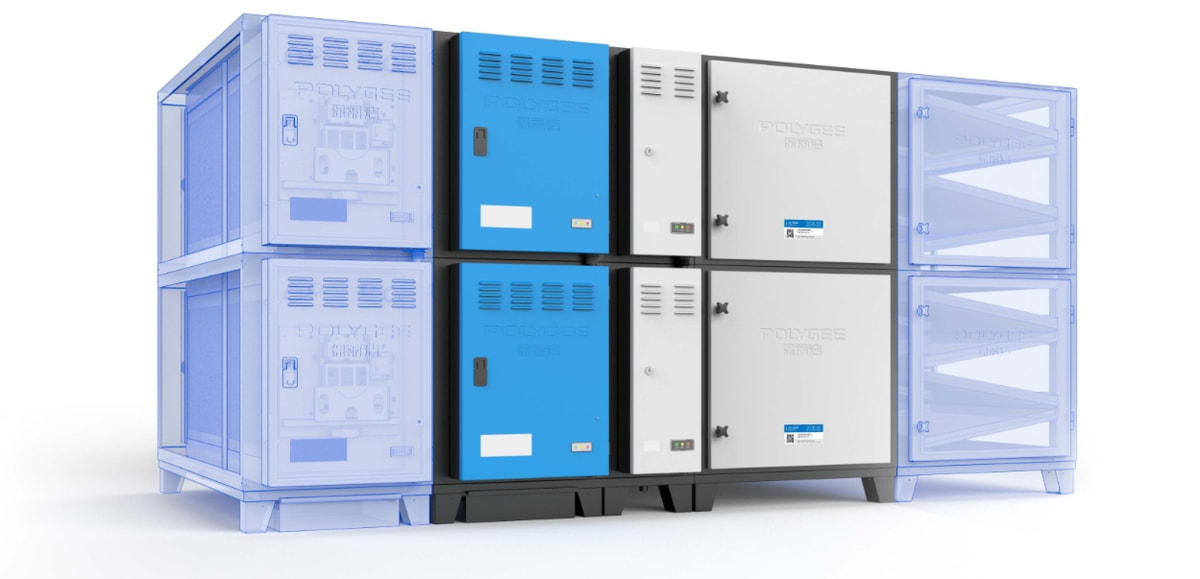
The Application Input Sheet
Nine inputs decide the stage list and its size, and every one of them is something you already hold or can read off a drawing. The sheet is written to be pasted into an email: you fill the third column, the supplier fills the fourth, and the fifth says which document settles it.
| Parameter | Why it matters | Buyer supplies | Supplier declares | Verification document |
|---|---|---|---|---|
| 1. Cooking process and appliances | Sets the pollutant mix and the load; solid fuel changes the whole system | Menu, appliance schedule with fuel, whether any solid fuel or tabletop grill is used | The stage list in flow order, with the reason for each stage | The stage list on the quotation |
| 2. Exhaust airflow, m³/h and CFM | Sets the module size, and the airflow any efficiency figure has to be read at | Design figure from the drawings; for a retrofit, the measured figure from the balance report | The rated airflow of each module and the airflow at which any efficiency figure was measured | Test report with its airflow stated; the balance report |
| 3. Duct size and the position available | Sets the module face, the transition and whether even airflow across the cells is possible | Duct dimensions, straight length available, which side can be opened for service | Module dimensions, transition lengths, service clearance | General arrangement drawing |
| 4. Existing hood filter type and listing | Sets what reaches the duct stage; a listed filter is required whatever is added | Baffle or mesh, and whether the label reads UL 1046 | That the in-duct stage does not replace the hood filter | The filter label; IMC 2021 Section 507.2.8 |
| 5. Odor complaint on record | Decides whether any gas-phase stage belongs on the list | Who complains, from where, at what time of day, and whether it is in writing | Which stage is proposed for which phase, and what it will not do | The complaint letter, lease clause or planning condition |
| 6. Discharge location | Decides how much treatment the site needs before the outlet does its share | Height, direction, distance to the nearest window or intake | Nothing; dispersion sits with the designer | Site plan or roof plan |
| 7. Static pressure available | Decides whether the stages fit inside the fan budget at design airflow | The fan curve or the balance report, and the margin left | Pressure drop per stage, with basis, unit and the airflow it applies to | Fan curve; measured pressure drop in the test report |
| 8. Power supply at the position | Sets the power supply configuration of the unit | Voltage, phase and frequency available at the position | The supply each module is configured for | Datasheet and nameplate |
| 9. Run hours and the cleaning arrangement | Sets the service basis; efficiency figures describe clean equipment | Operating hours per day, and who will withdraw and wash the cells | The cleaning method and the interval, in writing, for this site | The maintenance clause of the quotation |
This sheet answers what a supplier needs to propose a stage list. It does not answer which supplier to choose; the six documents that can be checked rather than believed are in the commercial kitchen ESP buying guide.
Scope and limits
This page puts stages on a list; it does not prove that any stage will meet a limit at your outlet. Three layers apply to that proof, and passing one layer does not clear the next.
- Equipment evidence. A test report at a stated airflow, a listing, and the models a certificate names show what a stage is supported by. Passing one layer does not clear the next.
- Site installation and interfaces. The real airflow, the straight run, the fan static, the condition of the hood filter and the supply decide whether the tested condition exists on your duct at all.
- The operated system. The cleaning basis, the consumables and the run hours decide what the outlet does in week twenty, which is what the neighbor smells.
| Evidence | What it supports | What it does not prove on its own | Product-condition scope | Buyer action |
|---|---|---|---|---|
| UL 1046 listing on the hood filter | That the filter limits flame projection and drains grease | Efficiency; anything about the duct stage | The filter model on the label | Read the label; keep the filter whatever is added downstream |
| UL 867 listing on an electrostatic air cleaner | Electrical and fire safety of the models listed | Collection efficiency; coverage of models not listed | Ours: File E522667 covers the LK and SE 6K, 12K and 18K models only | Ask for the file number and the model list, not the word listed |
| CE certificate and RoHS report | Conformity for the models the certificate names | Performance; coverage of models not named | Ours: FQC2602501 names LK30 to LK480, the LK-E models it lists and the UV series; RoHS BKC25114877LC covers the LK, SE, HME, FMC, HPS and LK-E lines and not the UV, CB or SPP lines | Ask for the model annex, not the cover page |
| ASTM F2519 figure | Grease particle capture of a clean filter or extractor at a stated airflow | Performance when loaded; in-duct odor stages; comparison with figures from other methods | The item and the airflow tested | Check the figure against clause 1.2 of the method; how to read one is in ASTM F2519 |
| Third-party test report on the electrostatic unit | Efficiency and pressure drop of the tested model at the tested airflow | Other models; other airflows; odor | Ours: LK160 under ZY05W230298, CMA-accredited | Request the report itself and check the serial-number link and the test conditions before treating any figure as a performance basis |
The table settles what each document proves. It does not answer whether the installed system complies; that is the second and third layer, and only the site can supply them.
Some conditions take the selection out of this page. A recirculation arrangement is one: some authorities exclude electrostatic, UV and ozone stages from recirculated air altogether. If that is the arrangement proposed, start from commercial kitchen odour control in the UK and its three discharge options before any stage is priced. An odor result at a window is another: a treatment stage reduces a load, and the outlet, the wind and the distance do the rest. Record the complaint and its location, then evaluate the gas-phase stage against that record.
A cleaning interval for the cells and a change interval for the carbon are a third: both follow the cooking process, the run hours and the load. Ask for both in writing at quotation for your site. The fan is a fourth: give the fan designer the pressure drop of every stage with its basis, and let the fan be selected against the whole run.
Seven changes reopen the selection: a change of menu or appliance line, above all adding solid fuel; a change of design airflow; a duct alteration that removes the straight run or the service side; a fan replacement; a change in who cleans the cells and how; a new discharge position or a new local rule at the outlet; and a substitution of the model the report or the certificate names.
Buyer record
- Before requesting a stage list: name the pollutant behind the complaint, check the hood filter label, and fill the nine rows of the input sheet.
- Request from every supplier: the stage list in flow order with the reason for each stage · the rated airflow of each module · the efficiency report with its airflow and the model tested · the pressure drop per stage with basis and unit · the model annex of each certificate · the cleaning and consumable basis in writing.
- Record for your own file: why each gas-phase stage was or was not listed, so the decision can be defended when a complaint arrives or a stage is questioned.
- Triggers a re-check: a menu or fuel change · an airflow change · a duct or fan change · a new cleaning arrangement · a new discharge rule · a model substitution.
Key takeaways
- Pollutant: judge the stage list by which of the three pollutants the record shows, not by which filter the search results sell.
- Hood filter: judge it as a code item that stays, not as the stage an in-duct unit replaces.
- Electrostatic stage: judge it by the plume leaving a hood that captures, at the airflow the report was run at, not by a headline percentage.
- Gas-phase stages: judge them by a written odor requirement and place them after particle removal, not as a default third box.
- Airflow: judge the module count by the airflow band and the fan static, not by the cabinet size on the brochure.
Frequently Asked Questions
- What kind of filters are available for a kitchen exhaust fan?
- In a commercial kitchen there are two groups. At the hood, grease filters listed to UL 1046, usually baffle type, and mesh only where it is listed as part of the hood. In the duct, stages chosen by pollutant: an electrostatic precipitator for fine grease aerosol and smoke, a UV module for part of the gas-phase load, and activated carbon for the gas-phase molecules that carry a smell. The charcoal cartridge in a recirculating domestic hood is a different object and does not belong on a commercial list.
- What is the purpose of the charcoal filter in a kitchen hood?
- It adsorbs gas-phase odor molecules onto activated carbon. It does not catch grease or smoke particles. In a recirculating domestic hood it is the only treatment, which is why such hoods disappoint once there is real frying. In a commercial exhaust the carbon stage sits last, after the hood filter and the electrostatic precipitator, because grease reaching the media blinds it. The media is consumed and replaced, not washed.
- How should kitchen exhaust filters be cleaned?
- By stage. Hood grease filters are removed and washed on the schedule the manufacturer sets, inside the inspection tiers NFPA 96 sets by cooking type. NFPA 96 asks for the hood and duct work to be done by trained, qualified people. The cells of an in-duct electrostatic precipitator are withdrawn and washed on an interval set in writing for the site; there is no catalog number for it. Carbon is not cleaned; it is replaced. UV lamps are cleaned and replaced on the supplier basis. What a service visit covers is in our electrostatic precipitator cleaning guide.
- Does an electrostatic precipitator replace the hood grease filter?
- No. Section 507.2.8 of the 2021 International Mechanical Code requires the Type I hood to carry grease filters listed and labeled to UL 1046. That requirement does not change when an electrostatic precipitator is added downstream. The two act on different things: the hood filter takes the coarse droplets and acts as a flame barrier; the precipitator takes the fine aerosol and smoke that pass it. Drop the hood filter and the hood stops complying, and the precipitator loads up faster.
Send us the input sheet
Scoping a filtration train for your kitchen exhaust? Send us your menu and appliance list, your design airflow in m³/h or CFM, and the discharge location with any complaint on record. We will come back with a stage list in flow order, the module range each stage falls in, the pressure drop to budget for each stage with its basis, and the documents that apply to the models proposed.
You get back a written configuration proposal, quoted EXW, FOB or CIF as you prefer. Minimum order is one unit, and the standard lead time is 7 to 15 days for the models it names. Where a stage is not justified by your record, the proposal says so rather than adding it.
Send the input sheet →Why we write this
We build the electrostatic stage of kitchen exhaust filtration trains and supply the UV and carbon stages that follow it. The questions buyers bring us are which filters a kitchen exhaust needs, what the charcoal filter is for, and whether an in-duct unit replaces the hood filter. This page answers them by pollutant and by stage, with the input sheet a supplier needs before any stage is sized. It does not size or configure equipment; sizing and quotation live on the product pages.
Law manages installation and commissioning projects at Polygee, which designs and builds commercial kitchen exhaust filtration equipment and has done so since 2004. The module ranges, report numbers and certificate scopes on this page are Polygee’s stated basis and are available in writing for any model quoted. This article explains how to put stages on a list for planning purposes; the configuration for any project comes from a written proposal.
References & further reading
- International Code Council. 2021 International Mechanical Code, Section 507.2.8 Type I grease filters. codes.iccsafe.org
- UL Standards & Engagement. UL 1046, Grease Filters for Exhaust Ducts. shopulstandards.com
- NFPA. NFPA 96, Standard for Ventilation Control and Fire Protection of Commercial Cooking Operations, inspection and cleaning provisions. nfpa.org
- ASTM International. ASTM F2519-05(2025), Standard Test Method for Grease Particle Capture Efficiency of Commercial Kitchen Filters and Extractors, clause 1.2. astm.org
Related reading
- Electrostatic precipitator vs baffle filter. It sets out the role of each device and the five-year cost drivers to compare, once the stage list is settled.
- How to reduce smoke from commercial kitchen exhaust. It takes the smoke problem from the hood edge to the outlet, in the order the fixes work, before any stage is bought.
- Commercial kitchen ESP buying guide. It lists the six documents to ask each supplier for, and what each one can and cannot show.
- Electrostatic precipitator cleaning. It covers what a service visit washes, who does it, and what sets the interval.