

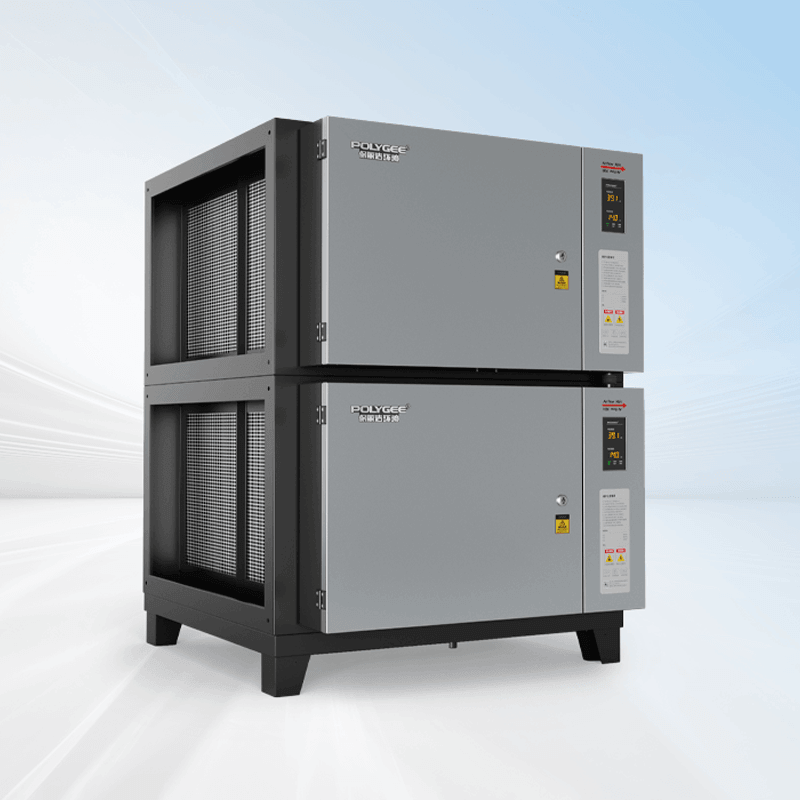
Quick answer on electrostatic precipitator UK supply: Polygee ships in-duct kitchen extract units directly from its own factory in Zhangjiagang, China. The minimum order is one unit and the standard lead time is 7 to 15 days. Buying from the factory changes who does what. We build the unit and prepare the documents; installation, commissioning, TR19 duct cleaning and any planning submission stay with your UK contractor and consultant. This page sets out that split, where the unit sits under DW/172 Section 24, our commercial terms in full and the documents we can supply. It ends with the inputs to send, so the quotation you get back can be lined up against a UK stockist’s.
This page helps you decide whether a factory-direct precipitator suits your UK project, and what to put in the first enquiry. It does not size a unit, quote a price, or make a planning determination. For the clause-by-clause reading of the specification, see our guide to DW/172 kitchen ventilation; for model tables, see the LK in-duct range.
| What you need to know first | Our answer |
|---|---|
| Minimum order | One unit |
| Lead time | 7–15 days as standard; freight to your UK port is quoted with the Incoterm |
| Airflow | LK in-duct units from 2,000 m³/h (about 0.56 m³/s); the standard table runs to 60,000 m³/h (about 16.7 m³/s) |
| Role under DW/172 | The particulate stage of Section 24: smoke and grease aerosol, not odor |
| Resistance for the fan selection | Complete unit rated at no more than 150 Pa, including the airflow distribution plate |
| Payment | 30% deposit, or 50% if your procurement rules ask for it; balance before shipment; T/T or L/C |
| Incoterms | EXW, FOB or CIF, arranged to suit the buyer |
| Warranty | One year on the complete unit; collection cells and the high-voltage power supply included |
| Support | Video calls and illustrated manuals, Monday to Friday, 8:00–17:00 (GMT+8); paid on-site service available |
- What a factory-direct order covers, and what stays with your UK contractor
- Where an in-duct ESP sits under DW/172 Section 24
- Commercial terms, stated up front
- Documents for the consultant, the council and the insurer
- Sizes, projects, and what to send for a quotation
- Scope and limits
- Frequently asked questions
What a factory-direct order covers, and what stays with your UK contractor
A factory-direct order covers the electrostatic precipitator and the paperwork. Everything that happens on site in the UK stays with your ventilation contractor, your consultant and, where a planning condition applies, the applicant. Settle who owns each line before comparing offers, because a line left out of one quotation does not disappear; it moves to another invoice.
| Item | Factory-direct from Polygee | Your UK contractor or consultant | What it means for your quote |
|---|---|---|---|
| In-duct electrostatic precipitator with its control gear | Supplied | — | State the airflow and the cooking style, so every offer prices the same unit |
| Tested primary grease separators in the canopy | Not supplied | Yes, with the canopy | DW/172 puts them ahead of any pollution control, so they are never replaced by the precipitator |
| Extract fan | Available with the unit, selected on the total static pressure | Usually in the ventilation package | Say which you want, or the offer that includes a fan reads as the dearer one |
| Ductwork, transitions, access doors and any fire protection on the duct | Not supplied | Yes | Adapter work left unstated turns into a variation after the order |
| Installation and commissioning | Not included; paid on-site service is available | Yes, including the flow and pressure measurements DW/172 asks for at handover | Price installation locally against our general arrangement drawings |
| Duct cleaning to TR19 Grease | Not supplied | A specialist cleaning contractor | The unit changes what the cleaner finds, not the cleaning duty |
| Planning or environmental health submission | Documents on request | The applicant and their consultant | Tell us what the condition asks for before the pack is assembled |
| Spare parts | Common spares held in stock; parts supplied for one year after a model is discontinued | Decide the holding you want | Quote a spare collector cell with the unit if the kitchen cannot close for cleaning |
This table answers who supplies what. It does not answer what any of it costs; that follows the airflow, the efficiency tier and the scope, as set out in what sets an electrostatic precipitator price.
Where an in-duct ESP sits under DW/172 Section 24
Under DW/172, an electrostatic precipitator is the particulate stage of pollution control, and the specification attaches conditions to it. Clause by clause, as quoted in our DW/172 guide, with what each one means for the unit you order:
| DW/172 clause | What it asks | What it means for the ESP you order |
|---|---|---|
| 24.3 | A high-efficiency canopy with tested primary separators comes before any pollution control | The precipitator goes after the separators, never instead of them |
| 24.6 | Electrostatic precipitators reduce smoke to a particle size the eye cannot see, which the specification puts at 0.3 microns or smaller; care in selection, because at higher velocities small particles can pass through untreated | Select a model whose rated band contains the airflow from your thermal convection calculation, not the next size down |
| 24.7 | Not a primary form of odor control; most odor sits in the gas phase | Where the complaint or the condition is smell, add UV-C or activated carbon, as in a kitchen ecology unit |
| 24.11 | The added resistance of any pollution control is included when the fan is selected | Carry our complete-unit rating of no more than 150 Pa into the fan selection |
| 24.1 and 24.12 | Discharge at least 1 m above ridge level as most codes require; a low-level discharge may be possible with effective pollution control, subject to local authority approval; dense urban authorities increasingly ask for high-performance odor control from the outset | The unit supports a scheme; the local authority decides whether the scheme is acceptable |
| Section 25 | Recirculation systems exclude UV and ozone from the filtration process, which the clause reads as excluding electrostatic precipitators | An in-duct ESP belongs to a discharging system, not a recirculating one |
This table answers where the precipitator fits. It does not answer what your scheme needs; that depends on the pollutant at the discharge, the discharge position and the local authority. Where a planning condition is about odor, the route and the risk scoring are covered in commercial kitchen odor control in the UK.
Commercial terms, stated up front
These are the terms that apply to a UK order. They are written out here so you can hold any offer against them, ours included.
| Term | What applies | What it means for your project |
|---|---|---|
| Minimum order | One unit | A single unit for one site is a normal first order |
| Lead time | 7–15 days as standard | Freight time is added according to the route and the Incoterm |
| Payment | A 30% deposit releases production, with the balance settled before shipment; a 50% deposit is also available; T/T and L/C are both accepted | Schedule the balance ahead of the shipment date |
| Incoterms | EXW, FOB or CIF, arranged to suit the buyer | Tell us the delivery point and we quote on that basis |
| Warranty | One year on the complete unit, covering the collection cells and the SPP high-voltage power supply | Labor and site attendance are separate |
| Labor and site attendance | Not included; paid on-site service is available | Price installation and commissioning with your UK contractor |
| Spare parts | Common spares held in stock; parts supplied for one year after a model is discontinued | Agree the spares holding with the order |
| Remote support | Video calls backed by illustrated manuals, Monday to Friday, 8:00–17:00 (GMT+8), which is 00:00–09:00 GMT, or 01:00–10:00 in British Summer Time | Send commissioning questions the day before; answers arrive by the UK morning |
| Your brand | Your logo on the unit and a different enclosure color; quantity and lead time for OEM builds agreed case by case | State it in the first enquiry, not after the order |
| Confidential drawings | An NDA can be signed by the company | Send it with the drawings |
| Factory inspection | Each unit is inspected before shipment | Ask what the inspection covers before you place the order |
This table answers what the terms are. It does not give a transit time, because shipping to a UK port depends on the route and the Incoterm. Ask for it with the proforma invoice, add it to the 7–15 day lead time, and check the total against your programme.
Documents for the consultant, the council and the insurer
We prepare the document pack against the list your reviewer issues: certificates, third-party test reports, general arrangement drawings and specification sheets. Each document answers one question about one set of models, so match it to the offer before relying on it.
| Document | What it supports | What it does not prove on its own | What to check |
|---|---|---|---|
| CE certificate FQC2602501 (Machinery, EMC and Low Voltage directives, valid to 9 January 2031) | Conformity of the models it names: LK30–LK480, LK30E1–LK150E1 and the UV series. CE marking continues to be recognized for the Great Britain market under the Product Safety and Metrology etc. (Amendment) Regulations 2024 | Performance, DW/172 compliance or any emission result | Match the model number on the quotation to the certificate |
| RoHS 2.0 certificate BKC25114877LC | Restricted-substance compliance for the lines it names, the LK and LK-E series included | Coverage beyond the lines it names | The same model-number check |
| ISO 9001, ISO 14001 and ISO 45001 certificates (ABZB25Q30072R3M, ABZB25E30043R3M, ABZB25S30027R2M) | The management systems the factory works under | The performance of any particular unit | Ask for copies with the pack |
| Third-party test report ZY05W230298 (CMA-accredited) | Grease removal of up to 97.6% on LK units at rated, evenly distributed airflow, under that test | The 0.3 micron smoke result in DW/172 24.6, an odor result, or performance at another velocity | Request the report itself and check the serial-number link and the test conditions |
| General arrangement drawings and specification sheets | Dimensions, weights, access side and electrical supply of the offered model | That the unit fits your plant area; that check belongs to your contractor | Send them to whoever coordinates the duct route and the access space |
This table answers what each document can carry. It does not answer what a council or an insurer will accept; only their list does that. Send it to us early and we will work out with you how to cover each item. The certificate scope by product line is also on our ESP certifications page.
Sizes, projects, and what to send for a quotation
LK in-duct units start at 2,000 m³/h, about 0.56 m³/s, and the standard table covers 41 models from 4,000 to 60,000 m³/h, about 1.1 to 16.7 m³/s. The LK-E engineering series comes in three grades, at or above 90, 95 and 98 percent design efficiency, and runs from 3,000 m³/h, with the widest grade reaching 40,000 m³/h. The brochure input supply is 220 V, 50 Hz, with 380 V and 60 Hz configured to order, so state your site supply. The model tables are on the LK-E series page and in our kitchen electrostatic precipitator range.
Our units are exported to 50 countries, the UK among them. Four large projects on record, with year, series and unit count; none is in the UK, and you can ask about any of them. The inputs that make a UK quotation comparable with any other, with where each is found, are set out in our electrostatic precipitator quotation guide.
| Project | Year | Equipment | Units |
|---|---|---|---|
| Marina Bay Sands, Singapore | 2012 | ODM units | 500 |
| Tun Razak Exchange, Kuala Lumpur | 2022 | LK-E and UV series | 300 |
| Dubai Mall, UAE | 2017 | ODM units | 40 |
| Waldorf Astoria Lusail, Qatar | 2016 | LK-E series | 30 |
UK electrostatic precipitator enquiry sheet
| # | Send us | Why it matters |
|---|---|---|
| 1 | Extract rate from the DW/172 calculation, in m³/s or m³/h | Fixes the model, and the velocity caution in 24.6 depends on it |
| 2 | Cooking style and fuel | Sets the efficiency tier |
| 3 | Duct size, the available run and the access side | Decides whether the unit fits and can be opened for washing |
| 4 | Site power supply: voltage, phase and frequency | The brochure input is 220 V, 50 Hz; other supplies are configured to order |
| 5 | What the planning or landlord condition asks for: smoke, odor or both | Decides whether a precipitator alone is enough |
| 6 | Whether the extract fan is in our scope | Keeps offers comparable |
| 7 | Delivery point and preferred Incoterm | Fixes the freight basis of the proforma invoice |
| 8 | Required on-site date and the reviewer’s document list | Shows whether lead time plus freight fits, and what goes in the pack |
What you get back:
- The model and efficiency tier proposed, with the reason for each
- The resistance of the unit at your airflow, with its basis stated
- A proforma invoice on your Incoterm
- The document pack list, matched to your reviewer
- The warranty boundary and the spares holding, in writing
Scope and limits
Three layers clear separately. Layer one, the equipment: the model, the terms and the documents. Layer two, the installation: separators, duct route, access and the flow and pressure measured at commissioning. Layer three, operation: cleaning, the discharge and what the local authority accepts. Passing one layer does not clear the next.
- No prices appear on this page. Send the enquiry sheet and the price comes back against a stated model and scope.
- No transit time is stated. Ask for it with the proforma invoice.
- The precipitator is not odor control on its own. Where smell is the issue, plan UV-C or carbon behind it.
- Nothing here is a planning determination. The local authority decides on the whole scheme, so send us the condition wording early.
- No cleaning interval is given. It is set by the cooking load and the operating hours, and we put it in writing with the quotation.
Key takeaways
- Scope: a factory-direct order covers the unit and the documents; installation, commissioning, TR19 cleaning and planning stay in the UK.
- DW/172: the precipitator is the particulate stage, after the separators, selected inside its rated airflow band, with its resistance in the fan selection.
- Odor: smell needs UV-C or carbon; the precipitator alone does not answer an odor condition.
- Enquiry: eight inputs make quotations comparable; a request for a price alone does not.
Frequently Asked Questions
- Is CE marking accepted for an electrostatic precipitator installed in Great Britain?
- CE marking continues to be recognized for the Great Britain market under the Product Safety and Metrology etc. (Amendment) Regulations 2024. Our CE certificate FQC2602501 covers the Machinery, EMC and Low Voltage directives and names LK30–LK480, LK30E1–LK150E1 and the UV series. A certificate covers the models it names and says nothing about performance or DW/172 compliance, so match the model number on the quotation to the certificate before relying on it.
- Does a kitchen electrostatic precipitator remove cooking odor?
- Not as its main job. DW/172 treats the precipitator as the particulate stage and states that it is not a primary form of odor control, because most cooking odor sits in the gas phase. Where the complaint or the planning condition is about smell, add UV-C or activated carbon behind the precipitator, as in an ecology unit. Plan the extra resistance into the fan selection.
- Can a kitchen electrostatic precipitator allow a low-level discharge?
- It can support one, but it cannot approve one. DW/172 says a low-level discharge may be possible with an effective pollution control system, subject to local authority approval. It also notes that dense urban authorities increasingly ask for high-performance odor control from the outset. The decision is the local authority’s, on the whole scheme, so send us the condition wording before the equipment is fixed.
- How do I get a price for an electrostatic precipitator in the UK?
- Send the extract rate from your DW/172 calculation, the cooking style and fuel, and the duct size and access side. Add the site power supply and what the planning or landlord condition asks for. Include whether the fan is in scope, the delivery point and Incoterm, and the required on-site date. You get back the proposed model and tier, the resistance at your airflow with its basis stated, and a proforma invoice on EXW, FOB or CIF terms.
Specifying an electrostatic precipitator for a UK kitchen?
Send us the extract rate, the cooking style and what the planning condition asks for. We will come back with the model and efficiency tier we propose and the resistance at your airflow, with its basis stated. You get back a proforma invoice on EXW, FOB or CIF terms and the list of documents we will prepare for your consultant or council.
Scarlett handles export inquiries, dealer relationships and commercial terms at Polygee. Polygee, founded in 2004, manufactures the in-duct electrostatic precipitators described here. This page states our published terms and our reading of DW/172 as quoted in our specification guide; it is not a quotation, a mechanical design or a planning determination.
References & sources
- Building Engineering Services Association — DW/172, Specification for Kitchen Ventilation Systems (2018), Sections 24 and 25. publications.thebesa.com
- UK Government — guidance on placing UKCA or CE marked products on the market in Great Britain. gov.uk
- Polygee — certificate numbers, directives, validity and scope by product line. polygeeesp.com/certificates
Related reading
- DW/172 kitchen ventilation specification — the clauses behind the table on this page, including separators, commissioning and cleaning.
- Commercial kitchen odor control in the UK — the route when a planning condition is about smell rather than smoke.
- TR19 Grease cleaning standard — what the duct cleaning certificate has to carry once the unit is installed.
- Electrostatic precipitator supplier profile — the factory, the listing and the certificates behind every Polygee unit.