

Demand control kitchen ventilation is usually sold as an energy measure. In the code it arrives as something else: one of three ways to satisfy a threshold, alongside two options that involve no controls at all. Knowing which of the three your project should take is worth more than any savings estimate.
The threshold is a total kitchen hood exhaust above 5,000 cfm, and crossing it does more than ask for a control strategy: it also requires listed hoods and caps how much each of them may exhaust. Britain arrives at almost the same number from a different document, though it recommends rather than requires, and its two exceptions are the same two of the American code’s three options.
Underneath all of it sits a question nobody writes on a submittal. Everything in the airstream was selected at an airflow, and a demand control system exists to move away from that airflow. The British specification is the one document that says so out loud, in two clauses worth reading before a system is bought. It does not select controls, sensors or fans, and it carries no savings estimate of ours. For the equipment this affects on our side, see the kitchen electrostatic precipitator page.
Demand control kitchen ventilation: the threshold and the three ways out
Nothing in the mechanical code asks for demand control of a kitchen exhaust system. The obligation is in the energy code, and it is conditional. Section C403.7.5 of the 2021 IECC states that where the total kitchen hood exhaust airflow rate is greater than 5,000 cfm (2360 L/s), each hood shall be a factory-built commercial exhaust hood listed by a nationally recognized testing laboratory in compliance with UL 710, shall have a maximum exhaust rate as specified in Table C403.7.5, and shall comply with one of three options.
| Option | What it requires | When it is the right one |
|---|---|---|
| 1. Transfer air | Not less than 50 percent of all replacement air shall be transfer air that would otherwise be exhausted | Where a dining room, corridor or other conditioned space genuinely has ventilation air to spare. No controls, nothing to commission |
| 2. Demand ventilation | Demand ventilation systems on not less than 75 percent of the exhaust air, configured to provide not less than a 50-percent reduction in exhaust and replacement air system airflow rates, including the controls necessary to modulate airflow in response to appliance operation and to maintain full capture and containment of smoke, effluent and combustion products during cooking and idle | Long hours with genuinely variable load. The savings come from time spent idle, so a kitchen running flat out from open to close saves least |
| 3. Energy recovery | Listed energy recovery devices with a sensible heat recovery effectiveness of not less than 40 percent on not less than 50 percent of the total exhaust airflow | Severe climates, where the recovered load is large enough to pay for the equipment and the extra resistance |
There is also an exception that removes the whole requirement: where not less than 75 percent of all the replacement air is transfer air that would otherwise be exhausted. And one drafting detail that catches mixed cooklines: where a single hood, or hood section, is installed over appliances with different duty ratings, the maximum allowable flow rate is based on the requirements for the highest appliance duty rating under that hood or section.
This table answers what the energy code asks above the threshold. C403.7.5 also carries provisions that bind below it, including the 10 percent cap on supply introduced into a hood cavity, which is read in commercial kitchen makeup air requirements. And it does not tell you which edition your jurisdiction has adopted, or whether a state energy code with its own numbering applies instead. Settle that before choosing the strategy.
Why the threshold quietly forces you onto listed hoods
The listed-hood condition in C403.7.5 is not an aside. Without it the energy code and the mechanical code would contradict each other outright. The two documents regulate the same number from opposite ends.
| Hood type, wall-mounted canopy | IMC 507.5 — minimum net exhaust, cfm per linear foot | IECC Table C403.7.5 — maximum net exhaust, cfm per linear foot (applies only above 5,000 cfm total hood exhaust, with listed hoods) |
|---|---|---|
| Light-duty | 200 | 140 |
| Medium-duty | 300 | 210 |
| Heavy-duty | 400 | 280 |
| Extra-heavy-duty | 550 | 385 |
On a project above the 5,000 cfm threshold, read literally, a wall canopy over a heavy-duty cookline would have to exhaust at least 400 cfm per foot and at most 280. The two are reconciled by a single exception: IMC 507.1 exempts a factory-built commercial exhaust hood listed in accordance with UL 710 from Section 507.5, among others, so a listed hood carries the airflow its listing establishes rather than the prescriptive minimum. That is why the energy code requires listed hoods in the same breath as the cap. Above 5,000 cfm the field-built hood on prescriptive IMC airflow is effectively off the table.
For a buyer this has a consequence that has nothing to do with energy: the hood on the drawing must come with a listing record naming the standard and the tested airflow, and the design flow follows that record. Why a catalog number can be lower than the code table is covered in commercial kitchen hood CFM requirements, and the listing landscape itself is mapped in UL 710B vs UL 710.
What a DCKV system must keep doing while it turns down
A demand control system is judged at the bottom of its range, not at the top. Both the energy code and the British specification define it by what must remain true when the fans have slowed down.
- Capture and containment, in both modes. The energy-code option requires controls that maintain full capture and containment of smoke, effluent and combustion products during cooking and idle. DW/172 22.5 uses almost the same words and adds that the system shall be capable of at least a 50 percent reduction in exhaust and supply air flow rates.
- A background ventilation floor. DW/172 22.6 states that when setting the algorithms, the minimum background ventilation of 20 air changes per hour is to be maintained at all times, because a commercial kitchen where no cooking is taking place is classified as a preparation area.
- Heat that is not cooking heat. DW/172 22.10 requires that with no cooking activity, the kitchen temperature is compared with that in each extract plenum and the fans increased to clear residual heat from occupants, solar gains and refrigeration equipment.
- Gas safety on its own terms. DW/172 22.12 requires CO and CO2 detectors positioned to the manufacturer’s instructions, and states that the detectors must override the settings of the DCKV system. Gas interlocking remains a separate matter under its own section, and what a trip does to a kitchen that cannot cook on gas until an engineer attends is in gas interlock in a commercial kitchen.
- A safe failure mode. DW/172 22.14 is unambiguous: in the event of a DCKV system malfunction, the system must automatically default to full air flow until the malfunction is rectified.
- Sensing that matches the duty. DW/172 22.9 asks for multiple sensors detecting temperature change and the presence of smoke and steam, offering airflow controlling devices in each ductwork spigot and optical sensors under the canopy adjacent to the cooking equipment as examples. Temperature alone is slow on a griddle and blind to a fryer at rest.
None of that removes the mechanical code duties underneath. IMC 507.1.1 still requires a Type I hood system to be designed so the exhaust fan starts automatically when cooking begins, and the duties collected in commercial kitchen exhaust fan requirements apply across the whole operating range, not only at full speed. The rest of the US hood duties are mapped in commercial kitchen hood code requirements.
The supply side has to follow, proportionally
A DCKV retrofit that modulates only the extract fan converts a balanced kitchen into a negative one at every step of turndown. DW/172 22.7 states it directly: as the extract flow rate fluctuates in harmony with the cooking activity, it is crucial that the corresponding make-up-air flow rate alters proportionately in order to maintain the correct air balance.
The energy code reaches the same place by wording its option around exhaust and replacement air system airflow rates together, and the mechanical code was already there. Neither the interlock duty in IMC 508.1 nor the 0.02 in. water column that NFPA 96 and the Uniform Mechanical Code measure against relaxes at part load; both are read in full in commercial kitchen makeup air requirements. They have to hold at every point in the range, not only at design flow.
Where the replacement air comes from, what limits each route and how the outdoor air balance is documented are set out in commercial kitchen makeup air requirements. Settle that before choosing between the three options, because option 1 and the 75 percent exception are answers to the same question.
What turndown does to the equipment in the duct
This is the part that rarely appears on a savings calculation, and it is the reason to read DW/172 Section 22 even on a project that will never see a British specification. Two clauses in it say what a demand control system does to everything downstream of the hood.
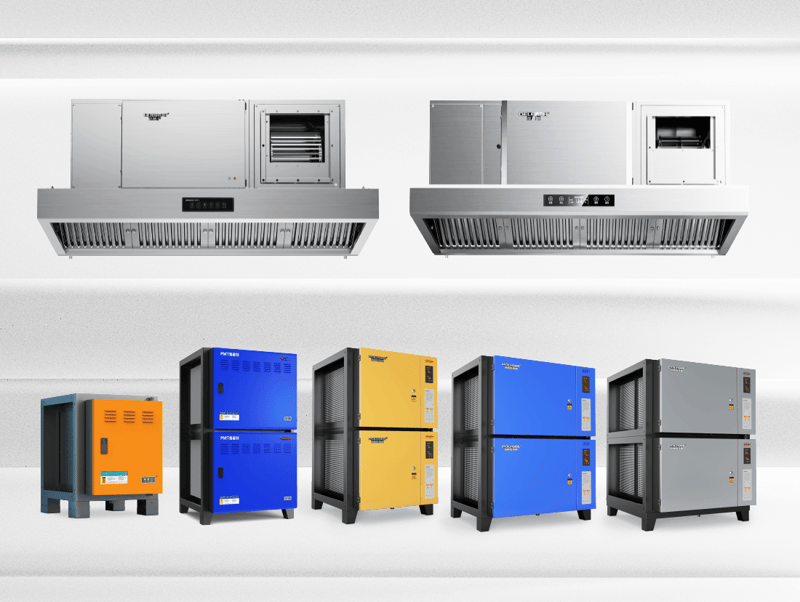
| What is in the airstream | What reduced flow does to it | What to ask for |
|---|---|---|
| Grease separators in the hood | DW/172 22.8: care must be exercised with any DCKV system so that the correct air velocity through the grease-removal devices is not compromised, thereby allowing excessive grease to enter the ductwork system. Clause 22.9 asks that the sensors keep the optimum velocity through separators maintained | The velocity range the separator was selected for, and how the control strategy stays inside it |
| A UV stage | DW/172 22.13: where ultraviolet lamps are incorporated within the system, there will be an increased production of ozone at times of lower extract flow rate. Our own UV odor control stage is subject to the same physics as anyone else’s | The supplier’s statement on ozone across the turndown range, not only at design flow |
| The grease duct itself | IMC 506.3.4 requires not less than 500 ft/min (2.5 m/s) in a Type I grease duct, and turndown reduces duct velocity along with everything else. A duct sized comfortably above 500 ft/min at design flow still clears the minimum at the bottom of the range; one sized close to 500 ft/min does not. That check belongs in the duct sizing, not in the control strategy | The velocity at minimum modulated flow, calculated for the duct as built |
| An in-duct air cleaner | It was selected for an airflow band, and any published efficiency was measured at a stated flow. Moving off that flow moves off the test condition | The rated airflow band, the resistance at your design flow, and a written answer on behavior across the range |
The one place a US code writes a number for this. The Uniform Mechanical Code, in Section 516.3 covering listed recirculating systems, requires an airflow switch that opens the interlock when airflow falls 25 percent below normal operating flow or 10 percent below the listed minimum, whichever is lower, alongside an electrostatic precipitator performance sensor with no interruption of power to the precipitator exceeding 2 minutes. That section governs recirculating systems listed to UL 710B rather than kitchens generally, so it is not a rule for a ducted DCKV project. It is worth knowing because it shows what a code drafter treated as a reasonable floor when air cleaning equipment and variable airflow met in one appliance. That case is covered in UL 710B vs UL 710.
Where we stand on it. Our in-duct units are rated in capacity bands, and the efficiency figure we publish was measured at rated, evenly distributed airflow: in CMA-accredited third-party tests our LK in-duct units reached up to 97.6% grease removal under those conditions. We hold no test data across a modulated range, and we will not quote a figure we have not measured. What we can give in writing is the rated airflow band, the resistance at your design flow, and the test conditions behind the efficiency figure; our complete in-duct units, with the standard airflow distribution plate fitted, are rated at not more than 150 Pa. If a project is going to modulate, tell us the minimum flow you intend to run at and we will size against the range rather than the peak. The service side of owning one is described in electrostatic precipitator cleaning.
Two documents, almost the same number
The most useful thing about reading the American and British texts together is how little daylight there is between them. The British clauses are worded closely enough to the American ones that a specifier who has satisfied one has largely satisfied the other. The thresholds are not identical, and the duty is framed differently, but the exits are the same.
| Question | 2021 IECC, C403.7.5 | BESA DW/172, Section 22 |
|---|---|---|
| Where does the threshold sit | Total kitchen hood exhaust greater than 5,000 cfm (2360 L/s) | Total exhaust air flow rates exceeding 2.5 m³/s, which is about 5,300 cfm |
| How is the duty framed | Shall comply with one of three options | Should be considered for DCKV, subject to two exceptions |
| Transfer air route | Not less than 50 percent of replacement air is transfer air | At least 50 percent of all replacement air is transfer air that would otherwise be exhausted |
| Energy recovery route | Sensible effectiveness not less than 40 percent on not less than 50 percent of exhaust | Sensible heat recovery effectiveness not less than 40 percent on at least 50 percent of total exhaust |
| Turndown depth | Not less than a 50-percent reduction, on not less than 75 percent of the exhaust air | Capable of at least 50 percent reduction in exhaust and supply air flow rates |
| Floor on the room | Not addressed here | Minimum background ventilation of 20 air changes per hour at all times |
| Payback | Not addressed | Typical payback periods can be between 1 and 5 years, depending on operating hours (DW/172 22.2) |
The payback figure is DW/172’s, quoted as the specification states it and dependent on operating hours in the way it says. It is not our estimate. DW/172 also credits a benefit that rarely reaches a business case: modulating fan speed through the day keeps noise to a minimum, which matters where neighboring premises are close. That subject is handled in commercial kitchen extraction regulations UK, and the specification itself in the DW/172 kitchen ventilation specification.
Which document proves what
A modulating system is bought on four pieces of paper, and none of them covers another’s question.
| Evidence | What it supports | What it does not prove | Who supplies it |
|---|---|---|---|
| The hood listing record (UL 710) | The airflow the hood was tested at, which the energy code makes compulsory above the threshold | That the hood captures at any reduced flow the controls will call for | The certification body, through the hood supplier |
| The control sequence of operation | What the system does at each step, the minimum flow, and the behavior on failure | That capture and containment survive at that minimum; a sequence is an intention, not a test | The controls supplier, before purchase |
| The commissioning record at minimum flow | That the hood held the effluent at the bottom of the range, not only at design | Anything about a different menu or a different appliance line | The commissioning agent, witnessed |
| The air cleaner’s test report | Removal at the stated airflow, under the stated method | Removal at any other airflow, including every modulated point below design | The equipment supplier, with the airflow stated on it |
The third row is the one most often skipped, and it is the only one that tests the claim the whole strategy rests on. Our own certification scope is on the certificates page.
Where this guide stops
- Editions and adoption. Section numbers are from the 2021 IECC and the 2021 IMC as published by the ICC. Many states enforce an energy code with its own numbering and its own thresholds, and the adopted document governs.
- Savings. This guide carries no savings percentage. The only payback figure here is DW/172’s. Anything more specific has to come from a model of your own hours and loads.
- Controls. We do not make DCKV controls, sensors or fans, and this is not a selection guide for them. The questions in the buyer record are the ones to put to the people who do.
- Performance across a range. We hold no test data for any air cleaner away from its rated airflow. Treat a confident efficiency figure quoted for a modulated system as a claim to be evidenced.
Buyer record
Have ready:
- The total kitchen hood exhaust in cfm, to see which side of the threshold the project sits on.
- The hood schedule with listing records, and each hood’s listed airflow.
- The replacement air split by route, and how much genuine transfer air there is.
- The adopted energy code and its edition.
- A list of everything installed in the airstream: separators, any UV or carbon stage, any in-line air cleaner.
Turndown questionnaire. The same four questions, put to the four parties who each own one answer. Take the written reply, not the conversation.
| Ask | The question | What the written answer has to contain | Their answer |
|---|---|---|---|
| Controls supplier | What is the minimum modulated flow, and what happens when the system fails? | A figure in cfm, the sensing strategy behind it, and confirmation that failure defaults to full flow | |
| Hood supplier | What velocity range were the grease separators selected for? | The range, and whether the control strategy’s minimum stays inside it | |
| UV supplier, if fitted | What happens to ozone at reduced flow? | A statement across the turndown range, not a figure at design flow only | |
| Air cleaner supplier | What airflow was the published efficiency measured at, and what is the resistance at my design flow? | The rated airflow band, the test conditions, and the resistance figure. Ours, complete with the standard airflow distribution plate fitted, are rated at not more than 150 Pa |
Ask each supplier for:
- From the controls supplier: the minimum modulated flow, the sensing strategy, how capture and containment is proved at the bottom of the range, and the failure mode.
- From the hood supplier: the velocity range the grease separators were selected for.
- From any UV supplier: an ozone statement across the turndown range, not only at design flow.
- From the air cleaner supplier: the rated airflow band, the resistance at your design flow, and the airflow the published efficiency was measured at. Ours, complete with the standard airflow distribution plate, are rated at not more than 150 Pa.
Re-check when:
- The menu or trading hours change, since both move the idle fraction the case was built on.
- An appliance is added under an existing hood, because the duty rating governing the cap is the highest one under it.
- Anything is added to or replaced in the airstream after commissioning.
- The control system is serviced, since the failure mode is only useful if it still works.
Frequently Asked Questions
- When is demand control kitchen ventilation required?
- It is one of three ways out of a threshold rather than a requirement on its own. The 2021 IECC states that where the total kitchen hood exhaust airflow rate is greater than 5,000 cfm (2360 L/s), each hood shall be listed to UL 710, shall have a maximum exhaust rate from Table C403.7.5, and shall comply with one of three options: not less than 50 percent of all replacement air is transfer air, or demand ventilation on not less than 75 percent of the exhaust air giving not less than a 50-percent reduction, or listed energy recovery with sensible effectiveness of not less than 40 percent on not less than 50 percent of the exhaust. A project with plenty of transfer air may never need a DCKV system at all.
- How far can a DCKV system turn the exhaust down?
- Far enough to matter and not as far as the fan can physically go. The energy-code option asks for controls configured to provide not less than a 50-percent reduction in exhaust and replacement air system airflow rates, so half is the target rather than the limit. The floor comes from what the system still has to do at the bottom of its range: maintain full capture and containment of smoke, effluent and combustion products during cooking and idle. DW/172 adds a floor for the room, saying the minimum background ventilation of 20 air changes per hour is to be maintained at all times, because a kitchen where no cooking is taking place is classified as a preparation area.
- Does the makeup air have to modulate with the exhaust?
- Yes, and both documents say so from different directions. DW/172 puts it plainly: as the extract flow rate fluctuates in harmony with the cooking activity, it is crucial that the corresponding make-up-air flow rate alters proportionately in order to maintain the correct air balance. The energy-code option is written for exhaust and replacement air airflow rates together, not the exhaust alone, and IMC 508.1 already requires mechanical makeup air to start and operate simultaneously with the exhaust. A retrofit that modulates only the extract fan turns a balanced kitchen into a negative one at every turndown step.
- What does reduced airflow do to a grease filter or an air cleaner?
- It changes the velocity they were selected at, and DW/172 treats that as a design risk rather than a detail. Clause 22.8 says care must be exercised with any DCKV system so that the correct air velocity through the grease-removal devices is not compromised, thereby allowing excessive grease to enter the ductwork system, and 22.9 asks that the sensors keep the optimum velocity through separators maintained. Clause 22.13 adds a separate warning: where ultraviolet lamps are incorporated, there will be an increased production of ozone at times of lower extract flow rate. Any in-line air cleaner is rated at an airflow, so ask each supplier in writing what their equipment does across the turndown range.
Specifying filtration for a system that will modulate?
Send us the design exhaust flow, the minimum flow the control strategy will run at, the duct size and route, the position available for an in-line unit, and the electrical supply. Our team will come back with the model whose rated airflow band covers the range rather than only the peak, its resistance at your design flow, the third-party grease removal test report with the airflow it was measured at stated on it, and a written note of which documents that model carries. Where we have no data for a condition you ask about, we will say so instead of estimating.
Talk to our team →Scarlett leads commercial work at Polygee, from first RFQ through Incoterms, certification scope and delivery for engineering firms, consultants and dealers, with equipment exported to 50 countries. Polygee, founded in 2004, builds commercial kitchen exhaust filtration equipment. This article summarizes published code sections and a published specification for planning purposes only — it is not a compliance determination, so confirm the requirements for a specific project with your engineer, the authority having jurisdiction and the edition in force.
References & further reading
- International Code Council — 2021 International Energy Conservation Code, Section C403.7.5 Kitchen exhaust systems and Table C403.7.5. codes.iccsafe.org
- International Code Council — 2021 International Mechanical Code, Section 507.1 and its exceptions, Section 507.5 Capacity of hoods, Section 507.1.1, Section 508.1, Section 506.3.4. codes.iccsafe.org
- BESA — DW/172 Specification for Kitchen Ventilation Systems, Section 22 Demand Controlled Kitchen Ventilation. thebesa.com
- NFPA — NFPA 96, Standard for Ventilation Control and Fire Protection of Commercial Cooking Operations. nfpa.org
- IAPMO — Uniform Mechanical Code, Section 511.3 Makeup air and Section 516, listed recirculating systems. codes.iapmo.org
- Polygee — kitchen exhaust filtration product range, certificates and third-party test reports. polygeeesp.com
Related reading
- Commercial kitchen makeup air requirements — the supply side that has to follow every step of turndown.
- Commercial kitchen hood CFM requirements — why a listed hood carries a different number from the code table.
- UL 710B vs UL 710 — the recirculating case, where a code does write an airflow floor for air cleaning equipment.
- Electrostatic precipitator cleaning — what a service visit covers once the equipment is installed.