

Quick answer: there is no list price for an ecology unit, and the reason is structural rather than commercial. The term describes an arrangement of stages, so the first thing that moves the number is how many stages are in it, and the second is the airflow they have to treat. Two quotations headed the same way can contain different equipment. The figure buyers compare wrongly most often is not the price at all — it is the pressure drop, because one supplier may be stating a collection cell in pascals while another states a complete unit in inches of water gauge, and those two numbers can differ by a factor of five without either being wrong.
This guide helps you decide what to put in a request so the prices you get back are comparable, and how to read the figures that arrive. It does not quote prices, give price ranges, or size equipment, and it does not cover the recurring cost of consumables. For the running cost, see ecology unit filters; for a single in-duct precipitator rather than a three-stage train, the quote factors are in what sets an electrostatic precipitator price.
| Your situation | Critical input | What it does to the number | Still needs confirmation |
|---|---|---|---|
| Visible plume only, no smell complaint | What the complaint actually is | One stage may be enough, which is the largest single saving available | Whether a smell requirement arrives later from the landlord or authority |
| Smell complaint from a neighbor | Where and when it is observed | Gas-phase stages enter scope | Whether two gas-phase stages are justified or one |
| Airflow above a single module range | Design airflow | Larger modules, or more than one train | Straight run and support at that size |
| Gulf or export project with a submittal | Which documents the specification names | Documentation effort, not equipment cost | Which certificates actually cover the offered models |
| Replacing equipment already installed | The existing interface | Transitions and adapter work enter scope | Covered separately in the replacement guide |
Why there is no list price
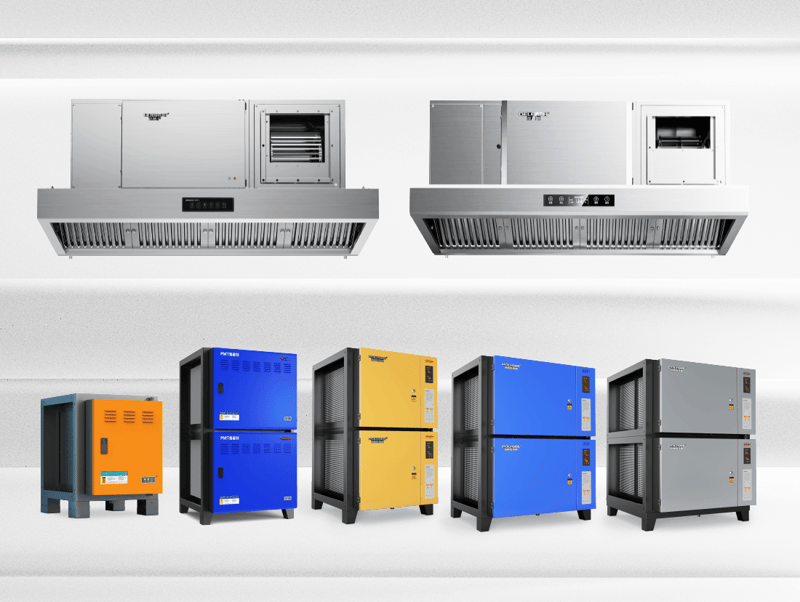
A list price exists where the product is the same for every buyer. An ecology unit is not one product. It is a train of stages assembled to a duty, and the stage list is decided by what is wrong at the discharge rather than by a catalog page.
That has a practical consequence for anyone collecting quotations. If you ask three suppliers for the price of an ecology unit without stating the stages and the airflow, you will receive three numbers that are not comparable, and the cheapest will usually be the one that assumed the fewest stages. This is not a trick on their part. It is what the question allows.
Decision rule. IF you want comparable prices, THEN state the stage list and the design airflow in the request itself, BECAUSE those two inputs account for most of the difference between offers, and leaving them to the supplier moves the decision out of your hands.
What actually moves the number
Six things, in roughly the order of how much they move it.
| Driver | Why it moves the price | What you supply to fix it | What it means for your quote |
|---|---|---|---|
| Stage count | Each stage is a separate module with its own cabinet, control gear and connections | The complaint you are solving: plume, smell, or both | The largest single lever; adding a stage is not a percentage change |
| Design airflow | Module size follows airflow, and so does cabinet, weight and shipping volume | The extract rate and who set it | Fixes the model within each stage |
| Efficiency grade of the electrostatic stage | Our engineering-grade platform is offered in three design grades | Your outlet requirement, if one has been set | Choose against the requirement, not against the previous unit |
| Arrangement and interfaces | Stacked layouts and transition pieces are fabrication, not catalog items | Straight run, access clearance and duct dimensions | Unstated interfaces become variations after the order |
| Documentation for the market | Submittal packages take engineering time, particularly on Gulf and export projects | The document list named in the specification | A cost in effort rather than in equipment; state it early |
| Commercial terms | Incoterms, payment structure and OEM requirements change the delivered figure | Destination, preferred Incoterm, whether you want re-badging | Affects the landed number more than most buyers expect |
This table answers what to state in a request. It does not tell you what any of it costs; prices are issued against a configuration, and this page deliberately contains none.
On our own commercial terms, so you have a fixed point to compare against: minimum order is one unit and standard lead time is 7 to 15 days. Payment is normally a deposit of 30 percent, or 50 percent, with the balance before shipment, and T/T or L/C are both acceptable. Incoterms are arranged to suit the buyer, whether that is EXW, FOB or CIF. Re-badging with your own logo and a change of cabinet color are available on OEM terms, with quantity and lead time agreed case by case. For a UAE project, the scope split and the submission documents are set out on our ecology unit supplier page for UAE projects.
The figure two quotations rarely state the same way
This section exists because it is the single most common way a comparison goes wrong, and because almost nobody publishes the numbers that would let you check.
Every supplier in this category describes their equipment as low resistance. Very few state a figure, and those that do rarely state what the figure covers. That matters commercially, because resistance is not an abstract specification: it is the pressure the fan has to overcome for the life of the installation, which is an energy cost, and it is also what decides whether your existing fan can take the equipment at all.
Two things make the numbers incomparable
The unit. One inch of water gauge is about 249 pascals. So a figure quoted as 0.5 in. w.g. is roughly 125 Pa, and 0.75 in. w.g. is roughly 187 Pa. A buyer reading one offer in pascals and another in inches without converting is not comparing anything.
The basis. This is the larger problem. A resistance figure can describe the collection cell on its own, the complete module including its airflow distribution plate, or an entire multi-stage unit including a pre-filter and a carbon bank. Those three are legitimately different numbers for the same equipment, and the smallest of them is the most flattering, so it is the one most likely to appear in marketing.
| Stage | What we publish, and on what basis | What it does not tell you | What to ask every supplier |
|---|---|---|---|
| Electrostatic precipitation | Complete module rated at no more than 150 Pa with its airflow distribution plate. The electrostatic cell itself contributes roughly 20 to 30 Pa. Brochure equipment resistance is 31 Pa on E0, 23 Pa on E1 and 34 Pa on E2 | The figure at a loaded condition rather than a clean one | Pressure drop at my design airflow, stated clean and loaded, and whether the figure is cell-only or complete module |
| UV-C photolysis | No published series figure. One measured value exists for a single model: 65 Pa on a UV80, from test report 2018I20-35-1594159016. Resistance is otherwise issued per model with the configuration proposal | Anything about the other models in the range | The figure for the model actually being offered, at my airflow |
| Activated carbon | Brochure equipment resistance of 150 Pa across CB30 to CB150; total system static pressure should be verified with your fan | How the figure moves as the media loads | The figure at my airflow, and how it is expected to change in service |
Field note on where this bites. The pressure allowance is normally set by whoever selected the fan, and it is rarely revisited when treatment stages are added later in a project. A comparison done on the wrong basis at tender stage turns into a fan change or a deleted stage at commissioning, and the stage that gets deleted is usually the carbon — the one that was there to answer the smell complaint in the first place.
What belongs inside the quoted scope, and what does not
Two offers can be identical on equipment and differ substantially on what surrounds it. Settle this line item by line item.
| Item | Normally in our scope | Normally yours | What goes wrong when it is left unstated |
|---|---|---|---|
| Treatment modules and control gear | Yes | — | — |
| Extract fan | Not as standard, but available on request, matched to the total static pressure of the configuration | Usually specified by the mechanical engineer | Two offers, one with a fan, read as a price difference on treatment |
| Ductwork and transition pieces | No | Yes | Adapter fabrication appears as a variation after the order |
| Support, hangers and structural work | No | Yes | Module weights arrive after the hanger schedule is fixed |
| Installation labor and commissioning | No; chargeable site attendance is available | Yes, through your contractor | Assumed included, then invoiced |
| Submittal documents | Yes, against a stated list | The list itself, from the specification | Late document requests delay approval, not delivery |
| Spare parts and consumables | Quoted separately | Decide the holding you want | First consumable invoice is unbudgeted |
On warranty and parts, our position: twelve months on the whole unit, covering the electrostatic collection cells and the high-voltage power module; UV lamps and activated carbon media are consumables and are not covered; labor and site attendance are quoted separately. Common spare parts are held in stock and remain available for one year after a model is discontinued. The recurring side of this is worked through in ecology unit filters.
What can be cut, and what only looks cuttable
When a number comes back above budget, there are honest reductions and there are false ones. The difference is whether the saving removes cost or removes function.
Genuinely reducible. Stage count, if the complaint does not justify all three — this is the real lever and it should be decided on evidence rather than on budget. Efficiency grade, where the outlet requirement allows it. Spare parts holding. Incoterm, by taking more of the logistics yourself. Delivery schedule, where a longer lead time suits the programme.
Not reducible without consequence. Airflow, which is set by the kitchen rather than by the budget. Stage order, which is physical. Access clearance, which decides whether the unit can be serviced at all. Submittal documents, where the specification names them, because a rejected submittal costs more than the documents did. And interface work, which does not disappear when it is removed from the quotation; it simply moves to somebody else’s invoice.
Scope and limits
Three layers clear separately and passing one does not clear the next. Layer one, the quotation: a price describes a configuration and a scope. Layer two, the site: interfaces, support and access decide whether that configuration installs as quoted. Layer three, operation: delivered airflow, capture at the hood and service discipline decide the result. Passing one layer does not clear the next.
- No prices or price ranges appear on this page, for any model or configuration, and none should be inferred from it. Figures are issued against a configuration.
- The pressure figures quoted here are ours, on the stated basis. They are not benchmarks, and they must not be placed alongside another supplier’s figure without first establishing that both describe the same thing at the same airflow.
- No consumable interval and no lamp life figure is given, because we do not publish either; both are set in writing for your site with the configuration proposal.
- Certificates cover named models, not catalogs. Our UL listing to UL 867 is held under file E522667 and covers the LK and SE units at 6K, 12K and 18K in the 230 V, 50 Hz configuration, and the SPP high-voltage power supply holds its own file, E514664. Ask which model numbers any certificate lists, including ours, before treating it as coverage for what you are being offered.
- Nothing here is a compliance determination. What your authority requires at the discharge is a question for your engineer and that authority.
Quote scope worksheet
Send this with the request and the offers that come back will be comparable. It takes one conversation to fill in.
The duty: design airflow in m³/h and who set it; what is on the cookline; the daily operating hours.
The requirement: what the complaint is, where it is observed and when, or the outlet condition the authority or landlord has set. This is what decides the stage count, so it is the single most valuable line on the sheet.
The stages you are asking to be quoted: stated explicitly, so that every supplier prices the same train.
The site constraints: straight run available, clear access at the intended position, support allowance, and the static pressure the fan selection left for treatment. The arithmetic behind these is in ecology unit installation.
The commercial frame: destination and preferred Incoterm, whether OEM re-badging is wanted, the documents the specification names, and the spare parts holding you want quoted.
Ask every supplier, in writing: the stage list and order; pressure drop per stage at your airflow, with the basis stated; which model numbers their certificates cover; what is excluded from the scope; the warranty boundary and which items are consumable; how long parts stay available; and what they will not commit to without a site review.
Key takeaways
- Stage count is the price: most of the difference between two offers is how many stages each contains, so state the stage list yourself.
- No list price is not evasion: the equipment is assembled to a duty, and a number without a configuration is not an offer.
- Pressure drop is the trap: convert the units, then establish the basis — cell, complete module, or whole unit — before comparing anything.
- Scope beats price: transitions, support and commissioning do not vanish when they leave a quotation; they move to another invoice.
- Cut terms before configuration: Incoterm, spares and schedule reduce the number without changing what the equipment does.
Frequently Asked Questions
- How much does an ecology unit cost?
- There is no list price, because an ecology unit is a train of stages assembled to a duty rather than a single catalog product, and the stage count alone can change the figure substantially. The two inputs that decide most of it are how many stages the configuration contains and the design airflow they have to treat. After that come the efficiency grade of the electrostatic stage, the arrangement and any transition pieces, the submittal documents the specification names, and the commercial terms including Incoterm and payment structure. If you request a price without stating the stages and the airflow, the numbers you receive will not be comparable, and the lowest will usually be the one that assumed the fewest stages.
- Why do two ecology unit quotations differ so much?
- Usually because they are not offers for the same thing. Check three things before treating the difference as a discount. First, count the stages in each: a two-stage offer and a three-stage offer are different equipment, not competing prices. Second, compare the scope around the equipment, because the fan, the transition pieces, the support arrangement, installation labor and commissioning attendance may sit inside one offer and outside the other. Third, check the airflow each was priced against, since module size follows airflow. Only once those three match does the remaining difference say anything about price.
- How much pressure drop does an ecology unit add, and how do I compare suppliers?
- Convert the units first, then establish the basis, because those two steps account for most bad comparisons in this category. One inch of water gauge is about 249 pascals, so a figure given as 0.5 in. w.g. is roughly 125 Pa and 0.75 in. w.g. is roughly 187 Pa. More importantly, a resistance figure may describe a collection cell alone, a complete module with its airflow distribution plate, or an entire multi-stage unit including stages ahead of and behind the cell, and those are legitimately different numbers for the same equipment. Our own figures, on their stated basis: the electrostatic stage is rated at no more than 150 Pa as a complete module, with the cell itself contributing roughly 20 to 30 Pa; for the UV-C stage we publish no series figure and one measured value exists, 65 Pa on a UV80 from test report 2018I20-35-1594159016; for activated carbon the brochure equipment resistance is 150 Pa across CB30 to CB150. Ask every supplier for the same basis at your design airflow, and compare those.
- What is not included in an ecology unit price?
- On our offers the treatment modules and their control gear are in scope. The extract fan is not part of the standard scope, although it can be supplied with the train and matched to the total static pressure of the configuration if you want it quoted that way. Ductwork, the transition pieces between the duct and the module flanges, support and structural work, installation labor and commissioning attendance are not included, and chargeable site attendance is available separately. Spare parts and consumables are quoted separately. On warranty, twelve months on the whole unit covers the collection cells and the high-voltage power module, while UV lamps and carbon media are consumables and are not covered. Settle each of these line by line before comparing two numbers.
- Can I reduce the price by removing a stage?
- Yes, and it is the largest single lever available, but the decision belongs to the evidence rather than to the budget. If the complaint at the discharge is a visible plume with no smell problem, the gas-phase stages may not be justified and removing them is an honest saving. If the driver is a smell complaint from a neighbor, removing the carbon stage removes the function you were buying, and the saving is temporary. Before cutting, record what the complaint actually is, where it is observed and when. Cheaper reductions that do not change what the equipment does are usually available first: the Incoterm, the spare parts holding, and the delivery schedule.
Want quotations you can actually line up side by side?
Send us five things: the design airflow, what is on the cookline, what the complaint at the discharge is, the static pressure allowance the fan selection left for treatment, and the documents your specification names. We will come back with a stated stage list and the reason for each stage, pressure drop per stage at your airflow with the basis written on it, a scope table showing what sits inside and outside the offer, and a plain statement of what we will not commit to without a site review. You get back something comparable, not a headline number. If the documents come from a landlord’s manual or a Gulf authority rather than a specification, our ecology unit requirements page sets out which text asks for which document, and at which approval gate.
Scarlett handles export inquiries, dealer relationships and commercial terms at Polygee, including multi-stage kitchen exhaust projects across the Gulf and South Asia. Polygee, founded in 2004, manufactures the electrostatic, UV-C and activated carbon stages described here. This article explains how offers are structured and states our own published terms; it contains no prices, is not a quotation, and is not a mechanical design.
References & sources
- Polygee — module specifications and published resistance figures by stage, commercial terms for warranty, parts and Incoterms; test report 2018I20-35-1594159016 for the measured UV80 resistance. polygeeesp.com
- UL Standards & Engagement — UL 867, Standard for Electrostatic Air Cleaners, the product safety standard behind the listing referenced here. shopulstandards.com
- Building Engineering Services Association — DW/172, Specification for Kitchen Ventilation Systems, the reference specification for kitchen extract systems in the United Kingdom. thebesa.com
Related reading
- Ecology unit filters — the recurring half of the cost: which stage is washed, which are consumed, and what to settle in the contract.
- What is an ecology unit — the three stages and what each one controls, which is where the stage-count decision comes from.
- Ecology unit installation — straight run, weight, pressure allowance and access, before a configuration is fixed.
- What sets an electrostatic precipitator price — the same exercise for a single in-duct precipitator rather than a three-stage train.