

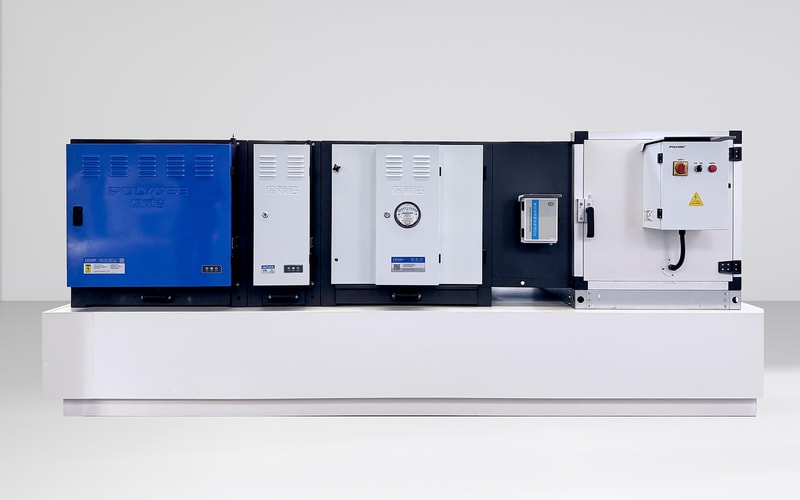
Quick answer: Polygee supplies the electrostatic precipitator Malaysia kitchen projects fit in the extract duct or inside the hood, shipping from its own factory in Zhangjiagang, China, and has seven Malaysian projects on record: Tun Razak Exchange in Kuala Lumpur, supplied in 2022 with 300 LK-E and UV series units, and six malls, chains and restaurants from Sri Petaling to Pavilion KL. The minimum order is one unit and the standard lead time is 7 to 15 days, on EXW, FOB or CIF Port Klang terms. Malaysia’s supply is 230/400 V at 50 Hz, the same frequency as the brochure input, so the order carries the voltage and phase count and no frequency change. Two product routes are available: an in-duct LK or LK-E unit downstream of the hood, or an HME hood with the electrostatic cells built in. This page sets out what the seven records do and do not tell you, which route fits which kitchen, what a factory-direct order covers, our terms in full, the documents we prepare, and the nine inputs that make a Malaysian quotation comparable with any other.
This page helps you decide whether a factory-direct electrostatic precipitator suits your Malaysian project, whether the in-duct unit or the ESP hood is the route to price, and what to put in the first enquiry. It does not size a unit, quote a price, or interpret any Malaysian code. For model tables, see the LK in-duct range and the HME ESP hood; for what sets the number, see what sets an electrostatic precipitator price.
| Question | Our answer |
|---|---|
| Supplied in Malaysia before? | Yes: seven projects on record, Tun Razak Exchange with 300 units among them |
| Minimum order | One unit |
| Lead time | 7–15 days as standard; freight to Port Klang quoted with the Incoterm |
| Two routes | In-duct LK or LK-E unit, from 2,000 m³/h to 60,000 m³/h in the standard table; or an HME ESP hood, twelve models from 3,000 to 4,800 m³/h |
| Resistance for the fan selection | In-duct unit rated at no more than 150 Pa complete, including the airflow distribution plate; the HME hood carries its own fan |
| Site supply | Malaysia is 230/400 V, 50 Hz, with 240/415 V still marked on many panels; the brochure input is 220 V, 50 Hz for in-duct units and 380 V, 50 Hz for HME hoods |
| Payment | 30% deposit, or 50% if your procurement rules ask for it; balance before shipment; T/T or L/C |
| Warranty | One year on the complete unit; UV lamps and carbon media, where fitted, are consumables |
| Support hours | Monday to Friday, 8:00–17:00 (GMT+8), the same clock as Malaysia |
- Seven Malaysian projects on record: from TRX to single restaurants
- Two product routes: in-duct unit or ESP hood
- What a factory-direct order covers in Malaysia, and what stays with your contractor
- Commercial terms, stated up front
- Site power: 230/400 V, 50 Hz, and the 240/415 V panels
- Import: the Certificate of Approval question
- Port Klang and the Incoterm
- Documents for the consultant or the authority
- What to send for a quotation
- Scope and limits
- Frequently asked questions
Seven Malaysian projects on record: from TRX to single restaurants
Malaysia has more Polygee projects on our published record than any country except Singapore, and the list runs across the range of kitchens a supplier is asked about: a financial district development, two malls, a restaurant chain and single outlets at three of Kuala Lumpur’s landmark retail addresses. Tun Razak Exchange was supplied in 2022 with 300 LK-E and UV series units. The other six are on record as sites supplied; the series and unit count for each is available when you enquire, and the table below says so rather than guessing.
| Project | Type | On record | What it does not prove |
|---|---|---|---|
| Tun Razak Exchange, Kuala Lumpur | Financial district development | 2022; LK-E and UV series; 300 units | The result at your discharge; acceptance by your consultant or authority |
| Pinnacle Sri Petaling Mall | Shopping mall | Site supplied | Series or count for your comparison; ask when you enquire |
| The Atera, Petaling Jaya | Development | Site supplied | The same |
| Oriental Kopi | Restaurant chain | Outlets supplied | Which outlets and how many units; ask when you enquire |
| Burger & Lobster, KLCC | Single restaurant | Site supplied | The same |
| Fusion Restaurant, Sunway Pyramid | Single restaurant | Site supplied | The same |
| Fashion Avenue, Pavilion KL | Retail dining | Site supplied | The same |
This table answers what the record is. It does not answer how your installation will perform; that depends on your cooking load, the delivered airflow, capture at the hood and how the cells are cleaned, none of which a past project can settle.
Two product routes: in-duct unit or ESP hood
Malaysian enquiries split between two builds, and the search term buyers use tells us which they have in mind: those looking for a kitchen exhaust hood in Malaysia usually mean a canopy with the cleaning built in, and those asking for an electrostatic precipitator mean a unit in the duct. We make both, and the choice follows the space and the cooking line rather than a preference of ours. The same two routes for an Australian project, with the 230/400 V supply, the RCM question and Port Botany, are on our electrostatic precipitator Australia page.
| Route | What it is | Better fit when | Main limitation | What it means for your quote |
|---|---|---|---|---|
| In-duct LK or LK-E unit | An electrostatic precipitator mounted in the extract duct downstream of any hood; standard table from 2,000 m³/h to 60,000 m³/h; LK-E in three grades at or above 90, 95 and 98 percent design efficiency, 3,000 to 40,000 m³/h | Several hoods share one extract; the duct run has room; an odor stage may be added later in the same run | Needs straight duct length and access on one side for washing the cells | Price the unit and, separately, the duct adapters your contractor supplies |
| HME ESP hood | A canopy with the electrostatic cells and fan built in; twelve models from 3,000 to 4,800 m³/h; brochure input 380 V, 50 Hz | A single cooking line; a fit-out where the ceiling void has no room for an in-duct unit | One hood, one line; larger extract rates mean more hoods rather than a bigger unit | Price by hood length and cooking line; the fan is inside the hood, so no separate fan line |
This table answers which route to price. It does not answer the model within the route; that follows the extract rate and the cooking load, and the offer names it.
What a factory-direct order covers in Malaysia, and what stays with your contractor
A factory-direct order covers the equipment, the paperwork and remote support. Everything that happens on site in Malaysia stays with your local contractor, and import clearance stays with the importer of record. Settle who owns each line below before comparing offers, because a line left out of one quotation does not disappear; it moves to another invoice.
| Item | Factory-direct from Polygee | Your Malaysian contractor or importer | What it means for your quote |
|---|---|---|---|
| In-duct unit or ESP hood, with the high-voltage power supply and control gear | Supplied, configured for the stated site supply | — | The part every offer should price the same way, so state the route, the airflow and the supply |
| UV-C or activated carbon stage, where an odor requirement calls for it; the full three-stage run is what drawings call an ecology unit | Available as modules in the same run | — | Say whether an odor stage is in scope; two offers with different stage lists are not comparable |
| Extract fan | Inside an HME hood; available with an in-duct unit, selected on the total static pressure of the run | Usually in the ventilation package for in-duct installations | Say which you want, or the offer that includes a fan will read as the dearer one |
| Ductwork, transition pieces, attenuators and any fire protection on the duct | Not supplied | Yes | Adapter work left unstated turns into a variation after the order |
| Supports, hangers and structural work | Not supplied | Yes | Module and hood weights come with the general arrangement drawings |
| Installation labor and commissioning attendance | Not included; paid on-site service is available | Yes | Price installation locally against our drawings |
| Import clearance and any Energy Commission classification | Technical file supplied | The importer of record | Agree who the importer is before the proforma invoice is issued |
| Submissions to the local authority and the fire authority | Documents prepared against the reviewer’s list | The submission itself | A late request delays approval, not delivery |
| Spare parts and consumables | Common spares held in stock; parts supplied for one year after a model is discontinued | Decide the holding you want | Quote them with the unit, so the first order is budgeted |
This table answers who supplies what. It does not answer what any of it costs; that follows the route, the airflow and the configuration.
Commercial terms, stated up front
These are the terms that apply to a Malaysian order. They are written out here so you can hold any offer against them, ours included.
| Term | What applies | What it means for your project |
|---|---|---|
| Minimum order | One unit | A single trial unit is a normal first order |
| Lead time | 7–15 days as standard | Freight time is added according to the route and the Incoterm |
| Payment | A 30% deposit releases production, with the balance settled before shipment; a 50% deposit is also available; T/T and L/C are both accepted | Schedule the balance ahead of the shipment date |
| Incoterms | EXW, FOB or CIF, arranged to suit the buyer | Tell us the delivery point and we quote on that basis |
| Warranty | One year on the complete unit, covering the collection cells and the SPP high-voltage power supply; UV lamps and activated carbon media, where fitted, are consumables and are not covered | Budget consumables separately when an odor stage is in scope |
| Labor and site attendance | Not included; paid on-site service is available | Price installation and commissioning locally |
| Spare parts | Common spares held in stock; parts supplied for one year after a model is discontinued | Agree the spares holding with the order |
| Remote support | Video calls backed by illustrated manuals, Monday to Friday, 8:00–17:00 (GMT+8), which is Malaysian time | No time-zone offset to plan around |
| Your brand | Your logo on the unit and a different enclosure color; quantity and lead time for OEM builds agreed case by case | State it in the first enquiry, not after the order |
| Confidential drawings | An NDA can be signed by the company | Send it with the drawings |
| Factory inspection | Each unit is inspected before shipment | Ask what the inspection covers before you place the order |
This table answers what the terms are. It does not answer the price, which is set by the route, the airflow and the configuration as explained in what sets an electrostatic precipitator price.
Site power: 230/400 V, 50 Hz, and the 240/415 V panels
Malaysia’s nominal low-voltage supply is 230 V single-phase and 400 V three-phase at 50 Hz, with a tolerance of plus 10 and minus 6 percent, in line with MS IEC 60038; the Energy Commission’s guideline on national differences records the change from the earlier 240/415 V nominal on 1 January 2008 and allows the frequency to vary by 1 percent either side of 50 Hz. Panels marked 240/415 V are still common, and the same guideline accepts equipment rated at either 230 or 240 V single-phase and either 400 or 415 V three-phase. The frequency matches our brochure input of 220 V, 50 Hz for in-duct units and 380 V, 50 Hz for HME hoods, so a Malaysian order carries no frequency change. What it carries is the voltage and the phase count as measured at the panel that will feed the unit.
| Site fact | Where to read it | What to state in the enquiry |
|---|---|---|
| Frequency | The TNB or SESB connection; 50 Hz across Malaysia | Nothing beyond confirming 50 Hz; no configuration change follows |
| Voltage and phase | The panel schedule and a measurement at the panel feeding the unit | 230 or 240 V single-phase, 400 or 415 V three-phase, as measured; the build is configured to the stated supply |
| Isolator position and feeder route | The electrical contractor’s drawings | Nothing on the unit; it decides whether the access side of the run, or the hood’s service side, stays clear |
This table answers what to state about the supply. It does not answer whether the feeder is adequate; that check belongs to your electrical contractor, against the electrical data on the specification sheet.
Import: the Certificate of Approval question
Importers of electrical goods into Malaysia know the Energy Commission’s Certificate of Approval. The Commission describes its online system as being for the import and manufacture of household electrical equipment, applied for by the importer or its local agent after registering with Dagang Net, with the certificate issued when the test report and documents are in order. A commercial in-duct electrostatic precipitator is not household equipment, so as we read it the scheme is not written for it. That reading is ours, not a ruling. Whether a given unit is treated as regulated electrical equipment is the importer’s to confirm with the Energy Commission against the declared classification, and if a confirmation calls for a technical file, we supply it: specification sheets, general arrangement drawings, the electrical data, and the CE and RoHS certificates for the models they name.
Port Klang and the Incoterm
Most sea freight for the Klang Valley lands at Port Klang, which the government designated Malaysia’s National Load Centre in 1993 and which the Port Klang Authority administers through two container operators, Northport and Westports. Penang serves the north and the Port of Tanjung Pelepas serves Johor, so a project outside the Klang Valley may name a different port. A CIF quotation names the port as the delivery point; a FOB or EXW quotation hands the sea leg to your forwarder and the port question moves to them. Transit time is the one figure this page cannot give you. Ask for it with the proforma invoice, add it to the 7–15 day lead time, and check the total against your on-site date.
Documents for the consultant or the authority
We prepare the submission pack against the list your reviewer issues: certificates, third-party test reports, general arrangement drawings and specification sheets, put together for the market you are submitting in. The approvals themselves stay with your contractor: the local authority and the fire authority review the installation through the project’s own submission, and nothing in the pack is an approval.
| Document | What it supports | What it does not prove on its own | What to check |
|---|---|---|---|
| CE certificate FQC2602501 (Machinery, EMC and Low Voltage directives, valid to 9 January 2031) | Conformity of the models it names: LK30–LK480, LK30E1–LK150E1 and the UV series | Coverage of any model not named on it, the HME hoods included | Match the model numbers in the offer against the certificate |
| RoHS 2.0 certificate BKC25114877LC | Restricted-substance compliance for the lines it names, the LK and LK-E series included | Coverage beyond the lines it names | The same model-number check |
| ISO 9001, ISO 14001 and ISO 45001 certificates (ABZB25Q30072R3M, ABZB25E30043R3M, ABZB25S30027R2M) | The management systems the factory works under | The performance of any particular unit | Ask for copies with the pack |
| Third-party test report ZY05W230298 (CMA-accredited) | Grease removal of up to 97.6% on LK units at rated, evenly distributed airflow, under that test | An odor result, a result at another velocity, or the result on a different model | Request the report itself and check the serial-number link and test conditions before treating the figure as a performance basis |
| General arrangement drawings and specification sheets | Dimensions, flange sizes, weights and electrical supply of the offered configuration, hood or in-duct | That the unit fits your duct route or the hood fits your cooking line; that check belongs to your contractor | Send them to whoever coordinates the ceiling void or the kitchen fit-out |
This table answers what each document can carry in a submission. It does not answer what your reviewer will accept; only their list does that. Send it to us early in the enquiry and we will work out with you how to cover each item.
The certificates behind these numbers are listed by product line on our ESP certifications page. The company facts a vendor registration usually asks for are on our electrostatic precipitator supplier profile. Our units are exported to 50 countries, Malaysia among them.
What to send for a quotation
An enquiry that says “ESP, send price” gets back a number that cannot be compared with anything. The sheet below is what turns it into a quotation you can line up against other offers, including a local supplier’s. The market-neutral version of that sheet, with where each input is found and what you receive against it, is our 10-input ESP enquiry sheet.
Malaysia electrostatic precipitator enquiry sheet
| # | Send us | Why it matters |
|---|---|---|
| 1 | Extract rate in m³/h or CFM, and who set it | Fixes the model size, or the number of hoods |
| 2 | Cooking style and load | Sets the electrostatic tier, and whether an odor stage is worth discussing |
| 3 | The space available for an in-duct unit with its access side marked, or the cooking line length for a hood | Decides the route, and within it the arrangement |
| 4 | Site power supply: voltage and phase, as measured at the panel | Malaysia is 50 Hz, as the brochure input is; 230/240 or 400/415 V as measured sets the build |
| 5 | Whether the extract fan is in our scope, for an in-duct installation | Keeps offers comparable; an HME hood carries its own fan |
| 6 | Delivery point and preferred Incoterm, and the importer of record | Fixes the freight basis of the proforma invoice and who the documents are issued to |
| 7 | Who reviews the submission, and the document list they issue | Lets us assemble the pack to that list |
| 8 | Required on-site date | Shows whether the lead time plus freight fits your programme |
| 9 | Whether you want the Malaysian project record set out in the offer | Puts the record in writing next to the configuration it is being compared with |
What you get back:
- The route the offer is based on, in-duct or hood, and the model selection at your airflow
- The pressure drop of an in-duct unit stated as complete unit, or the hood’s own fan data
- A proforma invoice on your Incoterm, issued to the importer of record
- The submission pack list, matched to your reviewer
- The warranty and consumable boundary, in writing
There is no list price, because the number follows the route, the airflow and the configuration. What sets an electrostatic precipitator price explains what moves it.
Scope and limits
Three layers clear separately. Layer one, the offer: the route, the configuration, the terms, the documents and the project record. Layer two, the site: installation, ductwork, supports, access and the import classification decide whether that configuration goes in as quoted. Layer three, operation: delivered airflow, capture at the hood, cleaning and consumables decide the result at the discharge. Passing one layer does not clear the next, and a past project belongs to layer one only.
- No prices appear on this page. Send the enquiry sheet and the price comes back against a stated configuration.
- No transit time is stated. Ask for it with the proforma invoice and add it to the 7–15 day lead time.
- The project list is a supply record. Six of the seven entries carry no series or count on this page; ask for them, and none carries a performance figure.
- The Certificate of Approval reading is ours. The classification of an import is confirmed by the importer with the Energy Commission, not by this page.
- Certificates cover the models they name. The CE certificate does not name the HME hoods; check the model numbers on each certificate against the offer, ours included.
- Nothing here is an approval. The local authority and the fire authority decide on the documents your contractor submits, so send us their list before the pack is assembled.
- No cleaning interval is given. The washing interval is set in writing for your site with the configuration proposal.
Key takeaways
- Record: seven Malaysian projects prove that supply has run before at every scale; the test report, not the project list, speaks to performance.
- Route: several hoods on one extract point to an in-duct unit; a single line with no duct space points to an ESP hood.
- Supply: Malaysia is 50 Hz like the brochure input, so state the voltage and phase as measured, 230/240 or 400/415 V.
- Import: the Certificate of Approval system is written for household equipment; the importer confirms the classification, and we supply the file.
- Enquiry: nine inputs make quotations comparable; “send price” does not.
Frequently Asked Questions
- Have you supplied electrostatic precipitators in Malaysia?
- Yes. Seven Malaysian projects are on record. Tun Razak Exchange in Kuala Lumpur was supplied in 2022 with 300 LK-E and UV series units. Pinnacle Sri Petaling Mall, The Atera at Petaling Jaya, Oriental Kopi restaurants, Burger & Lobster at KLCC, Fusion Restaurant at Sunway Pyramid and Fashion Avenue at Pavilion KL are on the list as sites supplied; ask about the series and count of any of them when you enquire. The records show that supply into Malaysian malls, chains and single restaurants has run before. They do not show the result at your discharge.
- Does the unit need reconfiguring for Malaysia’s 230/400 V, 50 Hz supply?
- Not for the frequency. Malaysia’s nominal low-voltage supply is 230/400 V at 50 Hz, with the older 240/415 V marking still in use on many panels, and the brochure input is 220 V, 50 Hz, with 380 V three-phase configured to order. Write down the voltage and phase count the electrical contractor measures at the panel that will feed the unit and we configure the order to that.
- Does a commercial in-duct ESP need a Certificate of Approval from the Energy Commission?
- The Energy Commission’s Certificate of Approval system covers the import and manufacture of household electrical equipment, applied for by the importer or its local agent. Whether a commercial in-duct electrostatic precipitator is treated as regulated electrical equipment is the importer’s to confirm with the Energy Commission against the declared classification. Our part is the technical file: specification sheets, general arrangement drawings, electrical data, and the CE and RoHS certificates for the models they name. Name the importer in the enquiry so the proforma invoice is issued to the right company.
- Should a Malaysian kitchen take an in-duct unit or an ESP hood?
- It follows the space and the cooking line. An HME hood carries its electrostatic cells inside the canopy, in twelve models from 3,000 to 4,800 m³/h, and suits a single cooking line where there is no room in the duct run. An in-duct LK or LK-E unit sits downstream of any hood and covers extract rates from 2,000 m³/h to 60,000 m³/h in the standard table, so several hoods can share one unit. Send the extract rate, the cooking style and the space available and the offer names the route it is based on.
- How do I get a price for an electrostatic precipitator in Malaysia?
- Send the extract rate, the cooking style, the space available for the unit or the hood dimensions, and the site supply. Add whether the fan is in scope, the delivery point and Incoterm, the reviewer’s document list and the required on-site date. There is no list price, because the airflow and the configuration decide most of the number. You get back a model selection with its pressure drop at your airflow, a proforma invoice on EXW, FOB or CIF Port Klang terms, and the document list for your reviewer.
Specifying an electrostatic precipitator for a Malaysian kitchen?
Send us the extract rate, the cooking style, the space you have and the site supply. We will come back with the route the offer is based on, a model selection and its pressure drop at your airflow, a proforma invoice on EXW, FOB or CIF Port Klang terms issued to your importer of record, and the list of documents we will prepare for your reviewer. Ask for the Malaysian project record and it goes in the same offer.
Scarlett handles export inquiries, dealer relationships and commercial terms at Polygee, including multi-outlet restaurant chains and mall projects across Southeast Asia and the Gulf. Polygee, founded in 2004, manufactures the in-duct electrostatic precipitators and ESP hoods described here and has exported to 50 countries. This page states our published terms and project record; it is not a quotation, a mechanical design or an approval.
References & sources
- Polygee — LK in-duct range: model tables, airflow, resistance and ordering terms. polygeeesp.com/products/kitchen-electrostatic-precipitator
- Polygee — HME ESP hood: models, airflow range and input supply. polygeeesp.com/products/kitchen-esp-hood
- Polygee — certificate numbers, directives, validity and scope by product line. polygeeesp.com/certificates
- Energy Commission of Malaysia (Suruhanjaya Tenaga), ECOS — Guidelines for Approval of Electrical Equipment, Regulatory Requirements related to National Differences, GP(E)/ECOS/008/2024: nominal 230/400 V (+10%, −6%) per MS IEC 60038, the 2008 change from 240/415 V, and 50 Hz ±1%. ecos.gov.my (PDF)
- Energy Commission of Malaysia — Certificate of Approval (CoA): the online system for the import and manufacture of household electrical equipment, registration with Dagang Net, and issue against the test report and documents. st.gov.my
- Port Klang Authority — Port Klang as Malaysia’s National Load Centre since 1993, administered through Northport and Westports (named, not linked).
Related reading
- Electrostatic precipitator Singapore — the same terms across the causeway, with four Singapore projects on record and PSA terminals on the CIF line.
- Electrostatic precipitator UK — the same factory-direct split for a market that specifies under DW/172.
- HME ESP hood — the hood route: twelve models with the electrostatic cells built into the canopy.
- Kitchen electrostatic precipitator range — the LK model tables behind the in-duct route.
- Electrostatic precipitator supplier profile — the factory, the listing and the certificates behind every Polygee unit.