

Updated September 2026
Activated carbon filter for commercial kitchen exhaust is a gas-phase adsorption stage that polishes cooking odor and vapor after particulate removal, not a grease filter and not a range-hood charcoal pad. The precipitator upstream collects grease aerosol and smoke; the carbon bed downstream holds the molecules that pass any precipitator: gases, not droplets. A generous bed still underperforms when the exhaust is hot, wet or grease-laden, and a spent bed looks like a fresh one. The worked figures below are illustrative, not Polygee test data or quotations.
This guide is for consultants, contractors and facilities engineers who specify a commercial kitchen exhaust treatment train for a United States or United Kingdom project. It covers what the bed removes, what passes through, the inputs that size it, how exhaustion shows itself and how to write a clause a supplier can test. It deliberately does not repeat the model range, MOQ, lead time or quotation content on the Polygee activated carbon filter product page. The first question is what the word on the module label promises.
Key points
- Carbon adsorbs vapor-phase molecules; grease aerosol that reaches the bed blinds its pores.
- Residence time and media depth, not the media brand name, set the odor result.
- A spent bed looks like a fresh one; only a discharge check shows breakthrough.
What a Carbon Filter Is, and What the Label Does Not Tell You
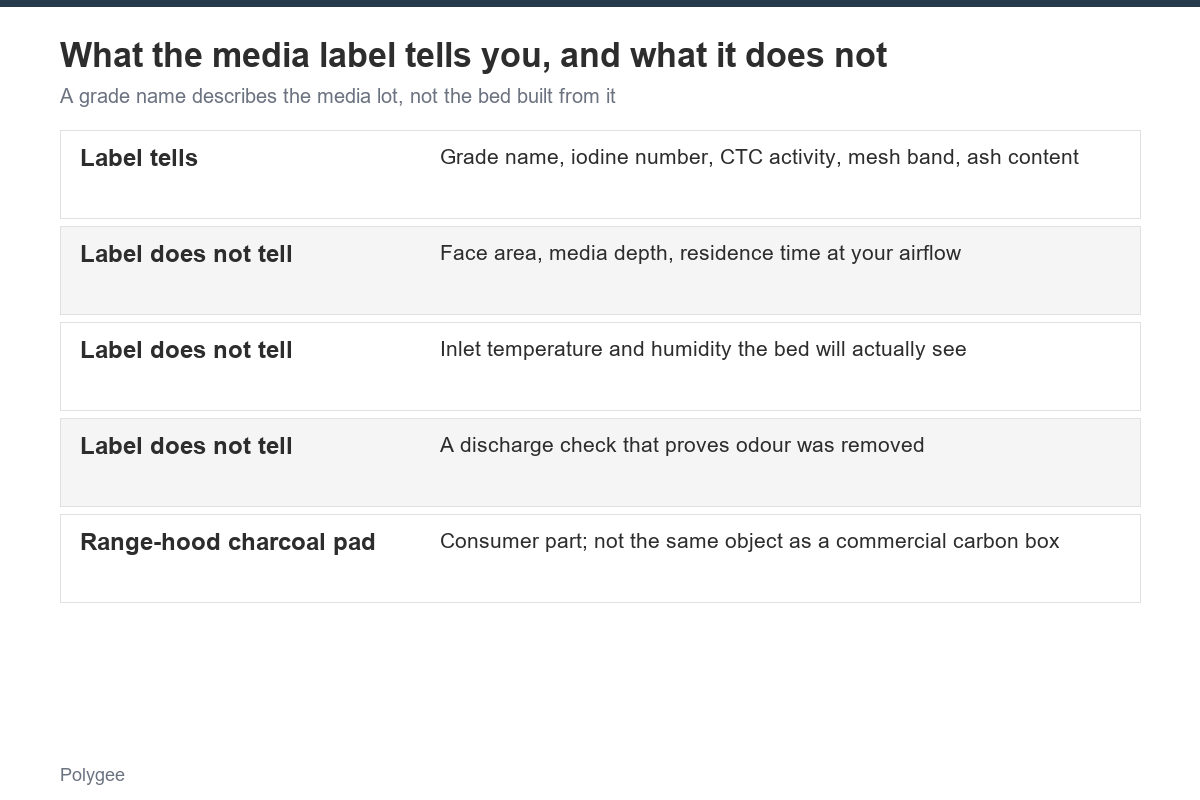
A carbon filter is a packed bed of adsorbent granules or carbon-filled panels placed in the exhaust after particulate removal, and the label on the module describes the media, not the odor outcome at the discharge.
Activated carbon is carbon processed to open an internal network of pores, so that a small mass carries a very large surface. Vapor-phase molecules that touch that surface are held by physical adsorption, not by a chemical reaction, which is why the hold is reversible: the bed can be exhausted, and what it holds can be displaced or driven off by heat. In a kitchen exhaust the bed is a consumable, not a permanent component.
The retail listings that fill the search results for this phrase sell recirculating range-hood charcoal pads: a thin mat of carbon-loaded fabric behind a domestic hood. A commercial carbon box is a duct-mounted cabinet of drawer-type carbon panels with a stated media depth, placed in a discharged exhaust behind a precipitator. The two share a media name, not a duty.
Datasheets carry four numbers a specifier will encounter. ASTM D4607-14(2021) covers the iodine number, a laboratory index of micropore volume measured in solution; its scope does not rate a bed against cooking vapor, and a high value does not prove that the bed will hold a fatty-acid fragment at kitchen temperature. ASTM D3467-04(2020) covers carbon tetrachloride activity, a capacity index taken with one test vapor; it does not translate into an odor-removal percentage for any menu. ASTM D2862-16(2022) covers particle size by sieve and ASTM D2866-11(2025) covers ash content; both describe the lot, not the bed built from it.
When a quotation says “high-grade carbon” without any of these numbers, the phrase is a label, not lot evidence. Ask for the grade sheet, the base material and the test method behind each figure; set a value against another supplier’s only once the method behind each is confirmed.
Decision rule: specify the carbon stage by residence time, media depth and a breakthrough check at the discharge, not by the adjectives on the media datasheet. The media numbers qualify the carbon; the geometry and the site check qualify the stage.
The label says what was poured into the module; only the geometry and the exhaust conditions say what the bed will do on that roof.
How Adsorption Turns Cooking Vapor Into a Loaded Bed
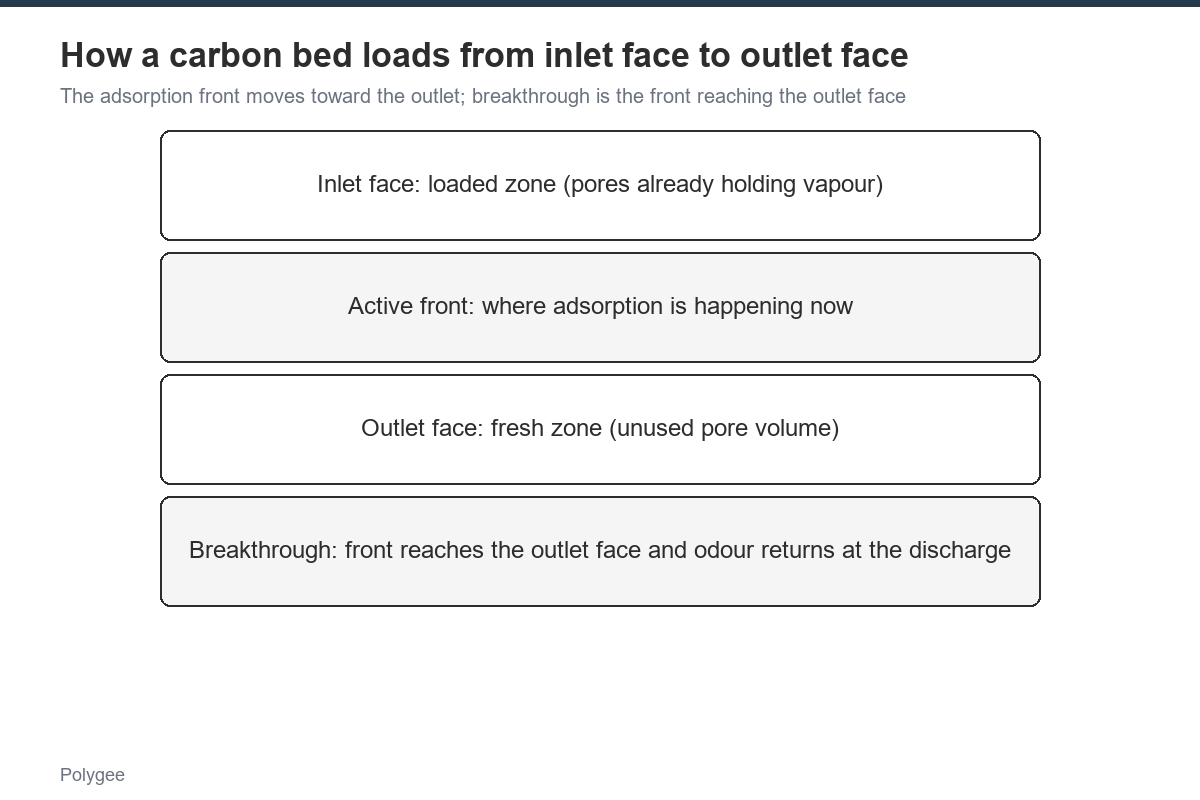
The bed works as a moving front, not as a fixed filter: the inlet layers load first, the front travels toward the outlet, and the day it arrives is the day the odor returns.
- Remove the droplets first — the precipitator upstream takes out grease aerosol and smoke particulate so that the carbon receives gas, not a coating of oil.
- Pass the gas through the bed — the airflow, the bed face area and the media depth together set how long each molecule is in contact with the carbon.
- Let the molecules diffuse into the pores — heavier, less volatile molecules are held more readily; small, very volatile ones are held weakly and can be displaced by heavier arrivals.
- Watch the front move — the zone of active adsorption travels from inlet to outlet as the upstream layers saturate; temperature and humidity change how fast it moves.
- Recognize breakthrough — when the front reaches the outlet face, the outlet concentration climbs toward the inlet concentration; nothing visible changes.
The US EPA describes volatile organic compounds as gases emitted from certain solids or liquids, the physical state the bed is built for; that page addresses indoor air and sets no discharge limit for a kitchen exhaust.
Two conditions push the front faster than any sizing sheet assumes. Warm exhaust lowers what the media can hold, because adsorption releases heat and reverses as temperature rises. Moist exhaust fills pore volume with water, so a bed downstream of a dishwash line loads with water before it loads with odor. Neither effect is a media defect.
For the precipitator side of the train, see our what is an electrostatic precipitator guide.
Which Inputs Decide Whether the Carbon Stage Earns Its Place?
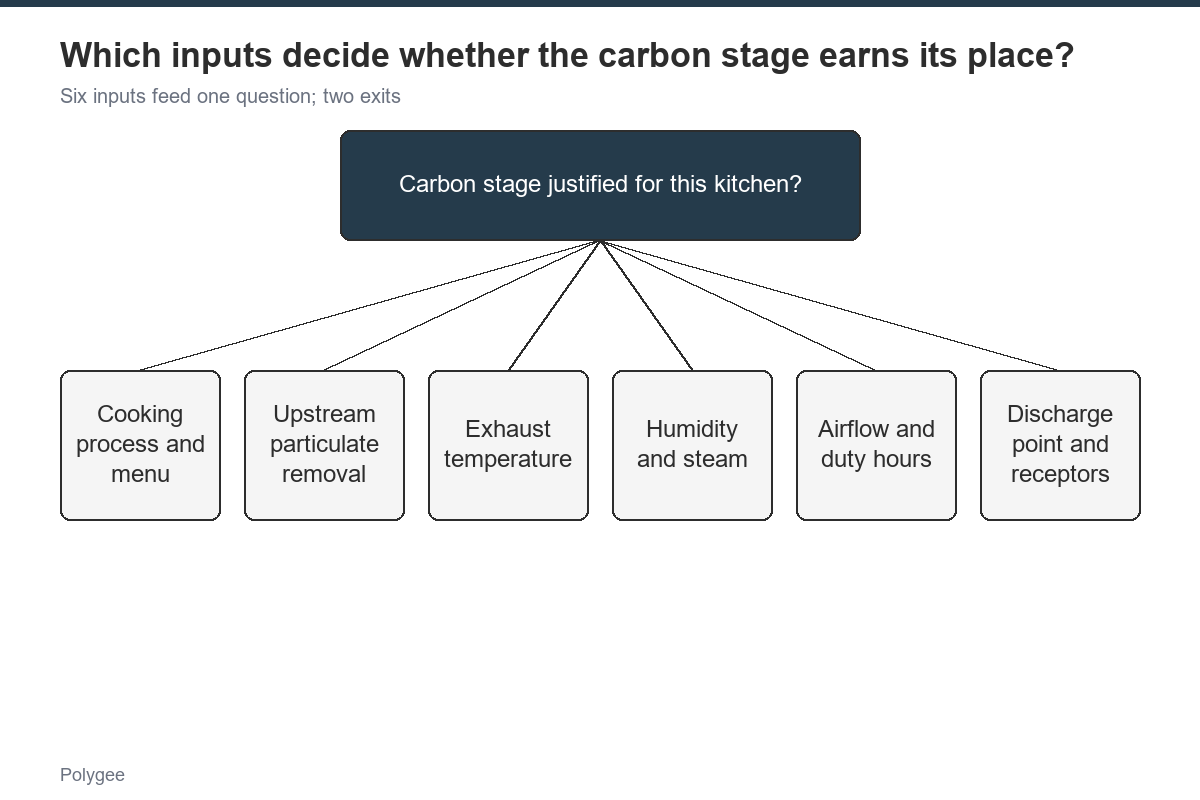
A carbon stage is justified by the discharge condition and the exhaust condition together, not by the fact that a kitchen produces odor.
Six inputs decide whether the bed is worth its pressure drop and media cost:
| Input | What it changes | Evidence to request | Limitation |
|---|---|---|---|
| Cooking process and menu | Compound classes and odor intensity; charbroil differs from bake | Equipment schedule with fuel type and duty per appliance | A menu describes likely compounds, not measured concentrations |
| Upstream particulate removal | Whether grease aerosol reaches the bed at all | Precipitator model, efficiency basis and the cleaning regime actually followed | A test-report efficiency was measured on a clean cell, not a cell in service |
| Exhaust temperature at the bed | Adsorption capacity, which falls as temperature rises | Expected temperature after the duct run and any dilution | A design figure is a calculation, not a logged value |
| Relative humidity and steam sources | Pore volume lost to water | Dishwash, boiling and combi-oven contribution | Humidity on the drawing is an assumption until measured |
| Design airflow, turndown and duty hours | Face velocity, residence time and how fast the front moves | Fan schedule with minimum and maximum flow; hours by daypart | A residence time at design flow says nothing about the peak |
| Discharge point and receptors | Whether a carbon stage is required and how strict the condition is | Planning condition or local ordinance text, distance to the nearest window | A condition sets an outcome, not a media specification |
In the United Kingdom the Defra guidance on the control of odour and noise from commercial kitchen exhaust was withdrawn on 15 September 2017; its four-part risk score survives in local authority guidance, but a withdrawn method is council practice, not current government policy, and citing it does not tell a supplier what the authority will accept. How the score is read is in our commercial kitchen odour control UK guide.
Where the discharge condition is loose and the exhaust is hot and wet, the honest answer may be that a carbon stage adds cost without a result; the consultant, not this article, owns that call.
The 6-Variable Carbon Filter Window
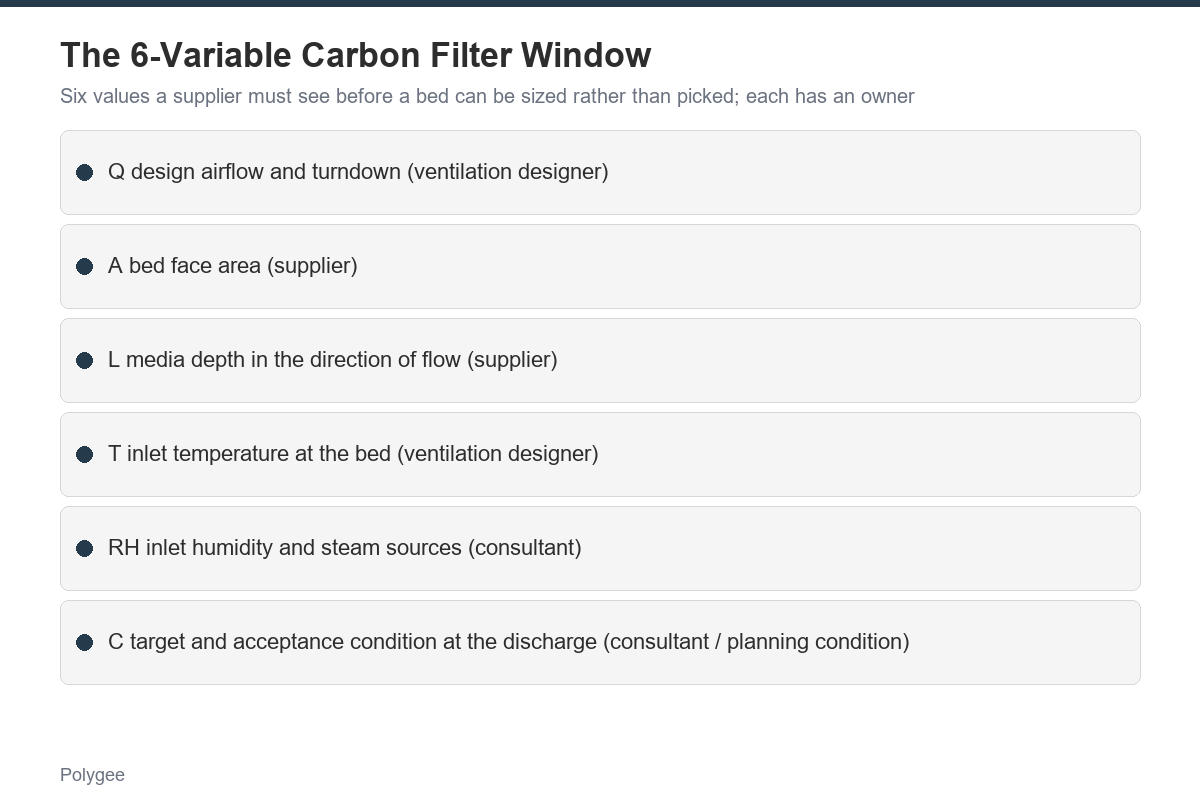
The 6-Variable Carbon Filter Window is the set of six values that must exist before any bed can be sized rather than picked.
| Variable | Symbol | Who supplies it | Stop condition if missing |
|---|---|---|---|
| Design airflow at the bed | Q | Ventilation designer | No Q, no face velocity; the bed cannot be sized |
| Bed face area | A | Supplier, from the module envelope | Without A the residence-time claim is unverifiable |
| Media depth in the flow direction | L | Supplier, from the module drawing | No L, no residence time; housing depth on the outline drawing is not a substitute |
| Inlet temperature at the bed | T | Consultant, from the duct heat balance | No T, no capacity figure; above the media supplier’s stated limit the figure is void |
| Inlet relative humidity | RH | Consultant, from the process schedule | No RH, no capacity figure; a wet exhaust needs a drier duct or a different train, not more carbon |
| Target compounds and discharge condition | C | Planning condition, odor assessor or consultant | Without a target the bed has no acceptance test |
The two ratios built from this table, Q/A and L/(Q/A), are defined in the sizing section below. Every other datasheet number sits behind these two, and both are checkable with a tape measure and the fan schedule.
A window with one value missing is a guess, not a specification; the supplier who quotes anyway is quoting a module, not a result.
What the Carbon Filter Removes, and What It Leaves Behind
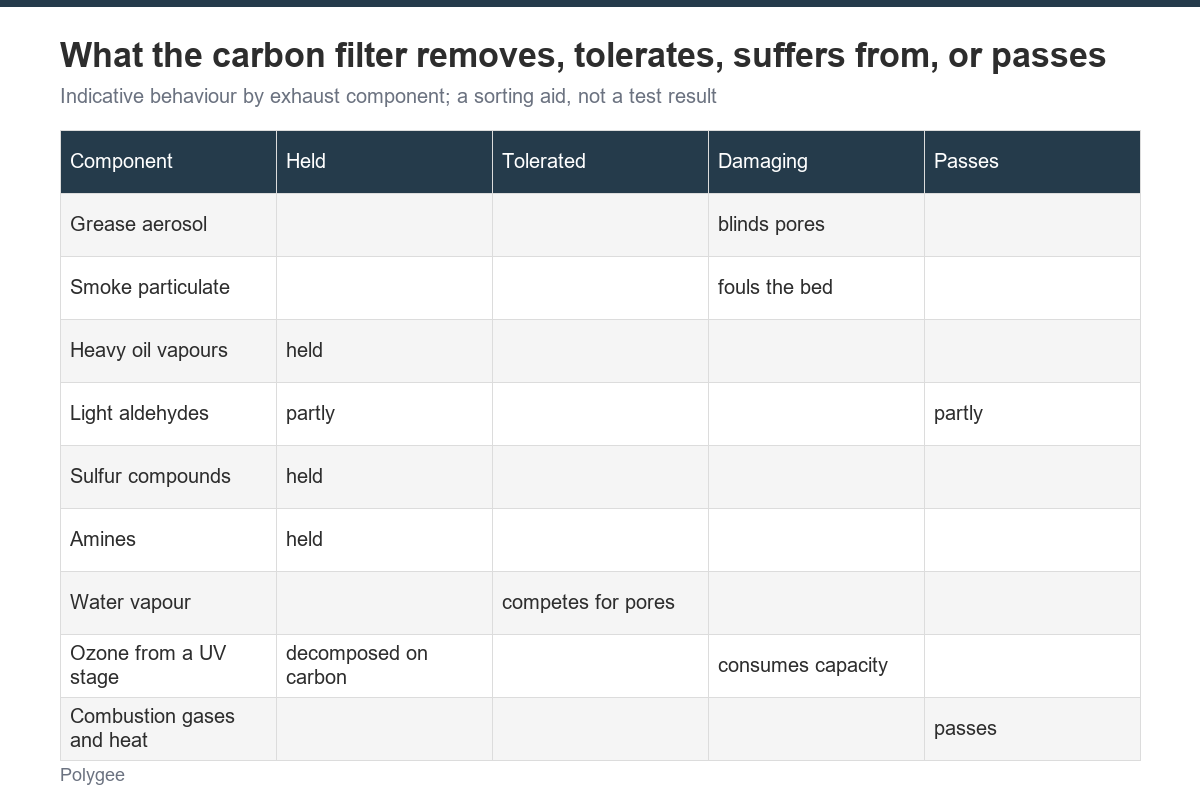
The bed sorts molecules by size, volatility and chemistry, and a kitchen exhaust contains every category at once.
The matrix below is a sorting aid, not a removal-efficiency table:
| Component | Typical source | Carbon filter response | What it cannot prove alone |
|---|---|---|---|
| Grease aerosol (droplets) | Frying, griddling, grilling | Should not reach the bed; droplets blind the pores | A grease-loaded bed proves an upstream lapse, not a media fault |
| Smoke particulate | Charbroiling, wok, solid fuel | Held as a crude dust filter, raising pressure drop | Inlet-face particulate says nothing about remaining vapor capacity |
| Heavier oil-breakdown vapors (long-chain aldehydes, fatty-acid fragments) | Hot oil, frying | Adsorbed readily; the main carriers of a fried-food odor | Good capacity for these does not extend to lighter molecules |
| Light aldehydes (formaldehyde, acetaldehyde) | Oil oxidation, gas combustion | Weakly held on plain carbon; can desorb when heavier molecules arrive | A fresh-bed reading on these is not a service-life reading |
| Sulfur compounds (garlic, onion, alliums) | Pan-frying, stir-fry | Adsorbed, but odor thresholds are so low that a small slip is smelled | A high percentage removal can still leave a detectable odor |
| Amines (fish, seafood) | Fish preparation, fermentation | Plain carbon holds them poorly; acid-impregnated carbon does better | Impregnation improves one family, not the rest |
| Water vapor and steam | Dishwash, boiling, combi ovens | Competes for pore volume; wet media loses odor capacity | Bed weight gain can be water, not odor loading |
| Ozone from an upstream UV or ESP stage | UV lamps, corona discharge | Residual ozone that survives the duct run after the lamps is decomposed on the carbon, which uses some capacity | Whether the ozone duty or the lighter gas-phase load after UV oxidation dominates depends on the train, so the bed is specified for the measured inlet |
| Combustion gases and sensible heat | Gas burners, cooking line | Not removed; heat lowers capacity for everything above | Temperature is a sizing input, not something the bed corrects |
The bed earns its place on rows three and five, holds row four only weakly, holds row six only when the media is impregnated for it, tolerates row seven, is damaged by rows one and two, carries row eight as a second duty, and does nothing useful on row nine. A specification that ignores the damaging rows buys a bed replaced early, not a bed that removes more.
Why the ESP Comes First: Grease Load and Bed Blinding
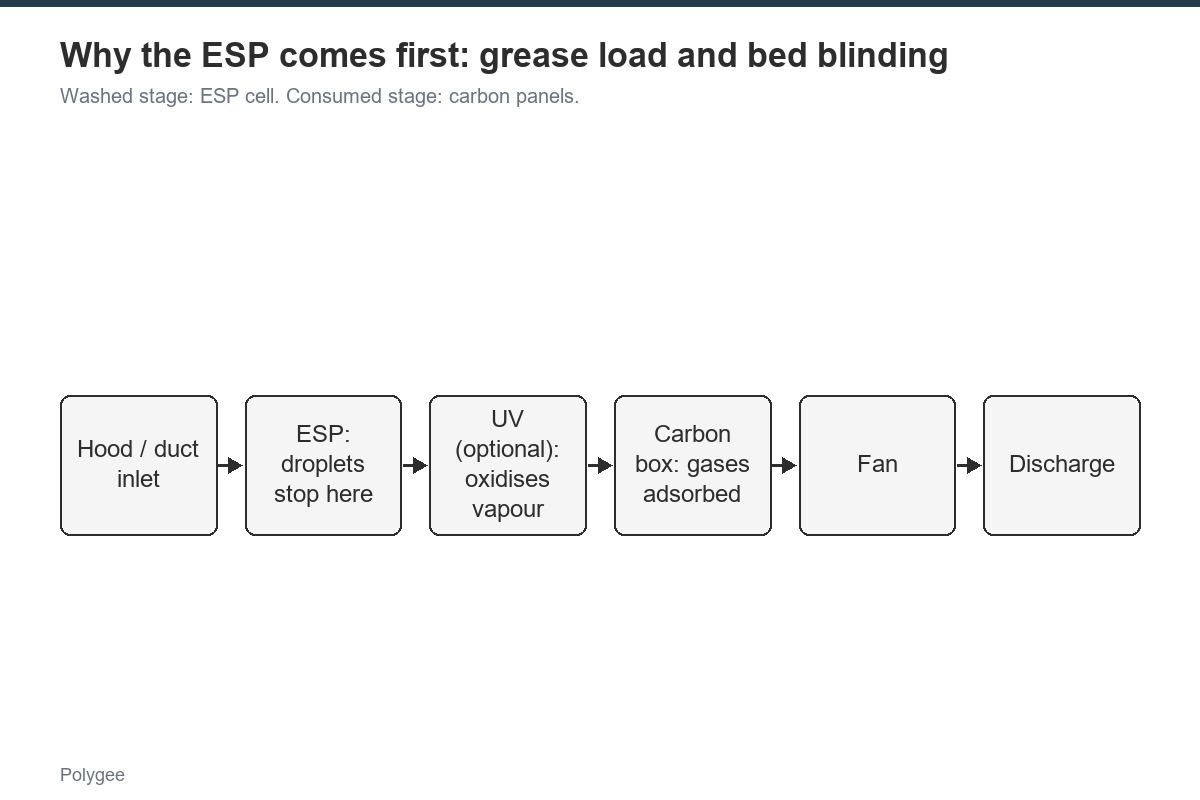
The order of the train is a protection decision, not a preference: particulate removal first, photolytic or oxidizing treatment second where used, adsorption last.
Grease leaves a cooking line as droplets small enough to pass a baffle filter. A precipitator charges them and collects them on plates; whatever passes the plates is what the carbon receives. When the precipitator is off, bypassed or running on fouled cells, the droplets coat the granules from the inlet face inward, and airflow does not reverse the coating. For a contractor, the failure risk is a bed grease-loaded early because a cell was left out after a wash, not a media defect.
Where a UV stage is fitted, it sits between the precipitator and the carbon, and the carbon bed must sit last. Its lamps and the precipitator’s corona produce ozone; residual ozone that survives the duct run after the lamps is decomposed on the carbon, which uses some capacity, while the UV stage’s oxidation of grease vapor reduces the gas-phase load reaching the bed. Which effect dominates depends on the train, so the carbon is specified for the measured inlet, not for odor alone. The three-stage layout is on the kitchen ecology unit page; the wider choice of stages is compared in the kitchen exhaust filtration guide.
The order also decides what the operator keeps buying. The precipitator cell is washed and refitted, so its cost repeats as labor; the carbon is used up and repeats as a purchase. On a drawer-type box the media is bought by the panel, so the carbon frame count on the model sheet is the reorder unit, not a performance figure; this guide gives no change interval for any model, because the load, not the airflow, decides it. Which stages are washed and which are consumed is in our ecology unit filters guide.
The standards that govern the train say little about how the bed is sized; the one that names carbon attaches a condition to it. NFPA 96 covers ventilation control and fire protection for commercial cooking operations, from hoods to the cleaning of the grease path; its scope does not set an odor limit or rate an adsorbent. In the United States, IMC 2021 Chapter 5 covers commercial kitchen hoods, grease ducts and exhaust equipment; the chapter does not certify a device. An authority having jurisdiction may also ask whether a pollution control unit carries a UL 8782 listing, which covers unit assemblies installed in line with commercial grease ducts; the listing addresses construction and fire behavior, not odor, and this page claims no such listing for any equipment. In the United Kingdom, BESA DW/172 Section 24 treats pollution control as project-specific: clause 24.6 names the precipitator as one way to reduce visible smoke, and clauses 24.7 and 24.8 name activated carbon as the adsorber for gas-phase odor and the recommended means of adsorbing surplus ozone where a UV stage is used, on condition of a high level of upstream protection, with the note that local authorities increasingly do not accept carbon as the primary means of odor control; under 24.11 the added resistance of whichever stages are chosen goes into the fan selection. It describes a system, not a tested performance of any module. How that clause is read is in our DW/172 kitchen ventilation specification guide.
Caution: a loaded carbon bed in a grease path is a fire-load question for the fire consultant and the adopted code. ASTM D3466-06(2023) covers the ignition temperature of granular activated carbon in flowing air; it tests fresh media, not a grease-laden spent bed. This page is not a compliance opinion, a hazard analysis or an approval.
The precipitator earns its place ahead of the carbon by keeping droplets off the media; the carbon earns its place behind the precipitator by taking what the plates cannot.
Sizing Language: Residence Time, Face Velocity and Bed Depth
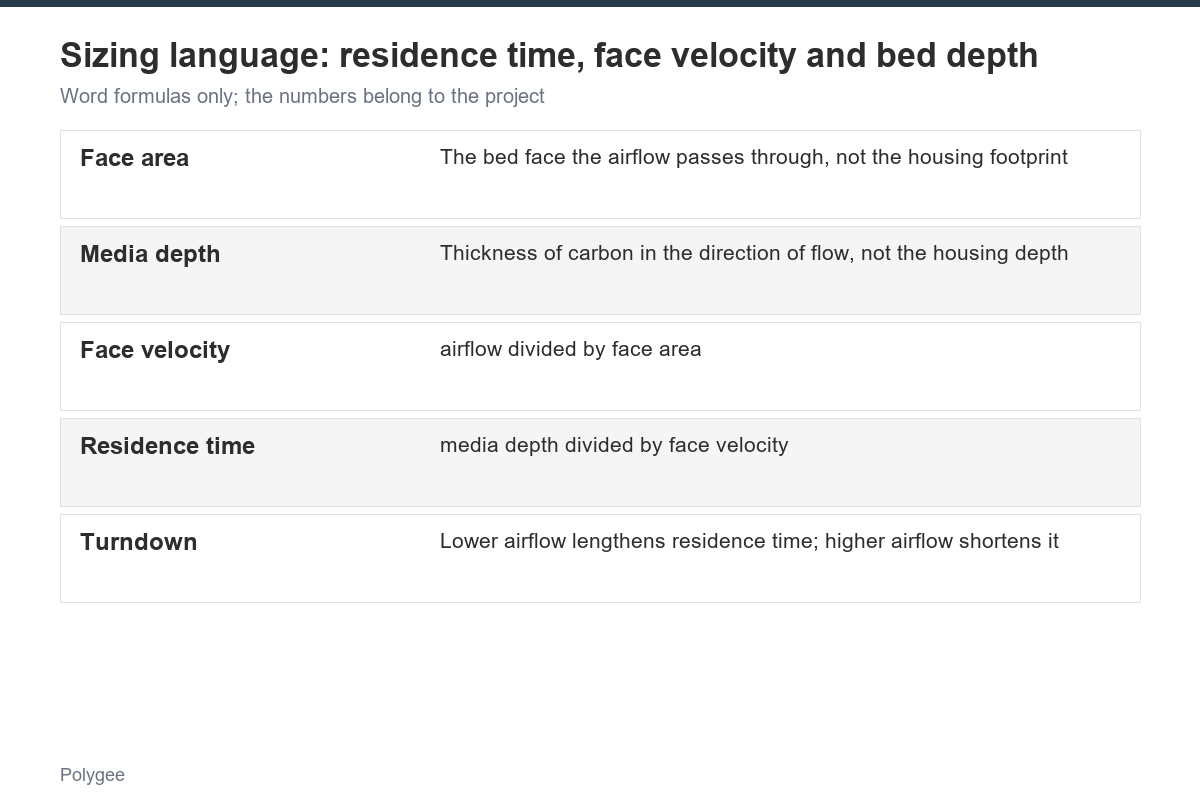
Three numbers turn a module into a specification, and all three can be checked on site.
Face velocity is the airflow divided by the bed face area. Residence time is the media depth divided by the face velocity. Bed depth is the media thickness in the direction of flow, not the housing depth on the outline drawing.
Suppose a design airflow of 10,000 m³/h, which is 2.78 m³/s, meets a bed face of 2.0 m² with a media depth of 0.30 m. Face velocity is 2.78 divided by 2.0, about 1.39 m/s; residence time is 0.30 divided by 1.39, about 0.22 s. If the fan turns down to 5,000 m³/h the residence time doubles to about 0.43 s; at 15,000 m³/h it falls to about 0.14 s. Teaching example only — not Polygee test data, not a product claim, not an acceptance threshold.
Device-level test methods also appear on quotations. ISO 10121-1 covers gas-phase air cleaning media and ISO 10121-2 covers full-size gas-phase air cleaning devices for general ventilation; ASHRAE Standard 145.2 covers a laboratory test method for gas-phase air-cleaning devices. Each uses named challenge gases at stated conditions; none reproduces a particular kitchen’s mixture, temperature or humidity, and a report to any of them does not imply that the quoted module was tested to it. A supplier figure such as “removal efficiency 95%” belongs to the challenge gas, concentration and airflow of that one test, not to this kitchen.
Pressure drop belongs in the same clause: the bed adds resistance to the fan static, and the value rises as the inlet face loads. The ventilation contractor, not this article, owns the fan static allowance.
Residence time is a specification number; a removal percentage is a marketing number until the challenge gas, concentration, temperature, humidity and airflow are written beside it.
How Do You Read Carbon Exhaustion Without Guessing?
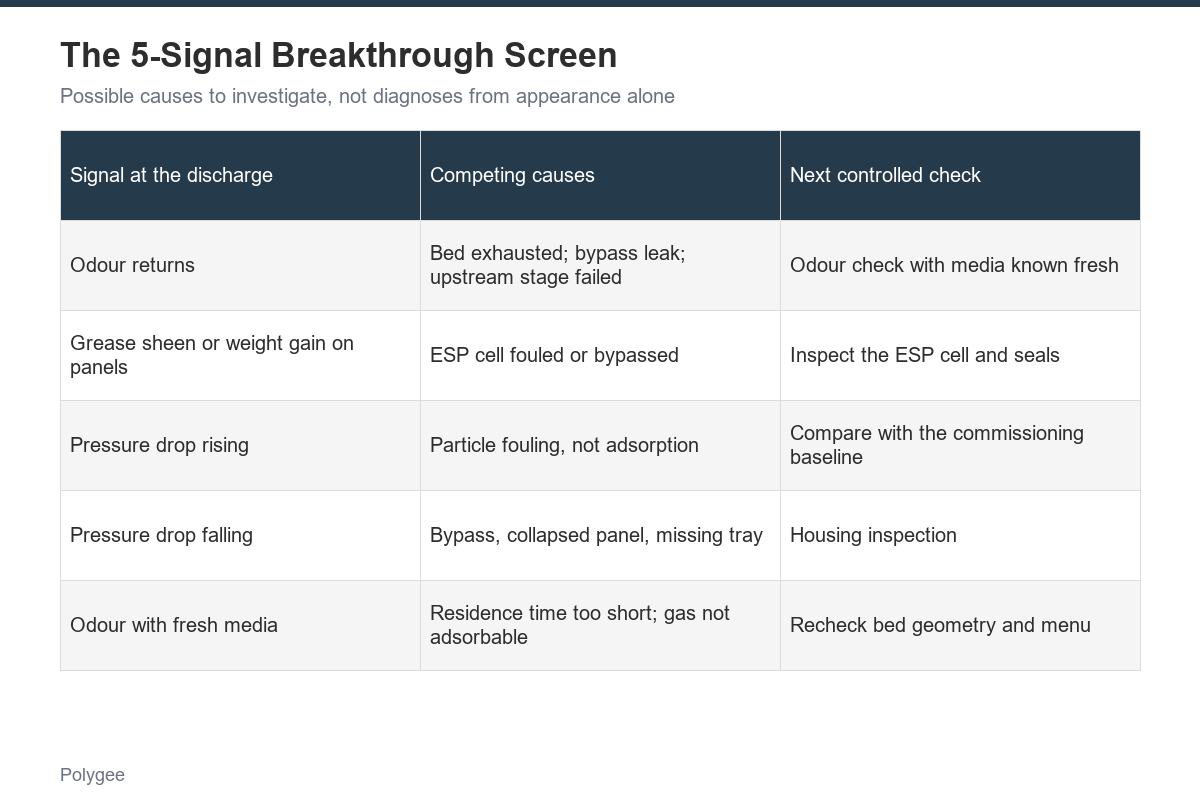
Only a paired sample, taken upstream and downstream of the bed on the same service, shows exhaustion; every other symptom has a competing cause, so rule those out one check at a time and act on the check that does not clear the bed.
Exhaustion has no visible signature, so the 5-Signal Breakthrough Screen pairs each symptom with its competing causes and the one check that separates them:
| Observed symptom | Competing explanations | Next controlled check | What it cannot prove alone |
|---|---|---|---|
| Odor returns at the discharge after a quiet period | Bed at breakthrough; fouled precipitator cell; bypass damper left open; a new menu item | Sample upstream and downstream of the bed on the same service; then inspect the cells | A complaint dates the symptom, not the cause |
| Grease sheen or weight gain on the inlet face | Precipitator off or bypassed; cells refitted wet; hood filters missing | Check the cell log and the fan interlock; weigh a removed panel against its delivered weight | Weight gain alone cannot separate water from grease from odor loading |
| Pressure drop across the module rising | Particulate loading; grease blinding; wet fines caking on the inlet face; fouled seals | Read the differential at a known airflow, then again after the precipitator is confirmed clean | A rising differential does not say whether vapor capacity remains |
| Pressure drop across the module falling | Channeling through settled media; media loss from a split panel; leakage around the frame | Smoke-pencil the frame seals; inspect the panel fill level | A falling differential proves bypass, not exhaustion |
| Odor at the outlet with freshly changed media | Compounds too light for plain carbon; inlet temperature above the media limit; high humidity; residence time short at peak flow | Log inlet temperature and humidity through the peak service, then recompute residence time at that airflow | A fresh-media failure is a sizing or train problem, not a media-life problem |
An optional differential-pressure gauge on a drawer-type carbon box feeds rows three and four of the 5-Signal Breakthrough Screen; it reads resistance across the whole module, which rises as the inlet face loads, not the vapor capacity behind it. Where the two samples in the first row differ only slightly, the bed is near its end; where they match, the bed is through. The change-out decision belongs to the operator’s record, not to the calendar or the module’s appearance.
Write a Carbon Filter Specification the Supplier Can Test
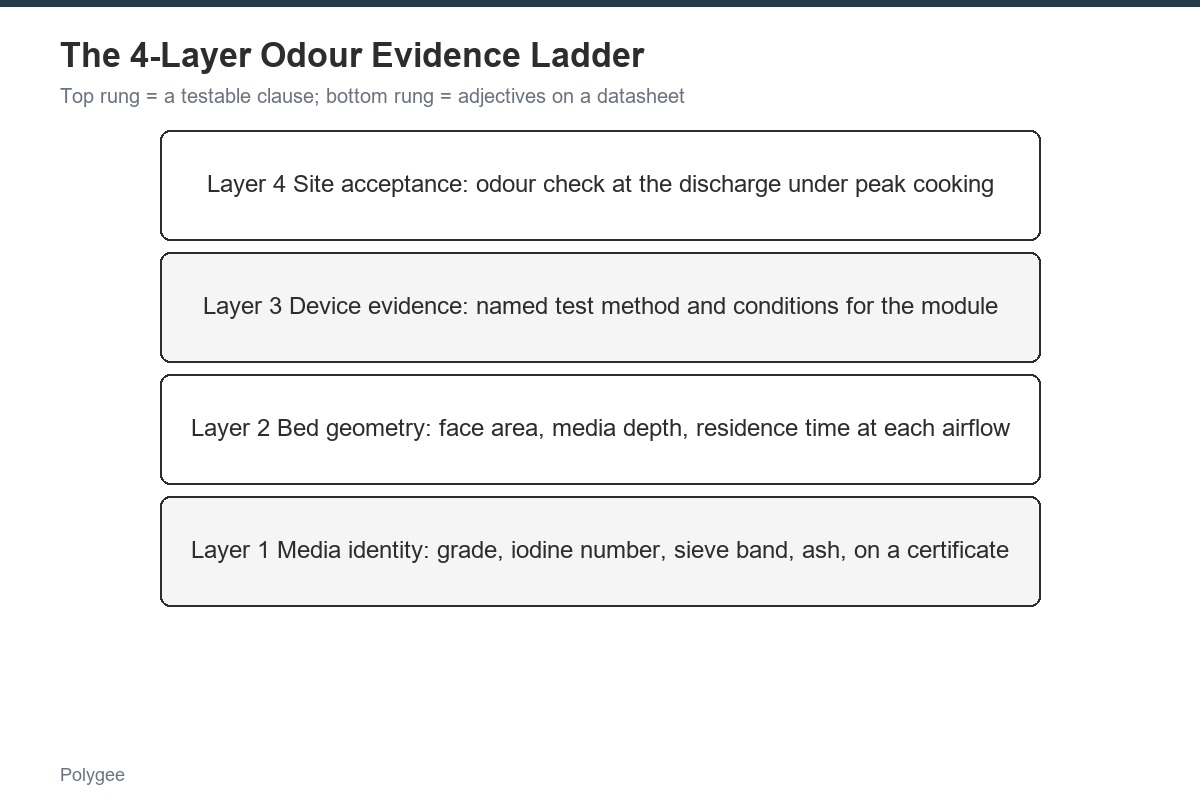
A testable clause names the media, the geometry, the evidence and the acceptance check in that order, and the 4-Layer Odor Evidence Ladder keeps the four apart.
- Media identity — grade name, base material, iodine number to ASTM D4607, carbon tetrachloride activity to ASTM D3467, mesh size to ASTM D2862, ash to ASTM D2866, and any impregnation named with its purpose. This layer proves what was supplied, not what it will do.
- Bed geometry — face area, media depth, media mass per module, face velocity, residence time and clean pressure drop at design airflow. This layer is what a contractor can measure on delivery.
- Device evidence — any test report offered, with the method, challenge gas, concentration, temperature, humidity and airflow stated. A report records that laboratory’s conditions, not a transferable result for this kitchen.
- Site acceptance — the sampling point downstream of the bed, the comparison point upstream, the method, who samples, who signs, and what reading triggers change-out. The consultant, not this article, owns the acceptance limit and the sampling method.
Supplier language is where clauses go soft. “Odor-free discharge” is a wish, not a test; “long-life carbon” is a claim until the duty hours, the inlet condition and the change-out trigger are written beside it. Do not borrow a removal figure from one kitchen for another; one site’s result says nothing about a different site’s bed.
The 4-Layer Odor Evidence Ladder is a coordination device, not a test method.
What Belongs in the Supplier RFQ
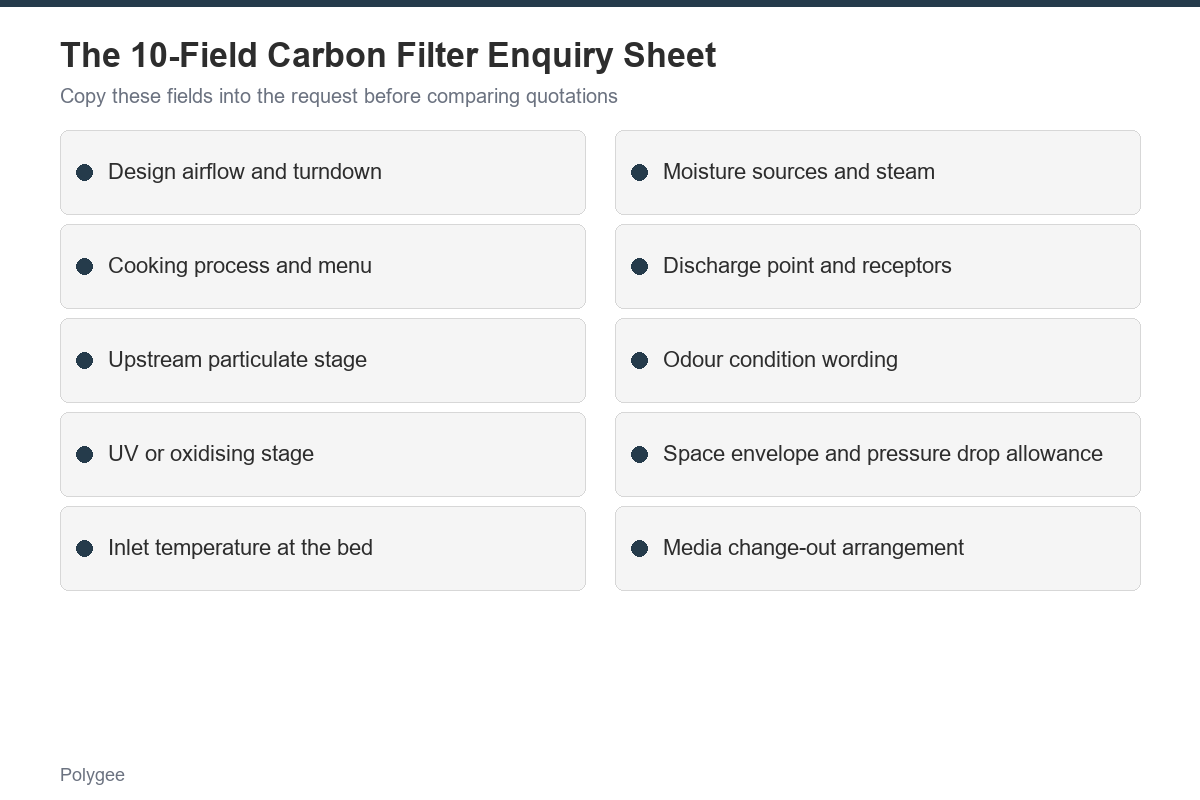
Copy these fields into the request before comparing quotations:
| Field | Minimum detail | Why it matters |
|---|---|---|
| Design airflow and turndown | Maximum, design and minimum m³/h at the bed, with the fan schedule | Sets face velocity and residence time at every operating point |
| Cooking process and menu | Appliance schedule, fuel, hours per daypart, notable items such as charbroil, wok or fish | Fixes the compound classes the bed must hold |
| Upstream particulate stage | Precipitator model, efficiency basis, cleaning responsibility, fan interlock | Decides whether grease aerosol will reach the media |
| UV or oxidizing stage | Present or not, lamp count, position in the train | Adds ozone decomposition to the carbon duty |
| Inlet temperature at the bed | Expected range after the duct run, with the calculation basis | Capacity falls as temperature rises |
| Moisture sources in the same exhaust | Dishwash, boiling and combi-oven contribution; expected humidity | Water competes for pore volume |
| Discharge point and receptors | Stack location and height, nearest window or receptor distance | Determines how strict the outcome must be |
| Odor condition wording | The planning condition or ordinance clause, verbatim | Converts an intention into an acceptance test |
| Space envelope and pressure drop allowance | Available length, cross-section, access side, fan static reserved for the bed | Bed depth and face area are bounded by both |
| Media change-out arrangement | Who changes the panels, access clearance, disposal route, exhaustion trigger | A bed nobody can reach is a bed nobody changes |
Polygee can help compare a proposed bed against the 6-Variable Carbon Filter Window and the 10-Field Carbon Filter Enquiry Sheet, but it should not overrule the consultant who owns the acceptance limit. The activated carbon filter product page carries the eight CB carbon box models, selected by airflow, flange size and carbon frame count, and the commercial terms; the one term worth repeating is that carbon media is excluded from the one-year unit warranty as a consumable. Please do not use this guide as a price or model list.
Bring the menu and the discharge point, not only the airflow
Send the appliance schedule, the fan airflow range, the position of the precipitator and any UV stage, the expected inlet temperature and humidity, and the wording of the odor condition. Polygee will reply with the CB models that match the airflow and flange size, the published media specification for the coal-based columnar carbon supplied, and the commercial terms; the bed geometry, residence time and acceptance check stay with your consultant.
Frequently Asked Questions
Does an activated carbon filter remove grease?
No. Grease leaves the cooking line as an aerosol of droplets, and a carbon bed is a gas-phase adsorber; droplets coat the granules and blind the pores instead of being removed.
Grease control belongs to the hood filters and the electrostatic precipitator upstream. A carbon bed that receives droplets loses its inlet layers to an oil coating that airflow cannot remove, and its odor capacity falls before it has held much odor. If a bed arrives grease-loaded, check the precipitator cleaning log and the fan interlock, not the media grade.
Can the carbon panels be washed and reused?
No. Washing removes surface dust and adds water to the pores; it does not release the molecules the carbon has adsorbed, so a spent panel is replaced, not cleaned.
The washable item in a kitchen exhaust train is the precipitator cell, whose plates can be cleaned and refitted. Carbon holds odor molecules inside its pore structure, and releasing them needs heat or vacuum in a regeneration plant, not a wash-down on site. A washed panel returns to the duct wet, which costs capacity rather than restoring it. Ask the supplier in writing which quoted items are washable and which are consumed.
Is a range-hood charcoal filter the same as a commercial carbon box?
No. A range-hood charcoal filter is a thin pad for a recirculating domestic hood; a commercial carbon box is a duct-mounted bed with a stated media depth behind a precipitator. They share a media name, not a duty.
A range-hood charcoal pad has a media depth measured in millimeters and no upstream particulate stage, so it loads with grease and vapor together. A commercial carbon box has a media depth measured in centimeters, a face area chosen for a residence time, and a precipitator ahead of it that keeps droplets off the media. A specification should name face area, media depth and residence time, not the phrase on a retail listing.
How do you know when the carbon needs changing?
By comparing a sample taken before the bed with one taken after it, not by the calendar and not by looking at it. A spent bed looks like a fresh one; breakthrough shows as returning odor at the discharge.
The most reliable trigger is a paired reading: sample the exhaust before and after the bed on the same service, with the same method, and record both. When the downstream reading approaches the upstream reading the front has reached the outlet. Weight gain, color and pressure drop each have competing causes, so none can trigger change-out alone. The operator’s record turns those readings into a decision the consultant can sign.
What does the iodine number on a carbon datasheet tell a specifier?
It is a laboratory index of micropore volume, measured in solution to ASTM D4607, and it ranks media lots against each other; it does not predict odor removal in a specific kitchen exhaust.
The iodine number is useful for confirming that the delivered lot matches the quoted grade, and for noticing when a supplier has substituted a cheaper media. It says nothing about bed depth, face velocity, temperature or humidity, the variables that set the result at the discharge. Ask for the test method beside every media number, and treat values from different methods as incomparable, not as a ranking.
References & Sources
Sources checked September 2026.
- ASTM D4607-14(2021): Determination of Iodine Number of Activated Carbon ASTM International
- ASTM D3467-04(2020): Carbon Tetrachloride Activity of Activated Carbon ASTM International
- ASTM D2862-16(2022): Particle Size Distribution of Granular Activated Carbon ASTM International
- ASTM D2866-11(2025): Total Ash Content of Activated Carbon ASTM International
- ASTM D3466-06(2023): Ignition Temperature of Granular Activated Carbon ASTM International
- ANSI/ASHRAE Standard 145.2-2025: Laboratory Test Method for Assessing the Performance of Gas-Phase Air-Cleaning Systems: Air-Cleaning Devices ASHRAE
- UL 8782: Outline of Investigation for Pollution Control Units for Commercial Cooking Operations UL Standards & Engagement
- NFPA 96: Standard for Ventilation Control and Fire Protection of Commercial Cooking Operations National Fire Protection Association
- 2021 International Mechanical Code, Chapter 5: Exhaust Systems International Code Council
- DW/172: Specification for Kitchen Ventilation Systems Building Engineering Services Association
- Guidance on the control of odour and noise from commercial kitchen exhaust Defra; withdrawn 15 September 2017
- Volatile Organic Compounds’ Impact on Indoor Air Quality US Environmental Protection Agency