

A wet scrubber for kitchen exhaust is a chamber in the extract line where the air is washed with water after the hood filter and before the fan. Part of the grease and smoke moves into the water, a demister strips the droplets, and a bleed goes to the drain. Two questions follow for a buyer: what the water captures, and where the grease goes next.
Take two readers, both composites drawn for this page rather than records of enquiries. In India, a brief that says “install a scrubber,” whether it comes from a consultant, a landlord or a pollution control board consent, lands on listings that describe spray chambers, impingement boxes and venturi units under one name, with efficiencies stated as a single percentage and no test condition. In Manila, a hotel engineer with a teppanyaki counter on a high floor, a roof with no drain and a building manager who wants neither a visible plume nor a smell on the podium asks the same question from the other end. Both are asking which of two routes to take, and the listings describe one route.
This page helps you decide what each wet scrubber design captures from cooking fume by particle size, what the water carries to the drain and which effluent rule in India or the Philippines it then meets, where a wet scrubber is the right call, where a two-stage electrostatic precipitator does the same particle job without a water circuit, and what to send both suppliers so the quotations come back comparable. It does not give a wet scrubber an efficiency figure, because no test on a kitchen line is in our record; it does not price either route; and it does not decide your effluent consent. One disclosure first: Polygee manufactures in-duct electrostatic precipitators, ESP hoods, UV-C and activated carbon modules. A wet scrubber is a technology we do not make, so where this page says it is the right call, that is a route to someone else.
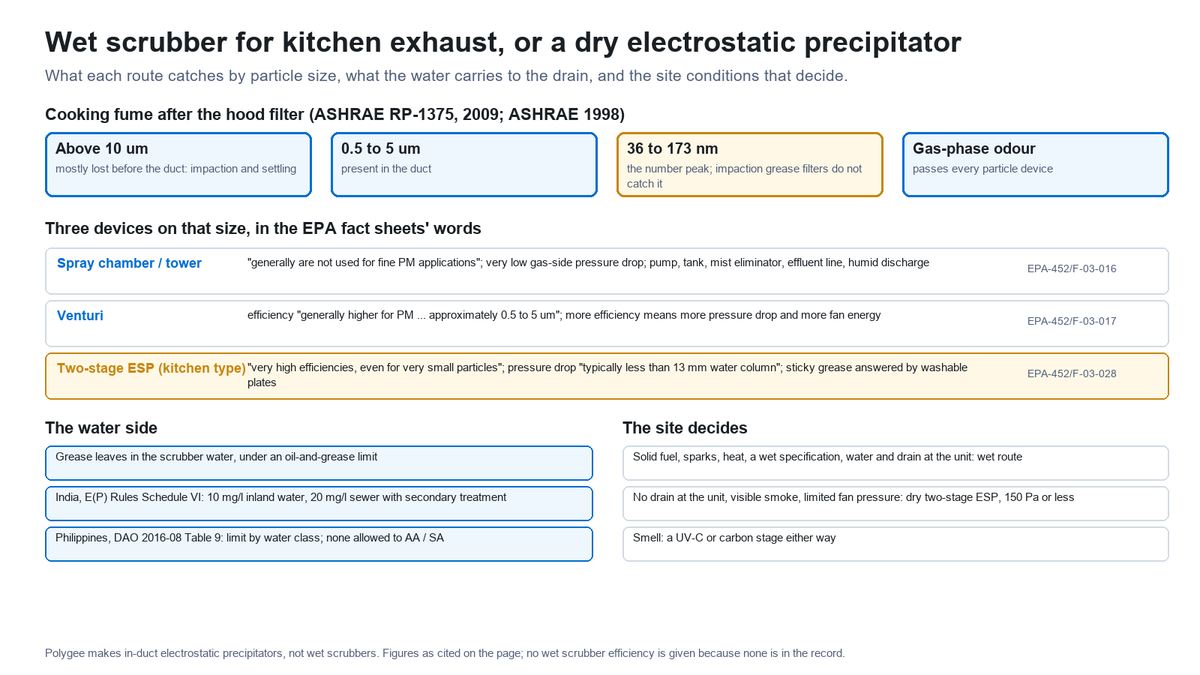
| Question | Short answer |
|---|---|
| What is a wet scrubber for kitchen exhaust? | A chamber in the exhaust line where the air is washed with water droplets or across a wetted surface; in Indian listings the name covers spray chambers, impingement or cyclonic boxes and venturi units, which behave very differently on fine particles |
| What size are the particles in cooking fume? | ASHRAE research on seven commercial appliances, measured with no filter in the hood, found the aerosol number peak between 36 nm and 173 nm, and an earlier ASHRAE emission-factor study found a majority of particles below 2.5 µm across the processes tested. The RP-1375 abstract adds that impaction grease filters do not capture that fraction efficiently |
| Does a wet scrubber catch it? | The EPA fact sheet says spray towers are generally not used for fine particulate because the liquid-to-gas ratio needed is above 3 litres per cubic metre; a venturi reaches fine particles only by raising its pressure drop and energy use. A low-pressure spray chamber removes large droplets and cools the gas |
| Where does the grease go? | Into the water. In India the effluent then meets Schedule VI of the Environment (Protection) Rules, oil and grease 10 mg/l to inland surface water and 20 mg/l to a public sewer that leads to secondary treatment; in the Philippines DAO 2016-08 sets oil and grease effluent limits by water body class and allows no discharge to Class AA or SA |
| When is wet the right call? | Solid-fuel exhaust with sparks, embers and heat that a dry pollution control unit is not listed for; a specification that names a wet process; a site that already has water, a drain, an interceptor and an effluent consent at the unit |
| When does the dry ESP route do the job? | Where smoke and grease aerosol are the complaint and there is no drain at the unit: a two-stage in-duct electrostatic precipitator runs at 150 Pa or less for the complete unit, needs no water circuit, and its cells slide out for washing; odour needs a UV-C or carbon stage behind it |
| Quick specs on this page | Figure | Basis |
|---|---|---|
| Aerosol number peak from seven commercial cooking appliances | 36 nm to 173 nm | ASHRAE RP-1375, 2009, abstract |
| Share of particles below 2.5 µm in cooking effluent | A majority, for all processes tested (thirteen uncontrolled and five with control technologies) | ASHRAE Transactions 1998, commercial cooking emission factors, abstract |
| Liquid-to-gas ratio above which a spray tower would have to run to collect fine PM | More than 3 l/m³; spray towers are generally not used for fine PM | US EPA fact sheet EPA-452/F-03-016 |
| Particle size range where venturi collection efficiency is generally higher | About 0.5 to 5 µm; higher efficiency requires higher pressure drop | US EPA fact sheet EPA-452/F-03-017 |
| Pressure drop of a dry electrostatic precipitator | Typically less than 13 mm water column (industrial wire-plate type) | US EPA fact sheet EPA-452/F-03-028 |
| Independent test of an ESP on a conveyor charbroiler line | PM mass reduced 86% (SCAQMD Method 5.1) and 90% (dilution method) | University of California, Riverside, Journal of Environmental Sciences 65, 2018 |
| Oil and grease limit, India, general discharge standards | 10 mg/l to inland surface water; 20 mg/l to a public sewer that leads to secondary treatment | Environment (Protection) Rules 1986, Schedule VI Part A item 7 and note (15) |
| Oil and grease limit, Philippines | Set by water body class in Table 9; no discharge allowed to Class AA or SA; values are maximum allowable limits | DENR Administrative Order 2016-08, Section 7 and Table 9 |
| Delhi-NCR fuel rule for charcoal tandoors in hotels, restaurants and banquet halls | Allowed with an emission channelization or control system; coal not permitted from 1 January 2023 | CAQM approved fuel list, as published by PIB on 28 December 2022 |
| Polygee in-duct precipitator, resistance when clean | Complete unit with airflow distribution plate 150 Pa or less; the cells themselves roughly 20 to 30 Pa | Polygee model data |
| Polygee LK series grease removal, third-party test | Up to 97.6% at rated, evenly distributed airflow, CMA-accredited report ZY05W230298 | Polygee test record |
- What a wet scrubber for kitchen exhaust is, and what the name covers in India
- What cooking exhaust contains, by particle size
- How each device treats that size
- The water side: what a wet scrubber sends to the drain
- Where the wet route is the right call
- Where the dry electrostatic route does the job
- Two markets, two triggers: Delhi-NCR fuels and a Manila high-rise
- Decision matrix: read your site, then choose
- The Wet-or-Dry Scrubber Site Sheet
- Eight mistakes in scrubber specifications
- Where this guide stops
- Buyer record and key takeaways
- Frequently asked questions
What a wet scrubber for kitchen exhaust is, and what the name covers in India
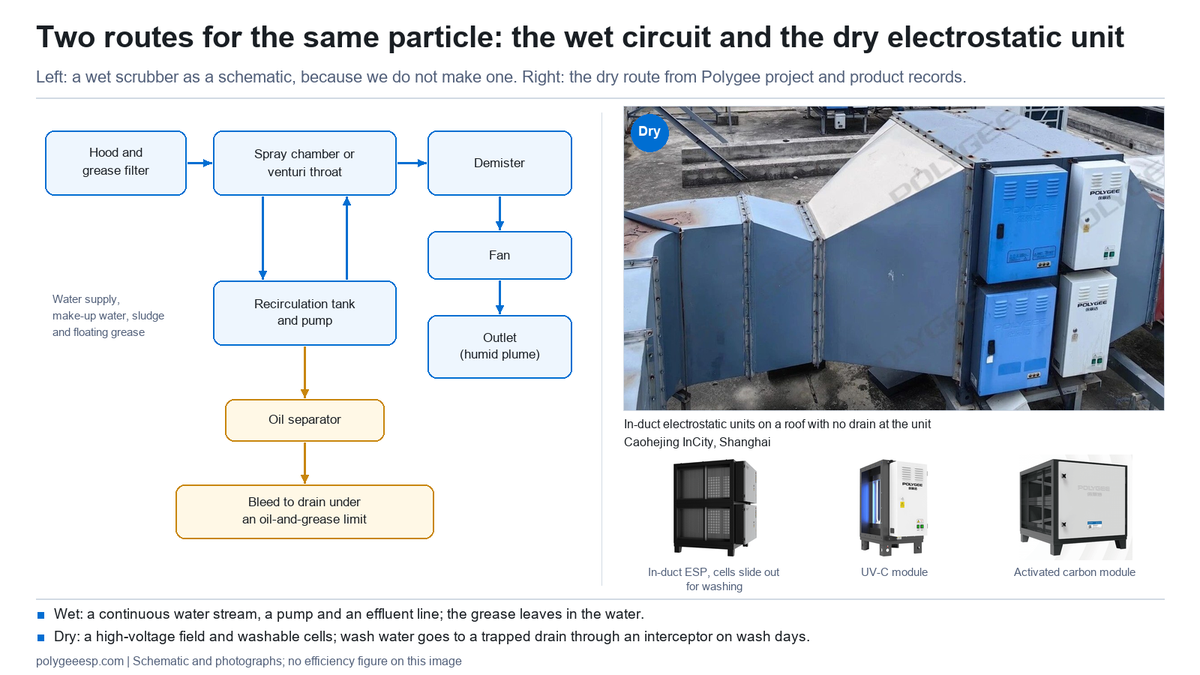
A wet scrubber for kitchen exhaust is a chamber in the extract line where the airstream is washed with water, and in India the one name covers at least three designs with very different abilities on fine particles. The air leaves the hood, passes the baffle or mesh grease filter, and enters the scrubber through a duct. Inside, it meets water in one of three ways: as a curtain of droplets from spray nozzles in an open chamber, as a sheet of water on plates or in a cyclone that the air has to impinge on, or as a dense fog made by forcing the air through a narrow venturi throat where the water is torn into fine droplets. Particles that touch a droplet or the wetted surface stay with the water. A demister, described in Indian listings as multi-bend PVC blades, strips the droplets back out of the air before the fan. The water drains to a tank, is pumped back to the nozzles, and a bleed stream plus the sludge or floating grease leaves the system.
The listings a buyer finds in India describe this circuit in roughly the same words, then give an efficiency as one figure. A unit offered in the Gurugram belt for 12,000 CFM with a 3 hp motor, for example, is listed with “Efficiency 99%” and no test condition, no particle size and no pollutant named. That is not a performance claim a buyer can compare with anything; the dry scrubber for kitchen exhaust guide on this site makes the same point about dry units sold under one name, and the rule is the same for wet ones: ask what is inside and what the figure was measured on.
Two more words need separating before the comparison. The scrubber family in the US EPA’s air pollution control technology fact sheets is written for industrial gases: sulphur dioxide, acid mists, ammonia, chlorine. The same device names appear in Indian kitchen listings, and the engineering is the same, but the problem is not: a kitchen is removing a sticky liquid aerosol and a gas-phase smell from warm, humid air, not a soluble acid gas. And a wet electrostatic precipitator is not a scrubber at all: it is a precipitator whose plates are rinsed with water, built for sticky industrial mists, and the what is an electrostatic precipitator page explains why a commercial kitchen uses neither that nor an industrial dry unit, but a two-stage plate machine whose cells slide out for washing.
| Design sold as a kitchen wet scrubber | How the air meets the water | What the EPA fact sheet says about fine particles | What it costs the system |
|---|---|---|---|
| Spray chamber or spray tower | Air passes through banks of spray nozzles in an open chamber | “Spray tower scrubbers generally are not used for fine PM applications because high liquid to gas ratios (greater than 3 liters per cubic meter (l/m3) or 22.4 gallons per thousand cubic feet (gal/1000 ft3)) are required”; collection efficiencies 70 to above 99 percent “depending upon the application” | Very low gas pressure drop; nearly all the contacting power comes from the liquid, so pump power, large liquid quantities and higher recirculation rates |
| Impingement-plate or cyclonic box | Air is forced through holes in wetted plates, or spun so droplets and particles hit the wall | No separate fact sheet is cited here. The spray tower sheet notes that cyclonic spray towers “generally achieve collection efficiencies at the higher end of the range”; both forms collect by inertia, so the heavier the particle, the better they work | Moderate pressure drop; water recirculation; plates to clean |
| Venturi | Air is accelerated through a throat where the water is atomised into a fine fog | “Collection efficiencies are generally higher for PM with aerodynamic diameters of approximately 0.5 to 5 µm”; “Increasing the venturi scrubber efficiency requires increasing the pressure drop which, in turn, increases the energy consumption” | The steepest pressure drop of the three designs as the EPA describes them, bought with fan power; some designs need clean liquid feed to avoid clogging |
What cooking exhaust contains, by particle size
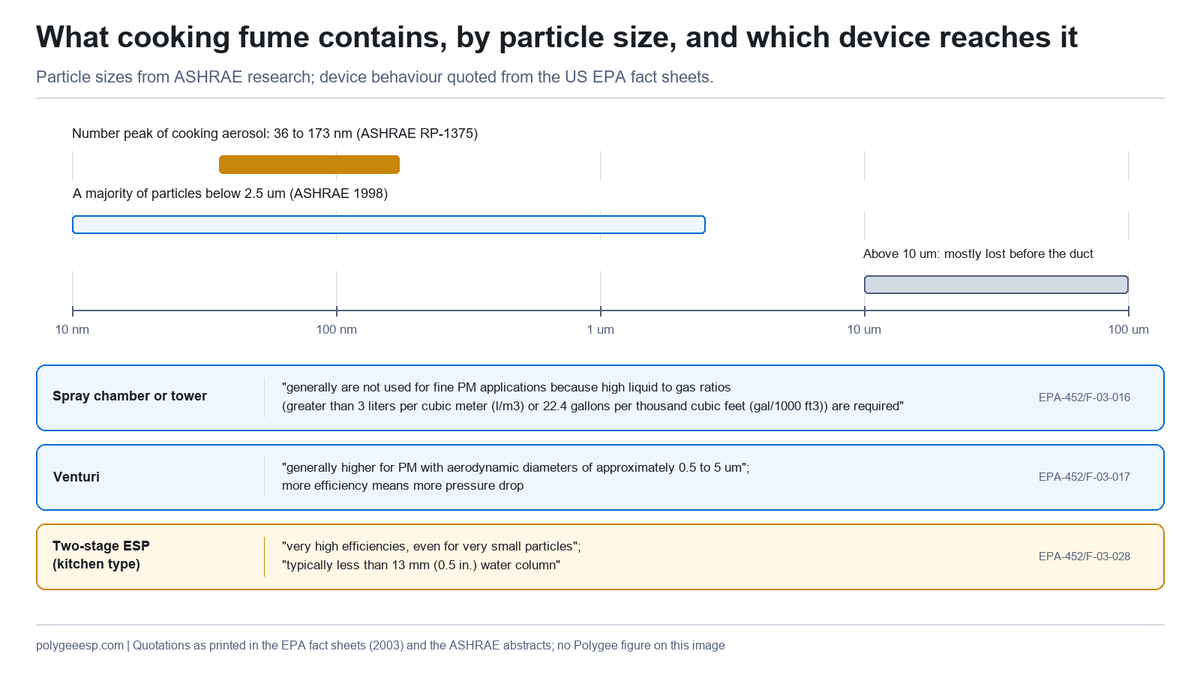
A majority of the particles in commercial cooking exhaust are smaller than 2.5 µm, and the particle count peaks well below one micrometre. The second of those findings comes from the ASHRAE research project RP-1375, published in 2009, which measured grease particle emissions, with no filter fitted in the hood, from seven commercial appliances: a gas conveyor broiler, a clamshell griddle, a gas conveyor pizza oven, a gas overfired broiler, an electric steamer, a solid-fuel broiler on mesquite charcoal and a gas wok. In the abstract’s words, “All appliances generated a well defined aerosol mode with a maximum number concentration between 36 nm and 173 nm,” and the size distribution of those small particles did not change appreciably between the plume above the appliance and the exhaust duct, which the authors read as an aerosol already at equilibrium when it entered the hood. The same abstract reports that most appliances produced substantial mass above 10 µm, but that most of those large particles were not observed in the exhaust duct, which the abstract attributes to a loss mechanism such as impaction or settling between the hood and the duct.
The 1998 ASHRAE emission-factor study that preceded it tested thirteen uncontrolled commercial cooking processes and five with control technologies, and its abstract states that “Particle-size distribution measurements for all processes tested indicate a majority of particles in the effluent with diameters less than 2.5” micrometres; the abstract as posted prints the unit as mm, which the context shows to be a misprint for micrometres. The same study found the highest particulate emission factor on an underfired charbroiler and emissions below detectable limits for several deep-fat fryer processes, and reported reduction efficiencies of 79% to 95% for the control technologies it tested. A separate 2008 study in Indoor and Built Environment found that cooking aerosols follow a lognormal distribution, that the mode diameter grows as cooking temperature rises, and that the sub-micrometre count in the 0.1 to 1.0 µm accumulation mode “increased rapidly when cooking temperature increased.” That study did not test a tandoor, so this page does not give a tandoor a particle size; it does say that hotter cooking pushes more of the fume into the range that the next section is about.
Two consequences follow for anyone choosing a scrubber. The large droplets that a water curtain catches easily have mostly fallen out before the duct. And the RP-1375 abstract draws the conclusion itself: “these fine aerosol particles are not captured efficiently by conventional commercial kitchen grease filters that rely on impaction as the main particle removal mechanism.” Impaction is also the mechanism of a low-pressure spray chamber. The ESP versus baffle filter page covers the hood filter’s side of that sentence; what follows covers the scrubber’s.
| Fraction of cooking fume | Where it is by the time it reaches a scrubber | What removes it | Source |
|---|---|---|---|
| Droplets above about 10 µm | Largely absent from the duct in the RP-1375 measurements, which name impaction or settling between hood and duct as the likely loss mechanism | Hood filter; any wet chamber | ASHRAE RP-1375 abstract |
| Particles between about 0.5 and 5 µm | Present in the duct | Venturi at a pressure-drop cost; two-stage ESP; cyclonic or impingement units partly | EPA-452/F-03-017; EPA-452/F-03-028 |
| Sub-micrometre aerosol, number peak 36 to 173 nm | The bulk of the particle count in RP-1375; a separate 2008 study found the 0.1 to 1.0 µm count rising with cooking temperature | Electrostatic charging; a venturi at high pressure drop; a spray chamber poorly | ASHRAE RP-1375; Indoor and Built Environment 2008; EPA-452/F-03-016 |
| Gas-phase odour compounds | Pass every particle device | Carbon adsorption; UV-C; a water scrubber absorbs the hydrophilic part | EPA-452/F-03-016; kitchen exhaust filtration page |
How each device treats that size
A low-pressure spray chamber removes large droplets and cools the gas; in the EPA fact sheets, reaching the fine fraction that the previous section describes is the work of a venturi throat with the pressure drop that comes with it, or of an electrostatic field. The three fact sheets describe each device in their own words, and they are worth reading side by side because they were written by one agency for the same purpose, comparing control devices for a permit engineer.
On the venturi scrubber, fact sheet EPA-452/F-03-017 gives a collection range of 70 to above 99 percent, adds that efficiency is “generally higher for PM with aerodynamic diameters of approximately 0.5 to 5 µm,” and then states the price: “Increasing the venturi scrubber efficiency requires increasing the pressure drop which, in turn, increases the energy consumption.” It also says where venturis are applied, “where it is necessary to obtain high collection efficiencies for fine PM,” on sources “with high concentrations of submicron PM.” A kitchen venturi asked to reach the sub-micrometre peak is therefore buying that reach with pressure drop, and the fan’s power and static pressure become part of the specification.
On the spray tower, fact sheet EPA-452/F-03-016 says the opposite about fine particles: spray towers “generally are not used for fine PM applications because high liquid to gas ratios (greater than 3 liters per cubic meter (l/m3) or 22.4 gallons per thousand cubic feet (gal/1000 ft3)) are required,” while noting that “Such devices have very low gas pressure drops, and all but a small part of the contacting power is derived from the liquid stream.” That is the design the Indian kitchen listings describe: a chamber, a bank of nozzles, a pump, a demister and a small fan. It does three things well. It knocks down the large droplets that reached it, it cools and humidifies the gas, and it absorbs part of whatever is water-soluble in the fume, which the same fact sheet describes for hydrophilic organic vapour. What it does weakly, by the EPA’s own account, is the fraction that makes a plume visible and a neighbour complain.
On the dry electrostatic precipitator, fact sheet EPA-452/F-03-028 describes the industrial wire-plate machine, and three of its sentences carry over to a kitchen with one translation. The advantages: ESPs “have very low pressure drops (typically less than 13 mm (0.5 in.) water column)” and “are capable of very high efficiencies, even for very small particles.” The caution: “Dry ESPs are not recommended for removing sticky or moist particles,” and “Ozone is produced by the negatively charged electrode during gas ionization.” The translation is the one the electrostatic precipitator guide on this site spells out: cooking grease is the sticky particle the industrial fact sheet warns about, which is why a kitchen ESP is not a rapped wire-plate unit but a two-stage machine with an ionizer ahead of flat collector plates that are taken out and washed. The field does the capture the fact sheet credits it with; the washing routine replaces the rapping the fact sheet assumes. The ozone sentence is also real and is dealt with on the ESP and ozone page rather than waved away here.
| Device | Capture mechanism | Behaviour on the fine fraction, in the EPA’s words | Pressure drop | What it adds to the kitchen | Fact sheet |
|---|---|---|---|---|---|
| Spray chamber or tower | Droplet impaction; absorption of soluble gases | “generally are not used for fine PM applications” | Very low on the gas side | Water supply, pump, tank, demister, oil separation, effluent line, humid discharge | EPA-452/F-03-016 |
| Venturi | High-velocity throat atomises water into fine droplets; impaction and diffusion | “generally higher for PM with aerodynamic diameters of approximately 0.5 to 5 µm”; finer particles bought with pressure drop | High, and it rises with the efficiency wanted | Everything above plus a larger fan and clean liquid feed | EPA-452/F-03-017 |
| Two-stage electrostatic precipitator (kitchen type) | Ionizer charges the aerosol; collector plates hold it; cells washed | “very high efficiencies, even for very small particles”; the sticky-particle caution answered by washable plates | “typically less than 13 mm (0.5 in.) water column” for the industrial type; 150 Pa or less for our complete in-duct unit including its distribution plate | High-voltage supply, cell washing routine, wash water to a trapped drain; no process water, no pump, no tank | EPA-452/F-03-028 |
One independent measurement puts a number on the electrostatic side without using our data. In 2018 the University of California, Riverside tested three control technologies on the exhaust of a conveyor charbroiler cooking beef patties at its commercial test cooking facility, and reported in the Journal of Environmental Sciences that the electrostatic precipitator “showed the largest reductions in PM mass emissions for Method 5.1 and the dilution method at 86% and 90%, followed by 58% and 57% for CT2, and 25% and 21% for CT1, respectively.” The particle distributions in that test were unimodal with peaks between 118 and 150 nm, squarely in the ASHRAE range. The authors also explain the gap to theory in a sentence every ESP buyer should keep: the unit could in principle exceed 99% on PM2.5, and “The lower observed removal efficiency of 86% with the ESP used in this study may be attributed to the abundance of organic vapors accumulated throughout the ESP.” An electrostatic stage that is not washed loads up, and the authors’ reading is that loading costs efficiency. That is why a kitchen ESP has removable cells, why the cleaning routine is written into a quotation rather than a brochure, and why the page you are reading gives no cleaning interval as a number.
Smell is the one place the comparison runs the other way, and only partly. Odour in cooking exhaust is mostly gas-phase, too small to be a particle, so an electrostatic stage clears the smoke without clearing the smell; the kitchen exhaust filtration page sets out the UV-C and activated carbon stages that do that job behind an ESP. A water scrubber absorbs the hydrophilic part of the odour, which the spray tower fact sheet describes as a VOC application with a typical range of 50 to 95 percent and the lower figures for “relatively insoluble compounds at low concentrations.” Whether cooking odour at duct concentrations sits toward the low or the high end of that range is a question for a test on the line, and none is in our record. A wet scrubber treats odour partly; neither route treats it fully without a stage built for it.
The water side: what a wet scrubber sends to the drain
The grease a wet scrubber removes from the air leaves in its water, and that water meets an oil-and-grease limit before it reaches a sewer or a river. This is the part of the decision that the listings leave out and that a buyer in India or the Philippines cannot leave out, because the effluent rule attaches to the kitchen’s discharge permit, not to the scrubber supplier.
Follow the water. Spray water picks up grease droplets, soot and whatever soluble compounds it absorbs, then drains to the recirculation tank. Some of the grease floats and can be skimmed; some emulsifies and stays in the water; some coats the tank, the pump, the nozzles and the demister blades, which is the cleaning the supplier’s maintenance schedule is about. Evaporation into the warm exhaust and the bleed needed to keep the circulating water usable both call for make-up water. The discharge leaves humid, so on a cool evening the plume at the outlet can show as vapour even when the smoke is gone, a point that matters wherever the outlet is near windows, which the low-level discharge page treats for ecology units and which applies with more force to a wet outlet. And the bleed goes to a drain, which brings in the rule.
In India the general discharge standards are Schedule VI of the Environment (Protection) Rules, 1986, and item 7 of Part A sets oil and grease at a maximum of 10 mg/l for discharge to inland surface water, 20 mg/l to public sewers, 10 mg/l to land for irrigation and 20 mg/l to marine coastal areas. Note (15) to the same schedule adds a condition that a city restaurant can meet without knowing it: the public sewer limits “shall be applicable only if such sewer leads to a secondary treatment including biological treatment system, otherwise the discharge into sewers shall be treated as discharge into inland surface waters.” In other words, where the municipal sewer has no secondary treatment behind it, the 10 mg/l figure applies, not 20. Which figure applies to a given kitchen is a question for the State Pollution Control Board consent, and this page does not answer it; it does say that a wet scrubber puts a grease-laden water stream under that consent where none existed before.
In the Philippines the instrument is DENR Administrative Order 2016-08, the Water Quality Guidelines and General Effluent Standards. Section 7.0 states that “Discharges from any point source shall at all times meet the effluent standards set forth” in its tables “to maintain the required water quality per water body classification,” and that “The GES shall be used regardless of the industry category.” Table 9 lists oil and grease among the effluent parameters with a limit for each receiving-water class from AA to SD, marks Class AA and SA as No Discharge Allowed, and its note (g) states that the values “are maximum allowable limit.” The 2021 amendment, DAO 2021-19, lists six parameters in its scope, ammonia, boron, dissolved copper, fecal coliform, phosphate and sulfate, and oil and grease is not among them. The figure for a Manila hotel therefore depends on the class of the water its sewer or outfall reaches, which the Environmental Management Bureau assigns; the page gives the structure of the rule and leaves the number to the discharge permit.
For readers under the US model codes, the International Mechanical Code already assumes that a pollution control unit in a kitchen has a wet side, because the units it describes are washed. IMC 2021 Section 506.5.2, item 11, requires that “Wash-down drains shall discharge through a grease interceptor and shall be sized for the flow,” and that drains be sealed “with a trap or other approved means to prevent air bypass.” That sentence applies to the wash water of an electrostatic unit as much as to a scrubber’s bleed, and it is the honest place to say so: the dry route is dry in operation, not in maintenance. The cells come out and are washed, and that wash water, with its detergent and its grease, goes to a trapped drain through an interceptor. The difference between the routes is a continuous process water stream with a pump and an effluent line against an intermittent wash, not water against no water.
| What the water side asks | India | Philippines | Applies to |
|---|---|---|---|
| Instrument | Environment (Protection) Rules 1986, Schedule VI Part A, general standards for discharge of environmental pollutants | DENR Administrative Order 2016-08, Water Quality Guidelines and General Effluent Standards, as amended by DAO 2021-19 | Any point source; the kitchen’s consent or discharge permit |
| Oil and grease | 10 mg/l inland surface water; 20 mg/l public sewer; 10 mg/l land for irrigation; 20 mg/l marine coastal | Table 9, one limit per water body class AA to SD; No Discharge Allowed to AA and SA; values are maximum allowable limits | The scrubber bleed and sludge water; ESP wash water on wash days |
| Condition to watch | Note (15): the sewer limits apply only where the sewer leads to secondary treatment including biological treatment; otherwise inland surface water limits apply | Which class the receiving water holds, assigned by the Environmental Management Bureau | Where the drain actually goes, not where the drawing says it goes |
| Continuous or intermittent | Wet scrubber: continuous recirculation with bleed and make-up, floating and emulsified grease, pump and tank cleaning. Dry ESP: intermittent wash of removable cells, wash water through an interceptor to a trapped drain | Sizing of the interceptor and the drain | |
Where the wet route is the right call
A wet scrubber is the right call where the exhaust carries sparks, embers or heat that a dry pollution control unit is not designed and listed for, where the specification names a wet process, and where water, a drain, an interceptor and an effluent consent already exist at the unit. This section is written by a manufacturer of the other route, so it is kept to conditions a buyer can check rather than to opinion.
- Solid fuel. A charcoal tandoor or a wood-fired grill sends embers, sparks and ash down the duct along with a hotter gas. A water curtain quenches all three. The US code states the dry-side rule in one sentence, IMC 2021 Section 506.5.2 item 14: “Extra-heavy-duty appliance exhaust systems shall not be connected to pollution-control units except where such units are specifically designed and listed for use with solid fuels.” That is written for the US model code and for any pollution control unit, electrostatic included, and the question it poses travels: before connecting any dry unit to a solid-fuel line, ask the manufacturer in writing whether the unit is designed and listed for solid fuel, and what spark arrestor and inlet temperature it requires. Where the answer is no, that dry unit is out, and the choice is between a wet scrubber and a dry unit that is designed and listed for solid fuel; the wet route has its own questions on the same line, ember carry-over into the demister and the fan among them, which its supplier should answer in writing.
- Inlet temperature. Every dry unit has an inlet temperature limit set by its maker, and this page does not give one for ours, because that figure belongs in a quotation against a stated appliance line rather than in an article. A scrubber cools the gas as part of its work; the spray tower fact sheet gives a working range for particulate duty of 4 to 370 degrees C. Where the exhaust at the unit position is hot enough that the dry unit’s maker declines it, the wet route is the practical one.
- A specification that names a wet process. Where the consultant’s document or the landlord’s fit-out guide says wet scrubber and will not be amended, the quotation has to answer that document. Offering a dry unit against a wet specification is a change request, not a quotation.
- Water services already at the unit. A plant room with a water point, a floor drain to an interceptor and a consent that already covers a grease-bearing effluent has paid the wet route’s entry price. The question then becomes the particle-size one in the previous section, not the plumbing one.
- A soluble gas as the real target. Where the complaint is a water-soluble gas rather than smoke, the scrubber is doing what the EPA sheets were written for. That is the case the industrial fact sheets were written for; a kitchen complaint about smoke is a particle case.
Two things this list does not say. It does not say that a wet scrubber is better for heavy grease. Heavy grease loading is a hood-filter and cleaning-routine question before it is a scrubber question, and the fine fraction that survives the hood filter is the fraction a spray chamber is weakest on. And it does not say that a wet scrubber removes smell. It absorbs part of it, as the previous section showed, and the part it leaves is the part a neighbour notices.
Where the dry electrostatic route does the job
A two-stage electrostatic precipitator does the same particle job without a water circuit, at a whole-unit resistance of 150 Pa or less, which is why it is the route for high-rise, mall and rooftop kitchens with no drain at the unit. The figures in this section are Polygee’s own and are given with their basis; nothing here is a test on a wet scrubber, and nothing is a claim that the dry route is right for every kitchen.
The in-duct electrostatic precipitator is a two-stage plate unit: an ionizing section charges the grease aerosol and smoke, a collector section of stainless steel plates holds them, and the cells slide out of the cabinet for washing. The LK series reached up to 97.6% grease removal in CMA-accredited third-party tests, report ZY05W230298, at rated and evenly distributed airflow; that is a grease result at the tested condition, not an odour result and not a promise for a different airflow. The LK-E engineering series is offered in three design-efficiency grades, at or above 90, 95 and 98 percent, chosen from the cooking load. The complete in-duct unit, with its standard airflow distribution plate, adds 150 Pa or less to the system; the electrostatic cells themselves account for roughly 20 to 30 Pa of that, which is why the figure to carry into the fan selection is the whole-unit one. The brochure input supply is 220 V, 50 Hz, with 380 V and 60 Hz configured to order. The whole unit carries a one-year warranty, with the electrostatic cells and the high-voltage power module covered and UV-C lamps and activated carbon treated as consumables.
Where smell is part of the complaint, the dry route adds stages rather than water: UV-C and activated carbon behind the electrostatic section, packaged as the kitchen ecology unit, with the carbon media coal-based columnar activated carbon of iodine value 800 mg/g or more and the UV-C and carbon modules each needing 1,000 mm clear on the access side. Where the hood is new, the HME range puts the electrostatic cells into the hood itself, with design efficiency at or above 98% across the twelve models from 3,000 to 4,800 m³/h on 380 V, 50 Hz; whether the fan is included is confirmed in the quotation for each project.
What the dry route asks of the site is the mirror image of the wet one. It needs an electrical supply at the unit and a cabinet position with the access side clear; it needs no water point, no pump, no tank and no continuous effluent. It does need a place to wash the cells, a trapped drain through an interceptor for the wash water on the days the cells come out, and a cleaning routine that is written down against the cooking load, because the Riverside authors attribute the gap between theory and their result to vapour accumulated in the unit. We put that routine in writing with the quotation, and we do not print an interval here.
Projects on record with these units are in Southeast and South Asia rather than in India or the Philippines: Marina Bay Sands in Singapore, 2012, 500 ODM units; Tun Razak Exchange in Kuala Lumpur, 2022, 300 units of the LK-E and UV series; Landmark 81 in Vietnam, 2021, 70 LK-E units; and the DoubleTree by Hilton in Weerawila, Sri Lanka, 2017, 10 LK-E units. A buyer in Mumbai or Manila can ask about any of them, and should treat the absence of a local reference as a fact to weigh, not a gap to be talked past.
| Dry route, Polygee figures | Value | Basis and condition |
|---|---|---|
| Grease removal, LK in-duct series | Up to 97.6% | CMA-accredited third-party test, report ZY05W230298, rated and evenly distributed airflow; not an odour figure |
| Design efficiency grades, LK-E series | At or above 90, 95 and 98 percent | Three engineering grades, chosen from the cooking load |
| Resistance, complete in-duct unit | 150 Pa or less | Including the standard airflow distribution plate; cells alone roughly 20 to 30 Pa; carry the whole-unit figure into the fan selection |
| HME hood with built-in cells | At or above 98%; 3,000 to 4,800 m³/h; 380 V, 50 Hz | Twelve models; fan inclusion confirmed in the quotation |
| Input supply, in-duct units | 220 V, 50 Hz standard | 380 V and 60 Hz configured to order; state the site supply |
| Warranty | One year, complete unit | Cells and high-voltage module covered; UV-C lamps and carbon are consumables |
| Water at the unit | None in operation | Wash water from cell cleaning to a trapped drain through an interceptor |
| Inlet temperature limit | Stated in the quotation | Against the appliance line and fuel; ask for it in writing from any dry-unit maker |
Two markets, two triggers: Delhi-NCR fuels and a Manila high-rise
In Delhi-NCR the approved-fuel list allows charcoal tandoors in hotels, restaurants and banquet halls only with an emission channelization or control system; in a Manila high-rise the trigger is a roof with no drain and a building manager who wants neither smoke nor smell. The two markets reach the scrubber question from opposite ends, and the page keeps them apart because the rules behind them are different documents.
The Commission for Air Quality Management in the National Capital Region, CAQM, issued a standard list of approved fuels for the whole NCR, and the Press Information Bureau release of 28 December 2022 that publishes it contains the two lines a restaurant owner needs. Under the approved fuels: “Wood/Bamboo Charcoal for Tandoors and Grills of Hotels/Restaurants/Banquet Halls (with emission channelization/ control system) and Open eateries/ Dhabas,” and, in the list of fuels permissible “only beyond the jurisdiction of NCTD,” that is in the NCR outside the National Capital Territory of Delhi, “Biomass Pellets/ Briquettes – for Tandoors and Grills of Hotels/ Restaurants/ Banquet Halls (along with mandatory emission channelization/ control system) and for Open Eateries/ Dhabas.” Under the prohibition: the Commission’s directions require the complete end of coal and other unapproved fuel use “for various operations/ applications across all sectors” with effect from 1 January 2023 in the entire NCR, the same release excepting low-sulphur coal in thermal power plants, with closure and environmental compensation for violations. Press reports in December 2025 described a further Delhi Pollution Control Committee direction banning coal and firewood in tandoors across hotels, restaurants and open eateries in Delhi itself; that direction is reported here, not quoted, because its text was not available to us.
Read against the previous sections, the NCR rule does two things to the scrubber decision. It makes an emission channelization or control system a condition of the fuel for hotels, restaurants and banquet halls; what counts as one is for the authority to say, and this page can only set out what the two control routes do on a solid-fuel line. And it keeps the tandoor on a solid fuel, which puts the question of item 14, sparks, embers and heat, and whether a dry unit is designed and listed for them, at the top of the sheet before any efficiency figure is compared. The list does not name a device type, and this page does not read a requirement for a scrubber or a precipitator into it; it reads a requirement for a channelization or control system on a solid-fuel line, which is the hardest case for the dry route and the case where water quenching counts most.
The Manila scenario turns on a drain, not a fuel. A teppanyaki counter on a high floor of a hotel is a heavy-duty line by the classification the kitchen exhaust filtration page uses, with a hood filter first and an electrostatic stage as the base stage behind it. The exhaust rises many floors to a roof plant level that can have an electrical supply and no floor drain, and the building’s own consent under DAO 2016-08 covers whatever the tower discharges. A wet scrubber at that position adds a water riser, a pump, a tank, an oil separator and an effluent line down to the interceptor, plus a humid plume at the outlet; a dry unit adds a cabinet, a supply and a wash routine for cells that are carried to a wash point. Which the building can carry is a question for its services drawings, and the Site Sheet below is built to put it to both suppliers at once. The food court exhaust page takes the parallel question of one central unit against one per tenant.
Decision matrix: read your site, then choose
Neither route is right in general; the site decides. The rows below are site conditions, not products, and the last column is what the choice costs the buyer if it is made the other way.
| Site condition | Wet scrubber | Dry two-stage ESP | Still to confirm | Consequence of choosing wrongly |
|---|---|---|---|---|
| Charcoal, wood or other solid fuel on the line | Quenches sparks, embers and heat; ask how ember carry-over is handled | Only where the unit is designed and listed for solid fuel; ask in writing | Spark arrestor; inlet temperature; the listing | A dry unit connected to a solid-fuel line it is not built for |
| No water point or drain at the unit position | Needs supply, drain, interceptor and an effluent line added | Needs an electrical supply and a wash point | Where the cells will be washed | A plumbing project priced after the equipment |
| The complaint is visible smoke | A spray chamber is weak on the fine fraction; a venturi reaches it at high pressure drop | The fine fraction is what the field is for | Hood filter condition; whether the cells are washed on schedule | A plume that persists after the invoice is paid |
| The complaint is smell | Absorbs the hydrophilic part | Needs a UV-C or carbon stage behind the ESP | Whether odour is in the requirement in writing | Either route alone leaves the smell |
| Discharge near windows or at low level | Adds humidity that can show as a vapour plume | Adds no humidity | Outlet position relative to neighbours | A complaint about steam in place of one about smoke |
| Sewer has no secondary treatment, or receiving water is a protected class | Bleed falls under the stricter oil-and-grease figure, or no discharge is allowed | Wash water only, through an interceptor | The consent or discharge permit wording | A continuous effluent stream the consent does not cover |
| Fan static pressure is limited | Spray chamber adds little; venturi adds a lot | 150 Pa or less for the complete unit | The fan’s spare static pressure | An unbudgeted fan replacement |
| Specification names a wet process | Answers the document | Is a change request | Whether the author will amend | A rejected tender |
The Wet-or-Dry Scrubber Site Sheet
The Wet-or-Dry Scrubber Site Sheet is twelve inputs to fill once and send to both a wet scrubber supplier and to us, so that two quotations describe the same kitchen. Every row says why it decides between the routes. There are no default values; a row the site cannot answer is written TBD and asked, not assumed.
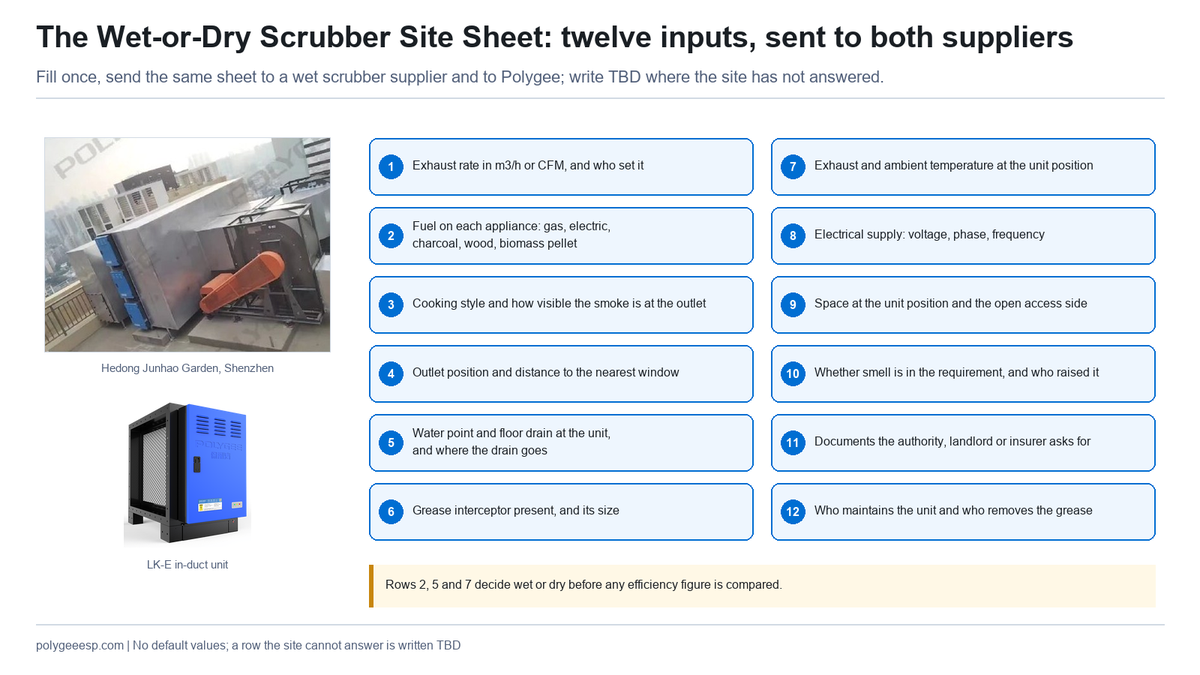
| # | Input | Why it decides wet or dry | Who fills it |
|---|---|---|---|
| 1 | Exhaust rate in m³/h or CFM, and who set it | Sizes every stage of either route; a figure without an author is re-measured | Consultant or hood supplier |
| 2 | Fuel on each appliance: gas, electric, charcoal, wood, biomass pellet | Solid fuel raises the sparks, embers and listing question before any efficiency; in NCR it also decides whether the fuel is approved and what control it must carry | Owner |
| 3 | Cooking style and how visible the smoke is at the outlet | Points at the fine fraction; a visible plume is the fraction a spray chamber is weakest on | Owner or chef |
| 4 | Outlet position: roof height, side wall, low level, distance to the nearest window | A wet outlet adds humidity that can show as a plume; a low or near outlet also raises the odour question | Consultant |
| 5 | Water point and floor drain at the unit position, and where the drain goes: inland water, sewer with or without secondary treatment, class of receiving water | The wet route’s entry price and its oil-and-grease figure; the dry route’s wash-water path | Building services |
| 6 | Grease interceptor present, and its size | Both routes drain through one; the wet route continuously, the dry route on wash days | Building services |
| 7 | Exhaust temperature at the unit position, measured or estimated, and ambient temperature in the plant room | Against the dry unit’s inlet temperature limit, which the maker states in the quotation | Consultant |
| 8 | Electrical supply: voltage, phase, frequency | Both routes need power; the dry route’s high-voltage module is specified to it | Building services |
| 9 | Space at the unit position and which side is open for access | Wet: tank, pump and separator footprint; dry: 1,000 mm clear on the access side for UV-C and carbon modules, cell withdrawal for the ESP | Consultant |
| 10 | Whether smell is in the requirement, and who raised it | Decides whether a carbon or UV-C stage is quoted behind the ESP, and whether a wet scrubber’s partial absorption is enough for the person complaining | Owner |
| 11 | Documents the authority, landlord or insurer asks for: consent conditions, fit-out manual clauses, test reports, listings | Tells both suppliers what the quotation must attach, and whether a wet process is named | Owner or consultant |
| 12 | Who will do daily and periodic maintenance, and who removes the grease | Wet: tank, nozzle and demister cleaning, sludge and floating grease disposal; dry: cell washing on a written routine | Owner or facility contractor |
What comes back from us against a completed sheet: the stages proposed and the reason for each; the resistance of each stage at the stated airflow with its basis; the inlet temperature limit for the quoted model; the cell washing routine written against rows 3 and 12; a proforma invoice on the stated Incoterm; and a plain list of which parts are consumables and which the warranty covers. The dry scrubber for kitchen exhaust page carries the shorter enquiry sheet for a kitchen that has already chosen the dry route.
Eight mistakes in scrubber specifications
- Treating scrubber as one machine. A spray chamber, a venturi and a two-stage electrostatic unit are three devices with three behaviours on the fraction that matters; a specification that says “scrubber” has not yet chosen.
- Comparing one supplier’s 99% with another’s 97.6%. A figure without the particle size, the pollutant, the airflow and the test method behind it cannot be compared with one that has them. Ask for the condition; where there is none, there is no figure.
- Not asking where the water goes. The wet route’s effluent line is a permit question in India and the Philippines, and note (15) of Schedule VI can turn a 20 mg/l figure into a 10 mg/l one.
- Carrying an industrial liquid-to-gas ratio into a kitchen. The EPA fact sheets describe what a spray tower needs to reach fine particles; a kitchen listing that gives a fan size and a motor rating but no liquid flow does not tell you whether the unit runs anywhere near that ratio.
- Connecting a dry unit to a charcoal tandoor without the listing question. IMC 506.5.2 item 14 states the rule for US installations and the question for every other: is the unit designed and listed for solid fuel, and what does it require ahead of it.
- Leaving inlet temperature out of the enquiry. Every dry unit has a limit; a quotation that does not state it against your appliance line is incomplete.
- Choosing wet on a roof with no drain. The riser, the pump, the tank and the effluent line become a second project priced after the first.
- Expecting either route to remove smell on its own. A water scrubber absorbs part of the odour; an electrostatic stage removes none of the gas phase. The stage built for odour has to be in the specification, whichever route carries the particles.
Where this guide stops
Four things are deliberately left to other people or other pages. No wet scrubber efficiency is given here as a fact, because no test on a kitchen line is in our record; the one listing figure quoted in the first section is shown as a claim without a test condition, not as a result; ask the wet scrubber supplier for a test result with its conditions, as you would ask us. No effluent consent is decided here; the Indian State Pollution Control Board or the Philippine Environmental Management Bureau assigns the figure that binds a given kitchen, and this page gives the structure of the rule and the sentences it rests on. No inlet temperature limit is printed for our units, because it is stated in a quotation against a named appliance line. And no cleaning interval is given for electrostatic cells, because the Riverside authors’ reading of their own result points to loading, which depends on the cooking load and the operating hours rather than on a brochure.
Three layers of acceptance apply here as on every page of this site. The equipment layer is what either unit is: its stages, its resistance, its test report, its listing. The installation layer is whether the water, the drain, the power, the access and the fan were provided as the unit requires. The operation layer is what leaves the outlet after a year of cooking, which depends on washing cells or cleaning a tank as much as on the device. Passing one layer does not clear the next, and a scrubber of either kind that is specified without the third layer in view will be judged on it anyway.
Buyer record and key takeaways
Before either supplier is asked for a price, these items are in your file.
- The completed Wet-or-Dry Scrubber Site Sheet, twelve rows, with TBD written where the site has not answered.
- The fuel on every appliance, and for a kitchen in Delhi-NCR the approved-fuel list and its condition on charcoal tandoors.
- Where the drain at the unit position goes, and the oil-and-grease figure the consent or permit applies to it.
- For any dry unit considered on a solid-fuel line, the manufacturer’s written answer on design and listing for solid fuel, the spark arrestor it requires and its inlet temperature limit.
- For any wet unit considered, the supplier’s test result with its conditions, the make-up water and bleed rates, and the maintenance schedule for tank, nozzles and demister.
- For any electrostatic unit considered, the whole-unit resistance at your airflow and the written cell washing routine.
Key takeaways
- The particle decides the device. Cooking fume in the ASHRAE measurements is mostly below 2.5 µm with a number peak between 36 and 173 nm; the EPA fact sheets place a spray tower outside fine-particle duty, a venturi inside it at a pressure-drop cost, and an electrostatic field inside it at low pressure drop.
- The water is where the grease goes. A wet scrubber turns an air-quality complaint into an effluent stream that meets Schedule VI in India or DAO 2016-08 in the Philippines, with a condition on sewers that changes the figure.
- Solid fuel is the wet route’s strongest case. Sparks, embers and heat are quenched by water, and a dry unit joins that line only where it is designed and listed for it.
- No drain at the unit is the dry route’s. A two-stage ESP at 150 Pa or less for the complete unit needs power, access and a wash routine, not a water circuit.
- Smell is a separate stage either way. A scrubber absorbs part of it; an ESP none; the stage built for odour goes in the specification whichever route carries the particles.
Frequently asked questions
- What does a wet scrubber remove from kitchen exhaust that a dry electrostatic precipitator does not?
- Heat, sparks and embers, and part of the water-soluble gas phase. A water curtain quenches a solid-fuel exhaust and cools the gas, which a dry electrostatic unit does not do, and the EPA spray tower fact sheet describes absorption of hydrophilic organic vapour as a scrubber application. On the particles themselves the comparison runs the other way: the same fact sheet says spray towers are generally not used for fine particulate because the liquid-to-gas ratio needed is above 3 litres per cubic metre, while the dry ESP fact sheet credits electrostatic units with very high efficiencies even for very small particles. In the ASHRAE measurements, cooking fume is mostly that fine fraction.
- Does a kitchen wet scrubber produce wastewater, and who regulates it?
- Yes. The grease and soot the water captures leave in the bleed stream and the sludge, and that effluent meets the general discharge standard of the country. In India, Schedule VI of the Environment (Protection) Rules sets oil and grease at 10 mg/l to inland surface water and 20 mg/l to a public sewer, with note (15) applying the 10 mg/l figure where the sewer does not lead to secondary treatment including biological treatment; the State Pollution Control Board consent states which applies. In the Philippines, DENR Administrative Order 2016-08 requires every point source to meet the effluent standards at all times and sets oil and grease limits by water body class in Table 9, with no discharge allowed to Class AA or SA. The dry electrostatic route also sends water to the drain, but intermittently, when the cells are washed, through a grease interceptor to a trapped drain.
- Can a wet scrubber or an electrostatic precipitator be used on a charcoal tandoor?
- A wet scrubber is the usual candidate, because water quenches sparks, embers and heat; ask its supplier in writing how ember carry-over past the demister is handled. An electrostatic unit joins that line only where its manufacturer states in writing that the unit is designed and listed for solid fuel and what spark arrestor and inlet temperature it requires; the US International Mechanical Code puts that rule in Section 506.5.2 item 14 for pollution control units generally. In Delhi-NCR the approved-fuel list published by PIB in December 2022 allows wood or bamboo charcoal for tandoors and grills in hotels, restaurants and banquet halls only with an emission channelization or control system, and prohibits coal from 1 January 2023, so a charcoal tandoor there has to carry a channelization or control system, and the choice between the routes starts from the solid-fuel questions above.
- What should I send to compare a wet scrubber quotation with an electrostatic precipitator quotation?
- The same twelve inputs to both suppliers: exhaust rate and who set it, fuel on each appliance, cooking style and visible smoke, outlet position, water point and drain at the unit and where the drain goes, grease interceptor, exhaust and ambient temperature at the unit, electrical supply, space and access side, whether smell is in the requirement, the documents the authority or landlord asks for, and who will maintain the unit and remove the grease. Then ask each supplier for the same three things back: a test result with its conditions, the resistance at your airflow, and the maintenance routine in writing.
Choosing between a wet scrubber and a dry unit for a kitchen in India or the Philippines?
Send us the twelve rows of the Wet-or-Dry Scrubber Site Sheet, or as many as the site can answer, with TBD on the rest. You get back the stages we would propose and the reason for each, the resistance of each stage at your airflow with its basis, the inlet temperature limit for the quoted model against your appliance line, the cell washing routine written against your cooking load, a proforma invoice on EXW, FOB or CIF terms, and a plain list of consumables against warranty items. Where a row of your sheet points to the wet route, we will say so in the reply rather than quote around it.
If the dry route is already chosen, the in-duct electrostatic precipitator page carries the model tables and test reports, and the kitchen ecology unit page covers the three-stage unit for kitchens where smell is part of the requirement.
Why we write this. The pages that answer a search for a kitchen wet scrubber are product listings with one efficiency figure and industrial scrubber explainers written for acid gas. Neither tells a restaurant owner in Pune or a hotel engineer in Makati what the water catches from cooking fume, what it then carries to the drain under their own effluent rule, or which site conditions make each route the right one. This page reads the EPA’s fact sheets, the ASHRAE particle studies, the Indian and Philippine discharge standards and the Delhi-NCR fuel list for a kitchen, says plainly where the technology we do not make is the right answer, and gives our own figures with their test conditions and nothing beyond them.
Law manages project delivery at Polygee, from application review and equipment configuration through interfaces, installation support and handover documentation for consultants, contractors and dealers. Polygee, founded in 2004, manufactures the in-duct electrostatic precipitators, UV-C and activated carbon modules, kitchen ecology units and ESP hoods named here and has exported to 50 countries; it does not make wet scrubbers and does not design or install ventilation systems. The EPA fact sheets, ASHRAE abstracts, the Riverside study, Schedule VI and DAO 2016-08 cited on this page were read in the published editions named in the references; equipment figures are from Polygee’s published model tables and third-party test reports, and no figure is given where the record holds none.
References & further reading
- US Environmental Protection Agency, Air Pollution Control Technology Fact Sheet, Spray-Chamber/Spray-Tower Wet Scrubber, EPA-452/F-03-016, 2003; Venturi Scrubber, EPA-452/F-03-017, 2003; Dry Electrostatic Precipitator (ESP), Wire-Plate Type, EPA-452/F-03-028, 2003; all three are listed on the Clean Air Technology Center products page, and the venturi sheet is also at epa.gov. epa.gov/catc
- ASHRAE Research Project RP-1375, Grease Particle Emission Characterization from Seven Commercial Kitchen Cooking Appliances and Representative Food Products, ASHRAE Transactions 2009 (paper LO-09-010); and Development of Emission Test Methods and Emission Factors for Various Commercial Cooking Operations, ASHRAE Transactions 1998, Volume 104, Part 2 (paper TO-98-14-3). Abstracts cited; full papers are ASHRAE publications. ashrae.org
- Size distributions of the aerosols emitted from commercial cooking processes, Indoor and Built Environment, Volume 17, Issue 3, 2008, pages 220 to 229. research.mpu.edu.mo
- University of California, Riverside, Particulate matter emissions and gaseous air toxic pollutants from commercial meat cooking operations, Journal of Environmental Sciences, Volume 65, 2018, pages 162 to 170. escholarship.org
- The Environment (Protection) Rules, 1986, Schedule VI, General Standards for Discharge of Environmental Pollutants, Part A: Effluents, item 7 and note (15); text as reproduced by the Puducherry Pollution Control Committee. dste.py.gov.in
- Department of Environment and Natural Resources, Philippines, Administrative Order No. 2016-08, Water Quality Guidelines and General Effluent Standards of 2016, Section 7.0 and Table 9; and Administrative Order No. 2021-19, Updated Water Quality Guidelines and General Effluent Standards for Selected Parameters, Section 3. faolex.fao.org (2016-08); ampeid.org (2021-19)
- Press Information Bureau, Government of India, Commission for Air Quality Management in NCR and Adjoining Areas (CAQM) to take stringent action against use of heavy polluting fuels, Release ID 1887103, 28 December 2022, reproducing the standard list of approved fuels. pib.gov.in
- International Code Council, 2021 International Mechanical Code, Chapter 5 Exhaust Systems, Section 506.5.2 Pollution-control units, items 11 and 14. codes.iccsafe.org
Related reading
- Dry scrubber for kitchen exhaust: what the name covers in Indian listings, what a factory-direct electrostatic unit includes, and the eight-row enquiry sheet for a kitchen that has chosen the dry route.
- What is an electrostatic precipitator: the dry, wet, plate and tube classification the EPA uses, why a kitchen unit is a two-stage plate machine with washable cells, and the applications where a precipitator is the wrong answer.
- Kitchen exhaust filtration: which stages a commercial kitchen needs, in what order, and what each one does not remove.
- Charbroiler emissions regulations: the South Coast rule for underfired charbroilers and the control devices its engineering guidance lists, electrostatic precipitators and wet scrubbers among them.