

Electrostatic precipitator cleaning is not one task on one schedule. A service visit covers five separate items, they belong to different people, and only one of them, the collector cell, is the part most buyers picture when they ask the question.
The interval is the part nobody can quote from a catalog. What loads a cell is the grease that reaches it, and that comes from the menu, the hours and the condition of the mesh pre-filter in front of it. The same model on a wok line and in a bakery is a different maintenance job.
This guide sets out what is cleaned and by whom, how the cells are washed, what raises and lowers the interval, how the duct-cleaning duties in three regions relate to equipment installed inside the duct, and which parts are washable rather than consumable. It gives no interval, because that figure belongs to a model and a menu and we put it in writing. For the unit itself, see the kitchen electrostatic precipitator page.
One disclosure: this is written by the manufacturer, about equipment built to be washed rather than replaced. Where a statement is about a code rather than the machine, the code is named and linked.
What a service visit actually covers
Electrostatic precipitator cleaning covers five items, and treating it as one job is how kitchens end up with a clean cell inside a dirty machine. The unit is a train of stages and each one holds something different: a mesh pre-filter for the coarse droplets, ionizing wires that charge what gets past it, grounded stainless steel plates that collect the charged particles, a tray that takes the grease running off those plates, and, where an odor stage is fitted, a UV-C or activated carbon module that is replaced rather than washed.
| Item | Who normally does it | What it looks like when it is due | What it prevents |
|---|---|---|---|
| Mesh pre-filter | Kitchen team, washed with the cells | Visible grease matting, or a filter left out after a previous clean | Coarse droplets reaching the plates and shortening the cell interval |
| Collector cells | Kitchen team where the manual for the model allows it; otherwise a maintenance contractor | A grease film across the plates rather than a wiped metal surface | Loss of collecting area, and grease carrying on into the duct |
| Ionizing wires | Looked over by whoever has the cells out; replaced by a technician | A broken or slack wire | A stage that charges nothing, so the cells behind it collect little |
| Collection tray and drain | Kitchen team | Standing grease, or a drain that no longer runs | Collected grease re-entraining into the airstream |
| UV-C lamps and carbon media, where fitted (the odor stages of an ecology unit) | Technician, on replacement rather than washing | Elapsed service life; odor returning with the smoke still clear | An odor stage that is present but no longer working |
This table answers what is in a visit and who owns each line. It stops at the unit: the hood filters, the duct and the fan belong to the exhaust cleaning regime in commercial kitchen exhaust cleaning requirements.
What raises and lowers the interval
No interval can be quoted in the abstract, because the thing being scheduled is grease arriving at a plate, not time passing. Four variables move it, and a buyer can read all four off a project before the unit is chosen.
The cooking. A wok range, a charbroiler and a fryer bank put out far more grease aerosol than a combi oven or a pastry line. That is the same gradient the mechanical codes use when they set exhaust rates by duty, in commercial kitchen hood CFM requirements, and it moves cell loading the same way.
The hours. Grease arrives while the line is running, so a kitchen open sixteen hours reaches a given load sooner than one open eight. A schedule that ignores hours is the usual reason a site that changed its opening times starts seeing smoke again.
What is upstream. The hood’s baffle filters and the unit’s mesh pre-filter take the coarse fraction. When either is missing, torn or left out after a clean, that fraction lands on the plates instead and the cell interval shortens. It is a common finding when a unit is said to be underperforming.
The airflow. A unit running well below or above its rated airflow does not collect the way it was tested to. Our published grease removal figure, up to 97.6% in CMA-accredited third-party tests on the LK units, is measured at rated, evenly distributed airflow, which is the condition the airflow distribution plate exists to produce. A demand control system moves the flow away from that condition by design, and what to establish in writing before it does is in demand control kitchen ventilation.
We do not publish a general cleaning interval, because the load that sets it belongs to a model and a menu. We state the interval for your model and your duty in writing with the quotation, and it is worth having that sentence in the document before the equipment is ordered rather than after the first complaint.
How cell condition affects collection
As a cell loads, its plates collect on a grease film rather than on a wiped metal surface. A laboratory test result for an electrostatic precipitator describes the unit in the condition the test started from, not the cells a kitchen runs between washes. Our SQEP LK120 report is a laboratory result from a rig fed with simulated cooking fume, not from a kitchen cell part-way through its service. The method behind each of our other reports is the one printed on its full copy.
ASTM F2519-05(2025) writes this limit into its own scope. Clause 1.2 states that its performance information is obtained for new or clean filters and does not include used or loaded filters. Its scope in clause 1.1 is equipment that captures grease before it enters the exhaust duct, so it was not written for an in-duct ESP. The HJ/T 62-2001 method cited by our SQEP LK120 report runs the unit in on simulated fume before the measured runs, under clause 5.2.8. How to read that sequence on a report is set out in our electrostatic precipitator test report guide.
What changes as a cell loads is the surface doing the collecting. The US EPA fact sheet on dry wire-plate electrostatic precipitators notes that collected particles form a continuous layer on the plates. All the ion current must pass through that layer to reach the ground plates. The sheet describes industrial units, not kitchen equipment. In a kitchen cell that layer is a grease film.
We do not publish how far collection falls as a cell loads, or what a wash restores. What a buyer controls is how easily the cells come out to be washed, and that is fixed when the ESP is chosen.
A cell that comes out on its own rails is the easier one to wash on time. Where cells can be cleaned only by taking the module apart, each wash depends on someone able to do that.
| Check before ordering | Why it matters for cell condition | Where it is written down |
|---|---|---|
| Cells withdrawable on their own rails from the access side | How much work removal takes decides whether the wash happens at the planned visit | Clause C1 of our ecology unit specification sheet; the datasheet and the general arrangement drawing |
| Washable stainless steel collecting plates | The collecting stage is washed and returned to service rather than bought again | The datasheet for the quoted model; the in-duct electrostatic precipitator and kitchen ecology unit pages |
| Clearance on the access side for withdrawing the cells | The cells are withdrawn from that side, so the clearance has to exist before the unit is positioned | Clause C3 of the same sheet; row 4 on our electrostatic precipitator quotation page |
| The wash method set for the model | The method comes with the model, not from a general cleaning routine on site | The installation and commissioning manual, sent on request |
This table answers what keeps a cell easy to take out and wash. It gives no cleaning interval and no figure for a loaded cell; the interval is stated on the quotation.
How the cells are washed
The cells are washed off the machine, and the unit is switched off and isolated before the door is opened. Our FAQ page gives the order the site follows: switch the unit off and disconnect the power, then slide the collector cells out. On our in-duct units a second layer sits behind that step, because opening the maintenance door breaks the high-voltage circuit through magnetic switches, and the product pages describe this as double protection for maintenance personnel. The interlock is a backstop, not a replacement for the isolation step in the manual.
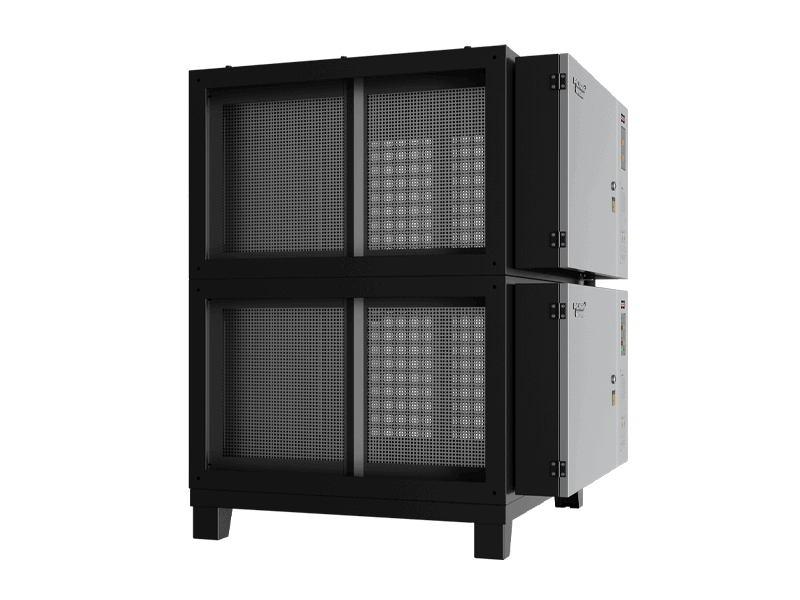
The cells themselves are built in a drawer format on the in-duct units and on the LK-E cabinets: they come out of the cabinet on their own rails and go back on the same rails. Off the machine they are soaked in an alkaline degreaser or run through a commercial dishwasher rather than scrubbed in place, which is why the plates are stainless steel and why the electrostatic stage has no media to buy. The integrated ESP hood page states that its cells come out from the front with no tools and no technician. Which isolation arrangement a given model carries is a question to settle with us in writing before a cleaning routine is written, and cell handling belongs to the kitchen team only where that answer is in hand. The duct, the fan and anything beyond the unit stay with a specialist. Where a wash stops restoring the outlet result, the question moves from cleaning to whether the cells or the whole unit are worth replacing, and that assessment is set out in commercial kitchen ESP replacement.
Two more things happen while the cells are out. The kitchen team drains and wipes the collection tray, because grease standing in a tray is grease available to be picked back up by the airstream. And the ionizing wires are looked over, because a broken wire disables a stage without stopping the machine; replacing one is a technician’s job.
The panel reports the machine’s condition rather than leaving it to be discovered at the outlet. Where the model carries the smart HMI panel it shows real-time voltage, current and electric field status with power, work and fault indicators, and the LK-E cabinets add work, clean and fault indicator ports plus a BMS port, so a building management system can carry the signal across an estate. The SPP supply suppresses arcs in microseconds and resets itself after a short circuit, which means an occasional arc is normal and a fault indicator that keeps coming back is not.
What the cleaning codes cover, and what they leave to the manufacturer
Every regime examined here is written around the hood and the duct; none of them schedules the collector cells inside an in-line unit. That division matters, because a site can be fully compliant on its duct cleaning and still be running a loaded ESP.
| Regime | What it schedules | What it says about equipment in the duct | On this site |
|---|---|---|---|
| NFPA 96 (United States; in Canada where a provincial building code adopts it, as set out in NFPA 96 in Canada) | Inspection of the exhaust system at intervals set by the cooking type, and cleaning of the contaminated parts to bare metal by a trained, qualified person | It schedules the exhaust system; it does not set a schedule for equipment installed inside it | Commercial kitchen exhaust cleaning requirements |
| BESA TR19 Grease (United Kingdom) | Starting intervals by hours of use, with the real trigger a measured grease deposit kept below a mean of 200 microns, verified after each clean | The deposit test is a duct-side measurement, not a test of an air cleaner | TR19 Grease cleaning standard |
| SCDF Fire Code 2023 (Singapore) | The entire exhaust duct and the kitchen hood degreased and cleaned at least once every 12 months, by a specialist, on record | NEA’s officers’ code asks premises to maintain and replace air cleaning systems to the manufacturer’s recommendation | Restaurant kitchen exhaust requirements in Singapore |
| BESA DW/172 (United Kingdom specification) | Visual inspection and baffle-separator cleaning at least weekly, and the duct at the intervals in its Table 12 | Notes that an electrostatic precipitator removes moisture and extends the life of disposable filters downstream of it | DW/172 kitchen ventilation specification |
This table answers who schedules what. It gives no cell interval, because none of these documents does; Singapore’s wording is the clearest on the point, sending the equipment back to the manufacturer’s recommendation.
Washable, consumable, or under warranty
An ESP is specified over disposable media on a heavy cookline because its collecting stage is washed rather than bought again, and the line between washable and consumable is the line the warranty follows.
| Part | Washed or replaced | Warranty position | What the buyer budgets |
|---|---|---|---|
| Collector cells (stainless steel plates) | Washed and returned to service | Named as a covered part in the one-year cover on the complete unit | Labor and detergent, no media |
| Mesh pre-filter | Washed with the cells | Within the one-year cover on the complete unit; not named as a separately warranted part | Labor only |
| SPP high-voltage power supply module | Replaced if it fails | Named as a covered part in the one-year cover | The part in the first year; labor and attendance quoted separately |
| UV-C lamps, where an odor stage is fitted | Replaced on their own service life | Consumable, excluded from warranty | Lamp cost at each change |
| Activated carbon media, where fitted | Replaced when exhausted | Consumable, excluded from warranty | Media cost at each change |
| Labor and site attendance | — | Not included; quoted separately | Either in-house time or a service call |
| Spare parts after a model is discontinued | — | Held in stock and supplied for one year after discontinuation | Parts remain available; price quoted at the time |
This table answers what recurs and what does not. It does not price a maintenance contract, and it assumes the odor stage that is actually fitted; a unit without UV or carbon has no consumable line at all, which is the recurring-cost comparison drawn in commercial kitchen exhaust cleaning requirements.
The inspection and change log
A maintenance regime that cannot be shown to an inspector or an insurer is a regime that will be argued about after an incident. The log below is the record we ask sites to keep for the unit itself, alongside the duct-cleaning certificates the codes require. It fits on one page, and it is the document to hand over when a building changes operator.
| Entry | Recorded by | What goes in the field | What it is used for later |
|---|---|---|---|
| Date and duty since the last visit | Kitchen team | Date, plus hours per day and any change of menu since the previous entry | Shows whether the interval still matches the load |
| Cells washed | Kitchen team or contractor | Which cells and the method used | Ties a performance question to a maintenance history |
| Pre-filter condition | Kitchen team | Washed, replaced, or found missing | The first thing to check when the interval seems too short |
| Ionizing wires | Looked over by whoever has the cells out; replaced by a technician | Intact or not, and the date a technician replaced any wire | Explains a drop in collection that cleaning did not fix |
| Tray drained | Kitchen team | Done, and whether the drain ran freely | Standing grease is a re-entrainment and a fire-load question |
| Panel status and faults | Kitchen team | Indicator state at the visit, and any fault that had recurred since the last one | A recurring fault is a service call, not a reset |
| UV lamps or carbon changed | Technician | Date and part, where an odor stage is fitted | Separates an odor complaint from a smoke complaint |
| Duct cleaning certificate reference | Site manager | The contractor’s certificate for the same period | Keeps the unit’s record and the code record in one file |
This log answers what happened and when. It does not diagnose a smoking outlet on its own; that route runs through capture, airflow and maintenance in the order set out in how to reduce smoke from commercial kitchen exhaust.
Writing the cleaning basis into the order and the contract
The basis for electrostatic precipitator cleaning belongs in the quotation and the contract, not in a manual read after the first complaint. Six lines go into the order: the duty basis, the cleaning interval, who does each item, the maintenance record, the warranty boundary and the efficiency basis. The same lines are copied into the record signed at handover, as set out on our electrostatic precipitator commissioning page.
The duty comes first, because an interval holds only for the load it was set on. Row 3 of our 10-Input ESP Enquiry Sheet, on the quotation page, asks for the operating hours per day and days per week. We set the cleaning interval for the site from the cooking on row 1 and those hours, and write it into the offer. The airflow on row 2 belongs in the same record, because a rebalanced airflow is one of the re-check triggers in the buyer record. Where the hours are not stated, the quotation states the hours it assumed.
In a tender the same rule is clause H3 of our 30-Clause Ecology Unit Specification Sheet, on the ecology unit specification page. The bidder states the interval in writing for the site with the configuration proposal, and no number is written into the specification. The clause is worded that way because a number in a tender can be contradicted by the first week of service.
Keep the efficiency figure and the cleaning basis apart in the contract. A tested figure belongs to one model, at one airflow, in its tested condition. It does not describe a cell between washes. Quote it with the model, the report number and the test condition, and keep it out of the clause that sets the cleaning.
| Line in the order or contract | What it fixes | Document that answers it |
|---|---|---|
| Duty basis | The cooking, the operating hours per day and days per week, and the design airflow behind the interval | The quotation, from rows 1 to 3 of the enquiry sheet |
| Cleaning interval for the collecting cells | The interval for this site, with no number written into a specification | The quotation or configuration proposal (clause H3) |
| Who does each item | Kitchen team or contractor, for each of the five items in a service visit | A schedule attached to the contract |
| Maintenance record | The entries the site keeps, and who holds the file | The inspection and change log, attached to the contract |
| Warranty boundary | One year on the complete unit, with the collecting cells and the SPP module named; UV lamps and carbon media excluded as consumables; labor and site attendance quoted separately | The quotation, in the same document as the interval |
| Efficiency basis | The model, the airflow, the report number and the test condition behind any figure the contract quotes | The report itself, read with our test report guide |
This table answers what the order should say about cleaning. It does not set the interval or price a service contract; the interval comes from us in writing for your duty.
Where this guide stops
- No interval, in any unit. The figure belongs to a model and a duty, and it is the one we state in writing with the quotation rather than one this page can publish for every kitchen.
- Our equipment, not everyone’s. The drawer format, the door interlock on the in-duct units, the washable stainless plates and the warranty boundary described here are how Polygee units are built. Another manufacturer’s cells may be fixed in place and may carry a different consumable line; read the manual for the machine you own.
- No performance recovery figure. We publish a tested grease removal result at rated airflow. We do not publish a figure for what a wash restores, because that is not something our third-party testing measured.
- The duct is a separate contract. Nothing here reduces the hood, duct and fan cleaning the codes require, or the records those codes ask for.
Buyer record
Have ready:
- The menu and the daily hours.
- The model and its rated airflow, against the design flow.
- Whether a UV or carbon stage is fitted.
- Who will pull the cells, kitchen team or contractor, and where they can be washed on site.
Ask the supplier for:
- The cleaning interval for your model and duty, in writing.
- The duty basis behind that interval, on the same quotation, so the contract shows which menu, hours and airflow it belongs to.
- The isolation arrangement the model carries, and the wash method the plates are rated for.
- The warranty boundary in the same document, naming what is consumable.
- The spare-parts position after discontinuation.
- The resistance at your design airflow, so the fan is not the thing that changes when the cells are clean again. Our complete units with the airflow distribution plate are rated at ≤150 Pa; ask for the figure at your flow.
Re-check the interval when:
- The menu adds wok, charbroiling or a fryer bank.
- The opening hours lengthen.
- A pre-filter is found missing, or the airflow is rebalanced.
- The panel shows a fault that keeps coming back, which is a service call rather than something to clear on site.
Frequently Asked Questions
- What decides how often electrostatic precipitator cells need cleaning?
- The grease that reaches the cells, which comes from the menu, the hours and the condition of everything upstream of them. A wok line or a charcoal grill loads a cell faster than a bakery, and a torn or missing mesh pre-filter shortens the interval again, because the coarse droplets it should catch land on the plates instead. We do not publish a general interval, because the load that sets it belongs to a model and a menu. We state the interval for your model and your duty in writing with the quotation. The cleaning codes do not settle it either: NFPA 96, BESA TR19 Grease and Singapore’s Fire Code schedule the hood and the duct, not the collector cells inside an in-line unit.
- How are electrostatic precipitator cells cleaned?
- Off the machine. On our units the cells are built in a drawer format, so they come out of the cabinet on their own rails and go back on the same rails, and they are soaked in an alkaline degreaser or run through a commercial dishwasher rather than scrubbed in place. Our FAQ sets out the order the site follows: switch the unit off and disconnect the power, then slide the cells out. In the same visit the kitchen team washes the mesh pre-filter and drains and wipes the collection tray, and the ionizing wires are looked over while the cells are out, with anything found broken left to a technician.
- What happens if electrostatic precipitator cells are not cleaned?
- The collecting surfaces lose area to the grease film that covers them, so less of what enters the unit stays in it and more passes to the duct and the outlet. That usually shows first as smoke returning to a discharge that had been clear. Grease that passes the unit lands in the duct, where it becomes part of the fire load the duct-cleaning codes exist to control, so the duct gets dirtier between visits even though its cleaning schedule has not changed. On the machine side, a fault indicator that keeps coming back after the supply has reset itself is a service call rather than a nuisance.
- Does an electrostatic precipitator need replacement filters?
- Not for the electrostatic stage. The collector cells and the mesh pre-filter are washed and returned to service, which is the reason an ESP is specified over disposable media on a heavy cookline. What is consumable sits downstream: UV-C lamps and activated carbon media are replaced on their own schedule. Our warranty runs one year on the complete unit and names the collecting cells and the SPP high-voltage power supply module as covered parts; UV lamps and carbon media are excluded as consumables, labor and site attendance are quoted separately, and spare parts are held in stock and supplied for a year after a model is discontinued.
Writing the maintenance section of a specification?
Send us the menu, the daily hours, the model or the design airflow, and whether an odor stage is part of the scheme. Our project team will come back with the cleaning interval for that model and duty in writing, the isolation arrangement and wash method for the cells, the warranty boundary naming what is consumable, the resistance at your design airflow, and a blank inspection and change log you can hand to the kitchen.
Talk to our project team →Reviewed by Law, Project Manager, 9 October 2026
Written by Law · Project Manager, PolygeeLaw manages kitchen exhaust filtration projects at Polygee, from spec review through duct-side ESP sizing and installation support. Polygee, founded in 2004, builds commercial kitchen exhaust filtration equipment. This article describes how our own equipment is built and maintained, and summarizes published cleaning codes for planning purposes only — it is not a compliance determination, so confirm the duties for a specific site with your contractor and the authority having jurisdiction.
References & further reading
- NFPA — NFPA 96, Standard for Ventilation Control and Fire Protection of Commercial Cooking Operations. nfpa.org
- Building Engineering Services Association — TR19 Grease and kitchen extract system cleaning. thebesa.com
- Singapore Civil Defence Force — Fire Code 2023, Clause 7.1.13, exhaust system for kitchen. scdf.gov.sg
- National Environment Agency, Singapore — Code of Practice for Environmental Control Officers for Specified Premises, Section 9. nea.gov.sg
- Polygee — kitchen electrostatic precipitator, LK-E series and integrated ESP hood product specifications. polygeeesp.com
Related reading
- Commercial kitchen exhaust cleaning requirements — the NFPA 96 inspection tiers for the hood, duct and fan, and why an inspection interval is not a cleaning calendar.
- How to reduce smoke from commercial kitchen exhaust — the order to work in when the outlet smokes, of which cell condition is one step.
- Electrostatic precipitator vs baffle filter — which stage each device works at, and why an ESP does not replace a hood filter.
- Kitchen ESP FAQ — the short answers, including the order to follow before the cells come out.