

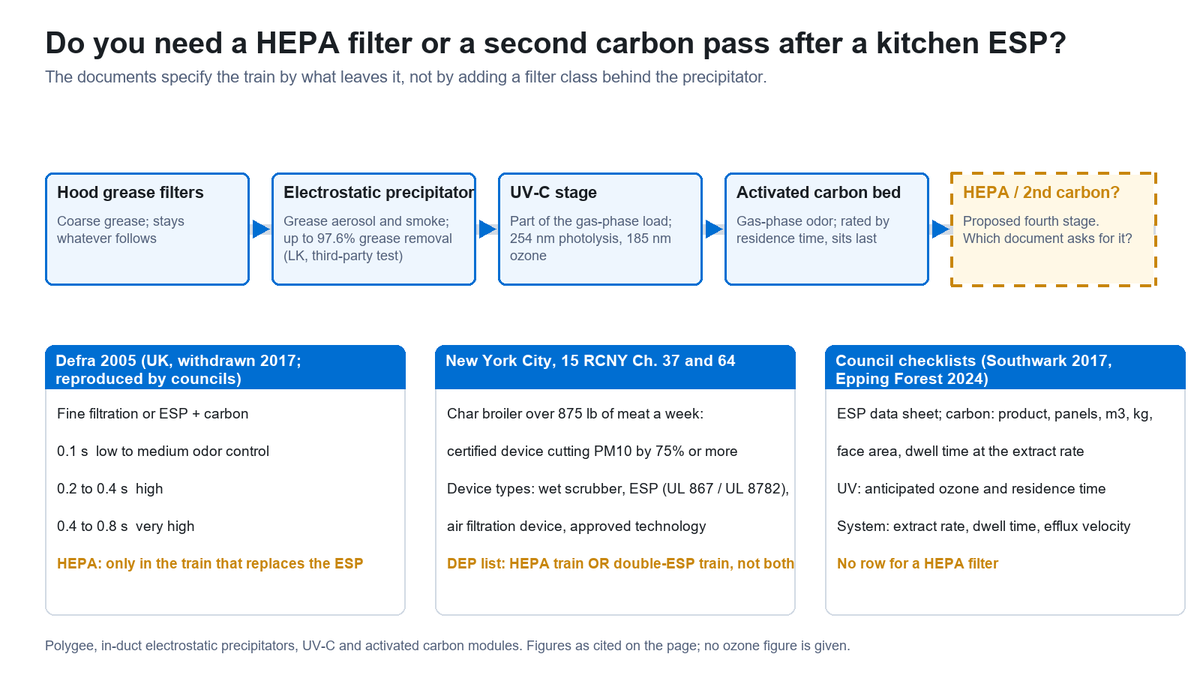
A HEPA filter is a pleated mechanical filter that, under the US definition, can theoretically remove at least 99.97% of particles at 0.3 microns. A hepa filter after electrostatic precipitator stages in a commercial kitchen exhaust is not what the regulations and council guidance we read ask for; the UK method asks for a carbon residence time and New York for a particulate reduction. This page sets out which document asks for what.
The request can arrive second-hand: a landlord’s consultant, a permit reviewer or a tender clause says the hood filters, the electrostatic precipitator, the UV-C lamps and the activated carbon bed are not enough, and that a HEPA filter or a second carbon pass should follow. If the document behind the request says exactly that, the clause governs. If it says something else, in units the request has lost on the way, the clause still governs, and this page is about reading it.
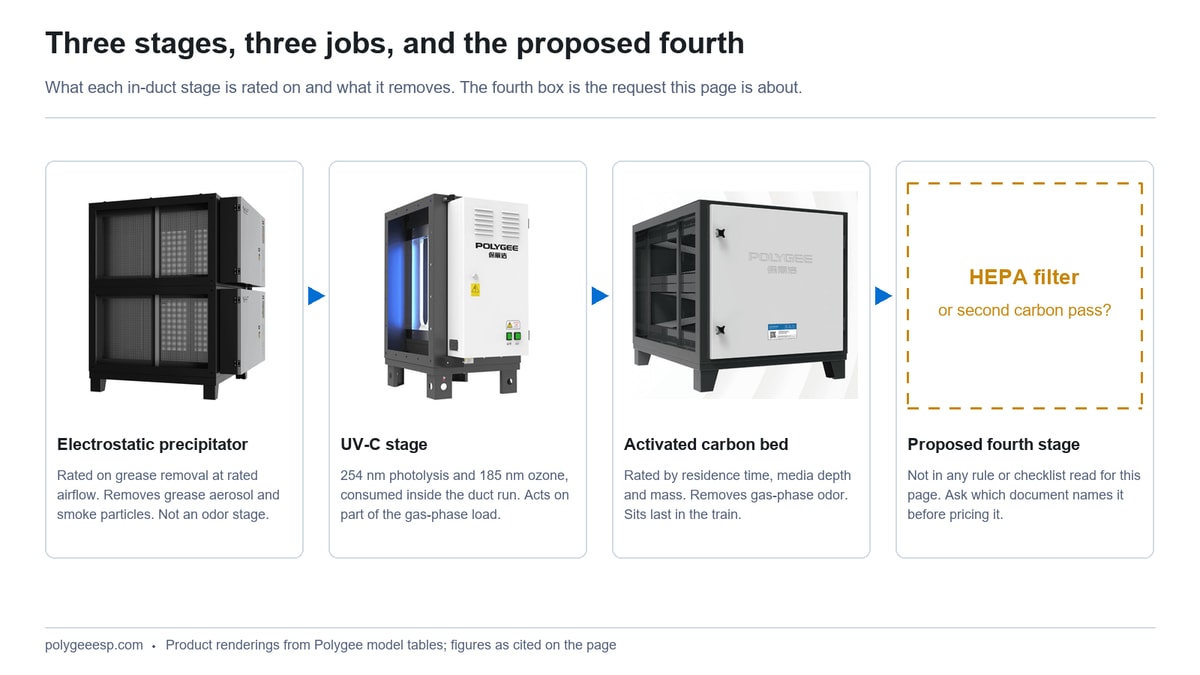
This page helps you decide whether a fourth stage belongs after the three-stage train, and which document to read before paying for it. It does not choose or order the three stages themselves, which is the job of our kitchen exhaust filtration guide, and it does not size a carbon bed, which the activated carbon filter guide does by residence time, face velocity and bed depth.
| Question | Short answer |
|---|---|
| Do I need a HEPA filter after a kitchen ESP? | Not in any document we read. The 2005 Defra guidance and the New York City certified-device lists treat a HEPA train and an electrostatic train as alternative particulate routes; neither places a HEPA filter behind a precipitator |
| What does New York actually require? | For a new under-fired or any chain-driven char broiler cooking more than 875 lb of meat a week, a certified emissions control device that cuts PM10 by 75% or more (Chapter 37); for an existing under-fired char broiler, a certified or field-tested device reaching a 75% PM reduction or a controlled emission of 10 mg/m³ or less, from the device types Chapter 64 lists; neither chapter names a filter class |
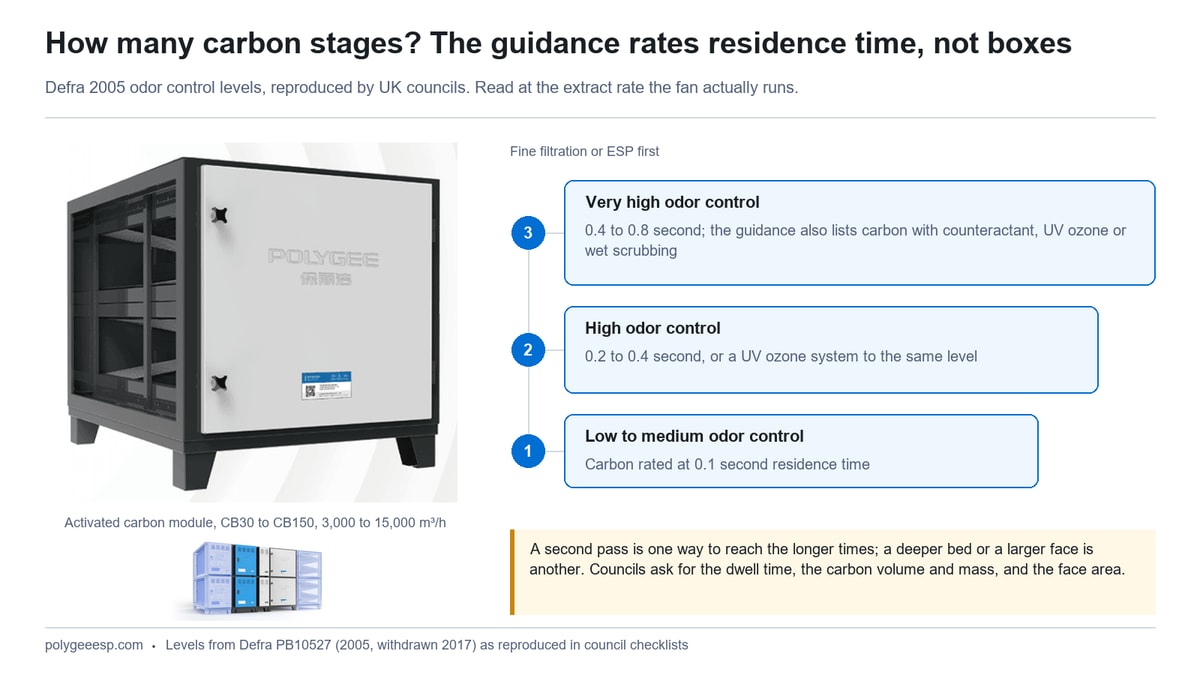
| How many carbon stages do I need? | The guidance rates residence time, not stages: 0.1 second for low to medium odor control, 0.2 to 0.4 second for high, 0.4 to 0.8 second for very high. A second pass is one way to reach the higher figures |
| Does carbon deal with the ozone from the UV stage? | Part of it, which is why carbon sits last; the Defra guidance still requires a system with an ozone or UV stage to discharge at high level |
| What about a hospital kitchen? | Ask which air stream the HEPA clause is written for. The filter class a hospital specifies for its supply air is not a requirement on the kitchen exhaust leaving the building |
| What does a fourth stage cost the system? | Resistance, which the fan must carry; replacement media on a grease-loaded duty; and access space. The Fourth-Stage Decision Sheet below lists the question to put to the authority before any of that is priced |
| Quick specs on this page | Figure | Basis |
|---|---|---|
| HEPA rating | At least 99.97% of 0.3 µm particles, the most penetrating particle size | US EPA, definition by the US Department of Energy |
| Electrostatic precipitator, smoke | Designed for 99% at 1 µm and 90% at 0.1 µm; the particle size at the discharge put at 0.3 microns or smaller | Defra 2005 section 4.7.3; DW/172 clause 24.6 as summarized on our DW/172 page |
| Polygee LK in-duct units, grease | Up to 97.6% grease removal, third-party tested at rated, evenly distributed airflow; a grease test, not a counting test | CMA-accredited test report |
| Carbon residence time levels | 0.1 s; 0.2 to 0.4 s; 0.4 to 0.8 s | Defra 2005 annex, reproduced in council checklists |
| Carbon bed limits | Inlet temperature of 40 °C as an upper limit; efficiency reduced above 75% relative humidity; particles in the gas stream make carbon filtration very questionable | Defra 2005 section 4.7.4 |
| Polygee UV-C and carbon modules | UV30 to UV150 and CB30 to CB150, 3,000 to 15,000 m³/h; in-duct precipitators from 2,000 m³/h; a complete in-duct unit with its airflow distribution plate at 150 Pa or less | Polygee model tables |
- What a HEPA filter is rated for, and what a kitchen ESP leaves behind
- Do you need a HEPA filter after a kitchen ESP? What the documents show
- How many carbon stages, and how to read a request for a second pass
- Ozone from the UV stage and the precipitator, and where the carbon sits
- Hospital kitchens: which air stream the HEPA clause is written for
- The Fourth-Stage Decision Sheet
- Where this guide stops
- Buyer record and key takeaways
- Frequently asked questions
What a HEPA filter is rated for, and what a kitchen ESP leaves behind
A HEPA filter is a particulate filtration grade; a kitchen precipitator is a grease and smoke collector; neither touches the gases that carry a cooking smell. Those three sentences frame every fourth-stage request, so they come first.
Why are HEPA filters tested at 0.3 microns?
Because, in the EPA’s explanation of the HEPA definition, 0.3 microns is the most penetrating particle size, so a rating there is a floor for every other size. The US Environmental Protection Agency’s explanation of the term gives the definition used by the Department of Energy: a pleated mechanical filter that can theoretically remove at least 99.97% of dust, pollen, mold, bacteria and other airborne particles at 0.3 microns, the most penetrating particle size, with larger and smaller particles trapped at higher efficiency. The same page notes that MERV ratings, the scale that appears on the New York City device lists discussed below, report a filter’s ability to capture particles between 0.3 and 10 microns.
The UK guidance that councils still reproduce uses the older European classes for the same idea. Table 4.6 of the 2005 Defra guidance on odour and noise from commercial kitchen exhaust, withdrawn in 2017 but quoted in the current Westminster, Bromley and Epping Forest documents, lists four high efficiency particulate air filter classes, Eurovent EU10 to EU13, at 85%, 95%, 99.5% and 99.95%. Its section 4.7.2 describes a fine filtration train of three stages: a disposable pleated filter as a secondary grease filter, a medium efficiency bag filter ideally at 95% capture, and an absolute filter ideally at 99%, with the warning that high efficiency or absolute filters bring high pressure drops and that the train will not deal with gaseous phase odors.
What do HEPA filters not remove?
Gases, which is the whole of the odor problem, and they are loaded by what a grease duct carries. A HEPA rating is a particle count; the molecules behind a cooking smell are in the gas phase and pass through a mechanical filter of any class, which is why the Defra text pairs its fine filtration train with a carbon stage and describes the filtration step as protection for the carbon against grease and particulate matter rather than as odor control in its own right. The same section says the fine filtration system may be preceded by a carbon filter in one configuration, but its working assumption, repeated in the cost tables, is filters first and carbon behind them.
The second limit is duty. In a kitchen exhaust the particles are grease aerosol and smoke, and they do not sit on a pleated medium the way dust does; they wet it. The Defra guidance writes the consequence into Table 4.8: fine or pre-filters carry a high pressure drop and require regular replacement, against a precipitator’s low pressure drop and effectiveness down to very small particle sizes. A final HEPA stage on a grease duct inherits both of those costs at the point in the train where the air is already cleanest.
Is an electrostatic filter better than a HEPA filter?
They do different jobs in the same position, and the documents we read treat them as alternatives, not as a pair. The 2005 Defra guidance says in section 4.7.3 that electrostatic precipitators can be designed to collect extensive quantities of smoke, with collection efficiencies of 99% at 1 micron and 90% at 0.1 micron; that their effectiveness is limited to removing the grease that adheres to smoke, so they should not be considered a primary source of odor control; that pre-filters should be fitted upstream to protect them from large contaminants passing the grease filters; and that the types used on kitchens are less effective above 60 °C and not suitable above 75% relative humidity. The UK ventilation specification DW/172, as summarized on our DW/172 guide, puts the particle size at the discharge of a precipitator at 0.3 microns or smaller, the same size a HEPA filter is tested at, and cautions that at higher velocities small particles can pass through untreated.
Our own figure is a different test and is given as one. In CMA-accredited third-party tests, LK in-duct units reached up to 97.6% grease removal at rated, evenly distributed airflow. That is a grease mass test, not a 0.3 micron counting test, and we do not translate one into the other. What the figure tells a buyer is which stage the precipitator is: the grease and smoke stage, selected on airflow and grease load, after which the question is whether an odor stage is required and at what level, not whether a second particle grade should follow.
| Stage | Rated on | Removes | Does not remove | What it costs the duct (Defra 2005, Table 4.8 and sections 4.7.3 and 4.7.4) |
|---|---|---|---|---|
| HEPA or absolute filter | Particulate efficiency at 0.3 µm, at least 99.97% under the US definition; 85% to 99.95% across the EU10 to EU13 classes in the 2005 UK table | Particles, with larger and smaller sizes trapped at higher efficiency than the rated size | Gas-phase odor molecules | High pressure drop; regular replacement; no gaseous odor removal |
| Electrostatic precipitator | Grease removal at rated airflow; designed for 99% at 1 µm and 90% at 0.1 µm | Grease aerosol and smoke particles | Gas-phase odor molecules; not a primary odor control | Low pressure drop; washing of the collector cells; specialist maintenance |
| UV-C stage | Lamp output and residence time in the chamber | Part of the gas-phase load by photolysis and the ozone it generates | Particles; it is not a collector | Pre-filtration required; residual ozone to disperse |
| Activated carbon bed | Residence time, media depth and mass | Gas-phase odor molecules; residual ozone, at a cost in capacity | Particles; grease blinds the working surface | Pressure drop rising as particles load it; replacement; inlet below 40 °C; efficiency reduced above 75% RH |
The table restates the 2005 Defra descriptions and the EPA definition as we read them; it does not rate any product, and the rows are the stage types the documents name, not a design.
Do you need a HEPA filter after a kitchen ESP? What the documents show
None of the regulations or guidance documents we read places a HEPA filter after an electrostatic precipitator; where HEPA appears at all, it is an alternative to the precipitator, in a train of its own. That is the finding from the three sources read for this page: the New York City rules, the UK council method, and the regional air district rule in California.
Does New York require a secondary HEPA filter after an ESP to meet the DEP smoke rules?
No. The New York City rules name a performance target and a list of device types, and HEPA appears in neither. Chapter 37 of Title 15 of the Rules of the City of New York, in section 37-02, provides that no person shall operate a new under-fired commercial char broiler used to cook more than 875 pounds of meat per week unless an ESP or other emissions control device, tested and certified under sections 37-05 and 37-06, has been installed, and that the device must reduce the char broiler’s baseline PM10 emissions, including condensable PM, at a reduction rate of 75% or greater. The same section applies the 75% figure to new and existing chain-driven char broilers, where a flameless catalytic oxidizer is the named example. The rule defines an electrostatic precipitator as a filtration device that removes fine particles, like dust and smoke, from a flowing gas using the force of an induced electrostatic charge, and calls it a type of emissions control device; it does not define or require a secondary filter.
For existing broilers, Chapter 64 applies the same 875 pound threshold to under-fired char broilers installed before 6 May 2016 and accepts a device that is either on the certified list or has passed a site-specific field test, reaching a 75% PM reduction or a controlled emission of 10 mg/m³ or less. Where neither a listed device nor a compliant non-certified device can be installed, a professional engineer or registered architect submits an assessment; if the assessment finds a device that reaches at least 25% but less than 75% with the controlled emission above 10 mg/m³, that device is installed and a further assessment follows within two years. Section 64-03 then gives a closed list of device types: wet scrubber systems and air filtration devices complying with UL 1978 (2010); electrostatic precipitators complying with UL 867 (2011) or UL 8782 (2017), with a certificate of approval from the Fire Department and sized to the cooking appliance as the manufacturer specifies; air filtration devices such as a carbon cartridge; and other technology approved by the department. A HEPA filter can be one way to build an air filtration device under that list. It is not a stage the rule adds behind a precipitator.
The department’s own list of certified devices for under-fired char broilers shows how the makers have read that. The same manufacturer appears twice: once with a prefilter, a MERV 15 filter, a HEPA filter and an optional odor control filter, and once with a MERV 15 filter, two electrostatic stages and the same optional odor control filter. Another entry is a prefilter, a bag filter and a 95% DOP filter rated MERV 16; another is a single or double pass electrostatic precipitator. Each is a complete certified train. In none of them does a HEPA filter follow an electrostatic stage. The buyer in New York asking whether a secondary HEPA is required to meet the smoke rule is asking in the wrong unit: the rule is written in PM10 reduction and in device types, a listed electrostatic train is one of the routes the department certifies, and the listing, the appliance match, the sizing and the maintenance conditions, not a filter class, are the things to check.
Two cautions belong here. The rule for new wood fired and anthracite coal fired cook stoves in Chapter 38 is written the same way, with a 75% total PM reduction, a wet scrubber, electrostatic precipitator or air filtration device as the device and UL 867 or UL 710 named for a precipitator, and its certified list again pairs a HEPA train and a double electrostatic train from the same makers; it is a different rule for a different appliance. And the UL conformance in section 64-03 is a listing question for the specific model proposed, which is why our UL 867 page sets out which of our models carry which listing rather than this page claiming a place on any list.
Where does HEPA appear in the UK guidance, and where does it not?
In the 2005 Defra guidance it appears as a route that replaces the precipitator, and in the current council checklists it does not appear at all. The Defra cost tables in section 4.10 list the abatement systems the guidance costed for a general kitchen: a panel and bag filter train and a panel, bag and HEPA train, both marked as grease control only; pre and fine filters followed by carbon; a panel, bag and HEPA train followed by carbon; an ESP followed by carbon; an ESP followed by an odor counteractant; and an ESP followed by an in-line UV or ozone system; for the high and very high grease and smoke case it costs the three ESP trains again. The HEPA train and the ESP train stand side by side. There is no line for an ESP followed by a HEPA filter; Table 4.12 gives capital and running figures for each route in each airflow band, at 2004 prices and without installation, and the guidance lists them without endorsing either route.
The submission checklists councils use now follow the same shape. The London Borough of Southwark’s technical guidance on air quality of August 2017 asks for a manufacturer’s data sheet for any filter proposed, including electrostatic precipitators, then a separate and longer list for carbon filters, then odor counteractant, UV and system-level figures; its introduction says it is usual for a filtration system to have three stages. Epping Forest District Council’s commercial kitchen checklist of April 2024 has rows for electrostatic precipitators, carbon filters and UV systems, and reproduces the Defra odor control levels with their carbon residence times. Neither has a row for a HEPA filter. A UK buyer told that the council wants HEPA behind the precipitator should ask for the page, because the published checklists want a precipitator data sheet and a carbon dwell time.
When would a final particulate filter after an ESP make sense?
When a document you can read writes a particle grade into the exhaust condition, and the price of the resistance and the media is accepted with it. If it does, the clause governs; it is not what the general rules ask for. The honest cases are a reviewer who has specified a filter class for a particular discharge, a landlord manual that has copied a supply-air filter class into its exhaust clause, or a system that recirculates treated air into the room, which is a different product under different rules and not what we supply, as our UL 710B guide explains.
Before a filter is bought for any of those, three things are read: the clause, so that the air stream and the test basis are known; the fan curve, because the Defra text puts high pressure drops against absolute filters and every added stage is carried in the fan selection; and the replacement interval, because the Defra text pairs fine and absolute filters with regular replacement, on a duty where what reaches them is the grease and smoke the precipitator did not collect. A reviewer who wants a particle result from a grease duct should be shown the test result for the precipitator selected inside its rated airflow band, which is where the DW/172 caution on velocity lives, before a filter is added that will be changed on a schedule nobody has costed. We say that as the maker of the precipitator; the reviewer’s clause outranks our opinion, which is why the question in the sheet below is addressed to them.
How many carbon stages, and how to read a request for a second pass
The guidance does not count carbon stages; it rates residence time, and a request for a second pass is read here as a request for a longer one, to be checked against the level. Reading the number behind the request is what decides whether a second module, a deeper bed or no change is the answer.
How many carbon filter stages are needed for odor control?
As many as it takes to reach the residence time the odor control level calls for, which in the UK method is a figure in seconds. The 2005 Defra annex pairs fine filtration or an electrostatic precipitator with carbon filtration rated at a 0.1 second residence time for low to medium odor control; with carbon rated at 0.2 to 0.4 second, or with a UV ozone system to the same level, for high odor control; and with carbon rated at 0.4 to 0.8 second for very high odor control, where it also lists carbon with a counteractant, UV ozone and wet scrubbing as alternatives at that level. Westminster’s 2021 guidance reproduces the Defra method, and the Epping Forest checklist reproduces the three residence time levels without the wet scrubbing line and with the counteractant line written for fine filtration only; the residence times are the same in all three. Section 4.7.4 of the same guidance gives the design range behind those levels: residence time typically between 0.1 and 0.2 second for gas streams with a relatively low concentration of odorants, rising to 1 to 3 seconds for high concentrations; linear velocities through the bed from 0.1 to 0.6 m/s; an inlet temperature of 40 °C as an upper limit; and reduced efficiency above 75% relative humidity, where preferential adsorption of water can leave the carbon inactive.
A second carbon pass of the same media depth, at the same face velocity and with no bypass, is one way to double residence time; a single bed twice as deep at the same face area is another; a larger face area at the same depth lowers the velocity and achieves part of the same thing. Which of the three fits a plant room is a layout question. What the council reads is the dwell time at the extract rate, and the Southwark guidance lists what it wants with it: the nature and product type of the carbon, the total number of carbon panels in the bed, the replacement frequency with its assumptions stated, the total volume of carbon in cubic meters, the total mass in kilograms, the total surface area exposed to the exhausted air, and the dwell time of the gases in the filter compartment with the control setting at which it is achieved, plus the extract rate, the kitchen volume and the efflux velocity for the system, and a statement of how a variable speed fan or dampers change the dwell time. Our carbon filter guide works the same numbers from the module side: face area, media depth, face velocity, residence time and a breakthrough check at the discharge.
Do we need carbon after an ESP for a ramen restaurant in a UK food court?
Only if the odor control level set for the unit calls for it, and the level is set by the landlord’s conditions and the council’s method, not by the precipitator. A precipitator is the particle stage: under the Defra text it is not a primary source of odor control, and under DW/172 it is the particulate stage of pollution control, selected after the primary separators. Whether a carbon bed follows it is decided by scoring the site, and the four-part method, with its cooking type, dispersion, proximity and size items, is set out on our UK odour control page. A kitchen in a shared food court is scored on proximity against the measured distance to the neighboring tenants and the mall’s own air intakes, and on dispersion against where the shared extract actually terminates; the level that produces is what fixes the residence time, and the residence time is what fixes whether one carbon module is enough.
Two practical points follow. The food court’s shared extract may be scored once for every tenant, in which case the landlord’s manual decides the stage list and the tenant decides the module; our food court guide covers who owns which decision. And a carbon bed earns its place only after the particle stage, because the Defra text is blunt about particles in the gas stream: they seriously interfere with the efficiency of the carbon bed and increase its pressure drop, and where particulate or condensing material is present the use of carbon filtration is very questionable. The precipitator is what makes the carbon bed a reasonable purchase; it does not replace it.
How do I size activated carbon after an ESP for a curry kitchen or a grill?
By the residence time the level calls for, at the design extract rate, with the inlet temperature and humidity checked against the carbon’s limits. The inputs are the ones the Southwark and Epping checklists ask for and the ones our carbon guide turns into a bed: design airflow with its minimum and maximum, hours by daypart, cuisine and fuel, the position of the precipitator and any UV stage, the expected inlet temperature and humidity, and the wording of the odor condition. A fried food menu drives the grease load on the precipitator; the odorant concentration, which the Defra text ties to the longer residence times, is set by the menu and the scored level rather than assumed from the name of the cuisine. In our range the carbon modules CB30 to CB150 cover 3,000 to 15,000 m³/h, and the airflow that passes through a module and its stated media depth decide the residence time it delivers, so a request for a second pass is answered with a residence time figure at the design airflow, not with a count of boxes.
| Odor control level (Defra 2005 annex, as reproduced by councils) | Particulate stage | Carbon residence time | Alternatives listed at the same level (Defra) | What a second carbon pass means here (our reading) |
|---|---|---|---|---|
| Low to medium | Fine filtration or ESP | 0.1 second | Fine filtration with a counteractant or neutralising system | One module, with its residence time checked at design airflow against 0.1 s |
| High | Fine filtration or ESP | 0.2 to 0.4 second | UV ozone system to the same level | A way to reach 0.4 s where one module gives 0.2 s at design airflow |
| Very high | Fine filtration or ESP | 0.4 to 0.8 second | Carbon with counteractant; UV ozone; wet scrubbing | Two passes, a deeper bed or a larger face where one module falls short, with the dwell time stated at the extract rate |
The first four columns restate the odor arrestment plant performance list of the 2005 Defra guidance, withdrawn in 2017; the last column is our reading. Which level a site falls in is scored by the council’s method, and the residence time is read at the extract rate the fan actually runs.
Ozone from the UV stage and the precipitator, and where the carbon sits
Ozone in a treated kitchen exhaust has more than one source, and the carbon bed is placed last partly because of it; the guidance nevertheless requires a system with an ozone or UV stage to discharge at high level, whatever the carbon takes up. That is why a question about how many carbon stages the ozone needs has a two-part answer.
Where does the ozone come from, and is it intentional?
In our UV-C modules it is intentional, and the corona in a precipitator can produce it as a by-product. The UV kitchen odor control page sets out the design: the lamps emit at 254 nm, which photolyses odor molecules directly, and at 185 nm, which splits oxygen so that ozone forms inside the chamber and oxidizes what photolysis has opened; the chamber is enclosed, a safety interlock cuts the lamps when the access door is opened, and the duct run after the lamp rack is sized so that the ozone is consumed in the oxidation stage before discharge. The corona in an electrostatic precipitator is a second source: a NIST study of in-duct electrostatic air filters, summarized on the institute’s publication page, reports that they are an effective particulate control for 20 to 100 nm ultrafine particles while having the potential to increase indoor ozone concentrations due to corona discharge; the study used residential units, and the figures are not ours.
The 2005 Defra guidance, in section 4.7.6, describes the in-line oxidation approach in the same terms, with a typical dose rate for an ozone system treating restaurant exhaust of 1 ppm by volume and average reaction times to completely oxidise material of as much as 20 seconds, which it says must be taken into account when designing the duct downstream of the injection device; it adds that ozone and oxygen ions degrade faster in high moisture or above 35 °C. The sentence that matters for the fourth-stage question comes next: due consideration needs to be given to residual ozone, complete degradation of ozone is unlikely to take place within the ductwork, and therefore the extraction system must discharge at high level, with restricted application in areas housing multiple commercial kitchens. Our low-level discharge guide covers what that means for the outlet.
Does carbon after the UV stage handle the residual ozone?
Part of it, and that is why the bed is last in the train rather than why it is there. Our carbon guide states the mechanism: residual ozone that survives the duct run after the lamps is decomposed on the carbon and uses some of its capacity, which is a reason to keep the UV stage between the precipitator and the carbon and the carbon last. The capacity it uses is capacity not available for odor, so a UV stage upstream is one of the inputs to the residence time calculation rather than a reason to add a separate module for ozone. Councils ask the question directly: the Epping Forest checklist wants, for any UV system proposed, the anticipated level of ozone being generated and the anticipated residence time, alongside the manufacturer’s data sheet. Our published record does not carry an ozone generation figure for the UV modules, and this page does not invent one; the figure for a specific model and airflow is requested from us in writing and supplied once our technical department has confirmed it, and the Defra requirement for high-level discharge stands regardless of what the carbon absorbs.
| Ozone source | Why it is there | What deals with it | What does not change |
|---|---|---|---|
| UV-C lamps at 185 nm | Intentional: the ozone oxidizes what the 254 nm photolysis has opened | Reaction in the duct run after the lamp rack, sized for it; the carbon bed last, at a cost in capacity | The Defra requirement that a system with an ozone or UV stage discharge at high level |
| Corona in the precipitator | By-product of charging the particles | The same downstream stages | The precipitator’s own selection, which is on grease and smoke |
| Residual ozone at the outlet | What survives reaction and adsorption | Dispersion at the outlet | Outlet height and velocity, decided by the authority |
Hospital kitchens: which air stream the HEPA clause is written for
The filter class a hospital specifies for its supply air concerns a different air stream from the kitchen exhaust; the first thing to establish is which stream the clause the reviewer is quoting was written for. We say that with a limit stated plainly: we could not read the Abu Dhabi food service design guideline or the health facility guidelines that AI answers cite for this question, so this section quotes no clause from them.
Do I need HEPA filters after an ESP for a hospital cafeteria kitchen exhaust in Abu Dhabi?
Ask the reviewer for the clause and the air stream before anything is priced, because the two readings lead to different equipment. If the clause is a filter class for air supplied to a ward, theater or pharmacy, it governs the air handling unit that serves those rooms and says nothing about the grease duct leaving the cafeteria kitchen. If the clause is a condition on the kitchen exhaust, the questions are the ones on this page: what reduction or what odor level it asks for, whether it names a device type or a filter grade, and what test basis it accepts. The published Abu Dhabi design guideline for food service premises and the Department of Health’s facility guidelines are the documents to ask about by name; we did not obtain readable copies while preparing this page and will not characterize what they require.
What a hospital kitchen does change is the receptor. A cafeteria exhaust on a hospital site may terminate near the air intakes of the buildings it serves, and an intake is a sensitive receptor, scored on its actual distance, which puts the outlet position under scrutiny. Our activated carbon module page names applications near hospitals and residences as the ones where a carbon polish is specified for residual VOCs and trace odors; that is a reason to score the site and set the carbon residence time from the level it produces, and to look at the outlet position, not a reason for a particle grade behind the precipitator. For a hospital kitchen on our own record, the Heze hospital canteen case describes a hood-integrated electrostatic installation and the documents that went with it; it is a case description, not a claim about any other site’s approval.
For a hospital canteen frying most of its food, is an ESP alone enough, or do UV and carbon belong too?
The precipitator is the grease and smoke stage and does not act on odor, so the answer is decided by whether the site has an odor condition and how close the intake is. Frying produces a high grease aerosol load, which is the precipitator’s job and the reason it is selected inside its rated airflow band and washed on a schedule. Whether the gas-phase load behind it needs a UV stage, a carbon bed or both is the odor control level question of the previous sections: a canteen whose outlet is far from any intake and window may sit at a low level and run on the precipitator with a short carbon residence time or none; the same canteen with an intake within the distance the authority watches sits at a high or very high level and needs the residence time that goes with it. Our kitchen exhaust filtration guide walks the stage list against airflow and menu; this page adds only that the evidence to put in front of a hospital reviewer is a data sheet and a dwell time, with the reviewer confirming what the condition requires, rather than a filter class borrowed from the ward.
The Fourth-Stage Decision Sheet
The sheet is the record to fill when someone proposes a stage beyond the three-stage train. Every row ends in the question to put to the authority or landlord before the stage is priced, because in the documents reviewed here the authority’s wording decides the row, and the equipment follows it.
The Fourth-Stage Decision Sheet: six proposed additions, what each removes, which document asks for it, what it costs the system, and the one question to ask first.
| Proposed addition | What it removes | Which document we read asks for it | What it costs the system | Ask the authority or landlord before buying | What to send us |
|---|---|---|---|---|---|
| A HEPA filter after the precipitator | Particles the precipitator passed; no odor | None of the rules or checklists reviewed; HEPA appears only as an alternative train to the precipitator | High pressure drop; media that loads on what the precipitator did not collect and is replaced rather than washed; access space | Which clause names a filter class for the exhaust, and what test basis it accepts | The clause; the fan curve; the design airflow |
| A second carbon pass | More of the gas-phase odor, at a longer residence time | The Defra levels, where the level requires 0.2 to 0.8 s and one module gives less at the extract rate | A second module’s resistance and replacement; plant room length | Which odor control level the site is scored at, and the residence time it expects | Design airflow with turndown; cuisine and fuel; the scored level |
| A deeper single carbon bed | The same residence time as a second pass at the same airflow and media volume, in one housing | The same levels; the choice between depth and a second pass is layout | Resistance in one place; one replacement event | Whether the dwell time may be stated at design flow or at maximum flow | The plant room envelope; the fan schedule |
| UV-C stage without carbon | Part of the gas-phase load by photolysis and oxidation | The Defra high and very high levels list UV ozone as an alternative to carbon at the same level | Lamp replacement; the duct run after the lamps; residual ozone, which the guidance requires to be discharged at high level | Whether the outlet can be at high level, and what ozone figure the council wants stated | Outlet position and height; the odor condition wording |
| No fourth stage | Nothing more; the three stages as selected | Where the scored level is met by the precipitator and the carbon residence time already provided | Nothing added; the fan selection carries the train as built, with each stage’s resistance from its own data: a complete in-duct precipitator of ours with its distribution plate at 150 Pa or less, and the UV and carbon modules by model | Written confirmation that the submitted data sheets and dwell time meet the condition | The data sheets as submitted |
| A different filter grade, such as MERV 15 or a 95% DOP filter | Particles, as a listed train in some US device lists | New York City certified lists, as part of a complete train with or instead of electrostatic stages | Resistance and replacement, as for any media filter | Whether the device must be on the department’s certified list, and which listing | The appliance, the weekly cooking load, the proposed device and its listing |
Two things the sheet does not do. It does not tell you what any council, department or landlord will accept, because that is a decision on the documents submitted; and it does not price a fan, because the resistance in the fourth column is carried by a fan selected by your engineer at your airflow. It tells you which question settles each row before equipment is quoted.
Where this guide stops
Four things are deliberately missing. An ozone generation figure for our UV-C modules, because our published record does not carry one and councils ask for it in writing per model, which is how we give it. The Abu Dhabi food service design guideline and health facility guidelines, and ASHRAE 170, because we did not read them and will not summarize them from search results. Any statement that a model of ours is on the New York City certified lists, because that is a listing question answered per model on our UL 867 page and by the department. And any claim that a HEPA filter never belongs in a kitchen exhaust; a reviewer can write one in, and then the clause, not this page, governs.
The three layers of acceptance apply to every stage on this page. The equipment data, from third-party tests and our model tables, is the first; what each stage removes and at what resistance. The installation is the second: where the stages sit, how they are accessed and what the fan was selected for. The system in operation is the third: what the neighbor smells, what the inspector measures and what the council concludes once the kitchen is trading. A fourth stage can pass the first layer and add nothing to the third, which is why the sheet asks the authority first.
Buyer record and key takeaways
Before a fourth stage is ordered, these items are in your file.
- The document and clause behind the request, in its own words, with the air stream it applies to and the test basis or device list it names.
- For a US char broiler or cook stove, the weekly cooking load, the appliance type and installation date, and the department’s certified list for that appliance.
- For a UK site, the scored odor control level and the residence time it expects, with the extract rate at which the dwell time will be stated.
- The design airflow with its minimum and maximum, the cuisine and fuel, and the expected inlet temperature and humidity at the carbon bed.
- The position of the precipitator and any UV stage in the duct, and the outlet height and distance to the nearest intake or window.
- The resistance of every stage at the design airflow, carried into the fan selection by your engineer.
Key takeaways
- A HEPA filter and an electrostatic precipitator are alternative particulate routes in the 2005 Defra guidance and on the New York City certified lists; no document we read places one behind the other.
- New York writes its char broiler rules in PM10 reduction and device types: 75% or more above 875 lb a week, or for an existing under-fired broiler a controlled emission of 10 mg/m³ or less; Chapter 64 lists wet scrubbers, precipitators with UL 867 or UL 8782 and a Fire Department certificate, air filtration devices and approved technology.
- The number of carbon stages is a residence time question: 0.1 s, 0.2 to 0.4 s, or 0.4 to 0.8 s by odor control level, stated at the extract rate with the carbon volume, mass and face area councils ask for.
- Carbon sits last partly because of ozone, from the 185 nm lamps and the corona; the Defra guidance still requires a system with a UV or ozone stage to discharge at high level.
- In a hospital, ask which air stream the HEPA clause governs; the supply-air class for a ward is not a condition on the kitchen exhaust.
- The Fourth-Stage Decision Sheet is the record to fill before any stage beyond the three is priced, starting with the authority’s column.
Frequently asked questions
- Does an electrostatic precipitator replace a HEPA filter in a kitchen exhaust?
- In the documents we read they are two routes to the same particulate stage, not a pair. The withdrawn 2005 Defra guidance lists a panel, bag and HEPA train and an electrostatic precipitator train as alternative ways to control grease and smoke, and the New York City list of certified devices for under-fired char broilers carries a prefilter, MERV 15 and HEPA train beside a MERV 15 and double electrostatic train from the same makers. Neither document places a HEPA filter after a precipitator. A precipitator is selected on grease removal at rated airflow; a HEPA filter is rated on its efficiency at 0.3 microns, and a grease duct loads it.
- Can a HEPA filter be installed after an ESP in a grease duct?
- Physically yes, and the Defra guidance warns what it costs: high efficiency or absolute filters bring high pressure drops, and the fine filtration train it describes exists to protect a carbon stage, not to polish an electrostatic one. If a reviewer has written a filter class into the exhaust condition, ask for the clause, the air stream it applies to and the test basis, then price the fan, the access and the replacement interval before the filter. If no document asks for it, check instead whether the site has an odor condition and whether the carbon residence time already provided meets it, because that is the unit odor conditions are written in.
- How many carbon filters are needed after an electrostatic precipitator?
- The guidance does not count filters; it rates residence time. The 2005 Defra annex, reproduced in current council checklists, pairs fine filtration or an electrostatic precipitator with carbon rated at 0.1 second for low to medium odor control, 0.2 to 0.4 second for high, and 0.4 to 0.8 second for very high. A second carbon pass is one way to reach the higher figures; a deeper single bed at the same face velocity is another. Councils such as Southwark and Epping Forest ask for the dwell time, the carbon volume and mass, the exposed face area and the extract rate the dwell time was calculated at.
- Does activated carbon remove the ozone from a UV stage after an ESP?
- Part of it. Residual ozone that survives the duct run after the lamps is decomposed on the carbon and uses some of its capacity, which is one reason the carbon bed sits last in the train, after the precipitator and the UV stage. The 2005 Defra guidance did not treat carbon as the answer to residual ozone: it said complete degradation of ozone is unlikely to take place within the ductwork, so a system with an ozone or UV stage must discharge at high level. Our record does not publish an ozone generation figure for the UV modules; councils ask for one, and the figure for a specific model is requested in writing and supplied once our technical department has confirmed it.
Been told to add a HEPA filter or a second carbon pass?
Send us the request in its own words, with the document it cites if you have it, the design airflow and its turndown, the cuisine and fuel, the position of the precipitator and any UV stage, and the outlet position with its distance to the nearest intake or window. You get back a reading of which row of the Fourth-Stage Decision Sheet the request falls in, the carbon residence time at your airflow for the level you are scored at, the data sheets councils ask for, the resistance of the train for your engineer’s fan selection, and, for a UV stage, a written answer on the ozone figure for the model proposed once our technical department has confirmed it. Whether the authority accepts the train stays with the authority; what you will not get from us is a HEPA filter sold on a clause nobody has read.
Send the request and the airflow →
If the train is already chosen, the kitchen ecology unit page sets out the three stages and their airflow ranges, and the in-duct electrostatic precipitator page covers the particle stage the rest of the train depends on.
Why we write this. The request for a fourth stage reaches a buyer as a sentence without its source, and the source can say something more useful: a reduction percentage, a residence time, a device list. This page puts the documents back under the sentence, from the US rule and certified lists, the UK guidance and council checklists, and our own model data, so that a buyer can ask the authority one precise question before paying for resistance. It gives no ozone figure our record does not hold, and no promise that any stage secures an approval.
Law manages project delivery at Polygee. Polygee, founded in 2004, manufactures the in-duct electrostatic precipitators, UV-C and activated carbon modules and kitchen ecology units named here and has exported to 50 countries. The rules, guidance and certified lists cited on this page were read in the sources listed below; equipment figures are from third-party test reports and Polygee’s published model tables, and no figure is given where the record holds none.
References & further reading
- United States Environmental Protection Agency, What is a HEPA filter? Indoor Air Quality. epa.gov
- Department for Environment, Food and Rural Affairs, Guidance on the control of odour and noise from commercial kitchen exhaust systems, January 2005, reference PB10527: sections 4.7.2 to 4.7.6 and 4.10, Tables 4.6, 4.8 and 4.12, and the odour arrestment plant performance annex. assets.publishing.service.gov.uk; withdrawn on 15 September 2017, as recorded on its gov.uk publication page.
- Rules of the City of New York, Title 15, Chapter 37, Emission Reduction Technologies for Char Broilers, section 37-02, effective 16 September 2016. codelibrary.amlegal.com
- Rules of the City of New York, Title 15, Chapter 64, Emissions Reduction Technologies for Existing Under-Fired Commercial Char Broilers, sections 64-02 and 64-03. codelibrary.amlegal.com
- Rules of the City of New York, Title 15, Chapter 38, Emissions from Cook Stoves, section 38-02. codelibrary.amlegal.com
- New York City Department of Environmental Protection, Approved Under-Fired Commercial Char Broiler Emissions Control Technology, certified device list. nyc.gov; and the corresponding approved cook stove technology list.
- London Borough of Southwark, Technical Guidance on Air Quality, August 2017, commercial kitchen extraction submission requirements. southwark.gov.uk
- Epping Forest District Council, Commercial Kitchen Checklist, April 2024. eppingforestdc.gov.uk
- National Institute of Standards and Technology, Ultrafine particle removal and ozone generation by in-duct electrostatic precipitators, publication page with abstract. nist.gov
- South Coast Air Quality Management District, Rule 1138, Control of Emissions from Restaurant Operations, for the regional rule that applies to chain-driven char broilers in the Los Angeles basin. aqmd.gov
Related reading
- Kitchen exhaust filtration: which stages, in what order: the three pollutants, the stage each one needs, and the airflow and menu bands that decide the list.
- Activated carbon filters for commercial kitchen exhaust: residence time, face velocity and bed depth, and the breakthrough check at the discharge.
- Commercial kitchen odour control in the UK: the four-part scoring method and the three scheme routes that set the odor control level.
- Ecology unit low-level discharge: why the outlet height is decided by the authority, and what residual ozone means for it.