

An electrostatic precipitator (ESP) is an air-cleaning device that charges the particles in a gas stream with a high-voltage field and collects them on plates or tubes of the opposite charge, so the gas leaves cleaner without passing through a filter medium.
The physics is the same on a cement kiln and over a wok range. The device is often shortened to precipitator or ESP. The particle decides the type, the cleaning routine and the standard that applies. Read this page and you can name the type a quotation describes, check it against your gas stream, and send a supplier the inputs that make the quotation answerable.
This page helps you decide which type of electrostatic precipitator a gas stream calls for and what to ask for in a quotation. It does not select or size a model; sizing and pricing live on the kitchen electrostatic precipitator range. For a multi-stage kitchen treatment train, see what an ecology unit is.
| Question | Our answer |
|---|---|
| What an electrostatic precipitator is | An electrostatic precipitator (ESP) is an air-cleaning device that charges the particles in a gas stream with a high-voltage field and collects them on plates or tubes of the opposite charge, so the gas leaves cleaner without passing through a filter medium. |
| How it works | For a kitchen unit, in six steps: a metal mesh pre-filter, an ionizer that charges the particles in a positive corona, collector plates alternating between high voltage and ground that hold the charged particles, and, for the drawer cells in our in-duct units, a wash of the withdrawn cells in place of the rapping a dry industrial unit uses. Efficiency follows plate area per unit of airflow and the condition of the plates. |
| The types | One axis is how the collected material comes off the plates. One is the shape of the collection surface. And one, which sits outside the usual classification but decides more than either for a commercial kitchen, is whether the machine charges and collects in the same place or in two separate places. |
| Kitchen vs industrial | A kitchen ESP is a two-stage, plate-type electrostatic precipitator that takes grease aerosol and smoke out of cooking exhaust, with collector cells that slide out for washing. An industrial ESP is a multi-field precipitator for process gas, cleaned by rapping or water rinsing. |
| Where it is the wrong answer | The target is a gas, not a particle. |
| Not on this page | Model selection, sizing, pricing and cleaning intervals; those live on the product pages. |
- What an electrostatic precipitator is and how it works
- How a kitchen electrostatic precipitator works, step by step
- Types of electrostatic precipitator: three axes
- Kitchen ESP vs industrial ESP: The 8-Row Kitchen-vs-Industrial ESP Check
- Applications, grouped by what the gas stream is like
- Which standards prove what
- When an electrostatic precipitator is the wrong answer
- Buyer record and key takeaways
- Frequently asked questions
What an electrostatic precipitator is and how it works
Whatever the type, the EPA describes a precipitator as being made up of four components. They appear in a power station and in a duct-mounted cabinet, at very different sizes.
| Component | What the EPA says it does | What it looks like in a kitchen unit |
|---|---|---|
| Gas distribution plates | Several perforated plates that help maintain proper flow distribution of the entering gas stream | The airflow distribution plate fitted as standard in our in-duct units, and the reason the published resistance figure is for the complete unit |
| Discharge electrodes | Energised electrodes that create ions, which collide with particles and apply the charge | The charging electrodes in the front section of the cell |
| Collection surfaces | Plates or pipes that provide the surface the charged particulate collects on | The stainless steel collector plates in the cell behind the ioniser |
| Rappers | The system responsible for removing collected particulate from the collection surfaces | Absent. A kitchen unit has no rappers, because grease does not fall off when struck; the cells come out and are washed instead |
This table answers what the components are for. It is the EPA’s classification of the technology, not the parts list of a kitchen cabinet: for that, including the washable mesh pre-filter that sits ahead of all of it, see the component list on our kitchen electrostatic precipitator range. The last row is the honest reason a kitchen unit needs a service routine rather than a mechanism, and what that routine covers is in electrostatic precipitator cleaning.
How a kitchen electrostatic precipitator works, step by step
A kitchen electrostatic precipitator works in a fixed order: a metal mesh pre-filter takes out the coarse droplets, an ionizer stage gives the grease and smoke particles that pass it an electric charge inside a corona, a collector stage of alternating high-voltage and grounded plates pulls the charged particles onto the plates, and the collected grease stays on those plates until the cells are cleaned; in our in-duct units the drawer cells are withdrawn and washed off the machine. The electrostatic stages hold the particles on plates rather than in a disposable filter medium, so the air path stays open, a clean unit has a low resistance, and the cells are cleaned rather than thrown away.
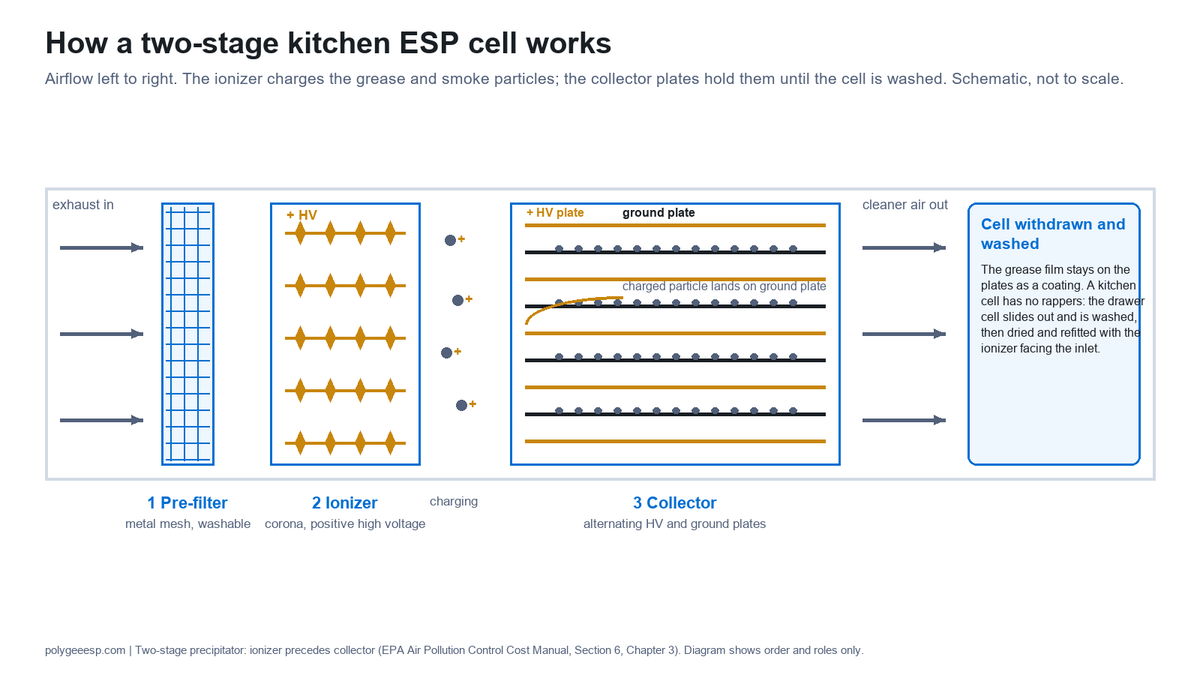
The ionizer does the charging and the collector does the holding; a quotation that does not tell you about both stages is not describing the machine. The EPA calls this arrangement a two-stage precipitator and treats it as a class of its own, apart from the industrial single-stage units described on the EPA monitoring page cited earlier on this page. In the words of the EPA Air Pollution Control Cost Manual (Section 6, Chapter 3), it is “a series device with the discharge electrode, or ionizer, preceding the collector electrodes.” It adds: “For indoor applications, the unit is operated with positive polarity to limit ozone generation.” The manual also says where the design is applied: to sources “emitting oil mists, smokes, fumes, or other sticky particulates”, and it notes that the smaller units are usually sold as pre-engineered package systems built from “a mechanical prefilter, ionizer, collecting-plate cell, after-filter, and power pack”. The six steps below follow that module from inlet to outlet.
The Six-Step Kitchen ESP Path
| Step | What happens | What changes the result | What to ask a supplier for |
|---|---|---|---|
| 1. Pre-filter | A washable metal mesh ahead of the cell catches the coarse droplets and other large particles before they reach the cell. The EPA lists a mechanical prefilter as the first element of a two-stage module; the Greenheck Grease Trapper manual describes the same stage as an impingement pre-filter that “removes large airborne particles from the incoming airstream prior to reaching the ionizer cell.” | Whether the mesh is in place and clean. A blocked mesh raises resistance; a missing one loads the cell faster. | Confirmation that the quoted unit includes the pre-filter, and whether it is washed with the cells |
| 2. Ionizer (corona) | A positive high voltage on sharp electrodes breaks the air down into a corona. The EPA manual: “The ions generated in the corona follow electric field lines from the wires to the collecting plates. Therefore, each wire establishes a charging zone through which the particles must pass.” In the two kitchen cells described in the next column, the electrodes are spiked plates that face the air inlet. | The voltage held on the ionizer and the spark rate. Two published manuals give the order of magnitude: the Greenheck Grease Trapper ESP installation manual (document 482585, Rev. 3) states that the spiked ionizer plates are “charged with 12,000 VDC.” The CaptiveAire pollution control unit operation manual (document A0011036, Rev. 48) states “13K VDC maximum to the ionizer” and “A maximum of one [1] spark per minute is allowed.” The EPA’s example for an industrial plate-wire ESP is far higher: pulsating DC in the range of 20,000 to 100,000 V. | The ionizer and collector voltages and the spark-rate limit, as printed in the installation and operation manual for the model |
| 3. Charging | Ions attach to the particles. The EPA names two mechanisms: field charging, which in the EPA’s account adds a larger share of the charge on particles larger than about 2 µm in diameter, and diffusion charging, which adds a greater share on particles smaller than about 0.5 µm. The EPA’s examples: a small aerosol particle under 1 µm can hold tens of ions before it repels further ions, and a large one over 10 µm can hold tens of thousands, so “The electrical forces are therefore much stronger on the large particles.” | Residence time in the charging zone. The EPA lists “more time for particle charging” as an advantage of the two-stage design over a single-stage unit, because the ionizer is a stage of its own rather than wires between the plates. | The design airflow the cell count was chosen for; a higher airflow through the same cells shortens the charging time |
| 4. Collection | The charged particle enters a stack of plates that alternate between a positive high voltage and ground. Greenheck gives the pattern as “alternating plates between ground (0 VDC) and 6,000 VDC potential”; CaptiveAire sets “7K VDC maximum to the collector.” In that Greenheck arrangement, with the plates at 0 VDC and 6,000 VDC, the positively charged particle is repelled by the high-voltage plate and lands on the grounded plate. The EPA describes the result as “a competition between the electrical and dispersive forces”: turbulence keeps mixing the particle back into the stream until it is close enough to a plate to be held. | Particle size. For a given field, the EPA notes the migration velocity “is usually at a minimum for particles of about 0.5 µm diameter.” Particles near that size are the slowest to reach a plate; both smaller and larger particles move faster under the same field. | The test report behind any efficiency figure, with the particle basis and airflow it was measured at; see how to read an ESP test report |
| 5. Holding and cleaning | The grease stays on the plate as a film. The EPA explains why two-stage units are chosen for oil mist and smoke in the first place: “there is little electrical force to hold the collected particulates on the plates.” The same manual lists the cleaning routes for these modules: either “water wash of modules removed from the system” or “automatic, in-place detergent spraying of the collector followed by air-blow drying.” Our in-duct units take the first route: the cells slide out and are washed off the machine. | How thick the film is allowed to get. A loaded plate narrows the gap and, as the Greenheck manual puts it, contaminant build-up can lead to short circuits in the ionizer and collector sections; that is the reason behind the service routine in electrostatic precipitator cleaning. | The cleaning method for the model, who does it, and the condition the cells must be in before the unit is energized again |
| 6. What sets the efficiency | The EPA reduces the whole chain to one relation, the Deutsch equation: the fraction of particles that escape equals exp(−we × SCA), where SCA is the specific collection area, plate area divided by gas flow, and we is the effective migration velocity of the particle mix. Collection efficiency is 100 × (1 − that fraction), “the number most often used to describe the performance of an ESP.” | Plate area per unit of airflow, and the condition of the plates. The same cells at a higher airflow have less plate area per unit of volumetric airflow and, with everything else equal, a lower efficiency; and ASTM F2519 states that its performance information “is obtained for new or clean filters and does not include the performance of used or loaded filters” (what that means for a quoted percentage is in how to read a grease capture efficiency figure). | The airflow and cell count the quoted efficiency belongs to, written on the quotation; the inputs are in the 10-input ESP enquiry sheet |
This table answers how a two-stage kitchen cell takes a particle out of the air and what each step depends on. It does not answer how many cells a given kitchen needs; that is a sizing question answered against the design airflow on the kitchen electrostatic precipitator range.
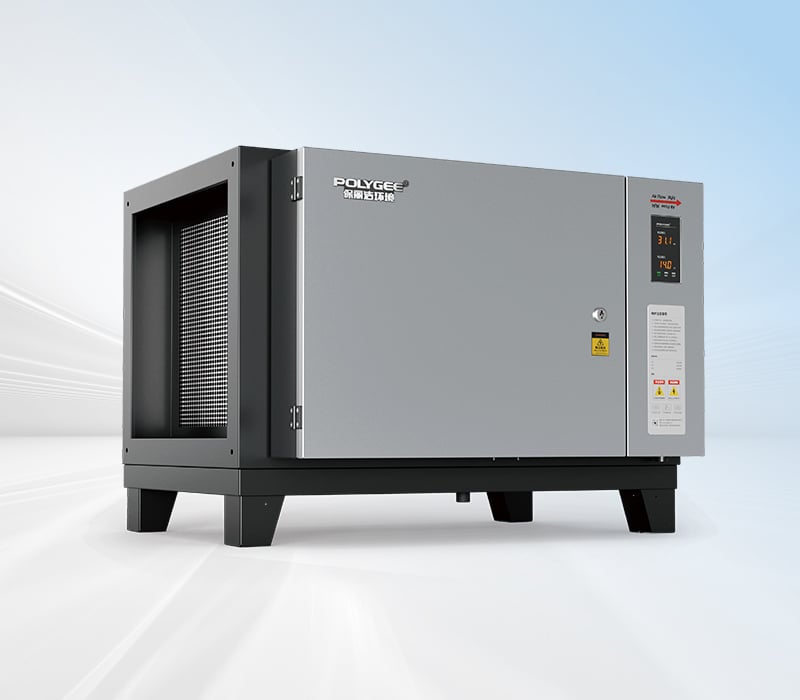
LK-K in-duct kitchen ESP cabinet
From ESP principle to real equipment
Polygee kitchen ESP models
- In-duct ESP units and integrated ESP hoods, with model-specific airflow ranges
- Two-stage electrostatic cells that slide out for washing
- Factory-direct, MOQ 1 unit on standard models
Types of electrostatic precipitator: three axes
Ask how many types of electrostatic precipitator there are and you will get three different answers, because the technology is classified along three axes at once. None of them is wrong. They are just answering different questions.
Types of electrostatic precipitator: the four the EPA publishes a fact sheet for
The cleanest published answer comes from the EPA, which publishes a separate technical fact sheet for each of four combinations. Two classifications crossed with each other give the four.
| Type | Collection surface | How it is cleaned | EPA fact sheet |
|---|---|---|---|
| Dry, wire-plate | Flat plates | Rapping: mechanical impulse or vibration | EPA-452/F-03-028 |
| Dry, wire-pipe | Pipes or tubes | Rapping | EPA-452/F-03-027 |
| Wet, wire-plate | Flat plates | Rinsing with water | EPA-452/F-03-030 |
| Wet, wire-pipe | Pipes or tubes | Rinsing with water | EPA-452/F-03-029 |
This table answers how the technology is formally classified. It does not tell you which one a given duty needs, which depends on the particle rather than on a preference, and it leaves out the single-stage and two-stage distinction entirely, because that is not part of this classification.
Dry and wet: the difference is how the plates get cleaned
The names suggest something about the gas. They are actually about housekeeping. The EPA puts it plainly: the primary difference between the two classifications is the method by which the collector plates are cleaned. In dry precipitators the plates are cleaned by applying mechanical impulses or vibration, which knocks the collected particulate loose, a process called rapping. In wet precipitators the plates are rinsed with water.
Two consequences follow, and they decide most projects.
- Dry is the default. The EPA describes dry precipitators as the most commonly used. If the dust is dry and will fall when the plate is struck, there is no reason to introduce water and the effluent that comes with it.
- Wet exists for what will not fall off. The EPA notes that wet precipitators are typically employed when gas streams contain sticky particles with low resistivity. That is the technical description of a mist, a tar or a fume that would build up on a plate no matter how hard you hit it.
Plate and pipe: the shape of the collection surface
The second axis is geometry, and the EPA folds it into the same four fact sheets. Collection surfaces are either plates or pipes, and the discharge electrodes are wires running between or through them, which is where the wire-plate and wire-pipe names come from.
| Geometry | What it looks like | Where it tends to appear |
|---|---|---|
| Wire-plate | Parallel flat collection plates with discharge wires in the gaps; gas passes horizontally between the plates | The large dry precipitators on boilers and kilns. A kitchen cell uses flat collection plates too, but with its charging section ahead of the plate pack rather than wires between the plates |
| Wire-pipe | Vertical pipes or tubes with a discharge wire down the center of each; gas passes up or down through the pipe | Duties where the collected material runs down and out, which is often a wet application |
This table answers what the two geometries are. It does not decide anything on its own: a project arrives at a geometry through the particle and the cleaning method, rarely by choosing the shape first.
Single stage and two stage: the split that decides a kitchen
This is the distinction that matters most to anyone specifying for a commercial kitchen, and it is not part of the dry-and-wet classification at all.
A single-stage precipitator charges the particles and collects them in the same region. That is the arrangement of the big industrial units: the EPA describes discharge electrodes divided into fields, with most units carrying three or four fields in series and very large ones as many as fourteen, energized by a transformer-rectifier (T-R) set power supply.
A two-stage precipitator separates the two jobs: a charging section ionizes the particles first, and a collection section behind it holds them. That is the arrangement used in commercial kitchen exhaust, and it is what a kitchen ESP cell actually is.
This distinction is not part of the EPA classification above and we are not citing it to the EPA: it is the ordinary industry description of the two layouts, and the reason we state it is that our own units are built the second way.
The same arrangement travels under three names, which is worth knowing before you compare quotations. Two stage describes a charging section followed by a collection section, and is the term to put in a specification. Dual zone is the same idea named after the two zones rather than the two stages, and it is the phrase our own product literature uses. Dual field or double pass means something else again: two such assemblies in series, so the air is charged and collected twice. A quotation that names only one of the three has told you less than it appears to.
The rest of the comparison between the kitchen machine and the industrial one — sticky and flammable grease, daily cycling, and the space available — is in kitchen ESP vs industrial ESP. What matters here is that if a specification says only “electrostatic precipitator” without saying two-stage, it has not yet described the machine a kitchen needs.
Which type for which duty
Read the left column as a description of your own gas stream; the row tells you which family you are buying from. The right-hand column is left blank for your own answer.
| If the duty is | The type that fits | Why | Is this my duty? |
|---|---|---|---|
| Dry dust at high volume and temperature | Dry, wire-plate, single stage, several fields | The dust can be rapped loose, and residence time is bought with fields in series | |
| Sticky particles with low resistivity; mists; acid | Wet, plate or pipe | The combination the EPA names for wet units: nothing will fall off a plate, so the surface has to be rinsed | |
| Collected material that should drain away | Wire-pipe | The geometry lets it run down and out | |
| Commercial kitchen exhaust | Dry, plate type, two stage, with washable cells | Grease is sticky, but it is not the sticky-and-low-resistivity mist duty the EPA describes for wet units. The kitchen answer is a cell that comes out and is washed off the machine |
This table answers which family a duty falls into. It does not size anything, and it does not settle acceptance, which depends on the documents an authority asks for rather than on the type.
Kitchen ESP vs industrial ESP: The 8-Row Kitchen-vs-Industrial ESP Check
What a kitchen ESP is, and what an industrial ESP is
The kitchen machine is the one this site is about. A kitchen ESP is a two-stage unit: an ionizer section charges the grease aerosol and smoke, and a collector section of stainless steel plates holds them. The two stages sit in one cell that slides out of the housing for washing, and the unit is fed by compact high-voltage power modules housed inside it rather than by a transformer-rectifier set. Our in-duct kitchen electrostatic precipitator range runs to 41 standard LK models from 4,000 to 60,000 m³/h, with duties from 2,000 m³/h and larger airflows met by units in parallel; the LK-E engineering series covers 3,000 to 40,000 m³/h in 33 models, and the HME hoods build the precipitator into the canopy at 3,000 to 4,800 m³/h. The dry, wet, plate and tube taxonomy that the EPA material uses is explained on our types of electrostatic precipitator page; a kitchen unit is a dry plate-type machine whose plates are washed rather than rapped.
Who buys which is settled by the exhaust, not by the building. A shopping mall food hall, a hotel kitchen floor and a chain restaurant all buy the kitchen machine: the TRX project in Kuala Lumpur took 300 units of the LK-E and UV series in 2022, and the Dubai Mall project took 40 units on an ODM basis in 2017. A boiler house or a kiln in the same city buys the industrial machine, and the two never cross.
Decision rule. IF the document in front of you mentions rapping, particle resistivity or a transformer-rectifier set, THEN it describes an industrial ESP, BECAUSE those belong to plant-scale designs; a kitchen datasheet describes its unit by airflow band, cell arrangement and supply voltage. The word field on its own does not decide it: kitchen datasheets, ours included, call the ionizer-and-collector stage an electrostatic field.
The 8-Row Kitchen-vs-Industrial ESP Check
A kitchen ESP is the candidate when the exhaust carries cooking grease and smoke at hood airflow; an industrial ESP remains the candidate when the stream is process gas carrying particulate at plant scale. The eight rows below are the ones on which a datasheet, a quotation or a certificate gives itself away, and the last column says what each row does to the quotation you are comparing.
The 8-Row Kitchen-vs-Industrial ESP Check (our own comparison, not an industry standard)
| # | Row | Kitchen ESP | Industrial ESP | What it means for your quote |
|---|---|---|---|---|
| 1 | What is collected | Grease aerosol and smoke from cooking: liquid at duct temperature, sticky, flammable | Process particulate: fly ash, dust, mist from a plant stream, dry or wet | A quote for cooking exhaust names grease and smoke as the duty; a datasheet written around dust does not transfer |
| 2 | Collection surface and cleaning | Stainless steel plates in drawer cells that slide out and are washed | Plates or pipes cleaned in place by rapping (dry) or water rinsing (wet) | Ask how the cells come out and where they are washed; a question about rappers has no answer on a kitchen unit |
| 3 | Airflow per unit | One unit per duct run, sized to the hood: our LK standard range 4,000 to 60,000 m³/h in 41 models, from 2,000 m³/h, larger duties by parallel units | Sized to the process gas flow of a plant; no standard catalogue sizes | The airflow on the quote is the hood design figure in m³/h, met by one unit or several in parallel, not by a field count |
| 4 | Electrical supply and power supply | 220 V single-phase or 380 V, 50 or 60 Hz to the customer’s site; compact high-voltage power modules housed in the unit | Transformer-rectifier set on a plant supply | Write the site supply on the enquiry; expect the power modules to be listed on the quotation, not a transformer-rectifier set |
| 5 | Stages in series | Ionizer and collector as two stages inside one cell; the number of cells is set by the model and the airflow | Three or four fields in series as the common case, more on large units | “Dual-pass” or “double-zone” on a kitchen datasheet refers to the cell arrangement, not to fields; ask for the cell count and arrangement in writing |
| 6 | Fire and access rules | Treated under NFPA 96 as a pollution control unit, with its access, grease-drainage and fire-protection provisions; where the air cleaner itself is listed, the listing is to UL 867 and names specific models (ours: LK/SE-6K, LK/SE-12K and LK/SE-18K, 230 V/50 Hz, File E522667) | Process and emission codes; no cooking-fire provisions | Ask which listing names the model you are quoted and which code edition the installer works to |
| 7 | Position in the train | Hood grease filters → duct → ESP → UV or carbon where odor is a condition → fan → outlet | Gas conditioning → ESP → stack | An ESP quote does not replace the hood filters, and an odor stage is a separate line, not a property of the ESP |
| 8 | How it is sold | Standard models by airflow (our terms: MOQ 1 unit; standard lead time 7 to 15 days; 1-year warranty on the unit, with UV lamps, carbon and site labour excluded) | Engineered and priced per project | Compare kitchen quotes on airflow, cell count, supply and scope; industrial pricing has no place in the comparison |
This table answers which machine a document describes. It does not answer which stages your kitchen needs; that is the kitchen exhaust filtration page, and the lines that make up a price are on the electrostatic precipitator price page.
Decision rule. IF rows 1 to 4 of a datasheet read as the kitchen column, THEN compare it with other kitchen quotations on airflow, cell count, supply and scope, BECAUSE rows 1 to 4 fix the price and rows 5 to 8 fix the scope; IF any of rows 1 to 4 reads as the industrial column, THEN the document belongs to another market and the comparison stops there.
Why a kitchen ESP is a two-stage plate unit with drawer cells
Cooking grease decides the design. It arrives as an aerosol, condenses on the collector as a liquid film, stays sticky at duct temperature and burns. Rapping, which clears dry dust from an industrial plate, does not release a grease film, and a wet industrial design that rinses continuously has no place in a restaurant plant room. The kitchen answer is a plate stack built as a drawer: the cell is withdrawn, washed, dried and returned, and the housing carries a drain for what runs off. The plates on our units are stainless steel, and the access door cuts the high voltage when it opens.
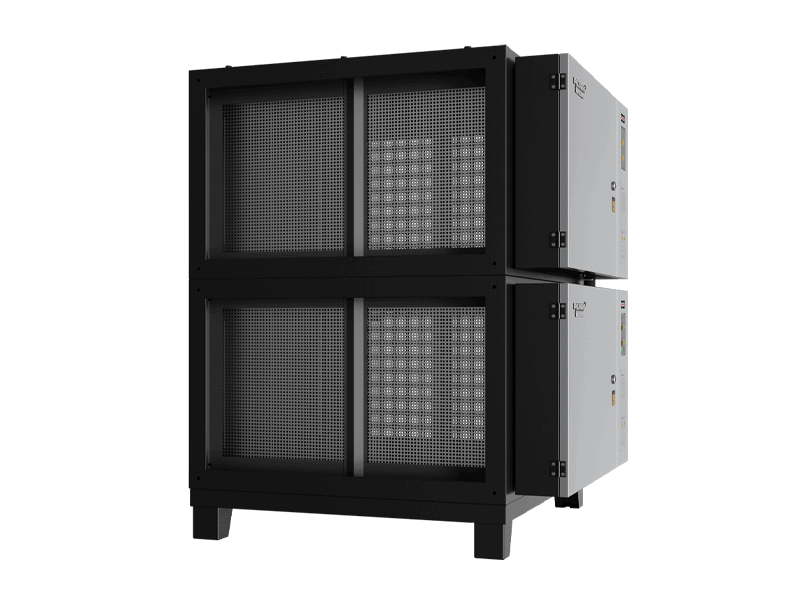
Two numbers on a kitchen datasheet need their basis read before they are compared. The first is pressure drop. Our LK units are quoted at 150 Pa or less for the complete unit including the standard air-distribution plate; the LK-E catalogue gives 23 to 34 Pa for the electrostatic field alone. The two figures describe different things, and a quotation that gives one without saying which is not yet comparable. The second is efficiency. The LK series carries a third-party figure of up to 97.6%, from a CMA-accredited laboratory test of the LK160 at its rated airflow, report ZY05W230298; the HME hoods tested at 98.0 to 98.1%; the LK-E series carries design figures of 90, 95 and 98% by grade, which are design values and not test results. None of these figures is a prediction for your kitchen, and how to read a report line against your own duty is on the electrostatic precipitator test report page.
Applications, grouped by what the gas stream is like
What actually decides an electrostatic precipitator application
Four properties of the gas stream decide whether a precipitator suits an application, and only one of them has anything to do with the industry.
| Property | Why it decides | What it changes about the machine |
|---|---|---|
| Particle resistivity | The EPA describes the desirable case as moderate resistivity: the particle conducts away some of its charge at the plate but keeps enough to be held lightly. Very high resistivity means it is slow to give up charge, so a negative charge builds on the plate that inhibits further particles from depositing. Very low resistivity means it loses its charge on arrival, takes the plate’s charge and is repelled back into the gas stream to be charged again | Whether the application works at all, or whether the gas has to be conditioned first |
| Stickiness | A dry dust can be shaken off a plate. A sticky deposit cannot | How the collection surfaces are cleaned, which is the difference between a dry and a wet precipitator |
| Gas temperature | The materials have to survive the stream, and temperature is one of the operating indicators the EPA lists | Construction, and whether the unit sits before or after other equipment |
| Volume and velocity | Collection depends on the particle having time in the field | The size of the unit, and how far the flow can be turned down before performance moves |
This table answers what to look at first. It does not size anything, and it does not tell you which type of precipitator results; that is in types of electrostatic precipitator.
The applications, grouped by what the gas stream is like
Group the applications by the particle and the same few families appear, whatever the industry is called.
| Family | Typical applications | What the stream is like | What that asks of the precipitator |
|---|---|---|---|
| Combustion ash | Utility and industrial boilers, power generation, waste incineration | High volume, hot, dry particulate; resistivity varies with fuel and temperature | The classic large dry precipitator: fields in series, rappers to shake the dust off. The hardware itself is described in types of electrostatic precipitator |
| Mineral process dust | Cement, lime, glass, mineral processing | Very high dust loading, and resistivity that often sits at the difficult end | Robust dry construction, and in many plants some form of gas conditioning before the precipitator |
| Metals and smelting fume | Steel, non-ferrous smelting, foundries | Fine fume, sometimes moist, sometimes with low-resistivity particles | Where the particle is sticky and of low resistivity, which is the combination the EPA names, this is where wet precipitators appear |
| Process mists and acid | Chemical processing, acid plants, some pulp and paper duties | Liquid mist rather than dry dust; corrosive | A wet precipitator, because the collection surfaces are washed rather than rapped |
| Cooking effluent | Commercial kitchen exhaust | Moderate volume, warm rather than hot, and the particle is grease: sticky, and mixed with smoke | Something the industrial answers do not provide, which is the next section |
The EPA reference does not group applications by industry; this grouping is ours. The table answers which applications resemble each other. It does not give emission limits, permit conditions or equipment sizing for any of them, all of which are specific to a plant and a jurisdiction.
Commercial kitchen exhaust, the application we build for
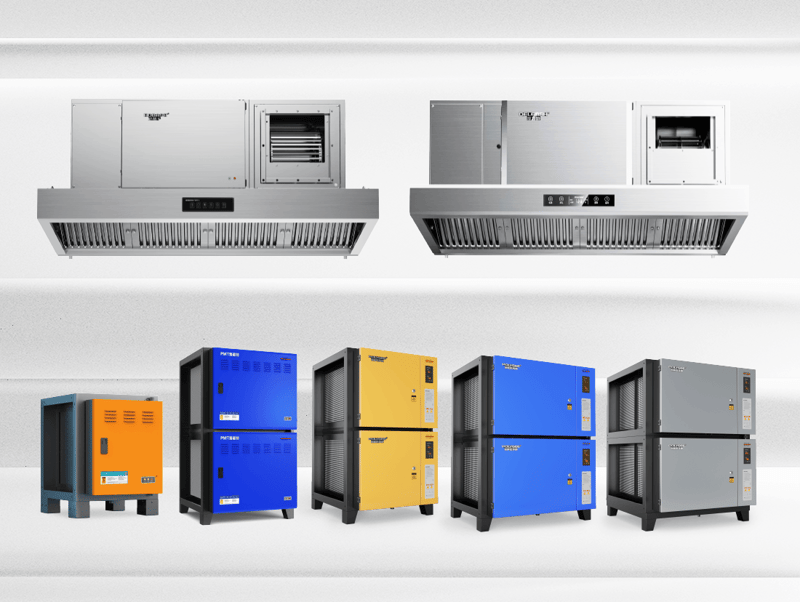
The rest of what differs — that grease is sticky and flammable where fly ash is neither, that a kitchen cycles daily rather than running continuously, and that the space available is a duct rather than a plant room — is set out in what is an electrostatic precipitator, which compares the two machines directly. The arrangement inside the machine, including the two-stage layout a kitchen cell uses, is in types of electrostatic precipitator.
Which standards prove what
A kitchen ESP and an industrial ESP are covered by different documents, and the quickest test of which machine a certificate belongs to is the standard it cites. The table gives each document, what it supports, what it does not prove on its own, and the models our own documents name.
| Evidence | What it supports | What it does not prove on its own | Product-condition scope | Buyer action |
|---|---|---|---|---|
| UL 867 listing, File E522667 | The listed models meet the safety standard for electrostatic air cleaners | Grease-capture performance; code acceptance of the installation | Three models only: LK/SE-6K, LK/SE-12K and LK/SE-18K, 230 V/50 Hz | Ask for the file number and check the model on it in UL Product iQ; how to read a listing is on our UL 867 page |
| CE certificate FQC2602501 | Conformity of the models it names | Performance; acceptance in a UL market | LK30 to LK480, LK30E1 to LK150E1 and the UV series | Ask for the certificate and its model list |
| Test report ZY05W230298 (CMA-accredited laboratory) | Efficiency of the tested model at its rated airflow | Efficiency in your kitchen; odor control | The LK160 on the report | Read the model, airflow and method lines before the percentage |
| NFPA 96 | How an in-duct unit is treated in a commercial cooking exhaust: as a pollution control unit with access, drainage and fire-protection provisions | That any particular unit is listed | The installation, by the contractor | Ask the installer which edition applies; our pollution control unit page follows the provisions through the IMC |
| UL 8782 | Pollution control units for commercial cooking, evaluated as a system | Anything about a unit that is not on its own UL 8782 listing | Only units named on a UL 8782 listing | Where a specification calls for UL 8782, say so at enquiry; the point is settled before a quotation, not at submittal |
| US EPA ESP description | What an industrial ESP is and how it is cleaned | Anything about kitchen units | Industrial | Use it to recognize the other machine, not to specify yours |
This table covers the documents a kitchen ESP enquiry meets. It does not cover the acceptance of the installed system, which is three separate layers, equipment evidence, site installation and whole-system operation, as set out on our certifications page; passing one layer does not clear the next.
Decision rule. IF a specification asks for UL 8782, THEN tell us at enquiry, BECAUSE the documents we hold are the UL 867 listing on the three named models and the CE certificate on the named models, and whether they meet the specification is settled before a quotation rather than discovered at submittal.
When an electrostatic precipitator is the wrong answer
Applications where a precipitator is the wrong answer
The technology has a clean boundary, and most disappointed buyers were standing on the wrong side of it.
- The target is a gas, not a particle. A precipitator charges and collects particulate. Odor molecules are in the gas phase and pass through. In a kitchen this is the single most common misunderstanding: the unit addresses smoke and grease, and the smell needs a separate stage, such as the UV-C and activated carbon stages of an ecology unit.
- Resistivity sits at an extreme and nothing is done about it. Both extremes defeat collection in the ways the EPA describes, and the answer is generally to condition the gas or change technology rather than to buy a bigger precipitator.
- The duty is rarely at rated airflow. Collection depends on residence time in the field. A unit that spends its life well away from the flow it was selected for is not being asked the question it was designed to answer.
- Acceptance depends on a document the equipment does not hold. This is a paperwork boundary rather than a physical one, and it stops projects just as effectively. Establish the listing or approval the authority expects before the equipment is chosen.
For the kitchen version of the first bullet, including what an ESP does and does not fix when a neighbour is complaining, see how to reduce smoke from commercial kitchen exhaust, and for the comparison against the filters already in the hood, electrostatic precipitator vs baffle filter.
When neither machine is the answer
- The complaint is smell, not smoke. An ESP takes particles; odor carried as gas passes through either machine. The step is to find out whether the residual odor is particle-phase or gas-phase, then price a UV or carbon stage after the ESP; the commercial kitchen odour control page sets out that order.
- The exhaust is steam with no cooking aerosol. Dishwash and steamer exhaust carries nothing for an ESP to hold. The step is a hood and duct design question, not a precipitator.
- The duty is solid-fuel cooking at high outlet temperature. A kitchen ESP is specified against the duct conditions it will see, and solid fuel changes them. The step is to send the appliance list and the expected duct temperature before any model is named; the solid-fuel exhaust page lists what the codes ask for first.
- The particulate comes from a process that is not cooking. Dust, fume or mist from a plant stream belongs to the industrial column of the Check, and the enquiry belongs with an industrial supplier.
Where this guide stops
- Industrial equipment. We do not build precipitators for boilers, kilns, smelters or chemical plants, and nothing here is a specification for one. The industrial material is included because the question “which applications use an ESP” cannot be answered honestly without it.
- Limits and permits. No emission limits, permit conditions or compliance requirements appear here. They are specific to a plant, a pollutant and a jurisdiction.
- Sizing. This guide does not size a unit for any application, including a kitchen. That needs the airflow, the duct and the duty.
- The efficiency figures. The EPA’s greater-than-99-percent is a statement about the technology; our 97.6% is a grease removal result on named models at a stated airflow. Neither predicts the other.
Buyer record and key takeaways
- The cooking process and appliance list, and whether solid fuel is used.
- The design airflow in m³/h or CFM, with its source (hood schedule, balancing report or estimate).
- Where the unit sits in the duct, and the distance to the fan and the outlet.
- The outlet location and any odor condition attached to it.
- The filters already in the hood, and the site supply voltage and frequency.
- Have ready: Whether the particle is dry or sticky, and roughly what its resistivity is if anyone has measured it.
- Have ready: The airflow, and how much of the day it is at that flow.
- Have ready: The duct size and route, and the space available for a cabinet.
- Ask each supplier for: Which of the four types they are quoting, in those words, and whether it is single or two stage.
- Ask each supplier for: How the collection surfaces are cleaned, and by whom.
- Ask each supplier for: The resistance at your design airflow, for the complete unit rather than the cell alone.
- Re-check when: The process or the menu changes the particle.
- Re-check when: The flow is going to be modulated rather than held at one rate.
- Re-check when: A supplier describes a kitchen unit as a wet precipitator, which is worth a direct question.
- Ask each supplier for: Which application family they built the model for, in their own words.
- Ask each supplier for: The rated airflow band, and what happens either side of it.
- Ask each supplier for: The test report behind any efficiency figure, with the method and the airflow stated on it.
- Re-check when: An odor complaint arrives and is treated as a smoke complaint.
Key takeaways
- Same physics, two machines: charging and collecting is shared; everything from the cleaning method to the sales model is not.
- Eight rows decide a kitchen quote: rows 1 to 4 (pollutant, cleaning method, airflow band, supply) fix the price and rows 5 to 8 fix the scope; compare quotations on those, not on anything from an industrial datasheet.
- Rapping is the giveaway: a document that mentions rapping, particle resistivity or a transformer-rectifier set is describing an industrial ESP.
- A certificate names models, not a series: UL 867 on LK/SE-6K, LK/SE-12K and LK/SE-18K only; CE on LK30 to LK480, LK30E1 to LK150E1 and the UV series.
- Odor is a separate line: neither machine removes gas-phase odor; the UV or carbon stage is priced on its own.
Frequently asked questions
- What is an electrostatic precipitator?
- An electrostatic precipitator is an air-cleaning device that gives the particles in a gas stream an electric charge and collects them on oppositely charged plates or tubes. It removes particles such as grease aerosol, smoke and dust; it does not remove gases or vapors on its own, so odor usually needs a separate stage.
- What are the types of electrostatic precipitator?
- Two classifications overlap. The first is dry against wet, which the EPA draws around how the collection surfaces are cleaned: a dry precipitator knocks the collected material loose by applying mechanical impulses or vibration, known as rapping, while a wet one rinses the plates with water. The second is the geometry of the collection surface, either plates or pipes, which the EPA reflects in its own fact sheets by publishing four of them: dry wire-plate, dry wire-pipe, wet wire-plate and wet wire-pipe. A third distinction, single stage against two stage, is not part of that classification but is the one that decides which machine goes into a commercial kitchen.
- What is the difference between a dry and a wet electrostatic precipitator?
- How the plates are cleaned, and therefore what the machine can be used on. In a dry precipitator the collector plates are cleaned by applying mechanical impulses or vibration, which knocks the collected particulate loose. In a wet precipitator they are rinsed with water instead. The EPA notes that dry precipitators are the most commonly used, and that wet ones are typically employed where the gas stream contains sticky particles with low resistivity. That is why a wet unit appears on process mists and certain metallurgical fumes, and why neither answer is the one a commercial kitchen uses.
- Is a commercial kitchen ESP the same machine as an industrial one?
- The physics is the same and the machine is not. An industrial precipitator on a boiler is built around fields of discharge electrodes energized by a transformer-rectifier (T-R) set power supply, with rappers that vibrate the collection surfaces so dry dust falls off; the EPA notes that most units have three or four fields in series and very large ones may have as many as fourteen. Cooking grease does not behave like fly ash: it is sticky, so it is not knocked loose by rapping. A kitchen unit is a duct-mounted cabinet with washable collector cells that are taken out and cleaned. The comparison is set out in full in our guide to what an electrostatic precipitator is.
- How often is a kitchen ESP cleaned?
- As often as the cooking duty, the hours and the airflow require, and that interval is stated in writing on the quotation for the kitchen described, not as a figure on a page. The practical signs that a cell is due are a fall in capture at the outlet and the indication on the unit; the cleaning page covers what a service visit consists of.
Is your application a commercial kitchen?
That is the one we build for. Send us the extract flow rate, the duct size and route, the position available for an in-line unit, the cooking type and the electrical supply. Our team will come back with the model whose rated airflow band fits the flow, its resistance at that flow, the third-party grease removal test report with the airflow it was measured at stated on it, and a written note of which documents that model carries. If your application is industrial, we will tell you plainly that it is not ours.
Talk to our team →Why we write this. Readers reach this page from the same search that returns power-station precipitators, and the questions behind it are whether the unit they found is the one for a restaurant and what to write in the enquiry. It answers both with the comparison rows and the enquiry inputs. This page does not size or configure equipment; sizing and quotation live on the product pages.
Reviewed by Law, Project Manager, 9 November 2026
Written by Law · Project Manager, PolygeeLaw manages project delivery at Polygee and reviews the airflow, stage and interface lines of offers against the site before an order is confirmed. Polygee, founded in 2004, manufactures the in-duct electrostatic precipitators and kitchen ESP hoods named on this page at its factory in Zhangjiagang, China, and has exported to 50 countries.
References & further reading
- US EPA, Air Emissions Monitoring Knowledge Base: Monitoring by Control Technique, Electrostatic Precipitators (components, fields, dry and wet cleaning, resistivity). epa.gov US EPA — Air Pollution Control Technology Fact Sheets, linked from the control-technique page above: dry ESP wire-pipe (EPA-452/F-03-027), dry ESP wire-plate (F-03-028), wet ESP wire-pipe (F-03-029), wet ESP wire-plate (F-03-030).
- NFPA 96, Standard for Ventilation Control and Fire Protection of Commercial Cooking Operations, National Fire Protection Association. nfpa.org
- UL 867, Standard for Electrostatic Air Cleaners, UL Standards & Engagement. shopulstandards.com
- UL Solutions, Pollution Control Units for Commercial Cooking Systems: Then and Now (UL 8782). ul.com
- Our own documents: the certifications page (UL 867 File E522667, CE FQC2602501 and the models each names), the test report page (report ZY05W230298) and the supplier profile.
- Polygee — kitchen exhaust filtration product range, certificates and third-party test reports. polygeeesp.com
Related reading
- For the unit itself, see the kitchen electrostatic precipitator page.
- In a kitchen this is the single most common misunderstanding: the unit addresses smoke and grease, and the smell needs a separate stage, such as the UV-C and activated carbon stages of an ecology unit.
- Electrostatic precipitator vs baffle filter: why the hood filter stays when an ESP goes in, and what each one controls.
- Electrostatic precipitator cleaning: what a service visit covers and how the cleaning basis is written into the order.