

Commercial kitchen grease filter requirements are shorter than most people expect and point somewhere different from where most people look: IMC 2021 Section 507.2.8 asks for filters listed and labeled in accordance with UL 1046, access for cleaning or replacement, a mounting angle of not less than 45 degrees from the horizontal, a drip tray beneath the lower edge, and a height above the cooking surface that depends on the appliance. The contrast is what that listing means, because UL 1046 is a flame-projection and drainage test — so the code is asking your filter to behave safely in a fire and to shed what it catches, and it is not asking it to capture any stated proportion of the grease going past. This guide walks the clauses in the order an inspector reads them, explains what the label proves and what it leaves open, settles the mesh question from the label rather than from a product comparison, and gives you a check sheet you can fill in with a phone in one hand.
This guide helps you decide whether the filter bank in your hood satisfies the code, and what to ask for when it does not. It does not select filter products, set a cleaning interval or determine whether the hood as a whole complies. For the hood requirements around the filters, see commercial kitchen hood code requirements; for the in-duct equipment behind them, the kitchen electrostatic precipitator page.
| Document | Product scope | What it supports | What it does not prove |
|---|---|---|---|
| IMC 2021 §507.2.8 with Table 507.2.8 | Grease filters in Type I hoods, where the IMC is adopted | That a filter must be listed and labeled to UL 1046, be accessible for cleaning or replacement, and sit at the tabulated height | Any removal efficiency, any service interval, and nothing about Type II hoods |
| IMC 2021 §507.2.8.1 | The filter bank as an air path | That the arrangement passes the required air without exceeding the filter’s designed or approved rate, and is removable and washable | That the installed airflow matches the design, which is a commissioning measurement |
| IMC 2021 §507.2.8.2 | Mounting geometry | An angle of not less than 45 degrees from the horizontal, and a drip tray beneath the lower edge | That the drainage path downstream of the tray is adequate or maintained |
| UL 1046, 4th edition, revised June 2022 | Single-stage and multi-stage grease filters for use under NFPA 96 and the IMC | Flame projection downstream after grease loading, and drainage that does not fall back onto the cooking surface | Grease removal efficiency, pressure drop, or performance on any particular cooking process |
| A listed hood’s own listing | The hood as an assembly, including whatever filtration was evaluated with it | That the components evaluated as part of that hood are covered | That a substituted filter is covered. Substitution moves you outside the listing |
What the code asks, clause by clause
Read as a list of separate obligations rather than a paragraph, Section 507.2.8 and its two subsections contain five requirements, and a filter bank can satisfy four of them and still fail. They are also the five things an inspector can check without instruments, which is why they come up so often.
| Requirement | Section | What is being asked | How it is checked on site |
|---|---|---|---|
| Listed and labeled | 507.2.8 | Grease filters listed and labeled in accordance with UL 1046 | Read the label on the filter. No label, no compliance, whatever the filter is made of |
| Access for service | 507.2.8 | Access for cleaning or replacement | Can a person reach and withdraw them as installed, with the hood in place |
| Height above the appliance | 507.2.8 and Table 507.2.8 | Lowest edge of the filter not less than the tabulated distance above the cooking or heating surface | Tape measure, against the appliance category |
| Mounting angle and drip tray | 507.2.8.2 | Not less than 45 degrees from the horizontal, with a drip tray beneath the lower edge | Angle by eye or gauge; the tray is either there or it is not |
| Removability, washability and drip interception | 507.2.8.1 | Frames or holders allowing removal without separate tools; where cleaning is intended, a size that fits a dishwashing machine or pot sink; arrangement or devices preventing grease dripping into food or onto preparation surfaces | Try to remove one by hand. Then see whether it fits the sink |
This table answers what the code asks. It does not tell you whether your hood is required to be a Type I hood in the first place, which is the question behind all of it and is covered in Type 1 hood vs Type 2.
Two of those five are worth dwelling on because they are the ones that quietly fail. The first is the angle. Forty-five degrees is not an efficiency provision; it is a drainage provision, and it works with the tray beneath the lower edge as one detail rather than two. A bank installed closer to the horizontal holds what it catches instead of shedding it, which turns the filter into a reservoir directly above the cooking line. The second is the sentence about drip interception in 507.2.8.1, which is the only line in the section that is about food rather than fire: filter units have to be arranged, or given drip-intercepting devices, so that grease or other condensate does not drip into food or onto food preparation surfaces.
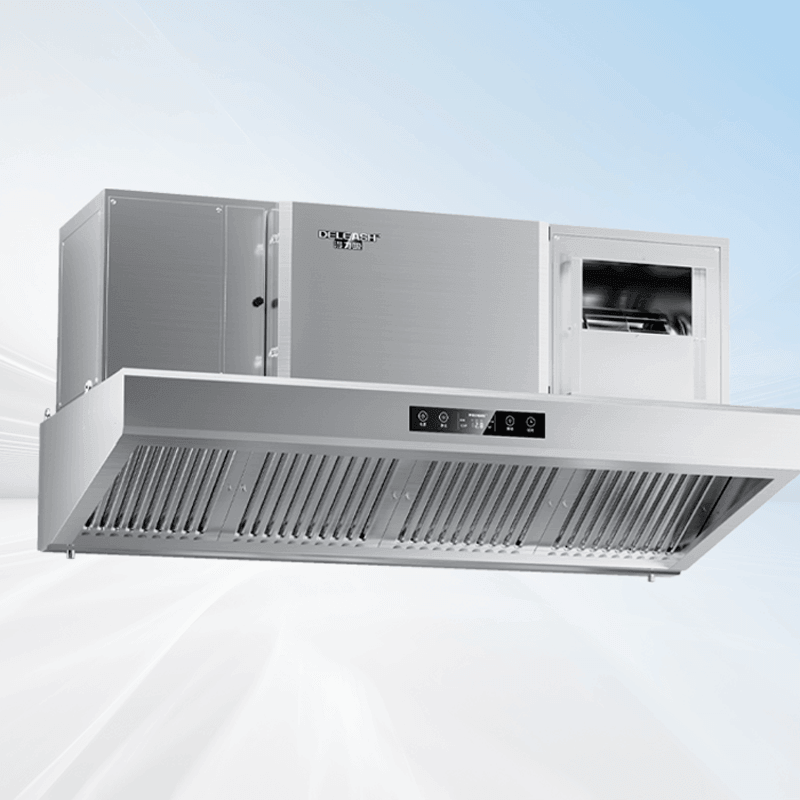
In a hood built with integrated cells, as above, the filter bank and the air cleaning stage sit in the same enclosure but remain two different things in code terms: the grease filters answer to Section 507.2.8 and carry a UL 1046 label, and the cells behind them do not fall within that standard at all.
What UL 1046 tests, and what it does not
If you take one thing from this page, take this: a UL 1046 listing is a fire and drainage credential, not a performance figure. UL describes the standard as covering single-stage and multi-stage grease filters intended for installation and use in accordance with NFPA 96 and the International Mechanical Code, and investigated for their capacity to limit the projection of flames downstream when subjected to flames on the upstream face after having been loaded with grease, and to drain any collected grease in such a manner that it does not fall back onto the cooking surface. The current edition is the fourth, published in February 2010, most recently revised in June 2022.
Set out as a boundary map, the standard covers less than its reputation suggests.
| Question a buyer asks | Does UL 1046 answer it? | What answers it instead |
|---|---|---|
| Will flame pass through this filter into my duct? | Yes. This is the central test, performed on a grease-loaded filter | — |
| Will the grease it catches run off rather than drip back onto the appliance? | Yes, as a drainage requirement | — |
| What proportion of grease does it remove? | No | A separate efficiency method: ASTM F2519 addresses grease particle capture efficiency and pressure drop for commercial kitchen filters and extractors. Ask for the result with its test conditions, and see electrostatic precipitator vs baffle filter |
| What pressure drop does it add, clean and loaded? | No | The manufacturer’s data at a stated face velocity, which your fan selection needs |
| How often will it need cleaning in my kitchen? | No | Cooking load and the inspection regime. See commercial kitchen exhaust cleaning requirements |
| Will it control smoke or odour at the outlet? | No, and it is not intended to | Downstream treatment selected against the actual outlet problem |
This table answers what the listing covers. It does not rank filter products, and it is not a recommendation to buy or avoid any type; where a genuine comparison of mechanical filtration against electrostatic treatment belongs is electrostatic precipitator vs baffle filter, which is a technology question rather than a code one.
Which filter type is not used as a grease filter in a commercial kitchen ventilation hood?
Plain mesh, on its own. The code does not say so in those words, which is why the question keeps being asked: Section 507.2.8 asks for a listing, and the mesh answer comes through the listing rather than through a prohibition. The National Air Filtration Association records that UL 1046 no longer recognises the old style mesh type filters, and that mesh filters shall not be used unless evaluated as an integral part of a listed exhaust hood, or listed in conjunction with a primary filter in accordance with UL 1046. Baffle filters are the common answer in current practice, and they are the product type the standard is mostly applied to.
That leaves mesh with two legitimate positions rather than none, and the difference between them is a document, not a shape.
| How the mesh is present | Accepted? | Evidence to produce | What it means for your quote or build |
|---|---|---|---|
| Loose mesh panels in the filter rails, no label | No | None exists to produce | Replace with a listed primary filter. This is the common finding on an older kitchen |
| Mesh evaluated as an integral part of a listed hood | Yes, within that hood’s listing | The hood’s listing and the components it names | Do not substitute. A like-for-like looking panel from another supplier may sit outside the listing |
| Mesh listed in conjunction with a primary filter under UL 1046 | Yes, in that combination | Both labels, and the listing that ties them together | Keep both stages. Removing the primary filter and leaving the mesh moves you back to the first row |
| Mesh used as a pre-filter ahead of separate in-duct equipment | Outside this section | The equipment manufacturer’s arrangement | It does not substitute for the hood’s grease filters, whatever it does for the equipment behind it |
The last row is the one we see misread most, and it cuts against our own interest to say so plainly: a washable mesh screen supplied as part of an in-duct air cleaner is there to protect that equipment. It sits downstream of the hood and it is not a Section 507.2.8 grease filter. If a project drops the hood filters because the in-duct unit has a mesh of its own, the hood no longer complies.
Table 507.2.8: your appliances set the height
The filter height is a property of the appliance line, not of the hood, which is why it is the requirement most often broken by a change nobody logged as a change. IMC 2021 Table 507.2.8 gives the minimum distance between the lowest edge of a grease filter and the cooking or heating surface.
| Type of cooking appliance | Minimum height above cooking surface | Why the figure moves | Buyer consequence |
|---|---|---|---|
| Without exposed flame | 0.5 feet | No flame reaches toward the filter face | Griddles and fryers under a canopy generally sit here |
| Exposed flame and burners | 2 feet | Flame is present at the appliance and can reach upward | An open burner range sets the bank higher than a griddle would |
| Exposed charcoal and charbroil type | 3.5 feet | Flare-up from solid fuel and charbroiling reaches furthest | Adding one charbroiler can raise the requirement for the whole bank above it |
For SI, one foot is 304.8 mm. This table answers the height under the IMC. It does not answer the exhaust rate for those same appliance categories, which is a separate set of figures in the code and is covered in commercial kitchen hood CFM requirements; nor does it cover solid fuel as a system, which brings its own separate requirements — see solid fuel cooking exhaust requirements.
The clause about airflow that gets skipped
Section 507.2.8.1 contains a requirement that reads like housekeeping and is actually a design constraint. Filters have to be of such size, type and arrangement as will permit the required quantity of air to pass through them at rates not exceeding those for which the filter or unit was designed or approved. In plain terms: the bank has to be big enough for the airflow, judged against the filter’s own rating, not against whether the air fits through.
That single sentence is where three project decisions meet. The exhaust rate comes from the code and the appliance mix. The face area comes from how many filters the hood takes. The rating comes from the manufacturer. If the first goes up during design and the second does not, the third is where the installation fails, and it fails quietly — the air does pass through, just faster than the filter was approved for, with more carried past it and more resistance for the fan to overcome.
| Parameter | Why it matters | Buyer supplies | Supplier declares | Verification document |
|---|---|---|---|---|
| Design exhaust rate at the hood | Sets the air the bank has to pass | The rate the hood is designed around | — | Design calculation or hood schedule |
| Filter face area installed | Converts the rate into a velocity through the media | Hood length and filter count | Filter dimensions | Hood drawing |
| Rated airflow per filter | The limit 507.2.8.1 refers to | — | Rated flow per filter at a stated condition | Product data sheet and label |
| Pressure drop clean and loaded | Fan selection and the point at which capture degrades | — | Curve or figures at stated velocity | Product data sheet |
| Measured airflow after installation | Whether the design rate was actually achieved | Commissioning access | — | Air balance report |
This table answers who owes which number. It does not size anything; sizing is the designer’s, and the fan side of it is in commercial kitchen exhaust fan requirements.
What the filter bank decides for the duct behind it
The filter bank is the first stage of the system, and its condition sets the load on everything after it. This is where our own interest enters the article, so it is worth being precise about what is a mechanism and what is a claim.
The mechanism is straightforward. Grease that the filter bank catches and drains is grease that does not enter the duct. Grease that passes the bank travels into the duct run, where it condenses on the duct wall, on any in-duct equipment, and eventually at the fan. Reduce what the bank catches — by leaving a panel out, by mounting the bank too flat, by running more air through it than it is rated for, or by letting it load up between cleans — and the quantity travelling downstream goes up. Our collector cells are one of the surfaces it goes up on, and the visible consequence is a shorter interval between washes. Electrostatic precipitator cleaning describes what that work involves.
What we are not going to do is put a number on that relationship. The interval depends on the cooking process, the hours, the airflow and the condition of the bank, and any figure that ignored those would be a sales figure rather than an engineering one. What we will say is that on a site where the duct is loading faster than expected, the filter bank is the first thing to look at, ahead of the equipment, and the checks are the five in the clause table above.
Which document proves what
Four kinds of document turn up in a filter discussion, and each proves something narrower than it is usually asked to.
| Evidence | What it supports | What it does not prove on its own | Product-condition scope | Buyer action |
|---|---|---|---|---|
| UL 1046 label on the filter | That this filter type was evaluated for flame projection after grease loading and for drainage | Any removal efficiency, any pressure drop, and nothing about how it is mounted | The filter as manufactured, in the configuration listed | Photograph the label and keep it with the hood record |
| A listed hood’s nameplate and listing | That the hood assembly, with the filtration evaluated as part of it, was listed | That a replacement filter from another source is inside that listing | The assembly as listed | Before substituting, ask whether the listing names the component |
| Manufacturer’s efficiency or pressure-drop data | Performance under the stated test conditions and face velocity | Performance at your velocity, or on your cooking process, unless the conditions match | The tested condition only | Read the conditions before using any figure as a design basis |
| IMC 2021 §507.2.8 and Table 507.2.8 | What the jurisdiction requires of the filter and where it must sit | Anything about a jurisdiction on another code, or about Type II hoods | Type I hoods where the IMC is adopted | Confirm the adopted edition; the numbering moved between editions |
| NAFA guidance on mesh | The industry record of how mesh is treated under the standard | A code prohibition, because the code asks for a listing rather than naming a type | Mesh products generally | Resolve mesh by producing the listing, not by arguing the type |
One edition note, because it costs people time: the numbering of this requirement moved. What is Section 507.2.8 in the 2021 IMC was Section 507.11 in the 2018 edition. If a specification cites a section number without an edition, ask which edition it means before you check anything against it.
Scope and limits
This guide reads published code text and a published standard scope. It does not approve an installation and it does not select a product.
- Applies where the hood is a Type I hood in a jurisdiction that adopts the IMC, and someone can state the edition.
- Needs a designer for the exhaust rate, the filter face area and the fan selection that follows from them.
- Needs the authority having jurisdiction where a listed hood’s coverage of a filter component is in question, or where an existing bank is being assessed rather than designed.
- Needs manufacturer data for anything about efficiency or pressure drop, with the test conditions attached.
- Needs project testing for the measured airflow through the installed bank; the design rate is not evidence of the installed rate.
- Safety stop condition. Nothing here is instruction to work on a hood, a fire-extinguishing system or a live appliance. A filter bank that sits under a fire-extinguishing system is part of that system’s protected arrangement, and altering it is not a housekeeping task.
- Cases that do not transfer. A filter arrangement accepted on a fryer line tells you nothing about the same hood over a charbroiler, because Table 507.2.8 changes. A filter accepted inside one hood’s listing tells you nothing about the same panel in a different hood.
- What triggers a re-check. A new or relocated appliance, particularly a charbroiler or any solid-fuel appliance; a change in design exhaust rate; a filter substitution; a hood replacement; a change of adopted code edition.
- Not controlled by the filter bank at all. Smoke and odour at the discharge. These are not what a grease filter is for; if that is the live problem, the question is what treatment sits downstream, and how to reduce smoke from commercial kitchen exhaust separates the causes before anyone buys anything.
Three layers of acceptance, and they are separate. Layer one is product evidence: the UL 1046 label, or the hood listing that covers the component. Layer two is the installation: angle, tray, height against the appliance category, removability by hand, and a bank sized for the design rate. Layer three is the system in operation: the measured airflow, the access actually being usable once the kitchen is fitted out, and a cleaning routine someone owns. Passing one layer does not clear the next.
Buyer record
Grease Filter Label Check Sheet. This can be filled in on site with a phone and a tape measure, and it is short enough to paste into an email to a supplier or an inspector.
| What to record | Your entry | What the entry proves — and does not |
|---|---|---|
| Standard and listing marks on the filter label | Proves the filter was evaluated under UL 1046. Does not indicate any removal efficiency | |
| Rated airflow per filter, from the label or data sheet | The limit in 507.2.8.1. Exceeding it is a non-compliance even though the air still passes | |
| Design exhaust rate for the hood, and the number of filters in the bank | Compare against the line above. If it does not divide, the bank is undersized for the duty | |
| Hood nameplate and listing reference, if it is a listed hood | Decides whether components evaluated with the hood are covered. Does not cover substitutions | |
| Appliance category beneath this bank: without exposed flame / exposed flame and burners / exposed charcoal or charbroil | Selects the row of Table 507.2.8 that applies | |
| Measured height, lowest edge of filter to cooking surface | Compare with 0.5, 2 or 3.5 feet from the row above | |
| Measured angle of the filters from horizontal | 507.2.8.2 asks for not less than 45 degrees | |
| Is there a drip tray beneath the lower edge? Yes / No | 507.2.8.2 requires one. There is no performance argument against this line | |
| Can one filter be removed by hand, without separate tools? | 507.2.8.1, for banks not designed to be cleaned in place | |
| Will one filter fit a dishwashing machine or pot sink? | 507.2.8.1, where the filters are designed and required to be cleaned | |
| Anything arranged to stop grease or condensate dripping onto food or preparation surfaces? | The last sentence of 507.2.8.1, and the only food-safety line in the section |
Ask your supplier for: the filter’s listing and rated airflow, in writing rather than from a catalogue page; the hood listing if there is one, with the components it names; and efficiency or pressure-drop figures complete with the test conditions and face velocity they were measured at. What is still missing at that point is almost always the measured airflow through the installed bank, and that comes from a commissioning report rather than from any supplier.
Frequently Asked Questions
- Which filter type is not used as a grease filter in a commercial kitchen ventilation hood?
- A plain mesh screen, standing on its own, is the answer most inspectors are looking for. The code route is indirect but decisive: IMC 2021 Section 507.2.8 requires the hood to be equipped with grease filters listed and labeled in accordance with UL 1046, so the question is not whether mesh works but whether the product in your rails carries that listing. The National Air Filtration Association records that UL 1046 no longer recognises the old style mesh type filters, and that mesh shall not be used unless evaluated as an integral part of a listed exhaust hood or listed in conjunction with a primary filter in accordance with UL 1046. In practice that means mesh is accepted in two situations: as part of a hood that carries its own listing covering it, or sitting with a listed primary filter rather than instead of one.
- Does a UL 1046 listing tell me how much grease a filter removes?
- No, and this is the single most useful thing to understand about the label. UL describes the scope of UL 1046 as covering single-stage and multi-stage grease filters investigated for their capacity to limit the projection of flames downstream when subjected to flames on the upstream face, after having been loaded with grease, and to drain any collected grease in such a manner that it does not fall back onto the cooking surface. Those are a fire test and a drainage test. Grease removal efficiency is not among them, so a listed filter is a filter that has been shown to behave safely in a fire and to shed what it catches, not one that has been shown to capture any stated proportion of what passes through it.
- How often should grease filters be replaced?
- The code does not set an interval, and it is worth knowing that it deliberately asks for something else. IMC 2021 Section 507.2.8 requires that grease filters be provided with access for cleaning or replacement, and Section 507.2.8.1 requires removable units to sit in frames or holders so as to be readily removable without the use of separate tools, and where they are designed to be cleaned, to be of a size that will allow them to be cleaned in a dishwashing machine or pot sink. The code is securing your ability to service them on whatever schedule the kitchen needs. The interval itself follows the cooking load and the inspection regime, which is the subject of commercial kitchen exhaust cleaning requirements rather than of this section.
- Do commercial kitchens require grease traps, and is that the same thing as a grease filter?
- They are two different systems and two different sets of rules, and the words get swapped constantly. A grease trap, or grease interceptor, sits in the drainage and keeps fats out of the sewer; it is a plumbing matter and it is enforced by the water authority. A grease filter sits in the exhaust hood and keeps grease-laden vapour from travelling into the duct; it is a ventilation and fire matter, and in the IMC it lives in Section 507.2.8. Whether your premises needs a trap is a question for the local drainage requirements. Nothing on this page addresses it.
- How high above the cooking surface does a grease filter have to sit?
- It depends on what you cook on, and IMC 2021 puts the figures in Table 507.2.8 as the minimum distance between the lowest edge of a grease filter and the cooking or heating surface. Appliances without exposed flame call for 0.5 feet. Exposed flame and burners call for 2 feet. Exposed charcoal and charbroil type appliances call for 3.5 feet. The practical consequence is that the height is a property of the appliance line rather than of the hood, so adding a charbroiler under an existing canopy can put a previously compliant filter bank out of compliance without anything being moved.
Checking a filter bank before it becomes a duct problem
If your duct or in-duct equipment is loading faster than you expected, send us the appliance schedule, the hood length and filter count, the design exhaust rate, and a photograph of one filter label. We will tell you what the bank looks like against the five clause checks above, and say plainly which parts of the answer belong to your designer or the authority rather than to us.
Scarlett leads commercial work at Polygee, from first RFQ through Incoterms, certification scope and delivery for engineering firms, consultants and dealers, with equipment exported to 50 countries. Polygee, founded in 2004, builds commercial kitchen exhaust filtration equipment. This article summarizes published code text and a published standard scope for planning purposes only — it is not a compliance determination, and it is not instruction for work on hoods, appliances or fire-extinguishing systems. Confirm the requirements for a specific kitchen with your engineer, the authority having jurisdiction and the edition in force.
References & further reading
- International Code Council — 2021 International Mechanical Code, Section 507.2.8 Type I grease filters, Table 507.2.8, Section 507.2.8.1 Criteria and Section 507.2.8.2 Mounting position of grease filters. codes.iccsafe.org
- UL Standards & Engagement — UL 1046, Grease Filters for Exhaust Ducts, fourth edition, most recently revised June 2022. shopulstandards.com
- NFPA — NFPA 96, Standard for Ventilation Control and Fire Protection of Commercial Cooking Operations. nfpa.org
- National Air Filtration Association — guidance on grease filters and exhaust hoods, including the treatment of mesh type filters under UL 1046. nafahq.org
- Polygee — commercial kitchen exhaust filtration product range, certificates and third-party test reports. polygeeesp.com
Related reading
- Commercial kitchen hood code requirements — the hood the filters sit in, and the rest of what the code asks of it.
- Electrostatic precipitator vs baffle filter — the technology comparison this page deliberately leaves alone.
- Fire dampers in a commercial kitchen extract — the same system at the other end, where the separation rules take over.
- Commercial kitchen exhaust cleaning requirements — the inspection regime that sets the interval the code declines to set.