

A grease trap is a plumbing device that slows and cools kitchen wastewater so that fats, oils and grease float to the top and are held back while the water flows on to the sewer. A grease trap works on that difference in density, either as a small hydromechanical unit with baffles and a vented flow control near the sinks or as a large gravity tank outside, and it keeps working only as long as the grease it has held is removed.
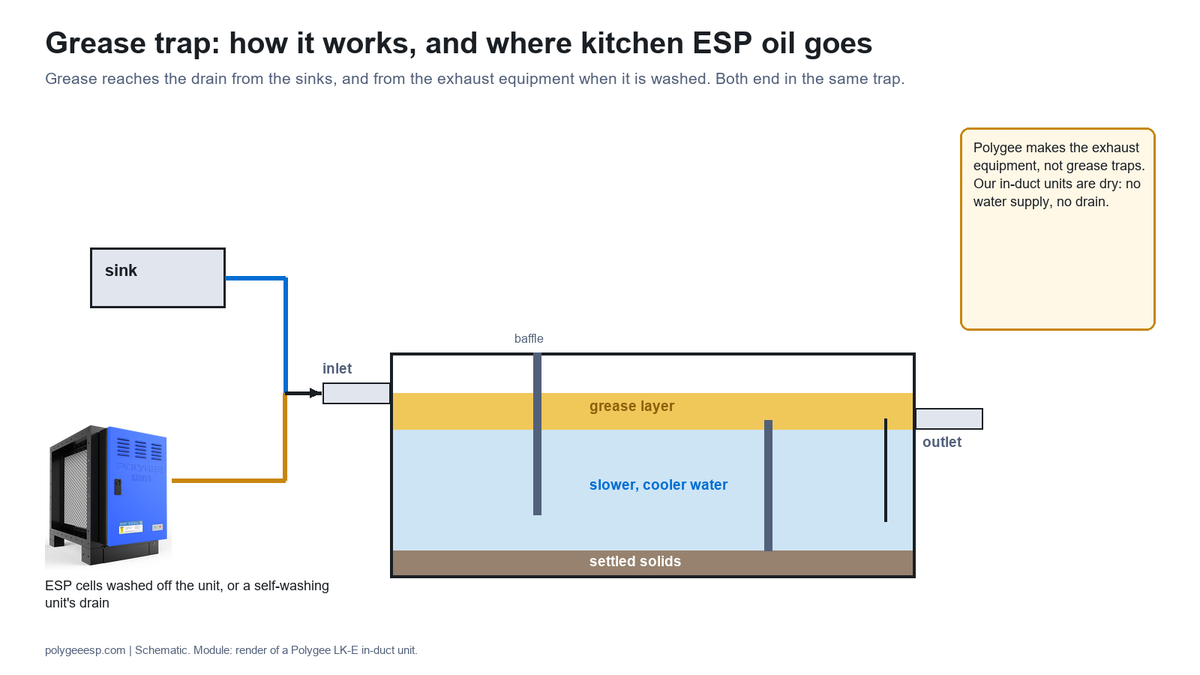
Kitchen grease also leaves by the air. The hood filters, and an in-duct electrostatic precipitator or kitchen ecology unit where one is fitted, take grease out of the exhaust, and that grease comes back down as wash water to the drains or as collected oil in a container. We make that exhaust equipment, not grease traps, and this guide follows the grease from the sink and from the duct to where each stream ends up, with each figure taken from the code, city rule or manufacturer’s manual it is attributed to.
This page helps you decide what kind of grease trap a kitchen needs, how it is sized, how often it has to be pumped, and what the grease collected by a kitchen ESP adds to it. It ends with The 9-Line Kitchen Grease Path Sheet, a record to attach to the plumbing design and to the ESP enquiry. It gives no installation or pumping procedure: those follow the device manufacturer’s instructions and the local fats, oils and grease (FOG) program, and pumping is done by a licensed hauler.
| Question | Short answer |
|---|---|
| How does it work? | Slowed, cooled water lets grease rise and solids settle; baffles hold both while the clearer water leaves. The US EPA describes the aim as letting FOG cool and separate in a non-turbulent environment |
| Trap or interceptor? | Hydromechanical units, usually indoors and rated by flow in gallons per minute; gravity interceptors, usually large outdoor tanks rated by volume. Portland gives 20 to 50 gpm for the first and 1,000 to 4,000 gallons for the second |
| How is it sized? | Hydromechanical: by flow, from the fixture volume and a one- or two-minute drain period. Gravity: by peak flow times 30 minutes (IPC 2021) or by drainage fixture units (California Plumbing Code 2022, based on UPC 2021). In Singapore, and for separators to BS EN 1825 under England’s Approved Document H, by EN 1825 nominal size |
| How often is it pumped? | Most of the city rules read use a 25% rule, with calendar limits from weekly (small indoor traps, Sioux City) to every 90 days (Half Moon Bay); Singapore’s PUB recommends at least every two weeks |
| What does a kitchen ESP add? | Self-washing units: wash-down drains that the 2021 and 2024 IMC send through a grease interceptor. Units like ours with cells washed off the unit: the sink or dishwasher water from that washing. Where that water is hot or carries degreaser, the sizing guidance read here adds factors for it |
- How a grease trap works
- Grease trap vs grease interceptor: hydromechanical and gravity
- What the plumbing codes require, and where they disagree
- How a grease trap is sized: three methods
- Where the grease from a kitchen ESP goes
- Hot water and degreaser: what washing does to a grease trap
- How often a grease trap is pumped: the 25% rule and the calendars
- The 9-Line Kitchen Grease Path Sheet
- Frequently asked questions
How a grease trap works
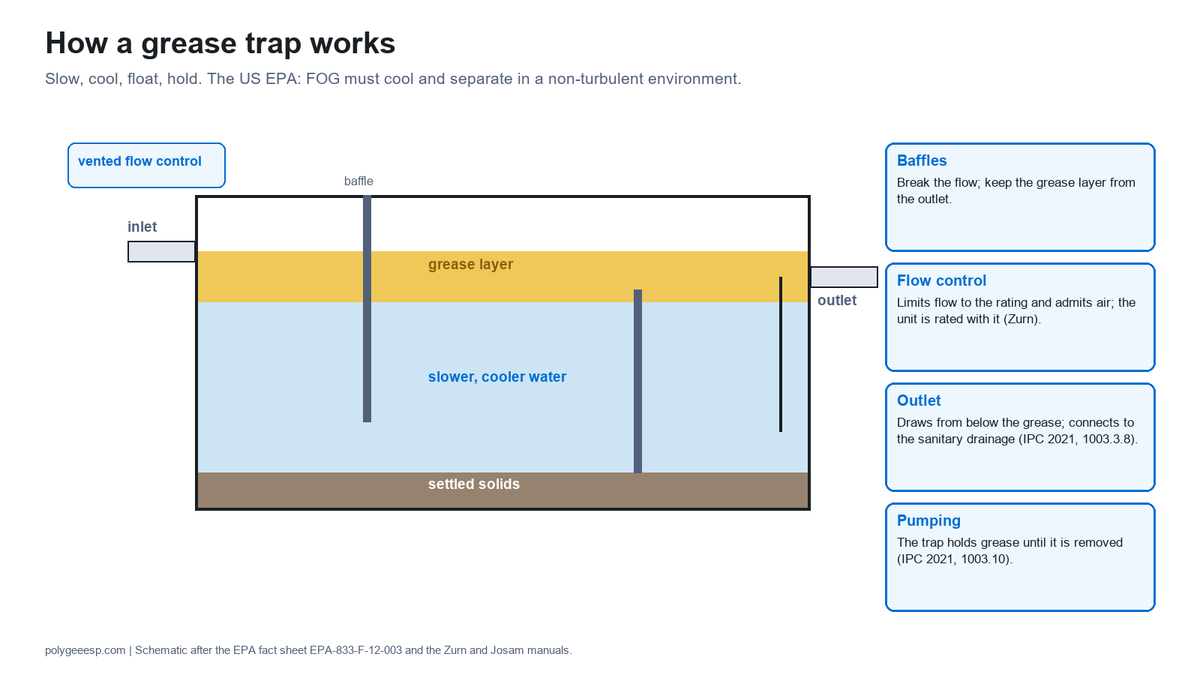
A grease trap works by giving wastewater enough time, in calm enough water, for grease to float and solids to sink before the flow leaves. The US EPA’s fact sheet on food service pretreatment puts the design aim in one line: interceptors must be designed and sized to allow FOG to cool and separate in a non-turbulent environment. Fast, turbulent water keeps grease in suspension; once the flow slows and cools in the body of the trap, the lighter grease rises into a layer at the top and food solids drop to the bottom, and an outlet drawn from below the grease layer lets the clearer water go on to the sanitary sewer.
The parts follow from that. Baffles break the incoming flow and stop the grease layer reaching the outlet. On a hydromechanical unit a flow control fitting upstream limits the flow to the rating, and it is vented: Zurn’s engineering bulletin says the vent lets air mix with the incoming water, which helps separation and, more importantly in Zurn’s words, keeps the proper operating level in the separation chamber; it warns that the interceptor is tested and rated with that vented flow control, and that leaving it out can let grease bypass the unit. A removable cover gives access for cleaning, and the California Plumbing Code recommends a sample box at the outlet of a gravity interceptor so that the authority can sample what leaves.
What a grease trap does not do is make grease disappear. It holds it. The 2021 International Plumbing Code, Section 1003.10, requires access to every interceptor and its maintenance by periodic removal of accumulated grease, scum and solids, and gives no interval; the interval comes from the local FOG program and from how much grease the kitchen sends down. The EPA fact sheet puts the annual quantity of collected grease trap waste and uncollected grease reaching treatment plants at 800 to 17,000 pounds a year per restaurant, and cites a 2004 EPA report to Congress that found grease from restaurants, homes and industrial sources to be the most common cause, 47%, of reported sewer blockages.
| Part | What it does | Source |
|---|---|---|
| Inlet and baffles | Break the flow so grease can rise and solids settle; keep the grease layer away from the outlet | EPA fact sheet; Josam installation manual |
| Vented flow control (hydromechanical) | Limits flow to the rating and admits air; the unit is rated with it | Zurn engineering bulletin p. 1; IPC 2021, 1003.3.5.2 |
| Grease retention space | Holds floating grease until pumping; rated in pounds on hydromechanical units | IPC 2021, Table 1003.3.5.1 |
| Solids space | Holds settled food solids; Endura limits them to 1 in. (25 mm) before servicing | Endura manual p. 17 |
| Outlet | Draws water from below the grease layer (Josam, Zurn construction); connects directly to the sanitary drainage system (IPC 2021, 1003.3.8) | Manufacturer manuals; IPC 2021, 1003.3.8 |
| Venting | Keeps the interceptor from becoming air bound | IPC 2021, 1003.9 |
Grease trap vs grease interceptor: hydromechanical and gravity
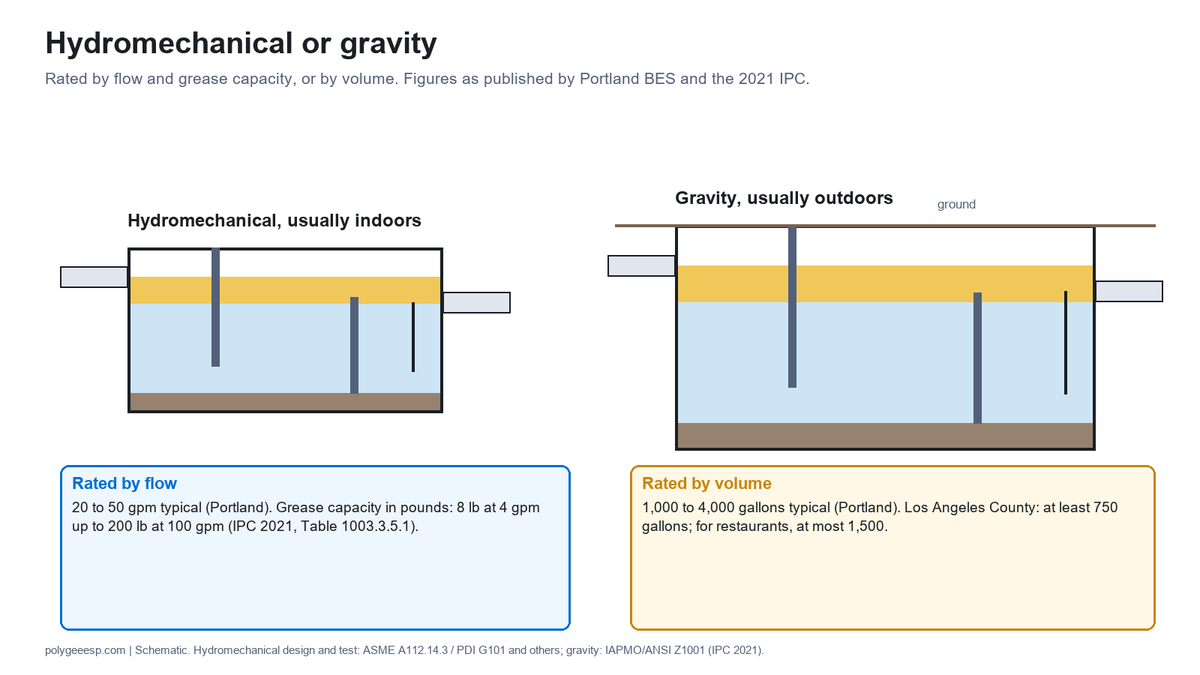
The two names are used loosely, but the documents read for this page separate two kinds of device by how they separate and how they are rated. Josam’s installation manual puts it simply: units that rely only on the difference in density are gravity-type and need a very large holding capacity, while hydromechanical units use an air intake, a flow control and baffles to separate more efficiently, so they can be smaller for the same application. The 2021 IPC treats them in two sections: hydromechanical interceptors in Section 1003.3.5, gravity interceptors in Section 1003.3.7.
| Point | Hydromechanical grease interceptor (often called a grease trap) | Gravity grease interceptor | Source |
|---|---|---|---|
| Where it sits | Usually indoors, at or near the fixtures | Usually outdoors, above or below ground | Portland BES; Sioux City (interior traps, exterior interceptors) |
| How it is rated | Flow, in gallons per minute; grease capacity in pounds | Liquid volume, in gallons | IPC 2021, 1003.3.5.1 and 1003.3.7 |
| Typical size quoted | 20 to 50 gpm | 1,000 to 4,000 gallons | Portland BES |
| Standards named for design and test | ASME A112.14.3, A112.14.4, CSA B481.1, PDI G101 or G102 | IAPMO/ANSI Z1001 | IPC 2021, 1003.3.5 and 1003.3.7 |
| One county’s definitions | “Grease trap”: single compartment, 25 to 75 gallons, at least 25 gpm | “Grease interceptor”: 750 gallons or more, two or more compartments, precast concrete | Los Angeles County Public Works restaurant guidelines p. 1 |
In the documents read, the choice follows the adopted code and the authority as much as the kitchen’s preference. A single sink or a small kitchen with no room outside may suit a hydromechanical unit, and a whole kitchen in a jurisdiction that sets a minimum tank volume may need a gravity tank; the California code also allows combinations where an existing building has no space. Los Angeles County Public Works, for the unincorporated areas and contract cities it serves, sets a minimum of 750 gallons and, for restaurants, a maximum of 1,500 gallons unless it authorizes otherwise. Portland adds that most interceptors are cleaned at 25% full of FOG and solids, while some high-efficiency hydromechanical units can accumulate up to 75%, and that the city sets each site’s frequency.
What the plumbing codes require, and where they disagree
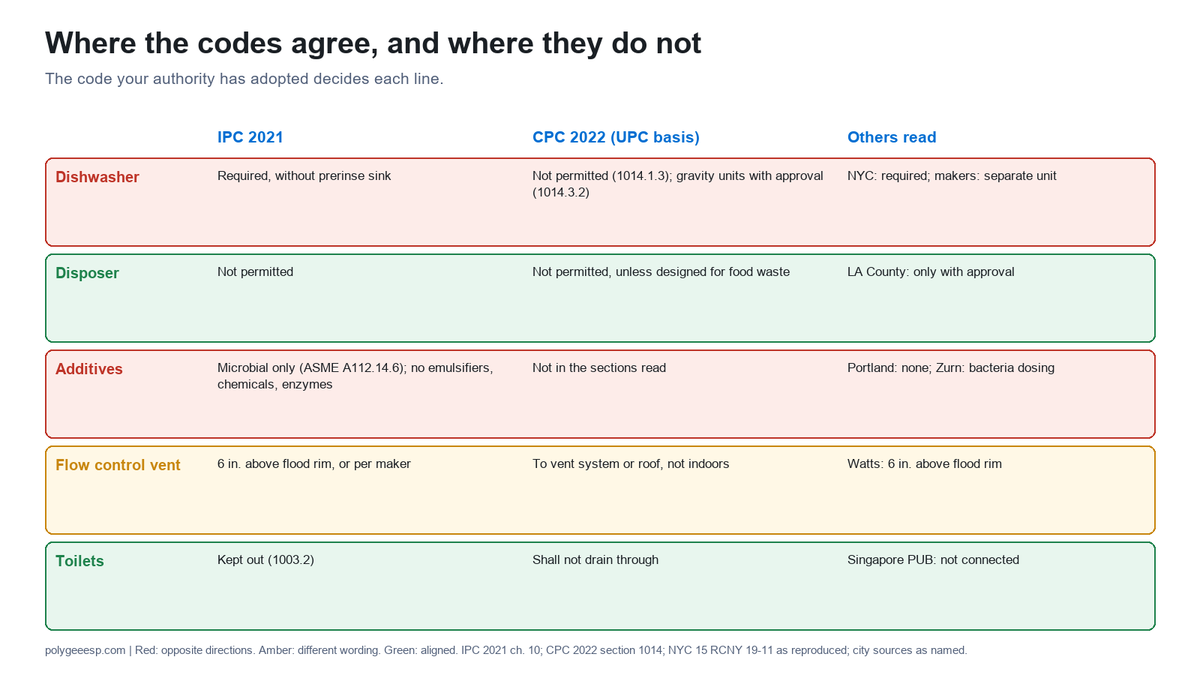
The plumbing codes agree that kitchen fixtures discharging grease need a grease interceptor, and disagree on several of the details that decide what is connected to it. The 2021 IPC, Section 1003.3.1, requires a grease interceptor or an automatic grease removal device for fixtures and equipment with grease-laden waste in food preparation areas, and names pot sinks, prerinse sinks, soup kettles, wok stations, floor drains or sinks into which kettles are drained, automatic hood wash units and dishwashers without prerinse sinks. Section 1003.2 keeps out waste that needs no treatment, and Section 1003.3.2 says a food waste disposer shall not discharge to a grease interceptor.
The 2022 California Plumbing Code, Section 1014, which adopts the 2021 Uniform Plumbing Code with amendments, starts from the authority: an interceptor is installed where the authority determines that pretreatment is required. Its Section 1014.1.3 then says no food waste disposer or dishwasher shall be connected to or discharge into a grease interceptor, and makes an exception for disposers only, into interceptors designed to receive food waste. Its Section 1014.3.2, for gravity interceptors, lists dishwashers among the grease-containing fixtures that shall be permitted to drain through the interceptor where approved by the authority, so the same code reads two ways and the authority settles it. On dishwashers the IPC and Section 1014.1.3 point in opposite directions, and New York City’s rule, 15 RCNY 19-11 as reproduced in a 2010 Department of Buildings bulletin, sides with the IPC: discharges from automatic dishwashers must be tributary to a grease interceptor, except the high-temperature sanitizer cycle.
| Question | IPC 2021 | California Plumbing Code 2022 (UPC 2021 basis) | Others read |
|---|---|---|---|
| Dishwasher into the interceptor | Required for dishwashers without prerinse sinks (1003.3.1) | Not permitted (1014.1.3); for gravity interceptors, permitted where approved by the authority (1014.3.2) | NYC: required (19-11(j), as reproduced in 2010); Endura (where local codes permit) and Zurn: a separate interceptor recommended for each commercial dishwasher |
| Food waste disposer | Not permitted (1003.3.2) | Not permitted, except into an interceptor designed for food waste (1014.1.3) | Los Angeles County: not without its approval |
| Additives | Microbial dosing only, conforming to ASME A112.14.6 and allowed by the interceptor maker; emulsifiers, chemicals and enzymes prohibited (1003.3.3) | Not addressed in the sections read | Portland: all additives prohibited; Zurn: recommends its bacteria dosing unit |
| Flow control vent | Not less than 6 in. above the flood rim, or per the manufacturer (1003.3.5.2) | To the vent system or through the roof, not to the free atmosphere inside (1014.2) | Watts: at least 6 in. above the flood rim |
| Toilets and human waste | Not named; 1003.2 keeps out waste that does not require treatment or separation | Shall not drain into or through the interceptor (1014.1) | Singapore PUB: shall not be connected |
Outside the US the requirement is written differently. In England, Approved Document H, paragraph 2.21, says drainage serving kitchens in commercial hot food premises should be fitted with a grease separator to BS EN 1825, or other effective means of grease removal. Singapore’s PUB Code of Practice on Sewerage and Sanitary Works, third edition of March 2025, requires grease traps in all food shops and food processing establishments, with an exception, subject to PUB’s permission, for food shops with no cooking and no dine-in. The Anglian Water FOG guide notes that the water legislation in England and Wales treats FOG as a substance likely to damage sewers without itself making equipment mandatory; the requirement comes through the building regulations and the European standard.
How a grease trap is sized: three methods
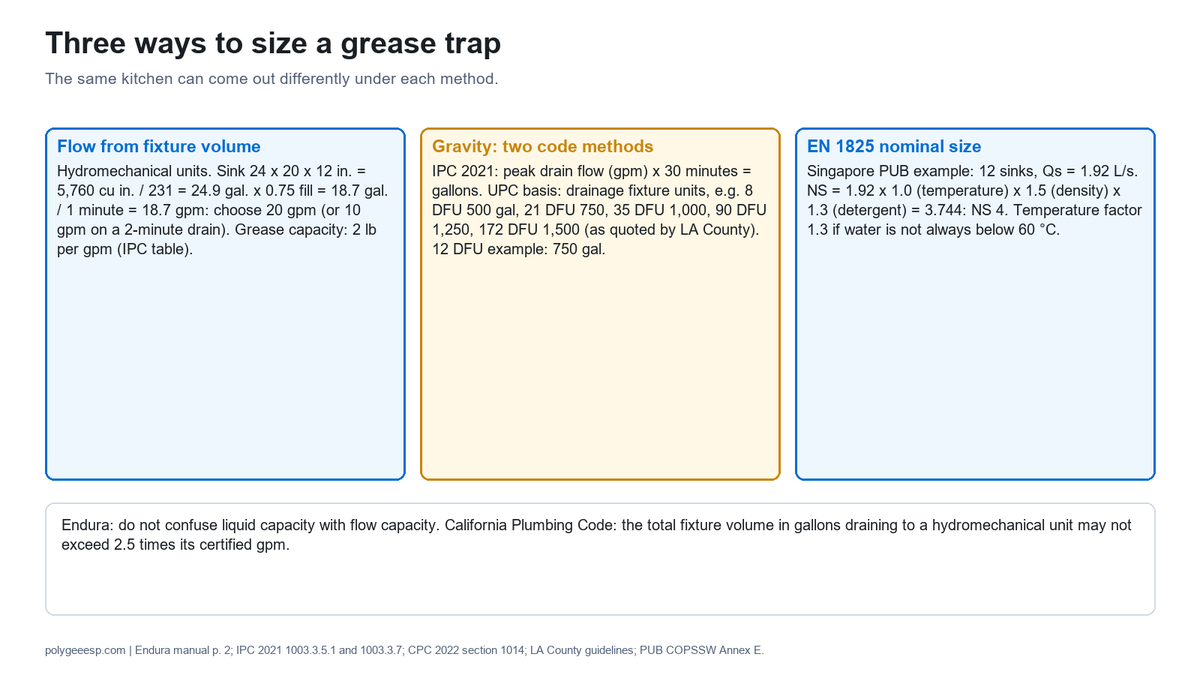
A hydromechanical interceptor is sized by flow and a gravity interceptor by volume, and three methods are in use depending on where the kitchen is. The first, for hydromechanical units, starts from the fixtures. Canplas’s Endura manual works one sink: 24 by 20 by 12 in. is 5,760 cubic inches, divided by 231 is 24.9 gallons; a fixture is normally filled to about 75% because the items being washed displace the rest, so 18.7 gallons drain; good practice in the manual’s words is a one-minute drain period, with two minutes acceptable where conditions permit, giving 18.7 or 9.4 gpm, and the next size up, 20 or 10 gpm, is chosen. The same manual warns against confusing liquid capacity with flow capacity.
The rated flow then sets the grease capacity. The 2021 IPC, Table 1003.3.5.1, gives retention capacity in pounds for each flow rating, 8 lb at 4 gpm up to 200 lb at 100 gpm, and above 100 gpm sets the retention capacity in pounds at twice the numerical flow rating in gpm; New York City’s rule, as reproduced in the 2010 bulletin, asks the same, a retention capacity in pounds of at least twice the flow rate in gpm, with an average removal of 90% or more and water entering at no more than 180 °F. The California Plumbing Code adds a limit the IPC does not have: the total volume of fixtures draining into a hydromechanical interceptor in gallons shall not exceed two and one-half times its certified flow rate in gpm, and its Table 1014.2.1, based on full pipe flow at a 1/4 in. per foot slope, gives a 4 in. drain a 150 gpm interceptor on a one-minute drain period or 75 gpm on two minutes.
| Method | Used for | How it is calculated | Worked example in the source |
|---|---|---|---|
| Flow from fixture volume | Hydromechanical units (PDI G101, ASME A112.14.3) | Length x width x depth / 231 = gallons; x 0.75; / drain period of 1 or 2 minutes = gpm | 24 x 20 x 12 in. sink: 18.7 gpm, choose 20 (Endura p. 2) |
| Peak flow x 30 minutes | Gravity interceptors under the IPC | Peak drain flow in gpm x 30 minutes retention = gallons (IPC 2021, 1003.3.7) | Not given in the code |
| Drainage fixture units | Gravity interceptors under the UPC | Table 1014.3.6: 8 DFU 500 gal, 21 DFU 750, 35 DFU 1,000, 90 DFU 1,250, 172 DFU 1,500 (as quoted by Los Angeles County from the 2016 edition) | 12 DFU of floor drains and sinks: 750 gallons (CPC 2022) |
| EN 1825 nominal size | Singapore; BS EN 1825 separators in England | NS = maximum flow in L/s x temperature factor x density factor x detergent factor | 12 rinse sinks with 40 mm outlets: 12 x 0.8 x 0.2 = 1.92 L/s; 1.92 x 1 x 1.5 x 1.3 = 3.744, rounded up to NS 4 (PUB Annex E) |
The EN 1825 method carries two factors that matter for a kitchen with exhaust equipment. In the PUB worked example, quoting EN 1825-2, the temperature factor is 1.0 only if the incoming water is always below 60 °C and 1.3 otherwise, and the factor for cleansing and rinsing agents is 1.3, or 1.5 for special cases such as hospitals. Calgary’s guide, under CSA B481, uses the same fixture approach in metric: two sinks of 64 and 27 litres at 75% give 68.25 litres, so a one-minute drain calls for an interceptor rated above 68.25 litres a minute. Which method applies is set by the code the authority has adopted, and the authority’s plan reviewer, not the device catalog, has the last word.
Where the grease from a kitchen ESP goes
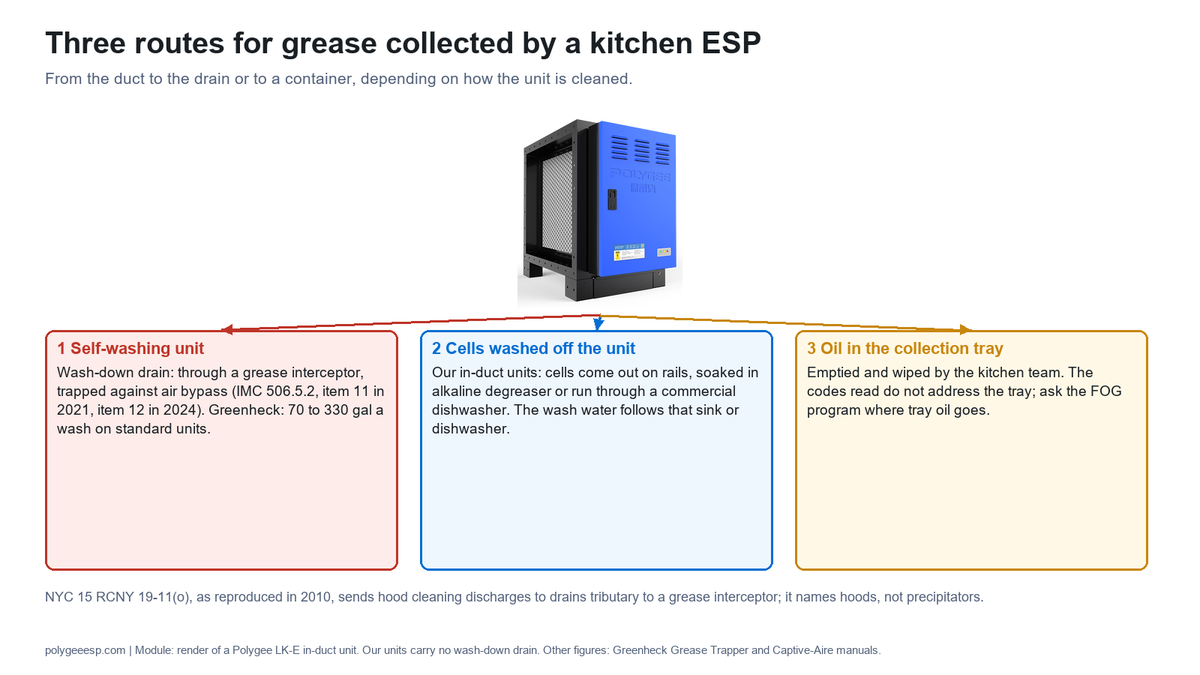
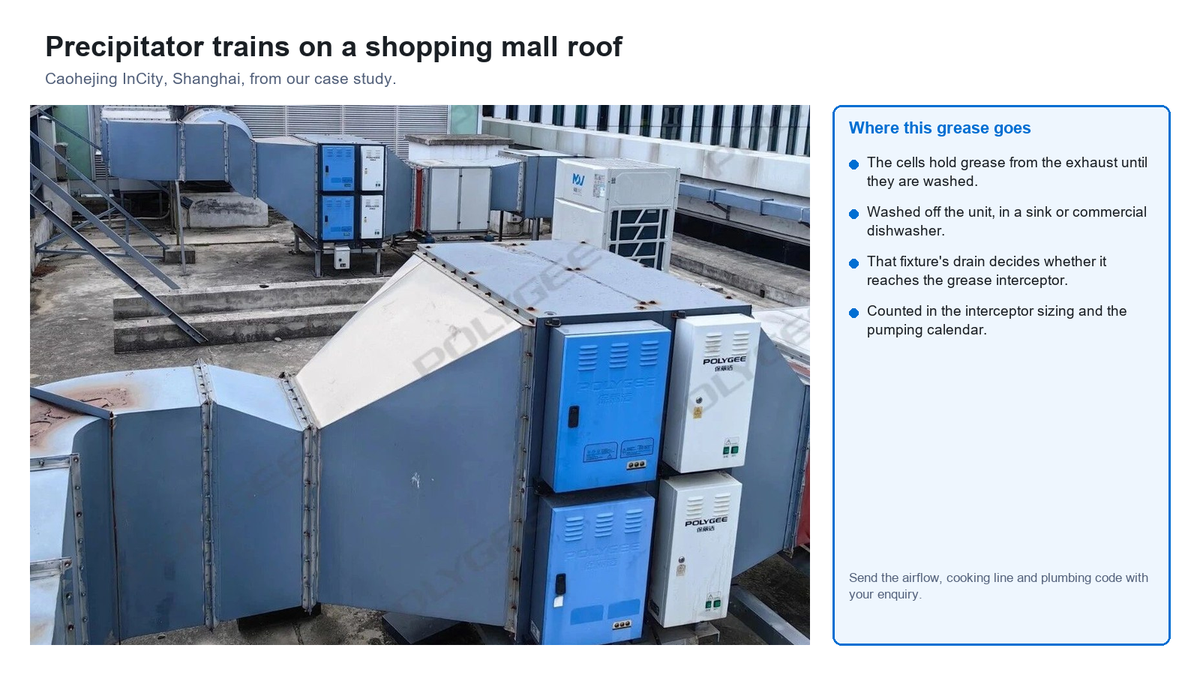
The grease that a kitchen electrostatic precipitator collects from the exhaust ends up in the drains or in a container, by one of three routes depending on how the unit is cleaned. The first route is a self-washing unit with a built-in wash system. The codes treat its drain as part of the plumbing: in the 2021 International Mechanical Code, Section 506.5.2 item 11, carried into the 2024 edition as item 12, wash-down drains from a pollution control unit shall discharge through a grease interceptor, be sized for the flow, and be sealed with a trap or other approved means against air bypass, with a seal depth that accounts for system pressurization and evaporation between cleanings.
Two makers of self-washing units publish what that drain carries. Greenheck’s Grease Trapper ESP manual runs a wash at the end of each cooking day, asks for a 1 in. water supply and a 2 in. waste drain at the unit, lists approximate water use per wash cycle from 70 to 330 gallons on its standard units at its default cycle times and 40 psi, recommends water at 140 to 180 °F, sizes the trap’s water column for the total system resistance plus 1 in. wg, and notes on its piping drawing that the drain shall be plumbed to an approved grease interceptor. Captive-Aire’s C-ESP manual washes the cells with hot, detergent-injected water each time the exhaust fan is shut off, in a programmed sequence of detergent wash stages with delays between them and a 3-minute hot-water rinse; it gives 5 minutes as the typical wash setting and water at 160 to 180 °F. Trion’s KES manual, for a unit whose cells it recommends washing by hand, asks for its two 2 in. cabinet drains to be piped to an acceptable catch basin and does not name a grease interceptor.
| Route | Where the grease goes | What the documents say | What it means for the grease trap |
|---|---|---|---|
| 1. Self-washing unit | Wash-down drain at the unit | IMC 506.5.2 (item 11 in 2021, item 12 in 2024): through a grease interceptor, the drains sealed with a trap or other approved means, with a seal depth for pressurization and evaporation; Greenheck: 70 to 330 gallons a wash on standard units, 140 to 180 °F; Captive-Aire C-ESP: a wash sequence every time the fan stops, 160 to 180 °F | A daily or more frequent hot, detergent-laden load to include in the sizing |
| 2. Cells washed off the unit (our in-duct units) | The sink or commercial dishwasher where the cells are washed | Our cells come out on rails and are soaked in an alkaline degreaser or run through a commercial dishwasher; the units themselves are dry, with no water supply, no drain and no chemical dosing | Whatever that sink or dishwasher drains to; the dishwasher rules differ between the IPC and the UPC |
| 3. Collected oil in a tray or receptacle | The tray, emptied by the kitchen team; on our HME hood, a receptacle that can be cleaned | The codes read here do not address the tray itself; the California Plumbing Code says grease collected from an interceptor shall not be introduced into drainage piping or a sewer | Ask the local FOG program where tray oil goes, before anyone tips it into a sink |
Our in-duct units take the second route. As our electrostatic precipitator cleaning guide sets out, the collector cells are built as drawers that come out of the cabinet, and they are soaked in an alkaline degreaser or run through a commercial dishwasher rather than scrubbed in place; the kitchen team drains and wipes the collection tray in the same visit. That keeps water and chemicals out of the duct, and it moves the grease to wherever the cells are washed. The cleaning interval we give is 15 to 30 days for a general lunch-and-dinner restaurant and 7 days for a heavy line with wok frying, deep frying or charcoal, so each wash sends a batch of the grease the cells have held into that sink or dishwasher drain.
The same logic appears in a city rule for hoods. New York City’s 15 RCNY 19-11(o), as reproduced in the 2010 bulletin, says discharges from cleaning kitchen hoods which may extract grease must go to receptacles or floor drains tributary to a grease interceptor, sized for those discharges, and that for hoods with automatic rinse cycles the interceptor is sized for the peak flow of the rinse as specified by the manufacturer. The rule names hoods, not precipitators, so for an ESP it is a parallel to ask the authority about rather than a clause that settles it. Sioux City’s grease removal guidance makes the practical point: cleaning vent hoods and exhaust systems will fill the grease control device faster, and the next pump-out should be planned accordingly.
Hot water and degreaser: what washing does to a grease trap
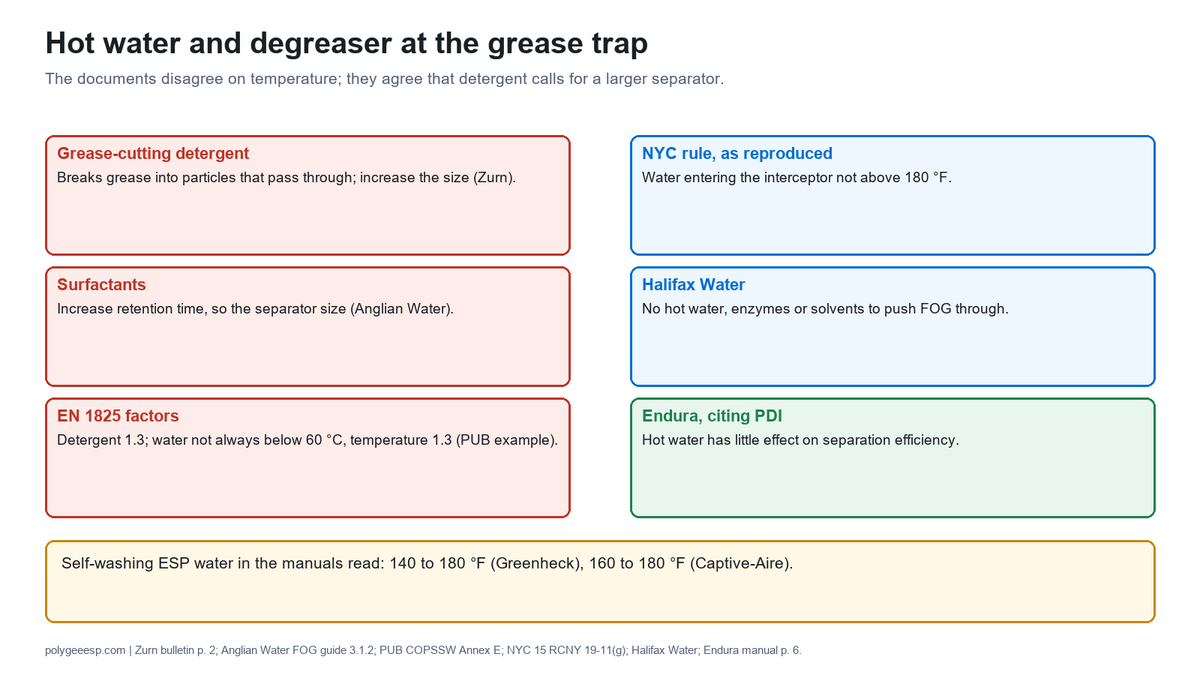
Washing exhaust equipment sends hot water and degreaser to the drain, and the drainage documents read for this page treat both as reasons to size up or to keep the flow apart. Zurn’s engineering bulletin lists grease-cutting detergents among the factors that affect performance: they break liquid grease into minute particles that can pass through the interceptor, and its recommended solution is to increase the size of the interceptor. The Anglian Water FOG guide says the same of surfactants in warewashing and cleaning, and of the volume and temperature of the water: to achieve the same efficiency, the retention time, and so the size of the separator, has to be increased.
On temperature the documents do not agree, and the disagreement matters because exhaust wash water is hot. New York City caps water entering an interceptor at 180 °F. The EN 1825 factor in Singapore’s example raises the nominal size by 1.3 when the water is not always below 60 °C. Sioux City’s practice list asks for wash water below 140 °F, and Halifax Water forbids enzymes, solvents, hot water or any other agent used to push FOG through the interceptor. On the other side, the Endura manual says the Plumbing and Drainage Institute has test data showing that hot water has little effect on separation efficiency. The self-washing ESP figures sit at the top of that range: 140 to 180 °F in Greenheck’s manual and 160 to 180 °F in Captive-Aire’s.
| Factor | What the document says | Source |
|---|---|---|
| Grease-cutting detergent | Breaks grease into particles that pass through; increase the interceptor size | Zurn engineering bulletin p. 2 |
| Surfactants, volume and temperature | Volume and temperature affect separation; where surfactants are used, increase retention time, so the separator size | Anglian Water FOG guide, 3.1.2 |
| Cleansing and rinsing agents | Factor 1.3 in the nominal size (1.5 for hospitals) | PUB Annex E, quoting EN 1825-2 |
| Water at or above 60 °C | Temperature factor 1.3 instead of 1.0 | PUB Annex E, quoting EN 1825-2 |
| Water entering the interceptor | Not above 180 °F | NYC 15 RCNY 19-11(g), as reproduced |
| Hot water to move FOG through | Not permitted | Halifax Water |
| Hot water and separation | Little effect, citing PDI test data | Endura manual p. 6 |
| Commercial dishwasher | A separate interceptor recommended for each (Endura, where local codes permit, citing industrial detergents; Zurn) | Endura manual p. 6; Zurn bulletin p. 1 |
For a kitchen that washes ESP cells off the unit, the practical question is where that wash happens. A soak tank or pot sink that drains to the grease interceptor brings the degreaser and the warm water with it; a commercial dishwasher brings whatever its own connection allows, which depends on the section of the code adopted, the type of interceptor and the authority’s approval. This guide names no detergent product, strength or temperature for our units; the routine is in the manual supplied with each model, and what it means for the drain is a question for the plumbing designer and the local FOG program. Residue left by an incomplete rinse is also a cause of trouble on the electrical side, as our electrostatic precipitator arcing guide describes.
How often a grease trap is pumped: the 25% rule and the calendars
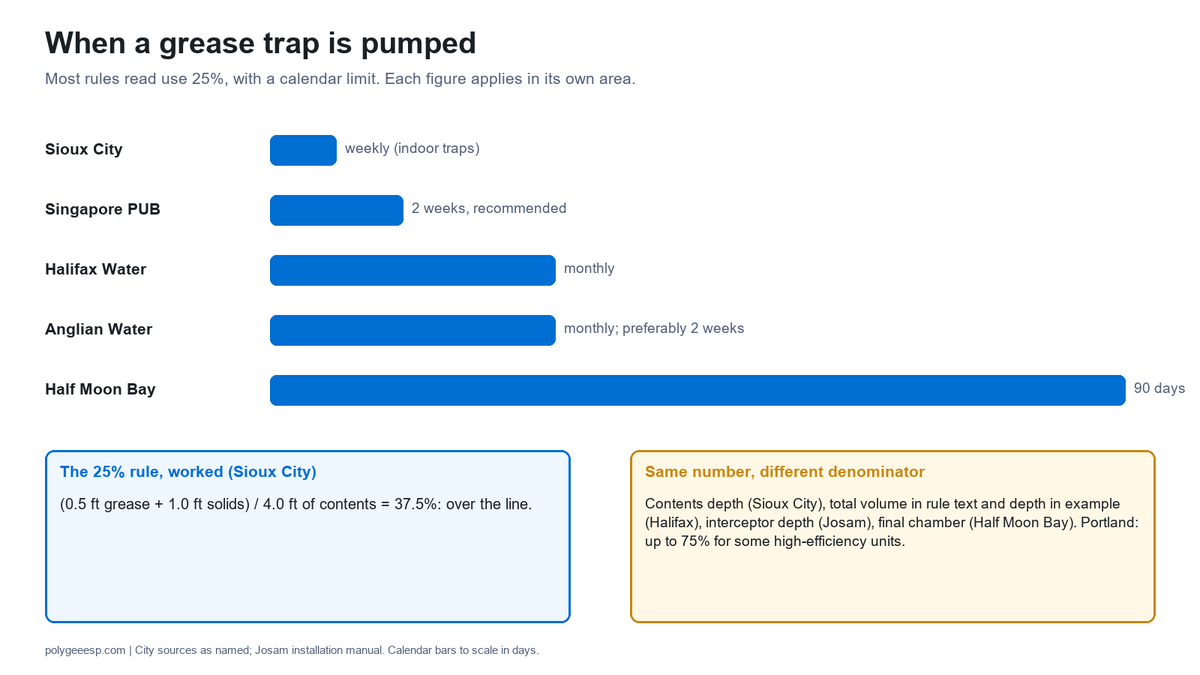
Most of the city rules read for this page pump a grease interceptor when grease and solids reach 25% of its depth or volume, and add a calendar limit that ranges from a week to 90 days. Portland’s Bureau of Environmental Services says most interceptors need cleaning at 25% full of FOG and solids, some high-efficiency hydromechanical units can accumulate up to 75%, the city sets each site’s frequency by type of establishment, interceptor size and flow, and a cleaning report is filed after every pump-out. Sioux City shows the arithmetic: 0.5 ft of grease and 1.0 ft of solids in 4.0 ft of contents is 37.5%, over the line.
| Jurisdiction or maker | Trigger | Calendar limit | Records and other conditions |
|---|---|---|---|
| Half Moon Bay, California | Final chamber 25% full of FOG and solids | At least every 90 days, whichever comes first | No decanting back into the interceptor; records kept 3 years |
| Sioux City, Iowa | 25% of total contents depth | Indoor traps at least weekly; outdoor interceptors by a certified hauler at 25% | Discharge limit 400 mg/L |
| Halifax Water, Nova Scotia | Before FOG and solids reach 25% | Or once a month, whichever comes first | Complete removal of solids and liquids; records kept 2 years |
| Portland, Oregon | 25% for most; up to 75% for some high-efficiency units | Set by the city per site | Report after every cleaning; all additives prohibited |
| Singapore PUB | Discharge limits | At least every 2 weeks, recommended | Licensed general waste collector |
| Anglian Water (EN 1825 separators) | Level alarm where fitted | At least monthly, preferably every two weeks, unless otherwise specified | Emptied, cleaned and refilled with clean water |
| Josam manual | Grease layer at 25% of interceptor depth | Days to weeks; a complete cleaning at least twice a year | Observe a few cycles before fixing a schedule |
| Watts and Zurn manuals | Watts: before grease reaches the rated capacity in pounds; Zurn: by interceptor capacity and grease content | Typically once a week to once in several weeks | Endura adds: solids no deeper than 1 in. |
The 25% figures share a number but not a denominator: Sioux City divides by the depth of the contents, Halifax by total volume in its rule text, worked as a depth ratio in its example, Josam by the depth of the interceptor, and Half Moon Bay applies it to the final chamber. The model codes give no interval at all; the 2021 IPC and the California Plumbing Code ask for periodic removal, and New York City’s rule asks for routine cleaning as needed. What sets the pace in practice is the load, and the EPA fact sheet says so directly: maintenance frequency depends greatly on the amount of FOG a facility generates and the practices it follows. A kitchen that adds ESP wash water, or washes cells in a sink that drains to the interceptor, is adding load, and the local discharge limit it is measured against, 50 to 450 mg/L with 100 mg/L the most common in the limits the EPA summarized in 2012, still applies.
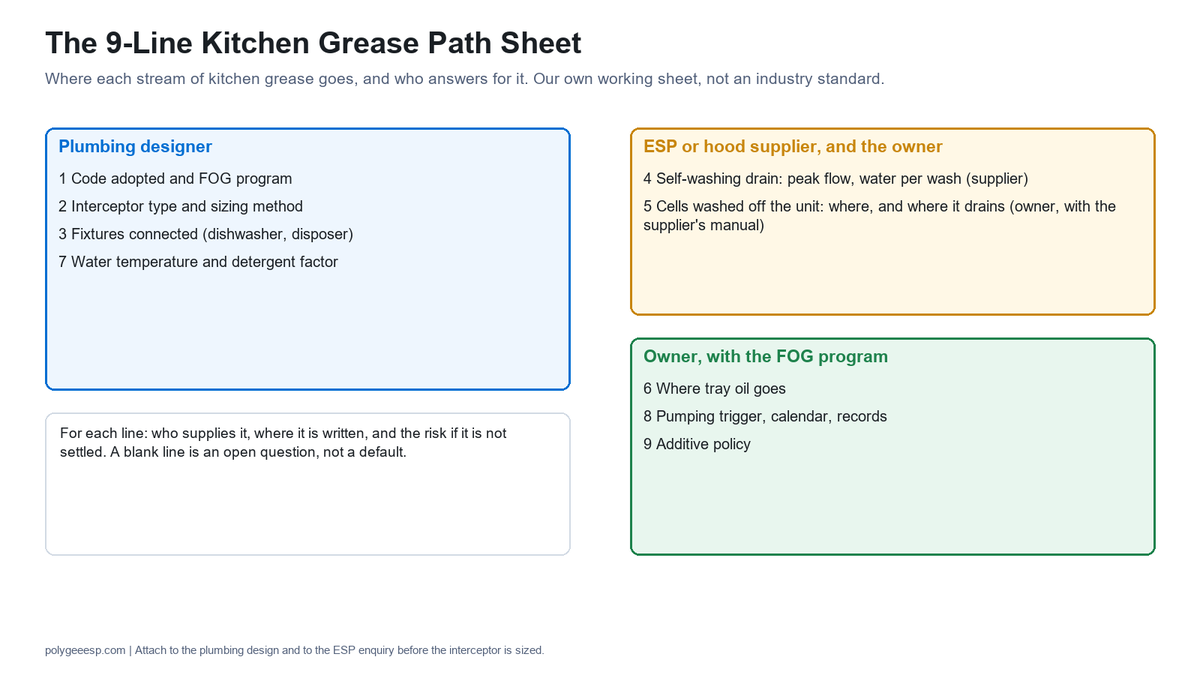
The 9-Line Kitchen Grease Path Sheet
The 9-Line Kitchen Grease Path Sheet records where each stream of kitchen grease goes and who answers for it, before the grease interceptor is sized and before an ESP or ecology unit is ordered. It is our own working sheet, not an industry standard; a line left blank is a question still open, not a default.
| # | Line | Who supplies it | Where it is written | Risk if it is not settled |
|---|---|---|---|---|
| 1 | Plumbing code adopted (IPC, UPC or local) and the FOG program that applies | Plumbing designer, from the authority | Drawing notes; FOG permit | Dishwasher, additive and sizing rules read from the wrong document |
| 2 | Interceptor type and sizing method (flow, peak flow x 30 minutes, DFU or EN 1825 nominal size) | Plumbing designer | Plumbing schedule | A unit sized by the wrong method for the authority |
| 3 | Fixtures connected: sinks, floor drains, kettles, and whether a dishwasher or disposer is permitted under the adopted code and the authority | Plumbing designer; kitchen designer | Fixture schedule | A dishwasher or disposer connected against the adopted code |
| 4 | Self-washing exhaust equipment: wash-down drain, peak flow, water per wash and temperature | ESP or hood manufacturer | Its manual; the quotation | An interceptor that never counted the wash |
| 5 | Cells washed off the unit: in which sink, soak tank or dishwasher, and where that drains | Owner, with the ESP supplier’s manual | Cleaning procedure | Degreaser and grease arriving at an interceptor not sized for them |
| 6 | Collected oil from trays or receptacles: where it goes | Owner, with the FOG program | Kitchen procedure | Tray oil tipped into a sink |
| 7 | Water temperature and detergent in each stream, and the factor the sizing applies | Plumbing designer | Sizing calculation | Emulsified grease passing through |
| 8 | Pumping trigger, calendar limit and records required | Owner, from the FOG program | Maintenance contract | Missed pump-outs and missing records at inspection |
| 9 | Additive policy: none, microbial only, or as the program allows | Owner, from the code and the FOG program | Maintenance contract | A dosing system the code or the city prohibits |
Lines 1 to 3 decide the interceptor; lines 4 to 7 decide whether the exhaust side has been counted in it; lines 8 and 9 decide whether it keeps working. For a precipitator or ecology unit from us, lines 4 and 5 are answered by the model: our in-duct units have no wash-down drain, and the cleaning routine in the manual for the model sets out how the cells are washed off the unit.
Key takeaways
- A grease trap holds grease until it is removed: slowed, cooled water lets grease float and solids sink, and the trap works only as long as the held grease is taken out.
- Hydromechanical units are sized by flow, gravity interceptors by volume: fixture volume x 0.75 over a one- or two-minute drain; peak flow x 30 minutes (IPC 2021); drainage fixture units (UPC); or EN 1825 nominal size.
- The codes disagree on dishwashers and additives: the IPC requires dishwashers without prerinse sinks to connect, the California code (UPC basis) forbids it in Section 1014.1.3 and allows it for gravity interceptors with approval in Section 1014.3.2; the IPC allows only microbial dosing and Portland allows none.
- Kitchen ESP grease leaves by three routes: a self-washing unit’s wash-down drain, which the IMC sends through a grease interceptor; the sink or dishwasher where cells are washed off the unit, as ours are; and the oil from the collection tray, whose disposal the local FOG program confirms.
- Hot water and degreaser count: Zurn and Anglian Water size up for detergent, and EN 1825, as quoted by PUB, applies 1.3 for water not always below 60 °C. Settle the nine lines on The 9-Line Kitchen Grease Path Sheet before the interceptor is sized.
Frequently asked questions
- Does sewage go through a grease trap?
- No. The 2022 California Plumbing Code, based on the 2021 UPC, says water closets, urinals and other fixtures conveying human waste shall not drain into or through a grease interceptor, and Singapore’s PUB says used water from toilets shall not be connected to grease traps. The 2021 IPC keeps out any waste that does not need treatment. Only fixtures and equipment that discharge fats, oils and grease, such as pot sinks, prerinse sinks, floor drains and, under the IPC, dishwashers without prerinse sinks, are connected.
- Can a restaurant operate without a grease trap?
- Not where the adopted code or the local program requires one. The 2021 IPC requires a grease interceptor or automatic grease removal device for grease-laden fixtures in food preparation areas; the UPC-based California code requires one where the authority determines pretreatment is needed; Singapore requires grease traps in all food shops, with a possible exception, subject to PUB’s permission, for shops with no cooking and no dine-in; and in England, Approved Document H expects a grease separator to BS EN 1825 or other effective means of grease removal.
- How often should a grease trap be cleaned?
- When grease and solids reach the trigger in the local rule, 25% in most of the rules read here, or at the calendar limit, whichever comes first. The limits read here run from at least weekly for small indoor traps in Sioux City, through a recommended two weeks in Singapore and a month in Halifax and in Anglian Water’s guidance, to 90 days in Half Moon Bay. Manufacturers such as Watts and Zurn give typical intervals of once a week to once in several weeks, depending on the load.
- What dissolves grease in a grease trap?
- No additive replaces removing the held grease under the rules read here. The 2021 IPC prohibits dispensing systems that discharge emulsifiers, chemicals or enzymes to grease interceptors and allows microbial dosing only where the interceptor manufacturer permits it and the system conforms to ASME A112.14.6. Portland prohibits all additives because they let FOG pass through to the sewer, and Halifax Water prohibits enzymes, solvents and hot water used for the same purpose.
- Does ESP wash water need to go through a grease interceptor?
- For a self-washing pollution control unit, yes under the International Mechanical Code: Section 506.5.2, item 11 in the 2021 edition and item 12 in 2024, requires wash-down drains to discharge through a grease interceptor; the drains are sized for the flow and sealed with a trap or other approved means against air bypass, with a trap seal deep enough for system pressurization and evaporation between cleanings. Where the cells are removed and washed in a sink or dishwasher, as on our in-duct units, the wash water follows that fixture’s connection, and the plumbing code adopted decides whether it reaches the grease interceptor.
- What happens if a grease trap is not cleaned?
- It stops holding grease back: a grease trap keeps working only as long as the grease it has held is removed. It holds grease; it does not make it disappear. The 2021 International Plumbing Code requires periodic removal of accumulated grease, scum and solids. On grease in sewers generally, a 2004 EPA report to Congress, cited in the EPA fact sheet, found grease from restaurants, homes and industrial sources to be the most common cause, 47%, of reported sewer blockages. Missed pump-outs and missing records are also a risk at inspection.
- How is a grease trap cleaned?
- It is pumped out by a licensed hauler, following the device manufacturer’s instructions and the local FOG program, and a removable cover gives access. What has to come out is the accumulated grease, scum and solids. Local rules read here add conditions: Halifax Water asks for complete removal of solids and liquids, Half Moon Bay allows no decanting back into the interceptor, Anglian Water’s guidance has the separator emptied, cleaned and refilled with clean water, and Portland requires a cleaning report after every pump-out.
- What is the difference between a grease trap and a grease interceptor?
- The two names are used loosely, but a grease trap is often the name given to a hydromechanical grease interceptor; the other kind is the gravity grease interceptor. A hydromechanical unit usually sits indoors near the fixtures, uses a flow control and baffles, and is rated by flow in gallons per minute; Portland quotes 20 to 50 gpm. A gravity interceptor is usually a large outdoor tank rated by liquid volume; Portland quotes 1,000 to 4,000 gallons. Los Angeles County Public Works’ restaurant guidelines define a grease trap as 25 to 75 gallons and a grease interceptor as 750 gallons or more.
- What are the main parts of a grease trap?
- The main parts of a grease trap are the inlet and baffles, the grease retention space, the solids space, the outlet and a removable cover. Baffles break the incoming flow and keep the grease layer away from the outlet. The grease retention space holds floating grease until pumping, and the solids space holds settled food solids. On Josam and Zurn units the outlet draws water from below the grease layer. A hydromechanical unit also has a vented flow control upstream that limits the flow to the rating.
Planning the drains for a kitchen ESP?
Send us the kitchen’s airflow and cooking line, where the unit would go, and the plumbing code and FOG program that apply. You get back the precipitator or ecology unit configuration for that airflow, a written statement of how its cells are cleaned and that the in-duct units carry no wash-down drain, the access the cell drawers need for removal, and the cleaning interval we give for the cooking load, so lines 4 and 5 of The 9-Line Kitchen Grease Path Sheet are filled in before the grease interceptor is sized.
Send the airflow, cooking line and drain details →
The stages of a pollution control unit and what the code attaches to each are on our pollution control unit page, the hood filter rules on our commercial kitchen grease filter requirements page, and the whole exhaust system on our commercial kitchen ventilation system guide.
Why we write this. Many of the grease trap guides on the first page of results come from drain, pumping and waste services, and the three we read in full stop at the sink. The exhaust takes grease out of the kitchen by another route, and it comes back to the drains, or into a container, when the exhaust equipment is cleaned; we make that equipment, not the trap, and the questions are easier to answer with the plumbing codes, the city rules and the manufacturers’ figures side by side. This page gives no plumbing design, no pumping procedure and no figure of ours that is not on our record.
Law is Project Manager at Polygee. Polygee, founded in 2004, manufactures the in-duct electrostatic precipitators, UV-C and activated carbon modules, kitchen ecology units and ESP hoods named here; it does not make grease traps or interceptors. The code text cited on this page was read in the sources listed below, and the device and city figures are those of the authorities and manufacturers named with them.
References & further reading
- International Code Council, International Plumbing Code 2021, chapter 10: sections 1003.1, 1003.2, 1003.3.1 to 1003.3.8, 1003.9, 1003.10 and Table 1003.3.5.1. codes.iccsafe.org
- International Code Council, International Mechanical Code 2021, chapter 5: section 506.5.2, items 11, 13 and 15 (items 12, 14 and 16 in the 2024 edition), and section 506.5.3; 2024 item numbers from the 2024 edition text. codes.iccsafe.org
- International Code Council, International Mechanical Code 2024, chapter 5: section 506.5.2, items 12, 14 and 16. codes.iccsafe.org
- California Plumbing Code 2022 (based on the Uniform Plumbing Code 2021), sections 1014.1 to 1014.3.6, as published by GoCodebook. gocodebook.com
- US EPA, Controlling Fats, Oils, and Grease Discharges from Food Service Establishments, EPA-833-F-12-003, September 2012 (archived copy). epa.gov
- New York City Department of Buildings, Buildings Bulletin 2010-028, reproducing DEP rule 15 RCNY 19-11 (marked for projects filed before 31 December 2014). nyc.gov
- Los Angeles County Public Works, Restaurant pretreatment guidelines. ladpw.org
- City of Portland Bureau of Environmental Services, Grease interceptors. portland.gov
- City of Half Moon Bay, Grease interceptor maintenance. halfmoonbay.gov
- City of Sioux City, Understanding the grease removal and 25 percent rule. sioux-city.org
- Halifax Water, Grease interceptor cleaning. halifaxwater.ca
- City of Calgary, How to size your grease interceptor. calgary.ca
- PUB Singapore, Code of Practice on Sewerage and Sanitary Works, 3rd edition, March 2025: section 4.2.2 and Annex E (quoting EN 1825-2). pub.gov.sg
- PUB Singapore, Grease trap requirements and recommended maintenance. pub.gov.sg
- HM Government, The Building Regulations 2010, Approved Document H, 2015 edition, paragraph 2.21. gov.uk
- Anglian Water, FOG management guide, March 2023: sections 2.1, 3.1.2 to 3.1.4. anglianwater.co.uk
- Canplas, Endura grease interceptor manual, 3935A-17: pp. 2, 6, 17. webstaurantstore.com
- Watts, grease interceptor installation instructions: pp. 2, 3. webstaurantstore.com
- Zurn, grease interceptor engineering bulletin, ZMKTG210-06: pp. 1–4. webstaurantstore.com
- Josam, grease interceptor installation manual: pp. 3, 5. webstaurantstore.com
- Greenheck, Grease Trapper ESP Installation, Operation and Maintenance Manual, Rev. 3, July 2019: pp. 3, 4, 8, 9, 34. greenheck.com
- Trion, KES Series Installation, Operation and Maintenance Manual (hosted by Johnson Controls): pp. 4, 5, 7, 8 (cabinet drains, trap seal, manual washing). docs.johnsoncontrols.com
- Captive-Aire Systems, Technical Manual for Installation, Operation and Maintenance of the Electrostatic Precipitator, C-ESP series with CGPC-6000-ESP command center, first printing November 2004: pp. 5, 18, 19. captiveaire.com
Related reading
- Electrostatic precipitator cleaning: how the cells come out, how they are washed, and the interval for each cooking load.
- Pollution control unit: the stages inside one and what Section 506.5.2 attaches to each.
- Commercial kitchen ventilation system: the six parts of the system and the clause that governs each.
- Direct drive vs belt drive fan: how the exhaust fan copes as an ESP loads between washes.