

A pollution control unit is the filter cabinet that a North American kitchen exhaust code places in the grease duct after a Type I hood, where it takes grease particles, smoke and odor out of the airstream before the discharge. Pollution control unit maintenance is the routine of washing, replacing and inspecting those filter stages so that the unit keeps its design airflow and its removal performance from one service to the next. The Gulf calls the same cabinet an ecology unit, and the UK an in-duct electrostatic precipitator.
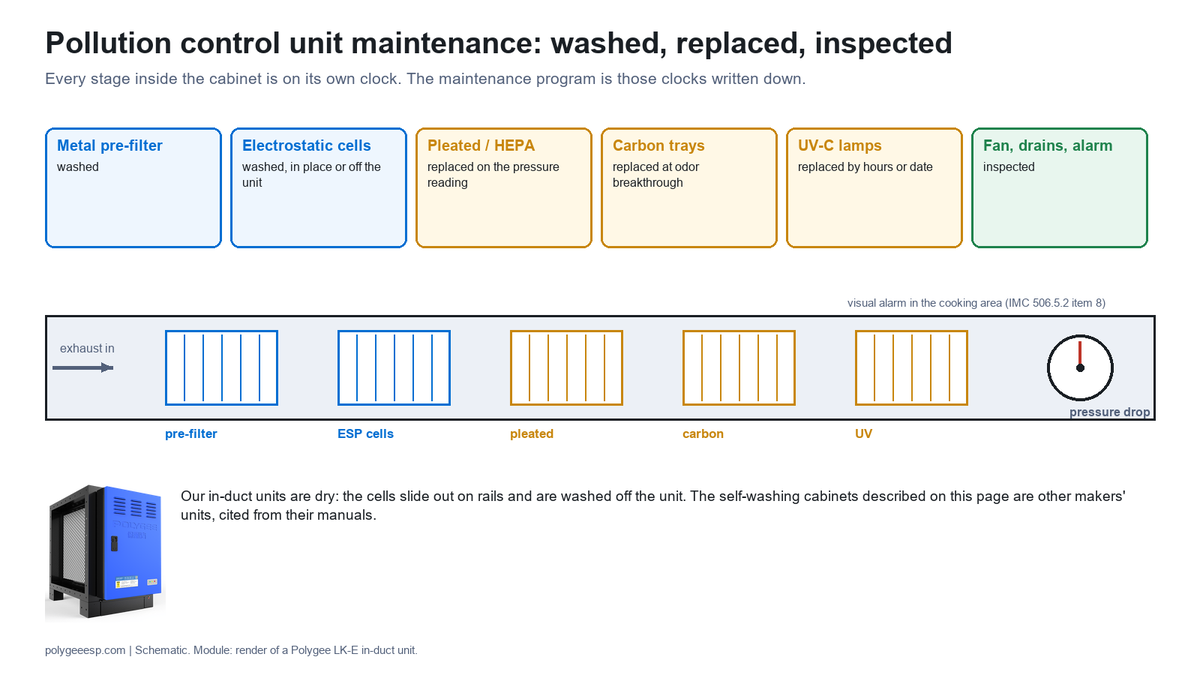
Each stage inside the cabinet wears on its own clock. A metal pre-filter is washed; an electrostatic cell is washed, in place on a self-washing unit or off the unit on a dry one; a pleated or HEPA filter is replaced when the pressure drop says so; a carbon tray is replaced when the odor comes back; a UV lamp is replaced by hours or by date; the fan is serviced on the fan manual’s calendar. A maintenance program is those clocks written down, with the person who winds each one named beside it. We manufacture in-duct electrostatic precipitators, the UV-C and activated carbon modules that follow them, and the kitchen ecology units built from the three, which is the equipment such a program is written for. Our in-duct units are dry, with no wash-down system, so this guide also reads two North American manufacturers’ manuals for the self-washing units we do not make, and takes each interval, threshold and code item from the document it is attributed to.
This page helps you decide what has to happen to each stage of a pollution control unit, how often, on whose authority, and what has to be on paper when the fire inspector or the insurer asks. It ends with The 11-Line PCU Service Record, a log you can attach to the maintenance contract. It gives no cleaning procedure for our units: how a cell is removed, washed and dried, and which cleaning agent is used, follow the manual for the model and the local code, and the figures and steps quoted from other makers’ manuals are summaries that describe their units, not ours.
| Question | Short answer |
|---|---|
| How often is a pollution control unit cleaned? | There is no single industry interval. CaptiveAire’s manual removes the electrostatic cells every 3 months; Greenheck’s self-washing unit washes daily and has the cells out by hand every 6 months at minimum; our dry in-duct units are opened every 15 to 30 days for a typical lunch-and-dinner restaurant and every 7 days for a heavy line. The cooking load sets it, and the manual for the model is the authority |
| Does NFPA 96 set that interval? | No. Table 11.4 of NFPA 96, reproduced as Table 514.3 of the 2022 California Mechanical Code, schedules the inspection of the entire exhaust system for grease buildup: monthly for solid fuel, quarterly for high-volume cooking, semiannually for moderate, annually for low. It is an inspection schedule for the system, not a cell-cleaning interval for the unit |
| What does the filter alarm mean? | That the airflow has fallen below the design velocity. Item 8 of IMC Section 506.5.2 requires a differential-pressure control across the filter sections with a visual alarm in the cooking area. It reports lost airflow and, on designs that read each stage, which filter stage is loading; it does not measure collection efficiency or carbon saturation |
| Which stages are replaced rather than washed? | Pleated high-efficiency and HEPA filters, carbon or other odor media, and UV lamps. Metal pre-filters, mist eliminators and electrostatic cells are washed. On our units the cells and the high-voltage power module are inside the twelve-month warranty; lamps and carbon are consumables outside it |
| Who does it? | Three layers: the kitchen team for what the model manual lets them open; a qualified contractor for the electrical stages once isolated, the fan and the housing; and, for the exhaust system, a trained, qualified and certified person acceptable to the authority, whose certificate stays on the premises as one New York fire inspector summarizes the 2017 edition |
- What maintaining a pollution control unit involves
- Stage by stage: washed, replaced, or inspected
- Two ways the cells get clean: self-washing units and cells washed off the unit
- Where the interval comes from: two manuals, one code table, and the cooking load
- The differential-pressure reading: what it tells you and what it does not
- Carbon, odor media and UV lamps: the stages you cannot see wearing out
- Access, isolation and who does what
- Common mistakes
- The 11-Line PCU Service Record
- Where this guide stops
- Frequently asked questions
What maintaining a pollution control unit involves
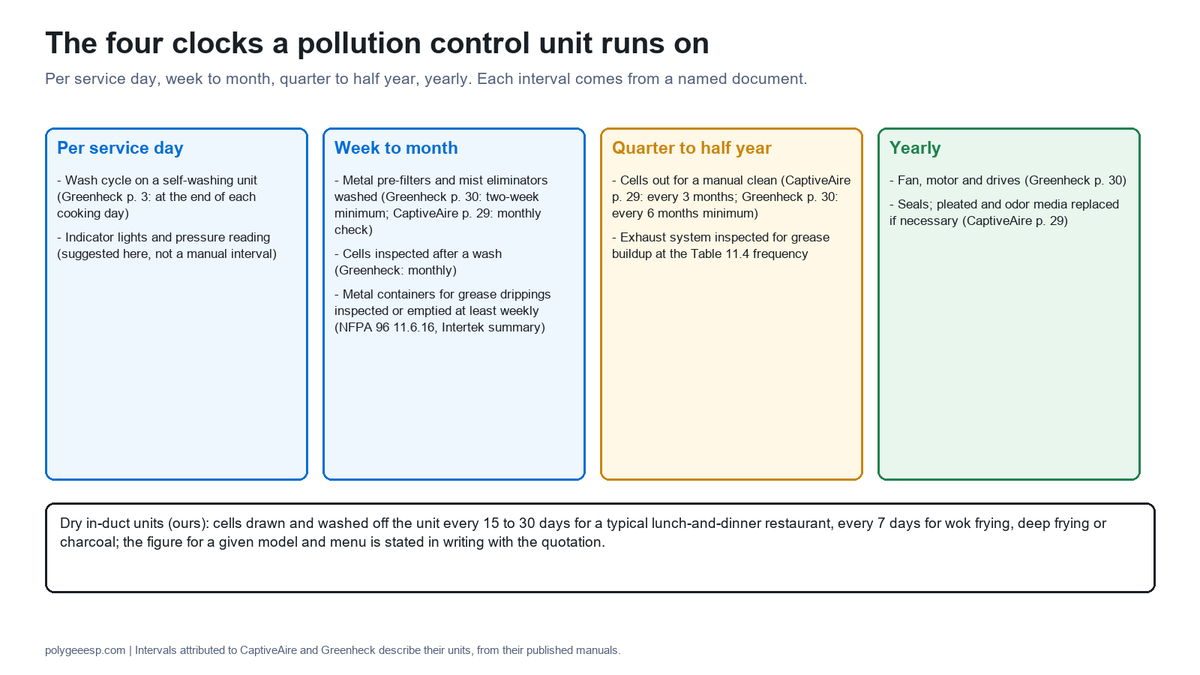
Maintaining a pollution control unit means keeping four clocks at once, because the stages inside the cabinet load, saturate and wear at four different rates. The first clock runs by the service day: on a self-washing unit, the wash cycle, and on any unit, a look at the indicator lights and the pressure reading, a frequency this page suggests rather than one a manual sets. The second runs by the week or the month: metal pre-filters and mist eliminators washed, cells inspected for grease build-up. The third runs by the quarter or the half year: cells out of the cabinet for a manual clean on self-washing units, and the whole exhaust system inspected for grease at the frequency the code table gives. The fourth runs by the year: fan, motor and drives, door seals, and the pleated or odor media that the pressure reading or the nose has not already called in.
Two North American manuals describe that routine for their own units. CaptiveAire’s Pollution Control Unit manual (May 2025, Rev. 48) opens its maintenance chapter with the sentence that most problems associated with PCU failures are directly related to poor service and maintenance such as not replacing or cleaning filters, and then gives a schedule at two weeks after start-up, every month, every three months and yearly. Greenheck’s Grease Trapper ESP manual (Rev. 3, July 2019) says that maintenance frequency will vary based on site conditions, asks for the cells to be looked at once a week for the first month of operation, and sets its intervals from there. Neither manual treats a self-washing unit as a unit that is left alone.
Our own units sit on the dry side of that routine. An ecology unit from us is an LK-E electrostatic stage followed by a UV-C module and an activated carbon module; none of the three carries a replaceable particle medium, the precipitator cell is washed, and the lamps and the carbon media in the two odor stages are the consumables. The cell comes out of the cabinet on its rails and is washed off the unit, which removes the water supply, the drain and the wash controller from the maintenance list and puts a calendar of cell removals in their place.
| Clock | What runs on it | Source for the interval |
|---|---|---|
| Per service day | Wash cycle on a self-washing unit; indicator lights and pressure reading (this page’s suggestion, not a manual interval) | Greenheck manual p. 3 (wash at the end of each cooking day) |
| Week to month | Metal pre-filters and mist eliminators washed; cells inspected after a wash; filter loading checked; metal containers for grease drippings inspected or emptied at least weekly under NFPA 96 clause 11.6.16 | Greenheck p. 30 (two-week minimum for the metal filters, monthly cell inspection); CaptiveAire p. 29 (monthly filter check); Intertek summary of NFPA 96 edition changes |
| Quarter to half year | Cells removed and cleaned by hand on self-washing units; exhaust system inspected for grease buildup at the Table 11.4 frequency for the cooking volume | CaptiveAire p. 29 (every 3 months); Greenheck p. 30 (every 6 months minimum); NFPA 96 Table 11.4 as reproduced in CMC 2022 Table 514.3 |
| Year | Fan, motor and drives; seals; pleated and odor media inspected and replaced if necessary | Greenheck p. 30; CaptiveAire p. 29 |
| Dry in-duct units (ours) | Cells drawn and washed off the unit every 15 to 30 days for a typical lunch-and-dinner restaurant, every 7 days for wok frying, deep frying or charcoal; the figure for a given model and menu is stated in writing with the quotation | Our published cleaning basis |
Stage by stage: washed, replaced, or inspected
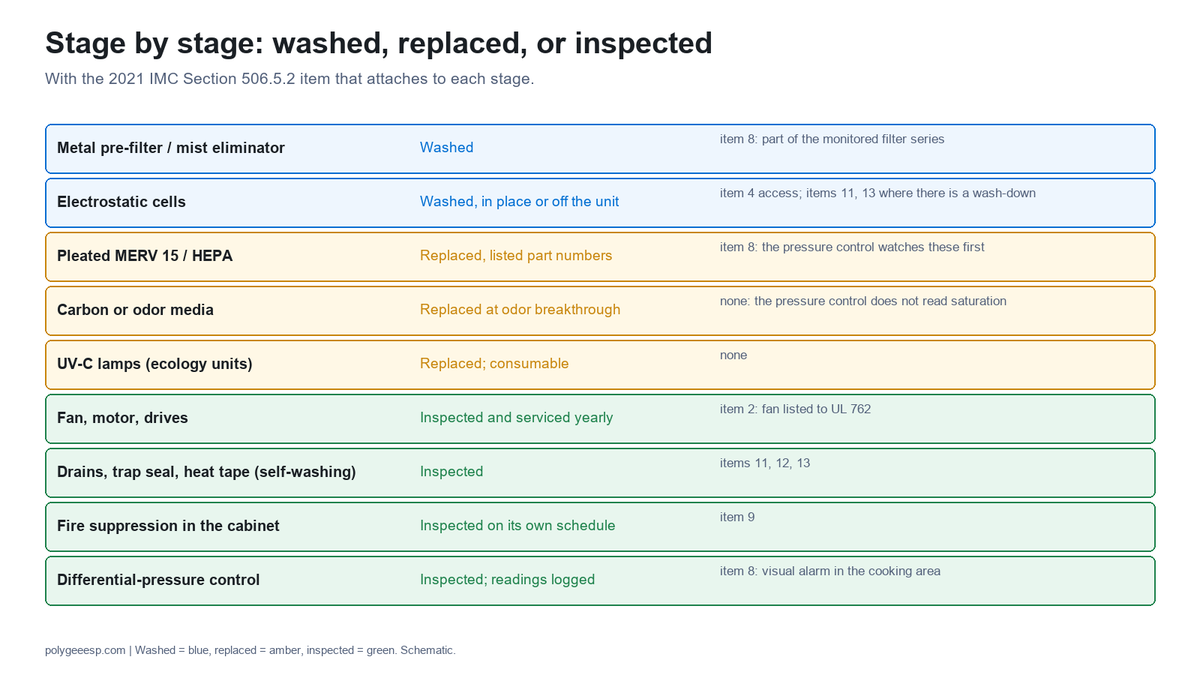
No stage in a pollution control unit is installed and then left alone; each one is washed, replaced or inspected, and the 2021 International Mechanical Code, Section 506.5.2, attaches a maintenance consequence to several of them. Item 4 requires access for servicing and cleaning of a unit installed indoors; item 8 requires the differential-pressure control across the filter sections; item 9 the factory-installed fire suppression; item 10 service space to the manufacturer’s instructions and Section 306; item 11 wash-down drains through a grease interceptor with a trap seal that accounts for system pressurization and evaporation between cleanings; item 13 a transition duct that slopes toward the cabinet drain pan where washing can splash. Those items name the equipment a maintenance program has to visit.
The stage list below follows CaptiveAire’s specification sheet for the order of a filter-type unit, washable steel pre-filter, MERV 15 pleated filter, optional electrostatic section with its own metal pre- and post-filters and internal wash, optional HEPA to MERV 17, then odor media, and Greenheck’s ESP unit for the order of an electrostatic one, impingement filter, electrostatic cells, mesh mist eliminator, carbon trays. Our ecology units run electrostatic cell, UV-C lamps, carbon.
| Stage | Washed, replaced or inspected | What IMC 506.5.2 attaches to it | Signal that it is due | Record |
|---|---|---|---|---|
| Metal mesh or impingement pre-filter | Washed. CaptiveAire: washable steel pre-filters cleaned in warm soapy water, checked monthly; Greenheck: metal filters removed and cleaned at a minimum of two-week intervals; ours: washed with the cells by the kitchen team | Part of the filter series the item 8 pressure control monitors | Visible matting; pressure reading rising | Date, who washed it, reinstalled with drain holes at the bottom edge or arrow with the airflow |
| Electrostatic cells | Washed. In place on self-washing units, plus a manual clean every 3 months (CaptiveAire) or every 6 months at minimum (Greenheck); off the unit on dry units like ours, every 15 to 30 days for a typical restaurant, 7 days for a heavy line | Item 4 access for servicing and cleaning; item 11 and 13 where there is a wash-down | Residual grease on the plates after a wash; sparking above the maker’s limit; the fault light | Date, in place or off the unit, inspection result, who did it |
| Mesh mist eliminator or post-filter | Washed; on Greenheck’s unit it keeps wash water out of the carbon section, so it is on the same two-week clock as the pre-filter | Part of the monitored filter series | Matting; carbon section wet after a wash | Date, who |
| Pleated MERV 15 and HEPA filters (filter-type units) | Replaced, with the part numbers the manual lists; CaptiveAire’s manual says the use of any other filters will void the warranty | Item 8: within the filter sections the pressure control monitors | The pressure control; the fault chart’s percentage clog | Date, part number, pressure before and after |
| Carbon trays or other odor media | Replaced at odor breakthrough; Greenheck’s ESP manual gives 3 to 6 months for typical cooking, more often for heavy grease; its mechanical-filter manual gives a few months to one year; our carbon module page gives a planning window of 3 to 6 months by cooking load, a range to budget against rather than a schedule | No separate replacement or saturation requirement; the whole-unit items still apply | Odor at the discharge or the complaint | Installation date; date breakthrough was first noticed |
| UV-C lamps (ecology units) | Replaced; consumables outside our twelve-month warranty. We publish no lamp-life figure, so the record is the installation date and the accumulated hours | No separate requirement; the whole-unit items still apply | Hours; lamp indicator where fitted | Installation date, hours |
| Fan, motor, drives | Inspected, serviced and cleaned annually to the fan manufacturer’s instructions (Greenheck); fan scroll washed every 6 months on its mechanical-filter unit | Item 2 requires fans serving the unit to be listed and labeled to UL 762 | Belt wear, noise, airflow | Annual date, belt and bearing findings |
| Drains, trap seal, heat tape (self-washing units) | Inspected; CaptiveAire’s drain has a float switch that cuts power to the ESP supply when the drain clogs, and outdoor piping takes heat tape unless its self-draining package is used | Item 11 grease interceptor and trap seal; item 12 freeze protection; item 13 transition slope | Drain-clog fault; water in the transition | Fault dates; interceptor pump-out dates |
| Oil tray (dry units) | Emptied and wiped by kitchen staff; where the oil goes is set by the local FOG program | No separate requirement; the whole-unit items still apply | Level | Date |
| Fire suppression inside the cabinet | Inspected and serviced on the suppression system’s own schedule | Item 9 | Its service tag | Service company, date |
| Differential-pressure control and alarm | Inspected; readings logged at each visit against the clean baseline | Item 8 | The visual alarm in the cooking area | Reading, date, alarm dates |
On our own units the list is shorter because the wash-down column is empty. The three stages are washed, consumed and consumed; the cells and the high-voltage power module sit inside the warranty and the lamps and carbon outside it; and the differential-pressure gauge across the filter sections is read and written down rather than wired to a wash controller. Which items a buyer ends up buying again after the unit is installed is set out stage by stage in ecology unit filters.
Two ways the cells get clean: self-washing units and cells washed off the unit
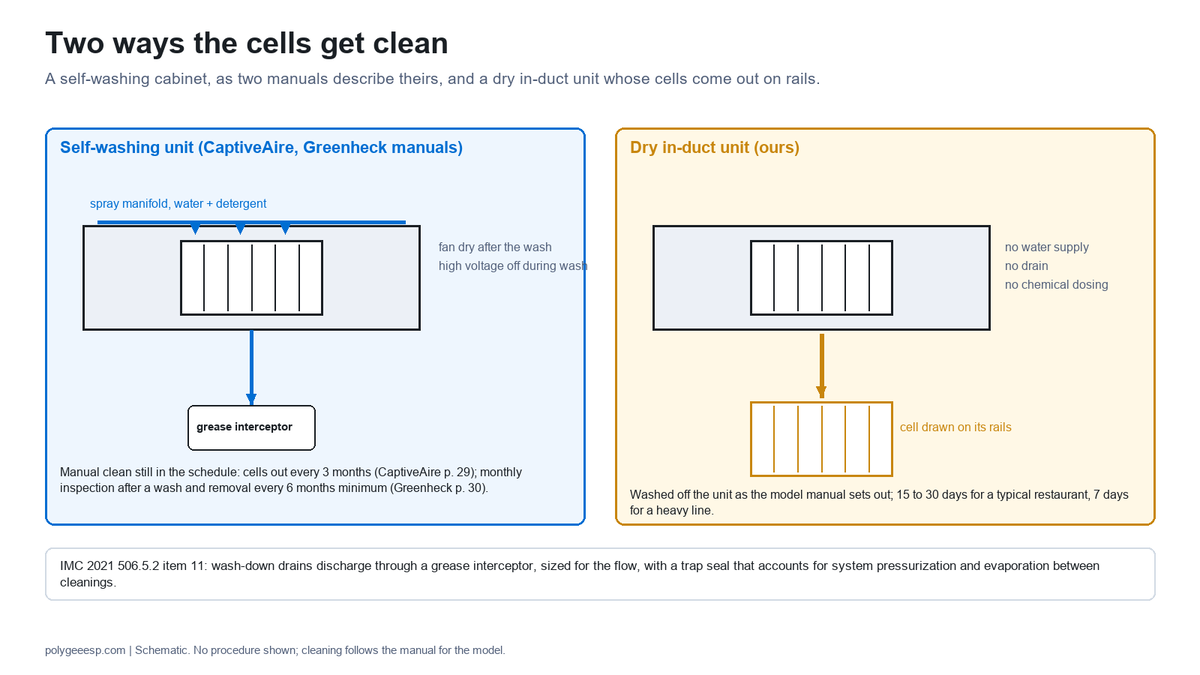
A pollution control unit’s electrostatic cells get clean by one of two routes, and the maintenance list is different for each. On a self-washing unit, a manifold sprays the cells inside the cabinet, the water drains to a grease interceptor, and the fan dries the cells before the high voltage comes back. On a dry unit, the cells slide out on rails and are washed away from the cabinet, and nothing in the duct carries water.
The two manuals describe the first route in detail. Greenheck’s unit starts a wash sequence at the completion of each cooking day; the factory sequence is a 4-minute rinse, a detergent spray of 30 seconds on the smaller housings and 1 minute on the larger, a 3-minute soak, a second 4-minute rinse, 1 minute of drip dry and 90 minutes of fan dry, and the manual says the length and frequency of washing will be determined by the grease load in the airstream. The automatic wash defaults to 2:00 a.m. and starts only if the fan is off; if the fan is switched on during a wash the sequence stops. The unit needs a 1-inch water supply and a 2-inch waste drain, and its mesh mist eliminator exists to keep that water out of the carbon section. CaptiveAire’s self-cleaning sequence is a spray of 3 minutes by default, adjustable from 1 to 15, a fixed 5-minute drain period and a dry mode of 120 minutes, adjustable from 90 to 240, during which the fan is forced on and the high-voltage supply stays off; the water is to be between 140 and 170 degrees Fahrenheit at 20 to 100 psi, outdoor piping takes heat tape unless its self-draining package is used, and a clogged drain trips a float switch that cuts power to the ESP supply.
The code follows the water. Item 11 of Section 506.5.2 sends the wash-down drains through a grease interceptor, sized for the flow and sealed with a trap or other approved means against air bypass, with a seal depth that accounts for the system pressurization and the evaporation between cleanings; item 13 slopes the transition duct toward the cabinet drain pan for at least 18 inches where washing can splash. Where that interceptor is, how it is sized and when it is pumped is the subject of our grease trap guide. And the wash does not retire the manual clean: Greenheck asks for a monthly inspection of the cells after a wash cycle, a manual clean whenever grease build-up is apparent and a removal every 6 months at minimum, and its access steps run from switching the fan off and the terminal box switch off, through lock-out and shorting the cells to ground, to handling a cell of approximately 35 pounds, straightening bent collector plates and reinstalling with the airflow arrow; CaptiveAire has the cells out every 3 months for a wash in warm soapy water and asks for a 30-second wait after de-energizing before any high-voltage component is touched. Residual grease found at that inspection is, in Greenheck’s words, a sign that wash times may need to be increased.
Our in-duct units take the second route. The train is dry, with no water supply, no drain and no chemical dosing, so the wash-down drain and trap seal of item 11, and the water-supply freeze protection of item 12, have nothing to attach to; item 13’s duct connection requirements still apply, with its slope toward the cabinet drain pan for at least 18 inches only where water splash or carryover can occur as a result of a washing operation. The cells are withdrawn on their own rails from the access side and washed off the unit as the manual for the model sets out, the mesh pre-filter goes with them, and the oil tray is emptied and wiped by kitchen staff. Opening the maintenance door on the in-duct units breaks the high voltage, and the cells are drawn with the unit switched off and isolated. How a service visit to those cells runs, and how the cleaning basis is written into the order, is on our electrostatic precipitator cleaning page; this page keeps to the program around it.
| Item | Self-washing unit (as the two manuals describe theirs) | Cells washed off the unit (our in-duct units) |
|---|---|---|
| What cleans the cell | In-cabinet spray with detergent, then fan dry; daily (Greenheck) or by the controller’s schedule (CaptiveAire) | Removal and washing away from the cabinet, per the model manual |
| Manual clean still required | Yes: every 3 months (CaptiveAire); monthly inspection and every 6 months at minimum (Greenheck) | It is the only clean: 15 to 30 days typical restaurant, 7 days heavy line |
| Services at the unit | Water supply, waste drain to a grease interceptor and detergent (both manuals); heat tape on outdoor piping, except with its self-draining package, and a drain float switch (CaptiveAire) | No water service for cell cleaning; electrical supply and access clearance as for any unit |
| Code items in play | 506.5.2 items 11, 12, 13 plus 4, 8, 9, 10 | 506.5.2 items 4, 8, 9, 10 and the duct connections of 13; the wash-down drain of 11 and the water-supply side of 12 do not apply |
| What a missed clean looks like | Residual grease after the wash; rising wash times; drain faults | Rising pressure reading; the symptoms in our arcing guide |
| Record | Last complete wash and last aborted wash with reason (Greenheck’s controller stores both); manual-clean dates | Removal dates, who, inspection result |
Where the interval comes from: two manuals, one code table, and the cooking load
There is no industry-wide cleaning interval for a pollution control unit; there are intervals that manufacturers publish for their units, a code table that schedules something else, and a cooking load that every one of them names as the variable. This page reads them side by side so that it is clear which applies to what.
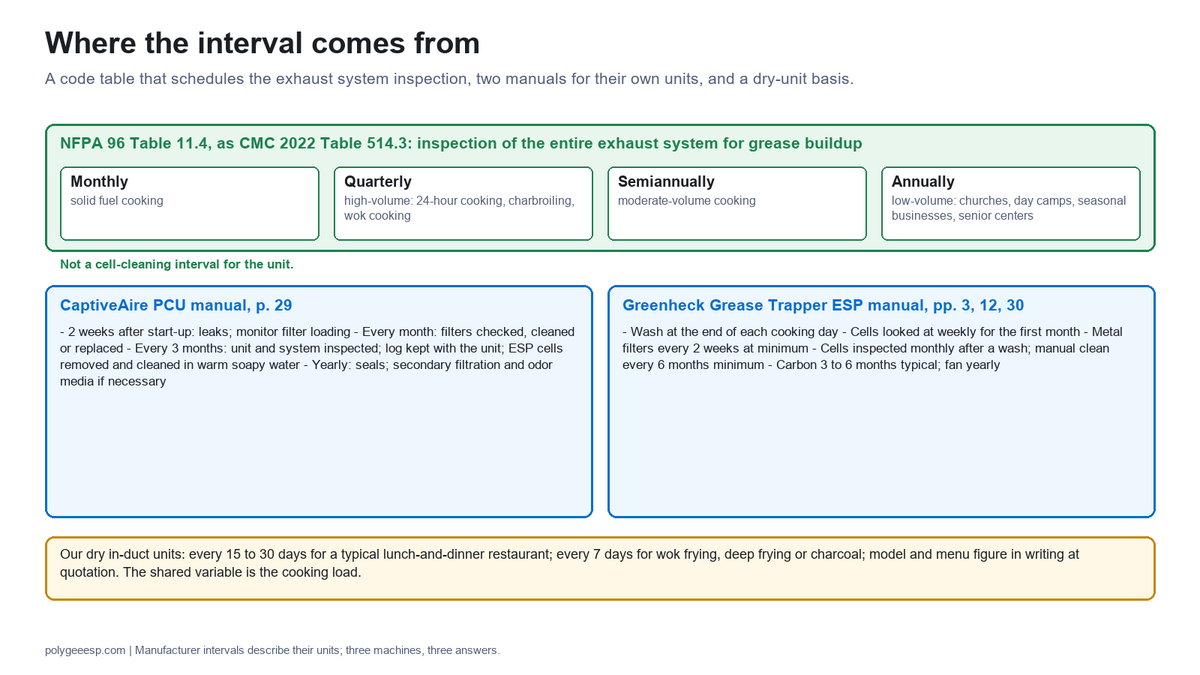
The code table first, because it is the one this page most needs to separate from the cell interval. Section 11.4 of NFPA 96, carried into the 2022 California Mechanical Code as Section 514.3, requires the entire exhaust system to be inspected for grease buildup by a properly trained, qualified and certified person acceptable to the authority having jurisdiction, at the frequency in the table: monthly for systems serving solid fuel cooking, quarterly for high-volume cooking, which the table’s footnote defines as 24-hour cooking, charbroiling and wok cooking, semiannually for moderate-volume and annually for low-volume cooking, with churches, day camps, seasonal businesses and senior centers as the footnote’s examples of low volume. That is an inspection schedule for the hood, the duct, the fan and whatever sits in the duct, and the standard’s own trigger for cleaning, as the Village of New Paltz fire inspector summarizes clause 11.6.2, is that surfaces are cleaned before they become heavily contaminated with grease or oily sludge. The table does not say how often a precipitator cell is washed; it says how often someone qualified looks.
The manuals then give their own clocks, and they do not match each other, because the units are different. CaptiveAire’s schedule for its filter-type unit with the electrostatic option: two weeks after start-up, inspect for grease or air leaks and monitor filter loading to determine the replacement frequency, which the manual says will vary with the amount of contaminated effluent being filtered; every month, check filters for loading and clean or replace; every three months, inspect the entire unit and exhaust system, record inspection and cleaning in a log kept with the unit, and remove the electrostatic cells for cleaning in warm soapy water; yearly, inspect seals, replace the pre-filter if necessary and replace all secondary filtration and odor control media if necessary. Greenheck’s schedule for its self-washing ESP unit: a wash at the end of each cooking day; a visual inspection of the cells at least once a week for the first month, with the wash times adjusted to what is found; the metal impingement and mist eliminator filters out and cleaned at two-week intervals at minimum; the cells inspected monthly after a wash and removed for a manual clean every six months at minimum; carbon trays changed at the first increase in odor breakthrough, between three and six months for typical cooking; fan, motor and drives annually.
Our interval for a dry in-duct unit is a third clock again, because the cell is cleaned by removal and nothing washes it in between: every 15 to 30 days for a typical lunch-and-dinner restaurant, and every 7 days for a heavy line, meaning wok frying, deep frying or charcoal, with the figure for a given model and menu stated in writing with the quotation. The three sets of numbers are not in competition; an in-cabinet wash, daily on Greenheck’s unit and on a controller schedule on CaptiveAire’s, backed by a manual clean every 3 months on CaptiveAire’s and every 6 months at minimum on Greenheck’s, and a removal every 15 to 30 days or every 7 days on a dry one, are answers for different machines. What they share is that each is set by the cooking load on site, named as the amount of contaminated effluent in one manual, as site conditions and grease load in the other, and as menu and operating hours in our basis: related measures of the same load rather than one quantity.
| Source | What it schedules | Interval | What it does not cover |
|---|---|---|---|
| NFPA 96 Table 11.4, as CMC 2022 Table 514.3 | Inspection of the entire exhaust system for grease buildup, by a trained, qualified and certified person | Monthly (solid fuel) · quarterly (high-volume: 24-hour, charbroiling, wok) · semiannually (moderate) · annually (low-volume) | How often a cell or filter inside the unit is washed or replaced |
| NFPA 96 clause 11.5, as summarized by the Village of New Paltz | Listed hoods with internal washing components or other mechanically operated devices, inspected and tested | Every 6 months or at the manufacturer’s frequency in accordance with the listing | The unit downstream |
| CaptiveAire PCU manual, p. 29 | Its filter-type unit with optional ESP module | 2 weeks after start-up · monthly filter check · every 3 months cells out and system inspected, log kept with the unit · yearly seals and media | Other makers’ units; dry units |
| Greenheck Grease Trapper ESP manual, pp. 3, 12, 30 | Its self-washing ESP unit with carbon section | Wash each cooking day · cells looked at weekly for the first month · metal filters every 2 weeks · cells inspected monthly, manual clean every 6 months minimum · carbon 3 to 6 months typical · fan yearly | Units without a wash system |
| Our published basis | Dry in-duct precipitators and ecology units, cells washed off the unit | Every 15 to 30 days for a typical lunch-and-dinner restaurant; every 7 days for wok frying, deep frying or charcoal; model and menu figure in writing at quotation | Self-washing units; the hood and duct, which keep their own schedule |
The differential-pressure reading: what it tells you and what it does not
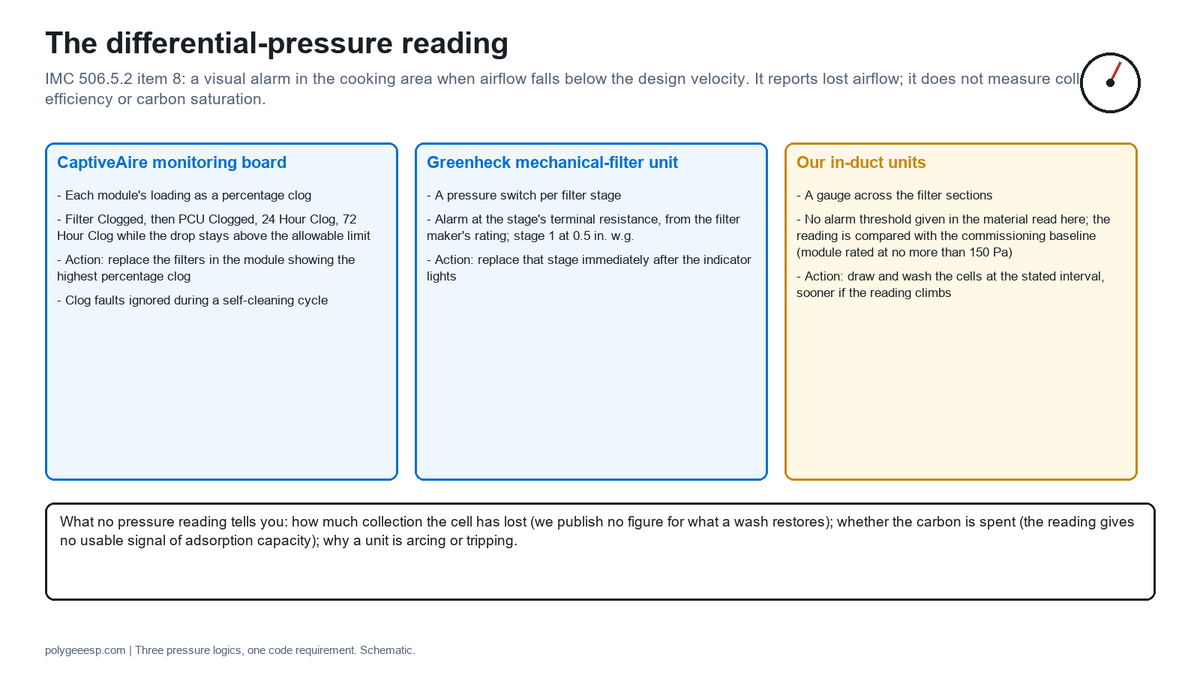
The differential-pressure control on a pollution control unit reports that airflow has fallen below the design velocity; it does not measure the grease on a stage, the collection efficiency of a cell or whether the carbon is spent, although a percentage-clog or terminal-resistance design does give an indirect loading signal for the filter stages. Item 8 of IMC Section 506.5.2 fixes what it has to do: monitor the pressure drop across the filter sections and, when the airflow is reduced below the design velocity, activate a visual alarm in the area where cooking operations occur. The alarm is therefore first a statement about airflow, which capture at the hood depends on, and only then a statement about the filters.
How a manufacturer turns a pressure into an alarm is its own design, and the two manuals show two logics. CaptiveAire’s monitoring board expresses each module’s loading as a percentage clog and raises a sequence of faults: Filter Clogged for a module, then PCU Clogged, 24 Hour Clog and 72 Hour Clog when the pressure drop across the entire unit exceeds allowable limits and stays there for a day and for three days; the corrective action in its fault chart for those clog faults is to replace the filters in the module showing 100 percent clog, or the highest percentage clog for the whole-unit faults, with clean filters of the same type, after the full fault chart has been checked for the other causes it lists. The board also carries minimum and maximum inlet-pressure settings for the electrostatic module, defaulting to 25 and 120 percent, that decide when its high-voltage supply turns on and stays on, and a separate discharge threshold, defaulting to 0.100 inches of water column, that the manual uses to help detect a missing door; none of these is a clog alarm, and the board ignores the clog faults during a self-cleaning cycle and the drying delay that follows it. Greenheck’s mechanical-filter unit uses a pressure switch per filter stage, factory preset to send an alarm when that stage reaches its terminal resistance, a setting based on the filter manufacturer’s rating, with stage 1 at 0.5 inches of water gauge; its instruction is to replace that stage immediately after the indicator lights.
Our in-duct units carry a differential-pressure gauge across the filter sections, and the material read for this page gives no fault sequence for it, so the reading has to be written down to mean anything. The number to write first is the clean baseline at commissioning: a complete in-duct module including its airflow distribution plate is rated at no more than 150 Pa, and the electrostatic cell itself contributes roughly 20 to 30 Pa, so the gauge at start-up is the reference every later reading is compared with, and it belongs on the commissioning record. Record a reading that climbs between cell removals as loading to be confirmed at the next removal; record a reading that changes right after a removal as a prompt to check the reinstallation, the door seating and the mesh before anything is concluded.
Three things the reading does not tell you. It does not say how much collection the cell has lost: we do not publish how far collection falls as a cell loads, or what a wash restores, because that is not something our third-party testing measured, and no pressure gauge measures it either. It does not say the carbon is spent: the reading gives no usable signal of how much of the bed’s capacity has been used. And it does not explain arcing, trips or a burnt smell with a clean outlet: those are read from the fault indicator and from when in the day they appear, which is the subject of our electrostatic precipitator arcing guide.
| Design | What is measured | What triggers the alarm | What the manual says to do | What it cannot tell you |
|---|---|---|---|---|
| CaptiveAire monitoring board | Pressure drop per module and across the whole unit, expressed as percentage clog | Filter Clogged; PCU Clogged, then 24 Hour Clog and 72 Hour Clog if the drop stays above the allowable limit (the ESP module’s own inlet-pressure and discharge settings serve other checks in the manual) | Replace the filters in the module showing 100 percent clog, or the highest percentage clog, with the same type, after checking the fault chart’s other causes | Cell collection efficiency; carbon saturation |
| Greenheck mechanical-filter unit | Resistance across each filter stage, by a pressure switch per stage | Stage reaches its terminal resistance from the filter maker’s rating; stage 1 setting 0.5 in. w.g. | Replace that stage immediately after the indicator lights | Carbon saturation; the industry standard, in its words, is the human sniff test |
| Our in-duct units | Pressure drop across the filter sections on a gauge | No alarm threshold is given in the material read here; the reading is compared with the commissioning baseline | Draw and wash the cells at the stated interval, sooner if the reading climbs | What a wash restores; carbon saturation; the cause of arcing |
Carbon, odor media and UV lamps: the stages you cannot see wearing out
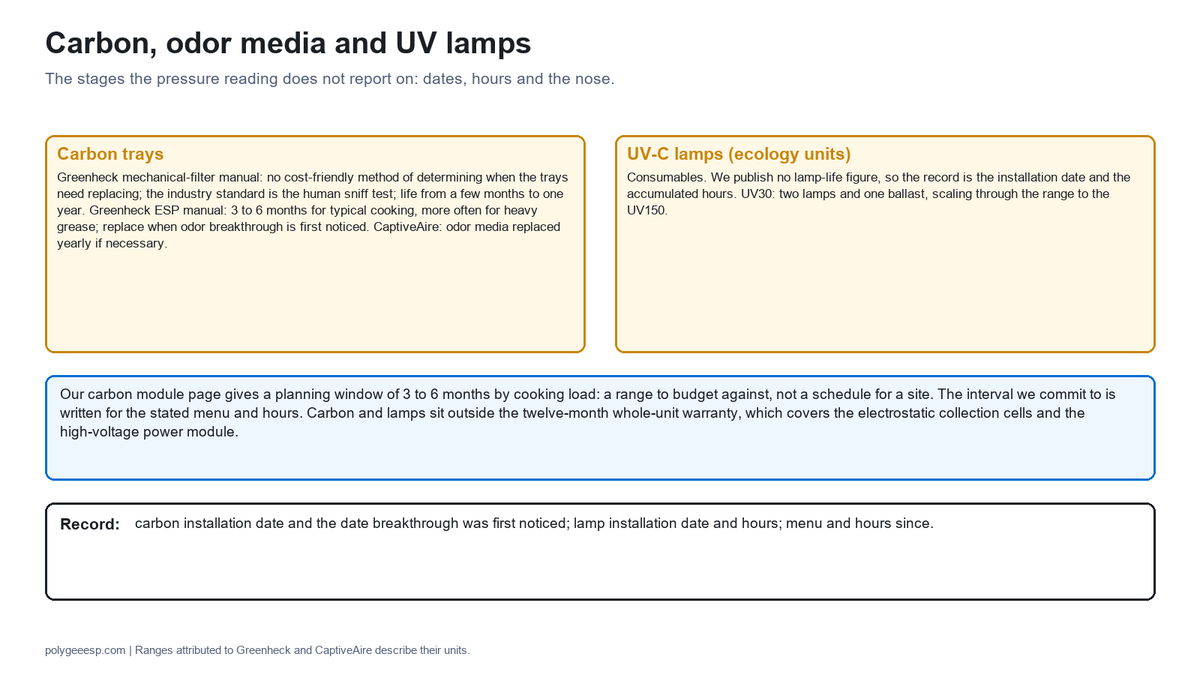
The odor stages of a pollution control unit wear out without a usable pressure signal of their condition, so their maintenance runs on dates, hours and the nose. Greenheck’s mechanical-filter manual puts it plainly: technology has yet to develop a cost-friendly method of determining when the carbon trays need replacing, so the industry standard is the human sniff test; as the carbon loses effectiveness, odor breakthrough gradually occurs, and across its installations the life of the carbon trays ranges from a few months to one year. Its ESP manual narrows that for typical cooking to between three and six months, more often for heavy grease applications, with the instruction to replace when an increase in odor breakthrough is first noticed; each of its carbon filters is a 20 by 20 by 2 inch tray weighing 12 pounds, designed for an airstream velocity of no more than 90 feet per minute. CaptiveAire lists carbon, potassium permanganate blends, 100 percent permanganate and caustic-impregnated media for its odor section and inspects them yearly, replacing them if necessary.
Our activated carbon module page gives a planning window of 3 to 6 months by cooking load; it is a range to budget against, not a schedule for a site, and the interval we will commit to is written for the stated menu and hours. The carbon media and the UV lamps are consumables outside our twelve-month whole-unit warranty, which covers the electrostatic collection cells and the high-voltage power module; labor and site attendance are quoted separately. For the lamps we publish no life figure, so the maintenance record carries the installation date and the accumulated hours, and the UV30 module’s two lamps and one ballast scale up through the range to the UV150. What each stage of a three-stage unit costs to keep running, and how to get the consumable terms into the order before the first invoice, is worked through in ecology unit filters; the modules themselves are on the activated carbon filter and UV-C odor control pages.
| Stage | Signal that it is due | Published range | What to record | Budget line |
|---|---|---|---|---|
| Carbon trays (Greenheck ESP unit) | First increase in odor breakthrough | 3 to 6 months typical cooking; more often for heavy grease | Installation date; breakthrough date | Trays per unit by housing size, from the manual |
| Carbon trays (Greenheck mechanical-filter unit) | The sniff test | A few months to one year | Same | Same |
| Odor media (CaptiveAire) | Yearly review | Replace yearly if necessary | Media type and part number; date | By module size and media type |
| Carbon module (ours) | Odor at the discharge; the interval agreed in writing for the site | 3 to 6 months planning window by cooking load; site figure in writing | Installation date; menu and hours since | Carbon frames per module; outside warranty |
| UV-C lamps (ours) | Hours; installation date | No life figure published | Installation date; accumulated hours | Lamps per module, with lamp and ballast counts published by model; lamps outside warranty |
Access, isolation and who does what
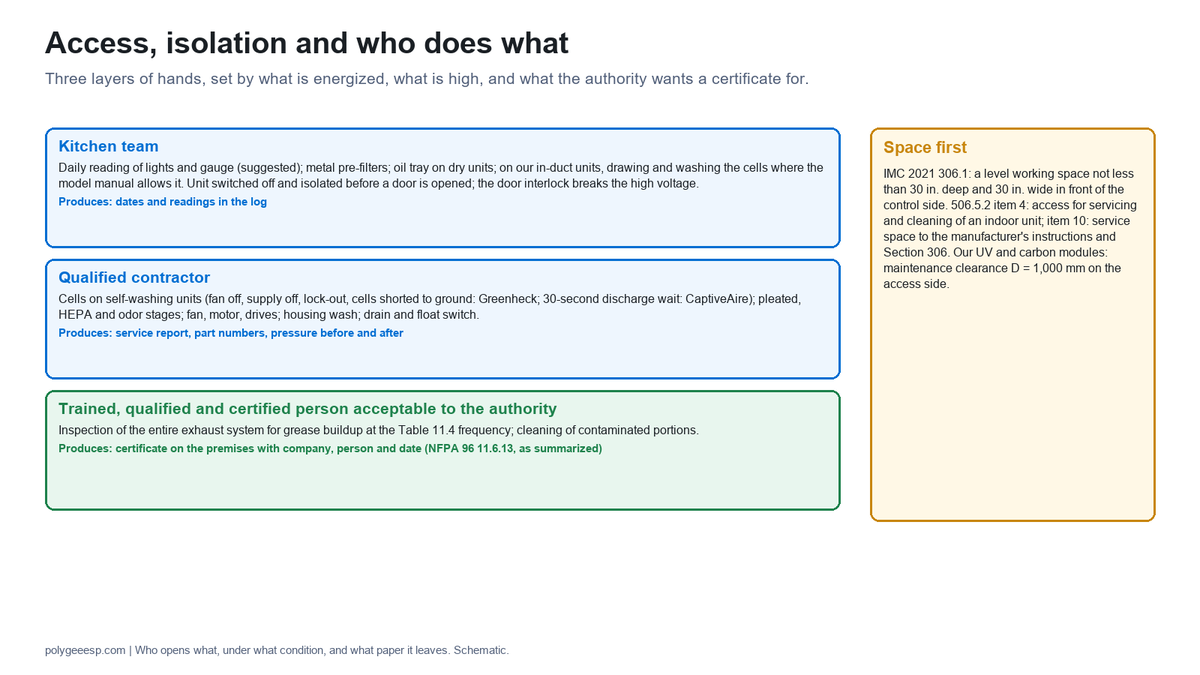
Maintenance on a pollution control unit splits into three layers of people, and the split is set by what is energized, what is high, and what the authority wants a certificate for. The kitchen team handles what the model manual lets them open with the unit isolated: the indicator lights and the gauge read daily, a frequency this page suggests, metal pre-filters washed, the oil tray on a dry unit emptied, and on our in-duct units the cells drawn and washed where the manual for the model allows it, with the unit switched off and isolated before the door is opened; the door interlock on those units breaks the high voltage when the maintenance door opens. A qualified contractor handles the rest of the cabinet: cells on self-washing units, which Greenheck has removed only after the fan is off, the terminal box switch is off, lock-out is applied and the cells are shorted to ground, and which CaptiveAire has touched only after a wait of at least 30 seconds for the cells to discharge from supplies rated up to 13 kV at the ionizer and 7 kV at the collector; the pleated and HEPA stages; the fan, motor and drives; the housing wash that Greenheck’s mechanical-filter manual allows as needed or as dictated by local code, with degreasers compatible with stainless steel and care around the static pressure tips, tubing, fire system nozzles and detectors. The third layer is the exhaust system inspection that NFPA 96 Section 11.4, as carried into the California code, reserves for a properly trained, qualified and certified person acceptable to the authority, the cleaning that the New Paltz summary of clause 11.6.1 assigns to the same kind of person, and the paper that goes with it.
That paper is specific. As the Village of New Paltz fire inspector summarizes the 2017 edition, when an exhaust system is inspected or cleaned, a certificate showing the name of the servicing company, the name of the person performing the work and the date of inspection or cleaning is kept on the premises under clause 11.6.13; access panels and cover plates are restored to their normal operational condition under 11.6.9; and, in the Intertek summary of the edition changes, a nonoperational or impaired exhaust or fire-extinguishing system is tagged as noncompliant under 11.1.6.1. CaptiveAire adds a document of its own: its start-up and measurement form, completed after the system has been air balanced, with the note that the warranty will be void without completion of this form, and its maintenance chapter asks that every service be recorded in the documentation section at the end of the manual.
Space is the quiet precondition for all three layers. Item 4 of Section 506.5.2 requires access for servicing and cleaning of an indoor unit; item 10 requires service space to the manufacturer’s instructions and to Section 306, whose first clause requires appliances to be accessible for inspection, service, repair and replacement without disabling a fire-resistance-rated assembly or removing permanent construction, with a level working space of not less than 30 inches deep and 30 inches wide in front of the control side. Our UV and carbon modules publish a maintenance clearance of D = 1,000 mm on the access side, and a cell that cannot be drawn to its full length is a cell that will not be washed on schedule; the straight run, weight, pressure and access a three-stage train needs before anyone orders one are on our ecology unit installation page. Spares sit behind the schedule: common spare parts are stocked, parts continue to be supplied for one year after a model is discontinued, remote support runs by video call and illustrated manual, and site attendance is quoted.
| Layer | Does | Condition | Produces |
|---|---|---|---|
| Kitchen team | Daily reading of lights and gauge (suggested); metal pre-filters; oil tray on dry units; on our in-duct units, drawing and washing the cells where the model manual allows it | Unit switched off and isolated before a door is opened; the door interlock breaks the high voltage on our in-duct units | Dates and readings in the log |
| Qualified contractor | Cells on self-washing units; pleated, HEPA and odor stages; fan, motor, drives; housing wash; drain and float switch | Fan off, supply off, lock-out, cells shorted to ground (Greenheck); 30-second discharge wait (CaptiveAire); listed replacement parts | Service report; part numbers; pressure before and after |
| Trained, qualified and certified person acceptable to the authority | Inspection of the entire exhaust system for grease buildup at the Table 11.4 frequency; cleaning of contaminated portions (clause 11.6.1, as summarized) | Acceptable to the authority having jurisdiction | Certificate on the premises: company, person, date (clause 11.6.13 as summarized) |
| Fire suppression contractor | The factory-installed suppression inside the cabinet, on its own schedule | Its listing and the local fire code | Service tag |
Common mistakes
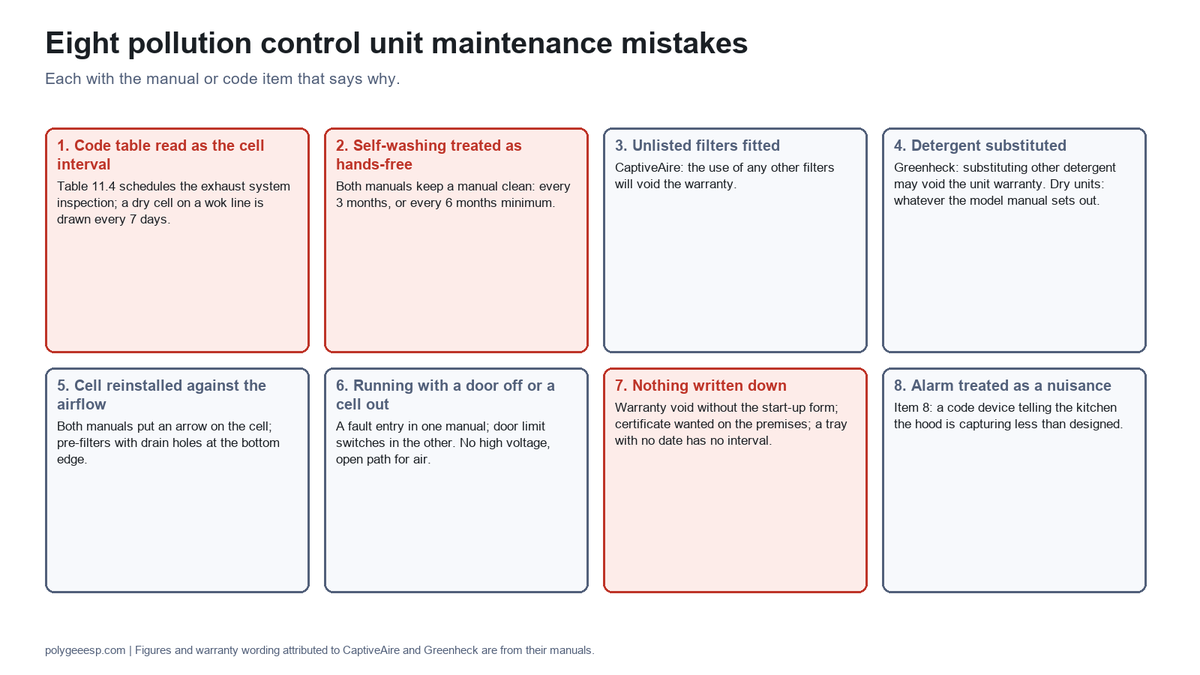
- Reading the code table as the cell interval. Table 11.4 schedules the inspection of the exhaust system for grease buildup, quarterly for a wok or charbroiler kitchen; a dry in-duct cell from us in that kitchen is drawn every 7 days. A quarterly removal on a heavy line is a cell that has loaded for a quarter.
- Treating a self-washing unit as a unit that needs no hands. Both manuals that describe one keep a manual clean in the schedule, every 3 months in one and every 6 months at minimum in the other, and one of them calls residual grease after a wash a sign that the wash times need to go up.
- Fitting filters the manual does not list. CaptiveAire’s manual says the use of any other filters will void the warranty and affect unit performance; the part-number tables are in the manual for that reason.
- Substituting the detergent on a unit whose manual names one. Greenheck’s manual says substituting other types of detergent may result in decreased system performance, system shut down and voiding of the unit warranty. For a dry unit, the cleaning agent is whatever the manual for the model sets out, and this page gives none.
- Reinstalling a cell or filter against the airflow. Both manuals put an arrow on the cell or filter and a line in the schedule about it; CaptiveAire adds that pre-filters go in with the drain holes at the bottom edge.
- Running with a door off or a cell out. CaptiveAire’s fault chart has an entry for a missing ESP door or cell, and Greenheck’s access steps end with closing the door completely so that the door limit switches are closed. Both manuals treat that as a fault condition, not a running state.
- Not writing it down. One manual voids the warranty without its start-up form, the standard, as summarized, wants the exhaust system certificate on the premises, and a carbon tray with no installation date has no interval. The record below exists because the dates are the maintenance.
- Treating the alarm as a nuisance. The visual alarm in the cooking area is a code device under item 8. It is telling the kitchen that the exhaust airflow has fallen below design, the condition capture at the hood depends on, and the pleated stage or the cells are the first place to look, not the lamp to tape over.
The 11-Line PCU Service Record
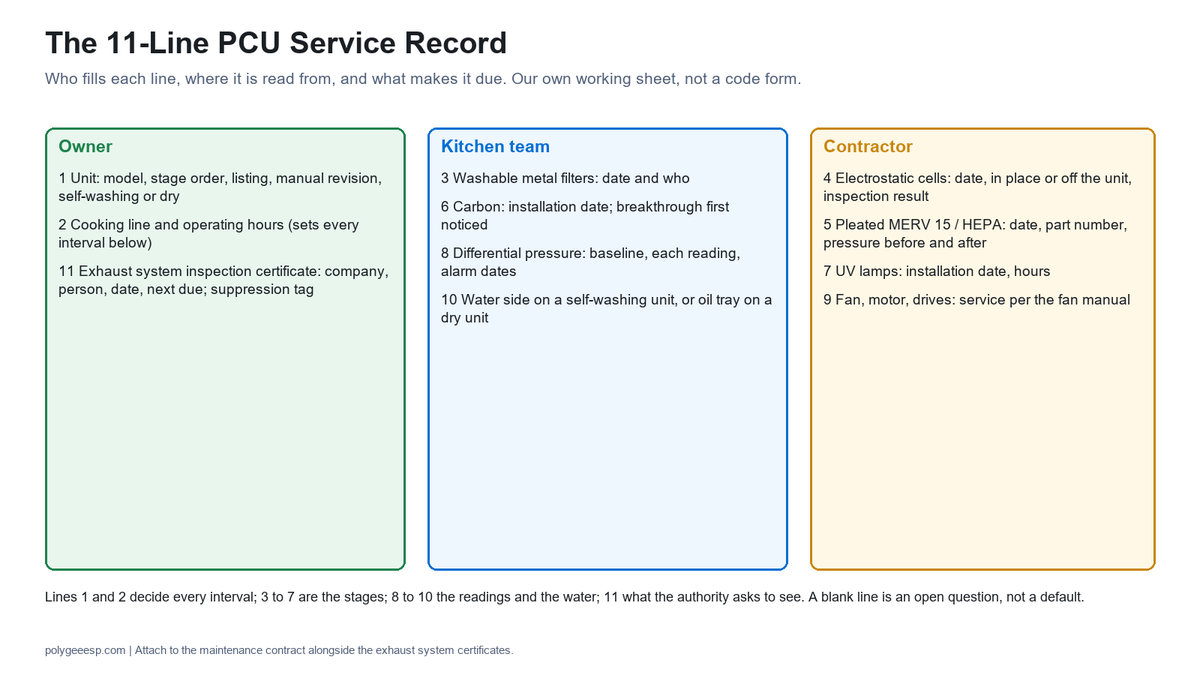
The 11-Line PCU Service Record is the log we suggest a site keeps for the unit itself, alongside the exhaust system certificates the standard, as summarized, requires. It is our own working sheet, not a code form or a manufacturer’s record; every line names who fills it, where the entry comes from, and what makes it due, and a line left blank is a question still open rather than a default.
| # | Line | Who fills it | Read from | What makes it due |
|---|---|---|---|---|
| 1 | Unit: model, stage order, listing, manual revision, self-washing or dry | Owner, from the submittal | Nameplate; manual cover | Once, and at any change of stage or media |
| 2 | Cooking line and operating hours per day and days per week | Owner | The kitchen | Once, and at any change of menu or hours; this line sets the load-dependent intervals below |
| 3 | Washable metal filters: pre-filter, post-filter, mist eliminator, date and who | Kitchen team or contractor | Visual; the manual’s interval | At least every two weeks (Greenheck) or at the monthly check (CaptiveAire); with the cells on ours |
| 4 | Electrostatic cells: date, in place or off the unit, inspection result | Contractor, or kitchen team where the model manual allows | The plates after a wash | Manual clean every 3 months (CaptiveAire) or every 6 months minimum after the monthly post-wash inspection (Greenheck), with the daily automatic wash logged separately in line 10; on our dry units, every 15 to 30 days for a typical lunch-and-dinner restaurant and every 7 days for a heavy line |
| 5 | Pleated MERV 15 and HEPA stages: date, part number, pressure before and after | Contractor | The pressure control | The alarm or the percentage clog; yearly review |
| 6 | Carbon or odor media: installation date; date breakthrough first noticed | Kitchen team; owner | The nose; the published window | Breakthrough, or the interval agreed in writing for the site |
| 7 | UV lamps: installation date, accumulated hours | Contractor | Hour counter or run log | Hours or date per the model manual |
| 8 | Differential pressure: commissioning baseline, each reading, alarm dates | Kitchen team daily; contractor at each visit | The gauge or the board | Every visit; any alarm |
| 9 | Fan, motor, drives: service per the fan manual; Greenheck’s ESP manual gives a yearly service and its mechanical-filter manual a fan interior wash every 6 months; belt and bearing findings | Contractor | The fan manual | The fan manual’s calendar: yearly or every 6 months on the Greenheck units read here |
| 10 | Water side on a self-washing unit: last complete and last aborted wash, drain fault dates, interceptor pump-outs; or, on a dry unit, oil tray emptied | Controller log; kitchen team | Controller; the tray | Each cooking day; each fault |
| 11 | Exhaust system inspection certificate: company, person, date, next due; suppression service tag | Owner, from the certified person and the suppression contractor | The certificate; the tag | Table 11.4 frequency for the cooking volume; the suppression schedule |
Lines 1 and 2 decide the load-dependent intervals on the sheet; lines 3 to 7 are the stages; lines 8 to 10 are the readings and the water; line 11 is what the authority asks to see. For a precipitator or ecology unit from us, line 10 is the tray, line 4 is a removal date, and the interval in lines 3 and 4 is the one written into the quotation for the cooking on line 2.
Key takeaways
- Four clocks, not one: per service day, week to month, quarter to half year, and yearly, with a different stage on each.
- Washed, replaced or inspected: metal filters and electrostatic cells are washed, pleated, HEPA, carbon and lamps are replaced, the fan, drains, suppression and pressure control are inspected, and IMC 506.5.2 attaches items 4, 8, 9, 10, 11 and 13 to that list.
- The code table is not the cell interval: NFPA 96 Table 11.4, as reproduced in CMC 2022 Table 514.3, schedules the inspection of the exhaust system, monthly to annually by cooking volume; the cell interval comes from the manual for the unit and the cooking load, every 3 months on CaptiveAire’s unit and every 6 months minimum on Greenheck’s self-washing unit, and on our dry in-duct units 15 to 30 days for a typical lunch-and-dinner restaurant and 7 days for a heavy line.
- The pressure alarm reports lost airflow: item 8 asks for a visual alarm when airflow falls below design velocity; it does not read collection efficiency or carbon saturation, which run on removal dates, hours and the nose.
- Three layers of hands and one sheet: the kitchen team, a qualified contractor and a certified person acceptable to the authority, with The 11-Line PCU Service Record carrying the dates that make the program real.
Where this guide stops
This page sets out the program around a pollution control unit, not the procedure inside it. It gives no procedure of ours for removing, washing or drying a cell, and no cleaning agent, water temperature or torque for our units; those follow the manual for the model and the local code. The steps, temperatures and detergent named for other makers’ units are summaries of their manuals, not instructions, and describe their units. It gives no cleaning interval of ours beyond the published basis of 15 to 30 days for a typical lunch-and-dinner restaurant and 7 days for a heavy line, no lamp-life figure, and no carbon interval beyond the planning window on the product page; the figure for a site is written for its menu and hours. It does not cover the hood and duct cleaning that the exhaust system certificate records, which is on our commercial kitchen exhaust cleaning requirements page, the grease interceptor the wash-down drains run to, or the suppression system inside the cabinet, which has its own guide on kitchen fire suppression systems.
Frequently asked questions
- How often should a pollution control unit be cleaned?
- At the interval in the manual for the model, adjusted to the cooking load. The two North American manuals read here remove the electrostatic cells every 3 months (CaptiveAire) and, on a unit that washes itself daily, every 6 months at minimum after a monthly inspection (Greenheck); metal pre-filters are removed and cleaned at least every two weeks on Greenheck’s unit, and checked monthly and cleaned or replaced as required on CaptiveAire’s. Our dry in-duct units are opened and the cells washed off the unit every 15 to 30 days for a typical lunch-and-dinner restaurant and every 7 days for wok frying, deep frying or charcoal, with the figure for a given model and menu stated in writing with the quotation.
- Does NFPA 96 set the cleaning interval for a pollution control unit?
- No. Table 11.4 of NFPA 96, reproduced as Table 514.3 of the 2022 California Mechanical Code, schedules the inspection of the entire exhaust system for grease buildup by a trained, qualified and certified person: monthly for solid fuel cooking, quarterly for high-volume cooking such as 24-hour cooking, charbroiling and wok cooking, semiannually for moderate volume and annually for low volume. The interval for the cells and filters inside the unit comes from the manufacturer’s manual and the cooking load.
- Can kitchen staff clean the cells in a pollution control unit?
- Only what the manual for the model allows, with the unit switched off and isolated before a door is opened. On our in-duct units the kitchen team draws and washes the cells where the manual allows it, and the door interlock breaks the high voltage when the maintenance door opens. On the self-washing units read here the manuals have the cells removed after the fan is off, the supply is off, lock-out is applied and the cells are shorted to ground, or after a 30-second wait for the cells to discharge, which is contractor work.
- What does the filter alarm on a pollution control unit mean?
- That airflow has fallen below the design velocity. Item 8 of IMC Section 506.5.2 requires a differential-pressure control across the filter sections with a visual alarm in the cooking area for that condition. On CaptiveAire’s board the fault escalates from Filter Clogged to 24 Hour and 72 Hour Clog and for those clogged-filter branches the action in its fault chart is to replace the filters in the module showing 100 percent clog, or the highest percentage clog, with the same type, after the chart’s other causes such as an open door have been checked; on Greenheck’s mechanical-filter unit a stage light means that stage has reached its terminal resistance. The alarm does not report collection efficiency or carbon saturation.
- How long do the carbon filters in a pollution control unit last?
- Until odor breakthrough, which the published ranges put between 3 and 6 months for typical cooking on Greenheck’s ESP unit, more often for heavy grease, and from a few months to one year across the installations its mechanical-filter manual describes; the sniff test is, in that manual’s words, the industry standard. Our carbon module page gives a planning window of 3 to 6 months by cooking load, a range to budget against rather than a schedule, and the interval we commit to is written for the stated menu and hours. Carbon is a consumable outside our twelve-month warranty.
Writing the maintenance section for a PCU or ecology unit?
Send us the cooking line, the operating hours, where the unit would sit and the access around it, and whether the specification asks for a self-washing cabinet or a dry train. You get back the configuration for that airflow, an in-duct precipitator or a three-stage ecology unit, a written statement of how its cells are cleaned and the interval we give for that cooking load, the access dimensions including the 1,000 mm service side on the UV and carbon modules, and the warranty boundary between the cells and power module and the consumable lamps and carbon, so lines 1 and 2 of The 11-Line PCU Service Record, and the cleaning basis behind lines 3 and 4, are settled before the maintenance contract is drafted.
Send the cooking line, hours and access →
What a pollution control unit is and which code edition asks for one is on our pollution control unit page; the same section under its Gulf name, stage by stage, is on what is an ecology unit; and the in-duct units and modules themselves are on the kitchen ESP product overview.
Why we write this. On the two US result pages sampled for this question on 7 November 2026, three or four of the ten results were service companies offering to do the work, and the rest were product pages and short blog posts; the manuals that hold the intervals and thresholds are a layer below, and the code table that gets quoted for the cell interval schedules something else. We manufacture the dry side of this equipment and read the manuals for the self-washing side so that the two routines could sit on one page with the code items attached, and so that a buyer writing a maintenance contract has the document, page and clause for each number rather than a round figure. This page gives no procedure or cleaning agent for our units and no figure of ours beyond the published basis, and the other makers’ figures are theirs.
Law is Project Manager at Polygee. Polygee, founded in 2004, manufactures the in-duct electrostatic precipitators, UV-C and activated carbon modules, kitchen ecology units and ESP hoods named here; its in-duct units are dry and carry no wash-down system. The code text cited on this page was read in the sources listed below, and the intervals, thresholds and procedures attributed to CaptiveAire and Greenheck are taken from their published manuals and describe their units.
References & further reading
- International Code Council, International Mechanical Code 2021, chapter 5: section 506.5.2, items 2, 4, 8, 9, 10, 11, 12 and 13. codes.iccsafe.org
- International Code Council, International Mechanical Code 2021, chapter 3: section 306.1, access and service space. codes.iccsafe.org
- California Mechanical Code 2022 (Title 24, Part 4), section 514.3 and Table 514.3, reproducing NFPA 96 section 11.4 and Table 11.4, as published by GoCodebook. gocodebook.com
- Village of New Paltz, Department of Building, Planning and Zoning, Kitchen Hood Cleaning Requirements: summary of 2017 NFPA 96 sections 11.4, 11.5, 11.6.1, 11.6.2, 11.6.9 and 11.6.13 (the sheet states that it is not authoritative). villageofnewpaltz.gov
- Intertek, Standards Update Notice, NFPA 96: clauses 10.1.3, 11.1.6.1 and 11.6.16 and the editions that added them. intertek.com
- National Fire Protection Association, NFPA 96, Standard for Ventilation Control and Fire Protection of Commercial Cooking Operations (the standard itself was not read for this page; its Table 11.4 is cited from the California reproduction and the New Paltz summary above). nfpa.org
- CaptiveAire Systems, Pollution Control Unit Installation, Operation and Maintenance Manual, A0011036, May 2025, Rev. 48: pp. 16, 17, 19, 26, 27, 28, 29, 30. captiveaire.com
- CaptiveAire Systems, Pollution Control Unit Specification sheet: p. 1 (filter sections and odor media). captiveaire.com
- Greenheck, Grease Trapper ESP Kitchen Exhaust Pollution Control System, Installation, Operation and Maintenance Manual, 482585, Rev. 3, July 2019: pp. 3, 4, 12, 17, 30, 36. greenheck.com
- Greenheck, Grease Trapper Kitchen Exhaust Pollution Control Unit, Installation, Operation and Maintenance Manual, 479927: pp. 8, 9 (copy hosted by a distributor). pipsa.com.mx
Related reading
- Pollution control unit: what it is, what is inside, and which code edition asks for it.
- Electrostatic precipitator cleaning: what a service visit to the cells covers, and how the cleaning basis is written into the order.
- Ecology unit filters: which stage is washed, which stages are consumed, and what you keep buying after the unit is installed.
- Electrostatic precipitator arcing: sparking, trips and a burnt smell, read by when in the day they appear.