

A grease filter made of two rows of interlocking metal channels is the first separation stage in a commercial kitchen hood. That device is the baffle filter: it makes the exhaust air turn sharply, so droplets too heavy to follow the turn hit the metal and drain to a trough. It is washable steel or aluminum, and in a Type I hood it is also the flame barrier ahead of the duct.
A baffle filter is a fire and drainage device first and a separator of coarse grease second. The listing a code official looks for on a baffle filter says so in its own scope, and the test that measures what a baffle filter captures returns a curve by particle size, not one percentage. On one manufacturer’s published figures a standard baffle filter removes 28 percent of grease particles at 8 microns and 16 percent at 3 microns. It does not capture the fine aerosol efficiently, and it does not remove grease that is still vapor. An in-duct kitchen electrostatic precipitator collects the fine particles that pass the hood filter; it does not capture grease that remains in the vapor phase. We manufacture those precipitators and the UV-C and activated carbon modules that follow them; we do not sell hood baffle filters as standalone products, so every figure about a baffle filter on this page is taken from a code, a standard, a research paper or a filter maker’s own document, and is attributed to it.
This page helps you decide whether the baffle filter bank in a hood is the right type, the right count and correctly mounted, how often it has to be washed, and what is still in the air after it. It ends with The 8-Line Filter Bank Sheet, a record you can fill in from the hood drawing and the filter label. The comparison of a baffle filter with an electrostatic precipitator as two purchases is on electrostatic precipitator vs baffle filter, and the code clauses on the filter, one by one, are on grease filter requirements; neither is repeated here.
| Quick specs | Figure | Whose figure |
|---|---|---|
| How it separates | Inertial impaction; the air changes direction twice in a conventional baffle filter | Greenheck design guide; Defra 2005 (withdrawn UK guidance) |
| Listing a Type I hood needs | Grease filters listed and labeled to UL 1046, which tests flame and drainage and does not measure capture efficiency | IMC 2021 Section 507.2.8; UL 1046 scope 1.3 to 1.5 |
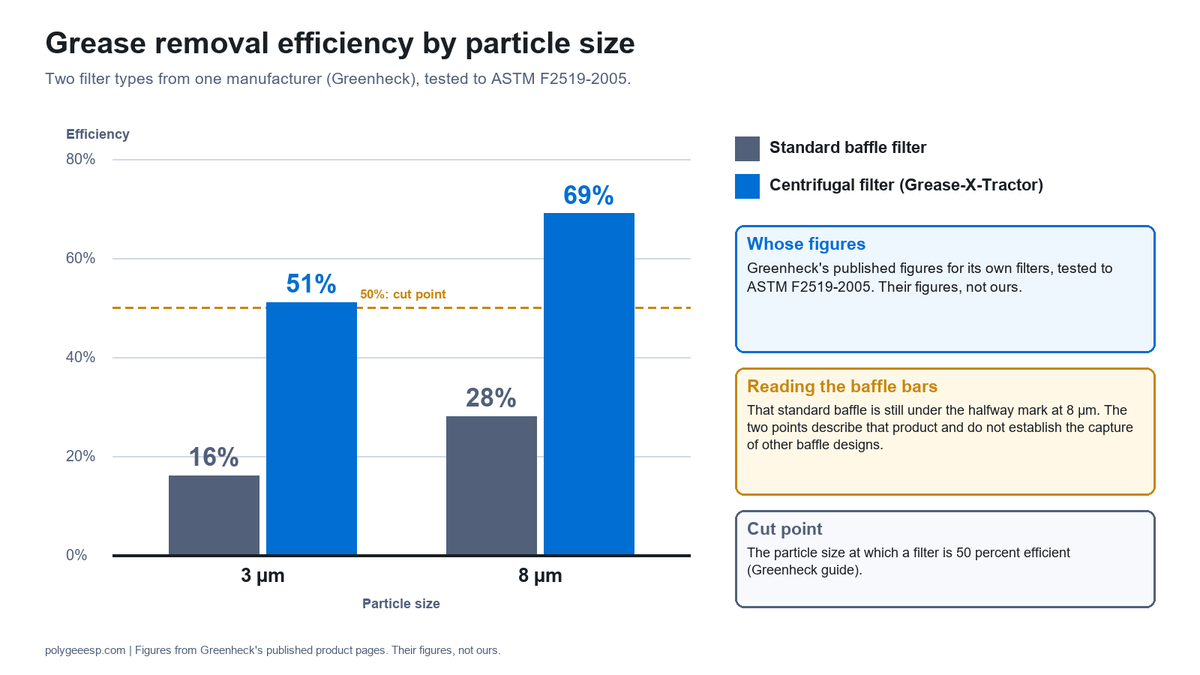
| Tested capture, standard baffle | 28% at 8 µm and 16% at 3 µm, tested to ASTM F2519-2005 | Greenheck product page |
| Pressure drop | 0.5 to 0.6 in. wg on a 9 × 4 ft hood at 2,050 cfm; 0.33 in. w.c. at 600 cfm through one 20 × 20 in filter | Greenheck; Kason airflow table |
| Common sizes | 16 × 20, 20 × 20 and 20 × 25 in, nominal 2 in thick; actual about 1/2 in under and 1-3/4 in thick | Kason, Smith Filter, Trine, Flame Gard |
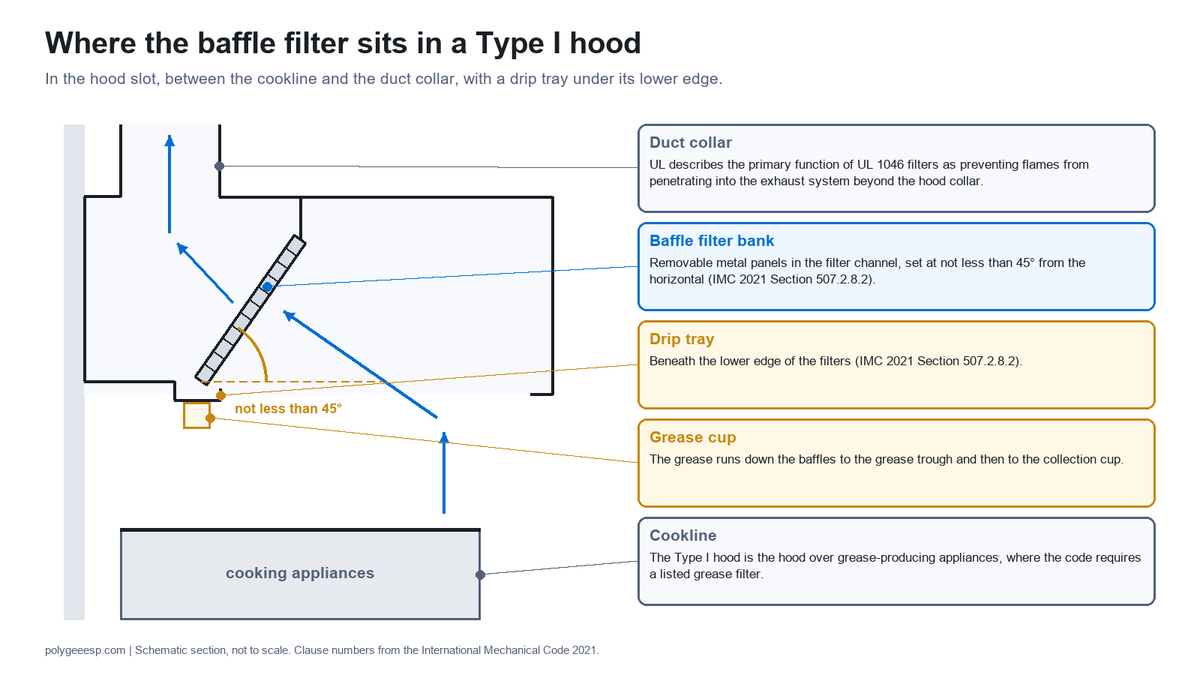
| Mounting | Not less than 45 degrees from horizontal, drip tray under the lower edge; lowest edge 0.5, 2 or 3.5 ft above the cooking surface by appliance | IMC 2021 Section 507.2.8.2 and Table 507.2.8 |
| Cleaning | Daily to weekly by appliance, in a commercial dishwasher or a heated soak | CaptiveAire and Greenheck manuals |
- What a baffle filter is
- How a baffle filter works in a kitchen hood
- What it catches, and what passes through
- Why one efficiency percentage misleads
- Sizes, materials and temperature limits: stainless steel, aluminum, galvanized
- Airflow, pressure drop and how many filters
- Baffle filter vs mesh filter, cartridge and cyclonic grease filters
- Mounting in the exhaust hood: angle, height, direction and drip tray
- Hood filter cleaning: how often, by appliance
- What reaches the duct in a commercial kitchen, and where an ESP fits
- The 8-Line Filter Bank Sheet
- Frequently asked questions
What a baffle filter is
A baffle filter is a removable metal panel that slides into the filter channel of a kitchen hood and separates grease from the exhaust by making the air change direction. It is one of the three classes of grease extraction that ASTM F2519 names for commercial kitchen ventilation: removable baffle filters, removable cartridge filters, and fixed extractors. In a commercial kitchen it belongs to the Type I hood, the hood over grease-producing appliances, where the code requires a listed grease filter; what separates that hood from one over a dishwasher is set out in Type 1 hood vs Type 2.
Two jobs are done by the same piece of metal, grease filtration and fire protection. UL describes the primary function of the filters covered by UL 1046 as preventing flames from penetrating into the exhaust system beyond the hood collar. Halton’s UK hood brochure puts the two jobs in one sentence: the purpose of a mechanical grease filter is to remove large particles from the exhaust stream and to provide fire protection by preventing flames from entering the exhaust unit and ductwork. The word “large” in that sentence is the subject of the next two sections.
Where the filter sits in the whole system, from the hood to the fan and the discharge, is drawn out in our guide to the commercial kitchen ventilation system. This page covers the baffle grease filters used in restaurant and other commercial kitchen exhaust hoods and the codes written for them, not the filter of a residential range hood.
How a baffle filter works in a kitchen hood
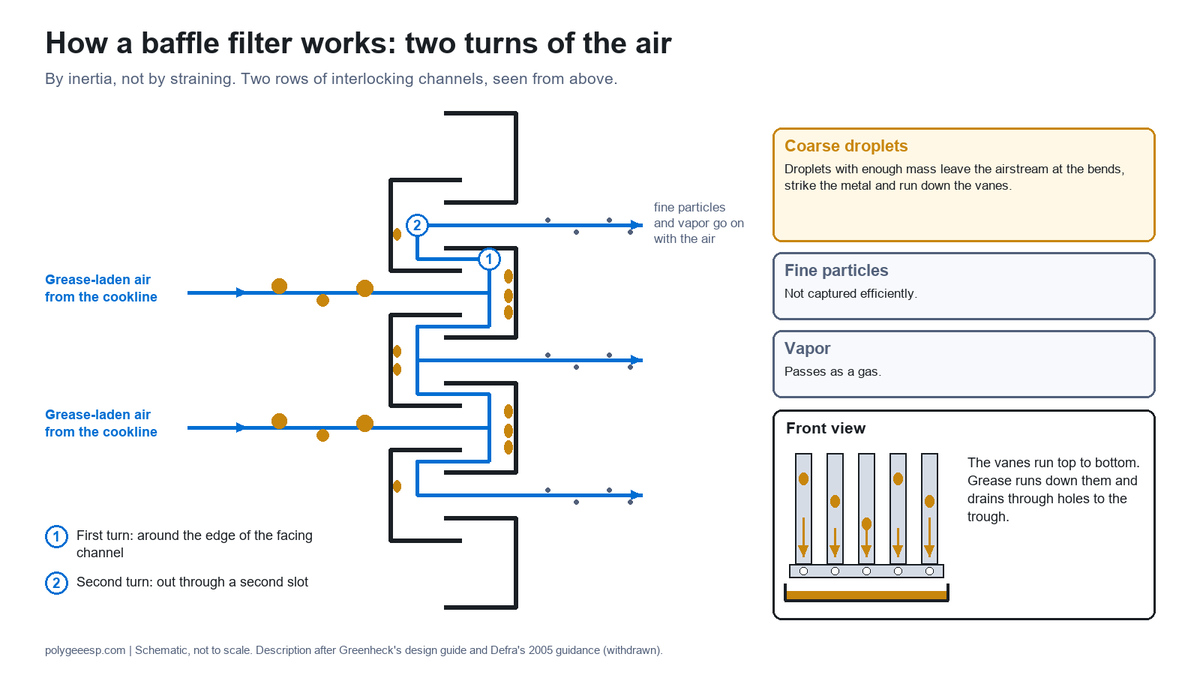
A baffle filter works by inertia, not by straining. Greenheck’s kitchen ventilation design guide states the principle: baffle filters use inertial impaction, the particle’s momentum throwing the particle out of the airflow as it changes direction. The interlocking baffles do not strain the air the way a fine mesh does. The air is accelerated through a slot between two channels, forced around the edge of the facing channel and out through a second slot, and a droplet with enough mass leaves the airstream at the bend and lands on the metal.
The construction follows from that. Defra’s 2005 guidance on commercial kitchen exhaust, a UK document that has since been withdrawn and that describes the construction and drainage of the filter, calls the baffle filter a number of interlocked vanes forming a two-pass grease removal device: grease-laden air passes through, a series of forced changes in direction and velocity separates the grease, it deposits on the vertical vanes, and it drains through weep holes into a collection drawer. One maker’s data sheet describes the same thing as two layers of baffles placed so that the air swirls and the grease adheres to the baffles. The same Defra section counts the turns: twice in a conventional baffle filter, four times in a cartridge filter.
Three consequences follow, and each returns later on this page.
- Capture depends on droplet size and on air speed. That follows from the principle, and it is our reading, not a maker’s statement. Two documents set an operating range without giving the reasoning: ACE Filtration recommends a slot velocity of 4.5 to 5.5 m/s for good grease retention, and Kason publishes an effective airflow range per filter for its Trapper filters, with a lower limit as well as an upper one.
- The grease has to drain. The vanes run top to bottom so that the liquid runs down them to the trough. Defra adds that the grease drawer must be isolated from the airstream, otherwise re-entrainment can occur: the air picks the collected grease up again.
- The design is non-overloading, and the metal is a flame barrier. Defra records that the resistance of a baffle filter is higher than that of a mesh filter, but the pressure drop remains constant and the blades provide a barrier in the event of a flash fire; the pressure drop still changes with airflow, as the tables below show. A filter left unwashed is a different case: Gaylord’s hood manual lists sticky grease accumulated within the filters as a cause of higher velocity inside them, “allowing grease to be pulled through.”
What it catches, and what passes through
Size decides. The published figures put the coarse droplets in the filter or out of the airstream, give a standard baffle 16 percent capture at 3 microns and 28 percent at 8 microns, describe the sub-micron aerosol as not captured efficiently, and treat the vapor as a gas that passes. Each statement is tied to its source below.
The coarse end. Greenheck’s guide puts the range of grease particulate at 0.01 to 100 microns and says that particulate larger than 10 to 20 microns is too heavy to remain airborne and will drop out of the airstream, with most grease filters operating between 1 and 10 microns. The staff report for the Bay Area Air Quality Management District’s charbroiler rule says the same from the regulator’s side: particulate matter greater than 10 microns in diameter is typically captured in the grease filter in the ventilation hood and is not exhausted to the atmosphere, and it cites a University of California study in which the particulate that passed the baffle filter was all PM10, that is, 10 microns and smaller.
The middle. Greenheck publishes the tested figures for its standard baffle filter: 28 percent grease removal efficiency at 8 microns and 16 percent at 3 microns, tested to ASTM F2519-2005. Its 2005 design guide gives 30 percent at 8 microns from curves measured on 20 × 20 in filters at 600 cfm per filter. The guide also defines the term that makes filters comparable: the particle size at which a filter is 50 percent efficient is its cut point. It gives about 6.5 microns for hoods with built-in cartridge or water-wash extraction, 5 microns as typical of a centrifugal filter, and 2 microns for its two-stage filter with a packed bead bed. At 28 to 30 percent, that standard baffle is still under the halfway mark at 8 microns; the two points describe that product and do not establish the capture of other baffle designs.
The fine end. An abstract of ASHRAE research on grease particle emissions, held in a GlobalSpec record dated 2009, describes seven cooking appliances tested with no filters in the hood. The record’s title does not match its abstract, so the paper is not identified here beyond that. The abstract reports that every appliance generated a well-defined aerosol mode with a maximum number concentration between 36 nm and 173 nm, and that these fine particles “are not captured efficiently by conventional commercial kitchen grease filters that rely on impaction as the main particle removal mechanism.” The same abstract notes that most appliances generated a large amount of mass in particles above 10 microns, and that most of those were not observed in the exhaust duct, which points to impaction or settling between the bottom of the hood and the duct.
The vapor. Part of the grease leaves the food as a gas. The Bay Area staff report, citing ASHRAE research project 745, gives the split for hamburger on a gas under-fired broiler: 50 lb of grease emissions for every 1,000 lb cooked, of which about 19 lb is condensable vapor and 31 lb is particulate; 21.5 lb is particulate larger than 10 microns and 7.3 lb is smaller than 2.5 microns. For chicken breast the same source gives 14 lb in total, about 69 percent of it vapor. The report states the consequence plainly: because vapors behave as gases, they cannot be removed through mechanical filtration.
Greenheck’s guide combines the three into a single case. Cooking hamburger on a gas griddle, the baffle filter has a particulate system efficiency of 33 percent (the caption of the corresponding figure reads 31 percent), and when vapor is included the total system efficiency drops to 19 percent.
| Fraction of the grease | What happens at a baffle filter | Source of the statement | What it means for the system behind |
|---|---|---|---|
| Spatter and droplets above about 10 µm | Typically captured in the hood grease filter; the no-filter abstract also reports losses between the hood and the duct | Greenheck guide; Bay Area staff report; ASHRAE abstract (GlobalSpec record) | This is the grease in the trough and the cup; it is the fuel the filter keeps out of the duct |
| Particles at 3 µm and 8 µm | Partly captured: 16% at 3 µm and 28% at 8 µm on one maker’s standard baffle | Greenheck product page, ASTM F2519-2005 | At those two sizes, on that filter, the larger share goes on into the ducting and to whatever stage is next |
| Fine aerosol, number peak between 36 and 173 nm | Not captured efficiently by impaction | ASHRAE abstract (GlobalSpec record) | These are the reported number-concentration peaks, not the full size range of cooking smoke; the abstract says impaction filters do not capture this aerosol efficiently |
| Grease vapor | Passes as a gas | Bay Area staff report; Greenheck guide | It can condense into fine particles after the filter, as the Riverside authors suggest below |
Why one efficiency percentage misleads
A single percentage without its test method, airflow and particle size is not a sound basis for comparing filters. Greenheck’s guide says that filters can seldom be given a single meaningful efficiency number, because a filter has a different efficiency for different particle sizes, different flow rates and different phases of the grease. It also says where the familiar round figure came from: many manufacturers list efficiency ratings of 90 percent, and those claims are made from the old Navy test, ULC 710 and the UL 1046 grease loading safety tests, which the guide calls inaccurate because grease particle size is not taken into account. A 2006 ASHRAE paper’s abstract records the background: before 2005 there was no recognized test method in the United States for the grease removal efficiency of mechanical filters used in kitchen ventilation.
Unsized figures are still in circulation. Defra’s 2005 table gave a typical efficiency of 65 to 80 percent for baffle filters and 40 to 50 percent for mesh, with a footnote that the figures were manufacturers’ data and no particle size. Kason’s Trapper catalog states 96.4 percent in a UL Canada grease collection efficiency test, and Trine’s sheet states “up to 85%” without a particle size, airflow or test method. None of these contradicts the 28 percent at 8 microns above. The documents do not establish a common test method or particle-size basis for these percentages, so the figures should not be ranked directly against Greenheck’s size-specific results.
| Document | What it tests | What it proves about a filter | What it does not prove | What to ask for |
|---|---|---|---|---|
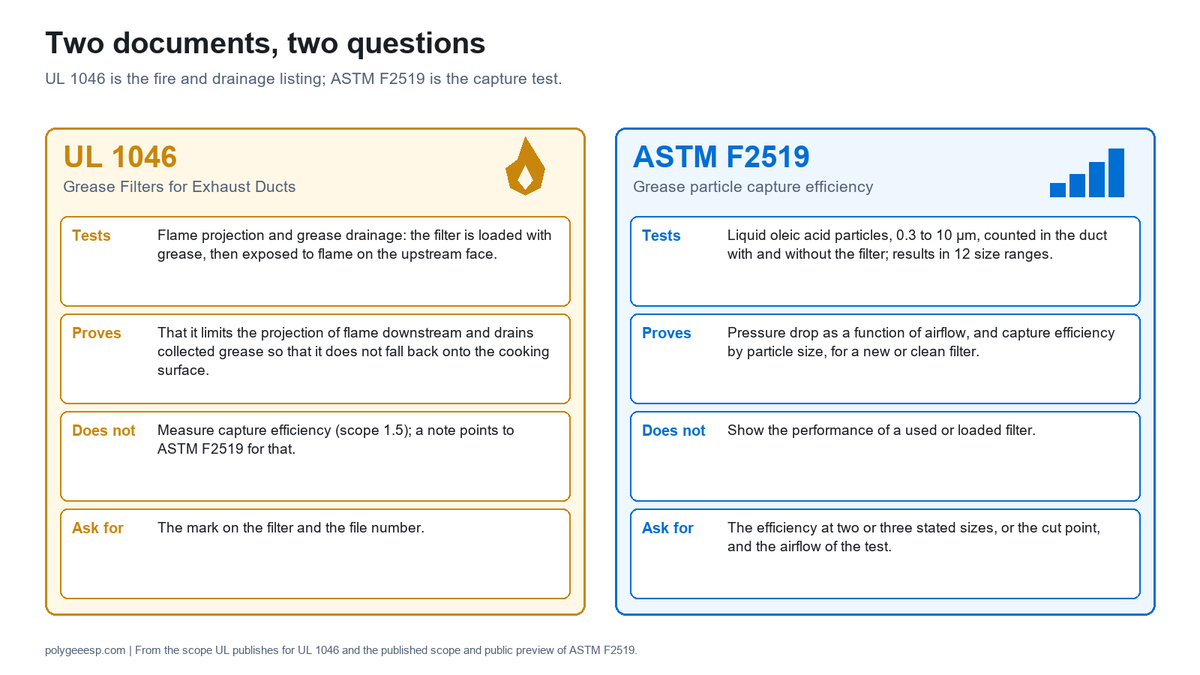
| UL 1046, Grease Filters for Exhaust Ducts | The filter is loaded with grease, then exposed to flame on the upstream face; drainage is observed. A drop test was added in the 2022 revision | That it limits the projection of flame downstream and drains collected grease so that it does not fall back onto the cooking surface | Capture efficiency. Scope 1.5 states that the standard does not measure capture efficiency, and a note points to ASTM F2519 for that | The mark on the filter and the file number |
| ASTM F2519, grease particle capture efficiency | Liquid oleic acid particles, 0.3 to 10 µm or as specified by the manufacturer, counted in the duct with and without the filter, at a baseline airflow of 250 cfm per linear foot of external filter width; results in 12 size ranges | Pressure drop as a function of airflow, and capture efficiency by particle size, for a new or clean filter | Performance of a used or loaded filter. Our reading: a liquid-particle result does not establish removal of grease that remains in the vapor phase | The efficiency at two or three stated sizes, or the cut point, and the airflow of the test |
What the UL 1046 label is and is not, question by question, is on our grease filter requirements page, and how to read an F2519 report is on ASTM F2519.
Sizes, materials and temperature limits: stainless steel, aluminum, galvanized
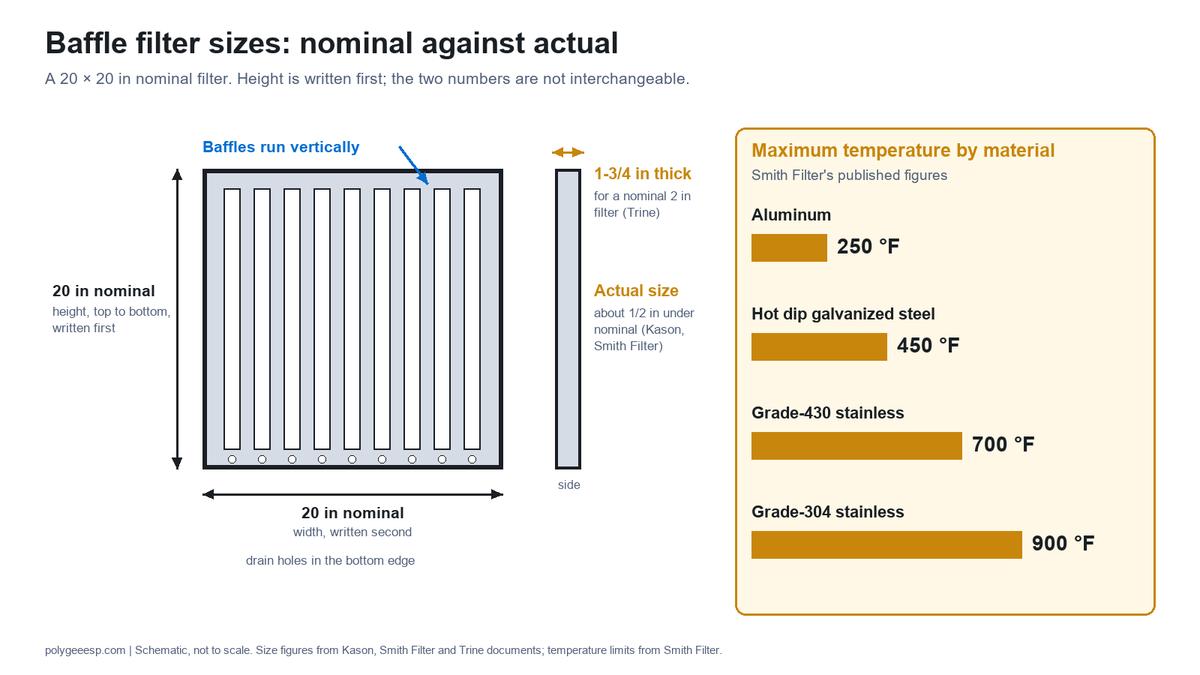
Baffle filter sizes are nominal, and the order of the dimensions is the maker’s. Kason, Smith Filter, Flame Gard and Jasun write the vertical dimension, top to bottom, first and the horizontal second, and the two numbers are not interchangeable because the baffles have to run vertically; Jasun states it as a rule of construction: the handles go on the H edge, the blades run along the H edge, and the drain holes are in the W edge. ACE Filtration’s metric table is headed width × height × depth. A replacement filter is ordered in the order the selected maker states.
| Item | Published figure | Maker and document | Why a buyer checks it |
|---|---|---|---|
| Actual against nominal size | 1/2 in (13 mm) under nominal; 7/16 in under on another range | Kason and Smith Filter; Trine | Match the nominal order size to the maker’s actual dimensions and the hood opening; the two are not interchangeable |
| Actual thickness | 1-3/4 in for a nominal 2 in filter; 1-5/8 in on one aluminum range and 1-7/8 in on one heavy stainless range | Trine; Flame Gard | The filter has to sit in a hood channel made for the nominal 2 in |
| Weight, 20 × 20 in | 4 lb aluminum, 7.13 lb galvanized, 7.13 lb stainless; 5.5 lb for another stainless model; 15.0 lb for a model with spark arrestor | Trine; Flame Gard | Check the weight and the maker’s removal method for filters taken out for washing |
| Open area, 20 × 20 in | Net free area 314 sq in; effective area 2.25 sq ft on another range | Flame Gard; Kason | Use the area definition and velocity basis in the selected maker’s data; net face velocity and slot velocity are different quantities |
| Maximum temperature by material | Aluminum 250 °F; hot dip galvanized steel 450 °F; grade-430 stainless 700 °F; grade-304 stainless 900 °F | Smith Filter | Read against the appliance under the filter |
| UK metric module | 495 × 495 × 45 mm for a 20 × 20 × 2 in nominal, rated 1,323 m³/h at a face velocity of 1.5 m/s; a 500 × 500 × 50 module rated 0.45 m³/s at 80 Pa | Jasun Envirocare; ACE Filtration | UK ratings are in m³/h and Pa at a stated velocity; US tables are in cfm and inches of water per filter |
The code sets the material floor. Section 509.2.3 of the 2022 California Mechanical Code requires grease filters to be listed, constructed of steel or other non-combustible material, and rigid enough not to distort or crush under normal operation, handling, cleaning or replacement. Over solid fuel the same code, citing NFPA 96, asks for grease removal devices of steel or stainless steel, or approved for solid-fuel cooking, with a spark arrester ahead of them where sparks and embers can be generated. Sheet thickness is not stated in any of the catalogs read for this page, so it is not given here.
Airflow, pressure drop and how many filters
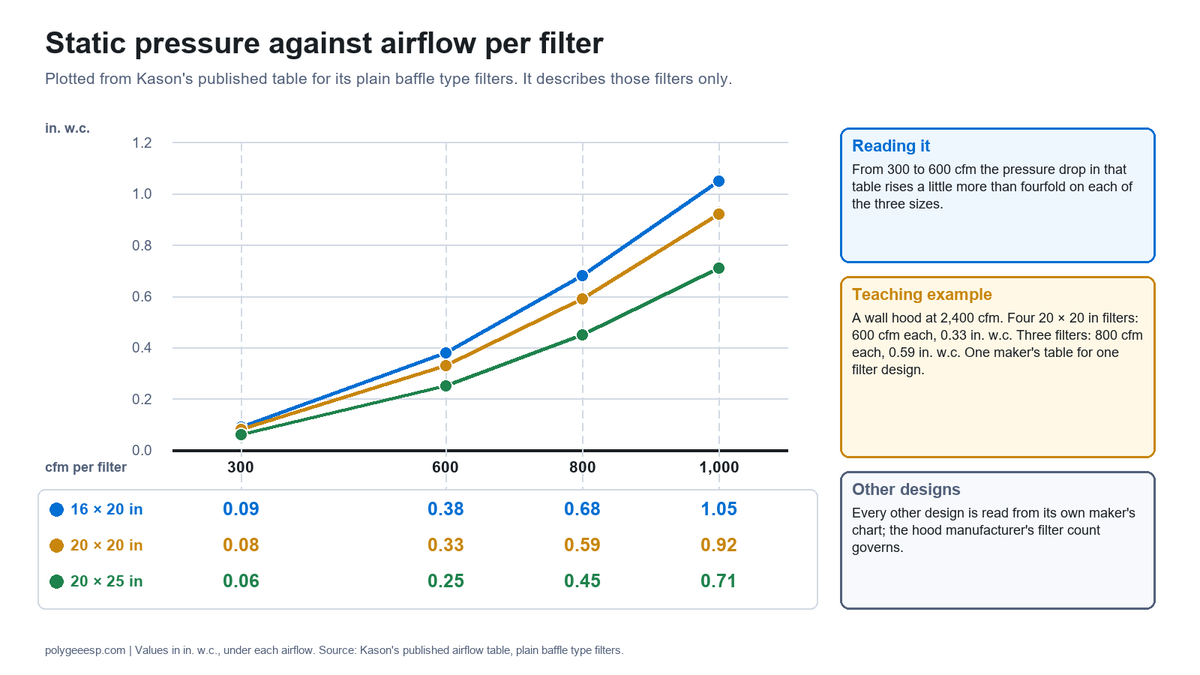
The airflow through each filter sets its pressure drop, so the number of filters in a hood is an airflow decision before it is a fitting one. The International Mechanical Code frames it in Section 507.2.8.1: filters shall be of such size, type and arrangement as will permit the required quantity of air to pass through at rates not exceeding those for which the filter or unit was designed or approved. Makers publish that rating as a table of cfm per filter against static pressure.
| Airflow per filter | 16 × 20 in baffle | 20 × 20 in baffle | 20 × 25 in baffle |
|---|---|---|---|
| 300 cfm | 0.09 in. w.c. | 0.08 in. w.c. | 0.06 in. w.c. |
| 600 cfm | 0.38 in. w.c. | 0.33 in. w.c. | 0.25 in. w.c. |
| 800 cfm | 0.68 in. w.c. | 0.59 in. w.c. | 0.45 in. w.c. |
| 1,000 cfm | 1.05 in. w.c. | 0.92 in. w.c. | 0.71 in. w.c. |
The table is Kason’s, for its plain baffle type filters, and it describes those filters only. Other designs read differently at the same flow: Smith Filter’s table for a 2 in filter gives 0.182 in. W.G. at a net face velocity of 267 fpm, which it equates to 600 cfm through a 20 × 20, then 0.360 in at 445 fpm and 0.753 in at 711 fpm. Greenheck states the result at hood level, 0.5 to 0.6 in. wg for a 9 × 4 ft hood at 2,050 cfm. In Kason’s table, doubling the flow from 300 to 600 cfm raises the pressure drop a little more than fourfold on each of the three sizes; every other design is read from its own data.
There is a lower limit as well. Kason marks an “effective range to meet UL collection requirement” on the chart for its Trapper filter, 350 to 750 cfm per 20 × 20 filter, and leaves the cells outside that range empty. The document does not explain how either limit was selected. In UK practice the same idea is written as a slot velocity, 4.5 to 5.5 m/s on one data sheet and 4.5 to 5.0 m/s at the slot in Defra’s table.
For selection, CaptiveAire’s filtration guide works from the exhaust rate per foot of hood length: its standard baffle in a 16 in height up to 275 cfm per foot and in a 20 in height over 275 cfm per foot. The exhaust rate itself comes from the hood listing or the code, which is the subject of hood CFM requirements.
Two further points belong to this step. ASTM F2519 notes that the pressure drop results can be added to those of the other components in an exhaust system to determine the total exhaust fan pressure requirement, which is how the filter enters the fan selection; the fan side of that sum is on direct drive vs belt drive fans. And a change of filter type is a change of resistance: CaptiveAire’s manual for its high-efficiency filter tells the installer to make sure the hood has sufficient fan power for the increased pressure drop before fitting it. For checking airflow on site, Greenheck’s hood manual takes velocity readings at five locations per filter, each over a filter slot.
Baffle filter vs mesh filter, cartridge and cyclonic grease filters
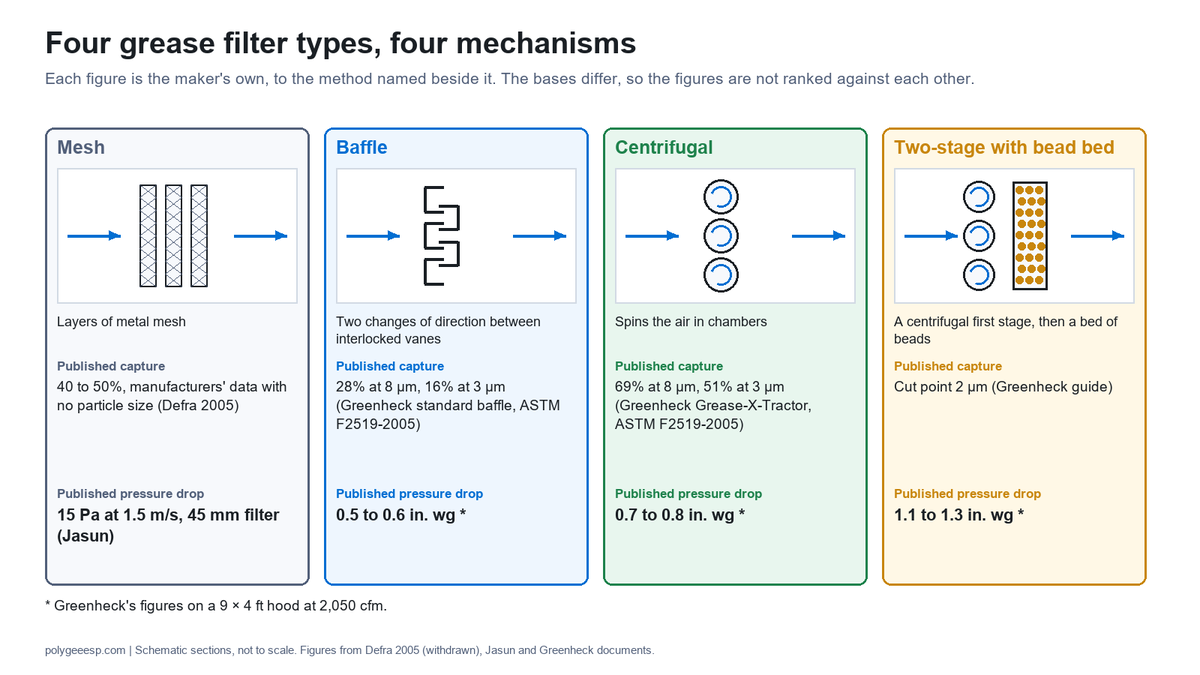
The grease filter types use different separation mechanisms and carry different airflow resistance. The table sets the published figures side by side with the basis of each, because the bases differ and a figure measured to one method cannot be ranked against a figure measured to another.
| Type | How it separates | Published capture figure and its basis | Published pressure drop | Position in the codes |
|---|---|---|---|---|
| Mesh grease filters | Layers of metal mesh; grease is held in the airstream path | 40 to 50%, manufacturers’ data with no particle size (Defra 2005) | 15 Pa at 1.5 m/s for a 45 mm filter (Jasun) | NFPA 96, as reproduced in the California code: mesh filters shall not be used unless evaluated as an integral part of a listed exhaust hood or listed in conjunction with a primary filter in accordance with UL 1046. Defra: mesh provides no barrier to flame |
| Baffle | Two changes of direction between interlocked vanes | 28% at 8 µm, 16% at 3 µm, ASTM F2519-2005 (Greenheck standard baffle) | 0.5 to 0.6 in. wg on a 9 × 4 ft hood at 2,050 cfm | Listed to UL 1046 where removable and not integral to a listed hood |
| High-efficiency single-stage baffle | S-shaped baffle with a slotted rear baffle | At least 75% at 5 µm and 85% at 7 µm and larger (CaptiveAire Captrate Solo specification; tested to ASTM F2519-05) | Not to exceed 1.0 in. w.g. | ETL listed to UL 1046 |
| Centrifugal or cyclonic | Spins the air in chambers | 69% at 8 µm, 51% at 3 µm, ASTM F2519-2005 (Greenheck Grease-X-Tractor); 95% on 10 µm particles, tested by VTT to VDI 2052 (Halton KSA) | 0.7 to 0.8 in. wg on the same hood; 120 Pa | Greenheck’s page states UL 1046 Classified; Halton states NSF and UL classification for KSA |
| Cartridge, or extractor built into the hood | Four changes of direction (Defra) | Cut point about 6.5 µm for hoods with built-in extraction (Greenheck guide) | 1.1 to 1.3 in. wg on a 9 × 4 ft hood at 2,050 cfm, for the water-wash and dry cartridge hoods in that guide | UL 1046 scope 1.2: extraction devices integral to a hood are tested with the hood under the UL 710 family, not under UL 1046 |
| Two-stage with packed bead bed | A centrifugal first stage, then a bed of beads | Cut point 2 µm, near-complete at 7 µm (Greenheck guide) | 1.1 to 1.3 in. wg on the same hood | Removable two-stage filter |
Halton’s 95 percent appears at 10 microns on its data sheet and web page and at 8 microns in two of its brochures; both are in print, and the size has to be asked for. The makers themselves place the baffle at the light end. CaptiveAire’s page says its standard baffle filter is designed for light duty grease applications; Greenheck lists its own for light to moderate grease; and Accurex’s selection sheet says that baffle filters carry the lowest up-front cost and would not be recommended for medium or heavy cooking applications. Whether a mesh filter is acceptable in a given exhaust hood is a question of listing and certification, and the answer for each arrangement is on grease filter requirements.
Mounting in the exhaust hood: angle, height, direction and drip tray
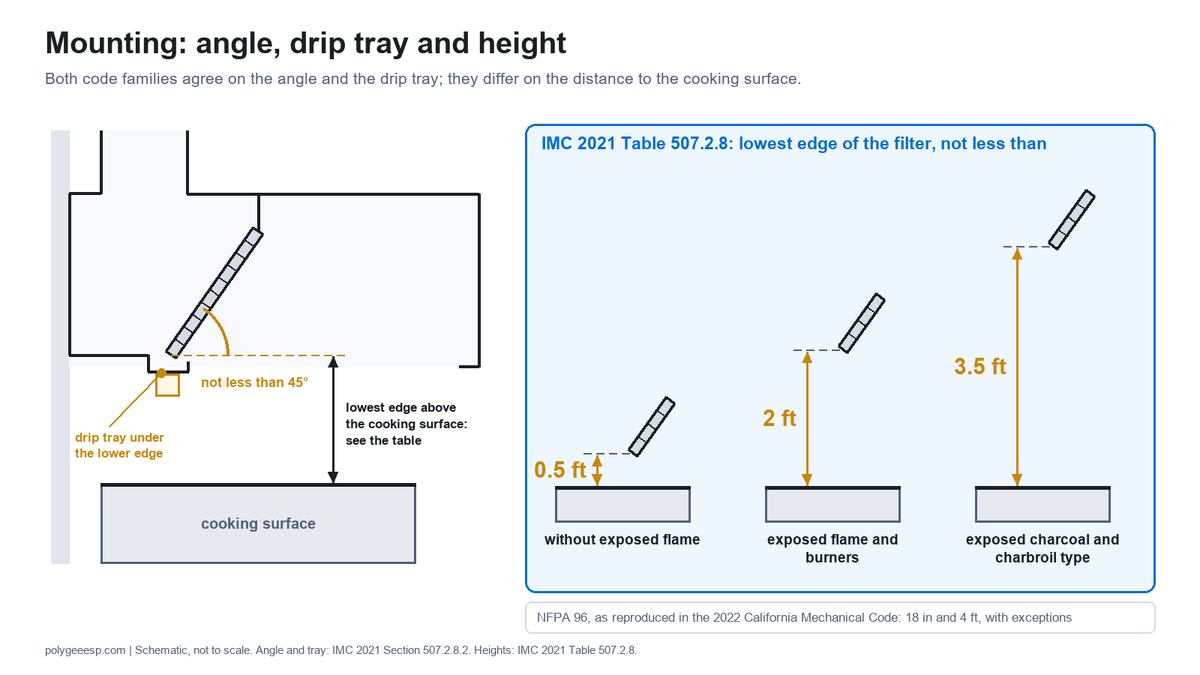
Two code families govern how a baffle filter is mounted, and they give two sets of height figures. The International Mechanical Code and NFPA 96 agree on the angle and the drip tray and differ on the distance to the cooking surface, so the edition in force where the kitchen is decides which column applies.
| Requirement | International Mechanical Code 2021 (2024 reads the same) | NFPA 96, as reproduced in the 2022 California Mechanical Code |
|---|---|---|
| Listing | Type I hoods equipped with grease filters listed and labeled in accordance with UL 1046 (507.2.8). Factory-built commercial exhaust hoods listed and labeled to UL 710 and installed in accordance with Section 304.1 are not required to comply with Section 507.2.8 (507.1, exception 1) | Listed grease filters or other listed grease removal devices; removable filters that are not an integral component of a listed hood are listed to UL 1046 and so designated on the filter (6.1.1, 6.1.2) |
| Angle | Not less than 45 degrees from the horizontal (507.2.8.2) | Not less than 45 degrees from the horizontal (6.2.3.6) |
| Height above the cooking surface | Lowest edge not less than: 0.5 ft without exposed flame; 2 ft over exposed flame and burners; 3.5 ft over exposed charcoal and charbroil type (Table 507.2.8) | As great as possible and not less than 18 in (457 mm) (6.2.1.1); 4 ft (1,219 mm) for solid fuel and solid fuel-type broilers, including gas or electrically heated charbroilers (6.2.1.2); three exceptions: 6 in (152 mm) for equipment without exposed flame where flue gases bypass the device (6.2.1.3); the separation distance in a device’s own listing (6.2.1.4); and, for devices supplied as part of listed hood assemblies, installation to the listing and the manufacturer’s instructions (6.2.1.5) |
| Drip tray | A drip tray beneath the lower edge of the filters (507.2.8.2); gutters drain to an approved receptacle accessible for cleaning (507.2.9) | A tray beneath the lower edges, kept to the minimum size, pitched to drain into an enclosed metal container of not more than 1 gallon (4 L) (6.2.4.1 to 6.2.4.3) |
| All the air through the filters | Size, type and arrangement to pass the required air at not more than the rated rate (507.2.8.1) | Filters arranged so that all exhaust air passes through them (6.2.3.4) |
| Removal | Readily removable without separate tools, unless designed and installed to be cleaned in place with the system equipped for it; removable filters that are designed and required to be cleaned are of a size that fits a dishwashing machine or pot sink (507.2.8.1) | Easily accessible for removal (6.2.3.5) |
| Direction | Not stated in this section | Filters that need a specific orientation to drain are so marked on the face, visible when installed, or built so that they cannot be installed the wrong way (6.2.5) |
The NFPA 96 clause numbers are those the California code prints beside each sentence; the standard itself was not read for this page. For UK kitchens, Defra’s withdrawn 2005 guidance gave an ideal distance of 450 to 1,350 mm between the lowest edge of the grease filter and the top of the cooking surface, to avoid temperatures at the filter that could vaporise the extracted grease and pass it to the ductwork. Where an appliance flue outlet is closer than 18 in to the filters, the California text asks for the filters to be protected, and allows a steel or stainless steel baffle plate between the heat source and the filter, sized and located so that flames or combustion gases travel not less than 18 in to the filter, and set not less than 6 in from it (509.2.2 to 509.2.2.3); that plate is a heat shield, not a filter.
The makers’ instructions fill in what the codes leave to the product. Flame Gard: filters should be installed with the baffles running in the vertical position, to allow the grease to run down the baffles to the grease trough and then to the collection cup. CaptiveAire, for its Captrate filter: arrows on the baffle pointing up, and the units slid together to leave no gaps between them. One UK filter is made with drain holes in both the top and bottom edges so that it can go in either way up. A gap is the fault that matters: air takes the open path, and the code sentence that all exhaust air passes through the filters is no longer true of the hood.
The fire code closes the loop on a filter left out. Section 606.3.1 of the 2021 International Fire Code requires that grease filters listed and labeled to UL 1046 be in place where equipment under a kitchen grease hood is used. The clearance figures around the rest of the hood are on hood clearance requirements.
Hood filter cleaning: how often, by appliance
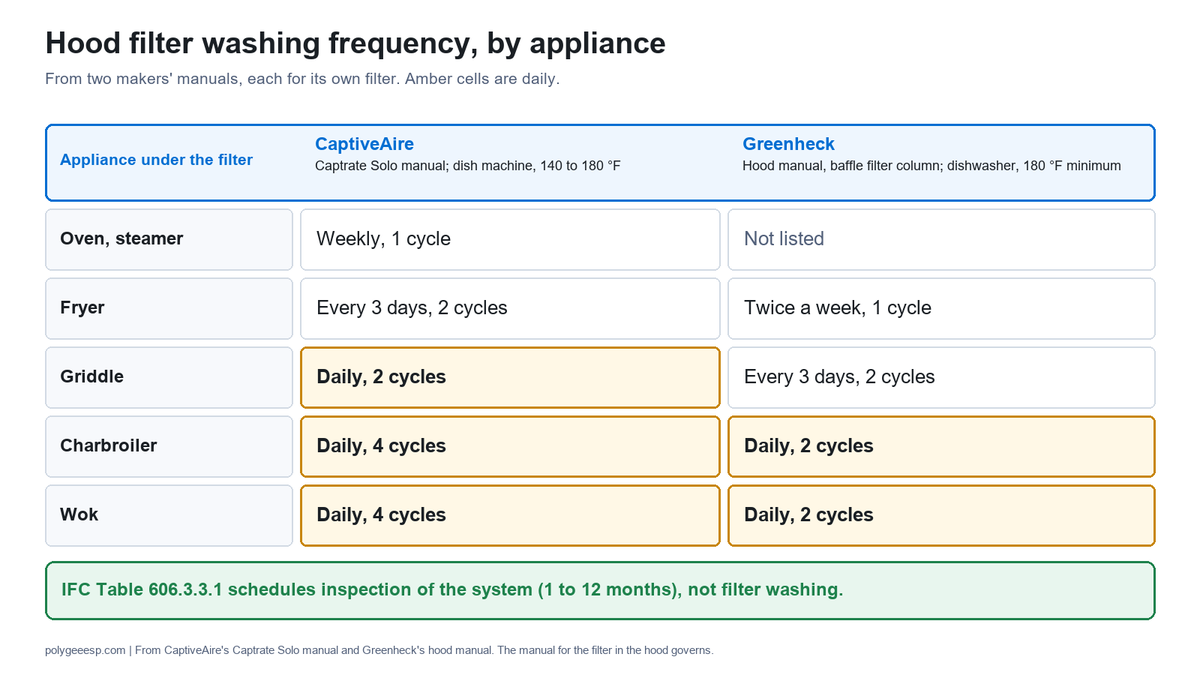
The interval comes from what is cooked under the filter, not from a table in the code. The makers publish the filter cleaning frequency by appliance, and the two manuals read here differ on the griddle: CaptiveAire, for its Captrate filters, lists ovens and steamers weekly, fryers every three days, and griddles, charbroilers and woks daily; Greenheck’s baffle filter column lists griddles every three days, fryers twice a week, and charbroilers and woks daily, and does not list ovens or steamers.
| Appliance under the filter | CaptiveAire, Captrate Solo manual: high-temperature dish machine, 140 to 180 °F | Greenheck hood manual, baffle filter column: commercial dishwasher, 180 °F minimum |
|---|---|---|
| Oven, steamer | Weekly, 1 cycle | Not listed in the rows read |
| Fryer | Every 3 days, 2 cycles | Twice a week, 1 cycle |
| Griddle, stove top | Daily, 2 cycles | Every 3 days, 2 cycles |
| Charbroiler | Daily, 4 cycles | Daily, 2 cycles |
| Wok | Daily, 4 cycles | Daily, 2 cycles |
Each column is for the maker’s own filter. The CaptiveAire column is for its high-efficiency Captrate Solo; for its standard baffle filter the same maker’s filtration guide recommends cleaning on a daily basis, in a commercial dishwasher as the preferred method. Greenheck’s manual lists weekly removal and washing of grease filters or cartridges in a dishwasher or pot sink, with the note that filters over heavy grease producing equipment may require more frequent cleaning. Gaylord’s manual has the filters removed and cleaned at the end of each cooking day or at periodic intervals depending on the type of cooking. Defra’s 2005 guidance put self-draining baffle filters and their collection drawers at weekly as a minimum, and mesh filters at twice a week.
On method, the code decides the first thing: under IMC Section 507.2.8.1, where filters are designed and required to be cleaned, removable filter units are of a size that allows them to be cleaned in a dishwashing machine or pot sink. Where there is no machine, the cleaning method in the manuals is a heated soak with pot detergent or a degreaser. CaptiveAire’s soak table, at 140 to 180 °F, runs from two hours weekly over an oven to overnight every day over a charbroiler; Gaylord’s gives a soak of 15 to 30 minutes in hot water with a degreasing detergent, then scrubbing and rinsing; and Greenheck’s table marks its lowest-ranked method, a pot sink with no heater, as not recommended over a charbroiler or wok. For its Captrate Solo and Combo filters, CaptiveAire adds two instructions: keep a spare set of filters in stock to prevent downtime while one set is being cleaned, and do not use a Solo or Combo filter that has been involved in a fire.
What the exhaust system as a whole owes the inspector is on kitchen exhaust cleaning requirements. The procedures above are summaries of other makers’ manuals for their filters; the manual for the filter in the hood, and the local code, govern what is done on site.
What reaches the duct in a commercial kitchen, and where an ESP fits
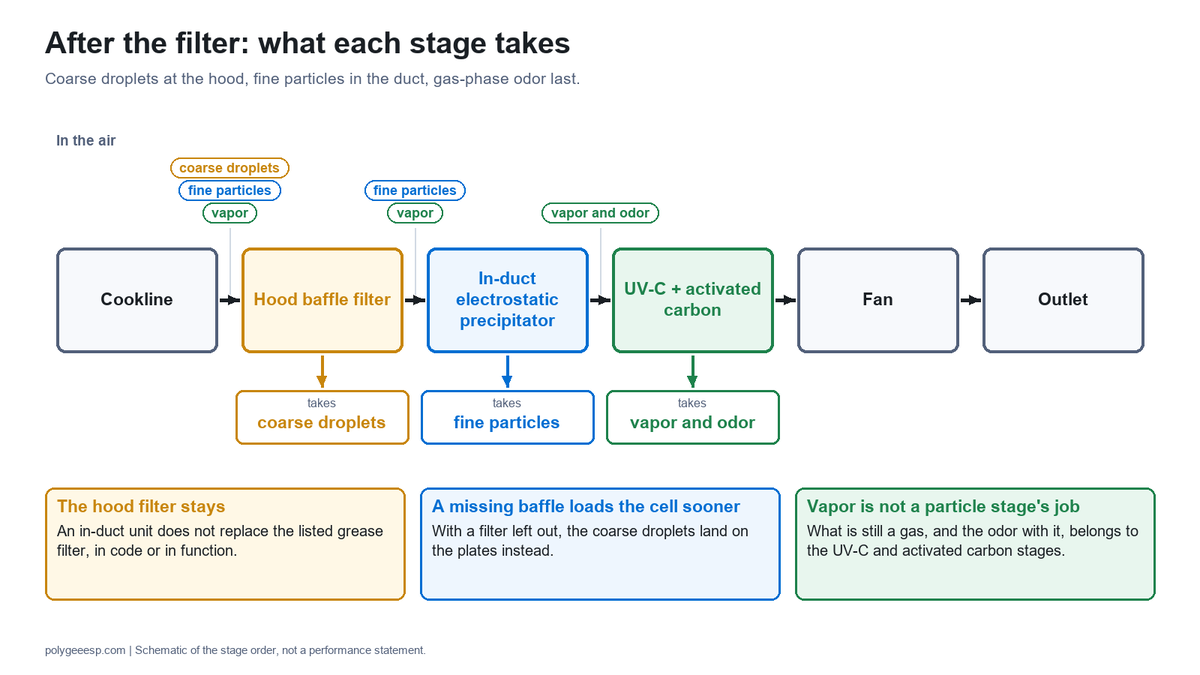
What leaves a clean, correctly mounted bank of standard baffle filters is, on the figures above, the larger share of the particles at 3 and 8 microns, the fine aerosol and the vapor. A test at the University of California, Riverside measured three specific control devices. Beef patties were cooked on an under-fired charbroiler and three control devices were measured against the baseline. The particle size distributions peaked between 118 nm and 150 nm, with a mean diameter of about 0.15 microns. An in-hood dual-stage filter, a steel cartridge followed by a fabric filter and installed directly above the grease baffles, reduced particulate mass by 25 percent and 21 percent on the two sampling methods used. An electrostatic precipitator followed by an activated carbon bed reduced it by 86 percent and 90 percent. The authors attribute the first result to the filter being more effective on solid particles than on the gaseous oil and mist vapors, and suggest that the gases may condense after the filter and not before it.
An in-duct arrangement places the second stage after the hood. Purified Air’s data sheet for an in-duct unit calls the electrostatic precipitator the second stage of a three-stage system, the first being the canopy filters and the third the methods for gaseous or odor control, and says that it traps the smaller grease particles and other contaminants that pass the grease filters in the cooker hood. An electrostatic precipitator charges particles and collects them on plates, a mechanism that does not depend on the particle having enough mass to leave a bend.
Three boundaries keep that statement honest.
- The hood filter stays. An in-duct unit does not replace the listed grease filter, in code or in function. Greenheck’s manual for its electrostatic unit says the system is not intended to remove the need for regular hood and ductwork cleaning, and CaptiveAire’s pollution control unit manual lists clogged hood filters among the causes of an airflow fault at the unit. Our own in-duct units carry a washable mesh pre-filter as their first stage, which takes large particles and evens the airflow ahead of the cell; it is a pre-filter for the unit and not a substitute for the filters in the hood.
- A missing baffle loads the cell behind it sooner. The hood’s baffle filters and the unit’s mesh pre-filter take the coarse fraction, so that what reaches the ionizing wires and the plates is the fine fraction the unit exists to collect. With a filter left out after a hood clean, the coarse droplets land on the plates instead, which is the mechanism described on electrostatic precipitator arcing.
- Vapor is not a particle stage’s job. The South Coast Air Quality Management District’s staff report on its charbroiler rule states that ESPs and HEPA filters do not capture the vapor portion of the emissions. Vapor that has condensed into droplets by the time it reaches the unit is then a particle and can be collected as one; what is still a gas, and the odor with it, belongs to the UV-C and activated carbon stages that follow. The order of those stages is on kitchen exhaust filtration.
On our side of the line, the LK series in-duct precipitators measured up to 97.6 percent grease removal in CMA-accredited third-party testing. That figure was not produced under ASTM F2519, which covers devices that capture grease before the duct, and it belongs to the test condition on its own report, so it is not set against the filter percentages above as if the two had been measured the same way; how to read it is on electrostatic precipitator test report. The complete unit, with its airflow distribution plate, adds no more than 150 Pa to the system.
Whether a kitchen needs the second stage at all is a separate decision, made on the cooking, the discharge position and the complaint history; the cases where filters alone are enough are set out on electrostatic precipitator vs baffle filter.
The 8-Line Filter Bank Sheet
One line per fact, each read from a document and not from memory. The 8-Line Filter Bank Sheet is filled in from the hood drawing, the filter label and the maker’s chart, and it goes with the hood file. A line that cannot be filled is written “not stated” and becomes a question to the supplier.
| Line | What to record | Where to read it | What the entry proves, and does not |
|---|---|---|---|
| 1 | Hood length, the appliances under it, and whether any burns solid fuel | Hood schedule; kitchen layout | Sets the height row, the material and the washing interval. Does not set the exhaust rate |
| 2 | Filter type, the mark on the filter, the file number, or the hood listing that covers it | Filter label; hood nameplate | That the filter is a listed fire and drainage device. Says nothing about capture |
| 3 | Nominal size in the order the maker states (height first on the US sheets read here), thickness, count, material | Filter label; hood drawing | What to reorder. Does not prove the bank is free of gaps |
| 4 | Design exhaust airflow divided by the filter count; the maker’s pressure drop at that airflow; whether it is inside the maker’s stated range | Balance report; maker’s airflow chart | An estimate of clean-filter resistance at the assumed flow per filter; compare it with the measured airflow and the fan selection record |
| 5 | Capture efficiency at stated particle sizes, or the cut point, with the test method and airflow | Maker’s data to ASTM F2519, if published | What share of each size is removed when clean. Not the performance of a loaded filter, and not removal of vapor |
| 6 | Angle, height of the lowest edge above the cooking surface, baffle direction, gaps, drip tray and cup | Site measurement against the code edition in force | That the mounting matches the clause. Does not prove the listing |
| 7 | Washing method, interval by appliance, spare set held, and who does it | Maker’s manual; kitchen rota | The planned washing method and who is responsible. Completed washing still needs a maintenance record, and it is not the system inspection |
| 8 | What follows the filters: any in-duct unit, the discharge position, visible smoke or complaints | Duct drawing; site record | Which treatment stages are installed downstream and what is observed. Not their removal performance, and not what the authority requires |
Common mistakes
- Reading the UL 1046 mark as an efficiency rating. The standard’s own scope says it does not measure capture efficiency.
- Comparing a percentage with no particle size against one that has it. A figure from a grease loading test and a figure at 8 microns answer different questions.
- Counting filters by what fits the opening. The count sets the airflow per filter, and the airflow per filter sets the pressure drop and the capture.
- Ordering a replacement filter by measured size alone. Catalog sizes are nominal, and the order of height and width is the maker’s.
- Fitting baffles horizontally, or leaving a gap at the end of the bank. Grease cannot drain along a horizontal vane, and air takes the gap.
- Taking the inspection table for the washing interval. The fire code schedules inspection of the system in months; the makers schedule washing of the filter in days.
- Expecting a standard baffle filter to clear visible smoke. The fine aerosol is not captured efficiently by impaction, and part of the grease is still vapor at the hood.
Key takeaways
- A baffle filter is a fire and drainage device that also separates coarse grease: UL 1046 tests flame and drainage; ASTM F2519 tests capture by particle size.
- Published capture for a standard baffle is 28 percent at 8 microns and 16 percent at 3 microns on one maker’s F2519 figures; particles above 10 microns are typically captured in the filter, the fine aerosol is not captured efficiently, and vapor passes.
- Airflow per filter sets the pressure drop: 0.33 in. w.c. at 600 cfm and 0.59 in. w.c. at 800 cfm through a 20 × 20 in filter in one maker’s table.
- Mounting is at not less than 45 degrees with a drip tray in both code families; the height above the cooking surface is 0.5, 2 or 3.5 ft in the IMC and 18 in or 4 ft, with exceptions, in NFPA 96 as California reproduces it.
- Washing runs from weekly to daily by appliance in the makers’ manuals; the code tables schedule inspection.
- What passes the filter is treated in the duct: fine particles by an electrostatic precipitator, vapor and odor by UV-C and carbon, with the hood filter kept in place.
Where this guide stops
This page describes the baffle filter as a component. It reproduces no figure read off a curve: where a maker publishes efficiency or pressure only as a chart, the chart is not converted to numbers here. NFPA 96, UL 1046 and ASTM F2519 are paid documents; the NFPA 96 text is quoted from the California Mechanical Code’s reproduction, UL 1046 from the scope UL publishes, and ASTM F2519 from its published scope and a public preview. The ASHRAE figures are taken from an abstract in a GlobalSpec record whose title metadata conflicts with it, and from an air district’s staff report that cites research project 745, not from the paper or the research report. Defra’s 2005 guidance is withdrawn and is used for its description of the filter, not as current UK policy. The figures attributed to filter makers describe their products under their stated conditions; this page reports no testing of those filters by us. No washing chemical, concentration or temperature is recommended here for any filter, and nothing on this page is an instruction for cleaning our units.
Frequently asked questions
- How does a baffle filter work?
- By inertia. The exhaust air is forced through a slot, around the edge of a facing metal channel and out through a second slot, and grease droplets with enough mass cannot follow the turn, so they strike the metal, run down the vertical vanes and drain through holes to the trough. A conventional baffle filter turns the air twice. Fine particles are not captured efficiently by impaction, and grease vapor passes as a gas.
- Are baffle filters better than mesh filters?
- In a commercial hood the question is settled by the listing. NFPA 96, as reproduced in the 2022 California Mechanical Code, does not allow mesh filters unless they are evaluated as an integral part of a listed exhaust hood or listed in conjunction with a primary filter in accordance with UL 1046, and Defra’s 2005 guidance notes that mesh provides no barrier to flame. A baffle filter has a higher pressure drop than mesh, drains itself, and acts as a flame barrier.
- How efficient is a baffle filter?
- It depends on the particle size, so a single percentage is not enough. Greenheck publishes 28 percent at 8 microns and 16 percent at 3 microns for its standard baffle filter, tested to ASTM F2519-2005. Particles larger than 10 microns are typically captured in the hood grease filter, according to an air district staff report, and the fine aerosol, with number-concentration peaks between 36 nm and 173 nm in an ASHRAE research abstract, is not captured efficiently by filters that rely on impaction.
- How often should baffle filters be cleaned?
- By what is cooked under them, at the interval in the filter maker’s manual. In the two manuals read here, for a commercial dishwasher, CaptiveAire lists ovens and steamers weekly, fryers every three days, and griddles, charbroilers and woks daily for its Captrate filters; Greenheck’s baffle filter column lists griddles every three days, fryers twice a week, and charbroilers and woks daily. The intervals in the fire code table, 1 to 12 months, are for inspection of the exhaust system, not for washing the filter.
- Does a baffle filter remove smoke?
- Not reliably. Conventional baffle filters do not capture efficiently the fine aerosol described in the research cited here, and they do not remove grease that remains as vapor. One University of California, Riverside test over a charbroiler reported a mean particle diameter of about 0.15 microns. An in-duct electrostatic precipitator is used for the fine particles, and UV-C and activated carbon stages address gas-phase odor.
Filters in place and smoke still at the outlet?
Send us lines 1, 4 and 8 of The 8-Line Filter Bank Sheet: the appliances under the hood, the design exhaust airflow, and where the duct discharges and what is seen there. You get back the in-duct precipitator size for that airflow, with or without UV-C and activated carbon stages, the resistance it adds to the system so that the fan can be checked, the access it needs in the duct run, and the scope of what it collects and what stays with the hood filters ahead of it.
Send the appliances, airflow and discharge point →
The in-duct units are on our kitchen electrostatic precipitator page, and the range as a whole on the kitchen ESP product overview.
Why we write this. On the US result pages sampled for this term on 10 November 2026, the results were, by their titles, filter retailers, cleaning guides and comparisons of baffle with mesh. The figures that describe what the filter does, an efficiency at a stated particle size and a pressure drop at a stated airflow, sit a layer below, in the makers’ own design guides and airflow tables and in the scope of the two standards, and they explain something our own equipment depends on: what the hood filter has already taken out, and what it has left, before the air reaches a unit in the duct.
Law is Project Manager at Polygee. Polygee, founded in 2004, manufactures in-duct electrostatic precipitators, UV-C and activated carbon modules, kitchen ecology units and ESP hoods for commercial kitchen exhaust; it does not sell hood baffle filters as standalone products. The code text cited on this page was read in the sources listed below, and the figures attributed to filter manufacturers are taken from their published documents and describe their products.
References & further reading
- International Code Council, International Mechanical Code 2021, chapter 5: sections 507.1 (exception 1), 507.2.8, Table 507.2.8, 507.2.8.1, 507.2.8.2 and 507.2.9. codes.iccsafe.org
- International Code Council, International Fire Code 2021, chapter 6: sections 606.3.1, 606.3.3.1 with Table 606.3.3.1, and 606.3.3.2. codes.iccsafe.org
- California Mechanical Code 2022 (Title 24, Part 4), sections 509.1 and 509.2, reproducing NFPA 96 chapter 6, as published by GoCodebook; sections 514.4 and 517.5 were read on the same site. NFPA 96 itself was not read for this page. gocodebook.com
- UL Standards & Engagement, UL 1046, Grease Filters for Exhaust Ducts, edition 4, published February 5, 2010, last revised June 22, 2022: scope 1.1 to 1.5 as published on the standards store page. shopulstandards.com
- ASTM International, F2519-05(2025), Standard Test Method for Grease Particle Capture Efficiency of Commercial Kitchen Filters and Extractors: scope and significance as published; test conditions from the public preview of the 2020 reapproval. store.astm.org
- Greenheck, Standard Baffle Filter product page: efficiency at 8 and 3 microns to ASTM F2519-2005, static pressure; with the Grease-X-Tractor and Grease Grabber pages for the comparison figures. greenheck.com
- Greenheck, Kitchen Ventilation Systems Application and Design Guide, Rev. 2, September 2005: pp. 23 to 25 (copy hosted by an engineering firm). tagengineering.ca
- GlobalSpec, standards record LO-09-034, dated 2009, displaying an abstract of ASHRAE research on grease particle emissions from seven cooking appliances; the record’s title metadata conflicts with the abstract, and the paper was not read. globalspec.com
- Bay Area Air Quality Management District, Staff Report, Regulation 6, Rule 2: Commercial Cooking Equipment, November 2007: PDF pages 7, 18, 43 and 44, citing ASHRAE research project 745 (archived copy). webarchive.library.unt.edu
- Gysel, N. et al., Particulate matter emissions and gaseous air toxic pollutants from commercial meat cooking operations, Journal of Environmental Sciences 65 (2018) 162–170. escholarship.org
- South Coast Air Quality Management District, Preliminary Draft Staff Report, Proposed Amended Rule 1138. aqmd.gov
- Schrock, D.W. et al., A New Standard Method of Test for Determining the Grease Particulate Removal Efficiency of Filter Systems for Kitchen Ventilation, ASHRAE Winter Meeting 2006: abstract. aivc.org
- Department for Environment, Food and Rural Affairs, Guidance on the control of odour and noise from commercial kitchen exhaust systems, prepared by Netcen, January 2005, reference PB10527 (withdrawn): section 4.7.1, Table 4.5 and the maintenance section. assets.publishing.service.gov.uk
- Kason Industries, Canopy Hood Accessories catalog, 0119 LIT 001: Trapper effective range chart and baffle type airflow table, pp. K5 to K7 (copy hosted by a distributor). webstaurantstore.com
- Smith Filter, Fire Patrol Grease Filter data sheet: materials, maximum temperatures and air delivery data (copy hosted by a distributor). filtrationworld.com
- Component Hardware Group, Flame Gard filter catalog (Type I, II and III), with the Flame Gard Type VI stainless steel specification SPC-FR51, Rev. 11/2017, and Harloff, Trine Baffle Grease Filters specification, read as separate documents: sizes, weights and orientation, each attributed to its own document (copies hosted by distributors; the link is to the first). webstaurantstore.com
- CaptiveAire Systems, Hood Filtration Guide; Captrate Solo Filter Specification; Captrate Solo and Combo Filters User Guide, A0011042, February 2025, Rev. 4: pp. 4, 5, 10, 11. captiveaire.com
- Greenheck, Canopy Hood installation, operation and maintenance manual: weekly maintenance, Filter Washing Frequency Guide, airflow measurement (archived copy). archive.org
- Halton, KSA cyclonic filter page and Capture Jet canopies brochure: purpose of a mechanical grease filter, efficiency and pressure loss. halton.com
- Accurex, Grease Filters for Type 1 Hoods selection sheet (copy hosted by a distributor); Gaylord, Model EL Series technical manual (copy hosted by a third party). chefsdeal.com
- Jasun Envirocare, Baffle Filter Model GFBS and Mesh Grease Filter data sheets; ACE Filtration, Technical Data Sheet AF111 (copies filed with UK planning applications). camdocs.camden.gov.uk
- Purified Air Ltd, ESP 1500E datasheet (as filed with a UK planning application): the stages of the system. planning.welhat.gov.uk
- CaptiveAire Systems, Pollution Control Unit Installation, Operation and Maintenance Manual, A0011036: fault chart. captiveaire.com
- Greenheck, Grease Trapper ESP Installation, Operation and Maintenance Manual, 482585, Rev. 3, July 2019: p. 3. greenheck.com
Related reading
- Electrostatic precipitator vs baffle filter: the two as purchases, when filters alone are enough, and the five-year cost drivers.
- Commercial kitchen grease filter requirements: the IMC clauses one by one, and what a UL 1046 listing proves.
- Kitchen exhaust filtration: which stages follow the hood filter, in what order, and what each one does not remove.
- Commercial kitchen ventilation system: the hood, duct, treatment stage, fan and make-up air as one system.