

Kitchen exhaust heat recovery is the transfer of heat from the air leaving a commercial kitchen hood to incoming outdoor air, such as the makeup air that replaces it. Under the International Mechanical Code, kitchen exhaust heat recovery on a Type I hood is limited to coil-type exchangers that move sensible heat only.
The coil then sits in grease-laden air, and that decides whether it keeps working. In a published case study of six restaurants in Ankara, every heat recovery line had an electrostatic precipitator ahead of the heat exchanger, and the coils that stayed clean were those whose precipitator was washed by a dedicated technician or an automatic system. A 2007 air district staff report on charbroiler emissions states the limit that matters here: of the grease vapor, a precipitator collects only the part that has condensed before reaching it. We manufacture in-duct electrostatic precipitators, UV-C and activated carbon modules, kitchen ecology units and the HME kitchen ESP hood. We do not make heat recovery coils, makeup air units or air handling units.
This page helps you decide whether heat recovery belongs on a Type I exhaust at all, which exchanger the code lets through, what has to sit upstream of the coil, who washes it, and where the partner coil goes. It includes The 10-Line Kitchen Heat Recovery Exhaust Sheet. How heat recovery compares with transfer air and demand control is set out in our demand control kitchen ventilation guide, and where replacement air comes from is covered on commercial kitchen makeup air requirements; neither is repeated here.
| Quick specs | What is written | Source |
|---|---|---|
| Heat recovery on a Type I kitchen exhaust | Prohibited, except equipment that recovers sensible heat only with coil-type heat exchangers | IMC 2021 Section 514.2 (Section 513.2 in the 2024 IMC) |
| New York City version | Type I or Type II exhaust; also opens a route for systems specifically designed or listed for the application as part of an engineered system | NYC Mechanical Code 2022 Section 514.2 |
| General energy recovery requirement for ventilation systems | Does not apply to commercial kitchen hoods used for collecting and removing grease vapors and smoke | IECC 2021 Section C403.7.4.2, exception 11 |
| Where the energy code names heat recovery | Above 5,000 cfm (2,360 L/s) of total hood exhaust, one of three options is listed energy recovery with a sensible effectiveness of at least 40 percent on at least 50 percent of the exhaust | IECC 2021 Section C403.7.5 |
| What a precipitator does with grease vapor | Of the vapor, it removes only the part that has condensed before reaching the device | BAAQMD staff report, Regulation 6, Rule 2, 2007 |
| Field record | Six restaurants, a precipitator ahead of every heat exchanger; the two with automatic precipitator washing operated successfully, the four without it clogged | Sümbül and Çimen, AIVC / ASHRAE conference, 2022 |
| Our LK in-duct units | 96.0–97.6% grease removal measured on three LK models at rated, evenly distributed airflow in CMA-accredited third-party tests; rated at 150 Pa or less for the complete unit including the airflow distribution plate; cells slide out for washing | Our data |
- Can you recover heat from kitchen exhaust? What the code allows
- Which heat exchangers fit the exception
- What reaches the coil: grease particles and grease vapor
- What six restaurants in Ankara show about keeping the coil clean
- Where the coil sits, and what the supply side needs
- What the coil adds to the exhaust fan and the makeup air plant
- When heat recovery is worth drawing at all
- The 10-Line Kitchen Heat Recovery Exhaust Sheet
- Which document proves what
- Common mistakes
- Frequently asked questions
Can you recover heat from kitchen exhaust? What the code allows
Yes, but under the IMC only one kind of equipment qualifies: Section 514.2 puts commercial kitchen exhaust serving Type I hoods on its list of prohibited applications, and its exception lets through equipment that recovers sensible heat only with coil-type heat exchangers. In the 2021 International Mechanical Code, Chapter 5, the section opens with “Energy recovery ventilation systems shall not be used in the following systems,” and item 4 of its five is “Commercial kitchen exhaust systems serving Type I hoods.” The exception reads: “The application of ERV equipment that recovers sensible heat only utilizing coil-type heat exchangers shall not be limited by this section.”
Two conditions sit in that exception, and a heat recovery proposal has to meet both. The equipment recovers sensible heat only, so no moisture is exchanged between the airstreams, and the exchanger is a coil. The same section adds a duty that matters later on this page: Section 514.3 requires a means of access to the heat exchanger and other components for service, maintenance, repair or replacement.
The model code, the New York City code and the energy code each say something different, and the drawing has to satisfy the one adopted for the project.
| Document and section | What it says | What it changes on the drawing |
|---|---|---|
| IMC 2021, Section 514.2 | Commercial kitchen exhaust serving Type I hoods is a prohibited application; the exception covers equipment that recovers sensible heat only with coil-type heat exchangers | On our reading, wheels, plate exchangers and enthalpy cores fall inside the prohibition; a coil loop fits the exception |
| IMC 2024, Section 513.2 | The same list and the same exception, under a new section number | Quote the section number of the edition the jurisdiction adopted |
| NYC Mechanical Code 2022, Section 514.2 | Lists commercial kitchen exhaust serving Type I or Type II hoods, applies the prohibition “Unless specifically designed or listed for the specific applications and as part of an engineered system,” and keeps the coil exception | In New York City a Type II exhaust is caught as well, and a listed, engineered system has a route the model code does not offer |
| IMC 2021, Section 514.3 | Access to the heat exchanger and other components for service, maintenance, repair or replacement | A means of access to the coil for service is a code item, not an option |
| IMC 2021, Section 514.4 | Air within an energy recovery system is not treated as recirculated where cross-leakage between the airstreams is limited to less than 10 percent of the total design airflow | Sets the cross-leakage level below which the air is not treated as recirculated |
| IECC 2021, Section C403.7.4.2 | Exceptions to the general energy recovery requirement include systems where the IMC prohibits energy recovery (exception 1) and commercial kitchen hoods used for collecting and removing grease vapors and smoke (exception 11) | The general rule for ventilation systems does not oblige a kitchen hood exhaust to recover heat |
| IECC 2021, Section C403.7.5 | Above 5,000 cfm (2,360 L/s) of total hood exhaust: listed hoods, a maximum exhaust rate and one of three options, the third being listed energy recovery devices with a sensible heat recovery effectiveness of not less than 40 percent on not less than 50 percent of the total exhaust airflow; none of the three is needed where at least 75 percent of the replacement air is transfer air that would otherwise be exhausted | Heat recovery becomes one way to comply above the threshold, not a requirement in itself |
Read the edition before quoting a section number. The 2024 IMC renumbered the section, New York City rewrote it, and a state or city that adopts another mechanical code, or amends this one, has its own text; the authority having jurisdiction applies the edition it has adopted. Where the recovery coil sits among the other parts of a kitchen system is set out in the six parts of a commercial kitchen ventilation system.
Which heat exchangers fit the exception
The run-around coil is the cleanest fit: one finned coil in the exhaust, a second in the supply air, and a pumped water or glycol loop between them, so the exhaust and the supply air do not share a casing. It moves sensible heat only, it is built from coils, and the two coils can sit in different rooms or on different floors. In the case study described below, five of the six restaurant systems used it.
The other common exchangers fail one condition or the other. A fixed-plate exchanger passes the two airstreams through alternate channels of one core, and an enthalpy core also moves moisture. A rotating wheel carries its matrix from one airstream into the other and back. None of these is a coil, so on the plain wording they stay inside the prohibition. A heat pipe is harder to call: it is a bank of finned tubes and it moves sensible heat, but both airstreams pass through the same bank on either side of a partition, so leakage between them becomes a question; Section 514.4 draws its recirculation line at 10 percent cross-leakage. Take a heat pipe to the authority having jurisdiction before it reaches the drawing.
Read against the exception, the run-around coil is the only common type that meets both conditions without argument.
| Exchanger | How the heat moves | Do the airstreams share a casing? | Heat moved | Reading under the IMC exception (our reading) | On record for kitchen exhaust |
|---|---|---|---|---|---|
| Run-around coil loop | The exhaust coil heats a water or glycol loop; a pump carries it to the supply coil | No | Sensible | Meets both conditions | Five of the six case-study systems; their coils stayed clean where the precipitator was washed often |
| Heat pipe | Sealed tubes evaporate a working fluid at the exhaust end and condense it at the supply end | Yes, one tube bank across a partition | Sensible | Coil construction with a shared bank; ask the authority having jurisdiction | Not covered by the sources read for this page |
| Fixed-plate exchanger | Heat conducts through thin plates between alternate channels | Yes, adjacent channels | Sensible; enthalpy cores add moisture | Not a coil; inside the prohibition | The one plate unit in the case study clogged before winter; the authors call plate exchangers almost impossible to clean |
| Rotary wheel | A matrix rotates through both airstreams in turn | Yes, the matrix carries air from one to the other | Sensible, or sensible and latent | Not a coil; inside the prohibition | Not covered by the sources read for this page |
Two more questions sit outside the IMC wording. If the project uses heat recovery to meet the energy code above 5,000 cfm, the third option asks for a listed energy recovery device, so ask the coil supplier for the listing that covers kitchen exhaust duty. And the coil has to be cleanable where it stands, which is where the plate exchanger in the case study failed.
What reaches the coil: grease particles and grease vapor
An electrostatic precipitator removes grease that has already become particles; the part that is still vapor passes through, and it can condense where the air is cooled, which is what a recovery coil does. The Bay Area Air Quality Management District staff report on Regulation 6, Rule 2 (2007) explains that charbroiling emissions include compounds that condense into particulate matter as they cool, termed condensable vapors, and states: “A control device that does not oxidize emissions, such as an electrostatic precipitator or a HEPA filter, will remove only the vapors that condense prior to reaching the control device.”
The vapor share can be large. The same report, citing a 1999 study by Gerstler and colleagues, gives about 39 percent of the grease emitted from cooking hamburgers on an under-fired broiler, and about 69 percent of the emissions from cooking chicken breast, as condensable vapors. Those figures belong to under-fired broilers; they show how far one appliance can swing with the menu, not a figure for a whole kitchen.
The step from the report to the coil is our reading, not the report’s: a recovery coil is a surface in the exhaust train that is deliberately kept colder than the air passing it, because it is carrying heat away to the supply side, so vapor that left the precipitator as vapor meets a cold surface there. In the case-study systems described below, the ecology units ahead of the heat recovery sections, which the authors describe as protecting those sections from oil and smoke, held activated carbon filters as well as a precipitator. Carbon adsorbs vapor-phase molecules and is blinded by grease aerosol, as our page on activated carbon in kitchen exhaust explains, so it depends on the precipitator ahead of it in the same way the coil does.
Our own figure has to be read with the same care. In CMA-accredited third-party tests, three models of our LK in-duct units measured 96.0–97.6% grease removal at rated, evenly distributed airflow. That figure belongs to those test conditions, and the air district’s point applies to any precipitator, ours included: vapor that has not condensed by the time it reaches the cells is not collected by them. What the cells do catch depends on keeping the design airflow inside the rated band, covered on ESP face velocity, and on the mesh pre-filter ahead of the cells.
What six restaurants in Ankara show about keeping the coil clean
In a published case study of six restaurants in Ankara, every heat recovery line had an electrostatic precipitator ahead of the heat exchanger, and the difference between a coil that kept working and one that clogged was whether the precipitator was washed often enough. The paper, Case Study: Heat Recovery and Demand Controlled Ventilation in Industrial Kitchens by A. Tayfun Sümbül and Faruk Çimen, was presented at the 41st AIVC / ASHRAE IAQ conference in Athens in May 2022. All six systems had ecology units, made up of electrostatic precipitators and activated carbon filters, ahead of the heat recovery section. The restaurants are in Turkey, outside the IMC jurisdictions discussed above, and one of the six used a plate exchanger.
The coils that lasted were the ones whose precipitator was washed by a dedicated technician or an automatic system; the record below is the authors’.
| Restaurant (authors’ numbering) | Exchanger | How the precipitator was washed | What happened to the coil |
|---|---|---|---|
| 1 | Plate | Not stated | Clogged before winter, and the restaurant closed after a short while; the authors call plate exchangers almost impossible to clean |
| 2 and 3 | Run-around | No regular maintenance by the restaurant crews | Precipitator cells and carbon cartridges clogged, raised the pressure loss and cut the hood exhaust rate, and were removed, followed by the heat recovery sections; the third restaurant’s heat recovery section had also clogged. Neither system ran for a year |
| 4 | Run-around | First year: a dedicated technician washed the cells once every two days. Second year: the building maintenance team washed them once a week | First year: coil and carbon quite clean, heat recovery successful. By the second winter the coil was dirty; efficiency dropped, and before the end of that winter the management shut down the circulation pump |
| 5 | Run-around | Automatic washing every night | Clean and efficient until the end of the fifth year. When the precipitator failed over a summer, the carbon and the coil clogged; the coil, which has a drain pan, was cleaned inside the ecology unit in about 3 hours |
| 6 | Run-around | Automatic washing | In one recorded condition at −5 °C (23 °F) outdoors, heat recovery warmed the incoming fresh air to 10 °C (50 °F) |
Three points in that record bear on a project. The washing interval is a design input, not a maintenance detail: the same restaurant had a clean coil at one interval and a dirty one at the next. Automatic washing is not hands-off either; in describing the fifth restaurant, the authors note that the kitchen crew did not follow the detergent level and hot water temperature properly. And the coil with a drain pan was cleaned inside its unit in about 3 hours, with satisfactory efficiency the following year, while the authors describe the plate exchanger as almost impossible to clean. The intervals in the table are those restaurants’ records, not a recommendation.
The cells in our in-duct units slide out and are cleaned by soaking them in alkaline degreaser or running them through a commercial dishwasher. On a heat recovery line, that puts the washing routine inside the heat recovery design: write it down against the cooking load, name who does it, and decide what the loop does while the cells are out. What the washing involves is on electrostatic precipitator cleaning, and a field study of a precipitator that loaded up between washes is discussed on our wet scrubber comparison.
Where the coil sits, and what the supply side needs
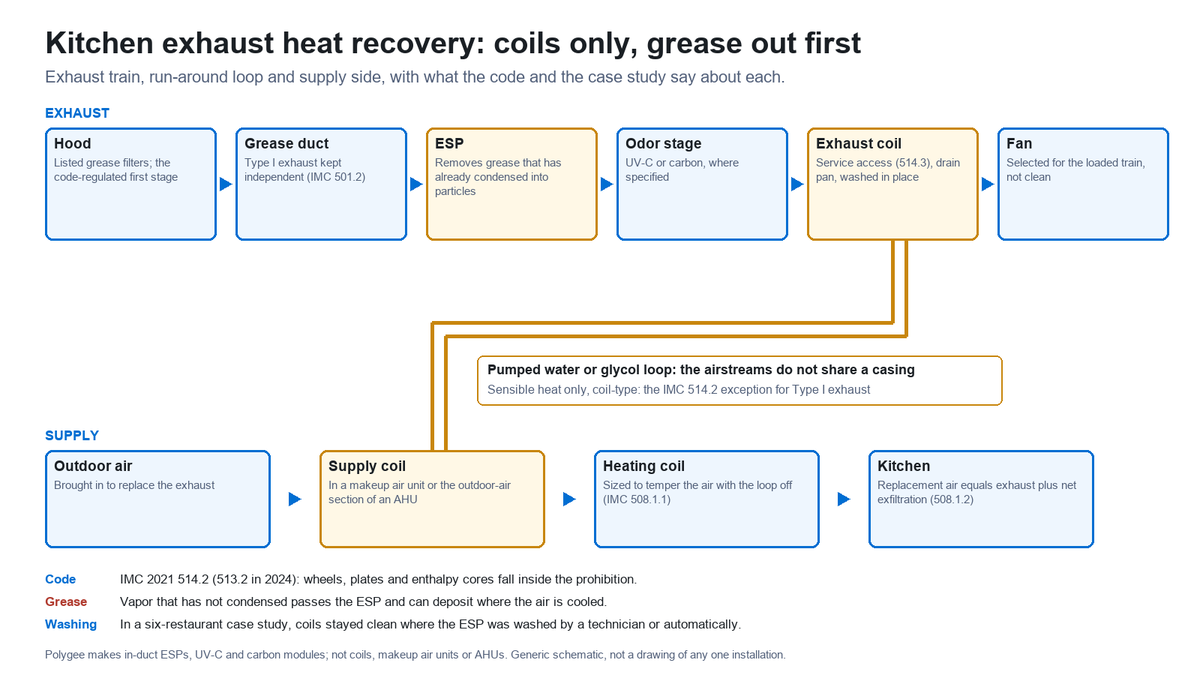
The exhaust-side coil goes downstream of the grease removal stages and ahead of the fan, with access for service, and its partner coil goes into the unit that conditions the replacement air. In order, a heat recovery exhaust train reads:
- Hood and listed grease filters. The code-regulated first stage; nothing downstream replaces it.
- Grease duct. Section 501.2 of the IMC keeps a Type I exhaust system independent of all other exhaust systems except as Section 506.3.5 allows, which on our reading also keeps it out of a recovery device shared with the building’s general exhaust.
- Electrostatic precipitator. Mesh pre-filter, airflow distribution and cells, selected so the design airflow sits inside the rated band.
- Odor stages, where specified. UV-C or activated carbon; in the case-study systems the carbon sat ahead of the coil.
- Exhaust-side recovery coil. With a means of access for service (Section 514.3), such as an access door. Give it a drain pan and a stated way of washing it in place.
- Exhaust fan and discharge.
On the supply side, the second coil goes into whatever conditions the replacement air: a dedicated makeup air unit, or the outdoor-air section of an air handling unit such as Koven Air’s Commercial & Industrial Air Handling Units. Downstream of it sits the heating coil that brings the air the rest of the way. Section 508.1.1 of the IMC limits the temperature difference between makeup air and the conditioned space to 10 °F (6 °C) unless the added heating and cooling loads stay within the capacity of the HVAC system, and Section 508.1.2 asks for a design outdoor air balance in which replacement air equals exhaust plus any net exfiltration. A run-around loop can also serve more than one supply unit: in the fifth case-study restaurant the recovered heat went to the kitchen makeup air unit and also preheated the dining hall and office air.
Equipment in the exhaust path also answers to the fire standard. Aerovent’s FE-3400 engineering summary of NFPA 96 states that thermal recovery units and air pollution control devices may be installed in ducts and hoods if specifically approved for such use, that other parts of the exhaust system may not be downgraded because of them, and that secondary filtration or air pollution control equipment installed in the airstream must be equipped with an approved fire-extinguishing system. The summary says it is not a reprint of the standard; read the edition your jurisdiction has adopted for the wording.
What the coil adds to the exhaust fan and the makeup air plant
A recovery coil adds its own air-side resistance to the exhaust train, and the fan has to be selected for the train in its loaded condition, not clean. The resistance of each stage comes from that stage’s maker at the design airflow: our in-duct units are rated at 150 Pa or less for the complete unit including the airflow distribution plate, and the coil’s figure comes from the coil selection. Add an allowance for the coil and the cells as they load between washes. In two of the case-study restaurants, clogged cells and carbon raised the pressure loss far enough to cut the hood exhaust rate, and a hood that loses exhaust can no longer capture all of the effluent; how the fan type responds to added resistance is discussed on direct drive vs belt drive fans.
The supply side needs a fallback. A heating coil sized to bring the replacement air to temperature on its own keeps the kitchen supplied when the recovery coil is bypassed, fouled or switched off, as the fourth restaurant’s pump was in its second winter. In the fifth restaurant the kitchen makeup air unit had no heat source other than the recovery coil; the authors report that coil clean and efficient for five years with nightly automatic washing. Settle the controls as well: what the loop does when the exhaust fan slows down, while the cells are out for washing, and in the warm months when the outdoor air is no colder than the exhaust.
When heat recovery is worth drawing at all
Kitchen exhaust heat recovery is one of three ways the IECC accepts above 5,000 cfm of hood exhaust, and on our reading, where the building has spare outdoor air to pass into the kitchen, transfer air comes first because it puts no coil in the grease stream. Section C403.7.5 drops the three-option requirement altogether where at least 75 percent of the replacement air is transfer air that would otherwise be exhausted. Demand control is the other route, and the trade between the three is set out in our guide to demand control kitchen ventilation.
Heat recovery earns its place where three conditions meet. The outdoor air is cold for much of the operating year, because a sensible coil only moves heat while the exhaust is warmer than the incoming air; in the first year of the fourth case-study restaurant, with outdoor air around 0 °C (32 °F) and exhaust around 40 °C (104 °F), the loop could preheat the supply air to 21 °C (about 70 °F). The kitchen runs long hours at a high exhaust rate. And somebody is assigned to wash the precipitator at the interval the cooking load needs, for as long as the coil is in service. Where the third condition cannot be met, the coils in that record were out of service within one or two years, and transfer air or demand control is the route that does not depend on it.
The 10-Line Kitchen Heat Recovery Exhaust Sheet
Settle these ten lines, each with the party who supplies it, before the coil is drawn; leave a line as TBD rather than filling in a default.
| Line | What to record | Why it matters | Who supplies it |
|---|---|---|---|
| 1 | Mechanical code and edition adopted for the project, with the section number (514.2, 513.2 or a local section) | The section number, and whether Type II exhaust is caught, change with the edition | Mechanical engineer |
| 2 | Hood type and total hood exhaust airflow, in cfm and m³/h | Type I exhaust brings in the prohibition; more than 5,000 cfm brings in IECC C403.7.5 | Mechanical engineer |
| 3 | Exchanger type, with a written statement that it recovers sensible heat only and is coil-type | These are the two conditions of the exception | Coil supplier |
| 4 | Listing document for the coil and the duty it covers | The energy code’s third option names listed devices, and the NFPA 96 summary asks for specific approval | Coil supplier |
| 5 | Grease removal upstream of the coil: hood filter listing, precipitator model and rated airflow, any carbon stage | The coil sees what these stages did not catch, including the vapor fraction | Precipitator supplier, mechanical engineer |
| 6 | How the precipitator cells are washed, by whom, and the interval the operator writes down for the cooking load | The deciding variable in the case study | Precipitator supplier for the washing method; owner or operator for the interval and the staff |
| 7 | Means of access to the coil, drain pan and method of washing the coil in place | Section 514.3 requires access; the case-study coil with a drain pan was cleaned inside its unit in about 3 hours | Coil supplier |
| 8 | Exhaust-side resistance at design airflow: precipitator complete unit, coil, and an allowance for loading | The fan is selected for the loaded train, or the hood loses exhaust | Precipitator and coil suppliers, mechanical engineer |
| 9 | Supply side: which unit carries the receiving coil, and whether its heating coil meets Section 508.1.1 without recovery | The kitchen still needs tempered makeup air when the loop is off | Mechanical engineer, makeup air unit or air handling unit supplier |
| 10 | Loop controls: bypass, pump off, behavior while cells are out and in the warm months | In the fourth case-study restaurant the management shut the pump down once the coil fouled | Controls contractor, mechanical engineer |
Lines 1, 2 and 9 belong to the engineer of record, and line 10 is settled by the engineer with the controls contractor; lines 3, 4 and 7 come with the coil quotation; lines 5, 6 and 8 come with the precipitator quotation and are agreed with the operator before handover.
- Under the IMC, heat recovery on a Type I kitchen exhaust is prohibited except for sensible-only, coil-type equipment; the run-around coil loop is the common type that meets both conditions without argument.
- A precipitator removes grease that has condensed into particles; vapor passes through and can deposit on the cooled coil.
- In the six-restaurant case study the coils stayed clean where the precipitator was washed by a dedicated technician or an automatic system, and clogged where that washing lapsed or never happened.
- Give the coil access for service, a drain pan and a way to wash it in place, and select the fan for the loaded train.
- Above 5,000 cfm, heat recovery is one of three IECC routes; transfer air needs no coil at all.
Which document proves what
The IMC and IECC sections quoted here state what may be installed and when the energy code names heat recovery, for the editions read; they do not certify any product. A listing covers the device and the duty it was listed for. A third-party test report on a precipitator covers the model and the airflow in the report, and ours were run at rated, evenly distributed airflow. The BAAQMD report describes charbroiler emissions and control devices that do not oxidize them; the 39 and 69 percent figures it cites belong to under-fired broilers. The case-study paper records six restaurants as their authors observed them; it is a case study, not a test standard. The NFPA 96 points come from a manufacturer’s summary, and NFPA 96 itself was not read for this page.
Common mistakes
- Drawing a wheel, plate exchanger or enthalpy core into a Type I exhaust in an IMC jurisdiction. They are not coil-type, and they fall inside the prohibition.
- Reading the precipitator’s tested efficiency as protection against vapor. The tested figure belongs to its test conditions; uncondensed vapor passes the cells.
- Leaving the washing routine to general maintenance. In the case study, a change from one interval to another turned a clean coil into a dirty one within a year.
- Buying a coil with no means of access, no drain pan or no way to wash it in place. Section 514.3 requires access, and the case-study coil that was cleaned in about 3 hours had a drain pan and was washed inside its unit.
- Selecting the exhaust fan on clean resistance. Loaded cells, carbon and coil add resistance until the hood exhaust drops.
- Sizing the makeup air heater on the assumption that the loop will run whenever it is needed. Loops get bypassed and switched off; the replacement air still has to arrive tempered.
Frequently asked questions
- Can a heat recovery wheel be used on restaurant kitchen exhaust?
- Not on a Type I exhaust in a jurisdiction that follows the IMC. Section 514.2 of the 2021 IMC, Section 513.2 in the 2024 edition, prohibits energy recovery ventilation systems on commercial kitchen exhaust serving Type I hoods, and the only exception is equipment that recovers sensible heat only with coil-type heat exchangers. A wheel is not a coil and can carry air and moisture between the airstreams; a run-around coil loop is the common arrangement that fits the wording without argument, and a heat pipe is a question for the authority having jurisdiction. Local editions differ, and the New York City code adds a route for listed, engineered systems.
- Is heat recovery required on commercial kitchen exhaust?
- Not on its own. The 2021 IECC exempts commercial kitchen hoods used for collecting and removing grease vapors and smoke from its general energy recovery requirement. Above 5,000 cfm of total hood exhaust, Section C403.7.5 asks for one of three options, and listed energy recovery with a sensible effectiveness of at least 40 percent on at least 50 percent of the exhaust is only one of them; where transfer air that would otherwise be exhausted makes up at least 75 percent of the replacement air, none of the three is needed.
- Does an electrostatic precipitator protect a heat recovery coil from grease?
- It protects the coil from grease particles, not from grease vapor. A 2007 air district staff report states that, of the vapor, a precipitator removes only the part that condenses before reaching it; on our reading, the uncondensed part can then condense on the coil, the surface kept cooler than the air. In a case study of six restaurants in Ankara, the coils stayed clean where the precipitator was washed often, including nightly automatic washing, and clogged where it was not.
- Where does the heat recovered from kitchen exhaust go?
- Into outdoor air on the supply side, through a second coil in a makeup air unit or in the outdoor-air section of an air handling unit. Because a run-around loop is piped, one exhaust coil can feed more than one supply unit; in one of the case-study restaurants it heated the kitchen makeup air and preheated the dining hall and office air. A heating coil downstream makes up the rest of the temperature so the makeup air stays within the temperature limit of IMC Section 508.1.1.
Planning a recovery coil behind an ESP?
Send us lines 2 and 5 of The 10-Line Kitchen Heat Recovery Exhaust Sheet: the hood type and total exhaust airflow, the cooking duty, and the grease filters in the hood. With the quotation, ask for the rest of line 5 and lines 6 and 8 in writing for the LK or LK-E model proposed: the model whose rated airflow band fits your design flow, its rated resistance as a complete unit, how its cells are washed, and which third-party test report, if any, covers that model and at what airflow. Three LK models have been tested by CMA-accredited laboratories; LK-E figures are design values. The coil, its listing and its washing method come from the coil supplier; the supply side comes from the engineer and the makeup air unit or air handling unit supplier.
Send the hood type and exhaust airflow →
The in-duct units are on our kitchen electrostatic precipitator page.
Why we write this. Heat recovery on kitchen exhaust is decided by one section of the mechanical code, an exception that names one kind of exchanger, and how often somebody washes the precipitator in front of it. This page puts the code text, an air district’s explanation and a published field record side by side, so the decision can be made before the coil is drawn.
Law is Project Manager at Polygee. Polygee, founded in 2004, manufactures in-duct electrostatic precipitators, UV-C and activated carbon modules, kitchen ecology units and the HME kitchen ESP hood; it does not make heat recovery coils, makeup air units or air handling units. The codes, the air district report and the case study cited on this page were read in the sources listed below. This page is not a compliance determination; the authority having jurisdiction applies the edition it has adopted.
References & further reading
- International Code Council, 2021 International Mechanical Code, Chapter 5, Exhaust Systems: Sections 501.2, 506.3.5, 508.1 to 508.1.2, and 514.1 to 514.4. codes.iccsafe.org 2024 International Mechanical Code, Section 513.2. codes.iccsafe.org 2022 New York City Mechanical Code, Section 514.2. codes.iccsafe.org
- International Code Council, 2021 International Energy Conservation Code, Chapter 4 [CE], Sections C403.7.4.2 and C403.7.5. codes.iccsafe.org
- Bay Area Air Quality Management District, Staff Report, Regulation 6, Rule 2: Commercial Cooking Equipment, November 2007, archived copy. webarchive.library.unt.edu
- A. T. Sümbül and F. Çimen, Case Study: Heat Recovery and Demand Controlled Ventilation in Industrial Kitchens, 41st AIVC / ASHRAE IAQ conference, Athens, May 2022. aivc.org
- Aerovent, FE-3400 Fan Engineering: NFPA 96, Standard for Ventilation Control and Fire Protection of Commercial Cooking Operations, a summary. aerovent.com
- Our own documents: third-party test reports for three LK in-duct models (LK40, LK120 and LK160) and product documentation, available on request.
Related reading
- Demand control kitchen ventilation: the IECC threshold and how transfer air, demand control and energy recovery compare.
- Commercial kitchen makeup air requirements: where replacement air comes from and what Section 508 asks of it.
- ESP pre-filter and after-filter: what sits before and behind the cells of the precipitator ahead of the coil.
- Electrostatic precipitator cleaning: what is washed, who does it, and what the log records.