

A kitchen exhaust treatment system is equipment used to reduce cooking pollutants before discharge outdoors. The kitchen exhaust requirements Hong Kong (China) buyers need to check cover licensing, emissions, fire safety, building work and gas or electrical interfaces. This guide maps those checks to the documents each party needs to provide.
Your task: establish which requirements apply before ordering an electrostatic precipitator, an ecology unit, a UV module or a carbon stage. Your record: The 6-Check Hong Kong Exhaust Submittal Sheet below. Your next decision: identify the missing project conditions and model documents, then request a configuration that answers them.
The sources include the Environmental Protection Department (EPD) booklet (marked 2/2026, read here as February 2026) and the Food and Environmental Hygiene Department (FEHD) July 2026 restaurant licensing guide, alongside the legislation and technical documents linked below. The checklist is our own purchasing framework, rather than a government application form.
| Quick facts | Answer for a purchasing file | Basis and buyer consequence |
|---|---|---|
| Restaurant oily-fume concentration limit | No restaurant-specific mass-concentration limit was identified in the documents checked for this guide | EPD guidance uses visible-fume and odor-nuisance criteria; a supplier percentage does not close the environmental question |
| Numerical smoke control | Dark smoke has a defined shade and duration restriction | Cap. 311C, regulations 2 and 3; distinguish this from an oily-fume concentration or removal-efficiency requirement |
| ESP fire-safety evidence | Evidence for a type approved by the Fire Services Department (FSD), matching the proposed equipment | FSD Circular Letter 2/2023, Appendix 1, section 4, and the Annex 1 inspection checklist; request the documentary proof |
| Automatic washing in a continuously operating kitchen | No blanket hotel requirement was found in the documents checked | EPD discusses daily activation where a built-in wash system is installed; the operating and maintenance plan still needs to work |
| Separate EPD prior approval | Conditional on the work and fuel-consumption scope | Cap. 311A, regulations 3 and 4; establish applicability from the cooking installation, rather than the ESP airflow |
| Factory file versus local certificates | Model information and reports support the submission; local professional certificates concern the installation | FEHD Parts VI and VII; assign the signatory before committing the order |
- Which departments check a kitchen exhaust installation?
- What emission limits apply to restaurant exhaust?
- What EPD and FEHD expect from ESP, UV and carbon
- Fire, duct and gas safety: the checks filtration cannot replace
- Does a continuously operating hotel kitchen need automatic washing?
- The 6-Check Hong Kong Exhaust Submittal Sheet
- Common mistakes and the limits of this guide
- Before quotation: resolve the open lines
Which departments check a kitchen exhaust installation?
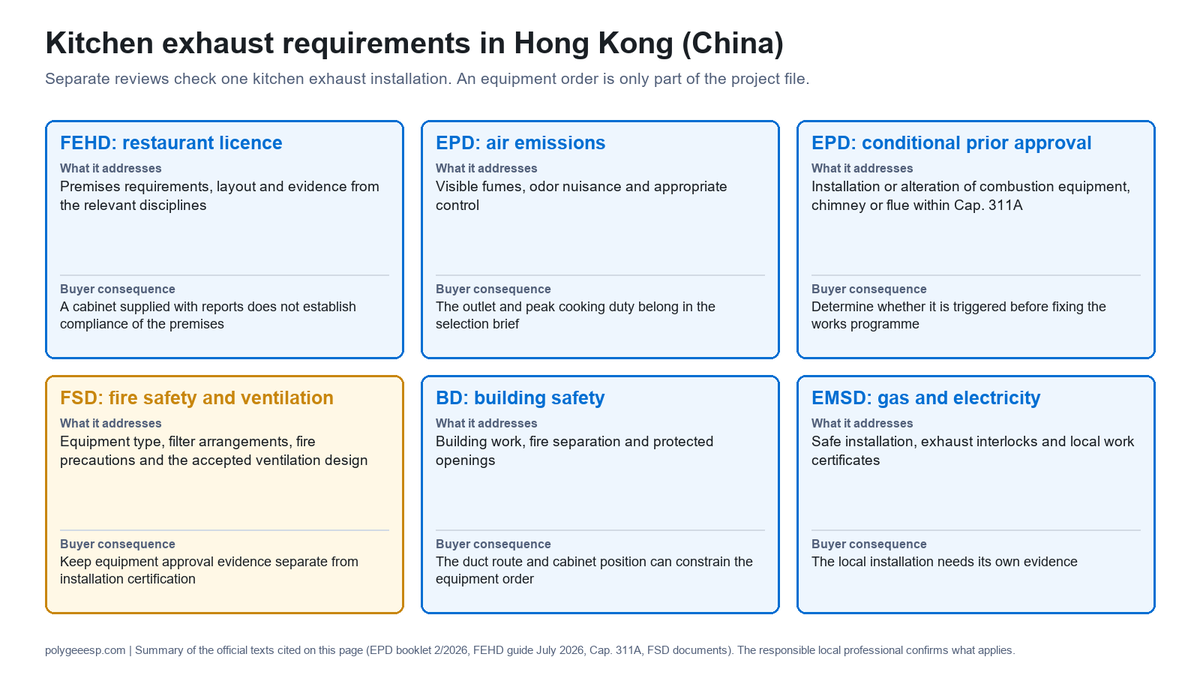
FEHD licensing, EPD pollution control, FSD fire safety, Buildings Department (BD) building work and Electrical and Mechanical Services Department (EMSD) gas or electrical interfaces form separate checks on a kitchen exhaust installation. The EPD booklet, Control of Oily Fume and Cooking Odour from Restaurants and Food Business, page 10, notes that prior approval from relevant government departments may be needed and advises owners to consult FEHD, FSD and BD where appropriate before installing equipment that forms part of the kitchen exhaust system. An equipment order is therefore only part of the project file.
Start with the licence and the works actually proposed. In the FEHD Guide to Application for Restaurant Licences, July 2026 edition, Part IX, paragraph 151, building approval and consent may also be required for installation of pollution control equipment. Paragraphs 153 and 155 address the site, outlet, maintenance access and effects on structural suitability and escape. The responsible local consultant needs the whole layout, including the treatment cabinet, rather than its brochure alone.
Assign each question to its reviewer before asking the supplier for a document pack.
| Review | What the official text addresses | Who assembles the response | Buyer consequence |
|---|---|---|---|
| FEHD: restaurant licence | Premises requirements, layout and evidence from the relevant disciplines; Parts VI, VII and IX of the July 2026 guide | Applicant and appointed local professionals | A cabinet supplied with reports does not establish compliance of the premises |
| EPD: air emissions | Visible fumes, odor nuisance and appropriate control; booklet pages 2 to 6 and FEHD paragraph 149 | Operator and designer, using supplier data | The outlet and peak cooking duty belong in the selection brief |
| EPD: conditional prior approval | Installation or alteration of combustion equipment, chimney or flue within Cap. 311A | Occupier as submitter, with the authorized person or qualified engineer preparing plans and specifications | Determine whether this additional application is triggered before fixing the works programme |
| FSD: fire safety and ventilation | Equipment type, filter arrangements, fire precautions and the accepted ventilation design | Applicant, ventilation and fire specialists; supplier provides model evidence | Keep equipment approval evidence separate from installation certification |
| BD: building safety | Building work, fire separation and protected openings; FEHD paragraphs 151 and 155, and the building fire code | Authorized person and relevant building professionals | The duct route and cabinet position can constrain the equipment order |
| EMSD: gas and electricity | Safe installation, exhaust interlocks and local work certificates; FEHD Part VII | Registered gas and electrical contractors, with the designer | The factory supplies interface information; the local installation needs its own evidence |
The certificate names also need a date check. FEHD Part VI, paragraphs 93 to 96, describes the regime for applications received after 1 November 2025: a Fire Safety Requirements Certificate (FSRC), a Fire Safety (Fire Service Installation) Certificate (FSC(FSI)) and a Fire Safety (Ventilating System) Certificate (FSC(VS)), issued by FSD where the applicant solely opts for FSD’s services. Paragraph 94 states that these certificates replace the Fire Services Certificate and Letter of Compliance only for licence applications received by FEHD after 1 November 2025; applications made before that date still require the Fire Services Certificate and, where the ventilation works fall within the Ventilation of Scheduled Premises Regulation (Cap. 132CE), the Letter of Compliance (Ventilating System). Under paragraph 96, a Registered Fire Engineer appointed within the scope of his or her registration class can instead provide the assessment or certification services, and FSD audits selected FSC(FSI) and FSC(VS) certificates issued by Registered Fire Engineers. The guide allows an applicant to use FSD and/or the relevant classes of Registered Fire Engineer. Record the route chosen for your application instead of copying an older project’s certificate list.
When the combustion installation needs separate EPD prior approval
FEHD paragraphs 28 to 30 and Air Pollution Control (Furnaces, Ovens and Chimneys) (Installation and Alteration) Regulations, Cap. 311A, regulations 3 and 4, provide the applicability test. FEHD paragraph 28 refers to the total fuel-consumption capacity inside the premises, including the proposed works. It identifies prior approval for installation or alteration of restaurant stoves or their chimney/exhaust where capacity exceeds 25 litres of conventional liquid fuel per hour, 35 kilograms of conventional solid fuel per hour, or 1,150 megajoules of gaseous fuel per hour.
Cap. 311A, regulation 3, excludes the small installations within its stated limits, solely electric furnaces or ovens, and the specified-process situations it describes. Establish the applicable scope with the engineer; do not compare a single ESP’s airflow or electrical consumption with those combustion thresholds. Environmental control of fumes and odor remains a separate question.
Where the application is required, regulation 4 requires plans and specifications at least 28 days before work commences. This is a submission lead time, not a promise of approval within that period. Regulations 5 to 7 address surrounding-building information where requested, the qualified plan preparers and specifications including fuel ratings, operating hours, controls and chimney details. The factory’s arrangement and control drawings are inputs to that professional submission. FEHD paragraph 30 also calls for an independent above-roof chimney for the diesel or solid-fuel premises exceeding the thresholds it states, with the relevant BD approval and consent.
A hotel restaurant, a mall tenant and a stand-alone restaurant can share exhaust issues while having different premises and works to review. This article does not determine the hotel establishment’s separate licensing route. Give the local team the kitchen’s use, cooking locations, fuel and proposed alterations so that it can identify the applicable process. For comparison with other markets, our Gulf approval-document guide and Singapore supply and compliance guide have their own geographical scope; their approval language is not a Hong Kong submission checklist.
What emission limits apply to restaurant exhaust?
The documents checked set a visible-fume and odor-nuisance criterion; no restaurant-specific oily-fume mass-concentration limit was identified. EPD’s February 2026 booklet, page 2, describes its standard of control in terms of avoiding air pollution, including odor nuisance, and discharge free from visible fume. FEHD Part IX, paragraph 149(a), uses the same practical criteria for kitchen exhaust and nearby sensitive receptors. That is a different question from the percentage printed on a treatment-unit report.
This finding has a defined research scope. The documents checked were the EPD booklet and restaurant guidance pages, FEHD Part IX, Air Pollution Control Ordinance, Cap. 311, sections 10 and 30, the installation and smoke regulations discussed below, and the Technical Memorandum for Issuing Air Pollution Abatement Notices to Control Air Pollution from Stationary Polluting Processes. The conclusion is not a claim that Hong Kong has no numerical air-quality controls. It means these sources did not supply a general restaurant oily-fume concentration or a universal required ESP removal percentage.
Cap. 311, section 10(1), allows an air pollution abatement notice to require cessation, reduction or other abatement steps where emissions cause or contribute to existing or imminent air pollution. Section 10(2) includes the source and affected location, emission timing, duration and frequency, objectionable odor and sensory effects among the considerations. Section 10(6) contains exclusions for the licensed specified-process and declared offensive-trade situations it describes. Those provisions should be read within their scope rather than reduced to a claim that a complaint automatically closes a restaurant.
For restaurant enforcement in particular, the Government’s written reply on cooking fumes and odors of 10 June 2026, reply parts (2) to (4), describes kitchen inspections, assessment at affected locations and consideration of location, time, duration, frequency, visible fumes, offensive odor and sensory discomfort. Its description makes the affected location part of the evidence. A photograph of a clean-looking outlet does not, by itself, answer the odor question at a neighboring window.
Dark smoke has numerical restrictions
Air Pollution Control (Smoke) Regulations, Cap. 311C, regulation 2, defines dark smoke by comparison with shade 1 on the Ringelmann Chart or an approved device. Regulation 3 makes operation of a chimney or relevant plant emitting dark smoke for more than 6 minutes in any period of 4 hours, or more than 3 minutes continuously, an offence. These are shade and duration criteria. They are not an oily-fume concentration in mg/m3, nor permission to discharge visible cooking fumes or offensive odor up to those durations.
Keep the legal control, a design target and a test result on different lines.
| Item in a specification | What it actually describes | Source or evidence needed | Buyer consequence |
|---|---|---|---|
| No visible cooking fumes; no odor nuisance | Discharge and effects on the surroundings | EPD booklet page 2; FEHD paragraph 149(a); site assessment | Ask for a system proposal covering the outlet and receptors as well as treatment |
| Dark-smoke shade and duration | A defined smoke condition at a chimney or relevant plant | Cap. 311C, regulations 2 and 3 | Do not convert the time limits into a cooking-fume allowance |
| A removal percentage | Performance under the report’s method, airflow and loading | Report identifying the tested model and conditions | It cannot establish odor, fire safety or the acceptability of the installed outlet |
| An outlet concentration requested by a project | A contractual or project-specific acceptance criterion unless a legal source is identified | Written clause, method, sampling location and the party who will judge compliance with it | Clarify its basis before agreeing to a test or a supplier statement |
The Technical Memorandum separates nuisance assessment in section 4 from health-protection concentration assessment in section 5. Its pollutant table should not be relabeled as a restaurant oily-fume stack limit. Likewise, a Mainland China test standard does not become a Hong Kong statutory limit through its appearance on a supplier report. Our guide to the model and conditions on a test report explains what to extract before using its result in a submission.
What EPD and FEHD expect from ESP, UV and carbon
The treatment train has to match peak cooking duty, odor risk and the discharge location. EPD’s booklet, page 4, and FEHD Part IX, paragraph 155 under Design of Exhaust System, base the design on expected peak load. They identify frying, charbroiling and roasting as processes requiring efficient control of oily fumes, and call for high-efficiency odor control where the exhaust has strong odor or the outlet is close to sensitive receptors. Neither passage supplies a universal equipment configuration for every kitchen.
Begin the equipment brief with the menu and the operating condition that the system must handle. List the appliances that can operate together, their fuel and the design extract airflow established by the mechanical designer. Add the proposed outlet position, nearby residences, schools or other sensitive uses, and the hours during which discharge occurs. These are purchasing inputs derived from the official design and nuisance criteria, rather than a substitute airflow calculation supplied by this article.
EPD’s Annex A distinguishes the roles of the technologies. Its grease-filter passage describes preliminary removal of large oily droplets. Its ESP passage explains that collection performance depends on appropriate design and maintenance. Its activated-carbon passage addresses odor adsorption and the adverse effects of moisture, temperature and oily particles. The EPD Green Restaurant FAQ, cooking-fume control section, also presents the technologies by function. A cabinet name such as ecology unit does not describe how those functions have been selected for your duty.
Specify the duty of each stage, then ask what protects it and how it will be maintained.
| Stage or interface | Role in EPD’s guidance | Information to request | Buyer consequence |
|---|---|---|---|
| Hood grease filter or wet preliminary stage | Preliminary treatment of oily droplets; Annex A | What is upstream of the selected treatment unit and the load it leaves downstream | The final unit should not be selected as though the upstream stage were absent or fully effective without evidence |
| Electrostatic stage | Collection of oily fume, dependent on design and cleaning; Annex A | Model, design airflow, distribution conditions, whole-unit resistance and maintenance access | A rating needs conditions that the duct arrangement can deliver |
| UV treatment | A technology described for fumes and odor, with cleaning requirements; pages 6 and 7 | Exact arrangement, protective features, maintenance requirements and the claimed function | A UV label alone leaves the operating and safety interfaces unanswered |
| Carbon or another adsorption stage | Odor treatment affected by moisture, heat and oily particles; page 9 | Upstream protection, airflow distribution, adsorption design basis, resistance and replenishment plan | Adding carbon without its conditions can leave the odor-control proposal incomplete |
| Outlet and surroundings | Dispersion and separation from sensitive receptors; page 3 | Route, discharge direction, obstructions and receptor locations | Additional filtration does not settle an unsuitable discharge location |
For carbon, EPD’s Annex A says preliminary treatment should remove oily fume and water, with temperature reduction where necessary to reach the operational range. Page 10 places odor-control equipment after preliminary removal of droplets and moisture. The procurement implication is to request a complete sequence and its inlet conditions, rather than specify carbon as an independent cure for every discharge. The designer also needs the resistance of the actual sequence for the fan selection.
Read the outlet-height condition with its fuel
EPD’s booklet, page 3, and FEHD paragraph 155, item (d) under Positioning of Exhaust Outlets, discuss vertically upward chimneys for diesel oil or solid fuel; FEHD paragraph 155 adds that the use of these fuels is “highly not recommended”. They describe a preferred extension of at least 3 metres above the source building’s highest point, consideration of taller adjacent or attached buildings within a 20-metre radius, and professional advice where that is impracticable. The fuel condition and the preferred wording matter. This is not a universal instruction to add that height above every gas or electric kitchen treatment unit.
For the equipment submission, transfer the selected airflow, stage sequence, complete resistance basis and inlet conditions into a project specification with explicit supplier responses. Use the datasheet review fields to distinguish a cell-only figure from the complete cabinet. Where a proposed model’s temperature limit, carbon quantity, UV output or wash utilities are not published, ask for them in writing for that model; do not fill those fields from another unit.
Fire, duct and gas safety: the checks filtration cannot replace
The proposed model, the duct route and the gas or electrical installation need different evidence. FEHD paragraph 156 expressly calls for an ESP of a type approved by FSD. FEHD paragraph 155 separately asks for advice on structural suitability, escape and headroom when installing ducting, fans, scrubbers and precipitators. These are related reviews, but a satisfactory answer to one is not a certificate for the others.
FSD: the ESP type and the carbon installation
FSD Circular Letter 2/2023, Appendix 1, section 4.1, requires ESPs to be of a type approved by the Director of Fire Services, with construction complying with applicable safety requirements in UL 867 and UL 710 or other acceptable national or international standards. Its Annex 1 inspection checklist asks for documentary proof of the approved type. Ask for the evidence covering the type and model proposed, with a clear correspondence to the quotation and equipment marking. FEHD’s July 2026 guide, paragraph 114, states that the test report and certificate of a proposed electrostatic precipitator have to be submitted to FSD for approval prior to its installation, and refers to FSD’s list of models already accepted for use. Settle that evidence before the unit is installed.
The standards named in that clause and an FSD-approved type should not be merged into a single label. A test or listing document has its own product scope. The supplier’s response must let the project reviewer identify the equipment and assess the relevant approval evidence. Appendix 1, sections 4.2 and 4.3, also address identification, the high-voltage warning, and protective, safety-interlocking and monitoring devices. A grease-removal report does not answer those safety items.
Carbon has a different issue. Appendix 1, section 2.4.1, says special filter applications such as odor removal by activated carbon require submissions to the Director of Fire Services for relaxation of the ordinary filter requirements and clarification of additional fire precautions. Put the carbon arrangement in the submission discussion rather than assume an ordinary air-filter document covers it. This is a question about the proposed installation and its evidence, not a claim that every odor-stage cabinet has the same approval.
BD and FSD: fire separation along the route
The Code of Practice for Fire Safety in Buildings 2011, 2024 edition, clause C8.2, states that openings for ducts and other services through a fire barrier should be protected with fire dampers or another suitable form of fire stop maintaining the required fire resistance rating. Clause C13.2 addresses restaurant kitchen enclosure and the conditions for protected lobbies. Those clauses require the building layout and fire compartments to be considered; they do not turn the treatment unit into a fire barrier.
For scheduled premises, the FSD ventilation requirements, September 2023, section 2(c), requires non-combustible duct construction; section 2(d) requires every duct passing through a floor, wall or ceiling to be fitted with a damper operated by fusible links of a type approved by the Director of Fire Services, and constructed or protected to resist fire for at least as long as the floor, wall or ceiling it passes through is designed to resist fire. The designer must reconcile the applicable requirements with the actual kitchen exhaust route and the accepted fire-safety design. Do not use this article as a damper installation detail or carry a rule from another jurisdiction into a Hong Kong drawing.
Cooking outside the kitchen introduces its own conditions. FSD’s Typical Fire Safety Requirements for Cooking Activity outside Kitchen (CAOK), sections 3 and 4, calls for restaurant sprinkler coverage and an additional automatic suppression or extinguishing system for the cooking locations it describes, complying with UL 300 or an acceptable equivalent and installed to its listing. This is a scoped example, not a statement that the same provision applies to every enclosed kitchen. Our discussion of suppression and in-duct treatment provides system context; the Hong Kong requirement comes from the applicable FSD text and project requirements.
EMSD: combustion air, extraction and interlocks
EMSD Code of Practice GU12, January 2004, covers mechanical exhaust for gas appliances with rated heat input up to 70 kW within its scope. Section 2.1.1 distinguishes the ventilation requirements in section 3 from the other sections, which concern appliances physically connected to the mechanical exhaust system by a flue pipe or duct. The heat-input figure concerns the gas appliance; it is not the electrical rating of the fan or precipitator.
GU12 sections 3.4 to 3.6 address negative pressure, the appliance’s draught requirements, combustion air and extraction for simultaneous full-load operation. For physical connections, sections 3.8, 3.11, 5.1 and 5.2 add manufacturer information, assessment and interlock provisions. FEHD’s July 2026 guide, paragraph 129(a), also describes the exhaust interlock or equivalent where catering installations need mechanical ventilation, referring to Gas Safety (Installation and Use) Regulations, regulation 24(4). Put the control interface and responsible gas contractor on the drawings; a fan-on signal alone is not a complete explanation of the design.
FEHD paragraphs 130 and 131 assign the gas-work Certificate of Compliance before works and Certificate of Completion after installation and commissioning to the registered gas contractor. Paragraph 124 deals separately with fixed electrical work and Form WR1 or the applicable endorsed WR2. Those documents concern the local installation. The equipment manufacturer can provide the proposed electrical and control information, while the registered professionals determine and certify their respective work.
Where the premises are supplied by HK Electric, its Supply Rules, rule 202, specify 50 Hz and list single-phase 220 V and three-phase 220/380 V, four-wire supply, at the company’s discretion; confirm the supply terms with the utility serving the premises. Our published order configuration allows 220 V or 380 V with frequency configured to order. For a Hong Kong quotation, have the electrical contractor confirm the available circuit, phase and 50 Hz requirement, and have the supplier state the actual proposed input. Configuration flexibility is not confirmation of the nameplate to be delivered.
Does a continuously operating hotel kitchen need automatic washing?
No blanket automatic-washing requirement for continuous hotel operation was found in the documents checked. EPD’s booklet, page 5, addresses an ESP’s built-in washing unit conditionally: where one is installed, it recommends daily activation to reduce the frequency of periodic component cleaning. The same passage describes cleaning by trained staff, loading-dependent intervals, inspection of emissions and sufficient space to remove components. Its wording does not make hotel opening hours a universal trigger for installing automatic washing.
Maintenance still has to be resolved in the design. FEHD Part IX, paragraph 162, suggests considering continuous operation in the design of pollution control equipment and calls for trained operation, professional maintenance, regular servicing, replacement materials, and a manual and repair log at the restaurant. For a kitchen serving meals throughout the day, the purchasing question is how the proposed system remains serviceable during the duty, including the time required to return it to operation after cleaning. That question needs an answer whether washing is automatic or manual.
The following is a procurement assessment derived from those maintenance provisions. It is not a government rule selecting one washing technology. Ask the operator to identify the available service windows and ask the supplier to state the cleaning arrangement for the quoted model, including inspection and any additional manual work. If the proposed arrangement cannot fit the service window, return it to the designer before ordering. Do not resolve an unknown window by assuming an automatic cycle can run while cooking continues.
Select a maintainable arrangement from written operating conditions, rather than from the hotel’s opening hours alone.
| Condition to establish | Question for the operator or supplier | Documented basis | Buyer consequence |
|---|---|---|---|
| Peak grease loading and service periods | What cooking duty sets the cleaning and inspection plan? | EPD pages 4 and 5; model manual | A calendar copied from a lighter-duty kitchen may not describe this installation |
| Available interruption or service window | What parts of the kitchen and extract system must be unavailable, and for how long? | Supplier’s written operating requirements; designer’s continuous-operation review under FEHD paragraph 162 | Unknown return-to-service time remains an unresolved design input |
| Built-in washing, if proposed | What does the cycle clean, what does it leave for inspection or manual cleaning, and how is completion assessed? | EPD page 5 and the exact model’s instructions | Automatic washing does not remove the need for an inspection and maintenance plan |
| Access and competent people | Can the relevant parts be reached, and who is responsible for each task? | EPD pages 4 and 5; FEHD paragraph 162 | A cabinet that fits the plant space may still lack usable maintenance access |
| Wash utilities and wastewater | What supply and discharge does the wash arrangement need, and what is the approved drainage route? | Supplier utility schedule; FEHD paragraphs 159 and 160 | A self-washing option can add drainage and treatment interfaces to the project |
| Records and response to deterioration | Where are observations, work, faults and corrective action recorded? | EPD pages 5 and 6; FEHD paragraph 162 | The operator has evidence of what happened between formal inspections |
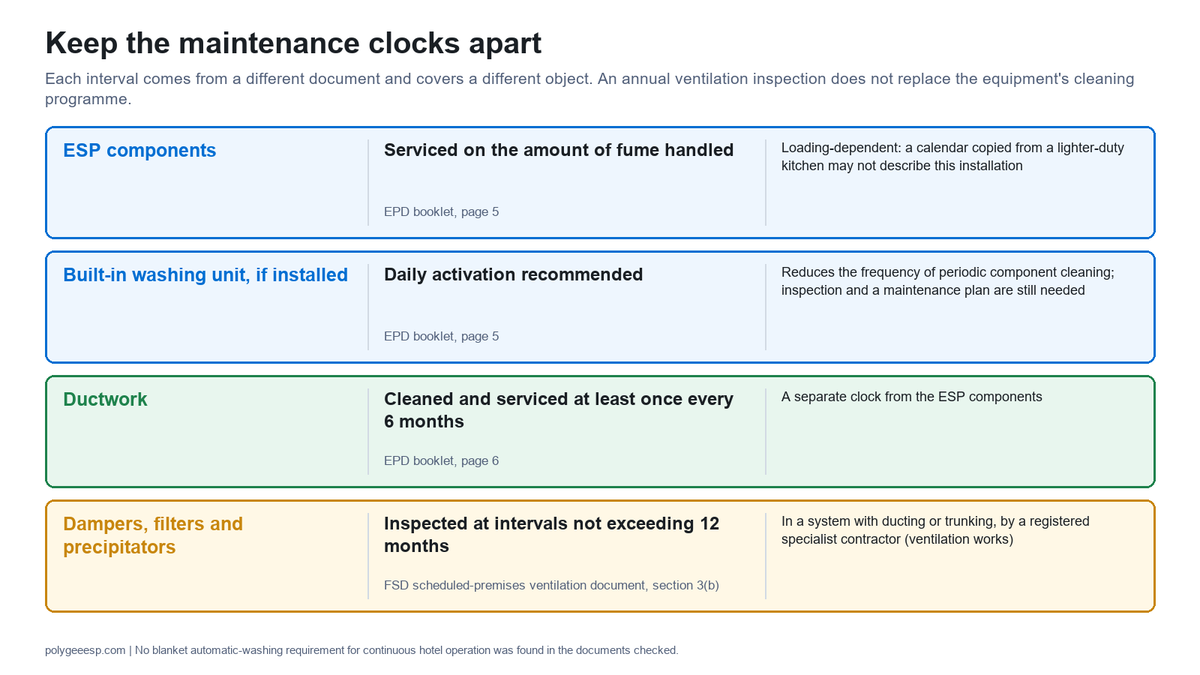
Keep the different maintenance clocks apart. EPD’s booklet, page 6, recommends cleaning and servicing ductwork at least once every 6 months, while its ESP paragraph bases component servicing on the amount of fume handled. FSD’s scheduled-premises ventilation document, section 3(b), requires, in a ventilating system that embodies ducting or trunking, inspection of dampers, filters and precipitators at intervals not exceeding 12 months by a registered specialist contractor in the ventilation works category. An annual ventilation inspection therefore does not replace the equipment’s cleaning programme.
Records also have separate scopes. GU12 section 6.4 and FEHD paragraph 132 address gas-installation maintenance and its records, including the associated exhaust safety checks. They should not be cited as a universal retention period for every EPD cleaning log. Use a maintenance matrix identifying the asset, required work, responsible party, record and governing document. Our guide to the parts and responsibilities in ESP cleaning and whole-train maintenance guide explain the equipment tasks; the schedule for this project needs its own written basis.
The 6-Check Hong Kong Exhaust Submittal Sheet
Use this record to assign each required document to the party that can produce it. The six checks are our own framework for organizing the sources above: 1 licensing, 2 environmental control, 3 equipment fire safety, 4 building interfaces, 5 gas and electricity, and 6 operational handover. Each row in the table carries the number of its check. They can overlap in time. They are not six compulsory approval certificates for every kitchen.
Copy the table into an email or spreadsheet and add the project name, proposed model, drawing revision and the reviewer responsible for each response. The empty response cells are deliberately left for the buyer and supplier to complete. An unanswered cell is an open item, rather than permission to assume a value. Where a review is not applicable, record who established that and the reason.
Keep the responsible department, the document owner and the missing response together.
| Check | Department and what it checks | Who prepares the file | Equipment supplier’s contribution | Project response | Buyer consequence if unresolved |
|---|---|---|---|---|---|
| 1. Licensing | FEHD: premises, application date, requirements and layout; Parts VI, VII and IX | Applicant and local consultant | Identify the quoted equipment and proposed treatment stages | ________ | The submission follows an assumed rather than confirmed requirements list |
| 2. Environmental duty | EPD and FEHD: visible fumes, odor, peak load and affected receptors; booklet pages 2 to 4, FEHD paragraphs 149 and 155 | Operator and mechanical or environmental designer | Model data and available test evidence with its conditions | ________ | The performance claim has no defined project condition |
| 2. Conditional combustion approval | EPD: Cap. 311A applicability, fuel ratings, plans and specifications; regulations 3 to 7 | Occupier as submitter, with the authorized person or qualified engineer preparing plans and specifications | Technical arrangement and controls information used as design inputs | ________ | The programme misses a conditional prior submission |
| 3. ESP type | FSD: approved type and identification; Circular 2/2023, Appendix 1, section 4, and Annex 1 checklist | Supplier and applicant’s submission team | Documentary evidence matching the type and model quoted | ________ | The cabinet delivered cannot be matched to the approval evidence |
| 3. Carbon and filter arrangement | FSD: special filter submission and additional precautions; Appendix 1, section 2.4 | Designer and applicant, using supplier details | Filter construction, arrangement and supporting documents | ________ | A general filter certificate leaves the special application unanswered |
| 3. Cooking outside the kitchen | FSD: applicable cooking-area and fire-protection conditions; CAOK sections 1 to 4 | Fire-safety designer and relevant contractors | Cabinet geometry and interfaces needed to coordinate the installation | ________ | Equipment is ordered against the wrong cooking-area assumption |
| 4. Building and duct route | BD and FSD: compartments, penetrations, structural and escape interfaces; C8, C13.2 and FEHD paragraph 155 | Authorized person and relevant designers or contractors | Dimensions, weight, connections and required service or withdrawal space for the proposed model | ________ | A factory arrangement is mistaken for an accepted installation drawing |
| 5. Gas and exhaust | EMSD: appliance scope, extraction, interlocks and work certificates; GU12 and FEHD paragraphs 129 to 132 | Registered gas contractor and ventilation designer | Controls and fault-interface information for integration | ________ | No party has demonstrated how gas safety and exhaust operation work together |
| 5. Electrical supply | EMSD: fixed electrical work; FEHD paragraph 124. Utility: available circuit and supply | Registered electrical contractor or worker | Proposed voltage, phase, frequency, load and controls information | ________ | Order configuration and site supply remain unconfirmed |
| 6. Cleaning and continuity | FEHD and EPD: maintainability, access, competent people and records; FEHD paragraph 162, booklet pages 4 to 6 | Operator, maintenance provider, designer and supplier | Written model instructions, wash-system scope if offered, and return-to-service requirements | ________ | Continuous operation has no practical maintenance arrangement |
| 6. Wash water and drainage | EPD and FEHD: greasy wastewater, treatment and foul drainage; FEHD paragraphs 159 and 160 | Drainage designer and operator | Water and discharge requirements for the arrangement actually offered | ________ | Wash utilities or wastewater disposal are omitted from the works |
| 6. Handover and changes | FEHD and FSD: certificate route and conformity to accepted plans; paragraphs 94 and 120. Operator: manual and logs | Applicant, relevant local professionals and operator | Actual model schedule, applicable documents and declared open items | ________ | The installed system, file and operating responsibilities do not match |
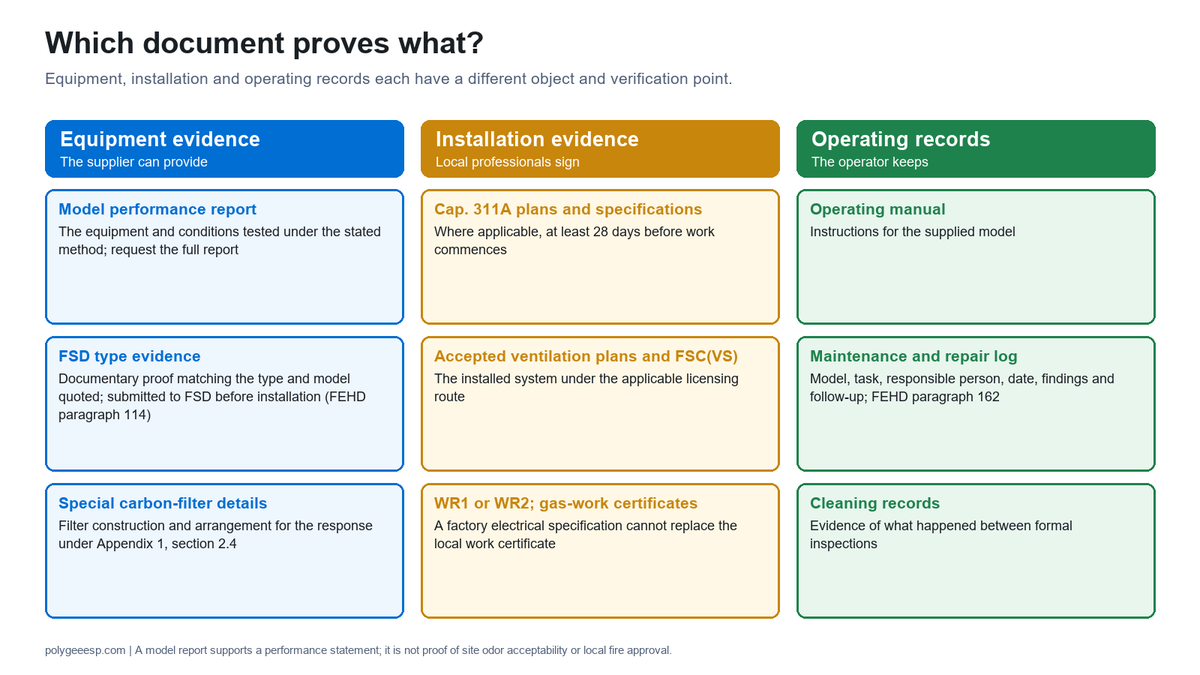
Which document proves what?
The evidence table separates equipment, installation and operating records. Each document has a different object and verification point.
| Document or standard | Object and scope | Verification point | Buyer consequence |
|---|---|---|---|
| Model performance report | The equipment and conditions tested under the stated method | Match model, configuration, method and airflow to the proposed duty; request the full report | Evidence for a performance statement, rather than proof of site odor acceptability or local fire approval |
| FSD type evidence; standards referenced in Appendix 1, section 4.1 | The proposed ESP type and applicable construction safety requirements | Match documentary proof, type, model and equipment identification; resolve its acceptability with the project reviewer | A standards label without the relevant type evidence leaves a submission question open |
| Special carbon-filter submission | The special filter installation and any additional fire precautions | Identify the response under Appendix 1, section 2.4, for the arrangement proposed | A carbon stage has its own fire-safety question alongside its adsorption duty |
| Accepted ventilation plans and FSC(VS) | The installed ventilation system under the applicable licensing route | FEHD paragraph 120: actual system, latest accepted plans and stipulated fire-safety requirements | A substituted unit or changed route may require renewed review |
| WR1 or applicable WR2; gas-work certificates | Local fixed electrical or gas installation, within the certificate’s scope | FEHD paragraph 124 and paragraphs 130 to 131; appropriate registered professional and actual works | A factory electrical specification cannot replace the local work certificate |
| Operating manual and maintenance record | Instructions for the supplied model and evidence of work on the installed equipment | Model, task, responsible person, date, findings and follow-up; FEHD paragraph 162 | A maintenance agreement alone does not show that the scheduled work occurred |
Request a written response against each line. For a complete ecology unit, identify each supplied stage and its evidence. An unpublished parameter stays open until the supplier answers it for the quoted model.
Common mistakes and the limits of this guide
A correct device can still leave an incomplete submission if its scope and the site conditions are missing. The errors below follow from mixing the different controls described above. They are review prompts for the purchasing file, not a claim about how frequently a particular mistake occurs.
- Importing a concentration limit. A value from another jurisdiction or a supplier’s test method needs its own stated role. It is not the Hong Kong restaurant limit merely because the equipment was tested against it.
- Calling an efficiency report an approval. The report, FSD type evidence, accepted drawings and local work certificates answer different questions. Keep them on separate lines.
- Dropping the condition from automatic washing. EPD’s recommendation concerns a built-in wash system where installed. It does not establish a blanket requirement based on hotel operating hours.
- Applying a roof height without the fuel condition. Preserve the diesel or solid-fuel scope and preferred wording in the EPD and FEHD passages, and establish the outlet for the actual project.
- Copying a foreign damper or suppression rule. The cross-jurisdiction discussion of kitchen extract dampers has stated geographical and code boundaries. The Hong Kong design needs the applicable local fire-barrier and ventilation requirements.
- Ordering automatic cleaning without utility and service details. The proposed cycle, access, manual work and wastewater route still need answers. A feature name is not an operating plan.
- Using the old certificate list for a new application. Establish the application date and the route in FEHD’s July 2026 guide before requesting completion documents.
Scope and limits
This guide covers the purchasing and document interfaces of kitchen exhaust treatment in Hong Kong, using the published sources read for it. It does not determine a particular licence, approve a duct detail or certify an installation. A project’s issued requirements, accepted plans and professional assessments decide its submission. Landlord and building-management requirements should be obtained separately and identified as such; this guide has not reviewed a particular mall’s private manual.
The finding about concentration limits and automatic washing is limited to the documents listed and the scope described. It does not exclude a project-specific condition, a separate process classification or a subsequent change. The general fire-barrier provisions cited here do not decide the detailed treatment of every kitchen grease-duct penetration. Restaurant kitchen enclosure under BD clause C13.2 and the additional FSD requirements for cooking outside a kitchen also have different scopes; this page does not combine them into one enclosure specification.
Solid fuel adds further questions. The FSD requirements for charcoal inside a kitchen, February 2019, section 5, addresses ventilation during charcoal burning. It should be assessed with the project’s other charcoal provisions, rather than treated as a particle-filter duty. Our solid-fuel inlet and upstream-protection guide explains why the ESP proposal also needs the expected temperature and upstream protective measures. Those inputs are not an approval of a model for charcoal use.
Before quotation: resolve the open lines
Resolve the project conditions and missing model documents before the order is committed. The practical output from this page is a submission record with a named owner for every open line. A complete response may be a document, a confirmed project condition, or a reasoned statement from the responsible reviewer that a particular requirement does not apply.
For the first enquiry, attach the relevant requirement pages rather than summarize them as an approved-unit request. Include the appliance and fuel schedule, designer’s airflow, treatment location, outlet route and available maintenance space. State whether this is a new licence application, an existing-system alteration or equipment replacement, and identify the person coordinating the local submission. The supplier can then answer against the proposed duty and documents instead of guessing what the word approval means.
Key takeaways
- Separate the emissions question from the fire, building, gas and electrical evidence. A treatment report answers only its own test scope.
- Keep the absence of an identified general oily-fume concentration limit distinct from the numerical dark-smoke rules and any written project criterion.
- For continuous kitchen operation, obtain a workable cleaning, access, service-window and drainage plan. Automatic washing needs its own model-specific explanation.
- Match the delivered equipment and controls to the file and the accepted system drawings, with the local certificate route identified.
Frequently asked questions
- Does Hong Kong specify a restaurant oily-fume limit in mg/m3?
- No general restaurant-specific oily-fume mass-concentration limit was identified in the documents checked for this guide. EPD’s February 2026 booklet and FEHD Part IX use visible-fume and odor-nuisance criteria. Cap. 311C separately defines dark smoke by shade and restricts its duration. A project asking for a concentration test should identify the written criterion, method, sampling location and reviewer; a limit from another jurisdiction should not be presented as Hong Kong law.
- Must a hotel install automatic washing because its kitchen operates all day?
- No blanket requirement based on continuous hotel operation was found in the documents checked. EPD’s booklet recommends daily activation where a built-in wash system is installed. FEHD paragraph 162 addresses continuous-operation design and maintenance. Ask for the model’s cleaning arrangement, available service window, additional manual work, utilities and drainage before deciding whether an automatic system fits the project.
- What should a quotation describing an FSD-approved ESP include?
- It should identify the proposed type and model and provide the documentary evidence supporting that description. FSD Circular Letter 2/2023, Appendix 1, section 4, and its Annex 1 inspection checklist address approved type, identification and safety provisions. Match the evidence to the quotation and equipment marking, and have the project reviewer resolve its acceptability. An efficiency report alone does not establish that approval.
- Does an all-electric kitchen fall outside the environmental checks?
- No. Cap. 311A, regulation 3, excludes solely electric furnaces or ovens from that particular installation-and-alteration regime. This does not remove the visible-fume and odor-nuisance criteria described in EPD’s booklet and FEHD paragraph 149, or the applicable fire, building and electrical checks. Confirm the scope of each review separately.
- Can an existing ventilation certificate cover a different unit or duct route?
- Do not assume it does. Under the post-1 November 2025 route, FEHD’s July 2026 guide, paragraph 120, ties the ventilation certificate to the actual system conforming to the latest plans accepted by FSD and the stipulated fire-safety requirements. It says alterations or additions affecting fire safety may require a new FSC(VS). Put the proposed substitution or route change to the responsible local team before committing it.
Preparing the equipment enquiry
Send The 6-Check Hong Kong Exhaust Submittal Sheet with the requirement pages, cooking and fuel schedule, design airflow and proposed layout. Ask us to identify the proposed treatment stages and models, state the technical documents available for them, and mark the items requiring further confirmation. Keep the local professional drawings, certificates and site acceptance with the parties responsible for those scopes.
Send the requirements and the airflow →
For the equipment scope before enquiry, see the kitchen exhaust treatment product range.
Why we write this. A buyer needs to know which question a document answers before choosing equipment. Hong Kong’s environmental, licensing, fire, building and gas publications address different parts of the system. Bringing their scopes and document owners together gives the buyer a usable enquiry and gives the reviewing professionals a clearer file.
Law is Project Manager at Polygee. This guide organizes published requirements for equipment selection and submission planning. The official sources, editions and relevant provisions are identified in the text; engineering recommendations are described as purchasing checks. The appointed professionals and reviewing authorities determine the requirements for the particular installation.
References & further reading
- Hong Kong legislation: Air Pollution Control Ordinance, Cap. 311, sections 10 and 30; Air Pollution Control (Furnaces, Ovens and Chimneys) (Installation and Alteration) Regulations, Cap. 311A, regulations 3 to 8; Air Pollution Control (Smoke) Regulations, Cap. 311C, regulations 2 and 3. Original current-version XML was read in the Department of Justice official legislation dataset. EPD, Technical Memorandum for Issuing Air Pollution Abatement Notices to Control Air Pollution from Stationary Polluting Processes, sections 2.1, 4 and 5.
- Environmental Protection Department, Control of Oily Fume and Cooking Odour from Restaurants and Food Business, marked February 2026; Green Restaurant FAQ. Government of the Hong Kong Special Administrative Region, LCQ15: Measures to control the emission of oily fumes and odours from restaurants, 10 June 2026, reply parts (2) to (4).
- Food and Environmental Hygiene Department, A Guide to Application for Restaurant Licences, July 2026 edition, paragraphs 28 to 30, Parts VI and VII, and Part IX, paragraphs 149 to 162. EPD, Air Pollution Control Regulations and Requirements Relating to Restaurant Operation, presentation sections 3 to 6, supporting background.
- Fire Services Department, Circular Letter 2/2023: Fire Safety Requirements for Mechanical Ventilating Systems, Appendix 1, sections 2.4 and 4, and Annex 1 inspection checklist; Fire Safety Requirements of Ventilating System for Scheduled Premises, September 2023; Typical Fire Safety Requirements for Cooking Activity outside Kitchen, May 2010, sections 1 to 4; Additional Fire Safety Requirements for Using Charcoal as Fuel Inside Kitchen, February 2019, section 5.
- Buildings Department, Code of Practice for Fire Safety in Buildings 2011, 2024 edition, clauses C8.1 to C8.7 and C13.2.
- Electrical and Mechanical Services Department, Code of Practice GU12: Installation of Mechanical Exhaust System for Gas Appliances (Rated Heat Input Up to 70 kW), January 2004, scope and sections 3, 5 and 6. HK Electric, Supply Rules, rule 202. All sources accessed 18 November 2026.
Related reading
- Gulf approval sources and document ownership: how the source of a requirement changes the documents requested, within those markets.
- Supplying equipment for Singapore: the commercial and local-compliance interfaces for that market.
- Maintaining the complete treatment train: which parts are inspected, washed or replaced, and what the records describe.
- Reading the supplier’s technical data: the conditions behind airflow, resistance and other figures used in a project selection.