

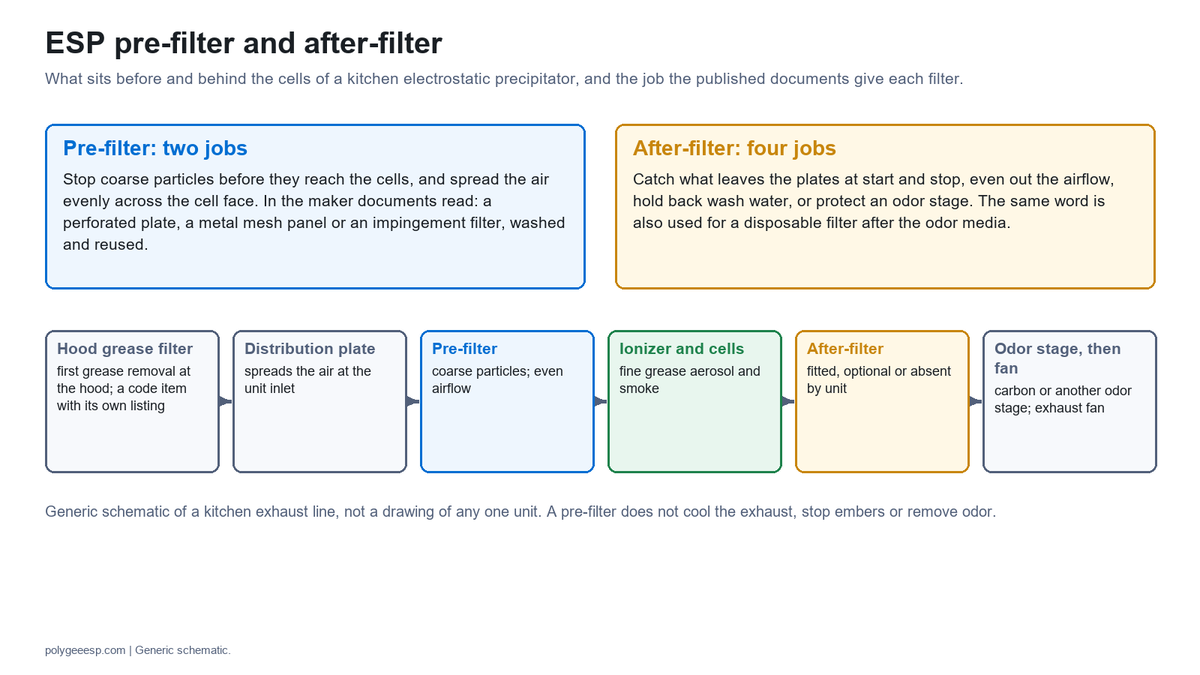
A pre-filter is the mechanical filter at the inlet of an electrostatic precipitator, ahead of the ionizer and the collector cells. In the maker documents read for this page, the ESP pre-filter in commercial kitchen exhaust is a washable perforated plate, metal mesh panel or impingement filter, and those documents give it two jobs: stopping coarse particles and spreading the air evenly.
The same documents put a second filter behind the cells, give it four different purposes, and use the word after-filter for two different things. They attach a MERV rating to disposable media filters, to one maker’s aluminum mesh filters and, in one specification, to the cells themselves. We manufacture in-duct electrostatic precipitators, UV-C and activated carbon modules, kitchen ecology units and the HME kitchen ESP hood. Statements attributed to other makers are taken from their published documents and describe their products, not ours; our own statements are marked as ours.
This page helps you decide what a quotation means by a pre-filter, whether a MERV rating belongs in that line of the specification, what should sit behind the cells, and what to record about each before ordering. It ends with The 9-Line ESP Pre-Filter and After-Filter Sheet. The grease filter in the hood is covered on how a baffle filter works, and the question of a HEPA stage is on HEPA after an ESP; neither is repeated here.
| Quick specs | What is printed | Whose document |
|---|---|---|
| Parts of a two-stage precipitator module | Mechanical prefilter, ionizer, collecting-plate cell, after-filter and power pack | US EPA Air Pollution Control Cost Manual |
| Pre-filter and after-filter, one maker | Perforated plate pre-filter, and a perforated plate or metal mesh after-filter, required for all installations | Trion Air Boss KES manual |
| Pre-filter with a rating, one maker | 2 in (51 mm) thick, aluminum frame, non-woven aluminum mesh, minimum MERV 7 | Halton PolluStop specification SS150 |
| What MERV reports | A filter’s ability to capture particles between 0.3 and 10 microns | US EPA |
| Washing of metal pre- and post-filters | Cleaned at least every two weeks in two manuals; checked monthly and cleaned as required in two other documents | Greenheck 2019 manual and Halton 2025 manual; CaptiveAire manual and Greenheck 2025 maintenance guide |
| Our in-duct units | Washable metal mesh pre-filter and a standard airflow distribution plate; 150 Pa or less for the complete unit including the plate | Our data |
- What an ESP pre-filter is, and the two jobs it does
- ESP pre-filter forms in maker documents
- The hood grease filter is a different filter
- Does a MERV rating apply to an ESP pre-filter?
- The after-filter behind the cells
- What a pre-filter cannot do: heat, sparks and odor
- Washing, orientation and a missing pre-filter
- Resistance: what each choice adds to the fan
- The 9-Line ESP Pre-Filter and After-Filter Sheet
- Common mistakes
- Frequently asked questions
What an ESP pre-filter is, and the two jobs it does
An ESP pre-filter is the mechanical filter at the inlet of the unit, and the documents give it two jobs: stopping coarse particles and spreading the air evenly. The US EPA Air Pollution Control Cost Manual lists it first among the parts of a two-stage precipitator: modules consist of a mechanical prefilter, ionizer, collecting-plate cell, after-filter and power pack. A United Air Specialists Smog-Hog SG manual, written for an industrial unit, states both jobs in one sentence: prefilters serve the dual purpose of trapping large particulate and diffusing the airstream evenly into the precipitator components at low, controlled velocity.
The first job protects the cells. In its list of options for large self-washing ESP systems, a kitchen exhaust feature in AIRAH’s Ecolibrium describes the pre-filter as a mesh filter that captures large particles which may short-circuit the ESP cell, and adds that it assists the flow over the cells. The passage gives no particle size and no plate gap. The second job protects the rating. A precipitator is rated with the air spread over the whole face of the cells, and ESP face velocity explains what happens when one side of the face takes more than its share.
Guidance documents treat the pre-filter as protection too. The 2005 Defra guidance on commercial kitchen exhaust, withdrawn in 2017 and still reproduced in council planning notes, says that where an ESP is installed, pre-filters should be fitted upstream to provide some protection from large contaminants that may pass through the grease filters. A Bay Area Air Quality Management District staff report describes an ESP as screening out large particulate with a pre-filter before the remaining particles are charged.
The pre-filter has a narrow job, and the table states what falls outside it.
| Task | Done by the pre-filter? | Where the job is done instead |
|---|---|---|
| Coarse droplets and debris | Yes, this is its first job | The hood grease filter takes the first share upstream |
| Even airflow over the cell face | Yes, together with any distribution plate and the inlet transition | Duct layout ahead of the unit |
| Fine grease aerosol and smoke | No | The ionizer and collector cells |
| Odor and gases | No | Activated carbon or another odor stage |
| Cooling hot exhaust, stopping embers | No | Measures ahead of the unit on solid fuel lines |
Our in-duct units carry a washable metal mesh pre-filter ahead of the cells and an airflow distribution plate as standard. The general working principle is on what an electrostatic precipitator is.
ESP pre-filter forms in maker documents
Maker documents show three forms ahead of the cells: a perforated plate, a metal mesh panel and an impingement filter. The table lists what each document places before and behind the cells, in the words of that document. It describes those makers’ products and is not a ranking.
| Document | Ahead of the cells | Behind the cells |
|---|---|---|
| Trion Air Boss KES manual | Perforated plate pre-filter | Metal mesh after-filter; a perforated plate is optional in its place. Both “act as trash screens and provide resistance for even air distribution” |
| Trion Air Boss ATS manual page | The ESP section must have both an internal prefilter and an after filter. Options listed: 40% open perforated, metal mesh, 2 in impinger | Same options |
| Greenheck precipitator unit manual | Mechanical impingement pre-filter that removes large airborne particles before the ionizer cell | Mesh mist eliminator that keeps wash water out of the carbon section |
| Gaylord ClearAir manual (the CaptiveAire C-ESP manual uses the same wording) | Removable, cleanable debris screens immediately upstream of the ESP cells | A moisture separator immediately downstream |
| CaptiveAire PCU written specification | Metal pre-filters on the inlet of the ESP section | Metal post-filters on the outlet |
| Parker SmogHog PSG manual, 2024 | Without in-place cleaning: filter media before the cells. With in-place cleaning: the filter media go after the cells only. Prefilters and afterfilters are “normally” aluminum metal mesh in an aluminum frame, for even air distribution and large particles. Separately, an inlet plenum, if supplied by Parker, has baffle filters or aluminum media | The same filter media as after-filters, with or without in-place cleaning |
| Smog-Hog SHN manual (industrial unit) | Reusable aluminum mesh; interchangeable with the afterfilters | Aluminum mesh that traps contaminant released from the cells during start and stop |
| Halton PolluStop specification SS150 | 2 in thick, aluminum frame, non-woven aluminum mesh, minimum MERV 7 | Mist eliminators of the same construction, and a 15 in deep MERV 14 safety filter; the specification lists both in the ESP module and does not state where the safety filter sits relative to the cells or the mist eliminators |
| Purified Air ESP 1500E data sheet, 2007 | Pre-filter, Eurovent Class 2, for larger particulate | Final filter, Eurovent Class 2, “to prevent any re-entrainment and provide good air distribution” |
| Airclean data sheet AC10.5 | Two metal washable filters within the ESP, each an aluminum frame with an aluminum knitted mesh pad | |
| Air Quality Engineering guide specification | Washable aluminum mesh, nominal 1 in (25.4 mm) thick, 9 layers | Not stated in the section read |
| Botonair kitchen ESP manual | Perforated airflow divider at the air inlet, which isolates large-grained pollutants and distributes the gas to all zones of the cells | Not stated |
| Our in-duct units | Washable metal mesh pre-filter, with an airflow distribution plate as standard | Not published; ask for it in writing for the model quoted |
Two readings follow from the table. First, a perforated plate and a mesh panel are not the same part, although both are sold as a pre-filter: the documents describe the plate as a screen or divider and the mesh as a filter pad or media, and give both the same two jobs without saying how much of each job either one does. Second, whether the filters are mandatory depends on the unit. Trion’s KES manual states that the perforated plate pre-filter and either a perforated plate or a metal mesh after-filter are required for all installations, and the same manual says that filter-equipped exhaust systems shall not be operated with filters removed.
For a quotation, the useful question is which form the unit carries, in what material and thickness, and whether it is washed or replaced. Those are lines 3 and 4 of the sheet below.
The hood grease filter is a different filter
The pre-filter in the unit does not replace the grease filter in the hood, and the mesh filter rule in the codes is written for the hood filter. The table separates three components on the path from the cooking surface, each with a different document behind it.
| Filter | Where it is | What governs it | What it is for |
|---|---|---|---|
| Hood grease filter | In the hood, above the appliances | Mechanical and fire codes; UL 1046 for listed grease filters | First grease removal and a barrier at the hood |
| ESP pre-filter | In the unit, ahead of the ionizer | The unit maker’s documents, and the listing of the unit where the code requires a listed pollution control unit | Coarse particles that passed the hood filter; even airflow |
| Collector cells | In the unit | The unit’s rating and test report | Fine grease aerosol and smoke |
The rule that mesh filters are not to be used alone is a hood rule. The California Mechanical Code, which reproduces NFPA 96 at this point, states that mesh filters shall not be used unless evaluated as an integral part of a listed exhaust hood or listed in conjunction with a primary filter in accordance with UL 1046. That sentence is written for the grease removal device in the hood. It is not a statement about the mesh pre-filter inside a precipitator several metres down the duct, and several of the documents in the table above fit mesh there. The code text for hood filters is on commercial kitchen grease filter requirements.
The hood filter still matters to the unit. The Defra guidance lists carbon filters, electrostatic precipitation and other odor abatement options, and then states: “In each case, grease filters must be installed.” The Ecolibrium feature notes that hood filters offer little at 0.3 micron, the size of smoke, yet can significantly reduce the load on downstream filtration. The New York City list of certified devices for under-fired char broilers writes the order into two of its entries: one train reads 1046 listed grease filter, ESP cell, optional MERV 16 filter and sorbent; another reads grease filter, prefilter, ESP cell, optional MERV 16 filter and sorbent.
Does a MERV rating apply to an ESP pre-filter?
Sometimes. MERV is a rating obtained under ASHRAE Standard 52.2, and the kitchen documents read here apply it to disposable media filters, to one maker’s aluminum mesh filters and, in one specification, to the cells themselves. There is no single MERV figure for the pre-filter of an ESP in the documents read for this page.
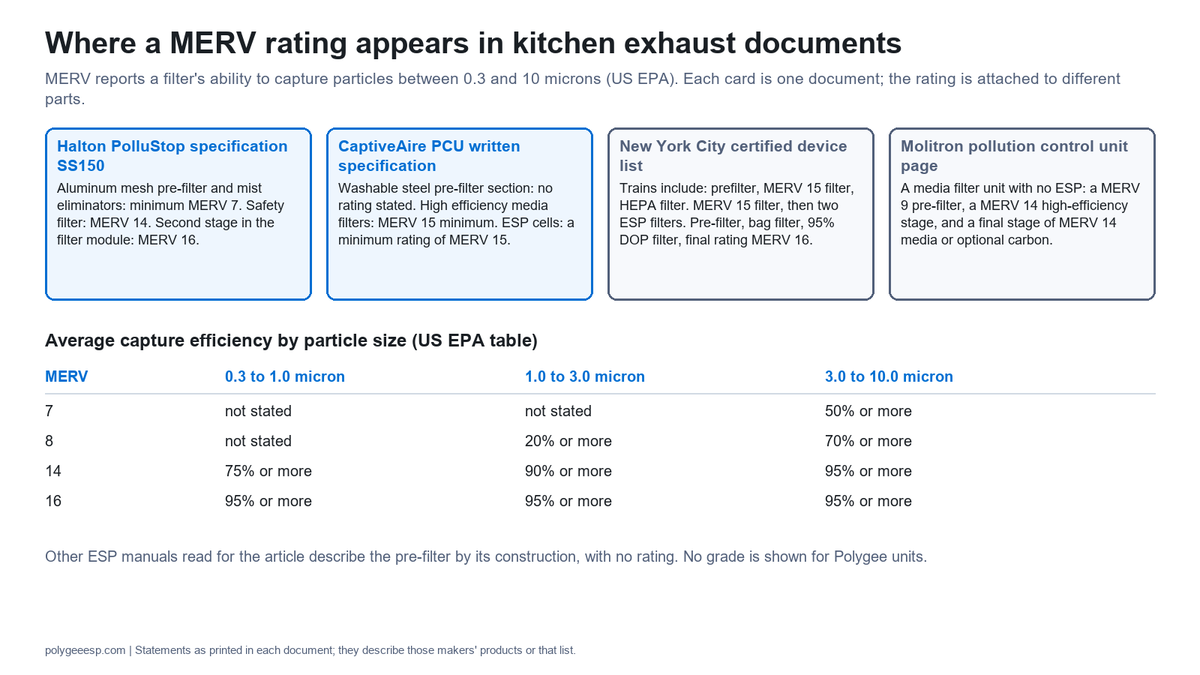
The US EPA’s page on MERV defines the term: Minimum Efficiency Reporting Values report an air filter’s ability to capture particles between 0.3 and 10 microns, the rating is derived from a test method developed by ASHRAE, and the value is helpful for comparing filters, particularly for heating, ventilation and air conditioning systems. A user’s guide from the National Air Filtration Association adds that the scale has 16 points, that it is built from three particle size groups, and that the single number is used along with the air velocity at which the test was performed.
The thresholds show what a claimed MERV grade has to meet; construction and washability alone do not establish a grade.
| MERV | 0.3 to 1.0 µm | 1.0 to 3.0 µm | 3.0 to 10.0 µm |
|---|---|---|---|
| 1 to 4 | Not stated | Not stated | Less than 20% |
| 7 | Not stated | Not stated | 50% or more |
| 8 | Not stated | 20% or more | 70% or more |
| 14 | 75% or more | 90% or more | 95% or more |
| 15 | 85% or more | 90% or more | 95% or more |
| 16 | 95% or more | 95% or more | 95% or more |
Source: average capture efficiency by particle size, US EPA table. The EPA notes that HEPA filters are not rated on the MERV system.
Against that scale, the kitchen documents use MERV in four different places.
| Document | What carries the rating | What it says |
|---|---|---|
| Halton PolluStop specification SS150 | The aluminum mesh pre-filter and the mist eliminators | A minimum MERV rating of 7 for each; a 15 in deep safety filter rated MERV 14; in the filter module, a second stage of MERV 16 |
| CaptiveAire PCU written specification | The high efficiency media filters, and the ESP cells | The unit’s pre-filter section is 2 in deep washable steel with no rating stated; high efficiency filters are MERV 15 minimum under ASHRAE 52.2; the ESP cells “should have a minimum rating of MERV 15” |
| New York City certified device list | Media filters in the listed trains | Trains include prefilter, MERV 15 filter and HEPA filter; MERV 15 filter followed by two ESP filters; pre-filter, bag filter and 95% DOP filter with a final rating of MERV 16 |
| Molitron pollution control unit page (a media filter unit with no ESP) | The particulate filter stages | A MERV 9 pre-filter, a MERV 14 high-efficiency stage, and a final stage of MERV 14 media or optional carbon |
Three points follow without going beyond those documents. First, if a specification asks for a MERV 8 pre-filter ahead of the ESP, ask the supplier to identify the exact filter with its rating and test basis: in the documents read here the one MERV-rated mesh is rated at a minimum of MERV 7, the other mesh and plate pre-filters carry no MERV grade, and the pre-filters rated MERV 8 or higher are media filters, so whether a different filter or arrangement is needed depends on that evidence. Second, a rated media filter ahead of the cells is a real arrangement, since one New York City entry places a MERV 15 filter before two ESP stages, and it brings the costs of media: the Defra guidance lists regular replacement and high pressure drop against fine or pre-filters, and an ASHRAE filtration FAQ says that increasing filter efficiency generally increases pressure drop. Third, position can depend on the wash system. For SmogHog PSG units with in-place cleaning, Parker’s manual says to install the filter media after the cells, not before them, and states that installing them before the cells reduces the effectiveness of the wash cycle by 50 percent. The manual describes these filters as aluminum metal mesh; it does not call them a disposable rated filter.
Other grading scales appear in the same position. The Ecolibrium feature grades a filter-pack train as G4, then F7 to F9, then E11, and the Purified Air data sheet uses Eurovent classes. A grade from one scale is not converted to another on this page. For our units we do not publish a MERV or Eurovent grade for the mesh pre-filter; the form and material are confirmed in writing with the quotation. How the stages line up across a whole treatment train is on kitchen exhaust filtration stages.
The after-filter behind the cells
The filter behind the cells has four different jobs in the documents, and the same word is used for two different things. Reading which job is meant settles whether the filter is needed on a given unit.
| Job | What the document says | Document |
|---|---|---|
| Catch what leaves the plates | Afterfilters trap collected contaminant that could release from the cells during start and stop operations; the after-filter prevents re-entrainment | Smog-Hog SHN manual (industrial unit); Purified Air data sheet |
| Even out the airflow | An after filter is occasionally used after the plates to restore a positive back-pressure and provide good gas distribution | Bay Area AQMD staff report; a South Coast AQMD staff report uses “sometimes” |
| Hold back wash water | A mesh mist eliminator prevents wash water from entering the carbon section; pre and post filters keep water contained in the ESP module during a self-cleaning cycle | Greenheck manual; CaptiveAire catalog page |
| Protect the odor stage | A final filter, typically F7 or F8, used to temporarily protect the odor-removal systems from poorly maintained ESPs; a 95% DOP filter to help extend the life of the adsorption media | Ecolibrium feature; Trion Air Boss KES specification sheet |
In the manuals, washable metal filters directly behind the cells are given two of these jobs: catching what leaves the plates (Smog-Hog SHN manual) and holding back wash water (Greenheck and CaptiveAire). Greenheck’s mist eliminator is also described as helping to protect the carbon section from grease. The airflow job comes from the two air district reports and the Purified Air data sheet, none of which says what the after filter is made of. Separate fine media filters further downstream are given the fourth job, and some documents call those an after filter as well. Gaylord’s manual requires a 30% pleated media After Filter immediately downstream of its loose-fill odor media, which places it after the odor stage. The AAF Asia product page calls the whole optional odor or gas section the after filter and says it is “entirely optional.” A buyer comparing two quotations that both say “after-filter” should ask which of these each one means.
Whether the metal filter behind the cells is required is the maker’s statement for its unit. Trion requires it on the KES; the two air district reports describe it as occasional. On a unit without a wash system and without an odor stage, two of the four jobs do not arise. Whether a HEPA or other fine stage belongs after the precipitator is a separate question, answered on the HEPA page linked above.
What a pre-filter cannot do: heat, sparks and odor
A mesh pre-filter or perforated plate is not, by itself, a cooling stage, an ember control or an odor treatment; other stages do those jobs. The protection runs in a chain, each stage shielding the next from what would foul it.
- The hood filter and the pre-filter protect the cells from coarse grease, as the sections above set out.
- The stages ahead of the carbon protect it. A New South Wales EPA guidance note for food outlets states that there must be a pre-filter to protect the carbon from excessive dust and grease, because these block the pores. The Defra glossary describes a fine filter as one normally located after a grease filter and usually present to protect a carbon filter or ESP. Bromley Council’s planning guidance says an ESP replaces the need for fine pre-filters; read with the Defra glossary, that puts the precipitator in the fine pre-filter position where it sits ahead of carbon. The carbon side is on activated carbon filters for kitchen exhaust.
- The pre-filter and the cells do not deal with heat. The Defra guidance says the types of ESP used on kitchen ventilation are less effective at temperatures over 60 °C and are not suitable for relative humidity above 75%. The Ecolibrium feature says additional measures should be taken if the duct temperature is expected to exceed 50 °C, which it calls common with solid fuel, and names a cold-water mist injection hood, an in-duct wet scrubber or another form of cooling ahead of filtration. A Greenheck maintenance guide for solid fuel units puts the incoming air temperature at no more than 130 °F (about 54 °C).
For charcoal and wood lines, the listing is the first question, and a UL Solutions article on pollution control units summarizes the code position: where an extra-heavy-duty appliance is exhausted through a pollution control unit, the unit is to be listed and designed specifically for use with solid fuel burning appliances. Greenheck’s manual describes its solid fuel configuration as three ESP modules and two carbon modules, against two and one on the standard unit. That passage does not say whether the pre-filter differs, and the 2025 maintenance guide asks for more frequent inspection of the impingement filter on solid fuel units, with creosote build-up removed. Temperature limits, spark arresters and the rest of that subject are on solid fuel cooking ahead of an ESP, and water-based treatment is on wet scrubbers for kitchen exhaust.
Washing, orientation and a missing pre-filter
The metal pre-filters in the manuals read for this page are washed and returned to service, and each schedule below belongs to the unit and the duty it was written for. They are not one range: the interval for any unit is the one in its own manual, adjusted to the cooking load.
| Document | What it says about the pre-filter and after-filter |
|---|---|
| Greenheck precipitator unit manual, 2019 | Impingement and mist eliminator filters are removed and thoroughly cleaned at least every two weeks |
| Greenheck maintenance guide for the same unit, September 2025 | The impingement filter is inspected monthly and cleaned if build-up is apparent; on solid fuel units the inspection frequency is increased and creosote build-up removed |
| Halton PolluStop operation and maintenance manual, 2025 | Aluminum mesh pre and post filters are removed and thoroughly cleaned at least every two weeks |
| CaptiveAire PCU manual | Filters are checked monthly for loading; washable steel pre-filters are cleaned; pre-filters go back with the drain holes at the bottom edge. After an accidental fire system discharge the disposable filters are replaced and the pre-filter cleaned; after a fire in the duct or the unit the filters are replaced, the pre-filter included |
| Gaylord ClearAir manual | Debris screens or impactor filters and moisture separators are washable and washed at the same frequency as the ESP cell rotation |
| Botonair kitchen ESP manual | The perforated airflow dividers are cleaned every month; too much grease on the divider is listed as a cause of exhaust that cannot be emitted smoothly |
| An installation contractor’s maintenance schedule filed with a Camden planning application | Mesh pre-filter cleaning from once a week to once every three months, depending on the degree of pollution |
| Smog-Hog SG and SGN manuals (industrial units) | Filters are always installed with drain holes down and the arrow on each frame pointing in the direction of airflow |
| Smog-Hog SHN manual (industrial unit) | Wet ionizers, collector cells and mesh filters are dried before the system is started; start-up of a wet system causes dead shorts or arcing |
Two details in the table are easy to lose on site. The panels in these manuals have a direction: Smog-Hog filters go back with the drain holes down and the frame arrow with the airflow, and CaptiveAire pre-filters with the drain holes at the bottom edge. And a filter that goes back wet belongs to the same fault family as wet cells, which is covered on ESP arcing and tripping. A pre-filter left out after a wash sends the coarse droplets it should have caught onto the plates, so the cells reach their wash condition sooner than the schedule assumed. CaptiveAire’s manual describes an optional filter monitoring system that reads pressure drop across each filter module and detects a missing filter as well as a clogged one, and the UL Solutions article cited below lists a pressure differential sensor across the filters, with an alarm in the cooking area, among the code items for pollution control units. A cleaning log records the service work; it does not detect a missing filter.
On our in-duct units the mesh pre-filter is washed with the cells by the kitchen team, as the manual for the model sets out, and it is covered within the one-year warranty on the complete unit without being named as a separately warranted part. The method and the cell interval are on electrostatic precipitator cleaning.
UK planning submissions ask for the pre-filter on paper. The Defra guidance, and council checklists that repeat the same item such as the Epping Forest checklist of April 2024, which points to the 2022 EMAQ+ document, ask for a manufacturer’s data sheet for pre-filters showing the manufacturer’s name, the filter name and product code, the dimensions, the nature of the filter media, and the manufacturer’s recommendations on the frequency and type of maintenance for the conditions of use. Those five items are a reasonable minimum to ask of any supplier.
Resistance: what each choice adds to the fan
A washable pre-filter is given some resistance on purpose, to spread the air, and no document read here prints a separate figure for it; a rated media filter has a stated clean resistance and a higher final one. Trion’s KES manual says the perforated plate and metal mesh filters provide some resistance to effect even air distribution. The table sets published figures side by side. They are on different bases (cells alone, a complete unit or a single media stage; clean, initial or final) and some of them overlap, so the table is not a ranking.
| Item | Published resistance | Document and basis |
|---|---|---|
| Electrostatic precipitator, general | 20 to 50 Pa, depending on air velocity and build-up | HVAC&R Centre article |
| One maker’s ESP unit, 1 high by 3 wide | 80 Pa | Airclean product page |
| Our complete in-duct unit | 150 Pa or less, including the standard airflow distribution plate; 23, 31 and 34 Pa for the electrostatic field alone on the LK-E1, LK-E0 and LK-E2 | Our data; LK-E brochure |
| MERV 14 safety filter, clean | Not more than 1.04 in. w.g. (about 259 Pa) | Halton specification SS150 |
| MERV 16 second-stage filter, clean | Not more than 0.6 in. w.g. (about 149 Pa) | Halton specification SS150 |
| Media filter unit with MERV 9 and MERV 14 stages, initial | 1.54 in. w.g. (about 384 Pa) | Molitron product page |
| HEPA filter | 250 Pa initial, 500 Pa final | HVAC&R Centre article |
Pascal values in brackets are conversions made for this page at 249.1 Pa per inch of water gauge. Two points follow for the fan schedule. Allow for the final resistance of any media filters when selecting the fan, and keep the clean figures for commissioning; CaptiveAire’s manual notes that airflow is reduced by filter loading. And a resistance figure has to say what it includes: the cells alone, the complete unit with its pre-filter and distribution plate, or the whole train. The basis of each line is explained on how to read an ESP datasheet.
The 9-Line ESP Pre-Filter and After-Filter Sheet
Nine lines turn the sections above into a record that goes with the enquiry. The sheet is our own framework, not a standard form. No line carries a default value: a blank is filled by the party named, or stays visibly blank.
| # | Line | Who supplies it | If it is left blank |
|---|---|---|---|
| 1 | Grease filter type and listing at each hood | Hood supplier or kitchen designer | The load reaching the unit is unknown, and the hood filter question is mistaken for a unit question |
| 2 | Cooking duty, fuel, and the expected exhaust temperature at the unit inlet | Operator and mechanical engineer | A solid fuel line is quoted as an ordinary one |
| 3 | Pre-filter in the quoted unit: form, material, thickness, washable or disposable | Unit supplier | “With pre-filter” can mean a plate, a mesh or a consumable |
| 4 | Any efficiency grade stated for it (MERV, ISO 16890 or Eurovent) with the test standard, or “none stated” | Unit supplier | A specified grade is assumed to be met by an unrated part |
| 5 | Airflow distribution: distribution plate or inlet plenum included, and the straight duct available | Unit supplier and mechanical engineer | The rated figure is assumed for an uneven face |
| 6 | After-filter or mist eliminator: fitted, optional or none, and which of the four jobs it does | Unit supplier | Two quotations that both say “after-filter” are compared as equal |
| 7 | Any media filter ahead of or behind the cells: grade, clean and final resistance, replacement basis | Unit supplier | The fan is selected on clean resistance and the consumables are missed |
| 8 | Resistance of the complete unit at the design airflow, stating which filters are included | Unit supplier | Cell-only and complete-unit figures are added or compared by mistake |
| 9 | Maintenance: who washes each filter, to which document, the orientation marks, and what is replaced after a fire system discharge | Unit supplier and operator | The pre-filter is washed by nobody, or goes back the wrong way round |
Lines 1 and 2 are the buyer’s. The supplier answers lines 3, 4 and 6 to 8 for the model it proposes; line 5 is completed with the mechanical engineer, because the straight duct available is a site condition; line 9 is agreed between the supplier and the operator before handover.
Common mistakes
- Treating the pre-filter as the grease filter. The hood filter is a code item with its own listing; the pre-filter is a part of the unit. One does not stand in for the other.
- Writing a MERV number against a washable mesh without checking what is meant. In the documents read here, one specification rates aluminum mesh filters at a minimum of MERV 7 and one rates the ESP cells at a minimum of MERV 15; the other MERV grades are on media filters. Identify the filter behind any grade.
- Comparing quotations on the word after-filter. It can mean a metal filter behind the cells, a fine filter protecting the odor stage, a pleated filter after the odor media or, on one product page, the odor section itself.
- Expecting a finer pre-filter to solve a solid fuel line. The published measures are cooling and a unit listed for the duty, not a tighter mesh.
- Selecting the fan on clean resistance. Allow for the final resistance of any media filters, and have the complete-unit figure state what it includes.
- Leaving the pre-filter out of the cleaning log. A missing pre-filter sends coarse material to the cells, and the log is where a missing or refitted part is recorded; a refitted pre-filter is checked against the maker’s drain-hole and airflow marks.
Which document proves what
ASHRAE Standard 52.2 produces a MERV for the filter that was tested, at the test velocity; it says nothing about a filter that was not tested. UL 1046 and the mechanical codes cover the grease filter in the hood. A unit maker’s manual and specification sheet state what its own pre-filter and after-filter are and how they are maintained, for that unit only. A third-party test report on a precipitator covers the model and the airflow in the report, with the filters fitted during the test. The Defra guidance is withdrawn guidance for England, cited here because council checklists still repeat its items; the EMAQ+ document that councils now point to was not available to us in a public copy and is not quoted. None of the documents on this page sets a required pre-filter grade for kitchen precipitators in general.
Frequently asked questions
- What pre-filter is required before an electrostatic precipitator in a commercial kitchen exhaust?
- The one the unit maker fits and names in its documents. In the manuals read for this page it is a washable perforated plate, a metal mesh panel or an impingement filter, placed ahead of the ionizer to stop coarse particles and spread the air evenly. One maker’s manual states that its pre-filter and after-filter are required for all installations. The grease filter in the hood is a separate, code-regulated filter and is still needed upstream.
- What MERV rating should the pre-filter before an ESP have?
- There is no single figure. MERV is a rating from the ASHRAE 52.2 test for particles of 0.3 to 10 microns. Among the documents read here, one specification gives an aluminum mesh pre-filter a minimum of MERV 7, the other ESP documents describe the pre-filter by its construction with no MERV rating (one data sheet gives a Eurovent class), and ratings of MERV 8 to 16 are attached to disposable media filters, apart from one specification that asks for MERV 15 on the cells themselves. If a specification asks for a rated pre-filter, ask which filter it means, on what test basis, and what resistance and replacement it brings.
- Is an after-filter needed behind the ESP cells?
- It depends on the unit and on which job is meant. Documents give the filter behind the cells four jobs: catching what leaves the plates at start and stop, evening out the airflow, holding back wash water, and protecting an odor stage. One maker requires it on all installations; two air district reports describe it as used occasionally or sometimes. The maker of the unit states whether it is fitted, optional or absent for the model.
- Can the ESP pre-filter be washed and reused?
- In the manuals read for this page, yes: the metal pre-filter is washed and returned to service. Two manuals have it cleaned at least every two weeks, two other documents have it checked monthly and cleaned as required, and one installation contractor’s schedule gives once a week to once every three months depending on the load. Where a unit also carries disposable media filters, the maker’s documents have them replaced, not washed. Two manuals for industrial units state that the filters go back with drain holes down and the arrow in the direction of airflow, and a third says wet filters are dried before start-up.
- Does a mesh pre-filter make an ESP suitable for charcoal or wood-fired cooking?
- No. A mesh or perforated plate is not a cooling stage or an ember control. Published guidance names cooling ahead of filtration where duct temperature is expected to exceed 50 °C, one maker limits incoming air to 130 °F on its solid fuel units, and the code position summarized by UL Solutions is that a unit serving extra-heavy-duty appliances is listed and designed for solid fuel.
Checking the filters on an ESP quotation?
Send us lines 1 and 2 of The 9-Line ESP Pre-Filter and After-Filter Sheet: the hood grease filter type and listing, the cooking duty and fuel, and the expected exhaust temperature at the unit inlet, with the design airflow at the unit. With the quotation, ask for lines 3 to 8 in writing for the LK or LK-E model proposed: the form and material of the mesh pre-filter, any grade stated for it, the airflow distribution plate, whether a filter sits behind the cells, and the resistance of the complete unit at your airflow with what it includes. Ask the supplier to mark any line it cannot answer for the model.
Send the hood filter type and the airflow →
The in-duct units are on our kitchen electrostatic precipitator page.
Why we write this. The answer to this question is spread over maker manuals, a government definition of a rating scale, air district reports and council checklists, and the same words mean different parts in different documents. This page sets what each document says side by side, with the unit and the purpose beside each.
Law is Project Manager at Polygee. Polygee, founded in 2004, manufactures in-duct electrostatic precipitators, UV-C and activated carbon modules, kitchen ecology units and the HME kitchen ESP hood. The standards and government documents cited on this page were read in the sources listed below, and the statements attributed to other manufacturers are taken from their published documents and describe their products. This page is not a compliance determination; the authority having jurisdiction applies the edition it has adopted.
References & further reading
- US Environmental Protection Agency, Air Pollution Control Cost Manual (EPA/452/B-02-001), Section 6, Chapter 3, Electrostatic Precipitators: two-stage precipitators. epa.gov
- US Environmental Protection Agency, What is a MERV rating? epa.gov
- National Air Filtration Association, Understanding MERV: user’s guide to ANSI/ASHRAE 52.2. nafahq.org ASHRAE, Filtration and Disinfection FAQ. ashrae.org
- Defra and Netcen, Guidance on the Control of Odour and Noise from Commercial Kitchen Exhaust Systems, 2005 (withdrawn 2017): electrostatic precipitation, filtration, the glossary, Table 4.8 and the information checklist. assets.publishing.service.gov.uk
- Epping Forest District Council, Commercial Kitchens Systems Guidance Note and Risk Assessment, April 2024. eppingforestdc.gov.uk
- Bay Area Air Quality Management District, Staff Report, Regulation 6, Rule 2: Commercial Cooking Equipment, 2007, archived copy. webarchive.library.unt.edu South Coast Air Quality Management District, Preliminary Draft Staff Report, Proposed Amended Rule 1138. aqmd.gov
- New York City Department of Environmental Protection, Certified Emission Control Devices for Commercial Under-Fired Char Broilers. nyc.gov
- NSW Environment Protection Authority, Local Government Air Quality Toolkit, guidance note: food outlets. epa.nsw.gov.au
- California Mechanical Code 2022 (Title 24, Part 4), section 509.1.1, reproducing NFPA 96, as published by GoCodebook. NFPA 96 itself was not read for this page. gocodebook.com
- UL Solutions, Pollution Control Units for Commercial Cooking Systems: Then and Now, 21 August 2019. ul.com
- J. Bunge, kitchen exhaust filtration feature, part 2, Ecolibrium, April 2018, AIRAH. airah.org.au J. Villazon-Leon, Commercial kitchen design: cleaning the exhaust air using electrostatic precipitation, HVAC&R Centre. hvacrcentre.nz
- Trion, Air Boss ATS manual, page 13, as reproduced on a manual archive. manualsdir.com Trion, Air Boss KES Series specification sheet, archived copy. archive.org Trion, Air Boss KES Series installation, operation and maintenance manual, read in a copy on file; the links above do not contain its text.
- Greenheck, installation, operation and maintenance manual for its electrostatic pollution control unit (model GESP), document 482585, Rev. 3, July 2019. greenheck.com Greenheck, Maintenance Guide, model GESP, September 2025. greenheck.com
- CaptiveAire, Pollution Control Unit installation, operation and maintenance manual. captiveaire.com CaptiveAire, PCU catalog page. captiveaire.com CaptiveAire, PCU Series written specification and C-ESP technical manual, read in copies on file.
- Gaylord, ClearAir RSPC-ESP-OW technical manual. gaylordventilation.com
- Halton, PolluStop 5000 CFM specification SS150. halton.com Halton, PolluStop installation, commissioning and maintenance manual OM044, 2025. halton.com
- Parker, SmogHog PSG installation, operation and maintenance manual, 2024, revision B; United Air Specialists, Smog-Hog SG, SGN and SHN manuals for industrial units. All four were read in copies on file.
- Airclean, data sheet AC10.5, Electrostatic Precipitator. airclean.co.uk Airclean, Electrostatic Precipitator product page, the source of the 80 Pa figure. airclean.co.uk Purified Air, ESP 1500E data sheet, November 2007, read in a copy on file. AAF Asia, Electrostatic Precipitator product page. aafasia.com
- Air Quality Engineering, kitchen exhaust air cleaning system guide specification, distributor copy. airfiltrationsystems.com Botonair, Commercial Kitchen ESP user manual, read in a copy on file. Molitron, Pollution Control Unit page, for the filter stages. molitron.com Molitron, EPFA product page, for the initial resistance. molitron.com
- London Borough of Bromley, Food and Drink Premises: Planning requirements for kitchen extraction/ventilation systems. bromley.gov.uk
- Eral Metal Fabrications, an installation contractor, specification and maintenance document filed with a London Borough of Camden planning application. camdocs.camden.gov.uk
- Our own documents: LK-E series brochure specification tables and product manuals, available on request.
Related reading
- How a baffle filter works: what the hood grease filter catches by particle size, and what passes through to the duct.
- ESP face velocity and rated airflow: why even airflow across the cell face is part of the rating.
- HEPA after an ESP: when a fine media stage behind the precipitator is asked for, and what it costs the system.
- Electrostatic precipitator cleaning: what is washed, who does it, and what the log records.