

Solid fuel cooking exhaust requirements start from a single rule that every other rule hangs off: wood- and charcoal-fired cooking gets its own exhaust system, separate from every other exhaust in the building. From there NFPA 96 and the mechanical codes add a spark arrester ahead of the grease filters, listed fire-extinguishing equipment over the appliance, make-up air interlocked with the exhaust, the extra-heavy-duty exhaust rate (550 CFM per linear foot of wall canopy under the IMC, the highest in the code), and inspection on the monthly tier.
But the rule most concepts trip on is not on that list. It is the assumption that a charcoal grill or a wood-fired oven is just a heavier-duty version of a gas cookline that can share the hood, the duct and the fan already on the drawings. It cannot. Solid fuel produces embers and creosote as well as grease, and the codes treat it as a different system from the hood back.
This guide lays out the requirements in the order they hit a project, what “separate” actually means, the exhaust rate and inspection tier that come with the category, and where filtration sits behind a solid-fuel line, including the first condition that has to be met before it is workable at all.
One disclosure: Polygee builds the in-duct filtration that goes behind solid-fuel and other Type 1 hoods. We do not make conventional hoods, spark arresters or suppression systems, and nothing here is a compliance determination; the authority having jurisdiction (AHJ) applies the edition it has adopted.
The separate-system rule, and what it costs
Solid-fuel cooking equipment served by a hood and duct system is kept separate from all other exhaust systems. NFPA 96 states it in those terms; the Uniform Mechanical Code (Section 517, Solid-Fuel Cooking Operations) says the same, and extends it to gas- and electrically operated equipment that burns solid fuel, with a limited exception where the solid fuel is used only for flavoring.
Separate means separate: its own hood, or its own duct from a shared hood, its own fan, its own outlet. NFPA 96 allows one specific sharing: equipment that does not itself require automatic fire-extinguishing equipment may sit under a common hood with solid-fuel equipment, provided the solid-fuel side is served by a duct system separate from the others. That is the exception for a grill next to a warming station, not for a grill next to the fryers.
The reason is the ember. A gas cookline puts grease-laden vapor into the duct; a charcoal or wood fire adds airborne sparks and embers, and a duct already coated in grease from the rest of the kitchen is the fuel they land on. Keeping the solid-fuel exhaust on its own run keeps the ignition source and the fuel apart, and lets the spark arrester and the suppression be designed for that run alone.
The cost is a second exhaust path: hood or duct, fan, outlet and the commercial kitchen exhaust termination requirements that come with it, plus the enclosure through the building if the route is long. On a concept where solid fuel was added to the menu after the drawings were done, this is usually the line item nobody budgeted.
Separate does not mean one system per appliance. What the rule keeps apart is solid fuel from every other exhaust; a row of charcoal grills on one cookline sharing one solid-fuel hood, duct and fan is the normal arrangement, with the grouping designed by the mechanical engineer and confirmed with the AHJ. Tabletop grills are the hard case: one appliance per table means one capture point per table, and how those are hooded, where the spark arresters sit with many inlets, and how the run is cleaned are questions to settle with the AHJ before the layout is fixed, not after.
Solid fuel cooking exhaust requirements, in order
The requirements follow the path a spark would take, from the fire to the outlet. The table is the order a reviewer walks them; the general Type 1 chain every hood is checked against is in commercial kitchen hood code requirements, and the rows below are what solid fuel adds to it:
| Requirement | What it asks for | Where it is decided |
|---|---|---|
| Hood | A Type 1 hood sized and located to capture and contain what the appliance discharges | UMC 517.3; IMC 507 |
| Spark arrester | Where airborne sparks and embers can be generated, a spark arrester ahead of the grease removal device, to keep them out of the filters, the hood plenum and the duct | NFPA 96; UMC 517.1.6 |
| Separate exhaust | Hood-and-duct system separate from all other exhaust systems; limited flavoring exception | NFPA 96; UMC 517.4 (flavoring exception: UMC 517.3.1.1) |
| Exhaust rate | Extra-heavy-duty tier: 550 CFM per linear foot on a wall-mounted canopy, 700 on a single-island canopy, for an unlisted hood | IMC 507.5 |
| Fire-extinguishing equipment | Listed fire-extinguishing equipment protecting solid-fuel appliances that produce grease-laden vapors | UMC 517.7; NFPA 96 |
| Make-up air | Interlocked with the exhaust and powered where needed, so the space does not go negative while the solid-fuel appliance runs | UMC 517.6 |
| Inspection | Monthly inspection of the exhaust system for grease and creosote buildup, cleaning when it exceeds the limit | NFPA 96 |
| Fuel and ash | NFPA 96 also governs how solid fuel is stored near the appliance and how ash is removed and held | NFPA 96 |
Three of these deserve a closer look because they change the equipment list rather than the paperwork.
The spark arrester. It sits before the grease filters, and its job is to stop what the filters cannot survive: a live ember landing in a grease-loaded baffle. It is a piece of hardware in the hood, it needs its own cleaning, and it is the first thing to check on a drawing that shows a charcoal appliance under a standard hood, because standard hoods do not carry one.
The interlock. A solid-fuel appliance burns whether or not the fan runs, so a kitchen that goes negative when a door opens or the exhaust stumbles will pull smoke and carbon monoxide back into the room. The make-up air has to be tied to the exhaust and, where needed, powered. This is a controls item, and it is the one that surfaces at commissioning rather than plan review. Put the interlock in the controls sequence of operations and on the commissioning checklist, and have the controls contractor demonstrate it with the solid-fuel appliance lit before handover. The general rules that the exhaust fan starts whenever cooking occurs and keeps running through a suppression discharge are in commercial kitchen exhaust fan requirements. The general makeup air duty this interlock sits on top of is in commercial kitchen makeup air requirements.
The suppression listing. The suppression system’s listing has to cover the solid-fuel appliance itself, not only the hood. Ask the suppression contractor to show that on the submittal before the hood package is ordered; the general requirements the system is checked against are in commercial kitchen hood fire suppression requirements.
Do pizza ovens need to be vented?
In a commercial kitchen, yes, and the fuel decides how. A gas or electric deck oven on a cheese-and-meat menu is a Type 1 hood installation; a wood-fired pizza oven is a solid-fuel cooking operation, and its ventilation requirements are everything on the table above, from the separate exhaust to the monthly inspection, unless the wood is used only for flavoring in an otherwise gas or electric appliance, where the Uniform Mechanical Code allows a limited exception. How the Type 1 decision is made, and where pizza ovens fall, is worked through in type 1 hood vs type 2.
The exhaust rate and the inspection tier that come with the category
Solid fuel sits at the top of both ladders: the highest exhaust rate in the IMC and the most frequent inspection in NFPA 96. Neither is negotiable by appliance size.
On the exhaust side, the International Mechanical Code grades cooking by duty, and solid fuel is the extra-heavy-duty tier: 550 CFM per linear foot of hood on a wall-mounted canopy and 700 on a single-island canopy, for hoods that are not listed to a lower rate. A 10-foot wall canopy over a charcoal grill is therefore 5,500 CFM before the engineer adds anything for capture, against 4,000 CFM for the same hood over a gas charbroiler line. The full ladder, the listed-hood exception and the conversion to m³/h are in commercial kitchen hood CFM requirements.
On the operating side, NFPA 96 puts exhaust systems serving solid-fuel cooking on the monthly inspection tier, the shortest interval in the standard, because creosote and ash accumulate faster than ordinary grease and burn hotter when they ignite. Inspection is not cleaning: the system is cleaned whenever the monthly look finds buildup past the allowed limit. The four tiers and what a compliant clean covers are in commercial kitchen exhaust cleaning requirements.
Filtration behind solid fuel: the spark arrester comes first
The codes handle the fire; the neighbors react to the smoke and the smell, and a charcoal or wood fire puts both into the exhaust in quantity. That is why charcoal and wood concepts are, in our experience, a common reason a restaurant is asked to add filtration after opening rather than before. The order of checks before that filtration is bought is in how to reduce smoke from commercial kitchen exhaust, and where the charbroiler itself falls under an emissions rule, the thresholds are in charbroiler emissions regulations.
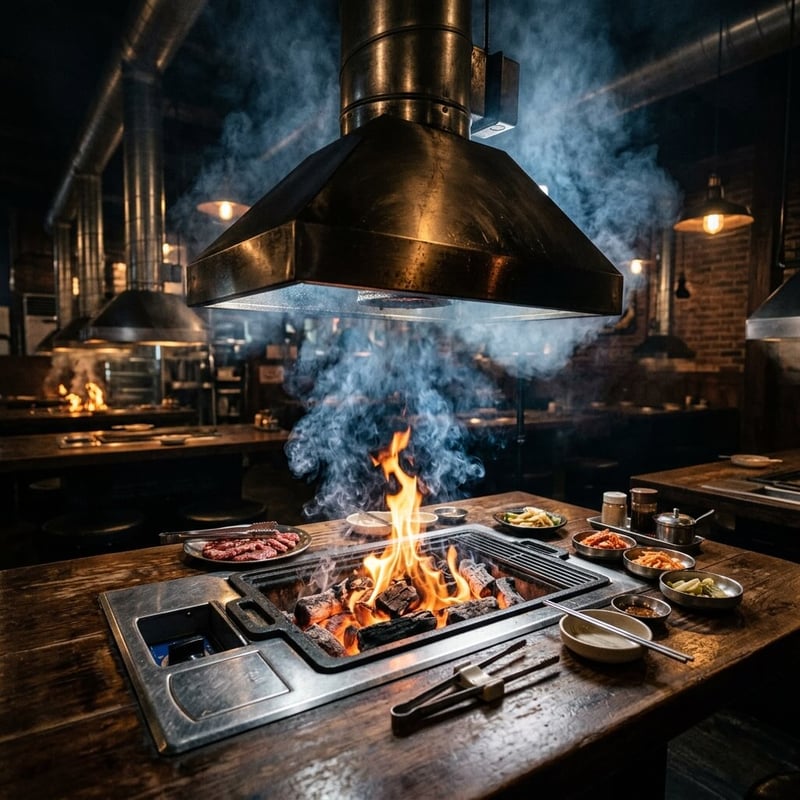
The sequence behind a solid-fuel hood runs in a fixed order, and the first item has to be in place before the rest is worth designing. The spark arrester and the hood’s grease filters take out embers and the larger droplets. A kitchen electrostatic precipitator in the duct downstream collects the fine grease mist and smoke that ride past them; Polygee’s LK in-duct units reached up to 97.6% grease removal in CMA-accredited third-party tests, measured at rated, evenly distributed airflow. That figure is from the standard test; what a given charcoal or wood duty delivers depends on the fuel, the hours and the airflow, and is confirmed with the supplier against the actual duty. UV and activated carbon stages behind the ESP handle the odor compounds, which are gases and pass through an electrostatic field; the options are on our kitchen exhaust odor control page. All three are sized against the same exhaust airflow, which for solid fuel is the extra-heavy-duty rate above.
As on any Type 1 run, the in-duct unit is reviewed as a pollution control unit with the hood, duct and suppression: NFPA 96 covers service access, grease drainage and fire protection, and the listing the adopted edition asks for is covered in grease duct requirements.
Four points specific to solid fuel when the unit is specified:
- No filtration unit goes behind solid fuel without a spark arrester upstream. An electrostatic field and a live ember do not belong in the same duct, and the code requires the arrester in any case. Confirm it is on the hood drawing before the filtration is sized.
- Ask for the unit’s temperature limit. Solid-fuel exhaust runs hotter than a gas line. Every in-duct unit has a maximum inlet temperature; ask the supplier for the figure for the model proposed and check it against the design exhaust temperature at the unit’s position in the run.
- Plan the washing interval for the duty. Charcoal and wood load collector cells faster than a gas cookline does. The interval is a question for the supplier against the actual duty, and it belongs in the same service record as the monthly inspection.
- In the fan calculation. A complete Polygee in-duct unit, airflow-distribution plate included, is rated at ≤150 Pa; ask for the figure at your design airflow and carry it with the second exhaust path’s own duct run.
For a worked layout of a charcoal cookline with ESP, carbon and UV stages on one run, see our BBQ smoke control solution page, written for the grilled-fish and barbecue chains, Tanyu among them, that run Polygee ESP.
Where this guide stops
Six boundaries on these solid fuel cooking exhaust requirements, so the table is used for what it is:
- Edition and amendments. The provisions are NFPA 96, the Uniform Mechanical Code and the International Mechanical Code as model documents. Jurisdictions adopt different editions and amend them; the flavoring exception is a Uniform Mechanical Code provision; check whether the document your AHJ has adopted carries one, and how it is worded, before relying on it.
- Outside U.S. code jurisdictions. Singapore, the Gulf, Southeast Asia and Europe set their own solid-fuel rules. The separate-system logic is common; the numbers and the exception wording are not.
- Fuel storage and ash handling. NFPA 96 sets specific limits on how much fuel is kept near the appliance and how ash is removed and stored. Those figures come from the adopted edition, not from this page.
- Not a design. Hood capture, duct routing, fan selection, the suppression system and the interlock controls are the mechanical and fire-protection engineers’ work, and the AHJ signs off on the result.
- Listed hoods and appliances. A hood or a solid-fuel appliance listed for a specific exhaust rate or configuration follows its listing for the exhaust rate; the rate figures on this page are the unlisted case. The separate-system rule, the spark arrester, the fire-extinguishing equipment and the monthly inspection apply whether the hood is listed or not.
- Residential outdoor cooking. Backyard grills and home wood-fired ovens fall under different codes entirely. Nothing here applies to them.
Frequently Asked Questions
- Can I use a charcoal grill in a commercial kitchen?
- Yes, but as a solid-fuel cooking operation with its own rules. Under NFPA 96 and the mechanical codes the charcoal appliance sits under a Type 1 hood served by an exhaust system that is separate from every other exhaust system in the building, with a spark arrester ahead of the grease filters, listed fire-extinguishing equipment over the appliance, make-up air interlocked with the exhaust, and inspection of the exhaust system for grease and creosote buildup on the monthly tier. The main softening is for solid fuel used purely for flavoring in an otherwise gas or electric appliance, where the Uniform Mechanical Code allows a limited exception. Your authority having jurisdiction applies the adopted edition and can add to it.
- What are the exhaust requirements for a pizza oven?
- It depends on the fuel. A gas or electric deck oven baking cheese- and meat-topped pizzas produces grease-laden vapor and is normally a Type 1 hood installation; its exhaust rate follows the IMC duty tier the engineer assigns to the oven, not the solid-fuel rate. A wood-fired oven is a solid-fuel cooking operation: a Type 1 hood, the extra-heavy-duty exhaust rate of 550 CFM per linear foot on a wall canopy, a separate exhaust system not shared with other cooking, a spark arrester, fire-extinguishing equipment, and monthly inspection. Ovens where wood is used only for flavoring can fall under the limited exception the Uniform Mechanical Code allows; the local authority decides which category applies.
- How to get rid of KBBQ smell?
- At the source rather than in the dining room. Korean barbecue and other charcoal or tabletop-grill concepts put smoke, grease mist and odor into the exhaust at high volume, and the codes handle the fire side: separate exhaust, spark arrester, suppression. The smell that reaches neighbors is a filtration question. An electrostatic precipitator in the duct captures the fine grease mist and smoke that carry the smell; UV and activated carbon stages behind it deal with the odor compounds themselves, which are gases and pass through an electrostatic field. All three are sized against the same exhaust airflow, and a spark arrester upstream is the first condition for an in-duct unit behind solid fuel; the unit itself is reviewed under the pollution control unit provisions like any other.
Charcoal or wood on the menu?
Send us the appliance type and count (or the number of tabletop grills), the fuel and the daily hours, the hood length or the design exhaust airflow if the engineer has fixed it, whether the hood drawing shows a spark arrester, whether the solid-fuel line has its own exhaust run and where on it the unit can sit, and who is downwind of the outlet. Our project team will come back with the ESP, carbon and UV configuration for that duty, its resistance at your design airflow, the service access and cell-withdrawal clearance the unit needs, the washing routine the duty calls for, and the third-party test reports for the model we propose.
Talk to our project team →Law manages kitchen exhaust filtration projects at Polygee, from spec review through duct-side ESP sizing and installation support, including charcoal and grilled-fish concepts. Polygee, founded in 2004, builds commercial kitchen exhaust filtration equipment. This article summarizes published model-code requirements for planning purposes only — it is not a compliance determination, so confirm every requirement for a specific installation with your engineer, your local AHJ and the adopted edition of the code.
References & further reading
- NFPA 96, Standard for Ventilation Control and Fire Protection of Commercial Cooking Operations — solid fuel cooking operations. nfpa.org
- Uniform Mechanical Code (UMC), Section 517: Solid-Fuel Cooking Operations. iapmo.org
- International Mechanical Code (IMC), Chapter 5: Exhaust Systems — Section 507, Commercial Kitchen Hoods. codes.iccsafe.org
- Polygee — kitchen exhaust filtration product range and third-party test reports. polygeeesp.com