

UL 710B and UL 710 look alike on a submittal and prove different things. They are two separate standards, not two editions of one. UL 710 is the performance test for an exhaust hood, and a hood listed to it may be installed at the exhaust rate, the clearance to combustibles and the mounting height in its listing instead of the figures in the code table. UL 710B is the test for a factory-built recirculating system, an electric cooking appliance with its own capture, filtration and fire-extinguishing equipment built in, and a system listed to it may be installed without a Type 1 hood and without a listed set of the hood-section provisions of the International Mechanical Code.
What neither listing does is travel. A UL 710 listing stops at the hood and says nothing about the duct, the fan, the suppression or the filtration behind it, and a UL 710B listing belongs to the whole packaged system and the appliances named in it, not to any component inside.
This guide sets out what each listing evaluates, what the codes let each one replace, the operating conditions a recirculating system carries, and how the rest of the listings along a ducted exhaust run fit around them. It does not recommend a hood or a ventless system; for the filtration behind a ducted hood, see the kitchen electrostatic precipitator page.
One disclosure: Polygee builds in-duct electrostatic precipitators and a ducted hood with the ESP cells built in. Neither is a recirculating system, and Polygee holds no UL 710 or UL 710B listing; the listings we do hold are stated further down. Nothing here is a compliance determination; the authority having jurisdiction (AHJ) applies the edition it has adopted.
What a UL 710 listing proves, and where it stops
A UL 710 listing is a performance result for a hood over specified appliances at a specified exhaust rate, and the code lets that result replace three table values. UL 710, the Standard for Exhaust Hoods for Commercial Cooking Equipment, now in its seventh edition, is a test of capture and containment. UL describes hoods certified to it, and grease ducts certified to UL 1978, as evaluated for clearances to combustible materials and for the capacity of the equipment to capture and remove the cooking effluent, on the basis of performance testing.
The International Mechanical Code turns that result into three substitutions: the exhaust rate in the listing rather than the per-foot rate the code table sets for its duty, which is the difference between two quotes for the same length of hood and is worked through in commercial kitchen hood CFM requirements; the clearance in the listing where the hood is listed for less than 18 in; and the mounting height and overhang the listing states, set out with the rest of the distances in commercial kitchen hood clearance requirements.
All three substitutions hold only inside the listing: a hood listed over medium-duty appliances and installed over a charbroiler is outside its listing for the purposes of the exhaust rate, and the code table comes back.
| Item | Unlisted hood | Hood listed to UL 710 | Buyer check |
|---|---|---|---|
| Exhaust rate | IMC 507.5 rate per linear foot by cooking duty | The rate in the listing | The appliances under the hood match the duty the listing names |
| Clearance to combustibles | 18 in (457 mm), with the gypsum-board exception | The clearance in the listing | The wall and ceiling material class is still recorded; the listing does not cover the duct |
| Mounting height and overhang | Lip not more than 4 ft (1,219 mm) above the cooking surface; 6 in (152 mm) overhang on open sides | The height range and overhang in the listing | The installed height is on record, because the listed rate is only valid inside the range |
| Duct, fan, suppression, in-duct unit | Code rules for each | The same code rules; the listing is silent on them | Each has its own listing or its own code section, mapped below |
This table answers what a UL 710 listing changes. It does not answer whether a particular hood captures a particular cookline; that is the hood manufacturer’s selection within the listing, and the engineer’s sign-off.
What a UL 710B listing proves
A UL 710B listing is a package result: the appliance, the capture hood, the filtration and the fire-extinguishing system tested together, so that the code can treat the package as not needing an exhaust hood.
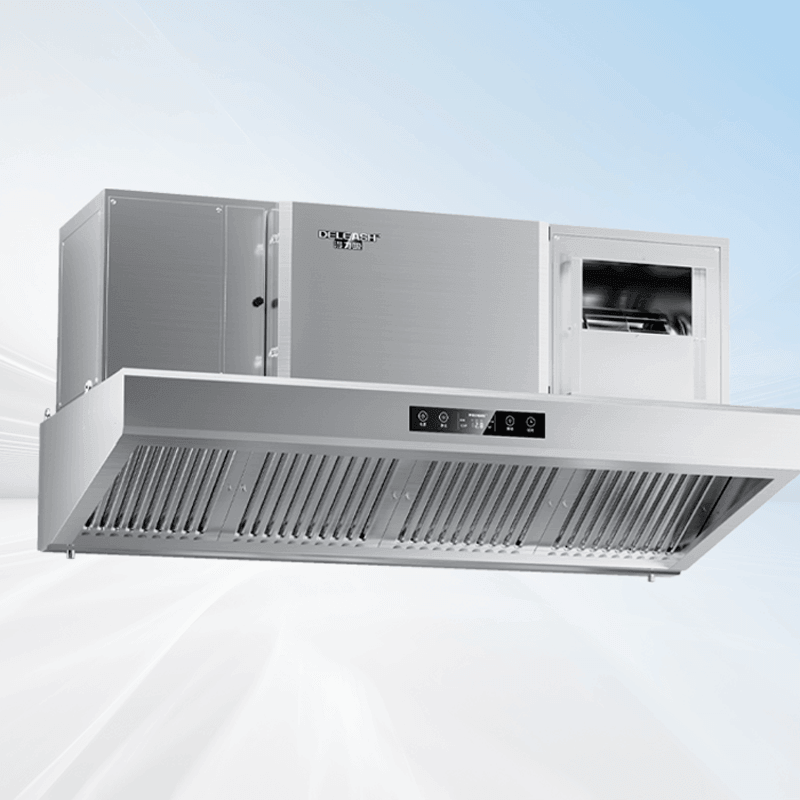
UL 710B, the Standard for Recirculating Systems, covers electric commercial cooking appliances provided with integral or non-integral recirculating systems and downdraft systems. The system includes a fan or downdraft assembly and an air filtering system, together with a fire-extinguishing system; UL describes the listed products as self-contained factory-built units that include a cooking appliance, a collection hood, grease filters and a fire suppression system, evaluated for reduced grease emissions. The UK counterpart, DW/172 Section 25 on recirculation systems with its electric-only rule and its exclusion of UV, ozone and electrostatic precipitators, is in DW/172 kitchen ventilation specification.
The package is tested for capture as a hood is, with the difference that the whole assembly, not a hood alone, has to completely capture all emission by visual observation. Two further things are tested that a hood listing does not cover. Fire: the package undergoes automatic-operation and delayed-operation fire tests of its own extinguishing system. Interlocks: the cooking fuel supply is not to be activated unless the exhaust and supply air systems are running, and a malfunction of any component has to render the recirculating system or the appliance inoperable.
NFPA 96 and the UMC write the recirculating system as a hood, grease removal devices, particulate and odor removal equipment and fire-extinguishing equipment, and their interlock and cleaning rules are written around an electrostatic precipitator as the particulate stage; any ESP inside the package is tested as part of that package, and the listing is held by the builder of the complete system for the appliances named in it. Electrostatic air cleaners have a component standard of their own, UL 867, and a UL 867 component listing is not a system listing, which only the builder of a complete recirculating package can hold. Where our own listings sit is stated on the map below.
What the codes let each listing replace
The IMC gives a listed hood three substitutions and a listed recirculating system one exemption, and both stop exactly where the listing stops.
For UL 710, the substitutions are the three in the table above; everything behind the hood is read against its own section of the code and its own listing.
For UL 710B, Section 507.2 of the IMC carries two exceptions to the Type 1 hood requirement. An electric cooking appliance that an approved testing agency has shown, under UL 710B, to release 5 mg/m³ or less of grease at an exhaust rate of 500 CFM does not need a Type 1 hood. And a factory-built commercial cooking recirculating system that is tested to UL 710B, listed and labeled, and installed in accordance with Section 304.1 and its listing is exempt from a listed set of Section 507 provisions (507.1.5, 507.2.3, 507.2.5, 507.2.8, 507.3.1, 507.3.3, 507.4 and 507.5 in the 2021 numbering), which take in the grease filter and exhaust-rate rules among others. The Type 1 hood and duct requirements set out in commercial kitchen hood code requirements do not apply to the package; its listing and the operating conditions in the next section apply instead.
The exemption is in the mechanical code and does not reach the fire code. The extinguishing system inside the package is part of its listing; how the fire code’s service intervals, manual actuation device and shutoff rules, set out in commercial kitchen hood fire suppression requirements, apply to a particular listed system is a question for the fire plan reviewer before the order.
Can a restaurant be open without a hood vent?
Only where the code makes an exception, and the AHJ decides each one: cooking that produces only heat, steam or moisture, which runs under a Type 2 hood or no hood and is classified in type 1 hood vs type 2; an electric appliance shown under UL 710B to release 5 mg/m³ or less of grease at 500 CFM, which needs no Type 1 hood; and a factory-built recirculating system installed under its listing. Everything else that produces grease-laden vapor or smoke needs a Type 1 hood. The heat-and-moisture side of that line, the Type II hood and the spaces that do without one, is in type 2 hood requirements. In Canada the same split is written into the hood standard itself, which sends recirculating systems to UL 710B by name; see NFPA 96 in Canada.
Operating conditions a recirculating system carries
The exemption from the hood section is paid for in operating rules, which NFPA 96 writes in a chapter of its own and the Uniform Mechanical Code carries in Section 516:
| Condition | What it asks for | Where it is decided |
|---|---|---|
| Listing | The recirculating system is listed with a testing laboratory in accordance with UL 710B or an equivalent standard | NFPA 96; UMC 516 |
| Appliances | Gas-fueled or electrically fueled cooking appliances only; solid fuel is excluded; a gas appliance keeps not less than 18 in (457 mm) from its flue outlet to the filter inlet | NFPA 96; UMC 516 |
| Components | A hood, grease removal devices, air movement, particulate and odor removal equipment, fire-extinguishing equipment, a fire damper with an actuation device rated not more than 375°F (191°C), and safety interlocks with airflow controls, each to its own section | NFPA 96; UMC 516 |
| Interlocks | Closure panels and each filter component proved in place; an ESP performance sensor, with no interruption of power to the ESP exceeding 2 minutes; an airflow switch that opens the interlock when airflow falls 25 percent below normal operating flow or 10 percent below the listed minimum, whichever is lower | NFPA 96; UMC 516.3 |
| Cleaning | ESP cells cleaned not less than once per week; filters cleaned or replaced to the manufacturer’s instructions; hood plenum and blower cleaned not less than once every 3 months | NFPA 96; UMC 516.6 |
| Records | Safety interlocks inspected not less than once every 6 months; a signed and dated maintenance log kept on the premises for the AHJ | NFPA 96; UMC 516.6 |
This table answers what a recirculating system commits the operator to. It does not answer whether a given concept should use one; that is a menu, staffing and site decision.
One tension is worth naming. UL 710B, as its certifiers describe its scope, covers electric appliances; NFPA 96 and the UMC write their recirculating-system rules for gas or electric appliances, which is why the gas flue-to-filter distance exists. Which gas packages hold a listing is read from the listing page, not assumed. The 25 percent airflow switch in the table above is the only place a US code writes an airflow floor for air cleaning equipment, and what that implies for a ducted system designed to modulate is taken up in demand control kitchen ventilation.
Two of the rows change the business case rather than the drawing. The weekly ESP wash is written into the code as a requirement, whatever the duty; on a ducted run the in-duct unit’s washing interval is set with the supplier against the actual duty and logged with the exhaust cleaning record, whose structure is in commercial kitchen exhaust cleaning requirements. And the appliance list is closed, so a menu that later needs a charbroiler needs a Type 1 hood, a grease duct and everything that follows from them.
Which listing proves what, along a ducted exhaust run
A ducted Type 1 run can carry as many as eight documents from the hood to the roof, each stopping at the edge of its own product. The map below is the one we use when a buyer sends a submittal and asks what is missing:
| Document | Product | What it supports | What it does not prove | Buyer check |
|---|---|---|---|---|
| UL 710 | Exhaust hood | Capture and containment over the listed appliances; the listed exhaust rate, clearance and mounting height | Anything behind the hood; performance outside the listed duty or height | Listing page, not brochure; appliances and height against it |
| UL 710B | Recirculating system (package) | The package runs without a Type 1 hood, under its listing | Any component on its own; any appliance not named; solid fuel | The appliance model on the listing; the operating conditions above |
| UL 1046 | Grease filters | The filter is a listed grease removal device | The distance from the cooking surface, which the code sets | Listed filters, at 45 degrees, at the code distance |
| UL 1978 | Factory-built grease duct | Duct installed at the clearances in its listing | Field-built duct, which follows the code rules | Listing for clearance; cleanouts still per code |
| UL 2221 / ASTM E2336 | Duct enclosure and wrap systems | The enclosure rating and reduced clearance where the duct passes through the building | The duct itself | Wrap listing against the building’s required rating |
| UL 705 Supplement SC (formerly UL 762) | Restaurant exhaust fan | The fan is listed for restaurant exhaust | Airflow at your static pressure; mounting, drain and access, which the code sets | Listing plus the fan curve at the design point |
| UL 8782 | Pollution control unit (2021 IMC) | The in-duct unit carries the listing the 2021 IMC asks for | Grease removal at your duty; fire protection downstream, which the code adds | Ask the supplier plainly whether the model carries it; which IMC editions ask for it is in what a pollution control unit is |
| UL 300 | Pre-engineered extinguishing system | The system is tested for commercial cooking fires | Coverage of appliances not on the drawing; the pollution control unit unless drawn in | Nozzle layout against the actual appliances; the semiannual tag |
| UL 867 | Electrostatic air cleaner (component) | The ESP component meets the electrostatic air cleaner standard | A system listing (UL 710B) or a pollution control unit listing (UL 8782) | Which models carry it; read the file number against the model |
This table answers which document to ask for at each point in the run. It does not answer whether a given product performs in a given kitchen; every listing is a test result under the conditions in the listing, and the balance report and the cleaning record are what prove the kitchen as built. The duct and fan rows are expanded in grease duct requirements and commercial kitchen exhaust fan requirements.
Where Polygee sits on this map. Our in-duct units are pollution control units on a ducted Type 1 run, and our commercial kitchen hood system is a ducted hood with the ESP cells built into it; neither is a UL 710B recirculating system. The listings we hold are UL 867, File E522667, on three in-duct models, the LK/SE 6K, 12K and 18K, and CE certification FQC2602501 covering the LK30 to LK480 series, the LK-E series and the UV modules; the hood system with built-in cells carries neither. We do not hold UL 710, UL 710B or UL 8782, and we say so on the submittal rather than leaving the reviewer to find out; what we do supply is the third-party grease removal test report where a model has one, with its test conditions, and a plain statement of which listings and reports each model carries and which it does not.
Where this guide stops
Four boundaries on this reading of the two listings:
- Edition and amendments. The code provisions are the International Mechanical Code, NFPA 96 and the Uniform Mechanical Code as model documents, and the standards are cited by title; jurisdictions adopt different editions and amend them, and acceptance of a recirculating package is a local decision. The AHJ decides.
- Outside U.S. code jurisdictions. UL listings are a North American regime. Singapore, the Gulf, Southeast Asia and Europe run their own approval systems, and CE marking is a different declaration with a different scope; the logic of reading what a document covers travels, the documents do not.
- Standard texts this page does not quote. The emission limit this page gives is the one the IMC writes into its exception; the test procedures and limits inside the two standards are in the standards themselves, and whether the adopted edition of NFPA 96 asks for component listings on the parts of a recirculating system is a question for that edition, which this page does not answer.
- Residential range hoods. Domestic hoods are tested and installed under different documents, and nothing here applies to them.
Frequently Asked Questions
- What is UL 710B?
- UL 710B, the Standard for Recirculating Systems, is the test standard for factory-built commercial cooking recirculating systems: an electric cooking appliance with its own capture hood, air filtration and fire-extinguishing system, built and tested as one package. The package is tested for complete capture of the cooking emissions, for its fire-extinguishing performance, and for interlocks that keep the appliance from running unless the filtration and airflow are working. A system listed to UL 710B may be installed under the International Mechanical Code without a Type 1 hood and is exempt from a listed set of Section 507 provisions, including the grease filter and exhaust-rate sections, provided it is installed in accordance with its listing. The listing belongs to the whole package and the appliances named in it, not to any component inside.
- What commercial ovens don’t require a hood?
- The code decides by what the oven produces and by testing, not by the oven type. An oven that produces only heat, steam or moisture, such as some light-duty electric ovens on a menu without grease, may be served by a Type 2 hood or, with the approval of the authority having jurisdiction, no hood at all. An electric appliance that an approved testing agency has shown under UL 710B to release 5 mg/m3 or less of grease at an exhaust rate of 500 CFM does not need a Type 1 hood, and a factory-built recirculating system listed to UL 710B is installed under its listing instead of under a hood. An oven that produces grease-laden vapor or smoke, which typically includes deck ovens baking cheese- and meat-topped pizzas and ovens roasting meat, needs a Type 1 hood; the test report or the listing page settles a specific model.
- What can you cook in a restaurant without a hood?
- Only what the code excepts, and the authority having jurisdiction decides each case. Cooking that produces only heat, steam or moisture may run under a Type 2 hood or, with the approval of the AHJ, no hood. An electric appliance shown under UL 710B to release 5 mg/m3 or less of grease at 500 CFM needs no Type 1 hood. And cooking on a factory-built recirculating system listed to UL 710B runs under that listing, which names the appliances it was tested with; NFPA 96 limits recirculating systems to gas- or electrically fueled appliances, with solid fuel excluded. Anything else that produces grease-laden vapor or smoke, from a charbroiler to a wok range, needs a Type 1 hood, a grease duct, an exhaust fan and a fire-extinguishing system.
Checking a listing before you order?
Send us the listing page of the hood or system on the proposal, the appliance list with the fuel, and whether the site is ducted or a recirculating package is on the table. We will come back with which of our configurations applies, the listings and third-party test reports each model carries and does not, and the questions to put to the hood or system supplier so that every document on the submittal covers the product it is attached to.
Talk to our commercial team →Scarlett leads commercial work at Polygee, from first RFQ through Incoterms, certification scope and delivery for engineering firms, consultants and dealers in 50 countries. Polygee has built commercial kitchen ESP systems since 2004. This article explains what published listings and model-code provisions cover, for planning purposes only — it is not a compliance determination, so confirm the documents for a specific project with your engineer, your local AHJ and the adopted edition of the code.
References & further reading
- UL 710, Standard for Exhaust Hoods for Commercial Cooking Equipment; UL 710B, Standard for Recirculating Systems; UL 867, Standard for Electrostatic Air Cleaners. ul.com
- International Mechanical Code (IMC), Chapter 5: Exhaust Systems — Section 507, Commercial Kitchen Hoods, including the Section 507.2 exceptions for UL 710B tested appliances and listed recirculating systems. codes.iccsafe.org
- NFPA 96, Standard for Ventilation Control and Fire Protection of Commercial Cooking Operations — recirculating systems. nfpa.org
- Uniform Mechanical Code (UMC), Section 516: Recirculating Systems. iapmo.org
- Polygee — kitchen exhaust filtration product range, certifications and third-party test reports. polygeeesp.com