

Local exhaust ventilation is an engineering control that takes a contaminant out of the air at the point where it is made, through a hood, a duct, an air cleaner, a fan and a discharge, before anyone can breathe it. A ducted kitchen extract with a filtration stage has every one of those parts. Whether the law treats it as LEV, and therefore asks for the thorough examination and test that LEV carries, is the question this page answers for a kitchen in Great Britain.
The question arrives in three forms. A landlord or an insurer asks for the LEV certificate. A new environmental health officer asks when the canopy was last thoroughly examined. A contractor quotes for LEV testing on a system nobody has ever tested, and the owner does not know whether the quote is for a legal duty or a service. The three forms have one answer with two parts: the kitchen canopy is a receiving hood in the Health and Safety Executive’s own classification of LEV hoods, and which document makes it a duty depends on what the cooking fume is to the people under the canopy.
This page helps you decide whether your extract system falls under the Control of Substances Hazardous to Health Regulations 2002 (COSHH), the Workplace (Health, Safety and Welfare) Regulations 1992, the DW/172 specification or all three; what the 14-month thorough examination and test looks at when it applies; what the report has to contain; why a commissioning report comes first; who may do the work; and where an in-duct electrostatic precipitator sits in the system and what the examiner measures on it. It does not decide the COSHH question for your kitchen, which is the employer’s assessment, and it does not price the test. One disclosure before the law: Polygee makes in-duct electrostatic precipitators and the hood with the ESP cells built in. We do not design, install, commission or examine LEV systems, and nothing here is a compliance determination.
| Question | Short answer |
|---|---|
| Is a kitchen canopy LEV? | In form, yes: HSG258 names a canopy hood over a hot process as a classic receiving hood, and the kitchen extract has the hood, duct, air cleaner, fan and discharge HSG258 lists. Whether the COSHH test applies is the employer’s assessment |
| Which law asks for what? | Workplace Regulations regulation 6: sufficient fresh or purified air and a failure warning where health or safety needs one. COSHH regulations 7 and 9: where the fume is a substance hazardous to health, maintain the control and thoroughly examine and test LEV at least every 14 months, records kept five years. DW/172 clause 28.2: a commissioning record of flows, pressures and fan currents, bound through the contract and the insurer |
| What is the 14-month test? | Three stages in HSG258: visual and structural examination, technical performance with the process running, assessment of control effectiveness against the commissioning benchmarks; a label on each hood, a red label on a failure, a report with a prioritised action plan |
| What if there is no commissioning report? | The examiner needs another source of intended performance, which HSE allows for simple systems from supplier data or recognised guidance; otherwise HSG258 says the employer may ask the examiner to produce a commissioning report at the same time; HSE’s catering sheet says the installer should recommission and report where data is absent |
| Who may do it? | A competent person, which can be an outside contractor or a competent employee; HSE requires no particular qualification and defines competence as knowledge, skills and application experience |
| Where does the ESP come in? | As the air cleaner. HSG258 lists electrostatic precipitators among particle air cleaners and asks the examiner to measure static pressure across the air cleaner; the unit’s resistance clean and loaded goes into the commissioning benchmarks, 150 Pa or less for our complete in-duct unit |
| Quick specs on this page | Figure | Basis |
|---|---|---|
| Maximum interval between thorough examinations and tests of LEV plant used as a COSHH engineering control | 14 months | COSHH 2002 regulation 9(2)(a) |
| Shorter statutory intervals | 1 month or 6 months, for four listed processes only: blast cleaning of metal castings, dry grinding and polishing of metal articles other than gold, platinum or iridium for over 12 hours a week, non-ferrous casting, jute cloth manufacture | COSHH 2002 Schedule 4; HSG258 Table 18 |
| Record retention | At least 5 years for the examination, test and repair record | COSHH 2002 regulation 9(4) |
| Stages of the examination | Three: visual and structural; technical performance; control effectiveness | HSG258 paragraph 336 |
| Red label criteria | Four: reduced or no detectable airflow; an enclosing hood that fails to contain; a receiving hood that fails to intercept or contain; a capturing hood whose capture zone misses the working zone | HSG258 paragraph 346 |
| Ventilation duty on every enclosed workplace | Sufficient quantity of fresh or purified air; a visible or audible failure warning where necessary for health or safety | Workplace (HSW) Regulations 1992 regulation 6 |
| Polygee in-duct precipitator, resistance when clean | Complete unit with airflow distribution plate 150 Pa or less; the cells themselves roughly 20 to 30 Pa | Polygee model data |
| Service clearance, UV-C and carbon modules | D = 1,000 mm on the access side | Polygee model data |
- What local exhaust ventilation is, and whether a kitchen canopy is one
- Three documents, three different duties
- Does cooking fume fall under COSHH? The question the employer answers
- The thorough examination and test: three stages, a label and a report
- Commissioning first: the benchmark the test is measured against
- Who is competent to examine a kitchen LEV
- Where the electrostatic precipitator sits, and what the examiner measures on it
- A worked example: one canopy, one file
- Eight gaps that weaken a test
- The Kitchen LEV Evidence File
- Where this guide stops
- Buyer record and key takeaways
- Frequently asked questions
What local exhaust ventilation is, and whether a kitchen canopy is one
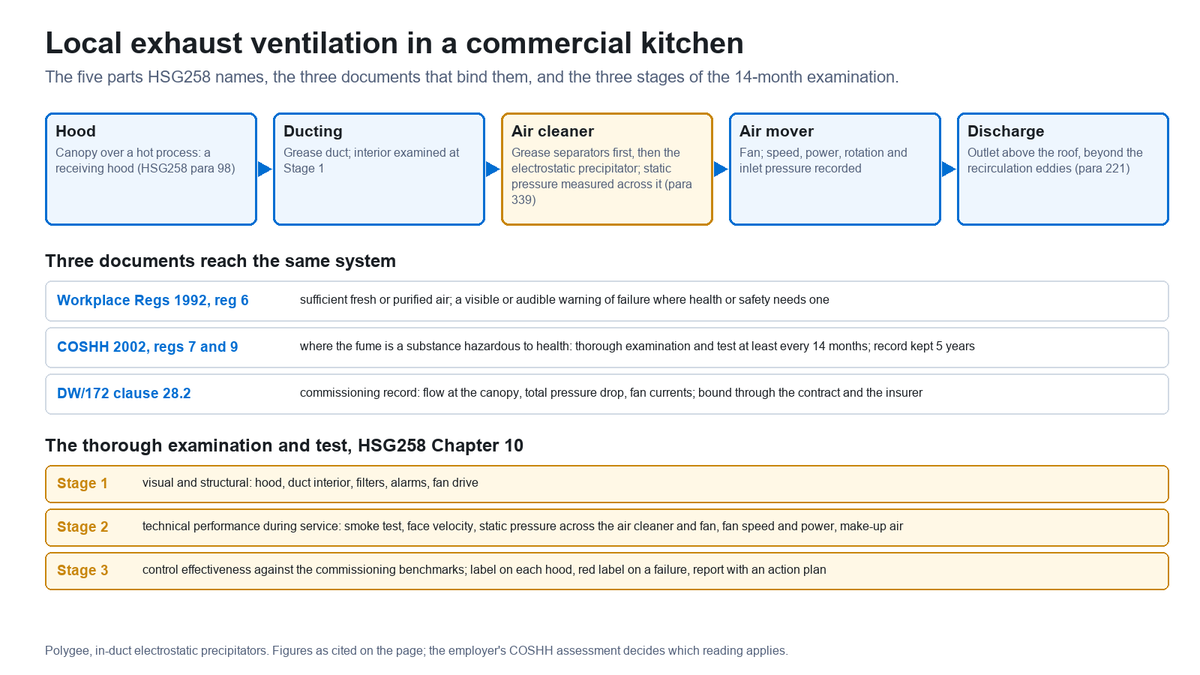
The Health and Safety Executive’s definition is short, and a kitchen extract meets every clause of it. HSG258, Controlling airborne contaminants at work: a guide to local exhaust ventilation, describes LEV at paragraph 10 as an engineering control system to reduce exposures to airborne contaminants such as dust, mist, fume, vapour or gas in a workplace, and says that most systems, but not all, have five parts: a hood, where the contaminant cloud enters; ducting, which conducts air and contaminant to the discharge point; an air cleaner or arrestor, which filters or cleans the extracted air and which not all systems need; an air mover, usually a fan; and a discharge, which releases the extracted air to a safe place. The HSE leaflet INDG408 puts the same five parts in a drawing and adds the purpose: collect the air that contains the contaminants, make sure they are contained and taken away from people, clean the air if necessary and get rid of the contaminants safely.
Set a commercial kitchen beside that list. The canopy is the hood. The grease duct is the ducting. The grease filters in the canopy, and any electrostatic precipitator, UV-C or carbon stage in the duct, are the air cleaner. The extract fan is the air mover. The outlet above the roof is the discharge. HSG258 goes further at paragraphs 95 to 98, where it classifies hoods as enclosing, receiving or capturing and states that a canopy hood over a hot process is a classic receiving hood, and again at paragraphs 126 and 127, where the canopy hood is described as placed over a hot process to receive the plume of contaminant-laden air given off, to be set as close as possible to the process, and ineffective over a cold process with no thermal uplift. That is a description of a kitchen canopy over a range, written for industry in general.
What the kitchen canopy is in form, then, is settled by the guide itself. What it is in law is a separate question, because HSG258 is guidance to a set of regulations, and those regulations apply to a control measure only where the thing it controls is within their scope. That is the subject of the next two sections. The parts the canopy heads, and the US code that governs each of them, are mapped in our guide to the six parts of a commercial kitchen ventilation system; this page reads the same system through British law.
Three documents, three different duties
Three documents reach a British kitchen extract from three directions, and the paperwork a landlord, an insurer or an inspector asks for depends on which one they have in mind. They do not say the same thing and they are not alternatives: a kitchen can be bound by all three at once.
| Document | What it asks of the extract system | Who applies it | What the evidence looks like |
|---|---|---|---|
| Workplace (Health, Safety and Welfare) Regulations 1992, regulation 6 | Effective and suitable provision so that every enclosed workplace is ventilated by a sufficient quantity of fresh or purified air; any plant used for that purpose to include an effective device giving visible or audible warning of failure, where necessary for reasons of health or safety | HSE and local authority environmental health officers | A system that works, maintained to the installer’s instructions, with a failure indication where the assessment calls for one |
| Control of Substances Hazardous to Health Regulations 2002 (COSHH), regulations 7 and 9 | Where exposure to a substance hazardous to health is controlled by an engineering control, keep it in an efficient state, in efficient working order, in good repair and in a clean condition; where that control is local exhaust ventilation plant, a thorough examination and test at least once every 14 months, or more often for the Schedule 4 processes; a suitable record, or a suitable summary of it, of examinations, tests and resulting repairs, kept for at least five years from the date it was made | HSE and environmental health officers, under the employer’s own assessment | Commissioning report, user manual, logbook, thorough examination and test report, labels on the hoods |
| DW/172, the Building Engineering Services Association (BESA) Specification for Kitchen Ventilation Systems, second edition 2018 with addenda April 2020 and May 2024 | Clause 28.2: a commissioning record of separator face velocity, supply and extract flows, the airflow verified at the canopy itself and not only at the fan, the total system pressure drop, fan currents, noise and CO and CO₂; clause 29 and Table 12: cleaning intervals, read beside TR19 Grease, the same association’s cleaning standard | Nobody by statute; bound through the contract that cites it, Approved Document F in England, the insurer and the council | The clause 28.2 record at handover; the TR19 Grease certificates with measured grease depth |
Two things follow from the table. The first is that the Workplace Regulations duty applies to every kitchen, whatever the fume, and it is the duty HSE’s own catering guidance leads with: Catering Information Sheet 10, Ventilation in catering kitchens, opens its law section with the 1992 Regulations, describes mechanical extraction via a canopy hood as the way the fumes and vapour cooking produces are removed and discharged to a safe location, and asks that mechanical ventilation be maintained in efficient working order in accordance with the manufacturer’s or installer’s instructions. The second is that the COSHH duty, with its 14 months and its five years, is conditional. It attaches to an engineering control provided to meet regulation 7, and regulation 7 is about substances hazardous to health. Whether the extract over a particular cookline is such a control is the next question.
HSG258 itself leaves room for a system to be LEV without being a COSHH control. Its legal appendix, after stating that employers must have their protective LEV thoroughly examined and tested at least every 14 months, adds a note that LEV may have been required for reasons other than COSHH, with removal of unpleasant odours as its example. A kitchen extract fitted to stop a smell reaching a neighbour is that case; one fitted to keep fume out of a chef’s breathing zone is the other. A kitchen can be both. The wider map of the law that reaches a British kitchen, from the Health and Safety at Work Act to the planning condition on the outlet, is in our commercial kitchen extraction regulations in the UK guide; what DW/172 asks clause by clause is in DW/172 kitchen ventilation specification.
Does cooking fume fall under COSHH? The question the employer answers
The regulations do not list cooking fume, and HSE’s two documents on the subject approach it from opposite ends, so the honest answer is that the employer’s assessment decides, and this section sets out what that assessment has to weigh.
COSHH regulation 2(1) defines a substance hazardous to health in five limbs. Four of them are specific: a substance classified as very toxic, toxic, harmful, corrosive or irritant under the supply rules; one with an approved exposure limit; a biological agent; dust of any kind, other than dust already within the first two limbs, at or above 10 mg/m³ inhalable or 4 mg/m³ respirable as an eight-hour time-weighted average. The fifth is general: a substance not within the first four which, because of its chemical or toxicological properties and the way it is used or is present at the workplace, creates a risk to health. Cooking fume, a mixture of grease aerosol, smoke, combustion products and the vapours of what is being cooked, is not named in the regulation 2 definition. Its components are weighed limb by limb; where none of the first four catches them, the fifth is the route, and the whole judgment is made by the employer under regulation 6, the assessment, applied to the actual process in the actual room.
HSE’s two guides pull in different directions on that assessment without contradicting each other. HSG258, the LEV guide, contains no catering example at all: the words kitchen, cooking and catering do not appear in it, and its air cleaner chapter is written around dusts, mists and fumes from industrial processes. Catering Information Sheet 10, the kitchen guide, does not use the words COSHH, LEV or HSG258, and places the duty to ventilate a kitchen under the Workplace Regulations and the gas safety law, while describing what the extract removes as fumes and vapours and, for solid fuel, carbon monoxide. Read together, neither document makes the determination for a kitchen canopy either way, and we found none elsewhere in the HSE guidance we read. The employer who cooks over charcoal or on a chargrill, in a small room, with staff under the canopy for a full shift, has more to weigh than the employer with an electric light-duty line in a large space, and the factors are the ones regulation 2(1) names: what the fume contains, how it is present and who is exposed to it for how long. Either way the conclusion is written down, and either way the Workplace Regulations duty and the DW/172 commissioning record still apply.
Two neighbours of the question are settled elsewhere on this site. The smell at the outlet is a nuisance and planning matter decided by the council, not a question the LEV examination answers, and the scoring method councils use is in commercial kitchen odour control in the UK. The gas interlock that stops gas reaching the appliances until the extract is proved is a duty under the Gas Safety (Installation and Use) Regulations 1998, met through BS 6173, not an LEV duty, and is in gas interlock in a commercial kitchen.
The thorough examination and test: three stages, a label and a report
The thorough examination and test, which HSE abbreviates to TExT, is defined at HSG258 paragraph 327 as a detailed and systematic examination sufficient to make sure that the LEV can continue to perform as intended by design and will contribute to the adequate control of exposure, normally including functional testing, carried out by a person who is competent and able to make an objective assessment. It is not the daily, weekly and monthly routine check, which paragraph 324 leaves to trained employees working to the logbook; it is the audit of those checks, and paragraph 326 says an employer can use it exactly so, as an audit of the past year’s LEV management.
The interval, and why a kitchen is on 14 months
Regulation 9(2)(a) of COSHH sets the maximum interval at 14 months for local exhaust ventilation plant, and shortens it only for plant used with a process in Column 1 of Schedule 4. Schedule 4 has four rows: blasting carried out in or incidental to the cleaning of metal castings in connection with their manufacture, one month; dry grinding, abrading or polishing by mechanical power of metal articles other than gold, platinum or iridium, for more than 12 hours a week in any room, six months; processes giving off dust or fume in which non-ferrous metal castings are produced, six months; jute cloth manufacture, one month. Catering is not in the schedule, so a kitchen on COSHH is on 14 months. HSG258 paragraph 329 adds the qualification that matters for a grease system: if wear and tear on the LEV system is liable to mean that the system effectiveness will degrade between tests, then thorough examinations and tests should be more frequent. Grease loading on filters and collector cells is the kind of degradation that sentence describes, and the interval the examiner recommends can be shorter than the statutory maximum; HSE’s commissioning guidance asks the commissioner to state the testing frequency if it differs from the statutory 14 months.
Stage 1: the visual and structural examination
Paragraph 336 divides the examination into three stages, and paragraph 338 lists what the first should include as appropriate: a thorough external examination of all parts of the system for damage, wear and tear; internal duct examinations; checks that any filter cleaning devices work correctly; inspection of the filter fabric, and of built-in pressure gauges where filters have them; checks of water flow and sump condition in a wet scrubber; checks that monitors and alarms function; inspection of the air mover drive mechanism, such as a fan belt; and checks for indications of effectiveness, with two questions the guide puts directly: are there significant deposits of settled dust in and around the LEV hood, and is any part of the system vibrating or noisy. In a kitchen the deposit is grease, and the internal duct examination overlaps with what a TR19 Grease survey records, so the two inspections can be planned together; what the TR19 certificate has to measure is in TR19 Grease cleaning standard.
Stage 2: technical performance with the process running
Paragraph 339 is the measuring stage, and its challenge tests are done with the process running, not on a cold Monday morning. It may include careful observation of the process and the contaminant sources; challenge tests with smoke with the process running, to check for leakage, eddying and breathing zone encroachment, for which the guide notes the examiner should warn employees and may need smoke alarms turned off; dust lamp tests; and measurements, which the guide lists as airflow velocity at hood faces, branch ducts and the main duct; static pressure at suitable, appropriately marked test points, including all hoods, ducting, across the air cleaner and the fan; fan speed, motor speed and electrical power consumption; direction of rotation of the fan impeller; the replacement or make-up air supply; alarms, by simulating a failure; air temperatures; and the air cleaner performance. Paragraph 337 names the kit: Pitot tubes, a smoke generator, a dust lamp, an anemometer and sometimes air sampling equipment. Paragraph 341 then has the examiner calculate volume flow rates, compare them with the design specification in the system documentation, and diagnose discrepancies, with the employer’s consent making simple alterations such as rebalancing a multi-branch system. Paragraph 340 draws one boundary: environmental legislation may require testing of air discharges, and HSG258 does not cover it.
The performance test an American inspector witnesses before approving a hood installation measures the same three things from the other side of the Atlantic, exhaust rate, make-up air and capture by smoke with the appliances hot; the parallel is drawn in our commercial kitchen hood installation guide. The British examiner has the harder job, because the test is not a one-off at handover but a comparison against a benchmark that has to exist.
Stage 3: control effectiveness, the label and the report
Paragraph 343 states the purpose again, that the LEV can continue to perform as intended by design, and lists what the examiner needs to have done to judge it: the visual and structural examination, the observation of process, sources and operator behaviour, suitable challenge tests, the measurements, and a comparison with any employer air sampling records. If those are met and acceptable, paragraph 344 says contaminant control should in nearly all circumstances be adequate and a test certificate issued. Paragraph 345 recommends, where appropriate, that the employer have the examiner attach a test label to each hood, carrying the test date, the next test date and the examiner, and a fail label where a hood has failed, and HSE’s FAQ notes that labelling is recommended rather than a specific legal requirement; paragraph 346 gives the four criteria for the red label, reduced or no detectable airflow, failure of an enclosing hood to contain the contaminant cloud, failure of a receiving hood to intercept or contain it, and failure of a capturing hood whose capture zone does not encompass the working zone. A kitchen canopy that lets the plume roll out over the front edge during service is the receiving hood case.
The report is where the duty becomes a document. Paragraph 349 lists what a suitable employer record of each thorough examination and test should normally contain, and the list is the one to check a contractor’s report against:
- The name and address of the employer responsible for the LEV; the date of this test and of the last one.
- The identification and location of the LEV, and the process and hazardous substance concerned.
- The operating conditions at the time of the test, and whether this was normal production or special conditions.
- A simple diagram of the layout and location with test points; the general condition of the system, including hood serial numbers and, where appropriate, photographs.
- Information about the plant showing its intended operating performance for adequately controlling the hazardous substance for the purposes of regulation 7, with the guide’s own note that if no such information is available, this indicates a need for a further assessment under regulation 6; whether the plant is still achieving that performance; and if not, the adjustments, modifications or repairs needed.
- The methods used to judge performance: visual, smoke test, airflow measurements, pressure measurements, dust lamp, air sampling, tests of the condition and effectiveness of the filter.
- Results of any air sampling; information on the way operators use the LEV; general wear and tear and components that may need repair or replacement before the next test.
- The name, job title and employer of the person carrying out the examination, and their signature; any minor adjustments or repairs made; any critical defects identified.
Paragraph 350 requires the report to be kept for at least five years with a copy available at the workplace, which is regulation 9(4) restated, and paragraph 348 asks the examiner to produce a prioritised plan for any actions and the employer to schedule the repair and retest. INDG408 puts the consequence plainly: if the examination shows the LEV is not adequately controlling exposure, stop the work and repair it, or protect the employees by other means while the repair is arranged, and leave the red label on until it is done.
Commissioning first: the benchmark the test is measured against
Every stage above compares the system with something, and the something is the commissioning report. Without it, or another source of intended performance such as a supplier’s standard data for a simple system, the examiner can measure flows and pressures and still have no way to say whether they are the right ones. HSG258 paragraph 334 lists the sources the examiner should use where available: the commissioning report, the user manual, the logbook, the previous thorough examination report, any air sampling records, and confirmation that nothing has changed in the LEV, the layout or the process since the last test. Paragraph 335 then addresses the kitchen that has none of them: if none of these documents are available, the employer could request the examiner to also carry out a commissioning report that provides sufficient detail to produce information for a user manual, as an additional service at an agreed cost. Catering Information Sheet 10 says the same from the installer’s side: for existing installations where data is absent or unavailable, the installer should recommission the system of extraction and make-up air and produce a report detailing its performance.
What goes into that report is set out on HSE’s LEV commissioning page and in HSG258 Chapter 8. The core is a benchmark: performance targets such as flow rates and pressures, as reference for statutory examinations, maintenance and performance management, with the system shown to be balanced and achieving the required performance at every hood. The record describes the configuration, components, fan specification, filter media, waste collection, make-up air supply and discharge arrangements, with photographs and an identification number, and gives quantitative results, volume flow rates, face velocities, duct velocities, static pressures, fan speed, motor speed, electrical power consumption and filter performance, together with a simple schematic with test points and the calibration certificates of the instruments. It carries the date, the duty holder’s name and address and the commissioner’s name, job title and employer, signed.
Read that list against DW/172 clause 28.2 and the two documents overlap heavily in what they measure. The specification’s commissioning record calls for separator face velocity, supply and extract flows, the airflow verified at the canopy itself and not only at the fan, the total system pressure drop, fan currents, noise and CO and CO₂. A kitchen whose installer delivered the clause 28.2 record at handover already holds a large part of an LEV commissioning report; a kitchen that has only a fan nameplate and a drawing holds none of one. HSG258 paragraph 274 adds the trigger for doing it again: all systems need recommissioning when there are changes in the process, changes in the workplace layout, any change of the equipment creating the source, or any other change such as modifying or adding a branch. A new chargrill, a longer cookline, a demand-control retrofit that varies the fan speed, or a filtration unit added to the duct is each such a change; what turning the fan down does behind the hood is in demand control kitchen ventilation.
The user manual and the logbook
Two further documents complete the set, and both are the supplier’s to provide. HSG258 paragraph 310 describes the technical part of a user manual: the purpose and description of the system with diagrams, how to use it, signs of wear and control failure, the schedule and description of checks, maintenance and replacement, a detailed description of the specific statutory thorough examination and test requirements and benchmarks, the performance information from commissioning and a list of replaceable parts; paragraph 312 adds the designed face velocities of all hoods and the duct velocities, the make-up air arrangements, the test points and the tests required, and the maintenance and cleaning frequencies. The logbook records the routine checks, maintenance, replacements and repairs and who made them. INDG408 advises keeping the logbook as long as the test reports, at least five years, and HSE’s LEV pages tell employers to ask the supplier for both if they were not provided.
Who is competent to examine a kitchen LEV
The law names a competent person and HSE declines to name a qualification. HSG258 paragraph 16 requires the employer to use a competent person to provide LEV services and states that this can be either an outside contractor or a competent employee of the LEV owner; paragraph 23 says the same of the examiner for the statutory test; paragraph 327 adds that the person must be able to make an objective assessment. HSE’s LEV frequently asked questions define competence as a combination of knowledge, skills and application experience that enables a person to do an effective and reliable job, answer the qualification question directly, HSE mentions certain training courses in its guidance as examples but does not require suppliers to have these qualifications, and say that while it is possible for an employer to undertake the thorough examination itself, most businesses engage someone with specialist knowledge, experience and skills.
The same page lists what the examiner needs from the employer about each component, and it is a useful test of whether a quotation for kitchen LEV testing is from someone who will do the job: for the hoods, the maximum number in use at one time, their position, the static pressure behind each and the face velocity; for the ducting, dimensions, transport velocity and volume flow; for the filter or collector, the specification, the volume flow and the static pressure at inlet, outlet and across the filter; for the fan, the specification, volume flow, inlet static pressure and direction of rotation. An examiner who has none of these before the visit will spend the first part of it collecting them. INDG408 adds the employer’s side of the selection: ask about experience in the industry, references, whether the supplier is tied to one product range, and how they will show that the LEV provides adequate control.
Where the electrostatic precipitator sits, and what the examiner measures on it
We make this equipment, so the disclosure comes first: nothing in COSHH, HSG258 or DW/172 requires an electrostatic precipitator in a kitchen extract. Where one is fitted it is the air cleaner in HSG258’s five-part system, and that position brings two consequences for the LEV file.
The first is that the guide names the component and the measurement. HSG258 paragraph 204 lists particle collectors as the most common group of air cleaning devices associated with LEV systems and names the group as fabric filters, cyclones, electrostatic precipitators and scrubbers; paragraph 209 describes the precipitator as giving dust and fume particles an electrical charge and attracting them onto collecting surfaces with an opposite charge, suitable for fine dusts and unsuitable for heavy contamination. The second clause is the important one for a kitchen, and DW/172 says the same thing in its own words: clause 24.3 makes a canopy with tested primary grease separators the precursor to any pollution control, so the precipitator sits behind the baffle filters and takes the fine fraction they pass, not the bulk grease; clause 24.6 warns that at higher velocities small particles can pass through untreated, so the flow has to sit inside the unit’s rated band; and clause 24.11 sends the resistance of whatever combination is chosen to the fan selection. The order of stages, filters first, then the precipitator, then any odour stage, is in kitchen exhaust filtration.
The second consequence is in paragraph 339: the examiner measures static pressure across the air cleaner and checks the air cleaner performance, and HSE’s FAQ asks the employer to hold, for the filter or collector, its specification, volume flow and static pressure at inlet, outlet and across the filter. The number the file therefore needs is the unit’s resistance at the design airflow, clean, as the benchmark, and a statement from the supplier of how the figure is expected to move as the cells load. For our complete in-duct unit with its airflow distribution plate the clean figure is 150 Pa or less, with the collector cells themselves contributing roughly 20 to 30 Pa; the UV-C and carbon modules are issued per model with the configuration proposal, and we would rather state that than add three figures from different bases into a total no test supports. HSE’s own FAQ notes that a manometer measuring static pressure across the filter unit can provide sufficient airflow indication for a simple system, which is one simple way a kitchen gets a failure indication of the kind the Workplace Regulations ask for where health or safety needs one. A rising reading across the cells is one of the signals to check the cells and wash them; the washing is logged, and what a wash involves is in electrostatic precipitator cleaning.
Three further points keep the unit’s place in the file honest. Adding a precipitator to a system that has a commissioning report is a change of equipment under paragraph 274 and calls for recommissioning, with the new resistance in the fan total; a fan that was selected without it can deliver less than the benchmark, and the examiner can find the shortfall at the next test, as commercial kitchen exhaust fan requirements works through. The unit’s own documents answer the unit, not the system: the CE certificate on the named series and the third-party grease removal report, which for our LK units recorded up to 97.6% grease removal at rated, evenly distributed airflow, say nothing about the smoke at the outlet or the capture at the canopy, and we hold no EN 16282-8 report and say so. And the access side of each module needs its clearance, D = 1,000 mm for our UV-C and carbon modules, or the examiner’s internal inspection and the operator’s washing both become dismantling jobs. What a British buyer receives from us for that stage, with the documents and the inputs for a comparable quotation, is on the electrostatic precipitator UK page.
A worked example: one canopy, one file
Take a restaurant kitchen in England with one wall canopy over a gas chargrill and a six-burner range, a grease duct to a roof outlet, an in-duct electrostatic precipitator added two years ago after a complaint about smoke, and a landlord who has just asked for the LEV certificate. The example is about documents, not figures; the figures belong to that kitchen’s commissioning report.
| Step | What is done | Where it comes from |
|---|---|---|
| 1 Decide which reading applies | The employer’s COSHH assessment records whether chargrill fume in that room, for that shift, is treated as a substance hazardous to health under regulation 2(1). If yes, the system is LEV plant under regulation 9; if no, it is maintained under the Workplace Regulations and the installer’s instructions, and the file below is still kept for the landlord and the insurer | COSHH regulations 2 and 6; Workplace Regulations regulation 6; CAIS10 |
| 2 Find the benchmark | The installer’s DW/172 clause 28.2 record from handover, if it exists, gives flows at the canopy, total pressure drop and fan currents. The precipitator was added later, so that record no longer describes the system: paragraph 274 calls for recommissioning, and the unit’s clean resistance and the fan’s current duty point go into the new benchmark | DW/172 28.2; HSG258 274; Polygee model data |
| 3 If there is no record at all | Ask the examiner to carry out a commissioning report with the thorough examination, as paragraph 335 allows, so that the first test also creates the benchmark the second will be measured against | HSG258 335; CAIS10 |
| 4 The examination, during service | Stage 1 on the canopy, duct interior, filters, cell condition, fan belt and the manometer across the cells; Stage 2 with smoke at the chargrill while it is lit, face velocity at the canopy, static pressure at the marked points including across the precipitator and the fan, fan speed and power, make-up air; Stage 3 against the benchmark | HSG258 338, 339, 343 |
| 5 The outcome | A test label on the canopy with date, examiner and next due date, or a red label if the plume escapes the front edge or the airflow is below benchmark; a report with the items of paragraph 349 and a prioritised action plan; a recommended interval, 14 months at most where COSHH applies, shorter if the examiner judges grease loading will degrade performance sooner | HSG258 345, 346, 348, 349; COSHH 9(2)(a) |
| 6 The file the landlord sees | Commissioning report, user manual, logbook with the cell washing entries, this and the previous thorough examination report, the TR19 Grease certificates with measured grease depth, kept five years | COSHH 9(4); HSG258 350; TR19 Grease |
Read the example for its shape. The COSHH question was answered first and in writing. The precipitator entered the file as a benchmark figure and a recommissioning, not as an afterthought. The test was run during service, against a document, by someone who asked for the hood, duct, filter and fan data before quoting. And the landlord received a file, not a certificate alone, because a certificate with no statement of intended performance behind it proves only that a visit took place.
Eight gaps that weaken a test
- No commissioning report or other statement of intended performance, so the examiner has nothing to compare against and the report records measurements with no verdict. Paragraph 335 is one remedy.
- The menu changed and nobody recommissioned. A chargrill replaced a griddle; the plume is larger and the canopy now spills. Paragraph 274.
- A filtration unit was added and the fan was not re-selected. The airflow at the canopy is below benchmark at the next test, and the unit is blamed for a fan problem. Clause 24.11.
- The test was done with the cookline cold. The smoke test and the face velocity mean nothing without the thermal plume the canopy is designed to receive. Paragraph 339.
- No airflow indication. Nothing tells the kitchen the flow has fallen between tests; a manometer across the filter unit is the simplest answer HSE offers. Paragraph 106 and the Workplace Regulations warning device.
- No logbook entries for cell washing or filter cleaning, so the examiner cannot tell whether a high reading is loading or a fault.
- Labels missing. No one in the kitchen knows when the last test was or when the next is due; the red label after a fail is the warning the staff need. Paragraphs 345 and 346.
- The report lacks the regulation 7 statement. Where no information on the intended performance for controlling the substance is available, the guide says this indicates a need for a further assessment under regulation 6. Paragraph 349.
The Kitchen LEV Evidence File
The file is seven documents and one line for the filtration stage. It covers what the landlord, the insurer, the environmental health officer and the LEV examiner ask for, each in their own words, and keeping it is the same work whichever of the three documents in the second section binds the kitchen.
The Kitchen LEV Evidence File: each document, who produces it, what it must contain, the provision behind it, and how long it is kept.
| Document | Produced by | Must contain | Basis | Kept |
|---|---|---|---|---|
| COSHH assessment entry for cooking fume | Employer | Whether the fume in this kitchen is treated as a substance hazardous to health under regulation 2(1), which limb applies, and the control relied on | COSHH regulations 2 and 6 | Reviewed on change; retention is the employer’s policy |
| Commissioning report | Installer or commissioner; or the examiner where none exists | Benchmarks: flows at each hood, face and duct velocities, static pressures at marked points including across the air cleaner and fan, fan and motor speed and power, make-up air; schematic with test points; configuration, fan specification, filter media; date, duty holder, commissioner, signatures; recommended test frequency | HSG258 Chapter 8 and 335; HSE commissioning page; DW/172 28.2 | Life of the equipment |
| User manual | Supplier | Purpose and description with diagrams; how to use; signs of wear and failure; check, maintenance and replacement schedule; the statutory examination requirements and benchmarks; commissioning performance; replaceable parts; designed velocities; cleaning frequencies | HSG258 310 and 312; INDG408 | Life of the equipment |
| Logbook | Kitchen staff and maintenance | Daily, weekly and monthly checks; filter and cell cleaning; repairs and replacements; who did each | HSG258 324; INDG408 | INDG408 suggests at least 5 years, with the reports |
| Thorough examination and test report | Competent examiner | The items of HSG258 paragraph 349, including intended performance for regulation 7, whether it is still achieved, methods, operating conditions, defects, examiner’s name and signature; a prioritised action plan | COSHH 9(2)(a) and 9(4); HSG258 348 to 350 | At least 5 years; copy at the workplace |
| Hood labels | Examiner | Test date, next test date, examiner; red label with inadequate control noted on a failed hood | HSG258 345 and 346 | Test label until the next test; a fail label until a competent person confirms the repair |
| TR19 Grease certificate | Cleaning contractor | Measured grease depth at recorded positions against the limit, not a date alone; edition cited | TR19 Grease 2020; insurer’s condition; DW/172 29 | As the insurer requires |
| Filtration stage line | Unit supplier, in writing per model; employer | Resistance at design airflow clean, and how it rises when loaded; rated airflow band; access clearance per module; test reports and listings held and not held; washing entries in the logbook | HSG258 204, 209, 339; DW/172 24.3, 24.6, 24.11 | With the commissioning report |
Two things the file does not do. It does not decide the COSHH question, which is the first row’s job and the employer’s; and it does not make an outlet acceptable to a council or a duct clean for an insurer, which are decided by the odour scheme and the TR19 measurement on their own pages.
Where this guide stops
Five things are deliberately left to other documents or other people. The COSHH Approved Code of Practice, L5, which HSE’s FAQ says gives practical advice on what the report should contain, is named here rather than quoted, because its text is the Code’s to state. Whether cooking fume is a substance hazardous to health in your kitchen is your assessment under regulation 6, and this page gives the definition and the two HSE readings without making the determination. The price of a thorough examination and test is the examiner’s, and this page gives none. Scotland and Wales share the COSHH and Workplace Regulations cited here, Northern Ireland has its own equivalents, and all three have their own building and fire instruments, and the Approved Document F route to DW/172 is the English one. And any statement that a unit of ours makes a system pass, because the examiner judges the system against its benchmark and the unit is one component with one figure in it.
Three layers of acceptance apply here as on every page of this site. The equipment data describe the parts: the fan’s specification, the filter media, the precipitator’s resistance and test report. The installation is whether those parts were commissioned to a benchmark and documented. The system in operation is what the examiner measures during service and what the staff breathe. The thorough examination and test is the statutory event among the three where COSHH applies, and it judges the third layer against the second.
Buyer record and key takeaways
Before the next request for an LEV certificate, these items are in your file.
- The COSHH assessment entry that says whether the cooking fume in this kitchen is treated as a substance hazardous to health, and the date it was last reviewed.
- The commissioning report or the DW/172 clause 28.2 record, with the benchmark flows and pressures, and the date of the last change to the cookline, the layout or the duct.
- The user manual and the logbook, with the filter and cell cleaning entries.
- The last thorough examination and test report checked against the paragraph 349 list, with the action plan closed out and the interval the examiner recommended.
- The labels on the hoods, and the date of the next test.
- For any filtration unit, its resistance at design airflow clean and loaded, its rated band, the access clearance per module, and the listings and reports it carries and does not.
- The TR19 Grease certificates with measured grease depth.
Key takeaways
- A kitchen canopy is LEV in form. HSG258 names the canopy over a hot process as a classic receiving hood, and the extract system has the hood, duct, air cleaner, fan and discharge the guide lists.
- Three documents, one file. The Workplace Regulations ask for sufficient ventilation and a failure warning where health or safety needs one; COSHH asks for the 14-month thorough examination and the five-year record where the fume is a substance hazardous to health; DW/172 asks for the commissioning record. The evidence is the same set of documents.
- The COSHH question is the employer’s. Cooking fume is not named in the regulation 2 definition; it is weighed limb by limb under the regulation 6 assessment, and the two HSE guides we read make no determination either way.
- Fourteen months is a maximum, and catering is not in Schedule 4. The examiner may recommend a shorter interval where grease loading degrades the system between tests.
- Without intended performance, no verdict. The test compares the system with its benchmark; where no commissioning report or other source of intended performance exists, ask the examiner to create one with the first test.
- The test is run during service, with smoke at the appliance, face velocity at the canopy and static pressure across the air cleaner and the fan.
- The precipitator is the air cleaner. Its resistance clean and loaded is a benchmark line, 150 Pa or less for our complete in-duct unit, and adding it to an existing system is a change that calls for recommissioning.
Frequently asked questions
- Is a commercial kitchen extract canopy local exhaust ventilation?
- In form, yes. HSG258, the HSE guide to local exhaust ventilation, describes an LEV system as a hood, ducting, an air cleaner where one is fitted, an air mover and a discharge, and names a canopy hood over a hot process as a classic receiving hood. A kitchen canopy, grease duct, filtration stage, fan and outlet are that system. Whether the COSHH thorough examination and test applies to it is a separate question, answered by the employer’s own COSHH assessment of whether the cooking fume in that kitchen is a substance hazardous to health; HSE’s catering guidance frames kitchen ventilation under the Workplace Regulations, and HSG258 notes that LEV may be required for reasons other than COSHH, such as removing unpleasant odours.
- How often does LEV have to be tested in a commercial kitchen?
- Where the extract system is a COSHH engineering control, regulation 9(2)(a) of the Control of Substances Hazardous to Health Regulations 2002 requires a thorough examination and test of local exhaust ventilation plant at least once every 14 months, and regulation 9(4) requires the record to be kept for at least five years. Shorter statutory intervals apply only to the four processes in Schedule 4, which are blast cleaning of metal castings, dry grinding of metal articles other than gold, platinum or iridium, non-ferrous casting and jute manufacture; catering is not among them. HSG258 adds that where wear and tear would degrade the system between tests, the examinations should be more frequent, and that routine daily, weekly and monthly checks by trained staff continue in between.
- What does an LEV thorough examination and test actually involve?
- HSG258 describes three stages. First, a thorough visual and structural examination of every part of the system, inside the duct included, with checks on filter cleaning devices, alarms and the fan drive. Second, a review of technical performance with the process running: smoke challenge tests, airflow velocity at the hood faces and in the ducts, static pressure at marked test points including across the air cleaner and the fan, fan and motor speed and power, impeller rotation, make-up air, and alarm tests by simulated failure. Third, an assessment of control effectiveness against the commissioning benchmarks. Each hood tested receives a label with the date, the examiner and the next due date, a hood that fails receives a red label, and the employer receives a report with a prioritised action plan.
- Does adding an electrostatic precipitator change the LEV test?
- It adds a component the examiner measures and a benchmark the file must hold. HSG258 lists electrostatic precipitators among the particle air cleaners an LEV system may contain and asks the examiner to measure static pressure across the air cleaner and to check the air cleaner’s performance, so the unit’s resistance at the design airflow, clean and loaded, belongs in the commissioning report before the first test. For our complete in-duct unit with its airflow distribution plate that figure is 150 Pa or less when clean, with the cells themselves at roughly 20 to 30 Pa; it rises as the cells load, which is why the washing record sits beside the test report. Adding the unit to an existing system is a change to the system, and HSG258 calls for recommissioning when the equipment or layout changes.
Adding a filtration stage to a kitchen that will be examined?
Send us the design extract flow or the appliance schedule with fuel types and plan sizes, the position on the duct where a unit can sit and its access side, the fan’s duty point or the static pressure it has to spare, whether a commissioning report exists, and whether the discharge has a neighbour. You get back the in-duct model whose rated band contains your flow, its clean resistance at that flow for the fan selection and the commissioning benchmark, the access each module needs, the washing routine the duty calls for, and a written statement of the test reports and listings the model carries and does not, so that the line for the filtration stage in your Kitchen LEV Evidence File is filled before the examiner arrives rather than after.
Send the flow and the duct position →
If the stage is already chosen, the electrostatic precipitator UK page sets out what a British order covers and the documents supplied, and the in-duct electrostatic precipitator page carries the model tables and test reports.
Why we write this. The guides we read while writing this one are written for factories and tell a kitchen owner to book a test. This page reads the same regulations and the same HSE guide for a kitchen: which of three documents binds the extract and why, what the examiner does in each of the three stages, what the report has to contain, why the commissioning report comes first, and where the one component we make sits and what is measured on it. It quotes no paid clause, makes no determination the employer has to make, prices nothing, and claims nothing for our equipment beyond the figures in its own record.
Law manages project delivery at Polygee. Polygee, founded in 2004, manufactures the in-duct electrostatic precipitators, UV-C and activated carbon modules, kitchen ecology units and ESP hoods named here and has exported to 50 countries; it does not design, install, commission or examine ventilation systems. The regulations cited on this page were read on legislation.gov.uk as made, and HSG258, INDG408 and Catering Information Sheet 10 in the editions HSE publishes; equipment figures are from Polygee’s published model tables and third-party test reports, and no figure is given where the record holds none.
References & further reading
- The Control of Substances Hazardous to Health Regulations 2002, SI 2002/2677: regulation 2 (interpretation), regulation 6 (assessment), regulation 7 (prevention or control of exposure), regulation 9 (maintenance, examination and testing of control measures) and Schedule 4 (frequency of thorough examination and test of local exhaust ventilation plant used in certain processes). legislation.gov.uk
- The Workplace (Health, Safety and Welfare) Regulations 1992, SI 1992/3004, regulation 6, Ventilation. legislation.gov.uk
- Health and Safety Executive, HSG258, Controlling airborne contaminants at work: A guide to local exhaust ventilation (LEV), third edition 2017: Chapter 2, Chapter 6, Chapter 7, Chapter 8, Chapter 9, Chapter 10 and Appendix 1. hse.gov.uk
- Health and Safety Executive, INDG408(rev1), Clearing the air: A simple guide to buying and using local exhaust ventilation (LEV), 2016. hse.gov.uk
- Health and Safety Executive, Catering Information Sheet No 10, Ventilation in catering kitchens, 2017. hse.gov.uk
- Health and Safety Executive, Local exhaust ventilation: Commission your LEV system, and LEV frequently asked questions. hse.gov.uk/lev
- Building Engineering Services Association, DW/172 Specification for Kitchen Ventilation Systems, second edition 2018 with addenda, publication page. publications.thebesa.com
Related reading
- Commercial kitchen extraction regulations in the UK: the map of statute, specification, guidance and local policy that reaches a British kitchen, and which document proves what.
- DW/172 kitchen ventilation specification: the extract-rate method, the canopy and duct clauses, the pollution control section and the clause 28.2 commissioning record.
- TR19 Grease cleaning standard: what the cleaning certificate has to measure, the published intervals and why DW/172 gives different ones.
- Commercial kitchen ventilation system: the six parts of the extract chain, the US code section that governs each, and the four lines that run through them.