

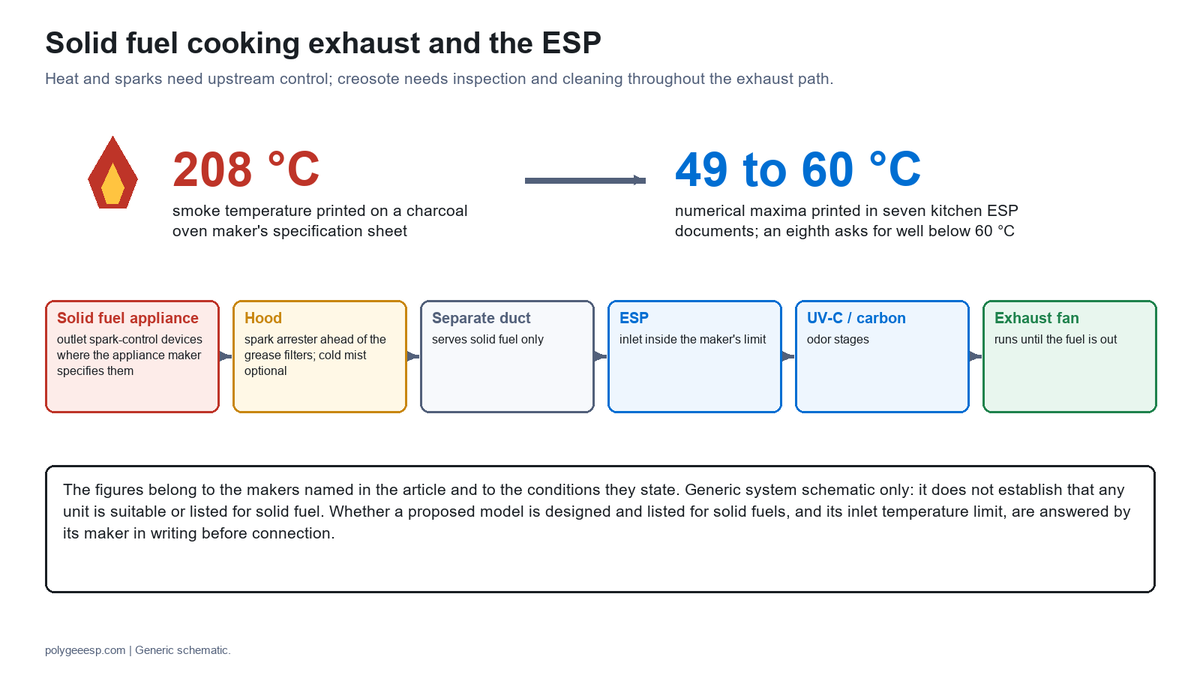
Solid fuel cooking is cooking over burning wood, charcoal or briquettes, which sends sparks, hot flue gas, creosote and carbon monoxide into the exhaust with the grease. On a solid fuel cooking line the heat, sparks and creosote need control upstream of an electrostatic precipitator (ESP), and carbon monoxide needs ventilation and monitoring. Seven kitchen ESP documents print inlet or operating maxima of 49 to 60 °C.
Here, solid fuel cooking means wood-fired pizza ovens, charcoal ovens, open charcoal grills, robata grills and tandoor ovens when they burn solid fuel. A charcoal oven maker’s specification sheet prints a smoke temperature of 208 °C. Seven of the eight kitchen electrostatic precipitator documents read for this page print a numerical maximum for the inlet or operating temperature, from 120 °F (49 °C) to 60 °C. A proposed line therefore needs an inlet temperature check, spark control upstream, and an inspection and cleaning plan that covers the duct and the unit. We manufacture in-duct electrostatic precipitators, UV-C and activated carbon modules, kitchen ecology units and the HME kitchen ESP hood; we do not manufacture conventional exhaust hoods, spark arresters, water mist systems or scrubbers. Figures attributed to other makers are taken from their published documents and describe their products, not ours.
This page helps you decide whether a solid fuel line can take an ESP at all, what has to sit between the fire and the unit, and what to ask the unit’s maker in writing. It ends with The 9-Line Solid Fuel Pre-Treatment Sheet. The code requirements clause by clause are on solid fuel cooking exhaust requirements and the wet route is on wet scrubber or ESP for kitchen exhaust; neither is repeated here.
| Quick specs | Figure | Whose figure |
|---|---|---|
| Inlet or operating temperature printed for kitchen ESPs | Numerical maxima from 120 °F (49 °C) to 60 °C in seven documents; an eighth asks for well below 60 °C | Smog-Hog, Air Quality Engineering, Greenheck, Purified Air, Airclean and Botonair documents; see the table below |
| Smoke temperature printed for a charcoal oven | 208 °C (407 °F), with a flue gas mass flow of 19.36 g/s | Josper HJA-25-HC specification sheet |
| Fan-inlet flue gas limit, wood-fired oven connected directly to a chimney | Not to exceed 450 °F | Wood Stone Mountain Series manual |
| Cold mist in the hood | Reduces exhaust air temperature “by up to 75 degrees Celsius”; 1.2 L/min per metre of hood at 3 bar | Halton cold mist hood documents (2025 and 2019) |
| ESP stages on a solid fuel unit | Three ESP modules and two carbon modules, against two and one on the standard unit | Greenheck Grease Trapper manual |
| The connection rule | Not connected to a pollution-control unit unless the unit is specifically designed and listed for use with solid fuels | International Mechanical Code 2021, Section 506.5.2, item 14 |
| Minimum hood exhaust, unlisted wall canopy | 550 cfm per linear foot | IMC 2021 Section 507.5.1 |
- What solid fuel cooking puts into the duct
- Can a solid fuel cooking line be connected to an ESP at all?
- How hot the exhaust is, and what a kitchen ESP is built for
- Where the heat goes between the fire and the unit
- Sparks and embers from solid fuel cooking: where they are stopped
- Creosote, soot and load: what changes in the unit and the schedule
- What the ESP does not do on this line
- Four appliances, four starting points
- The 9-Line Solid Fuel Pre-Treatment Sheet
- Common mistakes
- Frequently asked questions
What solid fuel cooking puts into the duct
Solid fuel cooking adds sparks, embers and creosote to the exhaust, with hotter fumes and a carbon monoxide risk that continues while the fuel burns down. The New York City Department of Buildings summarizes its mechanical code definition as appliances that “utilize open flame combustion of solid fuels such as hardwood, charcoal, briquettes, and mesquite to provide all or part of the heat source for cooking.” The words “all or part” matter: a gas appliance that burns wood for flavor can fall inside the definition.
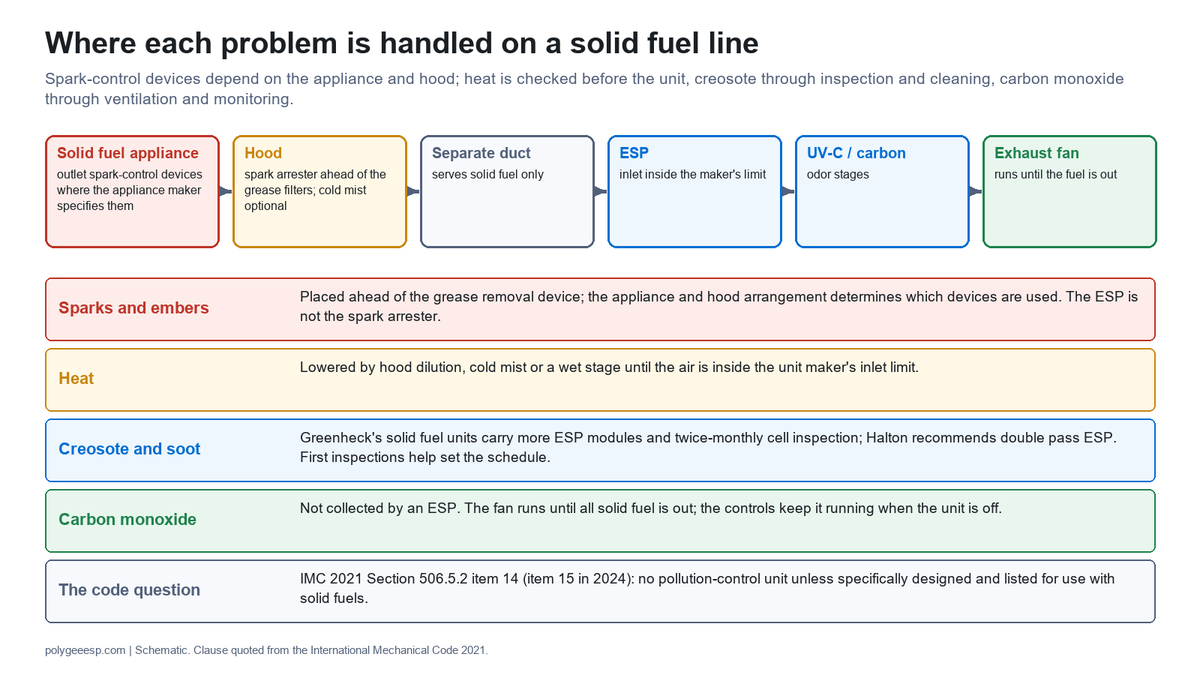
The sources read assign spark control, temperature checks, inspection and cleaning, and carbon monoxide ventilation and monitoring to different parts of the exhaust system.
| What the fire adds | What a published source says | Where it acts |
|---|---|---|
| Sparks and embers | A laboratory study of commercial charcoal products measured ember temperatures of up to 600 °C for lump charcoal (Mencarelli and others, 2025) | Grease filters, hood plenum, duct lining, and anything coated in grease or creosote downstream |
| Hot gas | The UK catering equipment distributors’ guidance says the fumes “are much hotter and more corrosive than gas fumes” | Fan, duct, and every air cleaning stage with a temperature limit |
| Creosote and soot | Oven manuals describe creosote vapors condensing “in the comparatively cool oven flue and exhaust hood duct of a slow burning fire” (Marra Forni) | Duct walls, filters, ESP cells, carbon |
| Carbon monoxide | The same UK guidance says the appliances give it off “particularly when cooling down” | The room and the neighbors; no particle stage acts on it |
| A load without a switch | “There is no on/off switch like most appliances”, so “the load is extremely variable and may exceed projected exhaust requirements” (Greenheck design guide) | Exhaust rate, and the loading on every stage |
The particles themselves are small. Sampling at the chimney exits of three pizzerias in São Paulo burning wood logs or wooden briquettes found an average PM2.5 concentration of 6,171.2 µg/m³ (Lima and others, 2020, abstract). Fine particle control is a separate question from grease capture at the hood; the study does not measure the efficiency of a baffle filter or of an ESP, and what a hood filter does by particle size is on our baffle filter page.
Can a solid fuel cooking line be connected to an ESP at all?
Where the International Mechanical Code (IMC) is adopted, one necessary condition is this sentence: “Extra-heavy-duty appliance exhaust systems shall not be connected to pollution-control units except where such units are specifically designed and listed for use with solid fuels.” That is item 14 of Section 506.5.2 in the 2021 edition and item 15 in the 2024 edition. It applies to any pollution-control unit, electrostatic or not, and it comes before any question of efficiency.
The other documents read for this page approach the same line from different sides. Each row below reports one document; an empty cell means that document was not found to say anything on the point, not that the jurisdiction has no rule.
| Document | Separate exhaust for solid fuel | What it says about air cleaning on that line |
|---|---|---|
| IMC 2021 (US model code) | A hood over extra-heavy-duty appliances does not cover other duties and discharges to an independent exhaust system (507.2.2); a shared grease duct is allowed only where the system does not serve solid-fuel-fired appliances (506.3.5) | No pollution-control unit unless specifically designed and listed for use with solid fuels (506.5.2, item 14) |
| California Mechanical Code 2022, Section 517, which prints the NFPA 96 solid fuel clauses | Exhaust systems serving solid-fuel cooking equipment “shall be separate from all other exhaust systems” (517.3.1), with a narrow allowance for gas equipment that burns a limited quantity of wood for flavoring (517.3.1.1) | Spark arresters ahead of the grease removal device (517.5.1); on a natural draft operation, no additional devices in the appliance, flue pipe and chimney other than the spark arresters (517.8.2) |
| New York City rules, 15 RCNY Chapters 38 and 62 | A cook stove is defined as wood fired or anthracite coal fired. Chapter 38 requires an emission control device that reduces total particulate matter by 75 percent or greater on a new cook stove; Chapter 62 sets an assessment process for cook stoves installed before May 6, 2016, with provisions for cases where 75 percent cannot be achieved. Under Chapter 62 an electrostatic precipitator “must comply with UL 867 (2011) or UL 710 (2012), must have a certificate of approval from the Fire Department, and must be correctly sized for the cooking appliance as specified by the manufacturer” (Section 62-03) | |
| City of Greater Geelong specification, quoting Australian Standard AS 1668.2-2002 | Hoods and exhaust systems over charcoal and solid fuel appliances “shall be provided with separate systems” | Where the exhaust is likely to significantly pollute the outdoor air, the discharge “may be required to be treated” |
| UK odour risk table as reproduced by Sunderland City Council from the 2018 EMAQ update | Any premises cooking with solid fuel scores 10, the “very high” band, for cooking type; the total score sets the level of odour control asked for |
For a buyer the consequence is one question to the maker of any dry unit proposed for the line, asked in writing: is this model specifically designed and listed for use with solid fuels, and under which standard. For our own in-duct units that answer is given model by model with the quotation, and this page does not claim such a listing. Where the answer is no and the adopted code carries this requirement, that unit is not connected to the line; any alternative pollution-control unit, a wet one included, has to meet the design and listing requirements that apply to it.
How hot the exhaust is, and what a kitchen ESP is built for
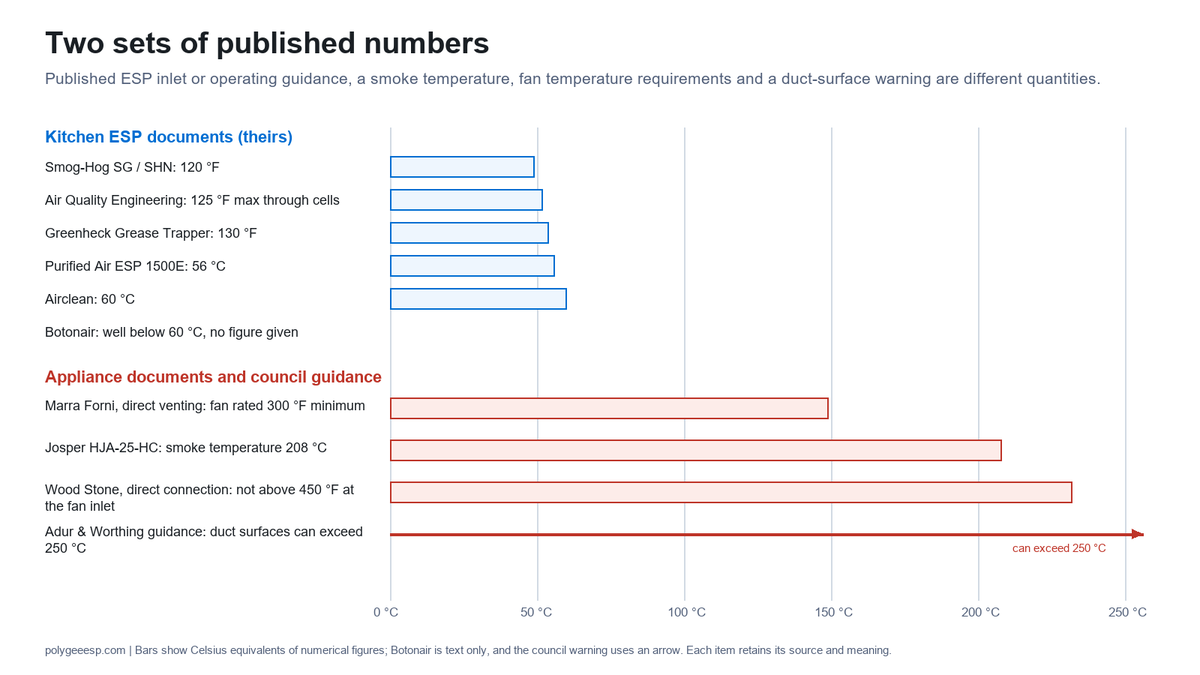
Eight documents from six makers of kitchen electrostatic precipitators give inlet or operating temperature guidance, seven of them as numerical maxima from 49 to 60 °C, while solid fuel appliance documents print a smoke temperature of 208 °C and fan temperature figures of 300 and 450 °F. The documents report different quantities, and each is read with the location and purpose its maker states. The two tables below set them side by side.
| Kitchen ESP document | What it prints | What the figure refers to |
|---|---|---|
| Smog-Hog SG and SHN manuals | Both manuals give a maximum of 120 °F for the operating temperature of the air stream; the SHN manual also prints 49 °C | Air stream into the unit |
| Air Quality Engineering kitchen exhaust air cleaning system | “Air flow through cells: 40 F minimum, 125 F maximum” (about 4 to 52 °C) | Air through the cells; the power supply has its own, wider rating |
| Greenheck Grease Trapper manual | “Operating temperatures of the airstream should not exceed 130°F” (about 54 °C) | Airstream through the unit |
| Greenheck pollution control unit maintenance guide, 2025 | For solid fuel units, the incoming air temperature during operation is not to exceed 130 °F | Incoming air, solid fuel units named |
| Purified Air ESP 1500E data sheet | “MIN/MAX WORKING TEMP 4/56°C” | Working temperature; the same sheet prints a maximum relative humidity of 75% |
| Airclean ESP product page | “Maximum operating temperature: 60°C” | Operating temperature |
| Botonair commercial kitchen ESP manual | The flue gas temperature entering the equipment “should be controlled well below 60℃” | Gas entering the unit; the manual does not say how far below |
Five other documents read for this page print no inlet temperature limit: the CaptiveAire pollution control unit manual and specification, the Trion Air Boss KES manual, and the Halton PolluStop brochure BR-013 and specification SS-150. Two of these makers’ documents do print temperatures, but for other purposes. CaptiveAire’s unit has fire system sensors set at 360 °F, and Halton’s specification offers an outlet fire damper with a 212 °F fusible link. Those are the points at which a fire response starts, not the temperature the unit is meant to run at.
An article in the Australian institute AIRAH’s journal puts the same band in general terms: effective treatment of kitchen exhaust by any method “requires air temperature in the duct to be under 50°C”, and exceeding it is described as “common if there is a solid fuel application” (Ecolibrium, April 2018). A filter maker’s checklist gives 55 °C as the point above which particulate filtration “may drop below levels required” and below which exhaust air must generally be for carbon to adsorb.
| Solid fuel source | What the document prints | Where the figure applies |
|---|---|---|
| Josper HJA-25-HC charcoal oven specification sheet | Smoke temperature 208 °C (407 °F); flue gas mass flow 19.36 g/s; exhaust rate 2,800 m³/h (1,648 cfm) | The sheet does not state the measuring point |
| Wood Stone Mountain Series manual, oven connected directly to a chimney | Power ventilator rated for a minimum of 450 °F; a static pressure of −0.14 inches water column at the oven flue collar so that flue gas temperatures “do not exceed 450 °F at the fan inlet”; 425 to 550 cfm by model | Direct connection only; the fan inlet, not the oven chamber |
| Marra Forni manual, direct venting | “A minimum temperature rating of 300°F is required for the power ventilator” | Direct connection only |
| Marra Forni manual and a Forno Bravo venting letter, oven under a Type I hood | 800 to 1,000 cfm; duct velocity 1,500 to 2,500 fpm | Hood route |
| Mibrasa HMB charcoal oven manual | 2,500 to 3,500 m³/h through an independent hood, by model | The French-language table of the manual; the oven outlet is not to be connected directly to the hood |
| Mencarelli and others, 2025, laboratory grilling test | Embers up to 600 °C; fumes 60 °C | The fume temperature was read in a range hood chimney 100 cm from the grill, with the exhaust air held at 2 m/s |
| Adur & Worthing Councils kitchen extraction guidance | Duct surface temperatures on wood burning appliances “can reach in excess of 250°C” | The duct serving the appliance |
We do not publish an inlet temperature limit for our own units on this page. The figure for the model proposed, and the design temperature it was checked against, is stated in writing with the quotation, which is the question our ESP arcing and tripping guide also sends there. One further caution: figures written for large industrial precipitators do not transfer. The US EPA cost manual says combustion exhaust below approximately 700 °F can be delivered directly to a precipitator, and it says so of single-stage industrial units, not of the two-stage cells a kitchen unit uses.
Where the heat goes between the fire and the unit
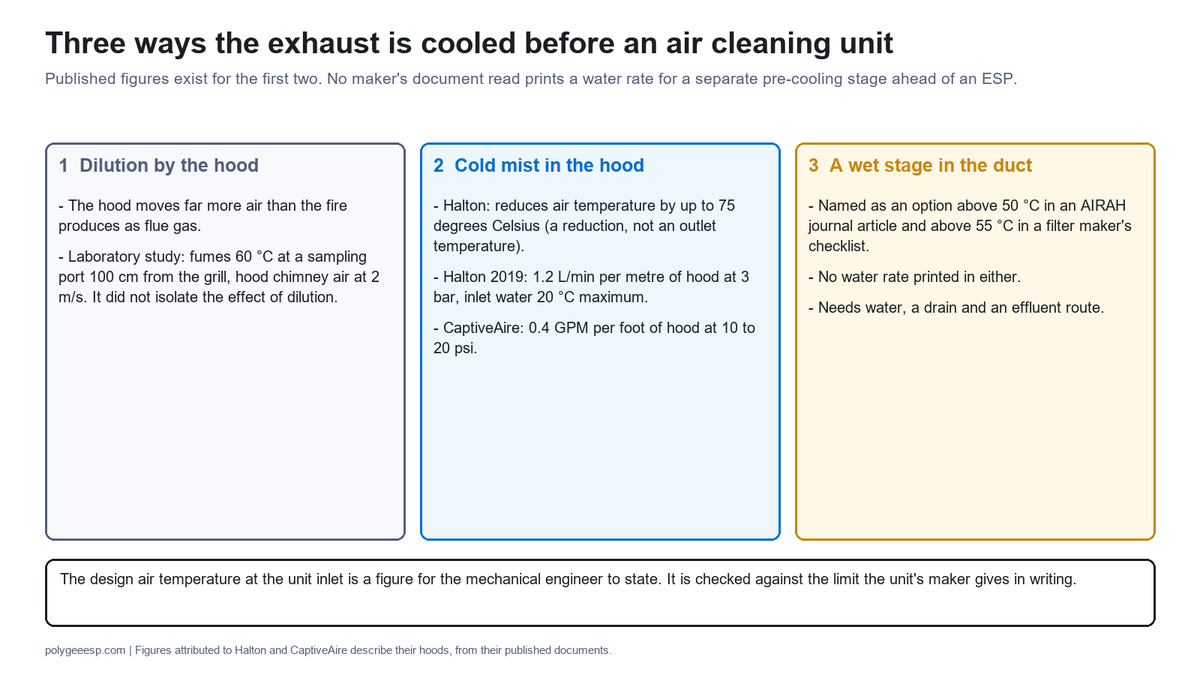
Three things lower the temperature between a solid fuel appliance and an air cleaning unit: room air drawn in by the hood, cold water mist in the hood, and a wet scrubbing stage in the duct. Published figures exist for the first two. None of the makers’ documents read for this page prints a water rate or a temperature drop for a separate pre-cooling stage placed in the duct ahead of a precipitator.
Dilution by the hood
A hood over a solid fuel appliance moves far more air than the fire produces as flue gas, and that is the first reason a hooded line is cooler than a chimney. The laboratory study above measured fumes at 60 °C at a sampling port one metre from the grill, with the air velocity in the hood chimney held at 2 m/s; it did not isolate how much of the temperature drop was due to dilution.
The direct-connected route is the other case. For it, the Wood Stone manual specifies 425 to 550 cfm by model and a ceiling of 450 °F for flue gas at the fan inlet; it does not state the temperature at a proposed air cleaner position. On any route, the temperature at the proposed unit position is checked against that unit’s limit, and the appliance’s venting instructions and the code in force have to permit the connection; a cooling stage alone does not establish permission to connect.
Cold mist in the hood
Cold water mist sprayed in the hood’s exhaust plenum cools the air and quenches sparks in the same step. Halton’s 2025 cold mist hood document says the mist “reduces the air temperature by up to 75 degrees Celsius”, a figure it describes as tested by a third party. Read it as written: it is a reduction, with no inlet temperature, outlet temperature or airflow printed beside it, so it does not say what temperature arrives at a unit downstream.
| Document | Water figures it prints for cold mist | Condition |
|---|---|---|
| Halton cold mist hood document, 2019 edition | Inlet water 20 °C maximum; 3 bar at the hood nozzles; 1.2 L/min per metre of hood at 3 bar | Mist in the hood plenum |
| CaptiveAire installation manual, constant cold water option, as mirrored on a manuals site | Unheated water at 10 to 20 psi; “Typical water flow rate is 0.4 GPM per foot of hood” (about 5 L/min per metre); the spray runs whenever the fans are on | Mist in the hood; the same manual’s 0.7 GPM per foot is the hot water wash, a different function |
| Halton mist on demand leaflet | A one-month comparison of two adjacent hood sections: 95.4 m³ of water with continuous mist and about 17.3 m³ with mist on demand | A single site; the hood length is not printed |
Two things follow for a buyer. Mist needs a water supply, a drain and somebody who notices when it stops; a consultant’s article hosted by CaptiveAire describes a duct fire on a wood-fired line where the water valves to a mist hood had been shut. And a cold mist hood needs the hood, the water supply, the drainage and the controls designed together, whether it is proposed for a new installation or a retrofit. Hood types and what each hands on downstream are on our commercial kitchen hood page.
A wet stage in the duct
The AIRAH journal article lists the options above 50 °C as a cold-water mist injection hood, an in-duct wet scrubber, “or any other form of airstream cooling prior to filtration”, and the filter maker’s checklist suggests a wet scrubber in the hood or duct ahead of the filtration system above 55 °C. Neither prints a water rate. One Australian supplier’s presentation states that its wet scrubber is required for solid fuel and charcoal and that it allows a common exhaust duct; that second claim runs against the separate-system clauses quoted above and is a matter for the code in force, not for a supplier’s slide. What a wet stage asks of the site, in water, drainage and effluent, is set out on the wet scrubber page.
Sparks and embers from solid fuel cooking: where they are stopped
Spark control belongs upstream of the grease removal device, not in the precipitator; which arresters are used depends on the appliance and the hood. The clause the California code prints from NFPA 96 reads: “If airborne sparks and embers can be generated by the solid fuel cooking operation, spark arrester devices shall be used prior to using the grease removal device, to minimize the entrance of these sparks and embers into the grease removal device and into the hood and the duct system” (California Mechanical Code 2022, Section 517.5.1). The next clause sets the filters at least 4 ft (1,219 mm) above the appliance cooking surface; the Geelong specification, quoting the 2002 Australian standard, gives 1,350 mm for charcoal and similar open fires.
| Barrier | What the maker’s document says | What it does not print |
|---|---|---|
| At the charcoal oven outlet | Mibrasa: a firebreak “to prevent flames or sparks from escaping the oven” and a dissipating filter that slows the flow and drops its temperature. Josper: a firebreak filter, described as a “Metal labyrinth where solid particulates cool and precipitate”, under a heat sink that cools the smoke to protect the extractor hood | A temperature after the device |
| Hood filter approved as a spark arrestor | CaptiveAire Captrate Solo: “Manufacturer approved for use in Solid Fuel applications as a Spark Arrestor”; listed to UL 1046; pressure drop not to exceed 1.0 in. w.g. (about 249 Pa) | A capture rate for sparks |
| Centrifugal hood filter | Accurex Grease-X-Tractor: UL 1046 classified and “spark arrestor certified”; 0.7 to 0.8 in. wg, stated for a 9 by 4 ft hood at 2,050 cfm | A capture rate for sparks |
| Cold mist | Halton: the mist “acts as an effective ‘Spark Arrestor’”; Greenheck: continuous water mist “can be used to extinguish embers” | A test standard |
The absence in the right-hand column is general. A consultant writing in a facility management magazine in 2016 put it this way: “Though ‘spark arrestor filters’ are available, there are no known standards or listing tests for application of these products to hoods over solid fuel cooking.” That is one author’s statement and it predates some current products, but none of the documents read for this page names a spark capture test either. UL 1046, which the filters above cite, is a flame exposure test for grease filters.
Two practical points follow. The resistance of the spark arresting filter belongs in the fan calculation with the rest of the system, alongside the resistance of the precipitator. And the word spark means something different inside an ESP manual: when CaptiveAire’s manual states “A maximum of one [1] spark per minute is allowed”, it is describing electrical sparkover in the cell, the subject of our arcing guide, not embers.
Creosote, soot and load: what changes in the unit and the schedule
For solid fuel cooking the published response of precipitator makers is more collecting stages and more frequent inspection, and no document read for this page prints a cleaning interval that holds for every fire. The reason is in how creosote forms. The Chimney Safety Institute of America’s paper on chimney fires says the flue gases contain hydrocarbon gases “each with its own concentration-dependent dew point, so there is no single critical temperature”, and that the temperature of the flue walls “has more to do with the condensation of hydrocarbons into creosote than does the flue gas temperature.” The paper is about residential chimneys, and the oven manuals describe the same mechanism in a hood and duct: vapors can condense on surfaces that are below their dew point. Cooling the exhaust may change where creosote condenses; the sources read do not establish where, so the inspection and access plan covers the whole exhaust path.
| Maker and document | What changes for solid fuel |
|---|---|
| Greenheck Grease Trapper manual | A solid fuel unit with three ESP modules and two carbon filtration modules; the standard unit has two and one |
| Halton PolluStop brochure | “Double Pass ESP Modules are recommended for extra heavy duty applications such as solid fuel cooking” |
| CaptiveAire pollution control unit manual | The manual describes two configurations, PF-HE-HEPA (NYC DEP CB2017-0004/CS2017-0001) and HE-ESP-ESP (CB2020-0001/CS2020-0001), each with optional odor control modules, as approved for use over a commercial charbroiler or commercial wood cook stove; inlet velocity under 800 ft/min for heavy duty and solid fuel, against under 1,000 ft/min for light duty |
| Greenheck maintenance guide, 2025 | ESP cells inspected monthly, “or twice monthly for solid fuel units”; cells removed and manually cleaned every six months as a minimum on any unit |
| CaptiveAire C-ESP manual (earlier product) | Cell rotation every 7 days for the extra heavy duty class, which the table gives as solid fuel broilers, against 14, 21 and 30 days for heavy, medium and light duty |
The appliance makers write their own schedules for the exhaust system, and they do not agree. Wood Stone asks for the duct to be inspected at least twice a month during the first two months “to establish rate of creosote buildup and necessary cleaning schedule”, and recommends cleaning and inspection at least monthly on any ventilation system serving solid fuel equipment. Marra Forni asks for inspection of the flue, duct and fan at least twice monthly. Josper recommends cleaning the extractor hood and its filters weekly. The NFPA 96 table, as California prints it, schedules inspection for grease buildup monthly for systems serving solid fuel cooking. The Wood Stone wording points to the method: the first inspections establish the rate of buildup on the line as built.
Our own published basis is on our pollution control unit maintenance page: our dry in-duct units have their cells drawn and washed off the unit every 15 to 30 days for a typical lunch-and-dinner restaurant and every 7 days for wok frying, deep frying or charcoal, with the figure for a given model and menu stated in writing with the quotation.
How much an electrostatic stage removes on a heavy smoke source has one public test worth reading with its limits. A University of California, Riverside study of an under-fired charbroiler cooking beef patties measured the largest reduction in particulate mass for the control technology that combined an electrostatic precipitator with an activated carbon bed: 86 percent by Method 5.1 and 90 percent by the dilution method (Gysel and others, 2018). The authors note that the result was below the theoretical capability of an electrostatic precipitator and suggest that organic vapors accumulated in the unit may explain it. The appliance was a gas charbroiler, not a wood or charcoal fire, the unit was not ours, and the figure is not a claim for any product. The study also reports a mean particle diameter of about 0.15 µm, within the operating range it cites for the precipitator.
What the ESP does not do on this line
An electrostatic precipitator collects particles; it does not act on carbon monoxide, and it does not replace the fan logic a solid fuel fire needs. The UK Health and Safety Executive’s information sheet on solid fuel appliances in commercial kitchens, which names tandoori ovens, charcoal grills and wood-fired pizza ovens, was written after carbon monoxide exposure in homes next to catering premises. It asks for procedures so that “the extraction system fan remains switched on until all solid fuel has been extinguished, even if there is nobody on the premises”, for a carbon monoxide alarm suitable for a commercial kitchen, and for the extraction system to be thoroughly examined and tested at least once every 14 months (HSE Catering Information Sheet 26). Hong Kong’s fire services licensing conditions for charcoal inside a kitchen require the ventilating system to be on whenever charcoal is burnt and a carbon monoxide detection system that alarms at 10 ppm. Josper’s handbook recommends leaving the hood running for 15 minutes after the oven’s upper and lower vents are closed; it does not say that all fuel is out at that point, and it does not replace the ventilation requirement that applies on the site.
For the air cleaning unit this means two things. The controls have to keep extraction running while solid fuel remains alight, after service has ended as well, and the controls designer confirms how that is achieved when the precipitator is off. And the 14-month examination is an examination of the extraction system, which the sheet separates from the regular cleaning programme it also requires.
Odor is the other limit. The smell of wood and charcoal smoke is partly gas, and a particle stage passes gas. The Adur & Worthing guidance asks, where cooking produces a large volume of smoke, for filters that remove smoke particles to be placed before any odour filters, which is the order of a kitchen ecology unit: precipitator, then UV-C, then carbon. The carbon stage has its own temperature condition, the 55 °C in the filter maker’s checklist above, so the temperature question is asked of every stage and not only of the cells. What a UV stage adds and what it emits is on our ESP and ozone page.
Four appliances, four starting points
These four solid fuel cooking appliance types start the conversation in different places, because their makers vent them differently. The table gives the first question for each and the document it comes from.
| Appliance | How its maker vents it | First question before an ESP is drawn |
|---|---|---|
| Wood-fired pizza oven | Two routes in the manuals: directly to a listed chimney (Wood Stone 425 to 550 cfm, fan inlet not above 450 °F) or under a Type I hood (Marra Forni and Forno Bravo 800 to 1,000 cfm) | Which route is built. For a natural draft solid fuel operation, California Mechanical Code 2022 Section 517.8.2 prohibits added devices in the appliance, flue pipe and chimney except the spark arresters required by Section 517.1.6. An air cleaner connection has to be permitted by the venting arrangement, the equipment instructions and the code in force |
| Enclosed charcoal oven | Under a hood, not connected directly to it; firebreak and heat sink or dissipating filter at the oven outlet (Josper, Mibrasa); 2,500 to 3,500 m³/h (Mibrasa), 2,800 m³/h for one Josper model | Whether the oven’s own outlet devices are fitted and the charcoal load is the maker’s; Mibrasa ties their correct operation to its recommended loads |
| Open charcoal grill or robata | Under a Type I hood at the extra-heavy-duty rate, 550 cfm per linear foot for an unlisted wall canopy under the IMC; cold mist hoods are sold for this duty | Where sparks are stopped, since an open fire has no firebreak of its own, and whether the hood is a mist hood or a dry one |
| Tandoor | No tandoor maker’s venting manual for a charcoal-fired unit was obtained for this page; the UK sheet names tandoori ovens among the appliances it covers | The same nine lines as any other solid fuel appliance, starting with the fuel: a gas-fired tandoor is a different class from a charcoal one |
Grilled-fish and barbecue chains run our precipitators, Tanyu among them. How the hood, duct, fan and air cleaning stages fit together around any of these appliances is on our kitchen ventilation system page.
The 9-Line Solid Fuel Pre-Treatment Sheet
Nine lines organize the information needed to assess a dry air cleaning unit proposed for a solid fuel line, and each has an owner. They do not replace the code and design review. The sheet is our own framework for collecting them; it is filled from the drawings, the appliance manual and the unit maker’s written reply, and no line has a default value.
| Line | What to record | Where to read it | If it is missing |
|---|---|---|---|
| 1 | Appliance make and model, the fuel, and the appliance listing | Equipment schedule; appliance data plate and manual | It is not known which maker’s venting instructions apply |
| 2 | Venting route: direct to a chimney, or under a hood | Appliance manual; mechanical drawings | A unit is priced for a line it cannot be placed on |
| 3 | Separate exhaust system for the solid fuel appliances, with the drawing number | Mechanical drawings; the code edition in force | The plan fails review whatever is installed behind the hood |
| 4 | Spark arrest: the appliance’s own outlet devices, and the device in the hood with its model and what it is listed or approved to | Appliance manual; hood submittal | Embers reach grease filters, duct lining and cells |
| 5 | Design air temperature at the unit inlet, and who calculated or measured it | Mechanical engineer’s calculation; commissioning reading | The unit maker’s limit has nothing to be checked against |
| 6 | Cooling method: dilution only, cold mist, or a wet stage, with water rate, inlet water temperature and drain | Hood or scrubber submittal | The temperature in line 5 is a hope and not a design |
| 7 | The unit maker’s written reply: whether the model is specifically designed and listed for solid fuels and to which standard, its inlet temperature limit, and the upstream devices it requires | Quotation or a letter from the maker | Under IMC 2021 Section 506.5.2 item 14 (item 15 in the 2024 edition), there is no basis for connecting the unit |
| 8 | Inspection and cleaning: the code inspection frequency, the unit maker’s interval for this duty, the first-weeks inspection plan, and who does each | Code edition in force; unit and appliance manuals; cleaning contract | The gas-line interval is carried over to a line that fouls faster |
| 9 | Fan and carbon monoxide: how the fan runs after service until the fuel is out, the alarm, and whether the unit is switched separately from the fan | Controls drawing; local safety guidance | The fan stops with the unit while the fire is still burning down |
Lines 1 to 6 are the project’s to fill and line 7 is the unit maker’s. A quotation written without lines 5 and 7 is a price for a unit, not for a unit on this line; the inputs a quotation normally needs are on our ESP quotation page.
Common mistakes
- Comparing efficiency before asking the listing question. Under IMC 2021 Section 506.5.2 item 14 (item 15 in the 2024 edition), the connection depends on the unit being specifically designed and listed for use with solid fuels.
- Reading a fire-trip temperature as an operating limit. The 360 °F and 212 °F figures in two makers’ documents are fire responses; the operating limits other makers print are 49 to 60 °C.
- Reading “up to 75 degrees” as an outlet temperature. It is a reduction, printed without the conditions that would turn it into a temperature at the unit.
- Drawing an air cleaning unit onto a natural draft flue. The California text prohibits added devices in the appliance, flue pipe and chimney of a natural draft solid fuel operation, except the required spark arresters.
- Treating the monthly inspection as the cleaning interval. The table schedules inspection for grease buildup; the cleaning interval comes from what the inspection finds and from the unit maker.
- Switching the fan with the precipitator. The fuel goes on burning after service ends, and UK guidance asks for the fan to stay on until all of it is extinguished.
- Adding charcoal to a gas line and keeping the hood, duct and unit. The fuel changes the class of the appliance, the exhaust system it needs and the question in line 7.
Key takeaways
- The code question comes first: where the IMC applies, a solid fuel exhaust is not connected to a pollution-control unit unless the unit is specifically designed and listed for use with solid fuels.
- Eight documents from six makers give ESP inlet or operating temperature guidance: seven state numerical maxima from 49 to 60 °C and one asks for gas well below 60 °C. A charcoal oven maker’s sheet prints a smoke temperature of 208 °C.
- Cooling happens upstream, by the air the hood draws in, by cold mist in the hood, or by a wet stage, and the published water figures are for mist in the hood: 1.2 L/min per metre of hood at 3 bar in one document, 0.4 GPM per foot in another.
- Spark control sits ahead of the grease removal device; the appliance and hood arrangement determines which arresters are used. The documents read name no spark capture test.
- Greenheck specifies more ESP modules and twice-monthly cell inspection for its solid fuel units, and Halton recommends double pass ESP modules; the first inspections help establish the cleaning schedule for the line as built.
- The ESP does not act on carbon monoxide; the fan runs until the fuel is out, independently of the unit.
Where this guide stops
This page reports what published documents say and how they bear on one decision. NFPA 96 is a paid standard and was not read: its solid fuel clauses are quoted as the 2022 California Mechanical Code prints them. The 2018 EMAQ odour guidance and AS 1668.2 were not read either; they appear through a city council’s reproduction and a municipal specification that quotes the 2002 edition, and the current editions may differ. The IMC definition of an extra-heavy-duty appliance is given through the New York City Department of Buildings’ summary of its own mechanical code. Indian rules on charcoal tandoors are not covered here; what we could read of them is on the wet scrubber page. Figures attributed to appliance makers and to other makers of air cleaning equipment describe their products under their stated conditions; we report no testing of those products, and no figure here is a rating for ours. The page gives no instruction on lighting, cleaning or extinguishing: those follow the appliance and unit manuals and the local fire and safety rules, and the authority having jurisdiction decides what is accepted on a given site.
Frequently asked questions
- Can an electrostatic precipitator be used on a wood-fired pizza oven or a charcoal grill?
- Only behind the right upstream equipment, and only where the code in force and the unit’s maker allow it. Under the International Mechanical Code a solid fuel exhaust is not connected to a pollution-control unit unless the unit is specifically designed and listed for use with solid fuels. Where that is met, the line still needs its own exhaust system, a spark arrester ahead of the grease filters and an inlet temperature inside the unit’s limit. New York City’s cook stove rules list electrostatic precipitators among the accepted control devices for wood and anthracite coal fired cook stoves, with conditions.
- What is the maximum inlet temperature for a kitchen ESP?
- It depends on the model, and the maker states it. Seven documents from five makers give numerical inlet or operating maxima of 120 °F (49 °C), 125 °F, 130 °F, 56 °C and 60 °C; an eighth document, from a sixth maker, asks for the gas to be well below 60 °C without giving a figure. Five other documents read print no limit. Ask for the figure for the model proposed in writing, and check it against the design temperature at the unit’s position on the line.
- Is water mist pre-cooling required before an ESP on solid fuel cooking exhaust?
- No code text read for this page requires mist ahead of an ESP. It is one of three ways the exhaust is cooled, with dilution by the hood and a wet stage in the duct. One hood maker states that its cold mist reduces the air temperature by up to 75 degrees Celsius and prints 1.2 L/min per metre of hood at 3 bar. Whether mist is needed depends on the design temperature at the unit and the limit its maker states.
- Does an ESP remove carbon monoxide from charcoal cooking?
- No. An electrostatic precipitator collects particles and carbon monoxide is a gas. UK guidance for solid fuel appliances in commercial kitchens asks for the extraction fan to stay on until all solid fuel has been extinguished and for a carbon monoxide alarm, so the controls have to keep the fan running when the air cleaning unit is off.
- How often is an ESP cleaned on a solid fuel line?
- Inspection and cleaning intervals depend on the component and the maker’s instructions. One maker’s 2025 guide asks for its ESP cells to be inspected twice monthly on solid fuel units, and an oven maker asks for the duct to be inspected at least twice a month for the first two months to establish the rate of creosote buildup. Our dry in-duct units have their cells drawn and washed off the unit every 15 to 30 days for a typical lunch-and-dinner restaurant and every 7 days for wok frying, deep frying or charcoal, with the figure for a given model and menu stated in writing with the quotation.
Planning an ESP behind charcoal or wood?
Send us lines 1, 2, 5 and 6 of The 9-Line Solid Fuel Pre-Treatment Sheet: the appliance and fuel, the venting route, the design air temperature at the unit position and how the exhaust is cooled, with the exhaust airflow and the code edition in force. You get back line 7 in writing for the in-duct precipitator or ecology unit proposed: whether that model is designed and listed for solid fuels and to which standard, its inlet temperature limit, the upstream devices it requires, and the cell washing interval we would start from.
Send the appliance, fuel and temperature →
The in-duct units are on our kitchen electrostatic precipitator page and the three-stage units on the kitchen ecology unit page.
Why we write this. The US result pages saved for this term on 13 November 2026 included code chapters and fire safety explainers, alongside other material about solid fuel cooking. The numbers that bear on whether an air cleaning unit can follow a solid fuel hood are in the unit makers’ manuals, the appliance makers’ manuals and one sentence of the mechanical code, and this page brings those published figures together for comparison.
Law is Project Manager at Polygee. Polygee, founded in 2004, manufactures in-duct electrostatic precipitators, UV-C and activated carbon modules, kitchen ecology units and the HME kitchen ESP hood; it does not manufacture conventional exhaust hoods, spark arresters, water mist systems or scrubbers. The code text cited on this page was read in the sources listed below, and the figures attributed to other manufacturers are taken from their published documents and describe their products. This page is not a compliance determination; the authority having jurisdiction applies the edition it has adopted.
References & further reading
- International Code Council, International Mechanical Code 2021, chapter 5: sections 506.3.5, 506.5.2 (item 14), 507.2, 507.2.2 and 507.5.1; and the 2024 edition, sections 506.5.2 (item 15) and 507.2.10.1. codes.iccsafe.org
- California Mechanical Code 2022 (Title 24, Part 4), sections 517.1 to 517.8 and Table 514.3, with the NFPA 96 clause numbers it prints, as published by GoCodebook. NFPA 96 itself was not read for this page. gocodebook.com
- New York City Department of Environmental Protection, Rules of the City of New York, Title 15, Chapter 62, Emissions Reduction Technologies for Existing Cook Stoves, and Chapter 38 (new cook stoves), as amended effective April 27, 2024. codelibrary.amlegal.com
- New York City Department of Buildings, Solid Fuel Cooking Appliances. nyc.gov
- Health and Safety Executive, Catering Information Sheet No 26, Preventing exposure to carbon monoxide from use of solid fuel appliances in commercial kitchens, 01/16. hse.gov.uk
- Hong Kong Fire Services Department, Additional Fire Safety Requirements for Using Charcoal as Fuel Inside Kitchen, February 2019.
- City of Greater Geelong, Mechanical Exhaust Systems Specifications, quoting AS 1668.2-2002; Sunderland City Council, odour risk assessment table reproduced from the 2018 EMAQ update of the Defra guidance; Adur & Worthing Councils, guidance on commercial kitchen extraction.
- CEDA (Catering Equipment Distributors Association), Technical Guidance Document No 6 rev 1, Ventilation of Solid Fuel Appliances in Commercial Kitchens.
- Greenheck, Grease Trapper installation, operation and maintenance manual; Pollution Control Unit maintenance guide, September 2025; Kitchen Ventilation Systems application and design guide. greenheck.com
- Smog-Hog, SG and SHN series manuals; Air Quality Engineering, kitchen exhaust air cleaning system specification; Purified Air, ESP 1500E data sheet; Airclean, ESP product page; Foshan Boton Air Technology, commercial kitchen electrostatic precipitator manual; Trion, Air Boss KES Series installation, operation and maintenance manual.
- CaptiveAire Systems, Pollution Control Unit operation, installation and maintenance manual and specification; C-ESP manual; Captrate Solo filter specification; CORE installation manual as mirrored on manualmachine.com. Doug Horton, articles on solid fuel cooking fire risk hosted by CaptiveAire, including FMJ, November/December 2016.
- Halton, CMW-FMOD Cold Mist Hood (2025); CMW cold mist hood brochure (2019); Mist on Demand leaflet; PolluStop brochure BR-013 and specification SS-150. halton.com
- Accurex, hood filter specification table (Grease-X-Tractor).
- Josper, HJA-25-HC specification sheet, edition 10.2020, and HJA-PLUS handbook; Mibrasa, HMB charcoal oven installation and use manual; Wood Stone, Mountain Series installation and operation manual M0036.14; Marra Forni, installation and operation manual; Forno Bravo, letter on venting for commercial ovens, June 9, 2016. Wood Stone manual
- Mencarelli A., Greco R., Grigolato S., Can the qualitative characteristics of commercial charcoal-based products affect combustion performance during grilling? Biomass Conversion and Biorefinery 15 (2025). doi.org
- Lima F. D. M. and others, Characterization of particles emitted by pizzerias burning wood and briquettes: a case study at São Paulo, Brazil. Environmental Science and Pollution Research 27 (2020); abstract only. doi.org
- Gysel N. and others, Particulate matter emissions and gaseous air toxic pollutants from commercial meat cooking operations. Journal of Environmental Sciences 65 (2018) 162–170. doi.org
- Chimney Safety Institute of America, Chimney Fires: Causes, Effects & Evaluation.
- AIRAH, Ecolibrium, April 2018, article on kitchen exhaust filtration; Camfil, kitchen exhaust filtration checklist. airah.org.au
- U.S. Environmental Protection Agency, EPA Air Pollution Control Cost Manual, Section 6, Chapter 3, Electrostatic Precipitators. epa.gov
Related reading
- Solid fuel cooking exhaust requirements: the separate system, the hood rate, fire-extinguishing equipment and fuel storage, clause by clause.
- Wet scrubber or ESP for kitchen exhaust: what the wet route asks of the site and where it is the stronger case.
- Pollution control unit maintenance: the four clocks a unit runs on and the document each interval comes from.
- Charbroiler emissions regulations: the New York and California rules for charbroilers, which sit beside the cook stove rules quoted here.