

The standard that fire inspectors in the United States apply to a restaurant exhaust system is published by the National Fire Protection Association and has no legal force of its own. NFPA 96, the Standard for Ventilation Control and Fire Protection of Commercial Cooking Operations, becomes a requirement when a fire code, a building code or a state rule adopts one of its editions. The edition adopted where you build decides which clause numbers and which requirements apply.
The current edition is 2027. Texas and Florida adopted the 2021 edition, the 2024 International Fire Code references the 2024 edition, and a 2024 Ontario requirements sheet still points to 2014. The chapters were renumbered in 2021, so a clause quoted from an older summary can sit one chapter away from where a newer edition prints it. We manufacture in-duct electrostatic precipitators, UV-C and activated carbon modules, kitchen ecology units and the HME kitchen ESP hood. We do not make fire-extinguishing systems or grease ducts, and we do not clean exhaust systems.
This page helps you decide which edition of NFPA 96 to quote on a project, how to translate a clause number between editions, and which clauses apply to an electrostatic precipitator or a pollution control unit installed in the exhaust. It includes The 6-Line NFPA 96 Edition Check. How Canadian codes bring the standard into a project is on our NFPA 96 in Canada page, and the plan-review checklist for hoods is on commercial kitchen hood code requirements; neither is repeated here.
| Quick specs | What is written | Source |
|---|---|---|
| Current edition | 2027, issued April 24, 2026 and effective May 14, 2026 | NFPA, NFPA 96 development page |
| What it covers | Preventive and operative fire safety requirements for public and private commercial cooking operations | NFPA, same page |
| Chapter renumbering | The 2021 edition added a chapter 11 and a chapter 17; inspection and cleaning moved from chapter 11 to chapter 12, solid fuel from chapter 14 to chapter 15 | Clause numbers printed in the California Mechanical Code, 2022 and 2025; NFPA revision documents |
| Inspection for grease buildup | Monthly, quarterly, semiannually or annually by type of cooking (Table 12.4; Table 11.4 through the 2017 edition) | NFPA 96 as extracted in NFPA 1 and in the California Mechanical Code |
| Air pollution control devices in the exhaust | Permitted where specifically listed for such use (9.3.1); protected by an automatic fire-extinguishing system (9.3.3, 10.1.3) | Same extracts |
| Pollution control units | Listed in accordance with UL 8782, from the 2024 edition (9.3.1.1, item 8) | NFPA first revision documents for the 2024 edition |
| Our UL listing | UL 867, File E522667, covering the LK/SE-6K, LK/SE-12K and LK/SE-18K models, 230 V/50 Hz | Our data |
- What is NFPA 96?
- Which edition of NFPA 96 applies to your project
- NFPA 96 chapters: the 2017-to-2027 chapter crosswalk
- What changed in 2017, 2021, 2024 and 2027
- The inspection schedule in Table 12.4
- Where an ESP or pollution control unit sits in NFPA 96
- NFPA 96 and the mechanical and fire codes
- The 6-Line NFPA 96 Edition Check
- Which document proves what
- Common mistakes
- Frequently asked questions
What is NFPA 96?
NFPA 96 is a fire safety standard for commercial cooking: it sets requirements for the hood, the grease removal devices, the exhaust duct, the fan, the fire-extinguishing equipment and the upkeep of all of them. On its development page for NFPA 96, the National Fire Protection Association describes it in one sentence: it “provides preventive and operative fire safety requirements intended to reduce the potential fire hazard of both public and private commercial cooking operations.”
The annex to its first section lists what falls inside. The requirements include “all manner of cooking equipment, exhaust hoods, grease removal devices, exhaust ductwork, exhaust fans, dampers, fire-extinguishing equipment, and all other auxiliary or ancillary components or systems that are involved in the capture, containment, and control of grease-laden cooking effluent” (A.1.1.1, as extracted in the 2027 revision of NFPA 1, Fire Code, Chapter 50). An electrostatic precipitator in the duct is one of those auxiliary components.
The scope reaches further than restaurants. Residential cooking equipment used for commercial cooking operations is covered (1.1.2). So is cooking equipment in “fixed, mobile, or temporary concessions, such as trucks, buses, trailers, pavilions, tents, or any form of roofed enclosure” (1.1.3). Cooking equipment located in a single dwelling unit is not covered (1.1.4). A facility also falls outside where four conditions are all met: only residential equipment is used, fire extinguishers are located in all kitchen areas, the facility is not an assembly occupancy, and the authority having jurisdiction has approved the installation.
None of the clauses read for this page sets a limit on smoke or odor at the discharge or states a grease removal efficiency. Those questions belong to air quality rules, planning conditions and test reports. What the standard asks of the equipment that does the cleaning is set out under where an ESP or pollution control unit sits.
Which edition of NFPA 96 applies to your project
The edition that applies is the one adopted by the jurisdiction, and it can be several editions older than the current one. NFPA lists 2027 as the current edition, issued on April 24, 2026 and effective on May 14, 2026, with earlier editions in 2024, 2021, 2017, 2014 and 2011. A fire code or state rule names one edition and keeps it until the rule is amended.
The documents below were read for this page. Each names a different edition, and one names none.
| Document | Edition of NFPA 96 it names | What it means on a project |
|---|---|---|
| NFPA, development page for NFPA 96 | 2027 (current edition) | The edition on sale; a jurisdiction applies it only after adopting it |
| 2024 International Fire Code, referenced standards | 2024 (“96—24”), referenced in Sections 606.2 and 904.14 among others | Where the 2024 IFC is adopted without amendment, clause numbers follow the 2024 edition |
| Texas Department of Insurance, adoption order 2023-7848 (State Fire Marshal rules) | 2021, with the adopted sections effective September 1, 2023 | Two editions behind the current one |
| Florida Administrative Code, Rule 69A-60.005, as published by the Legal Information Institute | 2021, added to the Florida Fire Prevention Code by an amendment effective December 31, 2023 | Two editions behind the current one |
| Georgia edition table for commonly referenced construction codes, 2025, as published by the City of Marietta | 2024, in the same table that lists the 2018 International Fire Code | The NFPA 96 edition can be newer than the fire code beside it |
| Washington Administrative Code 51-54A-0606, effective March 15, 2024 | No edition stated on that page; it requires commercial cooking systems to be operated, inspected and maintained to “Chapter 12 of NFPA 96” | The chapter number belongs to the 2021 and later numbering |
| City of Oshawa, Requirements for Commercial Cooking Equipment, under the 2024 Ontario Building Code | 2014 | Four editions behind the current one, with the older chapter numbers |
The lag reaches NFPA’s own documents. Chapter 50 of NFPA 1, Fire Code, requires commercial cooking equipment to “comply with this chapter and NFPA 96” and reprints many clauses of the standard. For the 2027 edition of NFPA 1, those extracts were being updated from the 2024 edition of NFPA 96 to the 2027 edition through a tentative interim amendment, because the second draft report for NFPA 96 was not available when the NFPA 1 committee met.
The practical step is to ask the authority having jurisdiction, before design, which code it applies and which edition of NFPA 96 that code names, including any local amendment. Write the answer on line 1 of the edition check.
NFPA 96 chapters: the 2017-to-2027 chapter crosswalk
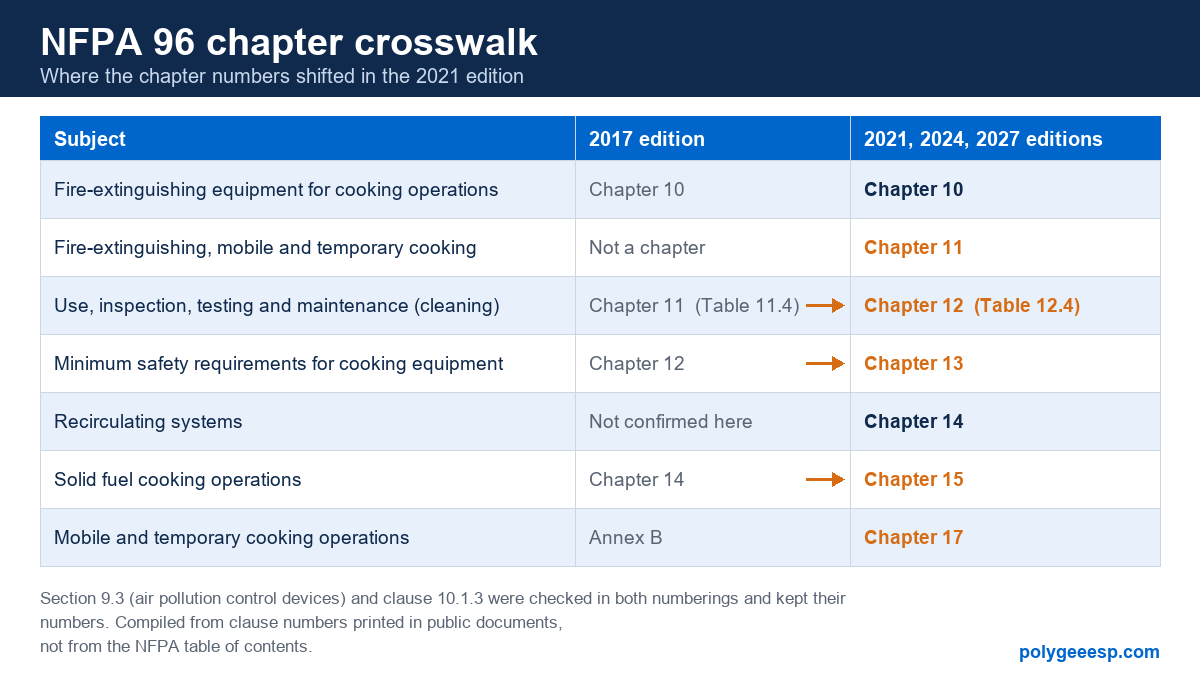
In the 2021 edition and the two after it, three chapters checked for this page carry a number one higher than in the 2017 edition: 11 became 12, 12 became 13 and 14 became 15. The 2021 edition added a chapter 11 on fire-extinguishing equipment for mobile and temporary cooking operations and a chapter 17 on those operations, material that had been in an annex. Inspection and cleaning therefore moved from chapter 11 to chapter 12, and solid fuel cooking from chapter 14 to chapter 15.
The shift can be seen in two editions of the California Mechanical Code, which prints the NFPA 96 clause number after each provision it takes from the standard. The 2022 California Mechanical Code tags its inspection table “NFPA 96: Table 11.4” and its solid fuel provisions 14.1.2 to 14.1.7. The 2025 edition tags the same table “NFPA 96: Table 12.4.” Neither code says on those pages which edition of NFPA 96 it extracts; the first set of numbers matches the 2017 edition and the second the 2021 edition.
The table is compiled from clause numbers and chapter references in the documents listed under References. It is not the NFPA table of contents, which we did not read.
| Subject | 2017 edition | 2021, 2024 and 2027 editions | Our page on the subject |
|---|---|---|---|
| Clearance to combustible material | Not checked for this page | Section 4.2 (2021 and 2027 texts read) | Hood clearance requirements |
| Hood construction | Not checked for this page | Section 5.1 (2021 text read) | Commercial kitchen hood |
| Exhaust duct: access openings, materials, welds | Not checked for this page | Sections 7.4 and 7.5 (2021 text read) | Grease duct requirements |
| Exhaust fans | Not checked for this page | Section 8.1 (2021 text read) | Exhaust fan requirements |
| Air pollution control devices and other equipment in the exhaust | Section 9.3 (clause 9.3.3 was read in 2017 and 2021 texts) | Pollution control unit | |
| Fire-extinguishing equipment for cooking operations | Chapter 10 (clause 10.1.3 was added in 2017 and is in the 2027 text) | Hood fire suppression requirements | |
| Fire-extinguishing equipment for mobile and temporary cooking operations | Not a chapter | Chapter 11 | — |
| Use, inspection, testing and maintenance, including cleaning | Chapter 11 (Table 11.4) | Chapter 12 (Table 12.4) | Exhaust cleaning requirements |
| Minimum safety requirements for cooking equipment | Chapter 12 | Chapter 13 | — |
| Recirculating systems | Not confirmed for this page | Chapter 14 | UL 710B and UL 710 |
| Solid fuel cooking operations | Chapter 14 | Chapter 15 | Solid fuel cooking exhaust requirements |
| Mobile and temporary cooking operations | Annex B | Chapter 17 | — |
Several pages on this site quote Table 11.4 and clauses 11.4 and 11.6. Those are 2017 numbers taken from the 2022 California code, and each page says so. On a project under the 2021 edition or later, the same provisions are in Table 12.4 and Sections 12.4 and 12.6.
What changed in 2017, 2021, 2024 and 2027
Each edition since 2017 has changed something that touches a drawing, a listing or a record. The table gives the changes found in official documents: the Texas adoption order, which summarizes the 2017 and 2021 editions, and NFPA’s own revision reports and product page for 2024 and 2027.
| Edition | Change | What it changes for the buyer |
|---|---|---|
| 2017 | “A device installed in a duct such as a pollution control device now must be protected by its own fire extinguishing system”; the term solid fuel replaces charcoal (Texas adoption order) | An in-duct air cleaner brings a fire protection line into the quotation |
| 2021 | A new chapter on mobile and temporary cooking operations, moved from a normative annex into the body of the standard (Texas adoption order); the chapters on maintenance, cooking equipment and solid fuel renumbered | Clause numbers from 2017 summaries shift by one chapter |
| 2024 | Pollution control units “shall be listed in accordance with UL 8782 and installed in accordance with the manufacturer’s installation instructions” (9.3.1.1, item 8, NFPA first revision report) | The listing standard for the unit is named in NFPA 96 itself |
| 2024 | After an inspection or cleaning, “an adhesive label shall be securely attached to the hood”; after an inspection for grease buildup, a written report goes to the owner within 2 weeks (NFPA second revision report) | The record changes from a certificate kept on the premises to a label on the hood plus a report |
| 2024 | “A service contractor with only periodic access to the equipment, such as the exhaust system cleaner and fire extinguishing system contractor, does not assume responsibility” (same report) | Responsibility stays with the owner unless it is transferred in writing; a contractor with only periodic access does not take it on |
| 2027 | New definitions of solid-fuel cooking equipment and solid cooking fuel; a definition of fire alarm system (NFPA product page for NFPA 96) | Clearer line on what counts as solid fuel cooking |
| 2027 | The grease depth figures that trigger cleaning moved from the cleaning section, 12.6, to the inspection section, 12.4 | Look in 12.4.1 to 12.4.3 for the measured depths |
| 2027 | Clause 10.3.1.3, which excused devices installed in the exhaust duct from the simultaneous operation requirement of 10.3.1.1, was deleted; the committee said it conflicted with 9.3.1.1 (NFPA first revision report for the 2027 edition) | Ask the fire protection contractor how the unit’s system operates with the hood system |
| 2027 | Automatic fire-extinguishing systems “shall be listed in accordance with ANSI/CAN/UL/ULC 1254 and ANSI/CAN/UL/ULC 300 or other equivalent standards” (10.2.3, as extracted in NFPA 1) | A second listing standard appears beside UL 300 |
NFPA’s product page words the 2027 relocation as the inspection section moving from 12.6 to 12.4. The revision documents show that the inspection section was already numbered 12.4 in the 2024 cycle, and the committee statement reads: “The requirements for grease depth have moved from the cleaning section of chapter 12 to the inspection section.”
The inspection schedule in Table 12.4
Table 12.4 schedules inspections, by type of cooking, at four intervals: monthly, quarterly, semiannually and annually. The sentence above it, as extracted in NFPA 1, reads: “The entire exhaust system shall be inspected for grease buildup by a properly trained, qualified, and certified person(s) acceptable to the AHJ.” The wording of the four rows is the same in the text printed by the 2022 California code, the text printed by the 2025 California code, and the 2027 extract in NFPA 1.
| Type or volume of cooking | Inspection frequency | Note printed with the table |
|---|---|---|
| Systems serving solid fuel cooking operations | Monthly | — |
| Systems serving high-volume cooking operations | Quarterly | “High-volume cooking operations include 24-hour cooking, charbroiling, and wok cooking.” |
| Systems serving moderate-volume cooking operations | Semiannually | — |
| Systems serving low-volume cooking operations | Annually | “Low-volume cooking operations include churches, day camps, seasonal businesses, and senior centers.” |
The table sets when to inspect, and cleaning follows from what the inspection finds. The annex states the purpose: to establish “whether the volume of grease buildup within the exhaust system warrants cleaning” and whether there is adequate access to remove it. Where the system is found contaminated, the contaminated portions are cleaned by a person described in the same words, trained, qualified, certified and acceptable to the authority (12.6.1). In the 2027 edition, a measured depth of 0.078 in (2,000 µm) on a surface other than a fan housing calls for cleaning (12.4.2), and 0.125 in (3,175 µm) in a fan housing (12.4.3).
The International Fire Code prints a table of its own. In the 2024 IFC, Table 606.3.3.1, the frequencies are 3 months for high-volume operations, 12 months for low-volume operations, 1 month for solid fuel, and 6 months for “all other cooking operations.” The IFC asks for “qualified individuals” and sends cleaning to ANSI/IKECA C10. The intervals match; the wording and the qualification of the person do not, which is one more reason to know which document the inspector holds.
None of these intervals is the washing interval of a precipitator’s cells. For the equipment NFPA 96 calls other equipment, clause 12.1.8 sets inspection and maintenance “at a frequency determined by the manufacturer’s instructions or the equipment listing.” The cleaning duties in chapter 12 are set out on commercial kitchen exhaust cleaning requirements, and the upkeep of an in-duct unit on pollution control unit maintenance.
Where an ESP or pollution control unit sits in NFPA 96
An electrostatic precipitator in a kitchen exhaust is what NFPA 96 calls an air pollution control device, and Section 9.3 sets the terms for installing one. The definition, in the 2024 text, is “equipment and devices used for the purpose of cleaning air passing through them or by them in such a manner as to reduce or remove the impurities contained therein” (3.3.3). In North America a unit combining a precipitator with filter and odor stages is sold as a pollution control unit, and elsewhere as an ecology unit.
The clauses below were read in the 2025 California Mechanical Code, which prints the NFPA 96 clause numbers, and in the 2027 extracts in NFPA 1; clause 9.3.1.1 and its item 8 were read in NFPA revision reports.
| Clause | What it says | What to ask before ordering |
|---|---|---|
| 9.3.1 | Fume incinerators, thermal recovery units, air pollution control devices or other devices may be installed in ducts or hoods, or in the path of travel of exhaust products, “where specifically listed for such use” | Which listing the authority accepts for the unit, and whether the model offered is named in it |
| 9.3.1.1 | Such devices comply with a list of requirements, among them the clearance requirements of Section 4.2, the hood construction requirements of Section 5.1, the duct construction and access requirements of chapter 7, the simultaneous operation requirements of 10.3.1 where installed in a hood, and clause 10.1.3 where installed in a duct | Clearance around the unit; access panels; for a unit built into a hood, how it operates with the hood’s extinguishing system |
| 9.3.1.1, item 8 (2024 edition onward) | Pollution control units are listed in accordance with UL 8782 and installed to the manufacturer’s installation instructions | Whether the adopted edition is 2024 or later |
| 9.3.1.3 | Space is provided at all access panels or doors “for the safe removal and servicing of control devices, such as filters, electrostatic precipitator cells, and odor control media beds, and for cleaning of the equipment housing” | The withdrawal length of the cells and the service side, from the manufacturer’s drawing |
| 9.3.2 | Downgrading other parts of the exhaust system because an approved device is installed, “whether listed or not, shall not be allowed” | The duct, fan and hood requirements stay as they are |
| 9.3.3 and 9.3.3.1 | Equipment in the path of exhaust products that provides secondary filtration or air pollution control has “an approved automatic fire-extinguishing system”; the system protects the component sections of the equipment and the ductwork downstream of it | Who supplies and installs the protection, and how far downstream it reaches |
| 9.3.4 | “If the equipment provides a source of ignition, it shall be provided with detection to operate the fire-extinguishing system protecting the equipment” | Whether the authority treats the unit as a source of ignition |
| 9.3.5 | Where an air pollution control device recirculates air into the building, the requirements for recirculating systems apply | Whether the exhaust leaves the building |
| 10.1.3 | Devices installed in the exhaust duct “shall be protected by an automatic fire-extinguishing system” | Same question as 9.3.3 |
| 12.1.7 and 12.1.8 | Secondary filtration and pollution control equipment is operated “in accordance with the terms of its listing and the manufacturer’s recommendations”; inspection and maintenance are by properly trained and qualified persons at the frequency in the manufacturer’s instructions or the listing | The maintenance instructions, in writing, with the quotation |
Two points follow for anyone buying a precipitator. First, the standard ties the unit to a listing and to fire protection, and the fire protection can be a separate scope: an approved automatic system, installed to the instructions of the fire-extinguishing system manufacturer. How that system is arranged for a hood and for a unit in the duct is described on our kitchen fire suppression system page.
Second, the listing the standard names for a pollution control unit from 2024 is UL 8782, and it is a different document from the electrostatic air cleaner standard. Our UL listing is to UL 867, under File E522667, and it covers three models at 230 V/50 Hz: LK/SE-6K, LK/SE-12K and LK/SE-18K. Which listing the authority asks for on your project is therefore a question to settle before the order, with the edition from line 1 of the check below. What each standard covers is set out on our UL 867 and pollution control unit pages.
On our LK in-duct precipitators the cells slide out for washing, which is the operation clause 9.3.1.3 asks the installer to leave room for. The models, airflow bands and options are on the kitchen electrostatic precipitator page.
NFPA 96 and the mechanical and fire codes
Three code families reach the same hardware by different routes, and each uses NFPA 96 differently. The International Mechanical Code writes its own rules, the International Fire Code references NFPA 96 for the extinguishing system, and the California Mechanical Code, which is based on the Uniform Mechanical Code, reprints NFPA 96 clause by clause. NFPA 1 does the same in its Chapter 50.
| Code | How it uses NFPA 96 | What it adds for a unit in the duct |
|---|---|---|
| 2024 International Mechanical Code, Chapter 5 | Names NFPA 96 once, in an exception to Section 507.1 for cooking appliances with integral down-draft exhaust systems listed and labeled for the application in accordance with NFPA 96; its own Sections 506 and 507 govern ducts and hoods | Section 506.5.2: pollution control units “shall be listed and labeled in accordance with UL 8782,” with an airflow differential pressure control across the filter sections and “a factory-installed fire suppression system” |
| 2024 International Fire Code | Section 606.1 sends hoods to the International Mechanical Code; Section 904.14 requires the extinguishing system to be installed “in accordance with this code, NFPA 96, its listing and the manufacturer’s installation instructions” | Its own inspection table and records, in Section 606.3 |
| California Mechanical Code, 2022 and 2025 (based on the Uniform Mechanical Code) | Prints NFPA 96 provisions in its Chapter 5 with the clause number after each | The NFPA 96 text for Section 9.3 as local law, under California section numbers |
| NFPA 1, Fire Code, Chapter 50 | Requires compliance with the chapter and with NFPA 96, and reprints clauses with their numbers | Chapter 10 and chapter 12 text, including clauses 10.1.3, 12.1.7 and 12.1.8 |
One difference matters on a quotation. Clause 9.3.3 of NFPA 96 asks for an approved automatic fire-extinguishing system on the unit, without saying in that clause whether it is installed at the factory; the 2024 International Mechanical Code asks for a system installed at the factory. A project under the 2024 International Mechanical Code and a project under an NFPA 96 edition can therefore need different scopes from the unit maker and from the fire protection contractor. The six parts of the exhaust system and the mechanical code section for each are on our commercial kitchen ventilation system page.
The 6-Line NFPA 96 Edition Check
The 6-Line NFPA 96 Edition Check is our own record sheet for the questions on this page. Fill it with the authority having jurisdiction and the fire protection contractor before a unit is selected; leave a line blank until someone has confirmed it in writing.
| Line | What to record | Who answers it | If it is left blank |
|---|---|---|---|
| 1 | The code adopted for the project and the edition of NFPA 96 it names, with any local amendment | Authority having jurisdiction | Clause numbers and listing requirements are quoted from the wrong edition |
| 2 | The numbering in use: 2017 and earlier (inspection in chapter 11) or 2021 and later (chapter 12) | Follows from line 1 | Review comments and submittals cite different chapters for the same provision |
| 3 | The type or volume of cooking and the inspection frequency that follows from the table the authority applies | Owner and authority | The inspection contract is priced on the wrong interval |
| 4 | The listing the authority accepts for the air cleaning unit, and the models the supplier’s file names | Authority and unit manufacturer | The unit arrives without the listing the reviewer asks for |
| 5 | Fire protection of the unit: who supplies it, whether it must be installed at the factory, and whether it covers the ductwork downstream | Fire protection contractor and authority | The protection of the unit falls between two scopes |
| 6 | The record after each inspection or cleaning: a certificate on the premises, an adhesive label on the hood with a written report, or a tag | Authority and cleaning contractor | The inspector does not find the record the adopted edition asks for |
- NFPA 96 is a fire safety standard; it applies through the code that adopts it, in the edition that code names.
- The current edition is 2027; Texas and Florida name 2021, the 2024 IFC names 2024, and an Ontario sheet names 2014.
- From 2021, inspection and cleaning are in chapter 12 and solid fuel in chapter 15; the 2017 numbers are 11 and 14.
- Table 12.4 schedules inspection, monthly to annually; cleaning follows from what the inspection finds.
- An ESP in the exhaust is an air pollution control device under Section 9.3: listed for the use, given service space, and protected by an automatic fire-extinguishing system.
Which document proves what
NFPA 96 states what a commercial cooking exhaust system has to have and how it is kept; it does not certify any product, and no manufacturer’s unit is compliant with it apart from a particular installation. A UL 8782 listing covers the pollution control unit assembly named in the file. A UL 867 listing covers the electrostatic air cleaner models named in the file, which for us are the three models above, at 230 V/50 Hz. A third-party test report on a precipitator covers the model and the airflow in the report: three of our LK models were measured at 96.0 to 97.6% grease removal at rated, evenly distributed airflow in CMA-accredited third-party tests, and those figures answer an efficiency question that the clauses read for this page do not ask. The decision on a project is made by the authority having jurisdiction under the edition it has adopted.
Common mistakes
- Quoting the current edition where an older one is adopted. The 2027 text is on sale; Texas and Florida name 2021.
- Carrying a clause number across the 2021 renumbering. Table 11.4 and Table 12.4 are the same table in different editions.
- Reading the inspection schedule as a cleaning schedule. The table schedules inspection; cleaning follows from the grease found.
- Applying the Table 12.4 interval to the cells of a precipitator. Clause 12.1.8 sends that equipment to the manufacturer’s instructions or the listing.
- Treating UL 867 and UL 8782 as the same listing. They are different documents, and NFPA 96 from 2024 names UL 8782 for pollution control units.
- Leaving the fire protection of an in-duct unit out of both scopes. Section 9.3.3 asks for it, including the ductwork downstream.
- Asking a supplier for an NFPA 96 certificate for a product. The standard is applied to an installation by the authority; what a supplier can show is a listing and its file.
Frequently asked questions
- Can you read NFPA 96 for free?
- NFPA lists a Free Access page for its codes and standards, and when we opened the viewer on November 28, 2026 it asked for a sign-in, so we did not read the standard there. Public documents print parts of it: the California Mechanical Code and Chapter 50 of NFPA 1 carry many clauses with the NFPA 96 clause number after each, and the clauses quoted on this page come from those and from NFPA revision reports. The printed standard is sold on the NFPA product page.
- Is there an NFPA 96 certification?
- The clauses read for this page do not describe a certificate showing that a product or a building complies; the certificates they mention are service records. They ask for people: inspection for grease buildup, and cleaning, by a properly trained, qualified and certified person or persons acceptable to the authority having jurisdiction. Which training and certificate the authority accepts is a local matter. For equipment, the documents to ask for are listings, such as UL 8782 for a pollution control unit or UL 300 for the extinguishing system.
- How often does NFPA 96 require hood cleaning?
- It schedules inspection and makes cleaning depend on the result. Table 12.4, Table 11.4 through the 2017 edition, sets inspection for grease buildup monthly for solid fuel cooking, quarterly for high-volume cooking such as 24-hour cooking, charbroiling and wok cooking, semiannually for moderate-volume cooking and annually for low-volume cooking. Where the inspection finds the system contaminated with grease deposits, the contaminated portions are cleaned.
- Does NFPA 96 apply to food trucks?
- Yes, by its scope: cooking equipment used in fixed, mobile or temporary concessions, such as trucks, buses, trailers, pavilions and tents, is to comply with NFPA 96. The annex adds that the authority having jurisdiction can exempt temporary facilities such as a tent after evaluating them. Since the 2021 edition, mobile and temporary cooking operations have chapters of their own, 11 and 17.
- Does NFPA 96 apply in Canada?
- It applies where a Canadian code adopts it. A City of Oshawa requirements sheet states that the removal of smoke and grease-laden vapors from commercial cooking equipment must comply with the 2014 edition of NFPA 96 under the 2024 Ontario Building Code. The chain from the building code to the hood listing is described on our NFPA 96 in Canada page.
Specifying an ESP for a project reviewed under NFPA 96?
Send us lines 1 and 4 of The 6-Line NFPA 96 Edition Check, with the hood type, the total exhaust airflow and the cooking duty. With the quotation, ask in writing for the model whose rated airflow band fits your design flow, the listing file and the models it names, the service side and cell withdrawal length for the access space, and the maintenance instructions.
Send the adopted edition and exhaust airflow →
The in-duct units are on our kitchen electrostatic precipitator page.
Why we write this. A buyer is told that a kitchen exhaust has to meet NFPA 96, and the summaries of the standard that we read while preparing this page were written around cleaning visits. This page puts the edition, the chapter numbers and the clauses for equipment in the duct in one place, so the question to the authority can be asked with the right edition and the right clause.
Law is Project Manager at Polygee. Polygee, founded in 2004, manufactures in-duct electrostatic precipitators, UV-C and activated carbon modules, kitchen ecology units and the HME kitchen ESP hood; it does not make fire-extinguishing systems or grease ducts and does not clean exhaust systems. The standard itself was not read for this page; its clauses are quoted from the public documents listed below, which reprint them with their clause numbers. This page is not a compliance determination; the authority having jurisdiction applies the edition it has adopted.
References & further reading
- National Fire Protection Association, NFPA 96 development page (current edition, issuance and effective dates, editions) and product page (2027 edition details). nfpa.org
- National Fire Protection Association, NFPA 1, Fire Code, proposed tentative interim amendment 1932: Chapter 50 extracts of NFPA 96, 2027 edition. docinfofiles.nfpa.org
- National Fire Protection Association, NFPA 96 revision reports for the 2024 and 2027 editions: public input responses, first revision and second revision statements. docinfofiles.nfpa.org
- California Mechanical Code, 2022 and 2025 editions (Title 24, Part 4), Chapter 5, with the NFPA 96 clause numbers it prints, as published by GoCodebook. gocodebook.com
- International Code Council, 2024 International Fire Code, Sections 606 and 904.14 and Chapter 80; 2024 International Mechanical Code, Chapter 5, Sections 506.5.2 and 507.1. codes.iccsafe.org
- Texas Department of Insurance, Commissioner’s Order 2023-7848, adoption of NFPA 1-2021 and NFPA 96-2021 with summaries of edition changes. tdi.texas.gov
Related reading
- NFPA 96 in Canada: how provincial codes bring the standard into a project, and what CAN/ULC 646 excludes.
- Commercial kitchen exhaust cleaning requirements: the inspection tiers, what gets cleaned, and by whom.
- Pollution control unit: the North American name for the unit, and what a UL 8782 listing covers.
- Commercial kitchen hood fire suppression requirements: UL 300 and the extinguishing system over the cookline.