

Commercial kitchen smoke is the grease aerosol and particulate that cooking releases above the cookline. It escapes at the hood edge, through the filters, or out of the exhaust outlet. How to reduce smoke from commercial kitchen exhaust starts with finding the leak, and an in-duct electrostatic precipitator only works once the hood and filters are right.
The mistake is buying equipment for a capture problem. A unit in the duct cannot collect smoke that rolled out of the hood front, and a hood that is short of its design airflow will still be short with a unit in the run.
This guide gives the symptoms and their likely causes, the six fixes in the order they should be tried, the evidence to collect at each step, and the point at which an electrostatic precipitator enters. It does not size equipment; the product pages, your engineer and your service contractor do that. For the unit itself, see the kitchen electrostatic precipitator page.
One disclosure: Polygee builds in-duct electrostatic precipitators, the fifth fix on this page. We do not make conventional hoods, fans or make-up air units, and nothing here is an instruction to work on live equipment; the checks below are things to observe and record, and the work goes to the contractor who holds the service contract.
Where the smoke escapes: three places, three fixes
Smoke leaves a commercial kitchen exhaust at the hood edge, through the filters, or out of the outlet, and the fix depends on which. At the hood edge the problem is capture: the hood is not pulling enough air for what is being cooked, the room is starving it of make-up air, a draft is pushing the plume out, or the appliances have crept forward of the overhang. Through the filters the problem is the filters themselves: loaded, missing, mounted flat, or long past their cleaning. Out of the outlet the problem is the fine fraction: the grease mist and smoke that pass a baffle filter by design, because baffles take the larger droplets and let the fine particles through.
Two things that look like smoke are not. Steam from a dishwasher or a steamer is water, is served by a Type 2 hood, and is a different problem; the classification is in type 1 hood vs type 2. And the smell that reaches the street is gas-phase, not particle-phase: an electrostatic field collects particles, and the odor compounds that pass it are the job of the UV and activated carbon stages on our kitchen exhaust odor control page. A complaint about smell is not solved by a smoke fix, and a complaint about smoke is not solved by an odor stage. How much odor treatment a site needs is a separate calculation from the smoke question, and in the UK it is set by a published four-part risk score rather than by an equipment list — that method, and what each stage removes, is in commercial kitchen odour control in the UK.
Symptoms and likely causes
The symptom tells you which of the three places is failing before anyone climbs a ladder. Record what you see, when, and what changed; the table is the record to bring to the contractor.
| Symptom | Likely cause | Evidence to capture | Safe first action | Escalation |
|---|---|---|---|---|
| Smoke rolls out of the hood front at peak hours | Capture is short: exhaust below the rate the cooking duty needs, a cross draft or make-up air blowing across the hood face, appliances forward of the overhang, or a room in negative pressure | The design exhaust rate and the last air balance report; photos of the plume; appliance positions against the 6 in overhang, from the drawing and a photo; doors that pull hard | Note whether the fan and the make-up air unit show as running; photograph where each appliance sits against the overhang; if any has crept forward, have the kitchen equipment contractor reposition it and confirm the suppression nozzles still cover it | Mechanical engineer: measure the airflow and balance the make-up air |
| Visible haze or smoke at the rooftop outlet with the hood capturing well | The fine fraction passing the baffle filters: charbroiling, wok cooking, solid fuel | The cooking duty and appliance list; filter type; photos of the outlet at peak, taken from the ground, a neighboring vantage point or the contractor’s next roof visit | Nothing at the hood; the filters are doing what they are made for | In-duct filtration sized to the exhaust airflow (fix 5) |
| Smoke got worse after a menu or equipment change | The cooking duty rose, and the hood, filters and fan were selected for the old duty | Old and new appliance schedules; the rate per foot the new duty requires | Record the change before adding equipment | Engineer re-rates the exhaust; solid fuel means a separate system |
| Haze spreading from the cookline into the dining room | Capture failing at the hood plus an air path toward the dining room: make-up air or a supply diffuser discharging across the hood face, a pass window or door with the pressure the wrong way, or a balance that leaves the kitchen positive to the dining room | Make-up air unit status and whether it starts with the exhaust; where the supply and make-up air outlets sit relative to the hood; which way the kitchen door pulls; when the haze appears | Note the door-pull direction and the time it happens; nothing at the hood | Engineer balances the kitchen slightly negative to the dining room within the code’s cooking-area limit and re-aims or re-routes the make-up air |
| Grease streaks on the filters or dripping from the hood | Filters loaded, missing, mounted at the wrong angle, or cleaning overdue | The cleaning record against the NFPA 96 inspection tier; filters in place at not less than 45 degrees | Photograph the empty or flat-seated slots; have the correct listed filters refitted when the line is cold, by the kitchen team’s own procedure or the contractor; book the cleaning | Exhaust cleaning contractor with trained, qualified personnel; which credential counts is local |
| Airflow at the hood dropped after an in-duct unit went in | The fan was not re-selected for the resistance the unit adds | Balance reports before and after; the unit’s resistance at design airflow | Do not have the unit removed; have the airflow measured | Fan re-selection or drive change against the new static pressure |
This table answers where to look first. It does not diagnose a particular kitchen; the airflow measurement and the contractor’s inspection do that, and two of the symptoms can be present at once.
How to reduce smoke from commercial kitchen exhaust: the six fixes, in order
The order matters because each fix assumes the one before it: filtration assumes capture, capture assumes airflow, and airflow assumes make-up air. The sequence is our own working order, not an industry standard.
1. Confirm the airflow against the duty. An unlisted Type 1 hood has to exhaust a set number of CFM per linear foot by cooking duty under the International Mechanical Code, from 200 for light duty to 550 for solid fuel on a wall canopy, and a hood listed to UL 710 exhausts the rate in its listing. The evidence is the air balance report, not the fan nameplate; if there is no report, the measurement is the first purchase. The rates, the listed-hood exception and a worked example are in commercial kitchen hood CFM requirements.
2. Get the make-up air restored. The exhaust can only remove air the room is given. The code asks for make-up air roughly equal to the exhaust, started and run with it, and NFPA 96 and the Uniform Mechanical Code limit the negative pressure in the cooking area to 0.02 in w.c. The interlock and the balance are the engineer’s and the controls contractor’s, and the fan rules they sit inside are in commercial kitchen exhaust fan requirements. What a reviewer measures when the balance is questioned, and the four routes the replacement air can take, are in commercial kitchen makeup air requirements.
3. Have the filters and the cleaning put right. Listed grease filters, mounted at not less than 45 degrees with a drip tray, all of them in place, and the exhaust system inspected on the NFPA 96 tier the cooking sets and cleaned when the inspection calls for it. A hood full of loaded baffles pulls less air through them, and capture at the hood edge falls with it. The tiers and what a compliant clean covers are in commercial kitchen exhaust cleaning requirements; the filter distances from the cooking surface are in commercial kitchen hood clearance requirements.
4. Check the fan against the run. A fan delivers what its curve allows at the resistance the system presents, and the grease duct has to keep at least 500 ft/min under the IMC. A longer duct, a loaded run, a changed menu or a unit added since the fan was selected all move the operating point. The balance report shows it; the fan supplier’s curve explains it.
5. Add in-duct filtration for the fraction the filters pass. Once the hood captures and the filters are right, what still reaches the outlet is the fine grease mist and smoke, and that is the job of an in-duct electrostatic precipitator placed in the duct after the filters and, in our practice, before the fan. Polygee’s LK in-duct units reached up to 97.6% grease removal in CMA-accredited third-party tests, measured at rated, evenly distributed airflow. That is a grease removal figure under that test, not a smoke or particulate measurement; ask for the report and read the test conditions before using it as a basis. The unit is sized against the exhaust airflow from fix 1, not against the smoke, and a complete unit with its airflow-distribution plate is rated at ≤150 Pa, a figure to ask for at your design airflow and to carry back into fix 4. The unit is reviewed as a pollution control unit, with access on both sides, grease drainage, the listing the adopted edition asks for and fire protection downstream; those are set out in grease duct requirements and commercial kitchen hood fire suppression requirements. The collector cells are stainless steel and washable, and what that regime involves is set out in electrostatic precipitator cleaning.
6. Treat the odor and place the outlet. What passes an electrostatic field is gas, and the odor stages on the kitchen exhaust odor control page linked above handle it; the outlet has distances to keep from the roof, the property line and any air intake, set out in commercial kitchen exhaust termination requirements. Charcoal and wood cooking has its own separate system and a spark arrester ahead of the grease filters, covered in solid fuel cooking exhaust requirements.
How to better ventilate smoke in kitchen?
Capture first, then filtration. A commercial kitchen ventilates smoke by pulling it into a Type 1 hood at the exhaust rate its cooking duty requires, with the overhang the code sets and the make-up air to match, and by keeping the grease filters in place and clean; a kitchen that does those three things keeps the smoke inside the hood under normal service. What the hood captures and the filters pass, the fine fraction, is then collected in the duct by an electrostatic precipitator before the air reaches the outlet. Adding a filtration unit to a hood that is not capturing moves the smoke around without removing it; when capture is short because the airflow is short, the remedy is the airflow (fixes 1, 2 and 4), not the filtration.
What an ESP does and does not fix
An in-duct electrostatic precipitator fixes one of the three failures, the fine fraction that passes the filters, and none of the other two. Which stages belong in the duct for your menu and airflow, and in what order, is worked through in our kitchen exhaust filtration guide.
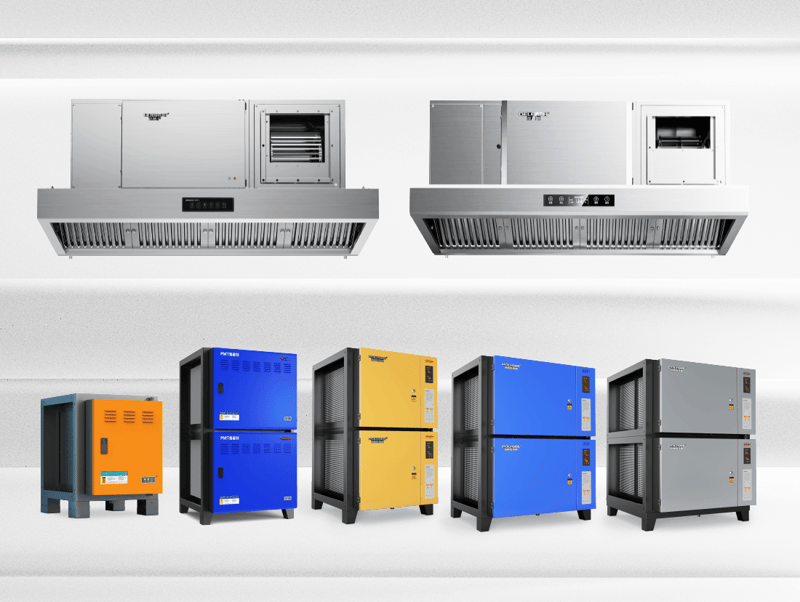
- It fixes: visible smoke and grease mist at the outlet from a hood that captures; the plume that coats the roof or the facade; the fine particulate that under-fired charbroiling puts past the baffles, which is what the charbroiler emissions regulations in New York City and California are written about, and the same fraction from wok cooking and solid fuel.
- It does not fix: smoke rolling out of the hood front; a room in negative pressure; a fan short of its airflow; the smell that remains after the particles are gone, which is the odor stages’ job.
- It changes: the static pressure the fan works against, by its rated resistance at your design airflow; the service routine, because the cells are washed on an interval set against the duty; and the suppression drawing, because the run downstream of it needs fire protection.
- It depends on: even airflow across the cells, which is what the airflow-distribution plate and the inlet transition are for, and on the airflow being the design figure, because the tested efficiency was measured at rated airflow.
The barbecue and grilled-fish chains that run Polygee ESP, Tanyu among them, are the clearest case of the order above: charcoal grills, and tabletop grills where they burn charcoal, put the fine fraction into the run whatever the hood does, so the unit is designed in from the start, behind a spark arrester and on the separate system solid fuel requires; the layout is on our BBQ smoke control page.
Five things to have in hand before asking anyone for a unit:
- The symptom record from the table above: where the smoke appears, when, and what changed.
- The design exhaust airflow and the latest balance report, or the hood length and cooking duty if there is no report.
- The appliance schedule, with fuel, and whether any of it is solid fuel or tabletop grills.
- The duct route and where on it a unit can sit, with the access and clearance around that point.
- The cleaning record and the make-up air status.
Where this guide stops
Five boundaries on this route to less smoke, so it is used for what it is:
- Not a diagnosis of your kitchen. The pairings are the common ones; the measurement and the inspection decide.
- Not operating instructions. Nothing here asks anyone to open a hood, climb to a fan or touch a live unit. The safe first actions are observations and calls; the work goes to the contractors who hold the service contracts.
- Code figures. The exhaust rates, the pressure limit, the duct velocity and the filter angle are the International Mechanical Code, NFPA 96 and the Uniform Mechanical Code as model documents; the adopted edition and the AHJ govern.
- Odor is a separate question. This page is about particles. Smell complaints that outlast a smoke fix are the UV and carbon stages’ territory, on the odor control page.
- Residential kitchens. Domestic range hoods follow the residential code, and nothing here applies to them.
Frequently Asked Questions
- Is it okay to leave the kitchen exhaust fan on all the time?
- During cooking it is not a choice: the International Mechanical Code requires a Type 1 hood system to activate the exhaust fan automatically whenever cooking operations occur, by an interlock with the appliances, heat sensors or another approved method, and the make-up air runs with it. Outside cooking hours, running the fan is a design and energy decision rather than a code requirement. A fan left on with no cooking pulls conditioned air out of the building and keeps the make-up air unit working against it, which is one more reason the code ties the fan to the cooking, and why some kitchens add demand-based controls that follow the cooking. What the fan must never do is stop while the cookline is on, or stop when the fire-extinguishing system discharges, unless a listed component of the ventilation system or the design of the extinguishing system requires the shutdown; a stopped fan is when the smoke leaves the hood.
- How do I clean my commercial kitchen exhaust system?
- On the inspection schedule NFPA 96 sets and with the people it names. The exhaust system is inspected for grease buildup at an interval set by the cooking, from monthly for solid fuel to annually for low-volume operations, and cleaned whenever the inspection finds buildup past the limit the standard allows, by trained, qualified personnel; the whole run from the hood and its plenum through the filters and duct to the fan and the outlet, any in-duct filtration unit included, is part of the job, and the record of each service is kept for the fire inspector. Grease filters and the collector cells of an electrostatic precipitator are washed on their own intervals between full cleanings, the filters through the warewasher and the cells by the method and on the schedule the unit supplier sets against the cooking duty. The tiers, what a compliant clean covers and how to read a cleaning quote are in our guide to commercial kitchen exhaust cleaning requirements.
Smoke at the outlet after the hood is right?
Send us the five items above. Our project team will come back with the unit configuration for that airflow, its resistance at your design airflow for the fan check, the access and drain positions for the drawing, the washing routine the duty calls for, and the third-party test reports for the model we propose, together with a plain statement of which listings that model carries and which it does not.
Talk to our project team →Reviewed by Law, Project Manager, 9 October 2026
Written by Law · Project Manager, PolygeeLaw manages kitchen exhaust filtration projects at Polygee, from spec review through duct-side ESP sizing and installation support. Polygee, founded in 2004, builds commercial kitchen exhaust filtration equipment. This article describes common causes and the order of checks for planning purposes only — it is not a diagnosis or a compliance determination, so confirm the cause and the fix for a specific kitchen with your engineer, your service contractor and your local AHJ.
References & further reading
- International Mechanical Code (IMC), Chapter 5: Exhaust Systems — Section 507 (hoods, exhaust rates, operation), Section 506 (grease ducts, exhaust equipment, air velocity), Section 508 (makeup air). codes.iccsafe.org
- NFPA 96, Standard for Ventilation Control and Fire Protection of Commercial Cooking Operations — air movement, replacement air, inspection and cleaning. nfpa.org
- Uniform Mechanical Code (UMC), Section 511: air movement and makeup air for commercial cooking operations. iapmo.org
- Polygee — kitchen exhaust filtration product range and third-party test reports. polygeeesp.com